



A domestic student at the University of Winnipeg who’s already covered under a parent’s benefits plan can opt out of the UWSA Health Plan entirely. An international student with an identical parent’s plan back home, or even existing coverage through a Canadian employer, cannot opt out under any circumstance. That asymmetry surprises a lot of students the first time they try to skip a fee they assume is optional, and understanding why the rules split this way, rather than just accepting a confusing policy at face value, actually explains a lot about how student health coverage works in Manitoba specifically.
- Domestic Students Are Automatically Enrolled, But Can Opt Out
- What the UWSA Plan Actually Covers
- The Opt-Out Process and What Counts as Comparable Coverage
- Part-Time Students Can Opt In for a Set Fee
- International Students Face a Completely Different, Mandatory System
- MISHP Is the Base Layer, the UWSA Extended Plan Sits on Top
- Sponsored and Indigenous Students Follow a Separate Path
- Adding a Spouse or Dependent
- What Happens When You Graduate
- Common Questions
- Confirm Your Status Before the Window Closes
The UWSA Health Plan automatically covers full-time domestic students at the University of Winnipeg, with an opt-out available for anyone who already has comparable coverage elsewhere. International students go through a completely different, mandatory system built on two layers, the province-wide Manitoba International Student Health Plan for basic medical care, plus a supplementary extended plan for everything from dental to prescription drugs, and opting out isn’t available to them at all.
Domestic Students Are Automatically Enrolled, But Can Opt Out
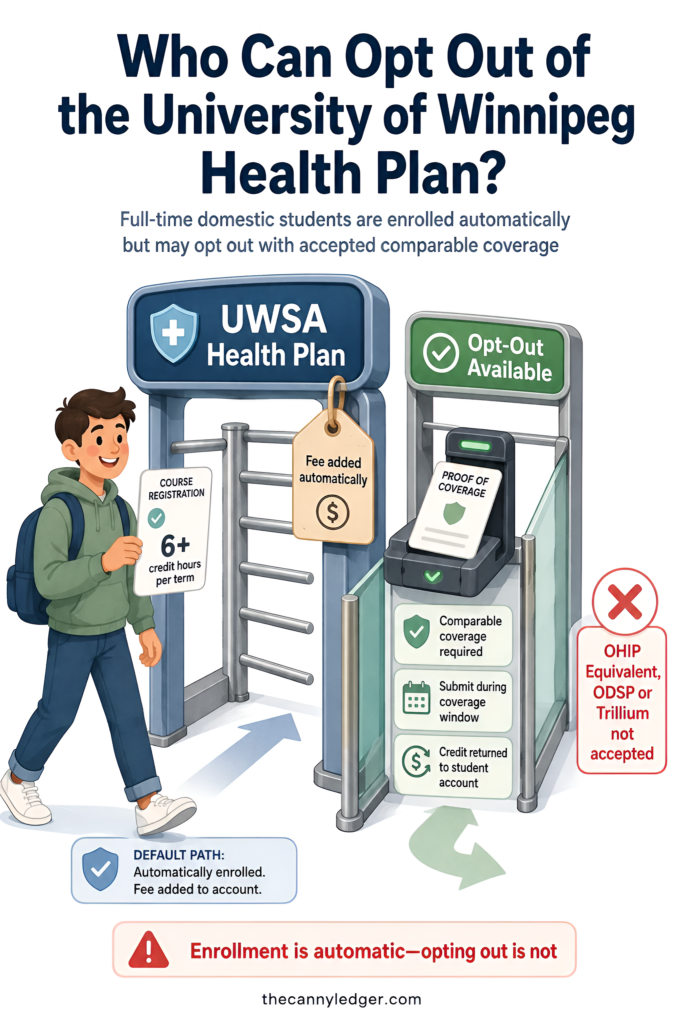
Full-time domestic students registered in six or more credit hours per term at the University of Winnipeg are automatically enrolled in the UWSA Health Plan and billed the fee through their student account, no separate registration step required to get coverage started. The plan itself is negotiated by the University of Winnipeg Students’ Association specifically to reduce the cost of extended health and dental coverage for students who don’t already have it through a family member’s plan or an employer, which is the entire logic behind why the university treats it as a default rather than an opt-in choice, most students genuinely benefit from having it and would otherwise go without any extended coverage at all.
If you already have comparable coverage, you can opt out and receive a credit to your student account for the fee amount, but this has to happen during a specific Change-of-Coverage Period at the start of each academic year, and proof of your existing coverage is required, not just a claim that you have some. One detail worth flagging directly since it trips up students who’ve recently moved from Ontario specifically: OHIP Equivalent coverage and ODSP or Trillium benefits are explicitly not accepted as comparable coverage for an opt-out, so students assuming an Ontario-style health credential will satisfy Manitoba’s opt-out requirement need to check the accepted coverage types before assuming they qualify.
What the UWSA Plan Actually Covers
Beyond the basic dental and vision benefits people generally expect from a student health plan, the UWSA plan’s coverage runs considerably broader: prescription drugs, vision care, dental treatment, travel coverage, and a range of practitioner services including massage therapy, chiropractic care, physiotherapy, and psychology or clinical social work counselling. That practitioner coverage specifically matters more than students often realize going in, since Manitoba Health doesn’t cover most paramedical services like these at all, and a semester of ongoing physiotherapy for a sports injury or counselling support during a genuinely difficult stretch of school can run into real money without this kind of coverage backing it up.
The plan’s policy year runs from September 1 through August 31 the following year, meaning coverage doesn’t reset with each individual term, it covers the full academic year in one continuous stretch once activated.


The Opt-Out Process and What Counts as Comparable Coverage
Getting the opt-out right the first time matters, since missing the Change-of-Coverage window means being locked into the fee for the full policy year regardless of what other coverage you actually have. The process runs through Studentcare’s online portal rather than through the university directly, and it’s worth remembering that an opt-out from a previous year doesn’t automatically carry forward. Every academic year you want to opt out, you have to submit that request again during that year’s specific window, treating a prior year’s approval as still valid is a genuinely common and avoidable mistake.

Part-Time Students Can Opt In for a Set Fee
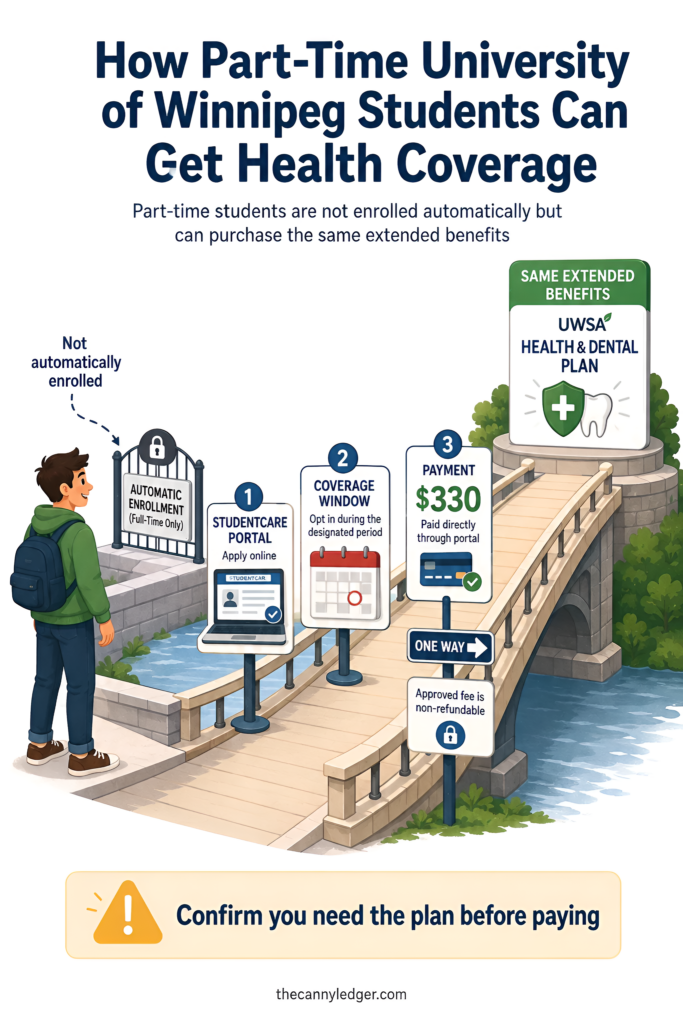
Part-time students aren’t automatically enrolled the way full-time students are, but they’re not locked out of the plan either. Opting in happens through the Studentcare Opt-In Portal during the same change-of-coverage period at the start of the term, and the current cost to opt in runs $330, payable directly through the portal, for the identical extended health and dental benefits full-time enrolled students receive. Once submitted and approved, that charge is non-refundable, so it’s worth being genuinely certain you want the coverage before completing the opt-in rather than treating it as something easily reversed if your plans change partway through the term.
International Students Face a Completely Different, Mandatory System
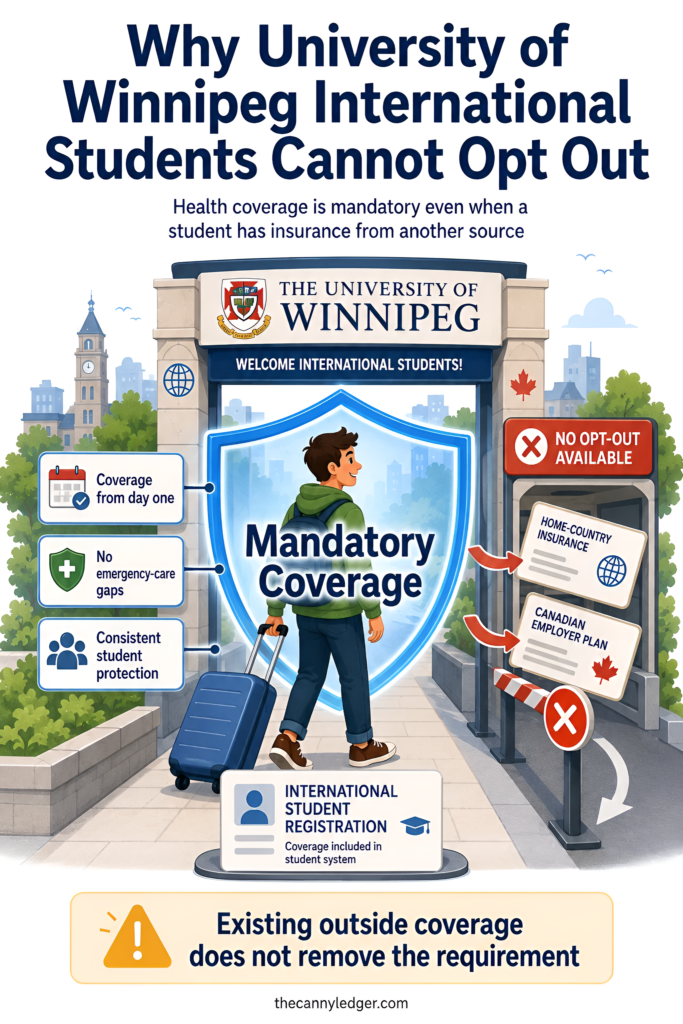
This is where the coverage structure changes entirely rather than just adding a few extra rules. Health insurance is mandatory for every international student at the University of Winnipeg, and unlike domestic students, opting out isn’t possible under any circumstance, not with existing supplementary coverage from your home country, and not with coverage through a Canadian employer either. The reasoning behind this stricter approach comes down to consistency and risk, the university wants every international student covered from day one without exceptions or gaps that could leave someone without emergency care access during their first weeks in an unfamiliar healthcare system.
MISHP Is the Base Layer, the UWSA Extended Plan Sits on Top
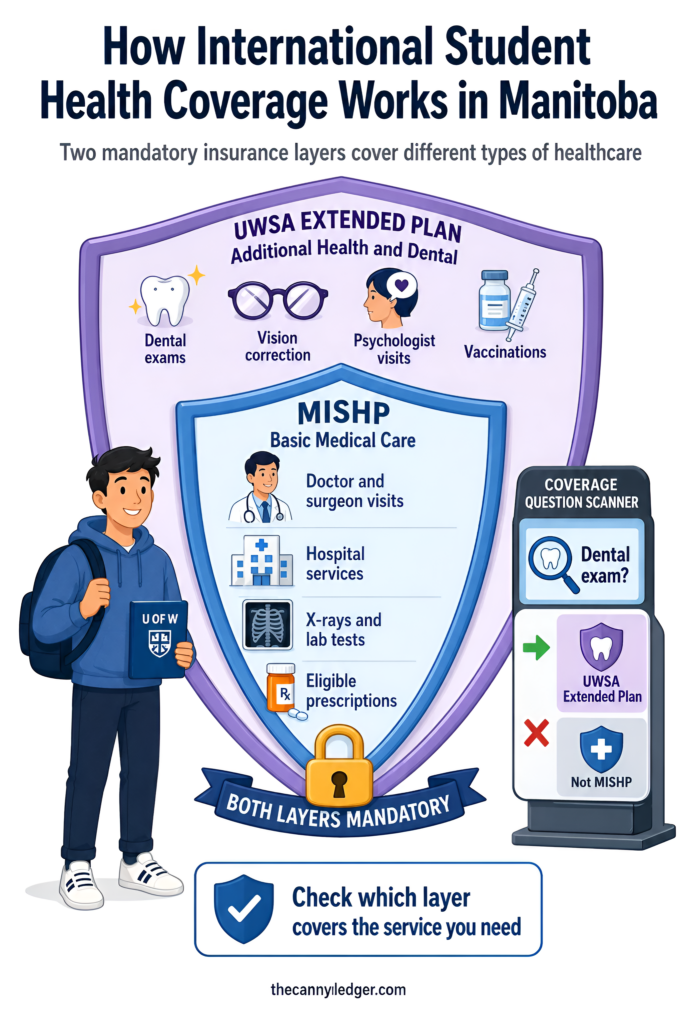
International student coverage in Manitoba works through two distinct layers rather than the single unified system some students expect based on how other provinces, particularly Ontario’s UHIP program, structure similar coverage. The Manitoba International Student Health Plan, known as MISHP, provides the primary, basic layer, covering medically necessary services like physician and surgeon visits, X-rays and lab testing, prescription drugs, and hospital services, functioning as your access point into Canada’s healthcare system in a way roughly analogous to what Manitoba Health provides Manitoba residents. Sitting on top of that, the UWSA Student Health and Dental Plan, administered specifically for University of Winnipeg students through Studentcare, adds the extended benefits MISHP doesn’t cover, vaccinations, psychologist visits, dental exams, and vision correction including eyeglasses and contact lenses among them.
Understanding this two-layer structure matters practically because a question like “does my health insurance cover a dental exam” has a genuinely different answer depending on which layer you’re asking about, MISHP explicitly doesn’t cover it, while the supplementary UWSA plan does. Both layers are mandatory for international students, and opt-outs for either layer generally aren’t available regardless of what coverage a student might have from elsewhere.
Sponsored and Indigenous Students Follow a Separate Path
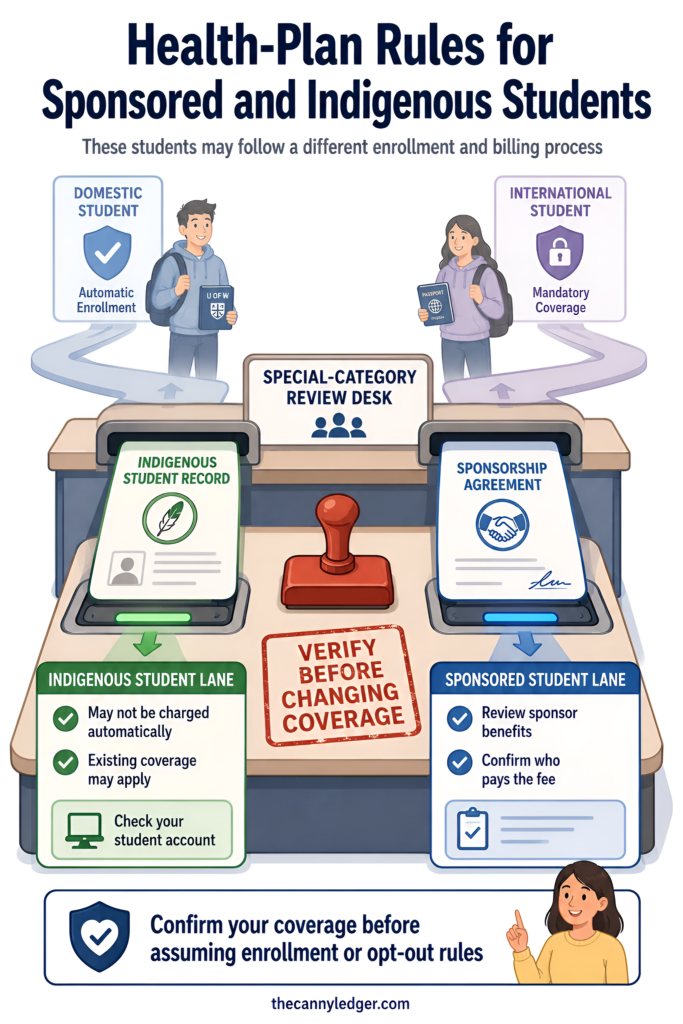
Students whose studies are covered through a sponsorship arrangement, or First Nations and other Indigenous students, generally follow a distinct process from the standard domestic or international structures described above. Most self-declared Indigenous students aren’t automatically charged the UWSA Health Plan fee in the first place, reflecting existing health coverage many already have through federal or First Nations-specific programs, and sponsored students should confirm directly with their specific sponsor what health coverage is already included in their sponsorship agreement before assuming either automatic enrollment or an opt-out applies to their situation the same way it would for an unsponsored domestic student.
Adding a Spouse or Dependent
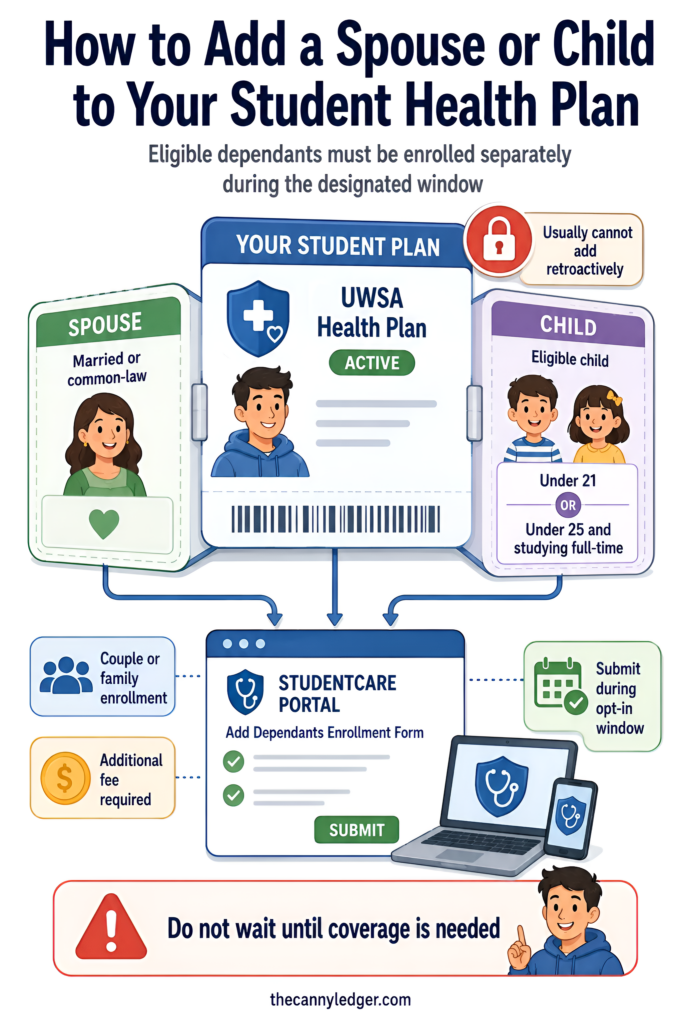
Any student on the plan, whether enrolled automatically as a full-time domestic student or opted in as a part-time student, can extend coverage to a spouse or dependent children through a separate couple and family enrollment form, for an additional fee paid directly through the Studentcare platform. Eligible dependents include a spouse, whether common-law or by marriage, and children under 21, or under 25 if they’re enrolled in school full-time themselves. This enrollment has to happen during the same designated opt-in window as everything else, and dependents generally can’t be added retroactively partway through the policy year, so if you’re planning to add a spouse or child to your coverage, timing that request to the actual enrollment window rather than whenever life circumstances change matters just as much as it does for the initial opt-in or opt-out decisions.
What Happens When You Graduate
Student health coverage doesn’t extend automatically past your time as an enrolled student, and losing that coverage right as you’re also losing the structure and predictability of student life is a genuinely common financial blind spot new graduates hit. Green Shield Canada, the insurer behind several Manitoba student plans, offers dedicated transition plans specifically for recent graduates looking to bridge that gap with something more affordable than a full individual plan bought cold. Our broader guide to health and dental insurance in Winnipeg covers the wider landscape of options once student coverage ends, including the federal Canadian Dental Care Plan and Manitoba Pharmacare, both worth checking as soon as graduation puts your UWSA coverage on a countdown. For international students transitioning into the workforce after graduation, our guides to jobs for new immigrants in Winnipeg and Social Insurance Number in Winnipeg cover two of the practical next steps that tend to follow closely behind graduation.

Common Questions
Do graduate students follow the same UWSA Health Plan rules as undergraduates? Coverage generally follows the same core structure of automatic enrollment with an opt-out option for domestic students, though it’s worth confirming your specific program’s credit hour or course load requirements directly with the UWSA, since graduate program structures don’t always map cleanly onto the standard undergraduate credit hour threshold.
Can I use the UWSA Health Plan for care outside Manitoba during a school break? The plan includes travel coverage specifically, which is meant to address exactly this kind of situation, though confirming the specific coverage limits and what counts as an emergency versus routine care while travelling is worth doing before you actually need to file a claim from outside the province.
What happens to my coverage if I drop below full-time status partway through the year? Since the policy year runs as one continuous September-to-August period once activated, dropping credit hours mid-year doesn’t automatically cancel existing coverage, but confirming your specific situation directly with the UWSA or Student Central avoids any confusion about what happens at renewal the following year.
Confirm Your Status Before the Window Closes
Whether you’re a domestic student weighing an opt-out against existing family coverage, a part-time student deciding if the $330 opt-in fee is worth it for your specific health needs, or an international student navigating the MISHP and UWSA two-layer system for the first time, the actual deadline for the Change-of-Coverage Period matters more than almost anything else covered here. Confirm the current year’s specific dates directly with the UWSA or Student Central before assuming you have more time than you actually do, since missing that window locks in whatever your default coverage situation happens to be for the full academic year ahead.