

Manitoba is one of a handful of Canadian provinces where the government itself stands behind your property title, not just a private insurance company. That single fact makes title insurance in Winnipeg a genuinely different question than it is almost anywhere else in the country, because most articles on this topic are written assuming Ontario’s system, where the government guarantee is much weaker and title insurance is treated as close to mandatory common sense. Manitoba isn’t that.
Title insurance in Manitoba is optional unless your lender requires it, and Manitoba’s Torrens land title system already guarantees the accuracy of your registered title through a government-backed assurance fund. What title insurance adds on top of that guarantee is coverage for things the government system was never designed to catch, survey encroachments, unpermitted work, zoning violations, and title fraud.
Understanding exactly where the government’s guarantee stops and where title insurance actually earns its premium is the whole question here, and it’s a more interesting answer than the generic “just get it” advice you’ll find written for buyers in other provinces.
What Manitoba’s Torrens System Actually Guarantees
Manitoba has operated under the Torrens system of land registration since 1885, administered through The Real Property Act and currently operated by Teranet Manitoba under the oversight of the Office of the Registrar-General, a government office established in 2014. About 95 percent of privately held land in Manitoba sits under this system today.
Torrens land registration runs on three core principles. The mirror principle means the certificate of title accurately reflects everything currently true about the property, including the registered owner and any registered interests like mortgages. The curtain principle means a buyer doesn’t need to trace the property’s entire ownership history, since the current certificate is treated as the complete and final word. And the insurance principle, sometimes called the assurance principle, means the government maintains a fund to compensate anyone who suffers a loss because of an error in the validity or accuracy of a registered title.
Put plainly: the Manitoba government insures every privately held title in this province against defect, as part of the system itself, not as an optional add-on you have to purchase separately.


Where the Government Guarantee Actually Stops
A government-backed guarantee sounds airtight, and for what it actually covers, it largely is. But the guarantee is scoped narrowly to the accuracy of what’s registered, and several real gaps exist outside that scope, confirmed directly by Manitoba law firms who handle these transactions regularly.
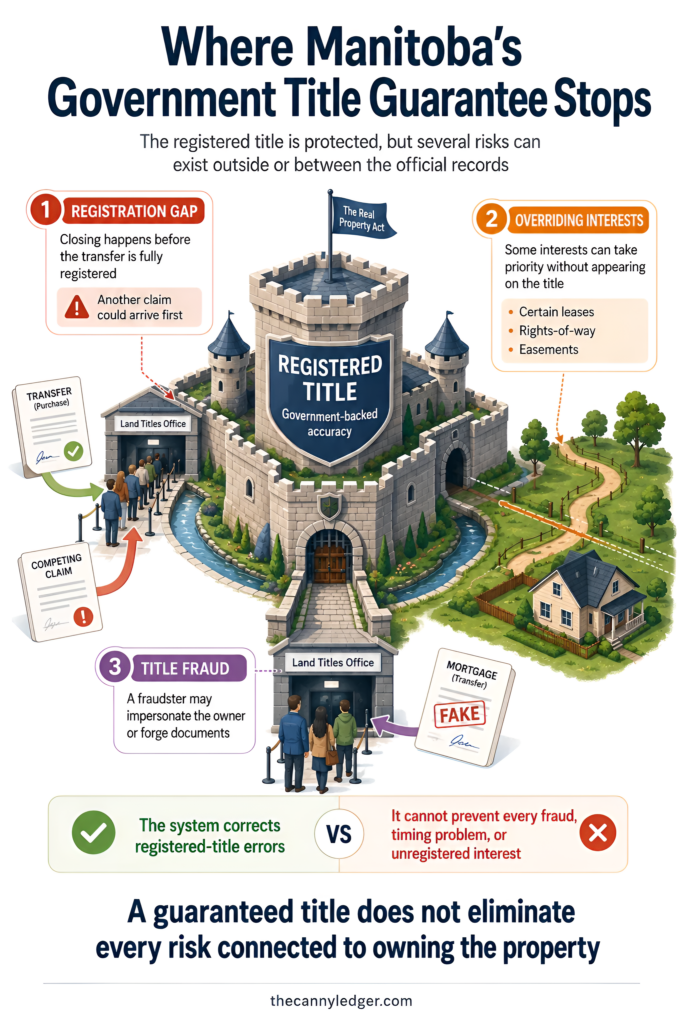
The first gap is what’s called the registration gap, the period between your purchase closing and the moment your Transfer of Land actually gets registered and assigned priority at the Land Titles Office. During that window, it’s theoretically possible for someone to register a competing claim against the title before yours takes effect. Manitoba law firms note this gap tends to run relatively short compared to some other jurisdictions, but the exposure exists during that window regardless.
The second gap involves overriding interests, specific categories that The Real Property Act allows to take priority over a registered title even without being formally registered themselves, including certain leases and rights-of-way or easements. A buyer relying purely on what’s shown on the certificate of title could miss one of these entirely.
The third and most talked-about gap is title fraud, where someone impersonates the actual owner or forges documents to fraudulently transfer or mortgage a property without the owner’s knowledge. The Torrens guarantee protects the accuracy of what’s properly registered, but it doesn’t prevent a skilled fraudster from getting a fraudulent transfer registered in the first place, which is a genuinely different problem than a government clerical error.
What Title Insurance Adds That the Torrens System Doesn’t
This is where the actual case for buying a policy lives, and it has almost nothing to do with the title’s legal validity, which Manitoba already guarantees.
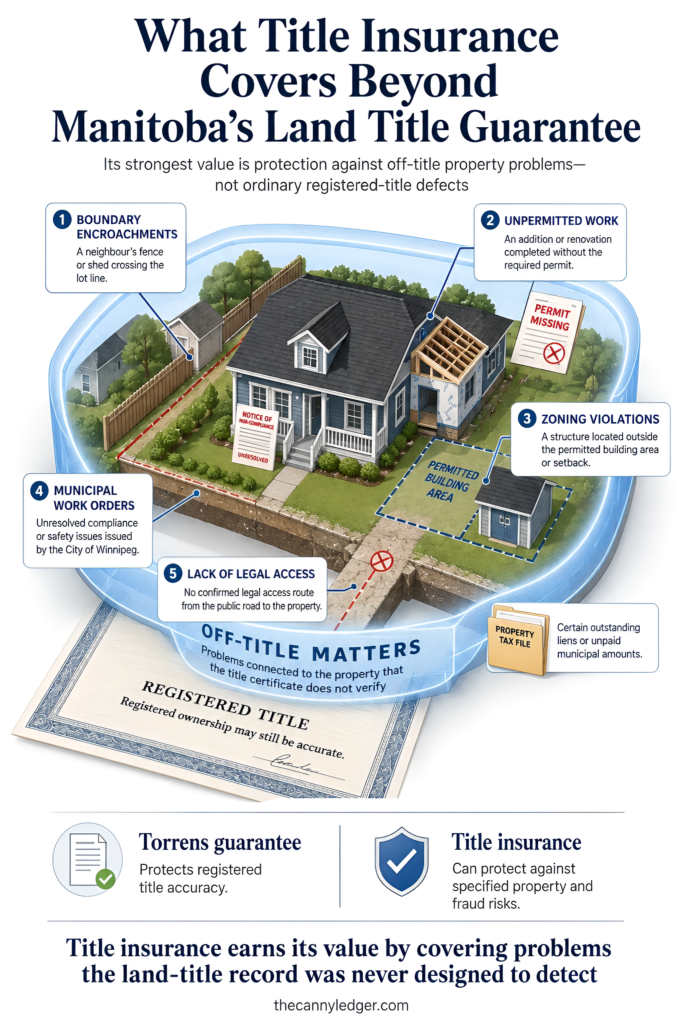
Survey and boundary issues are the clearest example: a neighbour’s fence, shed, or driveway sitting partly on your property, or your own structure encroaching onto theirs, isn’t something the Land Titles Office checks or guarantees at all. Unpermitted work, meaning renovations or additions completed without proper municipal permits, can surface as a real compliance problem years after you’ve bought a home that already had the issue baked in. Zoning violations, outstanding municipal work orders, and even a lack of legal road access to the property fall into this same category of things a title certificate says nothing about. Existing liens for unpaid property taxes or debts left by a previous owner can also attach to a property in ways separate from the title’s registered accuracy, which is worth understanding alongside how Winnipeg calculates and assesses property taxes in the first place.
None of these are title defects in the Torrens sense. They’re what the industry calls off-title matters, and Manitoba’s government guarantee was never designed to catch them, since it only speaks to the accuracy of the registered ownership interest itself.
Lender’s Policy vs. Owner’s Policy
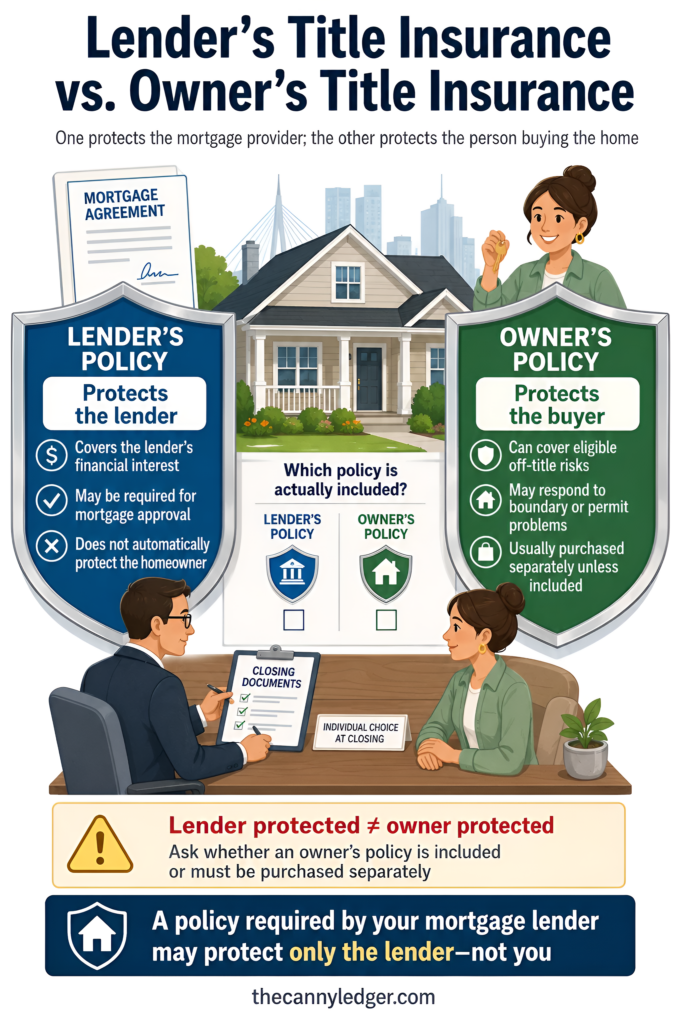
Title insurance in Manitoba, like elsewhere in Canada, comes in two distinct forms that protect two different parties. A lender’s policy protects the bank’s financial interest in the property, and if you’re financing your purchase with a mortgage, your lender may require this regardless of how strong Manitoba’s underlying title guarantee already is. An owner’s policy protects you directly, and it’s the one that actually addresses the off-title gaps covered above, since a lender’s policy alone does nothing for you personally if a boundary dispute or an unpermitted addition surfaces after closing.
Buyers sometimes assume that satisfying their lender’s requirement means they’re personally covered too. That’s not automatic. If protecting your own interests as the buyer matters to you beyond what your lender insists on, it’s worth asking directly whether an owner’s policy is included or needs to be purchased separately.
The Survey Workaround
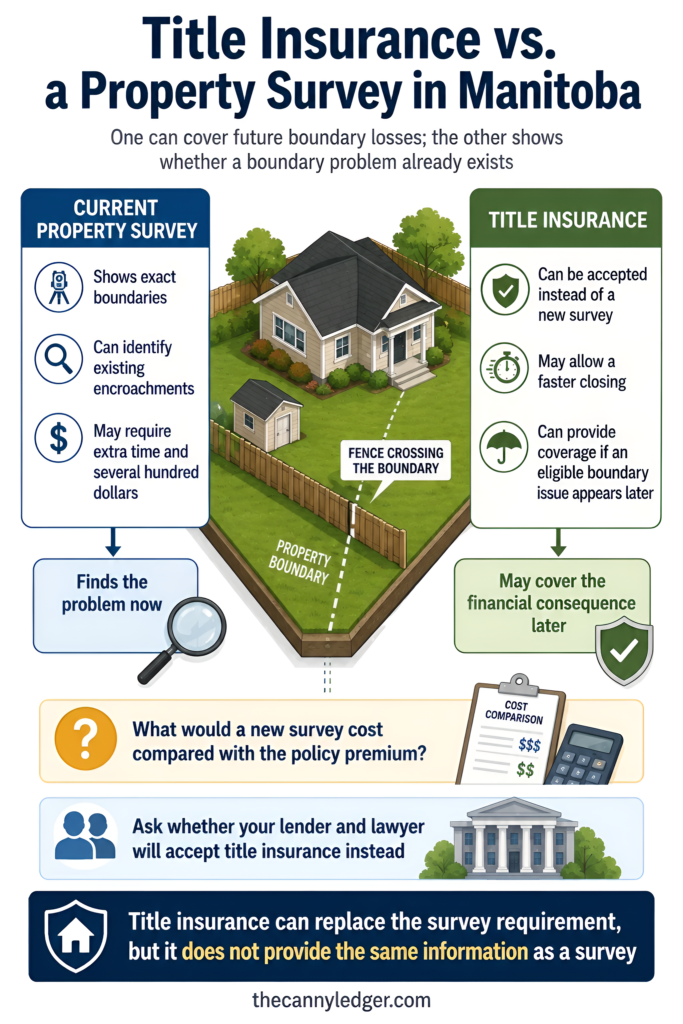
Here’s a genuinely practical detail most generic title insurance guides never mention. A current property survey, showing exact boundary lines and confirming no encroachments exist, used to be a standard part of closing a real estate purchase, and it typically cost several hundred dollars. Many Manitoba lenders and lawyers now accept a title insurance policy in place of ordering a fresh survey, letting the transaction close on schedule without that added cost and delay, with the policy providing coverage if a boundary issue turns up later instead.
This is worth knowing because it reframes the actual comparison. The question isn’t just “title insurance or nothing.” For a lot of Manitoba buyers, the real comparison is title insurance, often in the $200 to $300 range, against the cost of a full property survey, which frequently runs higher. Seen that way, the policy can function as a genuinely reasonable substitute rather than a pure add-on cost stacked on top of everything else.
What It Actually Costs
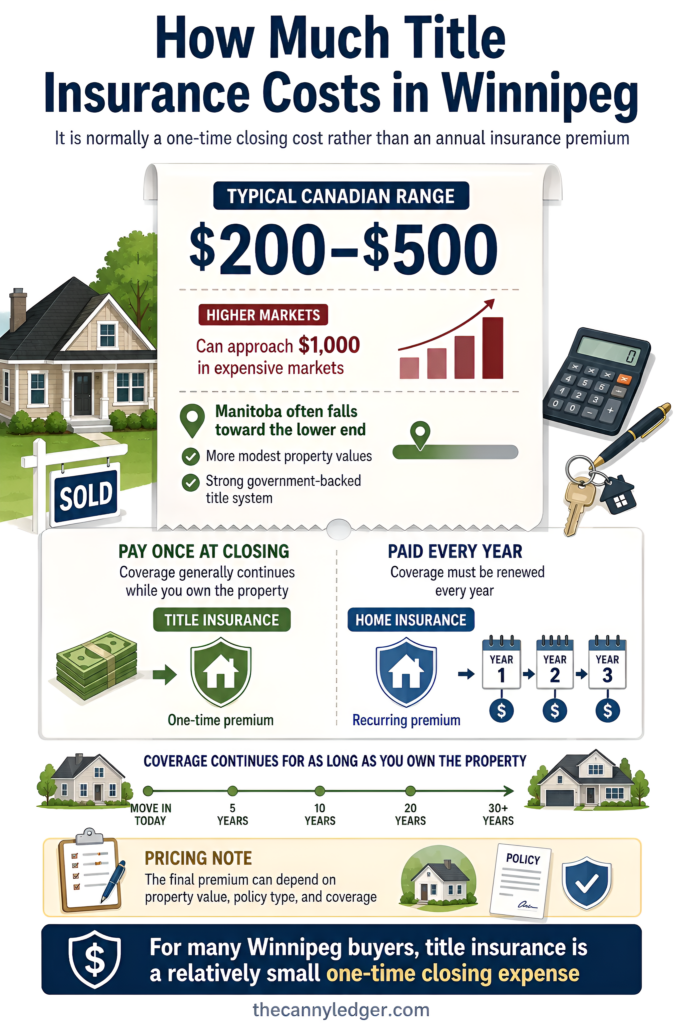
Title insurance in Canada is a one-time premium, typically ranging from $200 to $500, climbing as high as $1,000 in expensive markets like Toronto where property values and title risk both run higher. Manitoba, with more modest average property values and an already-strong government title guarantee reducing some of the underlying risk an insurer is pricing against, tends to sit toward the lower end of that national range.
Unlike an annual insurance premium, this cost is paid once at closing and the policy stays in effect for as long as you own the property, which makes the comparison against a repeated annual cost, like home insurance in Winnipeg, a genuinely different kind of decision.
So Do You Actually Need It in Manitoba?
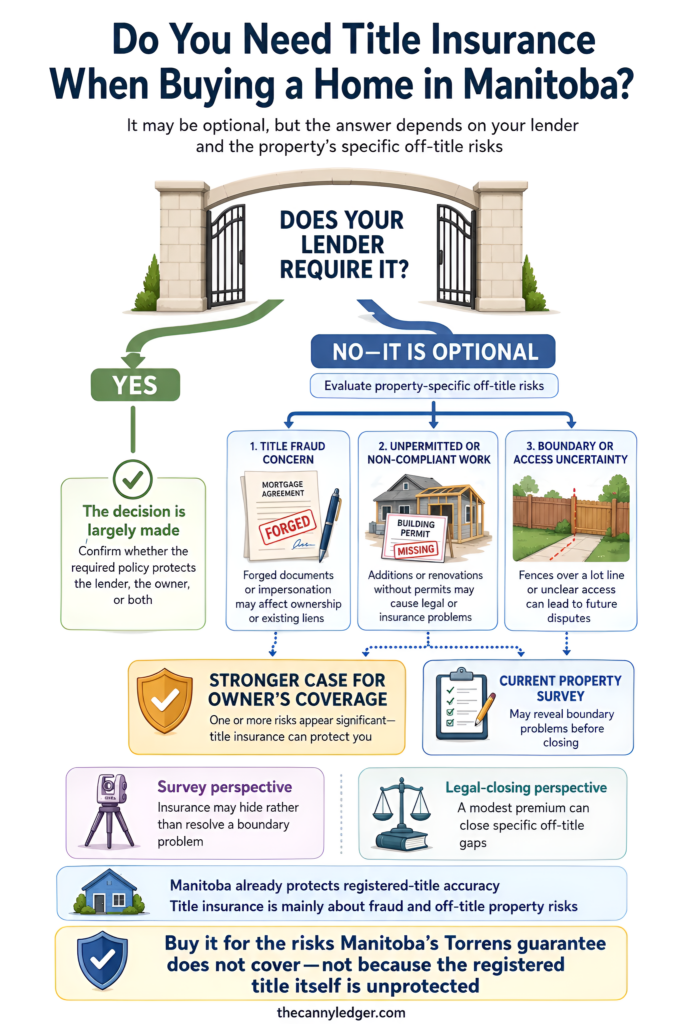
There’s a real, ongoing debate among Manitoba real estate professionals on this exact question, and it’s worth hearing both sides rather than a flattened answer. Some Manitoba land surveyors argue the product has limited marginal value here specifically, pointing out that the government already insures every title against defect at no separate cost to the buyer, and that skipping a proper survey in favour of a title insurance policy can mean genuine boundary problems go undetected and uncorrected rather than actually resolved. Manitoba law firms handling real estate closings generally take a more measured middle position: the Torrens guarantee is real and valuable, but it was never designed to cover fraud, off-title municipal issues, or boundary encroachments, and for a relatively small one-time cost, a policy closes those specific gaps cleanly.
Where this leaves a typical Winnipeg buyer: if your lender requires a policy, that decision is largely made for you. If it’s genuinely optional and you’re weighing it yourself, the strongest case for buying one is protection against title fraud and unpermitted work or zoning issues on the specific property you’re buying, neither of which Manitoba’s government guarantee touches, rather than protection against a defective title itself, which the province already backs.
What to Actually Do Next
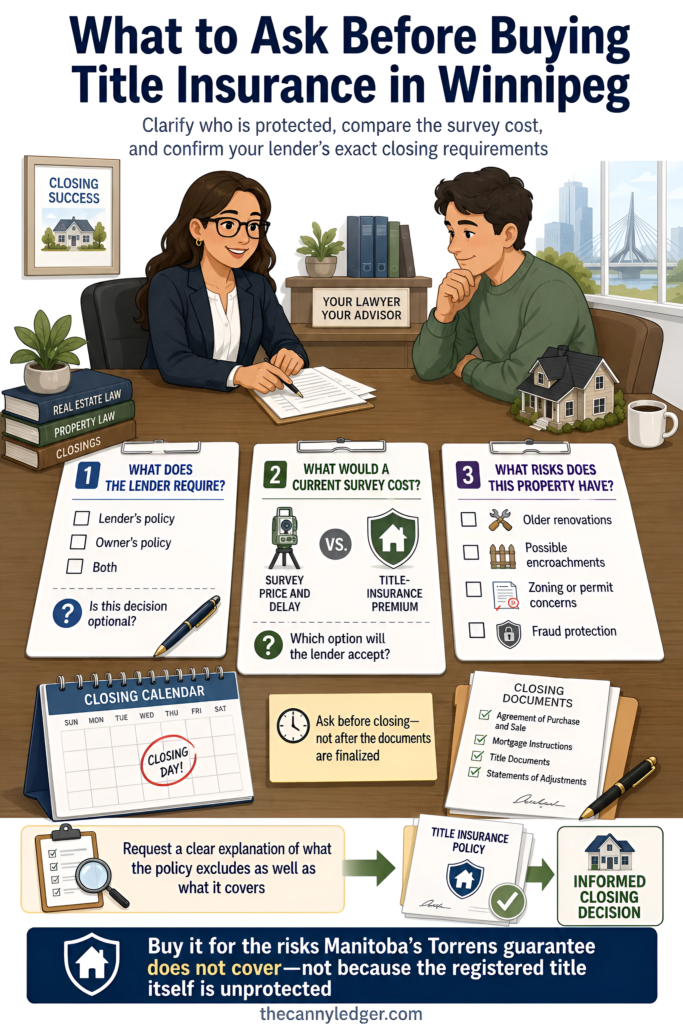
Ask your lawyer directly, before closing, whether your lender is requiring a lender’s policy, an owner’s policy, or both, since that answer determines whether this decision is even yours to make. If it’s optional, ask what a current survey would cost versus what a title insurance policy covering the same boundary risk would cost, since that comparison often makes the decision more concrete than an abstract yes-or-no. And if you’re still early enough in the process to be comparing financing options, it’s worth lining this decision up against your broader mortgage rate research for Winnipeg, since your lender’s specific requirements can vary from one institution to the next.