

Search “credit counselling Winnipeg” and the results page mixes two genuinely different kinds of businesses together with almost no visual distinction between them. One kind is a registered non-profit, funded partly through United Way and partly through voluntary creditor contributions, that will sit down with you for free and has no financial incentive to push you toward any particular outcome. The other is a for-profit debt settlement company that may call itself a “credit counselling service,” charge upfront fees before doing anything, and steer you toward whichever product happens to be most profitable for them. Telling these apart before you pick up the phone is, honestly, the single most useful thing this article can do for you.
- What credit counselling actually is, and what it isn’t
- The legitimate non-profit options serving Winnipeg
- How to tell a legitimate agency from a predatory one
- What actually happens during a first session
- Why the free consultation is worth using even if you’re not sure you need it
- If you don’t know where to start
What credit counselling actually is, and what it isn’t
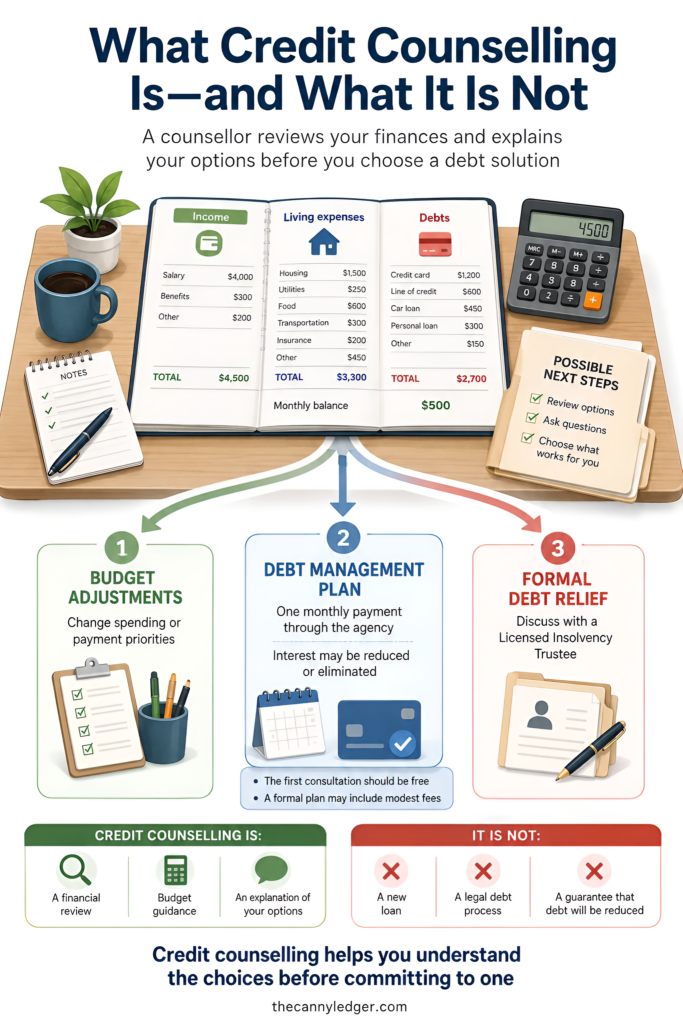
Credit counselling, at its core, is a conversation. A trained counsellor reviews your income, expenses, and debts, helps you build or repair a realistic budget, and explains the full menu of options available to you, from simple money-management adjustments up through formal debt relief tools. It is not itself a loan, a legal process, or a guarantee of debt reduction. That distinction matters because it’s genuinely different from the tools we’ve covered elsewhere on this site: our debt consolidation in Winnipeg guide covers the lending and negotiated-payment side of things, and our bankruptcy in Winnipeg guide covers the formal legal process administered only by a Licensed Insolvency Trustee. Credit counselling sits upstream of both, often as the first conversation that helps you figure out which of those paths, if any, actually fits.
A credit counsellor can, however, set up something called a debt management plan on your behalf, an arrangement where the agency negotiates directly with your creditors to reduce or eliminate interest charges and consolidates everything into one monthly payment that the agency then distributes on your behalf. This is the part of the process where fees, modest ones at legitimate non-profits, can enter the picture, and it’s worth understanding exactly what those fees look like before assuming “credit counselling” always means completely cost-free from start to finish.
The legitimate non-profit options serving Winnipeg
Community Financial Counselling Services is Manitoba’s own long-running non-profit in this space, based on Portage Avenue downtown, and it’s worth knowing about specifically because its services extend beyond straightforward debt counselling. Alongside budgeting help and debt management support, CFCS runs free tax filing for people who qualify, financial literacy workshops, and a dedicated program for people whose financial difficulties stem specifically from gambling, an area most national credit counselling chains don’t address directly. If your situation involves newcomer settlement alongside financial pressure, CFCS’s work with diverse Manitoba communities is also worth exploring alongside our new immigrant services in Winnipeg guide, since financial literacy support and settlement support often overlap more than people expect.
The Credit Counselling Society, operating under the name nomoredebts.org, has a physical office on Portage Avenue and serves Winnipeg alongside a wide list of surrounding communities including Selkirk, Steinbach, Stonewall, and Beausejour. It’s been operating since 1996, holds the Better Business Bureau’s highest rating, and has an accreditation record worth taking seriously: it’s an accredited member of Credit Counselling Canada, the national body that sets standards for legitimate non-profit agencies, and an affiliate of the National Foundation for Credit Counseling in the U.S. Ninety-eight percent of surveyed clients report they’d recommend the service, which is a meaningfully high number for an industry where trust is often the whole product.
Credit Canada also maintains a Winnipeg-facing presence and is accredited by both Credit Counselling Canada and the Association for Financial Counselling and Planning Education. Its counselling sessions are free, and if you enrol in its formal Debt Consolidation Program, the fee structure is transparent and modest: a one-time setup fee in the neighbourhood of fifty dollars, plus a management fee built into your monthly payment rather than charged as a separate surprise bill.
Consolidated Credit Canada rounds out the list of national non-profits with a specific Winnipeg service page, offering free initial counselling and debt consolidation program support along similar lines to the agencies above.
None of these four are competing with each other in any meaningful sense from a consumer’s perspective. They’re accredited, they don’t charge for the initial conversation, and calling more than one before deciding is a completely reasonable way to find a counsellor whose communication style actually works for you.

How to tell a legitimate agency from a predatory one
The Financial Consumer Agency of Canada, the federal body that oversees consumer protection in financial services, puts this plainly: both non-profit organizations and for-profit companies offer something they call credit counselling, and the burden is on you to check which kind you’re dealing with before handing over any information or money. A few checks take less than five minutes and are worth doing before your first call rather than after a bad experience.
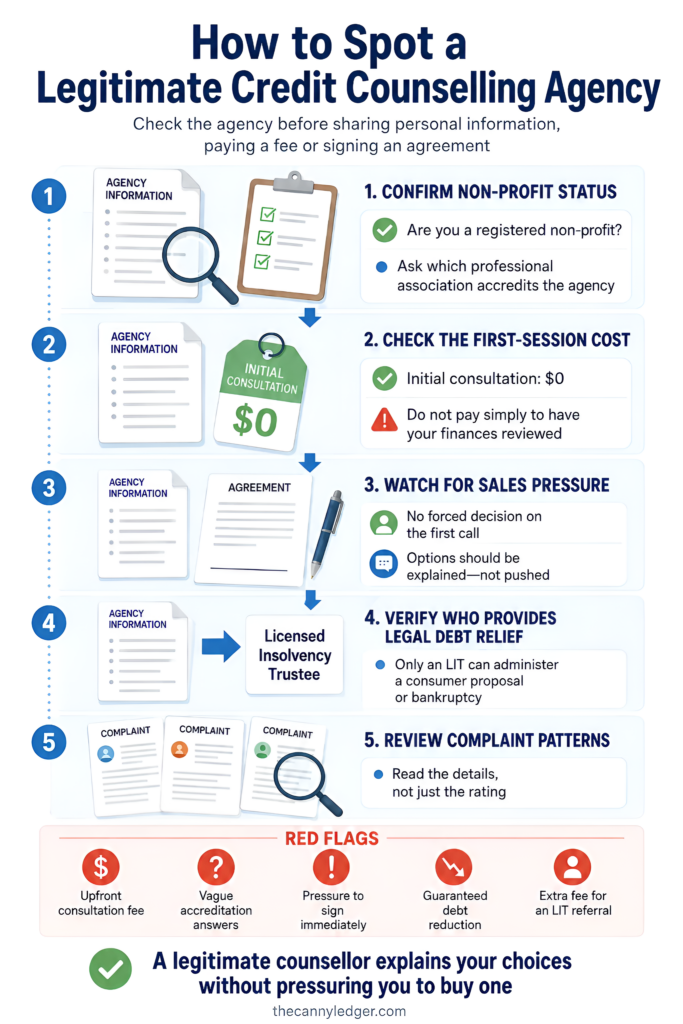
Ask directly whether the agency is a registered non-profit and which national or provincial association it belongs to. Credit Counselling Canada accreditation is the clearest signal in this country, and a legitimate agency will tell you their registration status without hesitation. If the answer is vague, evasive, or the person on the phone seems annoyed by the question, that’s information in itself.
Ask what the initial consultation costs before you book it. It should be free, full stop. Any agency charging a fee just to sit down and review your situation, before recommending anything, is behaving differently from every legitimate non-profit operating in this province.
Watch for pressure to sign something on the first call. A real counsellor’s job is to explain your options clearly, not to close a deal in a single conversation. If a consumer proposal or a formal debt settlement product is being pushed hard and immediately, it’s worth remembering that only a Licensed Insolvency Trustee is legally permitted to charge you for administering a consumer proposal, and an agency charging you separately for referring you to one is engaging in exactly the kind of double-charging that accredited associations explicitly prohibit their members from doing.
Check whether complaints against the company are on file with the Better Business Bureau or your provincial consumer protection office, and don’t stop at the star rating; read a few of the actual complaints to see whether the pattern matches your concerns. Our credit and collection agencies in Winnipeg page covers a related but distinct issue, what a company is and isn’t legally allowed to do once it’s actively collecting a debt from you, which is worth understanding alongside this if collection calls are already part of your situation.
What actually happens during a first session
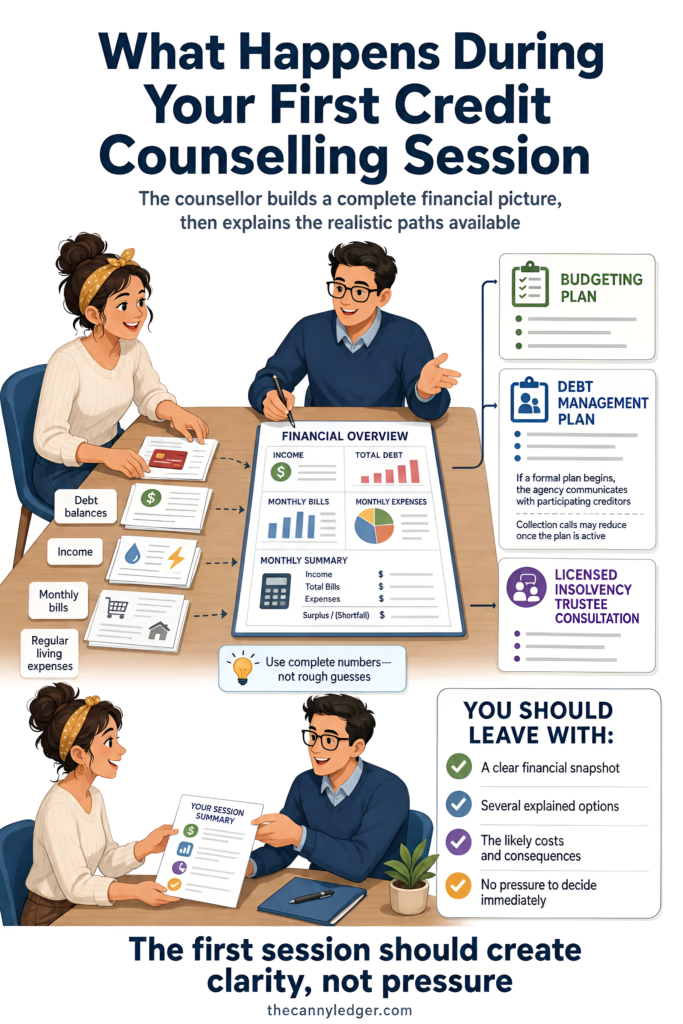
A first appointment, whether by phone, video, or in person, typically starts with a full picture of your finances: every debt, every source of income, every recurring expense, laid out honestly rather than estimated. From there, a counsellor will usually walk through where your situation currently sits relative to a few benchmarks, whether your debt-to-income ratio suggests a manageable budgeting fix, a formal debt management plan, or a conversation with a Licensed Insolvency Trustee about a consumer proposal or bankruptcy.
You should leave that first conversation with a clear, written sense of your options, not a single recommendation delivered as the only path forward. If a debt management plan does end up being the right fit, the agency will typically handle direct communication with your creditors from that point forward, meaning collection calls addressed to you personally should taper off considerably once the plan is formally in place.
Why the free consultation is worth using even if you’re not sure you need it
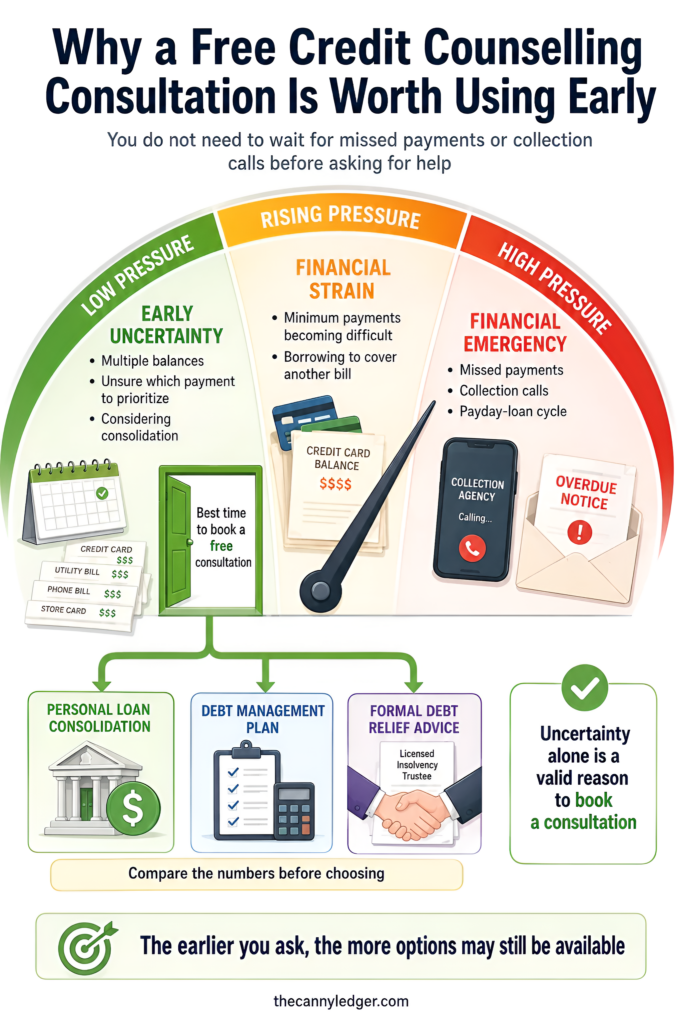
A meaningful number of people who eventually book one of these consultations do so only once things feel like an emergency, collection calls piling up, a payment already missed, a payday loan taken out to cover a gap that’s now creating a bigger one. The service works just as well, arguably better, earlier than that. If you’re carrying multiple balances and genuinely unsure whether a personal loan consolidation, a formal debt management plan, or something more serious is the right next step, that uncertainty by itself is a good enough reason to book a free session rather than guessing based on advertising you’ve seen. Our debt relief and debt help in Winnipeg guide lays out the fuller range of options a counsellor might walk you through, and it’s worth a read before your first call so you’re asking informed questions rather than sitting passively through the appointment.
If you don’t know where to start
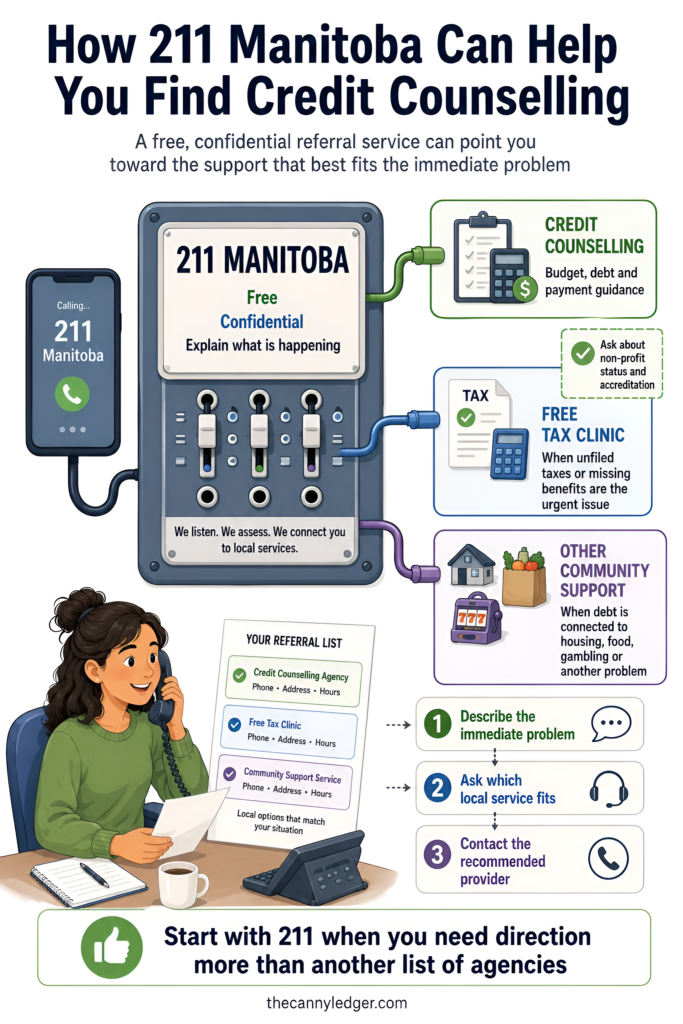
211 Manitoba exists specifically for people in exactly this position, unsure which service actually fits their situation and not wanting to spend an evening cross-referencing agencies. It’s a free, confidential line that can point you toward the right credit counselling agency, a free tax clinic if that’s the more immediate need, or a different kind of support entirely if debt turns out not to be the core issue. Our 211 Manitoba page explains exactly how the service works, and it’s a reasonable first call to make before any of the specific agencies listed above if you’d rather have someone point you in the right direction than choose blind.
Pick up the phone, ask the accreditation question early, and let a free conversation do the work of sorting out which path actually fits your numbers. That’s the whole point of the service existing in the first place.