



The first digit of a Social Insurance Number quietly tells Service Canada, and anyone else who knows to look, something about the person holding it. A SIN starting with the number 9 belongs to a temporary resident working or studying in Canada on a permit rather than a citizen or permanent resident, and that single digit determines everything from how long the number stays valid to whether it needs updating the moment an immigration document changes. Most Winnipeggers who’ve had a SIN for years have never noticed this, but it matters enormously for newcomers navigating their first application.
- What Your SIN Number Actually Reveals
- Documents You Need Before You Apply
- Applying Online Is Now the Recommended Method
- Applying by Mail or In Person in Winnipeg
- How Long It Actually Takes
- Updating Your SIN When Your Status Changes
- Protecting Your SIN From Fraud
- Lost or Stolen SIN: What to Do
- Common Questions
- Apply as Soon as You Know You’ll Need One
Applying for a Social Insurance Number in Winnipeg costs nothing and can be done online, by mail, or in person at a Service Canada Centre, with online now the method Service Canada itself recommends. You’ll need an original, valid identity document proving your legal status in Canada, and processing runs anywhere from same-day for in-person applications to about ten business days for applications submitted online.
What Your SIN Number Actually Reveals
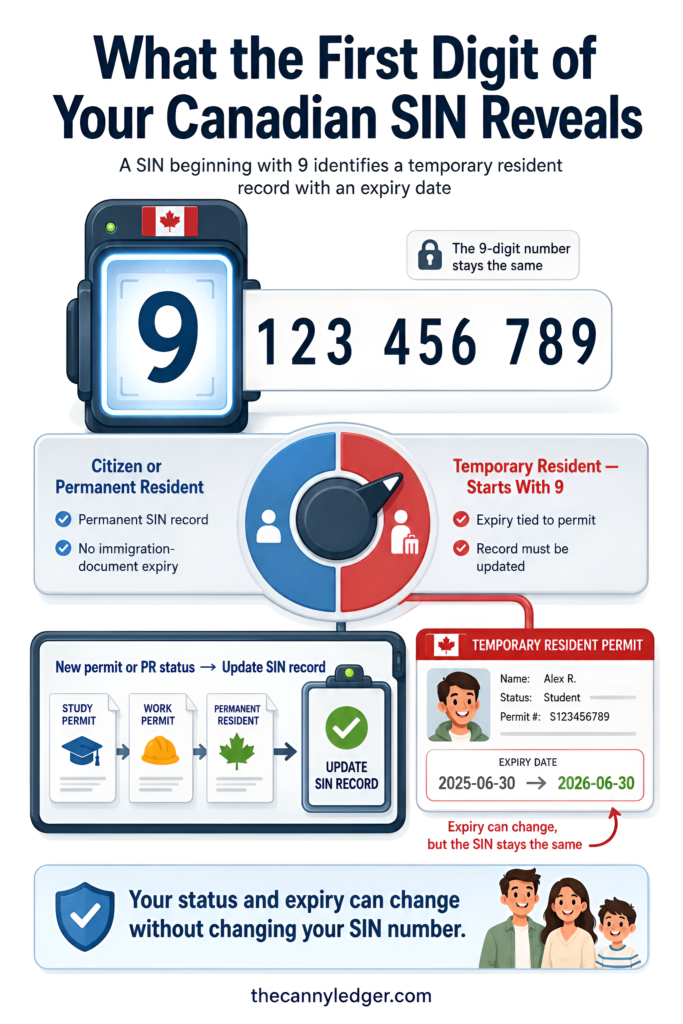
Every Canadian SIN is nine digits, and for the vast majority of Canadian citizens and permanent residents, that number is permanent for life, assigned once and never reused or reissued even if you later become a citizen after arriving as a permanent resident. Temporary residents, meaning people in Canada on a work permit, study permit, or similar temporary status, receive a SIN beginning with the digit 9 specifically, and that number carries an expiry date tied directly to the expiry of the immigration document that made you eligible for it in the first place. When that document expires or gets renewed with a new expiry date, your SIN record needs updating to match, even though the actual nine-digit number itself stays exactly the same throughout.
This distinction matters practically the moment someone’s status changes, say, moving from a study permit to a post-graduation work permit, or from a work permit to permanent residence. The number doesn’t change through any of these transitions, but the expiry date attached to the record does, and letting that update lapse can create real problems with payroll, tax filing, or benefit applications down the line if an employer’s system flags an expired SIN record even though your actual legal status is current.
Documents You Need Before You Apply
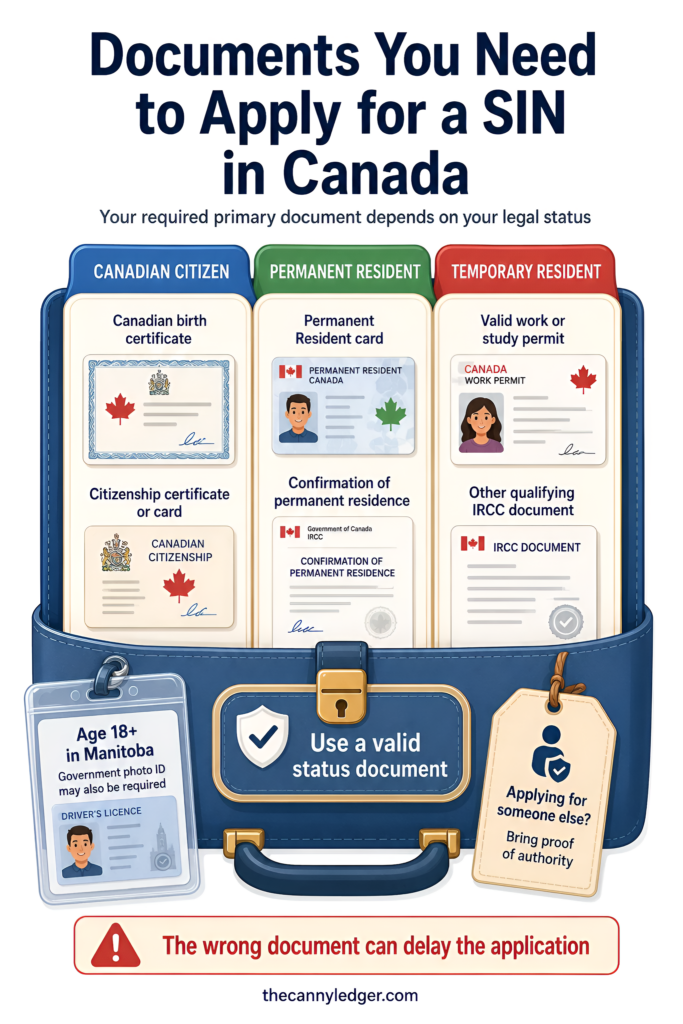
What counts as an acceptable primary document depends entirely on your specific status in Canada, and gathering the wrong document is the single most common reason an application gets delayed rather than processed on the spot. Canadian citizens generally need an original birth certificate issued by a Canadian province or territory, or a Canadian citizenship certificate or card. Permanent residents need their Permanent Resident card or confirmation of permanent residence document. Temporary residents need their valid work permit, study permit, or other immigration document issued by Immigration, Refugees and Citizenship Canada that authorizes them to be in the country. Photocopies aren’t accepted under any circumstance, the document has to be original, though Service Canada does return original documents submitted by mail once processing is complete.
If you’ve reached the age of majority in your province, which in Manitoba means 18, you’ll typically also need a secondary piece of government-issued photo identification alongside your primary document. Anyone applying on behalf of someone else, a parent applying for a child, for instance, needs additional documentation establishing that authority, so checking the exact requirement for your specific situation before showing up or submitting by mail saves a second trip or a rejected mail application.

Applying Online Is Now the Recommended Method
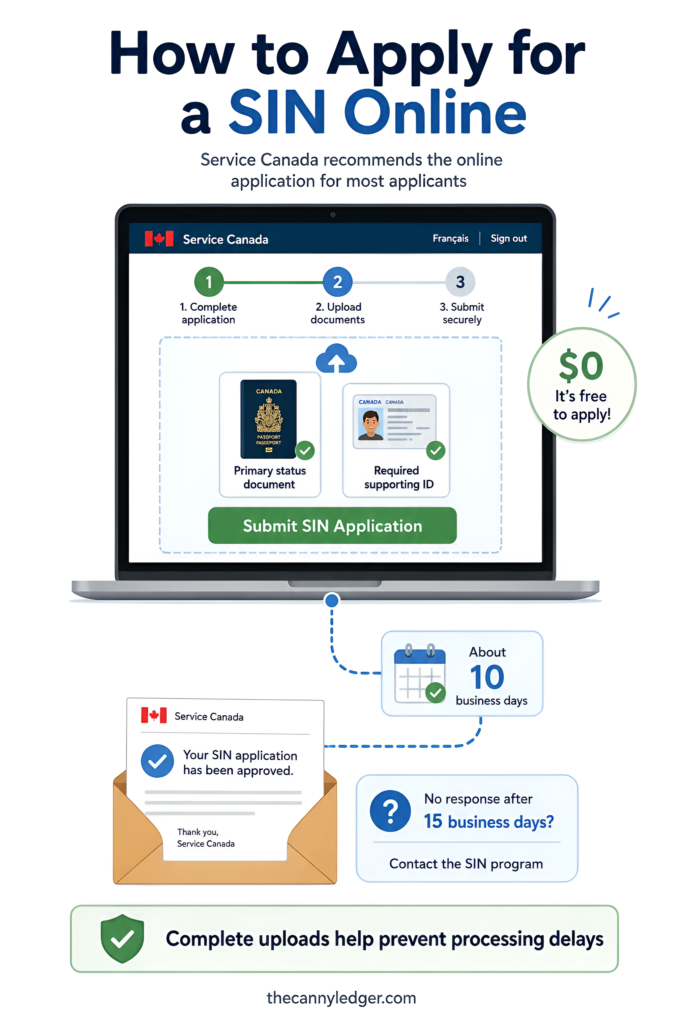
Service Canada has shifted its own guidance toward online applications as the preferred route, a genuine change from a few years ago when in-person applications were the default recommendation. The online application lets you upload digital copies of your required documents directly rather than mailing originals or booking an in-person appointment, and if your application is complete and accepted, you’ll receive a letter containing your SIN by mail within about 10 business days of submission. If more than 15 business days pass without a response, contacting the SIN program directly to check your application’s status is the recommended next step rather than assuming something went wrong and starting over.
Applying by Mail or In Person in Winnipeg
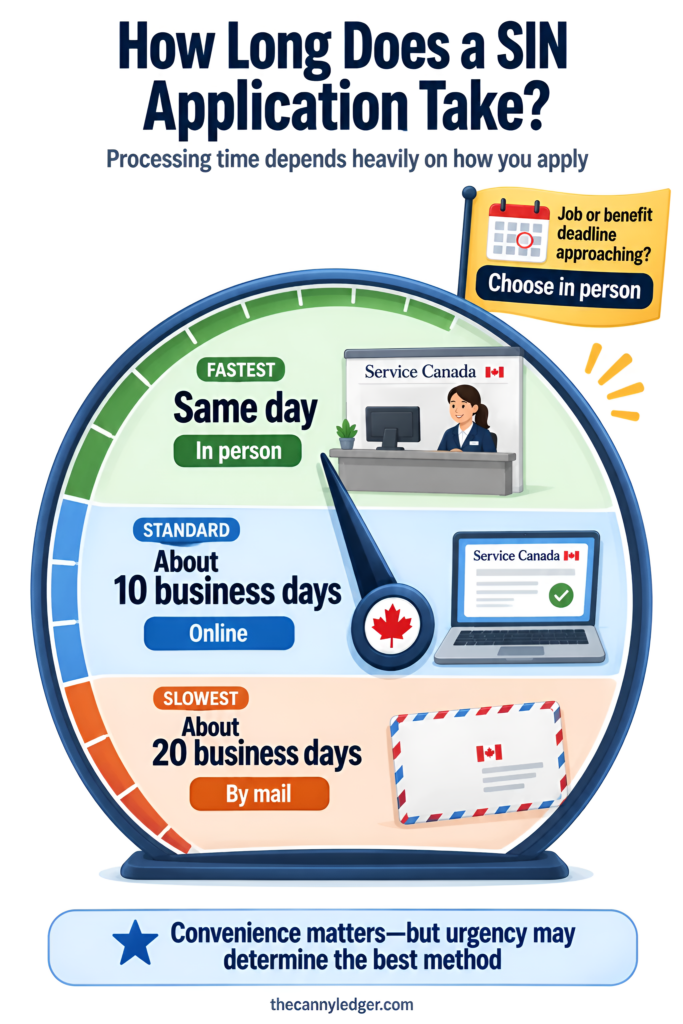
Mail applications follow a similar process but take longer, generally around 20 business days for a response, since original documents have to physically travel to the Social Insurance Registration office and back rather than being processed from a digital upload. For anyone who needs their SIN immediately, in-person remains the fastest option by a wide margin: applying at a Service Canada Centre gets you your SIN the same day, issued directly during your visit once your documents are verified. Winnipeg has several Service Canada locations, including a centre at Portage Place downtown, open Monday through Friday from 8:30 a.m. to 4:00 p.m., alongside other centres across the city and a scheduled outreach site in St. Boniface. Given that locations, hours, and appointment requirements can shift, checking Service Canada’s official office locator for the current address and hours nearest you before heading out is worth the extra minute rather than relying on a location list that might have changed.

How Long It Actually Takes
To summarize the timeline differences plainly since they genuinely matter for planning: in-person applications are resolved the same day, online applications typically take about 10 business days, and mail applications typically take about 20 business days. If a new job, a bank account, or a benefit application is waiting on your SIN, that timeline difference is usually worth an in-person visit even if online feels more convenient on paper, particularly for anyone on a tight timeline between accepting a job offer and their first day of work.
Updating Your SIN When Your Status Changes
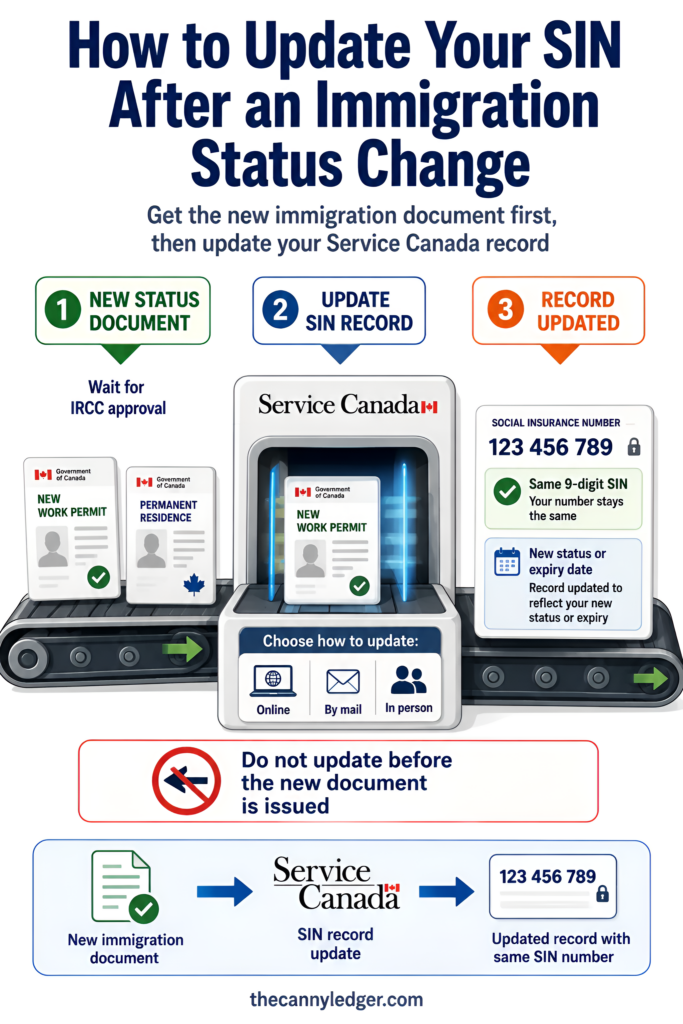
If your immigration status changes, a study permit becoming a work permit, or a work permit leading to permanent residence, your underlying nine-digit SIN doesn’t change, but the record tied to it needs updating to reflect your new document and its new expiry date. Service Canada won’t update your SIN record until Immigration, Refugees and Citizenship Canada has actually issued your new permit or confirmation document, which means the practical sequence is: get your new immigration document first, then update your SIN record, not the other way around. The same three methods, online, by mail, or in person, apply to updating an existing SIN record as apply to a first-time application, and the same document standards apply as well.
Protecting Your SIN From Fraud
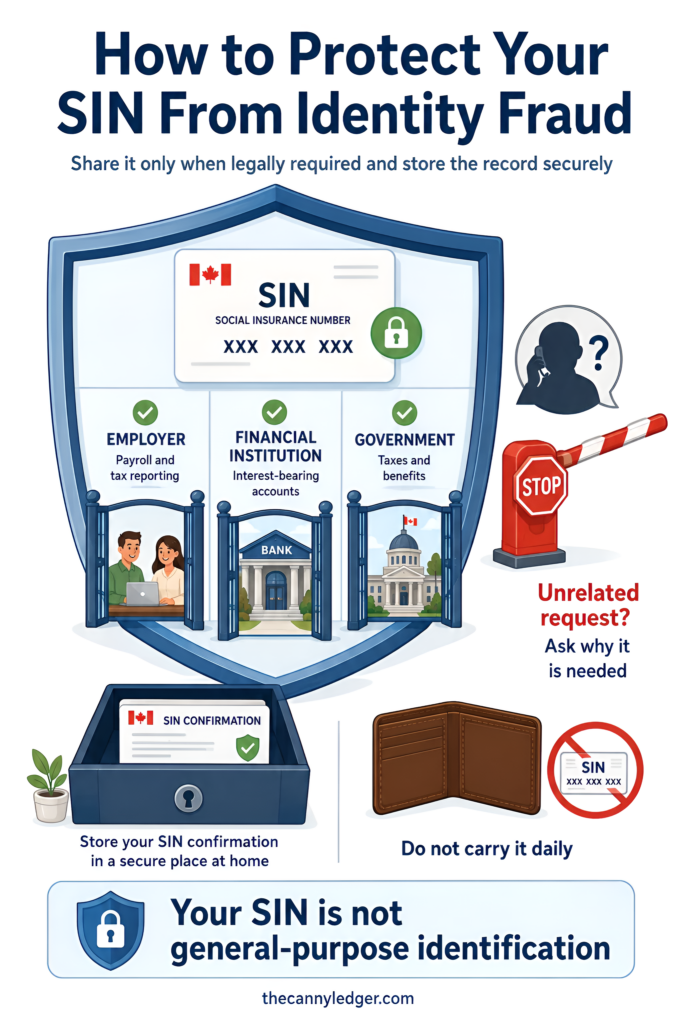
Your SIN is one of the most sensitive pieces of identification you’ll ever be asked to provide, since combined with a few other pieces of personal information, it can be used to open credit, file fraudulent tax returns, or apply for benefits in your name. Only provide your SIN when it’s genuinely required by law, employers for payroll purposes, financial institutions for interest-bearing accounts, and government agencies for benefits and tax purposes are the main legitimate categories, and be skeptical of any business or caller asking for it outside those specific contexts. Never carry your SIN card or confirmation letter in your wallet day to day the way you might a driver’s licence, since losing a wallet with your SIN inside it turns a routine inconvenience into a genuine identity theft risk.
Lost or Stolen SIN: What to Do
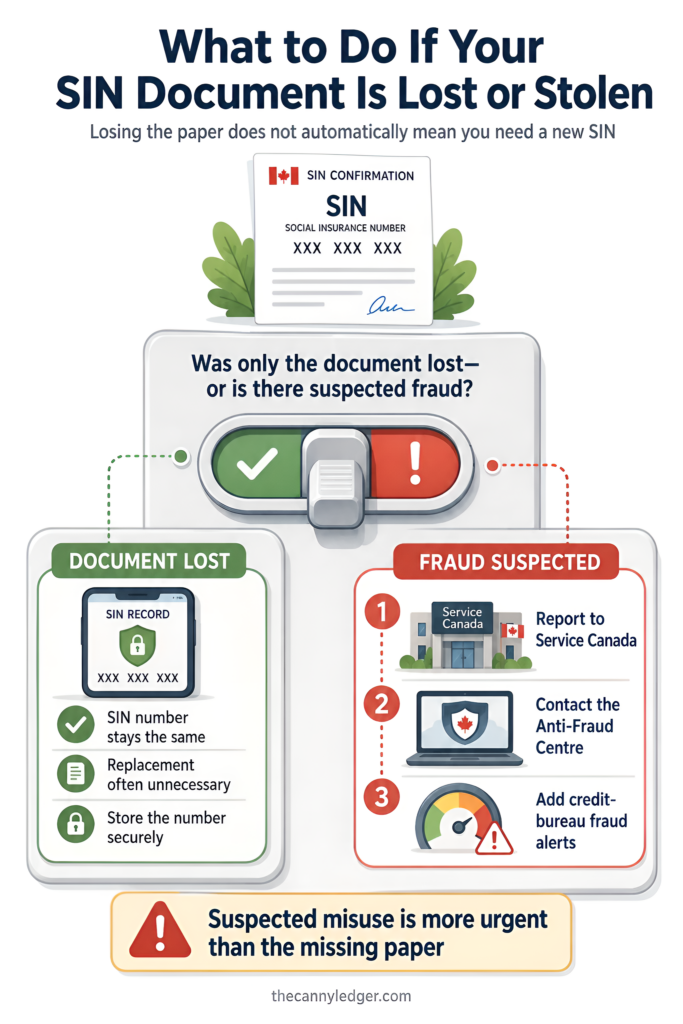
Losing the physical card or letter your SIN was issued on doesn’t mean your actual number changes, and in most cases you don’t need to apply for a replacement document at all, since the number itself, once memorized or recorded securely elsewhere, is what actually matters for most transactions rather than the physical paper it arrived on. If you suspect your SIN has been used fraudulently, though, that’s a different and more urgent situation, worth reporting both to Service Canada directly and to Canada’s Anti-Fraud Centre, alongside placing a fraud alert with the major credit bureaus to catch any unauthorized credit activity opened in your name.
For newcomers specifically working through this process alongside everything else involved in settling in Winnipeg, our newcomer’s guide to Winnipeg covers where a SIN application typically fits into the broader sequence of early tasks, and settlement workers at organizations like the Immigrant Centre in Winnipeg can walk you through the specific document requirements for your exact immigration category if anything here feels unclear for your situation.
Common Questions
Do I need a SIN to receive Employment Insurance? Yes, a valid SIN is required before an EI application can move forward at all. Our guide to Employment Insurance in Winnipeg covers the full application process once your SIN is in place.
Can I work in Canada while my SIN application is being processed? No, you generally need your SIN in hand before starting employment, which is exactly why applying in person for same-day issuance makes sense if a job start date is approaching quickly rather than waiting on a mailed response. Our guide to jobs for new immigrants in Winnipeg covers timing a job search around exactly this kind of paperwork.
Does my SIN change if I become a Canadian citizen after arriving as a permanent resident? No, your nine-digit SIN stays exactly the same through that transition. Only temporary residents holding a 9-series SIN see their number’s status change, specifically when they transition to permanent residence and receive a new, non-expiring SIN record.
Apply as Soon as You Know You’ll Need One
Don’t wait until a job offer or a bank appointment forces the issue, since applying for or updating your SIN as soon as your situation calls for it, rather than treating it as something to handle later, avoids the scramble of needing it immediately with only a slower mail or online timeline available. If timing is tight, an in-person visit at a Winnipeg Service Canada Centre remains the one option that solves the problem the same day you walk in.

