

Somewhere between hauling suitcases out of James Richardson International Airport and figuring out which bus actually goes downtown, most newcomers make the same mistake. They spend the first few days chasing furniture, groceries, and a phone plan while the paperwork that actually unlocks everything else, a health card, a Social Insurance Number, a bank account, sits untouched in a folder. It’s an understandable order of priorities. It’s also the one that costs people the most time later, because almost nothing else in your new life in Winnipeg works without those three pieces in place first.
- Register for Your Manitoba Health Card First
- Get Your Social Insurance Number Before You Start Job Hunting Seriously
- Open a Canadian Bank Account Early, Even Without a Job Yet
- Register With Manitoba Start Before You Try to Navigate Settlement Services Alone
- Sort Out Driving Before Your Foreign Licence Quietly Stops Being Valid
- Register Your Kids for School as Soon as You Have an Address
- Find Permanent Housing Once the Paperwork Above Is Moving
- Start the Job Search With Structure, Not Just Applications
- Get Your Taxes on the Radar Even If April Feels Far Away
- A Few Practical Things Nobody Tells You Upfront
- Common Questions
The first things to do after arriving in Winnipeg are registering for a Manitoba Health card, applying for your Social Insurance Number, opening a bank account, and connecting with a settlement agency such as Manitoba Start, ideally within your first one to two weeks. None of these carry a fee. Getting them done early prevents delays with employment, banking, and access to care down the line.
Register for Your Manitoba Health Card First
Manitoba’s public health plan is called the Manitoba Health Services Insurance Plan, or MHSIP, and the card that proves you’re enrolled is usually just called your Manitoba Health card. You can apply the moment you have a Manitoba address, either online through the Manitoba Health registration portal or in person, and you’ll need to show proof of your legal status in Canada (your Confirmation of Permanent Residence, permanent resident card, or work permit) along with something that confirms you actually live here, like a signed lease.
Processing isn’t instant, so treat your application date as the start of a waiting game rather than something that resolves the same week. Keep travel or private health insurance active until your card physically arrives, and don’t assume a walk-in clinic will bill the province correctly before your registration is fully processed. If you arrived with children, register everyone in the household on the same application where possible, since each family member needs their own coverage and personal health identification number.

Get Your Social Insurance Number Before You Start Job Hunting Seriously
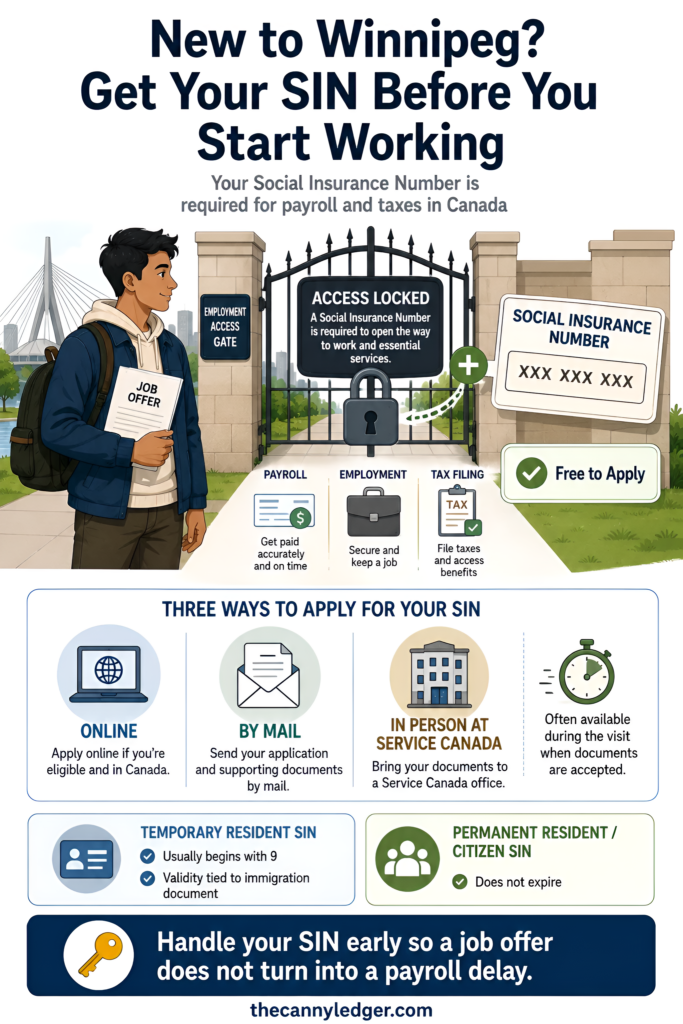
A Social Insurance Number, or SIN, is the nine-digit identifier Service Canada issues so you can legally work in Canada, get paid, and file taxes. Employers are required to ask for it, and you genuinely cannot be added to payroll without one. The good news is that applying costs nothing and, if you’re a permanent resident or citizen, your SIN never expires. Temporary residents get a SIN starting with the number nine, and it’s tied to the expiry of your immigration document, so keep an eye on that if your work permit has a defined end date.
You can apply online, by mail, or in person at a Service Canada office, and in-person applicants typically walk out with their number the same visit. If you’re headed to Winnipeg through certain major Canadian airports, it’s also worth checking whether a SIN@Landing desk is operating there, since some newcomers now get this handled before they’ve even left the terminal.
Open a Canadian Bank Account Early, Even Without a Job Yet
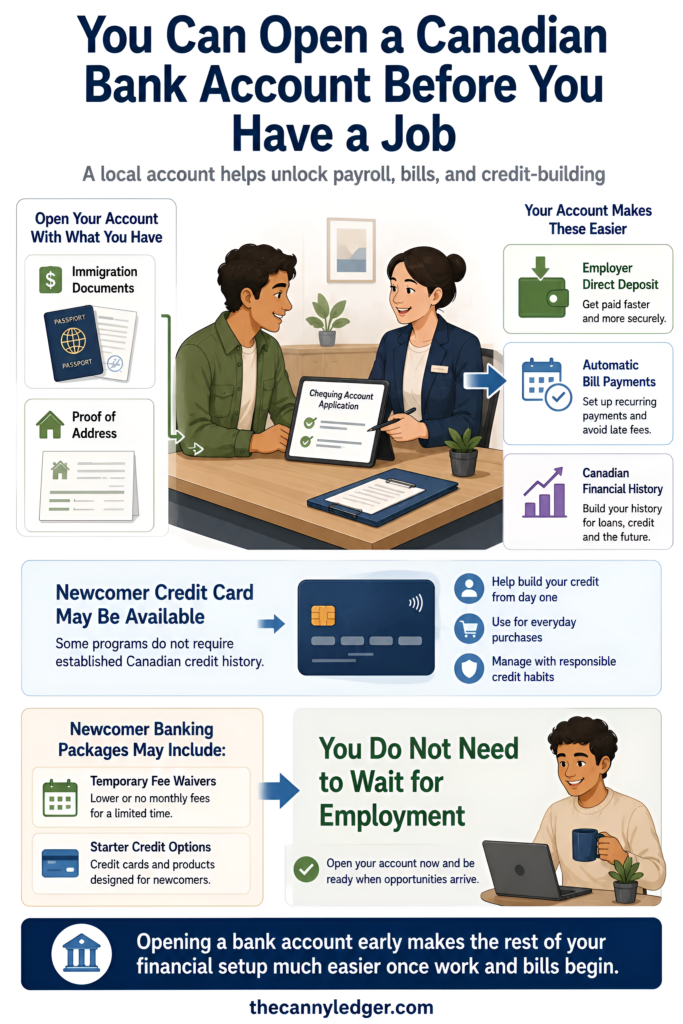
You don’t need to wait for employment to open a chequing account. Most major banks will let you set one up with your immigration documents and proof of address, and having a Canadian account matters for more than convenience, direct deposit from an employer, automatic bill payments, and building a Canadian credit history all depend on it. A newcomer banking package, which several Canadian banks offer specifically for people in their first year in the country, often waives monthly fees and sometimes includes a starter credit card that doesn’t require existing credit history.
Register With Manitoba Start Before You Try to Navigate Settlement Services Alone
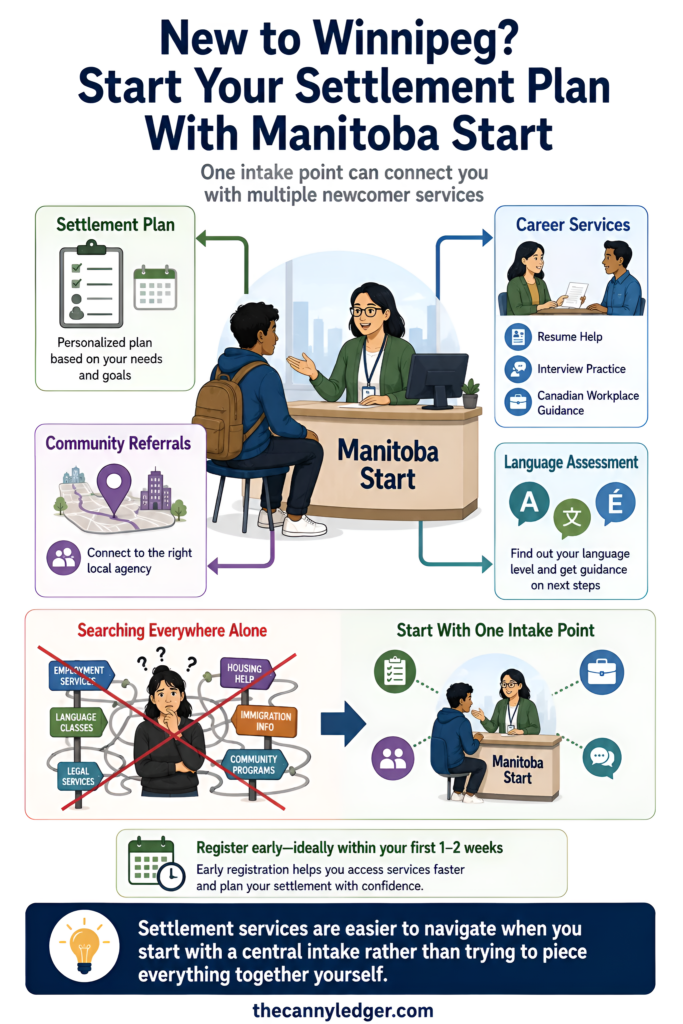
Manitoba Start operates as the central intake point for newcomer settlement services in Winnipeg, and registering there early saves you from piecing together information from a dozen different sources. A single visit gets you a personalized settlement plan, referrals to the specific agency in your neighborhood, and access to free career services including resume help, interview practice, and guidance on Canadian workplace norms that aren’t always obvious if you’ve never worked in a Canadian office before. If your English needs work before you’re ready for a job search, ask about language assessment while you’re there rather than treating it as a separate errand for another day, since many programs are stacked together intentionally.
For a fuller list of who’s out there beyond Manitoba Start, including agencies that focus on specific communities or specific needs, our rundown of new immigrant services in Winnipeg and the Immigrant Centre in Winnipeg are both worth bookmarking alongside this guide.
Sort Out Driving Before Your Foreign Licence Quietly Stops Being Valid
New residents can drive on a valid foreign or out-of-province licence for up to three months after settling in Manitoba, but that window closes whether or not you’ve gotten around to dealing with it. Whether your exchange is straightforward depends on where your original licence is from. Manitoba has reciprocal agreements with a specific list of countries and provinces, meaning your existing driving experience carries over without a road test. If your home jurisdiction isn’t on that list, expect to sit a knowledge test and possibly a road test before Manitoba Public Insurance issues you a Manitoba licence.
Either way, you’ll need to visit an MPI service centre or Autopac agent in person with your original licence, proof of identity, and two documents showing your Manitoba address. If your licence isn’t in English or French, budget time for an MPI-approved translation before your appointment, since translations from other sources get rejected at the counter. Once you’ve got a Manitoba licence, you’ll also need Manitoba auto insurance before you can legally drive, which works differently from private insurance markets in a lot of home countries. Our guides to what MPI actually is and Manitoba car insurance rates cover that side in more depth.

Register Your Kids for School as Soon as You Have an Address
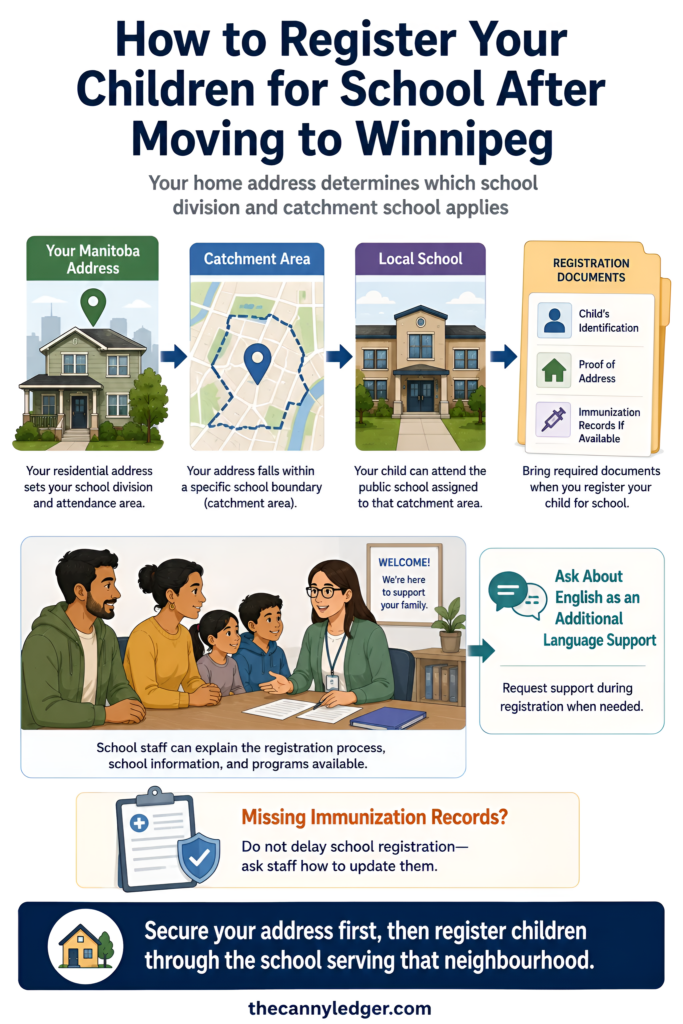
Winnipeg has multiple school divisions, and which one you fall under depends entirely on your address, so this is one task that genuinely can’t happen before you’ve settled on housing. Most divisions, including Winnipeg School Division, ask you to register at your catchment school first, in person, with an appointment, before applying for any specialized program or school-of-choice option. Bring identification for the child, proof of your address, and immunization records if you have them. If records didn’t travel with you, don’t let that hold up registration, schools and newcomer services staff are used to helping families track down or catch up on immunization requirements after the fact.
Ask directly about English as an Additional Language support when you register, since most divisions run dedicated programming for it, and it’s far easier to get a child placed into that support from day one than to request it retroactively once they’re already struggling in a mainstream classroom.
Find Permanent Housing Once the Paperwork Above Is Moving
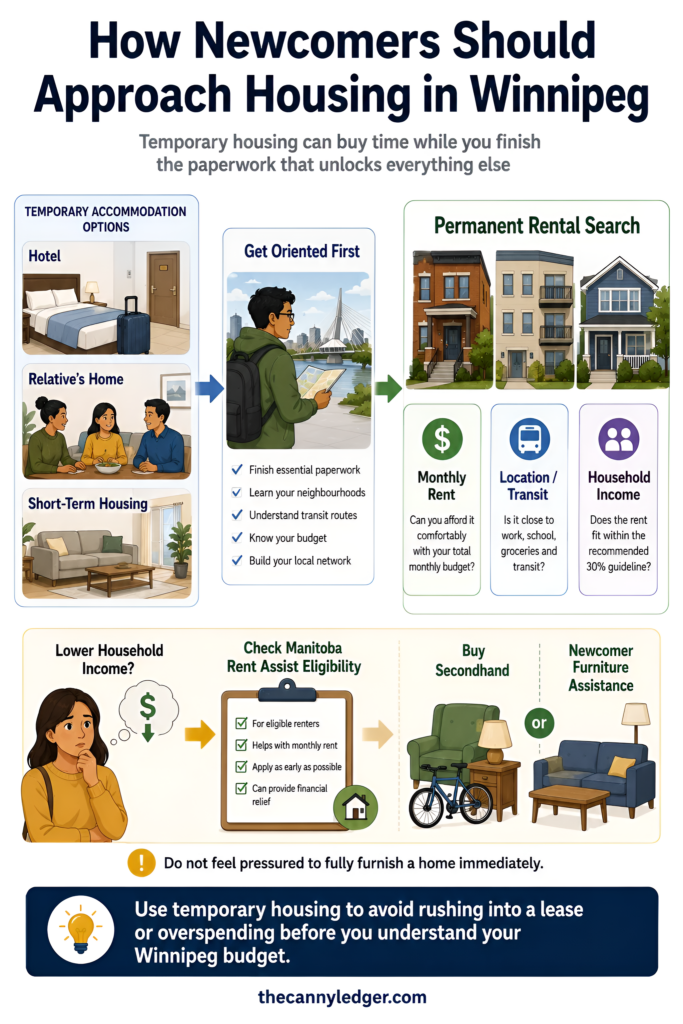
A lot of newcomers land in short-term housing, a hotel, a relative’s spare room, temporary settlement housing, while they get oriented, and that’s a reasonable way to buy yourself breathing room before committing to a lease. Once you’re ready to look seriously, income matters more in Winnipeg’s rental market than it does in some other Canadian cities, since a lower cost of living also means a lower bar for what counts as affordable housing here. If your household income ends up on the lower end while you’re getting established, it’s worth knowing that Manitoba runs a rent assistance program open to people who aren’t on social assistance, not just those who are. We cover the actual income cutoffs and how to apply in how to qualify for Rent Assist in Manitoba.
For the search itself, our breakdown of the cheapest neighborhoods in Winnipeg to rent is a reasonable starting point, and if you’re weighing whether to buy secondhand or borrow furniture while your budget stabilizes, several Winnipeg organizations run free furniture programs specifically for new immigrants rather than expecting you to furnish an entire home out of pocket in your first month.
Start the Job Search With Structure, Not Just Applications
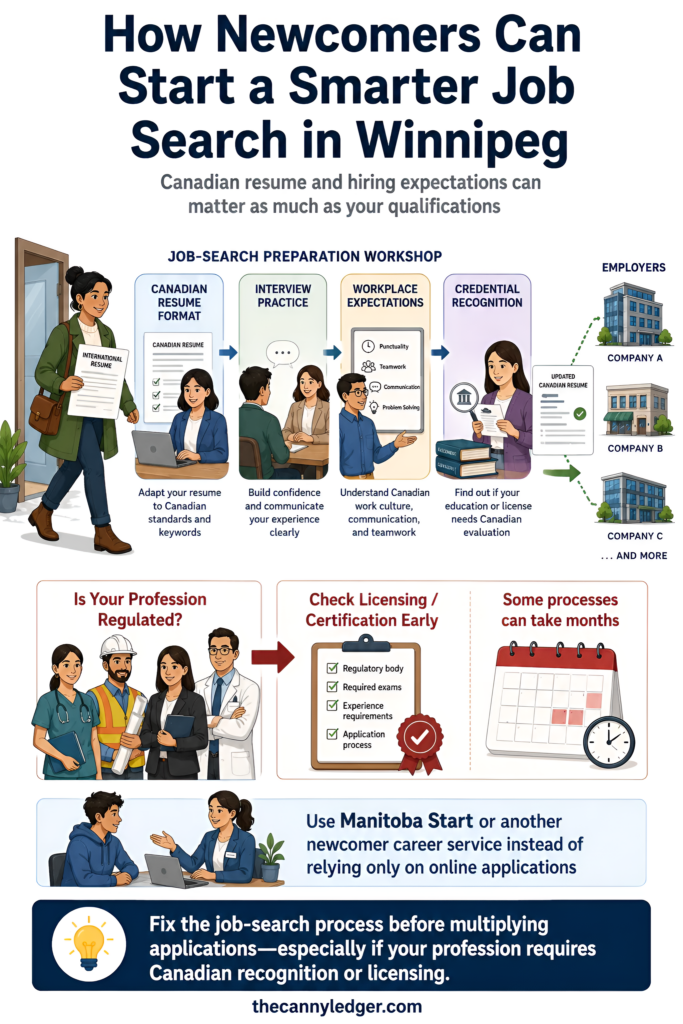
Sending out resumes on your own is possible, but newcomers who go through Manitoba Start’s career services or a similar settlement agency generally get further faster, because a lot of what trips people up in a Canadian job search isn’t qualifications, it’s format. Canadian resumes, interview norms, and how credential recognition works for internationally trained professionals are all things a career counsellor who works with newcomers daily can walk you through in a single session rather than you learning by trial and error. If your profession requires licensing or certification in Canada, ask about that specifically and early, since some regulated fields take months to sort out and you don’t want to discover that after you’ve already been job hunting for weeks. Our guides to career counselling for newcomers in Winnipeg and jobs for new immigrants in Winnipeg go deeper on both of those angles.
Get Your Taxes on the Radar Even If April Feels Far Away
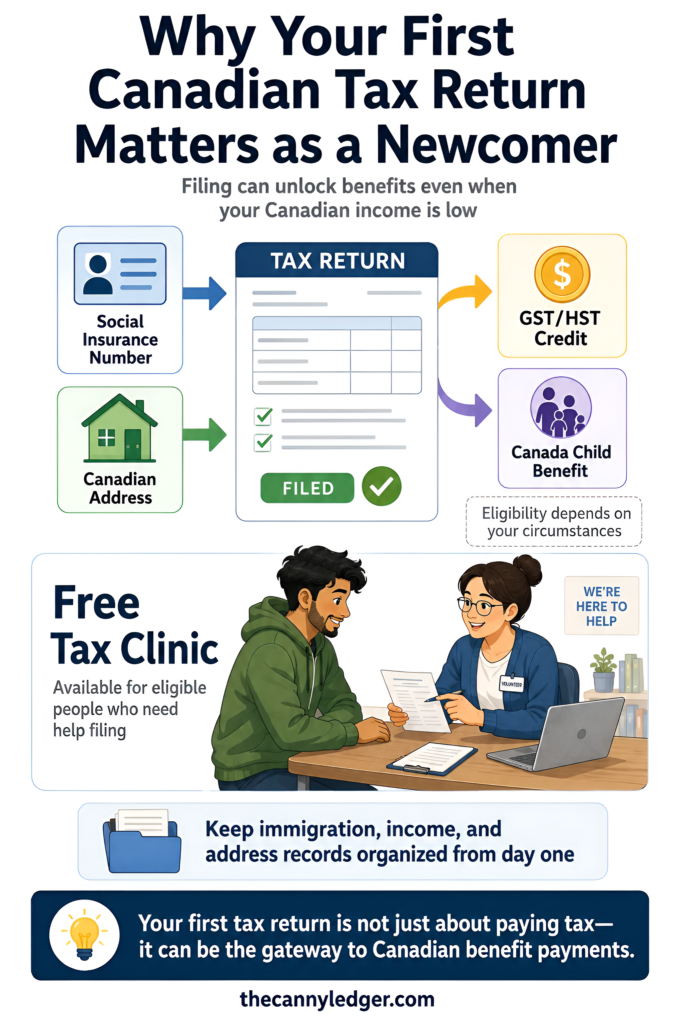
You won’t owe anything the moment you land, but a few things are worth setting up early. You’ll need your SIN and a Canadian address on file before you can file a return, and filing your first Canadian tax return, even with little or no income, is what actually triggers benefits like the GST/HST credit and the Canada Child Benefit if you have kids. Free tax clinics run by trained volunteers operate across Winnipeg specifically for people who can’t afford a paid preparer, and they’re a genuinely good option for a first-time filer navigating an unfamiliar system. Our list of free tax clinics in Winnipeg covers where to find one when tax season rolls around.
A Few Practical Things Nobody Tells You Upfront
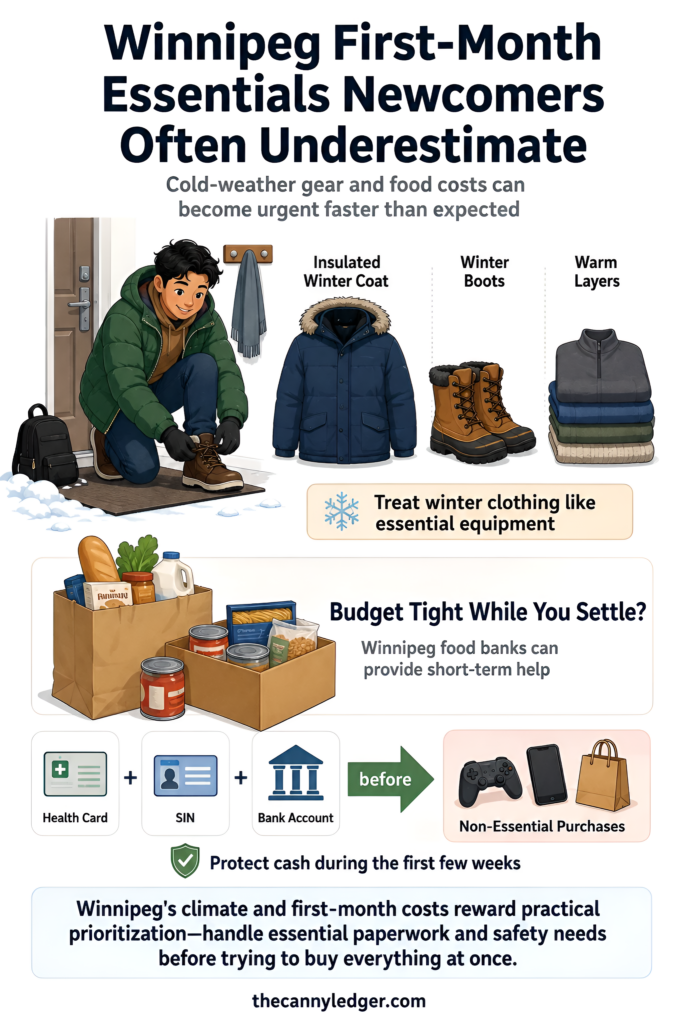
Winter here isn’t a minor inconvenience, it shapes how you dress, how you budget, and how you plan your errands for a solid five months of the year. If you’re arriving from a warmer climate, a proper winter coat, boots, and layers aren’t optional extras, they’re closer to safety equipment, and it’s worth prioritizing that purchase over things that feel more urgent in the moment. On the food side, if your budget is tight while everything else gets sorted, Winnipeg’s food bank network exists precisely for situations like a first month in a new country, and using it isn’t something to feel embarrassed about. Our guide to food banks in Winnipeg lays out locations and how intake usually works.
Common Questions
Do I need to do all of this in the first week? No, but the Manitoba Health card, SIN, and settlement agency registration are worth front-loading since everything else, banking, job applications, school registration, moves faster once those are in motion.
What if I don’t have all my documents translated yet? For Manitoba Health and MPI specifically, translations need to come from an approved translator rather than any translation service, so confirm the accepted list before you pay for one, and don’t assume a translation you arranged before leaving your home country will automatically be accepted here.
Is settlement help only for permanent residents? No. Manitoba Start’s services extend to permanent residents, refugees, and many temporary residents on valid work or study permits, not just those on a path to citizenship.
If you’ve just landed, the realistic order is this: get a Manitoba address sorted even if it’s temporary, apply for your Manitoba Health card and SIN in the same week, open a bank account, and book an intake appointment with Manitoba Start before you try to solve employment or housing entirely on your own. Everything else on this list moves faster once those four pieces are in place.