

A civil engineer with fifteen years on major infrastructure projects overseas spends her first six months in Winnipeg stocking shelves at a grocery store. A doctor who ran his own clinic back home ends up doing intake paperwork at a walk-in clinic instead of treating patients in one. This isn’t a rare story, it’s close to the default outcome for a lot of internationally trained professionals in their first year, and the reason has almost nothing to do with skill. It comes down to credential recognition, a process that most newcomers don’t fully understand until they’re already deep into a job search that isn’t going anywhere.
- Register With Manitoba Start Before You Send Out a Single Resume
- Find Out Whether Your Profession Is Regulated in Manitoba
- If You’re in a Regulated Field, Loop In the Fair Registration Practices Office
- Recognition Counts Can Cover What Credential Recognition Actually Costs
- Not Every Path Has to Run Back Through Your Old Title
- Where the Actual Job Postings Live
- Get the Basics Right Before You Start Applying
- What a Survival Job Is Actually For
- Common Questions
The fastest way for a new immigrant to start working in Winnipeg is to register with Manitoba Start for a personalized career plan, confirm whether your profession is one of Manitoba’s regulated occupations, and use Job Bank or Work in Manitoba to search live postings while that plan comes together. If your field requires licensing, financial help exists specifically to cover recognition costs, so money shouldn’t be the reason someone stays in survival work longer than necessary.
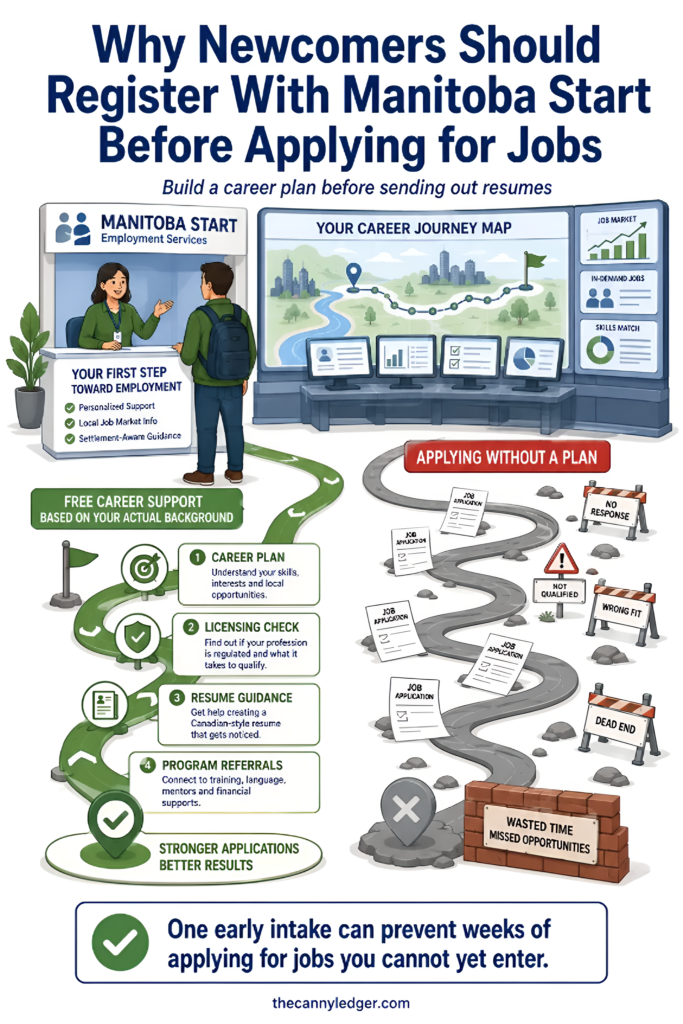
Register With Manitoba Start Before You Send Out a Single Resume
Manitoba Start functions as the front door for newcomer employment services in Winnipeg, and going through it first, rather than applying cold to job postings, changes how the whole search goes. A career coach there builds a plan around your actual background, flags whether your field needs licensing before you can legally practice, and refers you to the specific programs that match your situation instead of leaving you to discover them piecemeal. Registration is free and open to permanent residents, protected persons and refugees, and most temporary residents on valid work or study permits, not just people already holding citizenship or a green light to stay permanently.
Skipping this step is the single most common reason a job search stalls out. People spend weeks applying to postings that assume a Canadian work history or a licence they don’t yet have, when a fifteen-minute intake conversation would have redirected that energy somewhere it could actually land.
Find Out Whether Your Profession Is Regulated in Manitoba
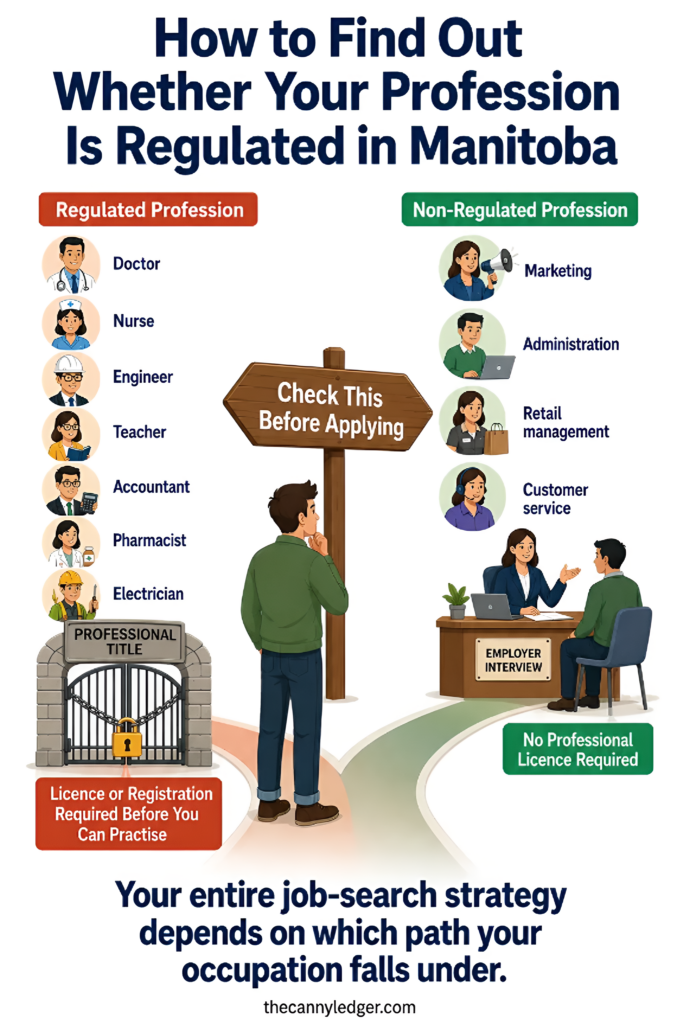
This is the fork in the road that determines almost everything else about your job search. Manitoba Start keeps a current overview of foreign credential recognition and Manitoba’s regulated professions worth checking before anything else. Manitoba has close to thirty self-regulated professions, doctors, nurses, engineers, teachers, accountants, pharmacists, and electricians among them, where you legally cannot practice under that job title until a professional regulatory body has assessed and approved your credentials. Working in one of these fields with foreign training isn’t a matter of convincing an employer you’re qualified, it’s a matter of clearing a formal registration process first, and that process runs entirely separate from any individual employer’s hiring decision.
Everything outside those regulated fields works differently. Marketing, retail management, most trades outside the compulsory ones, administrative and customer-facing roles, these don’t require a licensing body’s approval, which means the barrier is closer to what any Canadian-trained applicant faces: a resume that reads as credible to a local employer, references, and interview performance. Knowing which category you fall into before you start applying saves months of sending resumes into a process that was never going to move without a licence attached.
If You’re in a Regulated Field, Loop In the Fair Registration Practices Office
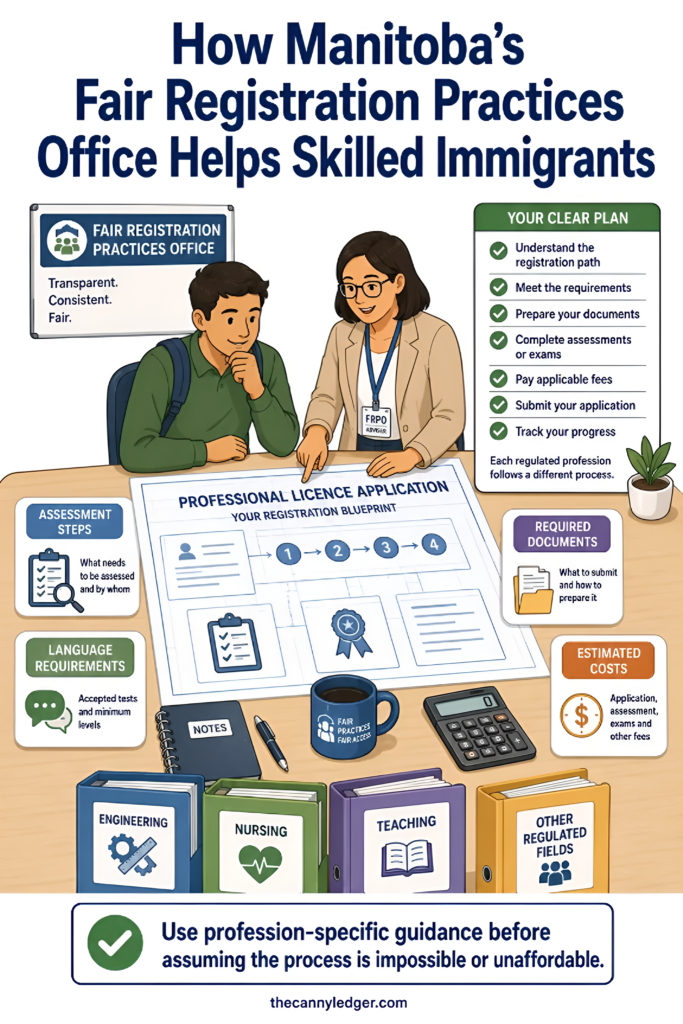
Manitoba’s Fair Registration Practices Office exists specifically to help internationally educated applicants understand what a specific regulator actually requires, since the process differs meaningfully between, say, becoming a licensed engineer and becoming a registered nurse. Their profession-specific fact sheets lay out the assessment steps, language requirements, and rough cost ranges for close to twenty different regulated occupations, which turns what feels like an opaque bureaucratic maze into something closer to a checklist.
It’s worth reading through this before you assume the worst about your own timeline. Some regulated professions move faster than people expect once the paperwork is actually filed correctly, and delays often come from missing documentation or a misunderstanding about which governing body handles what, not from the process itself being unreasonably slow.
Recognition Counts Can Cover What Credential Recognition Actually Costs
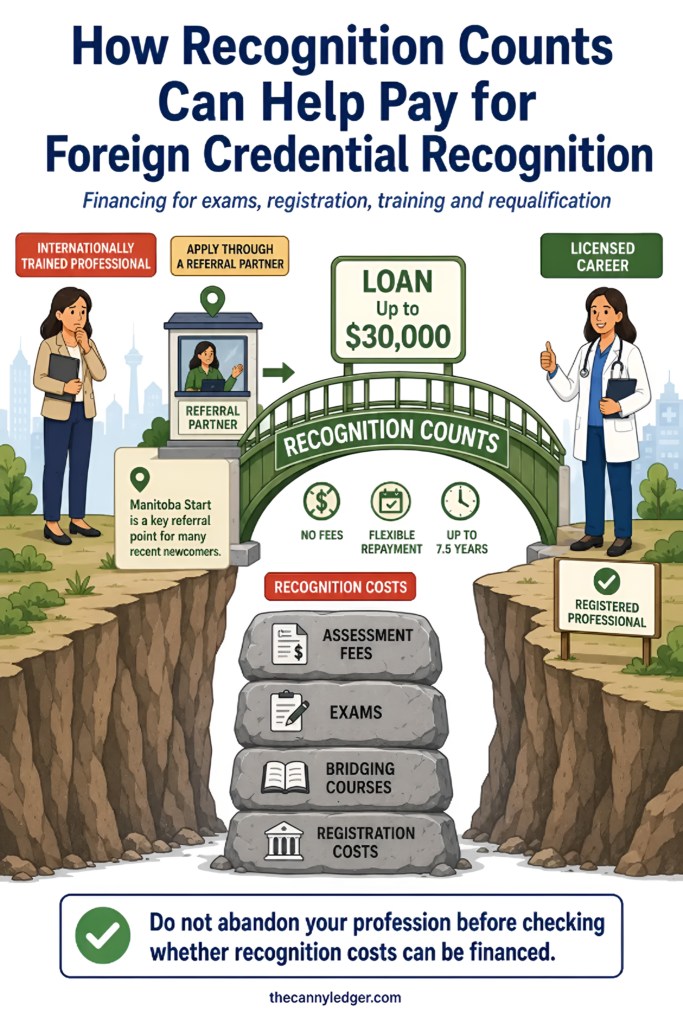
Assessment fees, exam costs, bridging courses, and professional registration can run into thousands of dollars, and that expense alone pushes a lot of skilled immigrants to abandon their field entirely rather than pursue it. SEED Winnipeg’s Recognition Counts program was built for exactly this gap. As of 2026, eligible applicants can access a loan of up to $30,000 through Assiniboine Credit Union, with no fees and flexible repayment stretched over as long as seven and a half years, covering not just registration and exam costs but living expenses, tuition, and even work equipment while you’re getting requalified. The federal government’s own foreign credential recognition overview is a useful companion read, since it explains how the provincial and federal pieces of this process fit together.
Eligibility runs through household income limits and requires permanent resident, protected person, citizen, or open work permit status, and you don’t apply directly, you go through a referral partner first. For most people in Winnipeg who’ve been in Canada less than three years, that referral partner is Manitoba Start itself, which is one more reason registering there early matters even if credential recognition feels like a problem for later. If you’ve already been in Canada more than three years, the Manitoba Jobs Skills and Development Centre and Success Skills Centre both serve as alternate referral points.
Not Every Path Has to Run Back Through Your Old Title
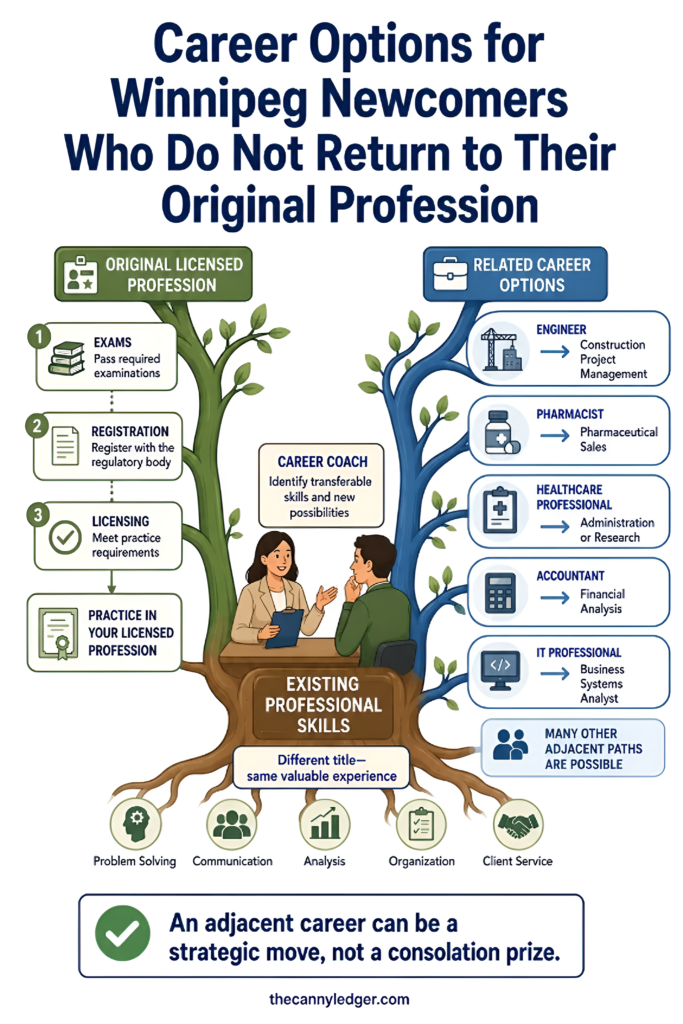
There’s a version of this that doesn’t involve fighting to get your exact previous job title back. A lot of internationally trained professionals find real, well-paid stability in an adjacent field that draws on the same underlying skill set without requiring the full licensing process, a structural engineer moving into construction project management, a foreign-trained pharmacist moving into pharmaceutical sales or regulatory affairs. This isn’t a consolation prize, and treating it as one tends to keep people stuck longer than necessary chasing a single narrow outcome. A good career coach will usually raise this option directly rather than waiting for you to ask about it, which is one more argument for going through Manitoba Start’s planning process instead of freelancing the search alone.
Where the Actual Job Postings Live
Once a plan is in place, the practical search happens across a small number of platforms rather than one obvious place. Job Bank, run by the federal government, aggregates postings from employers across Manitoba and lets you filter specifically for the province. Work in Manitoba is a separate, province-focused portal built to connect job seekers directly with Manitoba employers and will notify you when a new posting matches your profile. For anyone specifically interested in provincial government roles, Manitoba’s own job search site lists openings across departments from health and social services to engineering and IT, and it’s worth checking regardless of field since public sector hiring in Manitoba doesn’t always circulate through the same channels as private employer postings.
Networking matters more here than a lot of newcomers expect, particularly because a meaningful share of openings in Winnipeg’s smaller job market never get posted publicly at all. This is part of why career services connect people to industry mentors and networking events rather than just handing over a list of job boards.

Get the Basics Right Before You Start Applying
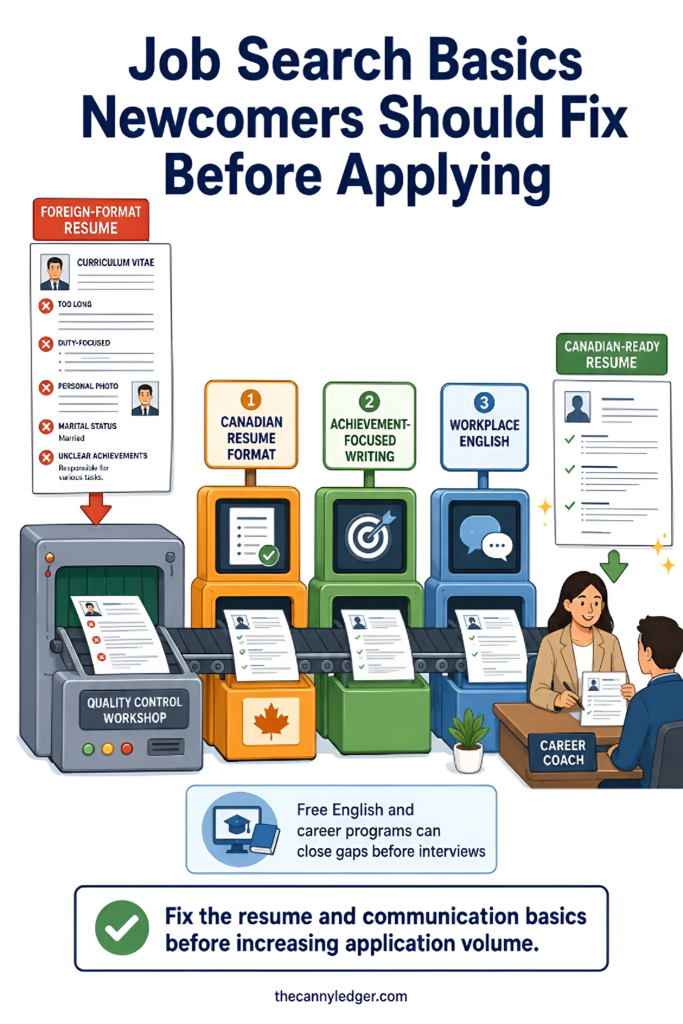
A Canadian-style resume looks and reads differently from resumes common in a lot of other countries, shorter, achievement-focused rather than duty-focused, and without a photo or personal details like marital status that would be standard elsewhere. Getting that format wrong before an employer even reads the content is an easy, avoidable way to lose a callback, and it’s exactly the kind of thing a career coach reviews in a single sitting.
If English isn’t your first language, or if workplace-specific vocabulary is still a gap, free English language programming exists across Winnipeg specifically to close that distance before it costs you an interview. Our guide to free English classes for immigrants in Winnipeg and the broader list of free courses for new immigrants in Winnipeg cover what’s actually available and how to get into a class quickly rather than waiting on a long list.
What a Survival Job Is Actually For
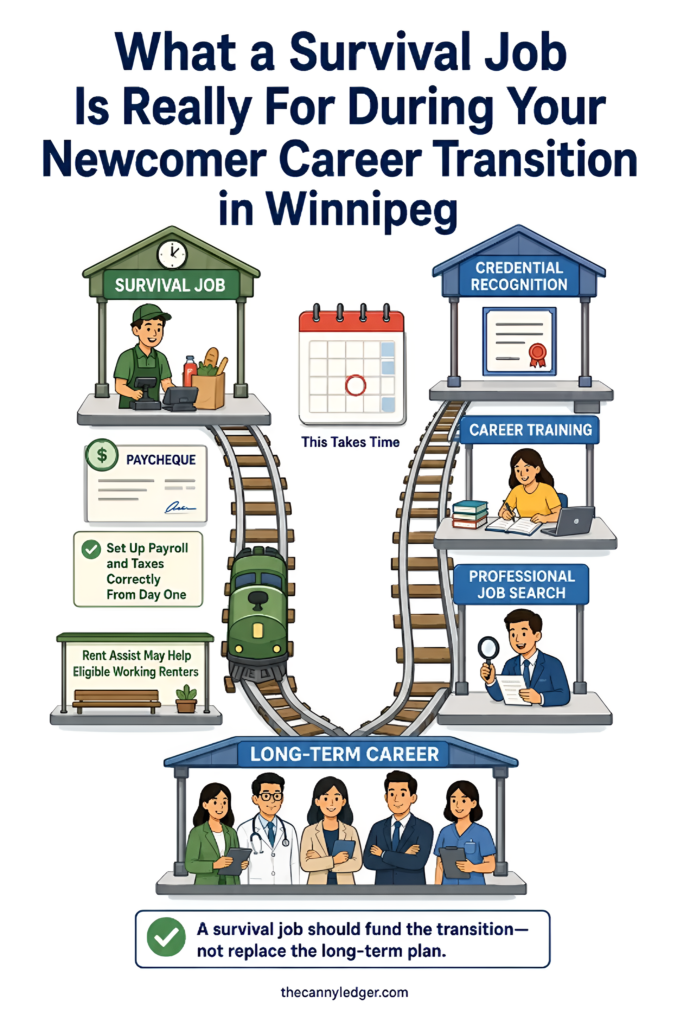
Taking a lower-skilled job while your credential recognition or job search plays out isn’t failure, and treating it as some kind of permanent downgrade tends to do more damage than the job itself. It’s income while the real process runs in the background, and for a lot of families, it’s also what keeps rent covered during a stretch where income is genuinely lower than it will be once things land. If your household income is tight during this period, it’s worth knowing Manitoba runs a rent assistance program open to working renters, not just people on social assistance, which we cover in how to qualify for Rent Assist in Manitoba.
It’s also worth getting your first Canadian paycheque and tax situation set up correctly from day one rather than treating it as an afterthought once things stabilize. Our Manitoba and Winnipeg personal income tax guide walks through what actually gets withheld and what a first return looks like for someone new to the system.
Common Questions
Do I need Canadian work experience before anyone will hire me? Not universally, but it’s a real bias in some sectors. Career coaches at settlement agencies specifically help address this gap through mentorship placements, volunteer opportunities in your field, and coaching on how to frame international experience so it reads as directly relevant rather than getting dismissed.
How long does credential recognition usually take? It depends entirely on the profession and how complete your documentation is going in, which is exactly why the Fair Registration Practices Office’s profession-specific fact sheets are worth reading before you estimate your own timeline based on someone else’s story.
Can I start the credential recognition process before I even have permanent resident status confirmed? Some assessment and bridging steps can begin earlier depending on your specific immigration status, so this is worth raising directly with a career coach or the relevant regulator rather than assuming you need to wait for a particular document to arrive first.
If you haven’t registered with Manitoba Start yet, that’s the first call to make, not the fifth. From there, confirm whether your field is regulated, and if it is, pull up the Fair Registration Practices Office’s fact sheet for your specific profession before you spend another week guessing at the process. Everything else, the loan through Recognition Counts, the job board search, the resume rework, moves faster once that first conversation has happened.
For a broader look at what else to prioritize in your first weeks in the city beyond employment specifically, our newcomer’s guide to Winnipeg covers the health card, banking, and housing side of things this article didn’t.

