

A few years back, asking a Winnipegger which credit union they belonged to would get you a shrug and a branch name pulled from muscle memory rather than research. That’s changed. Manitoba’s credit union sector has spent the last two years consolidating at a pace the province hasn’t seen before, and a name you may have banked with for a decade might not exist anymore in the form you remember it. Westoba is the clearest example. If you’re reading this because someone told you to “just go to Westoba,” you’ll want the next few paragraphs before you drive anywhere.
- Why Winnipeg leans so heavily on credit unions in the first place
- The wave of mergers you should know about before you pick one
- Assiniboine Credit Union / Caisse Assiniboine
- Cambrian Credit Union
- Access Credit Union
- Steinbach Credit Union
- Westoba: what happened to it, and what it means for former members
- The smaller names that don’t make the headlines
- How to actually choose between them
- A closing thought before you switch anything
This is the guide for people trying to actually decide where their money goes: newcomers who’ve just heard that credit unions are “a Manitoba thing” and don’t know why, long-time members wondering if their institution’s recent merger changed anything about their accounts, and anyone comparing local co-operatives against the big five banks before opening a new chequing account. We’ll go through Assiniboine, Cambrian, Access, Steinbach, and the now-folded-in Westoba, plus a note on the smaller players that don’t get mentioned as often but still matter to specific pockets of the city.
Why Winnipeg leans so heavily on credit unions in the first place
Manitoba has one of the strongest credit union sectors in Canada relative to its population, and Winnipeg sits at the centre of that. Part of it is historical: many of the city’s credit unions trace back to workplace savings groups formed in the 1930s and 40s, when a handful of employees pooled resources because commercial banks weren’t especially interested in serving them. Assiniboine Credit Union, for instance, began in 1943 when fifteen employees of the Winnipeg Electric Company decided to start their own financial co-operative, naming it after the street their office sat on. Steinbach Credit Union has an even more modest origin story: a five-cent scribbler used to track the first year’s transactions in 1941, when the credit union had all of 95 members.
The other part is structural. Every dollar deposited at a Manitoba credit union is backed by the Deposit Guarantee Corporation of Manitoba, a provincial body that guarantees deposits without a dollar limit, unlike the federal deposit insurance that covers banks up to a capped amount per account category. That single fact tends to surprise people who assume credit unions are the “riskier” option. In reality, Manitoba credit union depositors have never lost a cent of principal or contracted interest since the province’s first credit union opened in 1937, and that record is part of why the sector has such deep local loyalty. If you want more detail on how that guarantee compares with bank-side insurance and what it actually covers, our best banks in Winnipeg piece breaks down both systems side by side.

The wave of mergers you should know about before you pick one
If you’re trying to research Winnipeg credit unions online, you’ll run into old numbers and outdated branch counts almost immediately, because the last three years have brought a genuine restructuring of the local landscape.
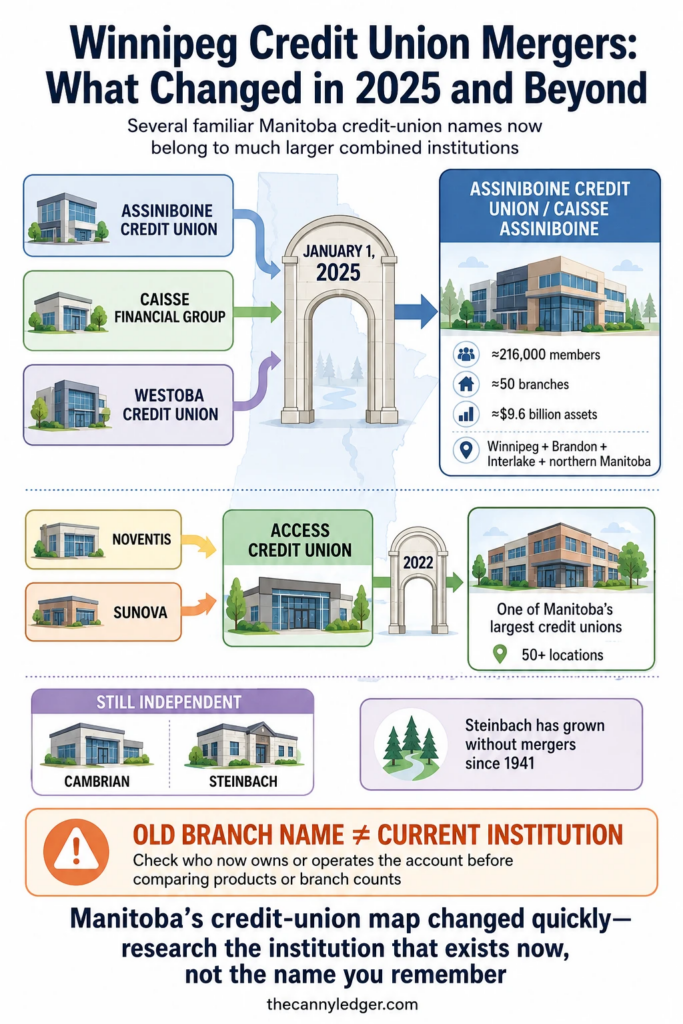
The biggest of these closed on January 1, 2025, when Assiniboine Credit Union, Caisse Financial Group (formerly Caisse populaire), and Westoba Credit Union amalgamated into a single entity now operating as Assiniboine Credit Union / Caisse Assiniboine. Members of all three institutions voted on the merger in June 2024, with roughly 89 percent of Assiniboine members, 84 percent of Caisse members, and 88 percent of Westoba members approving it. The combined organization now serves around 216,000 members across roughly 36 branches, with $10 billion or so in assets, giving it the widest geographic footprint of any credit union in the province, stretching from Winnipeg into Brandon, the Interlake, and northern communities like Thompson and Gillam.
If you were a Westoba member in Brandon or western Manitoba, your accounts, debit cards, loans, and mortgages carried over automatically. The practical upshot is that “Westoba” as an independent brand is functionally gone, even though the old branch buildings and some local signage may linger for a while during the integration period. Westoba’s naming-rights sponsorship of Brandon’s Keystone Centre, for example, has already been rebranded to Assiniboine Credit Union Place, which tells you how far along the transition already is.
This wasn’t Assiniboine’s first merger either. It absorbed Astra Credit Union and Vantis Credit Union back in 2007, so the pattern of smaller Manitoba credit unions folding into larger ones over time is well established, and it’s worth expecting more of it in the years ahead.
Access Credit Union has gone through its own version of this. It formed through a string of mergers among smaller southern Manitoba credit unions, and in 2022 it absorbed both Noventis Credit Union and Sunova Credit Union, a move that pushed its asset base well past $12 billion and made it one of the largest credit unions in the province by that measure. If you banked with Noventis in Winkler or Morden, or Sunova anywhere in its old footprint, you’re an Access member now whether or not anyone updated the sign on your branch.
Cambrian and Steinbach are the two holdouts that haven’t merged into anyone. Steinbach in particular is proud of that fact, describing its growth as entirely organic, member by member, since 1941, without ever merging with another institution. That’s a meaningful data point if you value dealing with a credit union whose culture hasn’t been diluted by integrating another institution’s systems, staff, and product lineup.
Assiniboine Credit Union / Caisse Assiniboine
Assiniboine is the credit union most likely to come up if you ask a Winnipegger about “ethical banking” or B Corp certification, and that reputation predates the recent merger. It’s the only Manitoba-based financial institution certified as a B Corp, and it was the first financial institution in the province to sign the Winnipeg Indigenous Accord, which commits the organization to specific actions supporting reconciliation.
Post-merger, ACU/Caisse Assiniboine offers the full range of personal banking products you’d expect from a large credit union: chequing and savings accounts, GICs, RRSPs, TFSAs, mortgages, personal loans and lines of credit, credit cards, and both direct investing and advisor-guided investment options. It also runs Outlook Financial as a virtual banking division for members who want higher-interest savings products without in-person branch banking, similar in concept to Achieva Financial under Cambrian. Because of the merger, Assiniboine also now offers French-language service across its network, something it inherited from Caisse, and it operates two community economic development branches in Winnipeg’s West Broadway and North End neighbourhoods, aimed specifically at serving members who’ve historically had trouble accessing mainstream financial services.
If you’re weighing a mortgage here against a bank, our bank vs. credit union mortgage rates in Winnipeg comparison and current mortgage rates in Winnipeg tracker are both useful companions to this section, since ACU’s posted rates move with the same broader market forces that move everyone else’s.

Cambrian Credit Union
Cambrian is Winnipeg and Selkirk’s own, founded in 1959, and it has stayed independent through decades while other institutions around it consolidated. It currently serves more than 66,000 members with roughly $4.6 billion in assets, making it noticeably smaller than Assiniboine or Access, but its footprint punches above its size in terms of member loyalty and product recognition, particularly because of its “Unfee” banking program, which waives up to $234 a year in account fees for members who set up a qualifying monthly direct deposit.
Cambrian’s other notable feature is Achieva Financial, its virtual banking arm launched in 1998, making it one of the earliest Canadian financial institutions to offer a branchless, online-only savings product. Achieva tends to post some of the more competitive GIC and high-interest savings rates in the province precisely because it doesn’t carry branch overhead, so it’s worth checking against Cambrian’s own in-branch rates and against Outlook Financial before committing to a term. Our GIC and savings interest rates in Winnipeg page tracks exactly this kind of comparison across the local virtual and branch-based options.
Cambrian also runs youth-focused employment and financial literacy programming for people aged 16 to 29, connecting young members to job-readiness resources that go beyond straightforward banking, something worth knowing if you’re a parent trying to get a teenager started with their first account.

Access Credit Union
Access is the credit union you’re most likely to encounter if you live or work anywhere outside the Winnipeg core, since its footprint stretches through the Interlake, southern Manitoba, and eastern Manitoba in addition to the city itself. It was founded in Winkler in 1940 and has absorbed a long list of smaller rural credit unions over the decades, with the Noventis and Sunova mergers in 2022 being the most recent and largest additions. That history shows up in its branch count, more than 50 locations across the province, and in its member base, which sits north of 169,000.
Because of its rural roots, Access carries a strong agricultural and small-business lending arm alongside standard personal banking, and its wealth division works through Aviso Wealth and Qtrade for investment and brokerage products. It also markets a “ding-free” ATM network, meaning members avoid surcharges at credit union and partner ATMs across the country, which matters if you travel for work or split time between the city and a rural property.
If you’re a small business owner sizing up Access against the competition for a commercial account or a line of credit, it’s worth reading alongside our small business insurance in Winnipeg guide, since bundling your operating accounts and your liability coverage through institutions that already work together can simplify renewal season considerably.

Steinbach Credit Union
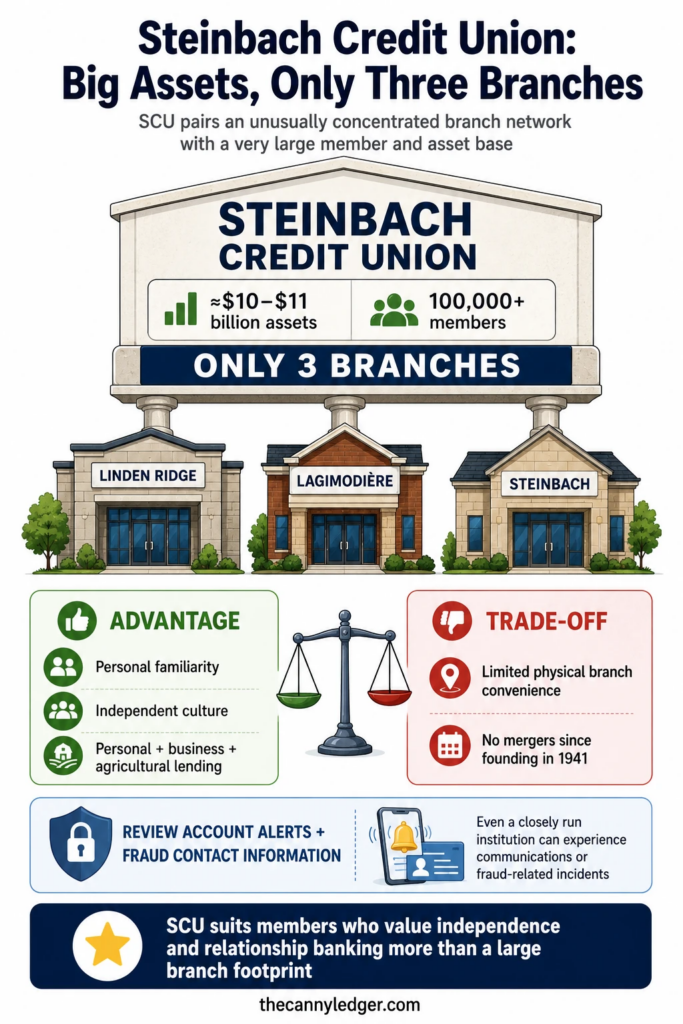
Steinbach Credit Union is the outlier on this list in the most literal sense: it operates only three branches, two in Winnipeg (Linden Ridge and Lagimodière) and one in Steinbach itself, yet it holds somewhere around $10 to $11 billion in assets and serves over 100,000 to 115,000 members depending on which recent figure you’re reading. That makes it the largest single-institution credit union by assets-per-branch in the country by a wide margin, a distinction it earned specifically by refusing to merge with anyone since its founding in 1941.
That concentration has an obvious trade-off. If convenience of a branch on every corner matters to you, three locations in a metro area the size of Winnipeg is thin. But members who bank there tend to describe a level of personal familiarity with staff that’s harder to maintain at institutions spread across dozens of branches, and SCU has leaned into that with a broad personal, business, and agricultural lending lineup, plus dedicated wealth management and a business lending centre on Pembina Highway.
Steinbach has also had a rockier year on the operational side. In November, an unauthorized third party managed to redirect calls placed to the credit union’s member contact centre for roughly a full day before staff noticed the silence and traced the problem, a reminder that even smaller, tightly run institutions aren’t immune to the fraud-adjacent risks that come with modern call centre infrastructure. If you bank with SCU, it’s a reasonable prompt to review your own account alerts and to know the number for reporting fraud by heart rather than searching for it after the fact.
Westoba: what happened to it, and what it means for former members
We’re covering Westoba here because so many people still search for it directly, not because it exists as a standalone option anymore. Westoba Credit Union was based in Brandon and had spent eight years as the naming-rights partner for the Keystone Centre before the merger folded it into Assiniboine. If you were a Westoba member, your deposits, loans, and mortgages transferred over under the same terms, and your coverage under the Deposit Guarantee Corporation of Manitoba was never at risk, since DGCM’s guarantee explicitly isn’t affected by a credit union changing its name or amalgamating with another one.
Practically, that means if you’re still banking under a Westoba card or statement, you’re an Assiniboine Credit Union / Caisse Assiniboine member now, with access to the combined branch network rather than the smaller western Manitoba footprint you started with. It’s worth logging into your online banking at least once to confirm your product names and fee structures haven’t quietly shifted during the transition, since post-merger institutions often consolidate account packages onto a single new lineup even when most features carry over unchanged.

The smaller names that don’t make the headlines
Beyond the five names in the headline, Winnipeg’s credit union map includes a handful of smaller or more specialized players worth a mention if you’re doing a genuinely thorough comparison. Entegra Credit Union still operates independently in the city with a smaller branch footprint focused on personal banking. Fusion Credit Union and Compass Credit Union serve members mostly outside the Winnipeg core but are visible enough in provincial credit union material that they’re worth knowing exist if you’re comparing rates across the whole sector rather than just the big city names. None of these carry the asset size of Assiniboine, Access, or Steinbach, but they’re all covered by the same DGCM guarantee, so size isn’t a safety consideration the way it might be when comparing smaller versus larger banks.

How to actually choose between them
Once you strip away branding, the real differences between these institutions come down to five practical questions.
Branch access matters if you still prefer doing business in person. Access and Assiniboine both offer the widest physical footprint across the city and province, while Steinbach’s three-branch model rewards members who live or work near one of those specific locations and care less about ubiquity.
Rate competitiveness shifts constantly and rarely favours one institution consistently across every product. Cambrian’s Achieva Financial and Assiniboine’s Outlook Financial both tend to post sharper GIC and savings rates than their parent brand’s in-branch offerings, because virtual divisions carry lower overhead. If a specific mortgage or GIC rate is your deciding factor, checking our best mortgage rates in Winnipeg roundup before locking anything in will save you from committing to whichever institution happens to have the best billboard that month.
Fee structures diverge more than people expect. Cambrian’s Unfee waives a real chunk of annual banking costs for members who route a direct deposit through their account, which is a meaningfully different value proposition than a flat monthly fee model. It’s worth running the numbers on your own deposit and transaction habits rather than assuming any one credit union is cheaper across the board.
Values-based banking is a genuine differentiator if it matters to you personally. Assiniboine’s B Corp certification, its Indigenous Accord commitment, and its community economic development branches represent a different institutional posture than a credit union that markets itself primarily on rate and convenience. That’s not a knock on the others, it’s simply a different priority, and whether it should influence your decision depends on how much weight you put on where your deposits get put to work.
Newcomer and settlement support is worth checking directly if you’ve recently arrived in Winnipeg, since credit unions vary in how built-out their new-to-Canada onboarding is, from simplified identification requirements to partnerships with settlement agencies. Our newcomers guide to Winnipeg touches on this from the settlement side, and it’s worth pairing with a direct call to whichever credit union you’re considering, since these programs change faster than most other product details.

A closing thought before you switch anything
None of these institutions are going to disappear your money or leave you exposed the way a headline about a “risky” small financial institution might suggest. The Deposit Guarantee Corporation of Manitoba’s unlimited guarantee has held for as long as Manitoba credit unions have existed, through every one of the mergers described above, and that protection follows your deposits regardless of what your credit union gets renamed to next. The bigger question isn’t safety, it’s fit: whether you want the scale and values-based positioning of the newly merged Assiniboine, the tight-knit branch model at Steinbach, the rural reach of Access, or the fee-forgiving structure at Cambrian. If you’re mid-mortgage-renewal or comparing lending terms across a couple of these at once, our mortgage renewal in Winnipeg and personal loans in Winnipeg guides are the natural next stop, and if the whole comparison is starting to feel like more than you want to manage solo, sitting down with one of the financial advisors in Winnipeg we’ve profiled elsewhere on the site can shortcut a lot of this research into a single conversation.