

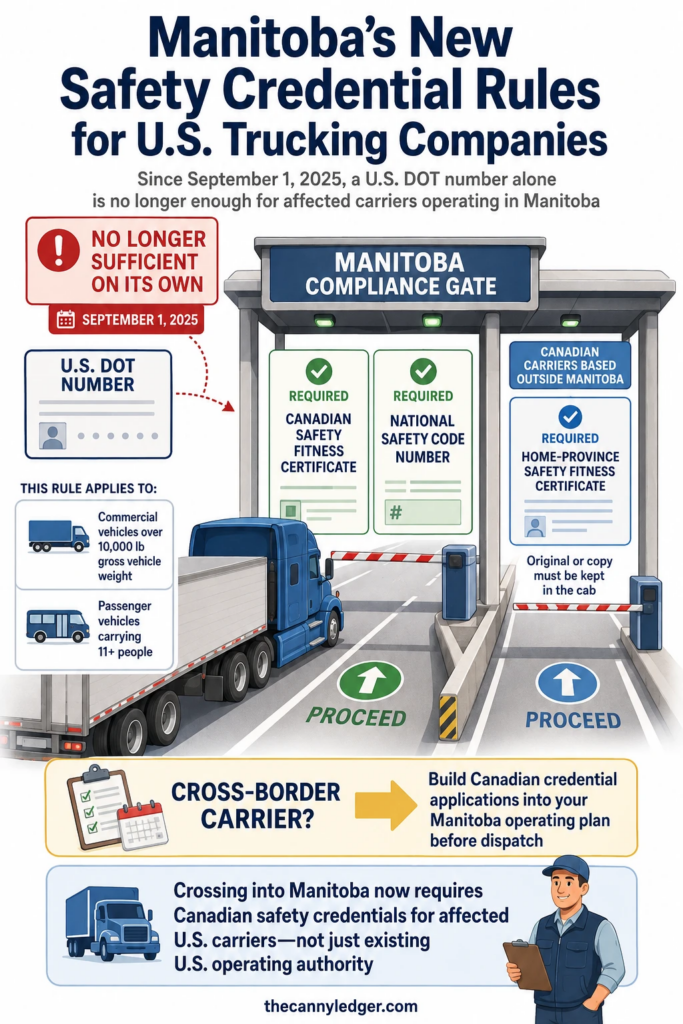
A US-based trucking company that’s operated in Manitoba for years under a valid US DOT number can no longer rely on that number alone. Effective September 1, 2025, Manitoba stopped treating US DOT numbers as equivalent to its own credentials, meaning any carrier over 10,000 pounds gross vehicle weight, or any passenger vehicle carrying 11 or more people, now needs a Canadian Safety Fitness Certificate and a National Safety Code number to legally operate in this province. This is a genuinely recent, significant shift, and it directly ties into insurance, since a Safety Fitness Certificate itself can’t be issued or renewed without proof of the right coverage already in place.
- Manitoba Stopped Recognizing US DOT Numbers in 2025
- Insurance Is the Gatekeeper for Your Safety Fitness Certificate
- What Minimum Coverage Actually Looks Like in Manitoba
- The National Safety Code Ties Everything Together
- Your Carrier Profile Follows You, and Insurance Feeds Into It
- New for 2026: Mandatory Accident Reporting
- Cargo Insurance Sits Outside the Liability Minimum
- WCB and General Liability Still Apply
- Building a Compliant Coverage Stack
- Common Questions
- Confirm Your Certificate and Coverage Status Directly With MTI
Trucking and transportation insurance in Winnipeg centres on Manitoba’s Safety Fitness Certificate system, which requires basic liability coverage before a carrier can legally operate, with additional minimums scaling up to $1 million or $2 million depending on cargo type and vehicle class. Beyond that regulatory floor, most carriers also need cargo insurance, general liability, and WCB coverage, none of which are automatically bundled into the base liability requirement that actually gates your right to operate at all.
Manitoba Stopped Recognizing US DOT Numbers in 2025
The policy shift that took effect September 1, 2025 applies specifically to non-Manitoba-based carriers, and it closes a gap that previously let US-registered operators cross into Manitoba without obtaining Canadian-specific safety credentials. Any Canadian-based carrier from outside Manitoba still needs a safety fitness certificate from its home province along with maintained liability insurance to operate here, and either the original or a photocopy of that certificate has to stay in the cab, ready to produce on request from enforcement. For US carriers specifically, this change means budgeting real time and paperwork for a Canadian Safety Fitness Certificate application before crossing into Manitoba becomes a routine part of doing business, rather than assuming an existing US DOT number carries the same legal weight it used to.
Insurance Is the Gatekeeper for Your Safety Fitness Certificate
Manitoba Transportation and Infrastructure states this plainly: every motor carrier and operator of a regulated vehicle needs basic insurance in place before they can obtain or renew a Safety Fitness Certificate at all, with some vehicle types requiring additional coverage up to $1 million or $2 million on top of that baseline. This structure means insurance isn’t simply a good business practice layered on top of your legal right to operate, it’s a direct precondition for that right existing in the first place. Letting coverage lapse doesn’t just leave you financially exposed if something goes wrong, it can put your entire Safety Fitness Certificate, and therefore your legal ability to run vehicles in Manitoba, at risk.

What Minimum Coverage Actually Looks Like in Manitoba
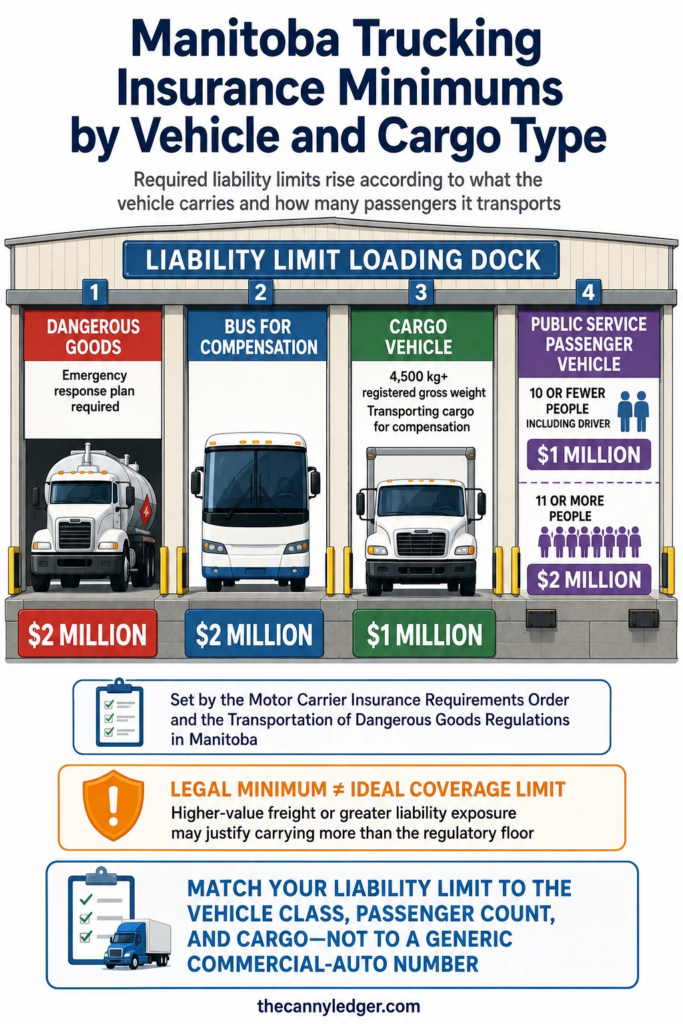
Manitoba’s Motor Carrier Insurance Requirements Order sets specific minimum liability amounts by vehicle and cargo type. Vehicles transporting dangerous goods requiring a filed emergency response plan under federal Transportation of Dangerous Goods Regulations need $2 million in coverage. Buses transporting passengers for compensation also carry a $2 million minimum. Other regulated vehicles used to transport cargo for compensation, with a registered gross weight of 4,500 kilograms or more, generally need $1 million in coverage. On the passenger side specifically, public service vehicles seating 10 or fewer people, including the driver, need a $1 million minimum, while vehicles seating 11 or more need $2 million. These figures represent legal minimums rather than recommended amounts, and a carrier hauling higher-value freight or facing greater liability exposure than the regulatory floor assumes often carries meaningfully more coverage than these baseline numbers require.
The National Safety Code Ties Everything Together
The National Safety Code, adopted by every Canadian jurisdiction, sets minimum performance standards covering safety ratings, carrier and driver profile systems, trip inspection reports, hours of service, vehicle maintenance and inspection requirements, and load security. Insurance sits inside this broader safety framework rather than existing as a separate, isolated requirement, since a carrier’s insurance status feeds directly into the safety fitness evaluation the NSC framework is built around. Understanding that your insurance coverage isn’t just a financial protection but an actual input into your ongoing safety rating changes how seriously a carrier should treat any lapse or gap in coverage.

Your Carrier Profile Follows You, and Insurance Feeds Into It
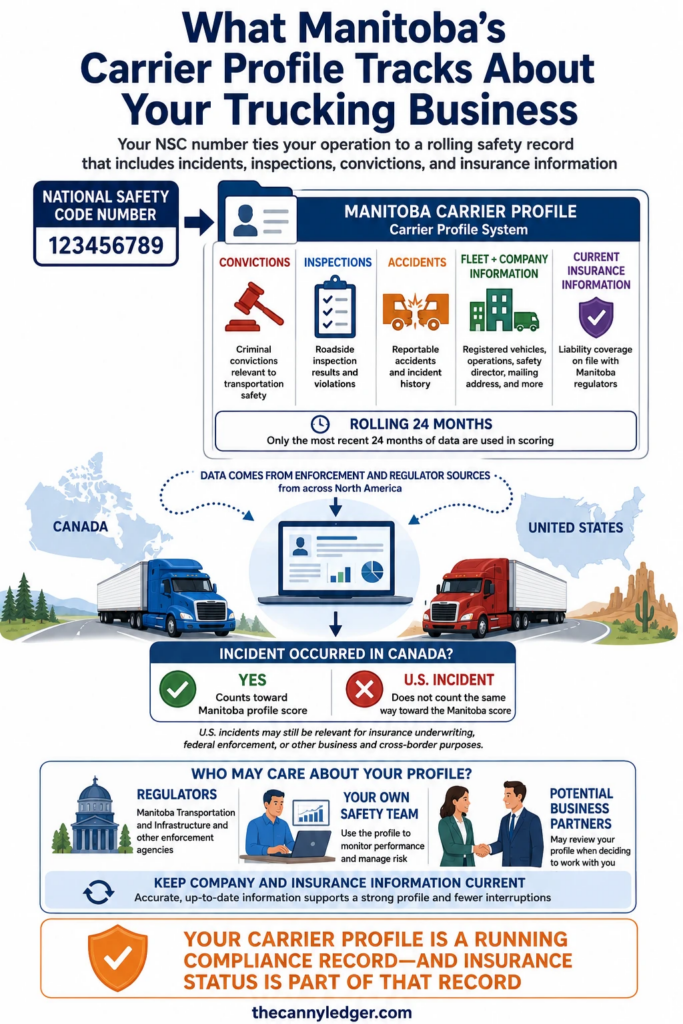
Every Manitoba carrier’s National Safety Code number ties to a Carrier Profile tracked through the province’s Carrier Profile System, recording convictions, inspections, and accidents connected to your regulated vehicles over a rolling 24-month period. Information gets collected from across North America, but only incidents occurring in Canada actually count toward your Manitoba carrier profile score, a genuinely useful distinction for any carrier operating across the border who might otherwise assume a US incident affects their Canadian standing the same way. Your profile’s general information section specifically includes your current insurance information alongside company details and fleet size, meaning insurance status is baked directly into the safety record regulators and potential business partners can pull up on your operation.
New for 2026: Mandatory Accident Reporting
Effective January 1, 2026, motor carriers are required to report accidents involving a regulated vehicle directly to Manitoba Transportation and Infrastructure, a change the province describes as part of its ongoing effort to enhance road safety and align with national standards. This is a new, current obligation layered on top of whatever your insurer’s own accident reporting requirements already are, meaning a carrier now genuinely has two separate reporting relationships to manage after an incident, one to the province directly and one to their insurance provider, rather than assuming insurer notification alone satisfies every regulatory requirement.

Cargo Insurance Sits Outside the Liability Minimum
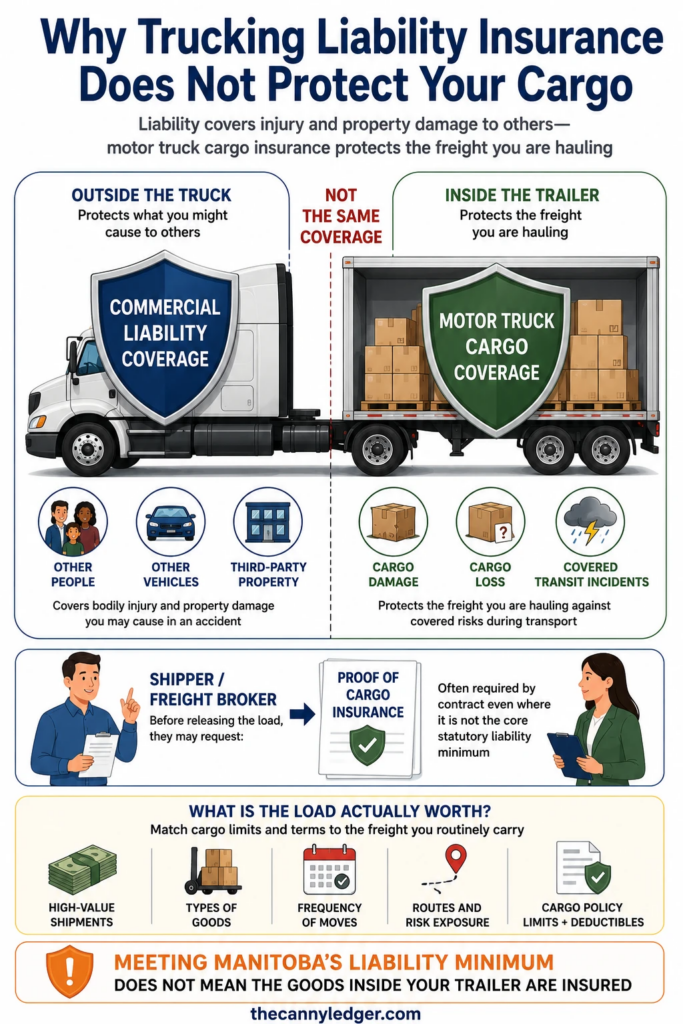
The liability minimums described above cover legal responsibility for bodily injury and property damage to others, not the value of the cargo you’re actually hauling. Cargo insurance, sometimes called motor truck cargo coverage, protects the freight itself against loss or damage during transport, and while it isn’t always a strict legal minimum the way liability coverage is, most shippers and freight brokers require proof of it before handing over a load regardless of what the regulatory floor technically demands. Treating cargo coverage as optional simply because it isn’t part of Manitoba’s core liability requirement misses that the practical business reality, most freight relationships, makes it functionally mandatory anyway.
WCB and General Liability Still Apply
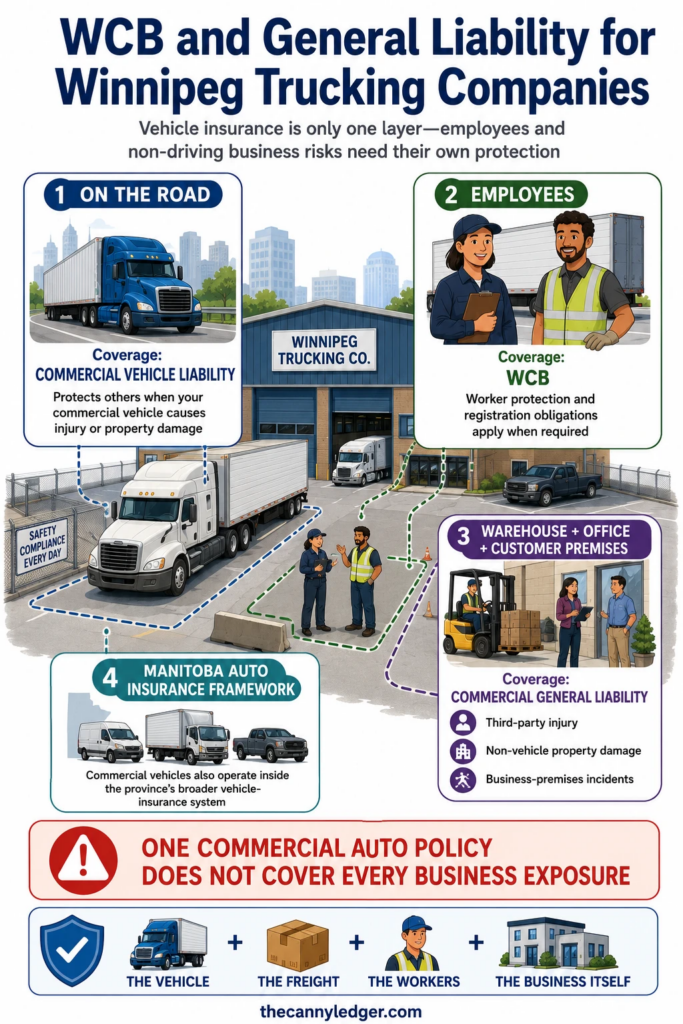
Beyond the vehicle-specific insurance requirements covered above, trucking and transportation businesses in Manitoba carry the same broader obligations any other employer does. Our guide to small business insurance in Winnipeg covers WCB registration, which is mandatory the moment a trucking company hires its first driver, alongside general liability coverage protecting against claims unrelated to the vehicle itself, a warehouse incident or an office-based dispute, for instance. Drivers and trucks operating on Manitoba roads also fall under the province’s broader auto insurance framework, and our guide to Manitoba’s public auto insurance system covers how that structure interacts with commercial vehicle coverage specifically.
Building a Compliant Coverage Stack
For a Manitoba-based or Manitoba-operating carrier, the practical sequence starts with confirming Safety Fitness Certificate status and the specific minimum liability coverage your vehicle class and cargo type require, since that’s the non-negotiable regulatory floor everything else builds on. From there, add cargo insurance to match what your actual shipping relationships require, confirm WCB registration is current, and layer in general liability for exposure beyond the vehicles themselves. Our directory of Winnipeg insurance companies and brokers and guide to choosing an insurance broker in Winnipeg both cover finding a broker who specifically understands the NSC and Safety Fitness Certificate framework this coverage sits within, rather than treating trucking insurance as a generic commercial auto purchase.

Common Questions
Does the September 2025 US DOT change affect Canadian carriers based outside Manitoba too? Yes, though slightly differently. Non-Manitoba Canadian-based carriers still need a safety fitness certificate from their home province and maintained liability insurance to operate here, while the specific shift eliminating US DOT number recognition applies specifically to US-based operators.
How often does my Safety Fitness Certificate need renewing? It varies, though Manitoba introduced automatic renewal in alternating years for eligible carriers starting October 1, 2025, a genuinely useful process simplification worth confirming applies to your specific operation directly with Manitoba Transportation and Infrastructure.
Do incidents that happen in the United States affect my Manitoba carrier profile? Only if they’re specifically flagged as relevant under the Carrier Profile System’s rules, since the system collects data from across North America but only applies Canadian incidents to the actual performance thresholds used to calculate your Manitoba profile score.
Confirm Your Certificate and Coverage Status Directly With MTI
Given how directly insurance ties into your legal right to operate under Manitoba’s Safety Fitness Certificate system, confirming your current status directly with Manitoba Transportation and Infrastructure, rather than assuming existing coverage from another province or an outdated US DOT number still applies, is the single most consequential step for any carrier operating in or through this province. A gap here doesn’t just create financial risk the way a missed coverage renewal might for a typical business, it can suspend your actual legal ability to keep vehicles moving.