

A buyer putting 20 percent down on Winnipeg’s current average-priced home, financing the rest at today’s typical five-year fixed rate over 25 years, lands on a monthly mortgage payment of approximately $1,694. That single number is the answer most searches for this topic are actually looking for, so it deserves to come first rather than buried under paragraphs of context. Everything else in this guide exists to explain exactly how that figure gets calculated and how much it shifts depending on your specific down payment, rate type, and the kind of property you’re actually buying.
- What Winnipeg Home Prices Actually Look Like Right Now
- The Actual Math Behind a Typical Winnipeg Mortgage Payment
- Fixed vs Variable Changes This Math Meaningfully
- Less Than 20% Down Changes the Math Again
- The Stress Test Qualifying Rate Isn’t What You’ll Actually Pay
- Detached vs Condo vs Townhouse Payments Compared
- Property Tax and Home Insurance Add to the Real Monthly Cost
- How Winnipeg Compares to the Rest of Canada
- Common Questions
- Run the Math on Your Own Specific Numbers
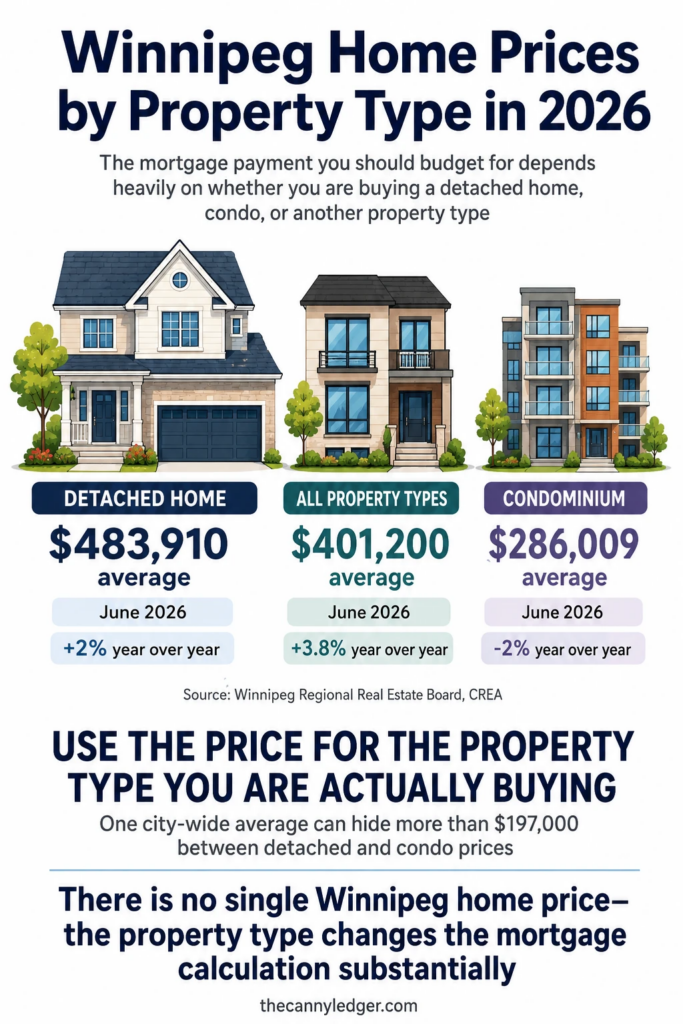
Winnipeg’s average resale home price across all property types sold for $401,200 in June 2026, up 3.8 percent year over year according to the Winnipeg Regional Real Estate Board, with detached homes specifically averaging $483,910 and condominiums averaging $286,009 over that same month. Financing the all-property average with 20 percent down at a current 5-year fixed rate near 4.0 percent produces a monthly payment around $1,694, while the same purchase at a 5-year variable rate near 3.5 percent runs closer to $1,607 a month.
What Winnipeg Home Prices Actually Look Like Right Now
Winnipeg’s housing market has posted genuinely strong numbers through 2026, with the Winnipeg Regional Real Estate Board reporting the average resale price across all property types at $401,200 for June, a new high for the month and a continuation of steady year-over-year growth. Detached homes specifically averaged $483,910 in June, up 2 percent year over year and a striking 8 percent above the five-year average for that same month, the highest June figure ever recorded in the market. Condominiums told a different story, with the average price easing slightly to $286,009, down 2 percent year over year even as the broader market kept climbing. These aren’t three competing numbers, they’re three genuinely different segments of the same market, and which one applies to your own calculation depends entirely on what type of property you’re actually buying.
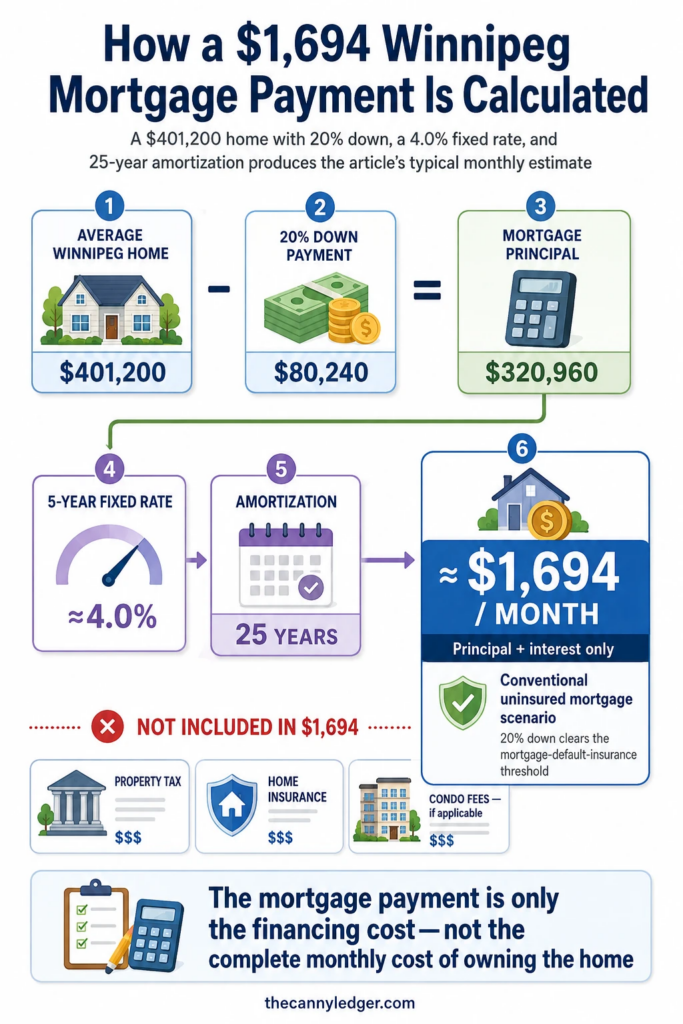
The Actual Math Behind a Typical Winnipeg Mortgage Payment
Using the $401,200 all-property average price, a 20 percent down payment of $80,240 leaves a mortgage principal of $320,960. At a 5-year fixed rate of 4.0 percent, amortized over 25 years, that produces a monthly payment of approximately $1,694, covering both principal and interest. This calculation assumes a conventional, uninsured mortgage available once you’ve cleared the 20 percent down payment threshold, and it doesn’t yet include property tax, home insurance, or condo fees where applicable, all of which layer on top of this base payment figure to determine your genuine total monthly housing cost.
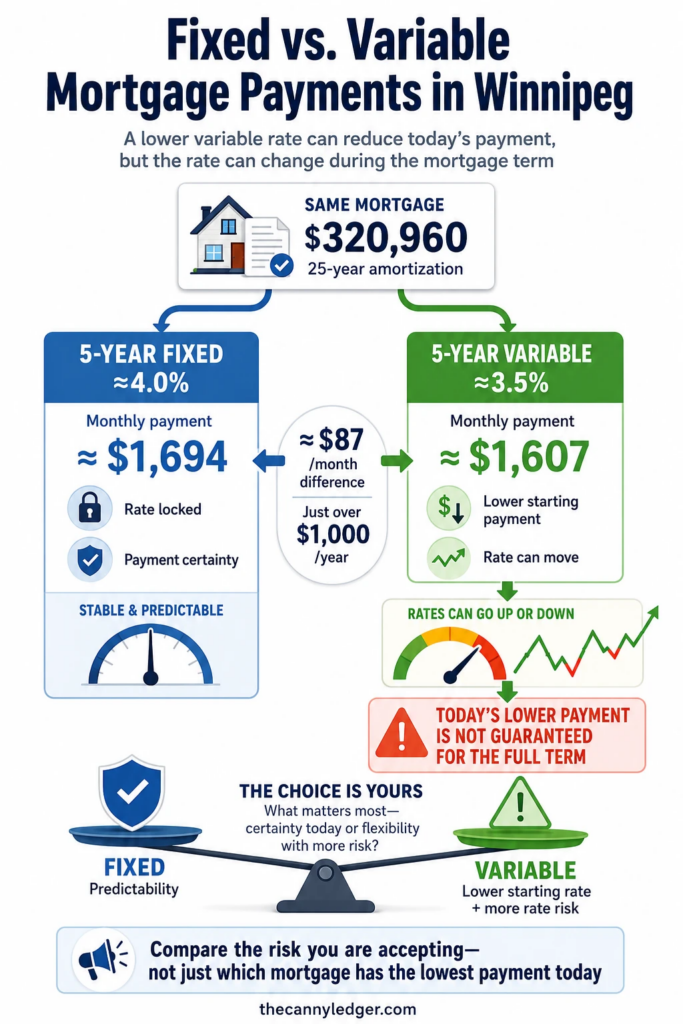
Fixed vs Variable Changes This Math Meaningfully
The same $320,960 mortgage financed instead at a current 5-year variable rate near 3.5 percent produces a monthly payment closer to $1,607, roughly $87 less per month than the fixed-rate scenario above. Over a full year, that gap adds up to just over $1,000 in payment difference, though a variable rate carries the genuine risk of moving upward over your term in a way a fixed rate locks in and protects against entirely. Our guide to fixed versus variable mortgage rates in Winnipeg covers this tradeoff in full, including the trigger rate risk specific to variable-rate mortgages that this payment comparison alone doesn’t capture.
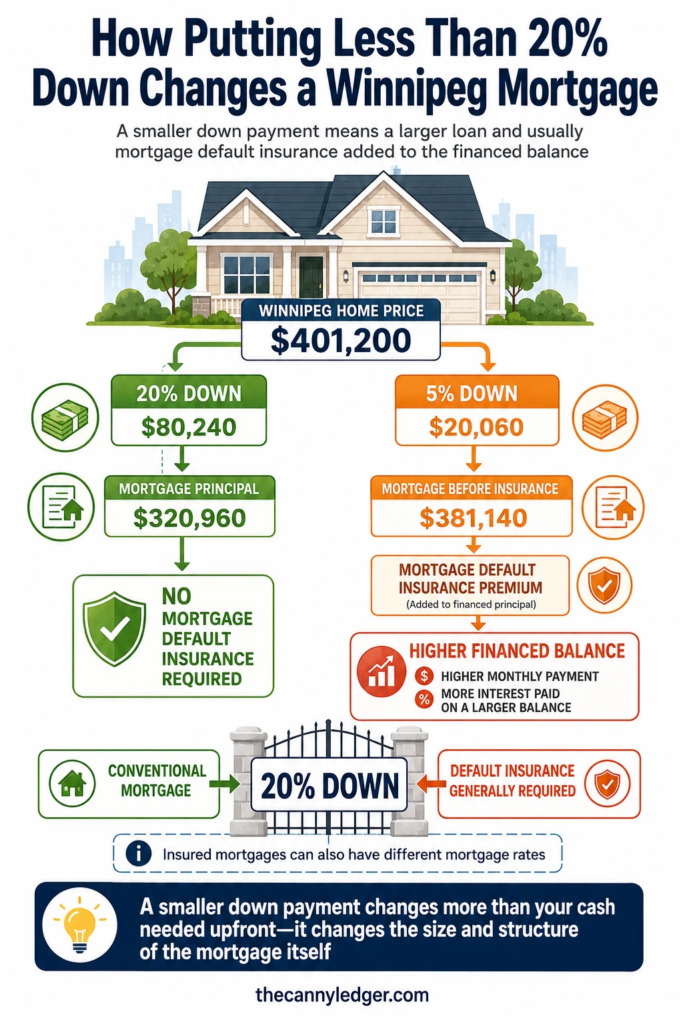
Less Than 20% Down Changes the Math Again
Buyers putting down less than 20 percent need mortgage default insurance, and that premium gets added directly to your mortgage principal rather than paid separately, meaning your actual monthly payment reflects a larger financed amount than the home’s purchase price alone would suggest. A buyer putting just 5 percent down on that same $401,200 home finances $381,140 before insurance premiums, and once the CMHC premium gets rolled into that principal, the resulting monthly payment lands noticeably higher than the 20-percent-down scenario, even before accounting for the fact that a smaller down payment also means paying interest on a larger overall balance for the life of the mortgage. Our guide to current mortgage rates in Winnipeg covers the specific rate differences between insured and conventional mortgages that factor into this calculation.
The Stress Test Qualifying Rate Isn’t What You’ll Actually Pay
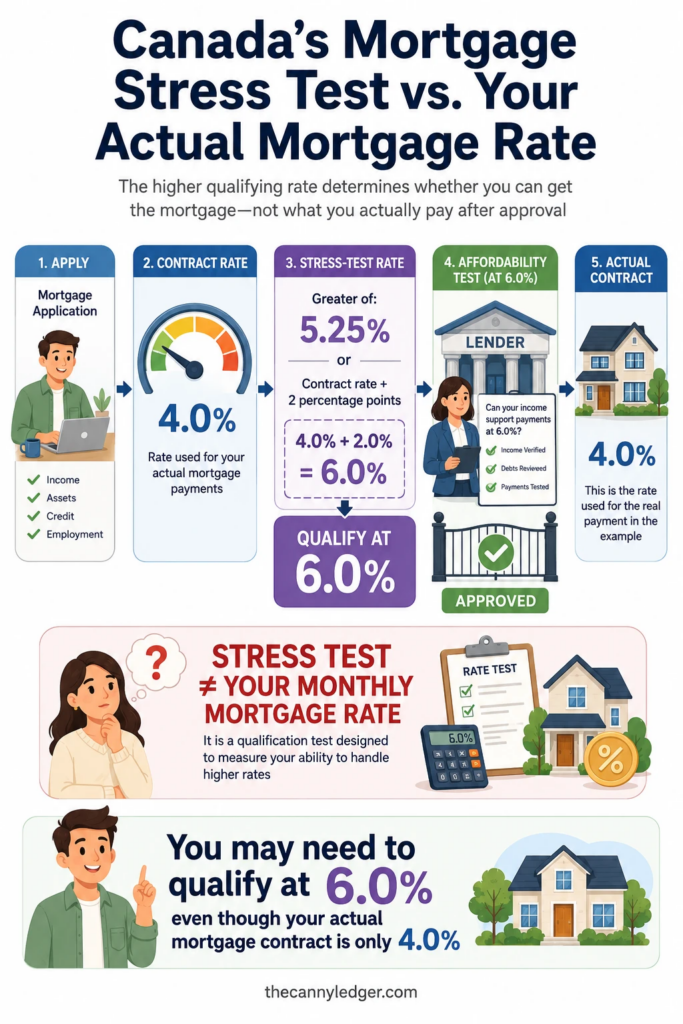
Every Canadian mortgage applicant, insured or not, needs to qualify at a stress-tested rate of either 5.25 percent or their actual contract rate plus 2 percentage points, whichever is higher, a rule that exists to confirm you could still afford your payments if rates climbed after you signed. For a 4.0 percent contract rate, that stress test qualifying rate works out to 6.0 percent, meaningfully higher than what you’ll actually pay monthly. This distinction matters because a lot of prospective buyers confuse the stress test rate with their actual payment obligation, when in reality the stress test only determines whether you qualify for the mortgage in the first place, not what shows up on your monthly statement once approved.
Detached vs Condo vs Townhouse Payments Compared
Applying the same 20-percent-down, 4.0-percent-fixed math to each property type produces genuinely different monthly payments. The June 2026 detached average of $483,910, with 20 percent down, finances a $387,128 mortgage producing a monthly payment around $2,042. A condominium at the June average of $286,009, with the same down payment structure, finances $228,807, producing a payment closer to $1,208 a month, before condo fees get added on top. The second-quarter 2026 median townhouse price of $317,500 lands in between, financing roughly $254,000 and producing a monthly payment around $1,341. These genuinely different numbers reflect why citing a single “average mortgage payment” figure without specifying property type only tells part of the story for any specific buyer.

Property Tax and Home Insurance Add to the Real Monthly Cost
The mortgage payment figures throughout this guide cover principal and interest only, and a genuine monthly housing budget needs to account for property tax and home insurance layered on top, both of which vary by the specific property and its assessed value. Our Winnipeg property tax calculator lets you estimate that specific cost based on a property’s actual assessed value, and our guide to understanding your Winnipeg property tax assessment covers how that assessed value gets determined in the first place, both genuinely necessary additions to the base mortgage figures calculated throughout this guide before you land on your true total monthly housing cost.

How Winnipeg Compares to the Rest of Canada
Winnipeg’s benchmark home price remains well below those of Canada’s other major cities, positioning the city among the more affordable major housing markets in the country even as local prices have climbed to new highs through 2026. This relative affordability translates directly into the mortgage payment comparisons above, since a Winnipeg buyer financing the city’s average home carries a meaningfully smaller monthly payment than an equivalent buyer would face in Toronto or Vancouver at those cities’ own average prices, even accounting for the fact that mortgage rates themselves don’t vary meaningfully by city within Canada’s national lending market.

Common Questions
Does a shorter amortization period lower my monthly payment? No, a shorter amortization period, 20 years instead of 25 for instance, actually raises your monthly payment since the same principal gets paid off over fewer months, though it reduces the total interest paid over the life of the mortgage.
Should I use the average price or the median price to estimate my own payment? The median often gives a more representative sense of a “typical” purchase since it isn’t skewed upward by a small number of very high-priced sales the way an average can be, so checking both figures for your specific property type gives a more complete picture than relying on either alone.
Does my mortgage payment change automatically when rates change during my term? Only with a variable rate mortgage that adjusts your actual payment amount, since a fixed-rate mortgage locks your payment for the full term regardless of what happens to rates elsewhere, and even many variable-rate mortgages hold your payment steady while the interest-to-principal split shifts instead.
Run the Math on Your Own Specific Numbers
These calculations use Winnipeg’s current market averages, but your own actual payment depends entirely on the specific property price, down payment, and rate you personally secure, so treating these figures as a starting benchmark rather than a precise prediction matters. Our guides to best mortgage rates in Winnipeg and bank versus credit union mortgage rates in Winnipeg both cover how to actually shop for the specific rate that would replace the benchmark figures used throughout this guide with your own real number.

