



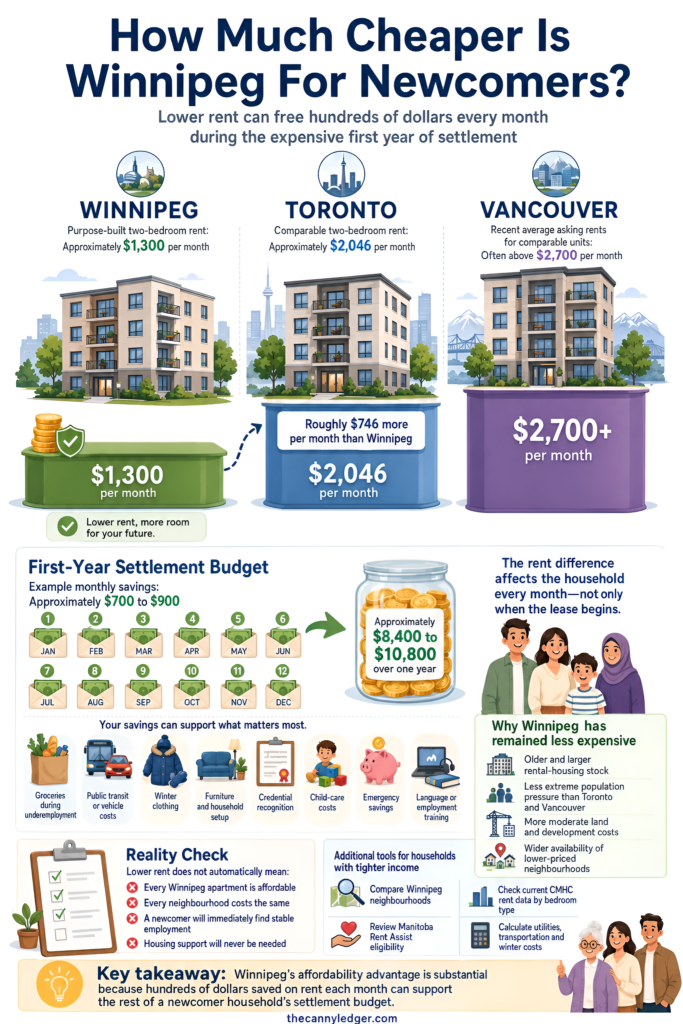
A two-bedroom apartment in Winnipeg rents for roughly $1,300 a month. The same size unit in Toronto runs closer to $2,046, based on the most recent CMHC Rental Market Survey data, a gap of more than 35 percent that shows up in a household’s budget every single month, not just once at move-in. That number alone explains a meaningful share of why Winnipeg keeps showing up on newcomer shortlists, but it’s not the whole story, and treating it as the only reason would miss what actually makes this city work, and what genuinely doesn’t, for someone weighing where to build a life in Canada.
- The Cost-of-Living Gap Is Real, Not Marketing
- The Manitoba Provincial Nominee Program Is a Genuine Structural Advantage
- Retention Numbers Tell a More Honest Story Than the Marketing Stat
- Winnipeg Is Already Diverse, Not Just Diversifying
- A Real Settlement Infrastructure Already Exists
- The Honest Tradeoff: Winters Are Real
- Who Winnipeg Actually Fits Best
- Common Questions
- Making the Decision With Real Numbers, Not a Brochure
People choose Winnipeg as an immigration destination primarily because of significantly lower housing costs compared to Toronto or Vancouver, the Manitoba Provincial Nominee Program’s structural advantages within Canada’s immigration system, and an already-established, diverse immigrant population that makes newcomers less of an anomaly than in many other mid-sized Canadian cities. Winter is real and worth planning for honestly rather than glossing over.
The Cost-of-Living Gap Is Real, Not Marketing
Every relocation guide claims affordability, so it’s worth being specific rather than taking the claim on faith. According to CMHC’s Rental Market Survey, purpose-built two-bedroom rents in Winnipeg run in the range of $1,300 a month, compared to roughly $2,046 in Toronto and considerably more in Vancouver, where average asking rents have sat well above $2,700 in recent reporting. That’s not a temporary dip either, Winnipeg’s rental market has stayed structurally cheaper than Canada’s largest cities for years, a function of an older, larger rental housing stock and a metro area that never saw the same population surge pressure that drove Toronto and Vancouver rents into a different tier entirely. CMHC’s own housing market data tool lets you track Winnipeg’s average rent by bedroom type directly if you want the current figures rather than a summarized comparison.
The practical effect compounds over a first year. A newcomer household saving roughly $700 to $900 a month on rent alone, relative to what the identical unit would cost in Toronto, has real breathing room to cover a car, groceries during a period of underemployment, or simply build savings while still adjusting to a new country, none of which is a small thing during a settlement period already full of unpredictable costs. Our breakdown of the cheapest neighborhoods in Winnipeg to rent goes further into where that affordability concentrates within the city itself, and for households whose income still runs tight even at Winnipeg prices, our guide to how to qualify for Rent Assist in Manitoba covers a program that can close that gap further.
The Manitoba Provincial Nominee Program Is a Genuine Structural Advantage
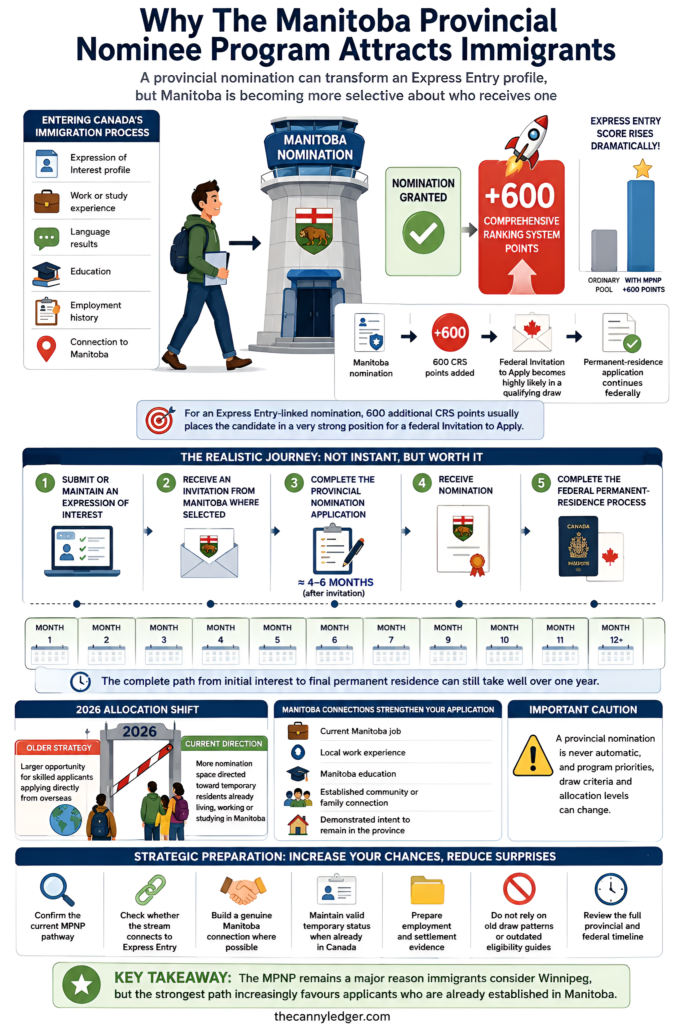
Beyond cost of living, Manitoba runs one of Canada’s more active Provincial Nominee Programs, and understanding what that actually means matters more than treating “PNP” as a buzzword. A nomination through the Manitoba Provincial Nominee Program adds 600 points to a candidate’s Comprehensive Ranking System score under Express Entry, which in practical terms all but guarantees an Invitation to Apply for permanent residence on the next federal draw, since 600 points puts a candidate’s score above nearly every other applicant in the pool. Provincial-level nomination processing has generally run in the range of four to six months once invited, considerably faster than many other steps in the broader immigration timeline, though the full path from initial Expression of Interest through final federal permanent residence confirmation still typically spans well over a year once every stage is added together.
It’s worth being straightforward about a real shift happening in this program right now rather than presenting it as static. Federal reductions to overall immigration targets have forced Manitoba to become more selective with its nominee allocations, and the province has been shifting more of its nomination spots toward temporary residents already living and working in Manitoba rather than skilled workers applying from overseas, a change the provincial immigration minister described directly in early 2026. This doesn’t eliminate the program’s advantage, but it does mean the easiest path into Manitoba’s PNP increasingly runs through already being here on a work or study permit first, rather than applying cold from another country, which is a meaningfully different strategic picture than it was a few years ago.
Retention Numbers Tell a More Honest Story Than the Marketing Stat
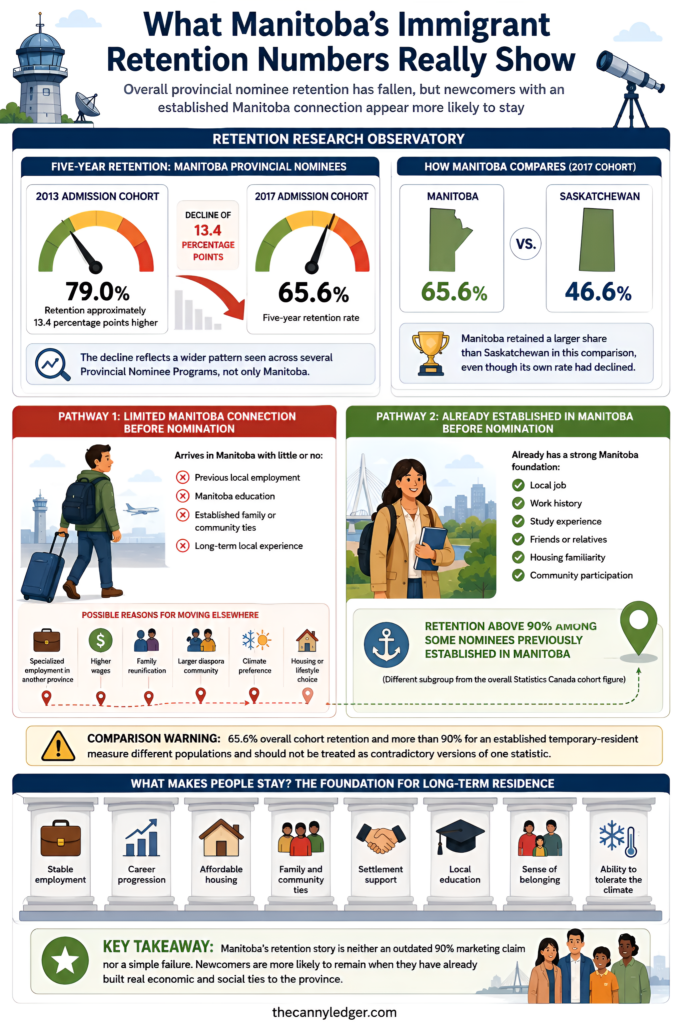
A frequently repeated claim about Manitoba’s program cites retention rates in the high 80s or even 90 percent, and that figure isn’t fabricated, it’s just increasingly outdated. Statistics Canada’s most recent published analysis found that the five-year retention rate for provincial nominees admitted to Manitoba in 2017 was 65.6 percent, a decline of 13.4 percentage points from the 2013 admission cohort. That’s a real number worth sitting with rather than replacing with an older, more flattering one, and it reflects a national pattern, not something unique to Manitoba specifically, since provincial nominee retention rates dropped across most provinces over the same period.
Context matters here too, though, and it cuts back the other way somewhat. Manitoba’s 65.6 percent figure still outperformed Saskatchewan’s 46.6 percent for the same cohort, and the province’s immigration minister has more recently pointed to retention rates exceeding 90 percent specifically among nominees who were already established as temporary residents in Manitoba before receiving their nomination, a genuinely different and more favourable number than the overall cohort figure. The honest takeaway is that Manitoba retains newcomers better than some provinces and worse than the marketing once implied, and retention specifically correlates with how connected someone already is to the province before their nomination lands, not with the province as an abstract concept.
Winnipeg Is Already Diverse, Not Just Diversifying
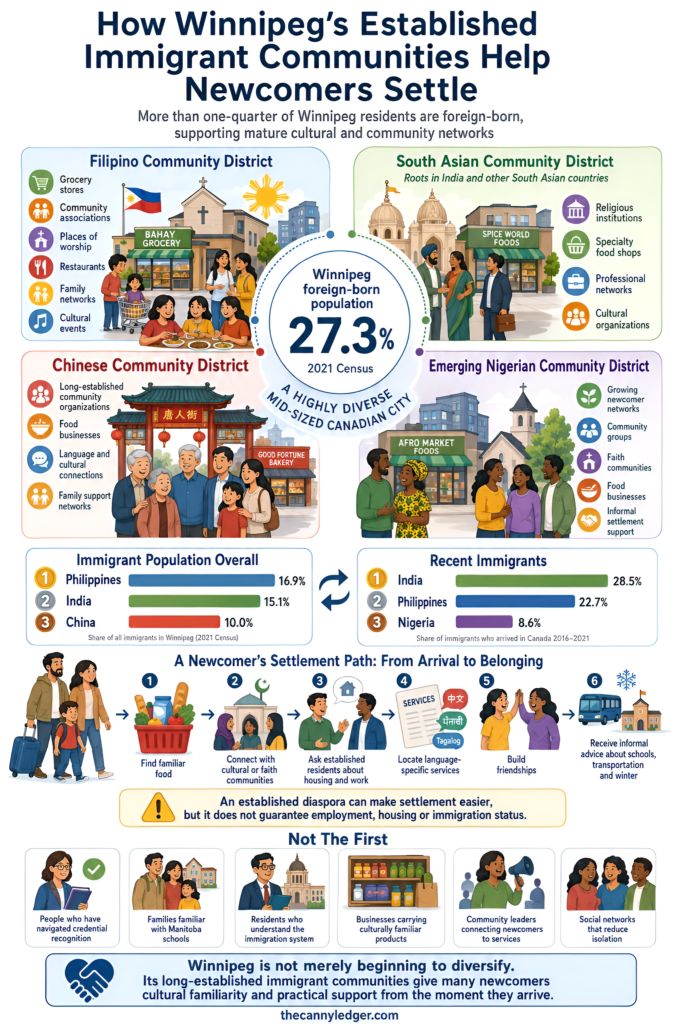
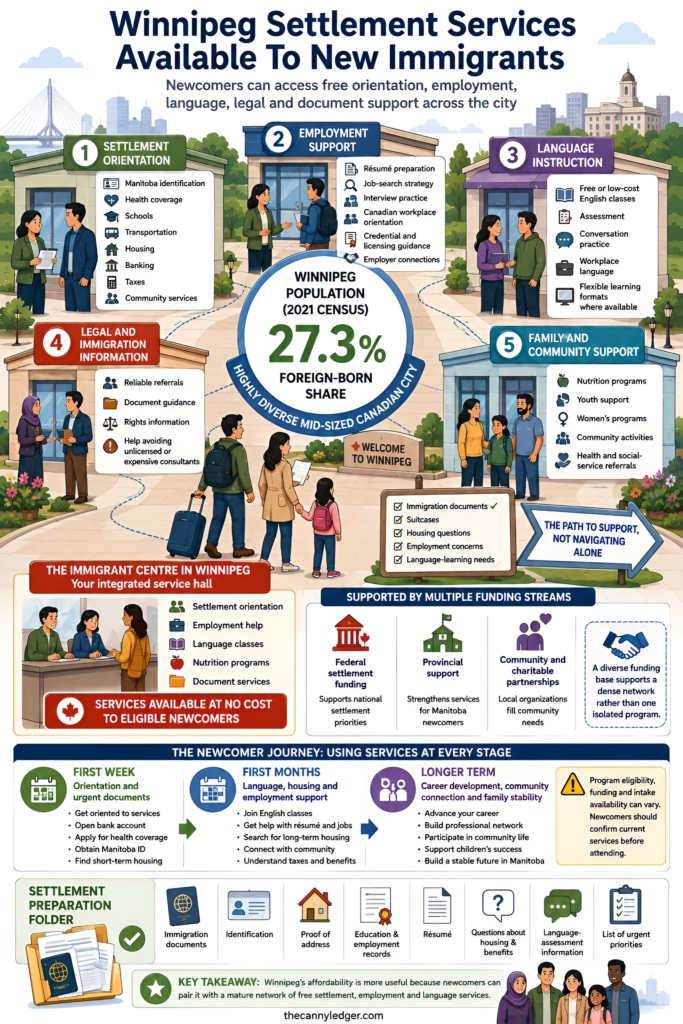
According to the 2021 Census, the most recent full census available, 27.3 percent of Winnipeg’s population was foreign-born, putting the city above the national immigrant share and firmly among Canada’s more diverse mid-sized urban centres. The top countries of origin among Winnipeg’s immigrant population overall were the Philippines, India, and China, while among more recent immigrants specifically, the order shifted to India, the Philippines, and Nigeria, reflecting how source countries for Canadian immigration broadly have shifted over the past decade. What this means practically is that a newcomer arriving in Winnipeg today isn’t the first person from their community to have made this move. Established Filipino, South Asian, Chinese, and increasingly Nigerian communities already exist across the city, with the cultural infrastructure, places of worship, grocery stores, and informal support networks that come with an established diaspora rather than a brand-new one.
That established diversity also shows up directly in the settlement infrastructure this city has built specifically to support it. Our directory of new immigrant services in Winnipeg and newcomer’s guide to Winnipeg cover the actual scale of that support system, from settlement orientation through employment help, and it’s a scale that reflects decades of sustained immigration to this specific city rather than a recent, untested surge.
A Real Settlement Infrastructure Already Exists
Cheap rent and a fast-moving PNP mean less if a newcomer lands and has to figure everything out alone, and this is where Winnipeg’s case gets genuinely stronger rather than weaker under scrutiny. The city supports a dense network of settlement agencies, employment programs, free language instruction, and legal aid built specifically around newcomer needs, much of it free and much of it funded jointly through federal and provincial settlement dollars rather than depending entirely on one funding source that could disappear. Our coverage of jobs for new immigrants in Winnipeg and free and low-cost immigration help in Winnipeg both reflect just how much of this infrastructure exists specifically because Manitoba has spent years actively recruiting and retaining immigrants as a deliberate economic strategy, not as an afterthought bolted onto a larger city’s existing services.
The Immigrant Centre in Winnipeg alone runs settlement orientation, employment help, language classes, nutrition programs, and document services under one roof, entirely free, which is the kind of concentrated, no-cost support that’s genuinely harder to find in a city where newcomer services are more fragmented across dozens of competing organizations with narrower individual mandates.
The Honest Tradeoff: Winters Are Real
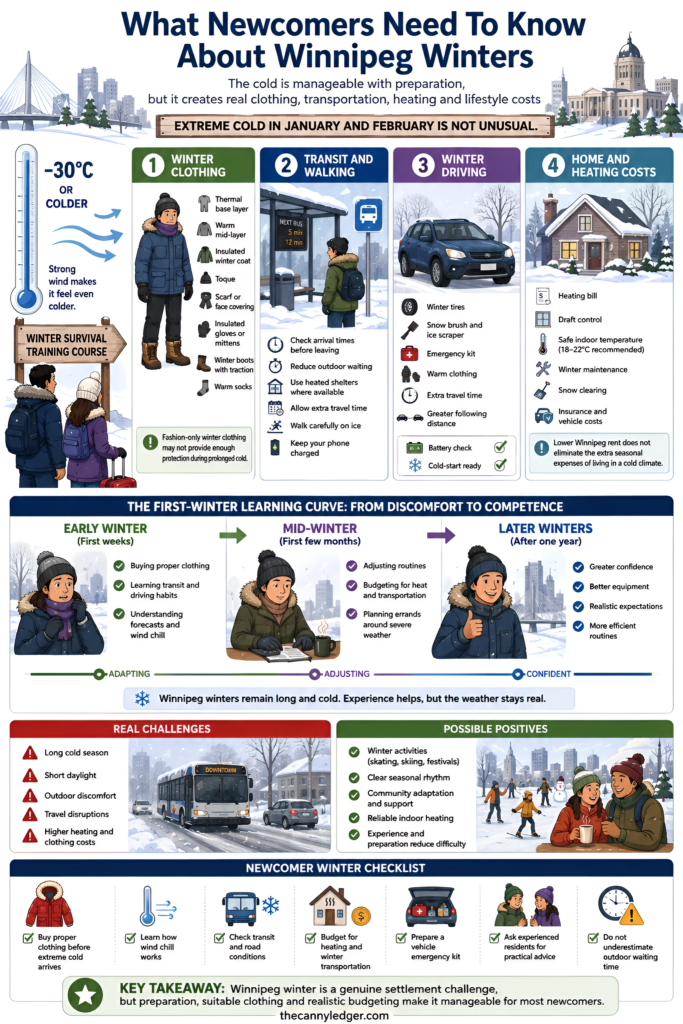
None of the above changes one plain fact worth stating directly rather than softening: Winnipeg winters are long, genuinely cold, and not something a newcomer from a warmer climate should treat as a minor adjustment. Stretches of minus thirty or colder aren’t unusual in January and February, and the practical adjustments, proper winter clothing, driving or transit habits, even how you budget for heating, are real costs and real learning curves that cheap rent doesn’t offset in the moment you’re standing outside waiting for a bus in a wind chill you’ve genuinely never experienced before. This isn’t a reason to avoid Winnipeg, most people who settle here adjust and plenty come to prefer the seasonal rhythm over a milder climate elsewhere, but presenting the winters as some kind of charming footnote rather than a genuine adjustment period would be exactly the kind of oversell this article is trying to avoid everywhere else.
Who Winnipeg Actually Fits Best
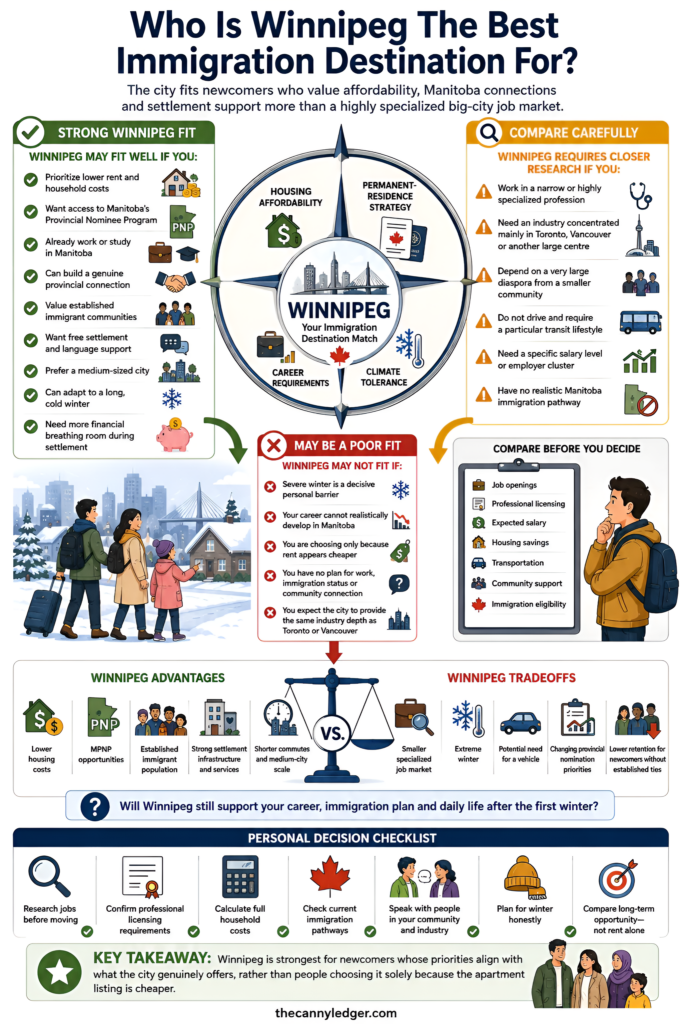
Put plainly, Winnipeg tends to make the most sense for people prioritizing affordability and a faster, more accessible path to permanent residence over the specific job market depth or established diaspora scale that Toronto or Vancouver offer in certain sectors. It fits particularly well for people who already have, or can build, some connection to Manitoba before applying, given how the Provincial Nominee Program has shifted toward rewarding exactly that kind of established presence. It fits less well for someone whose career depends entirely on a narrow, hyper-specialized industry concentrated almost exclusively in a larger city, or someone for whom climate genuinely outweighs every financial or procedural advantage on this list. Knowing which of those descriptions actually fits your situation, rather than choosing a city off cost of living alone, is the difference between a decision that holds up after the first winter and one that doesn’t.
Common Questions
Is Manitoba’s Provincial Nominee Program still worth pursuing given the recent policy tightening? Yes, particularly for people already in Manitoba on a work or study permit, since that’s exactly the group the province has been prioritizing more heavily. It’s simply less of a guaranteed path for applicants overseas with no existing Manitoba connection than it was a few years ago.
Does Winnipeg’s affordability come with a tradeoff in job opportunities? It depends heavily on your specific field. Manitoba’s economy leans on manufacturing, agriculture, healthcare, and logistics rather than the finance or tech concentration you’d find in Toronto or Vancouver, so the fit depends on whether your occupation lines up with what the local labour market actually needs.
How does Winnipeg compare to other Prairie cities like Regina or Saskatoon for newcomers? Winnipeg is significantly larger, with a correspondingly larger and more established immigrant population and settlement infrastructure, though rents in some other Prairie cities can run even lower. The tradeoff is generally city size and service depth versus marginal additional savings.
Making the Decision With Real Numbers, Not a Brochure
Winnipeg’s actual case rests on real, verifiable numbers, a genuine rent gap, a structural immigration advantage that’s shifted but not disappeared, and an already-established diverse population, not on vague appeals to friendliness or unquantified “quality of life.” Weighing those numbers honestly against your own career field, your tolerance for a real prairie winter, and whether you already have any connection to Manitoba gives a far more useful answer than any single ranked list of best Canadian cities for immigrants ever could.