

An adult child finds out their parent died with $40,000 in credit card debt and assumes that bill is now theirs. It isn’t, and this fear sits near the top of estate-related anxiety for a lot of Canadian families who’ve never had to deal with it before. Canadian law doesn’t transfer a parent’s, spouse’s, or anyone else’s personal debt onto you simply because you’re related to them. But that reassurance comes with real exceptions, and one of them has actually put a completely uninvolved sibling on the hook for tens of thousands of dollars in tax owed by a deceased relative, through a mechanism most Canadians have never heard of.
- The Estate Pays, Not the Family
- What Happens When the Money Runs Out
- The Two Ways Debt Actually Does Follow Someone
- The RRSP Exception Almost Nobody Knows About
- What This Means If You’re the Executor
- Quebec Runs This Differently in Name, Not in Substance
- Planning Around This Before You Need To
- Questions Worth Sorting Out Before You Need This
When someone dies in Canada, their debts become the responsibility of their estate, not their surviving family members. The executor pays what’s owed using estate assets before distributing anything to beneficiaries, and if the estate runs out of money, creditors generally absorb the loss rather than pursuing relatives directly. The real exceptions involve joint debt, co-signed loans, and a specific tax liability tied to RRSP and RRIF beneficiaries, none of which depend on simply being someone’s child, spouse, or sibling.
The Estate Pays, Not the Family
This is the governing principle, and it holds regardless of how much debt someone dies owing or how little the family knew about it beforehand. When a person dies, everything they owned and everything they owed becomes part of their estate, a legal entity separate from any individual family member, administered by an executor named in the will, or an appointed administrator if there wasn’t one. That executor’s job includes locating every debt, notifying creditors, and paying what’s owed out of estate assets before any inheritance gets distributed to beneficiaries.
Payment follows a rough priority order rather than a first-come-first-served approach. Secured debts tied to a specific asset, a mortgage or a car loan, generally get addressed first, followed by amounts owed to the Canada Revenue Agency, with unsecured debts like credit cards and personal loans settled from whatever remains. Licensed Insolvency Trustee firm Hoyes Michalos’ own guidance on this process confirms the proper channel runs through the estate specifically, and that a lender contacting a surviving spouse or relative directly for payment isn’t following the legally correct procedure. A will can direct how assets get distributed among beneficiaries, but it has no power to shift responsibility for a debt onto a person who never agreed to it in the first place.

What Happens When the Money Runs Out
An estate that can’t cover everything it owes is considered insolvent, and this is where the core reassurance actually gets tested. The executor still works through the same priority order, paying whatever can be paid with the assets that exist, and once those assets are exhausted, the remaining unpaid debt simply gets written off by the creditor. Beneficiaries named in the will don’t inherit that shortfall, and they don’t become personally responsible for covering it out of their own pocket, they just receive less than the will originally intended, potentially nothing at all if the estate’s liabilities outweighed its assets entirely.
That’s a meaningfully different outcome than many people assume going in, particularly anyone picturing an American-style scenario where family members can end up fielding collection calls over a parent’s unpaid medical bills. Someone worried about leaving an insolvent estate behind might look into debt management plans and settlement options or the broader question of how to get out of debt while they’re still able to address it directly, rather than leaving an executor to sort it out after the fact. In Canada, the debt actually dies with the estate’s ability to pay it, not with the family’s ability to pay it.

The Two Ways Debt Actually Does Follow Someone
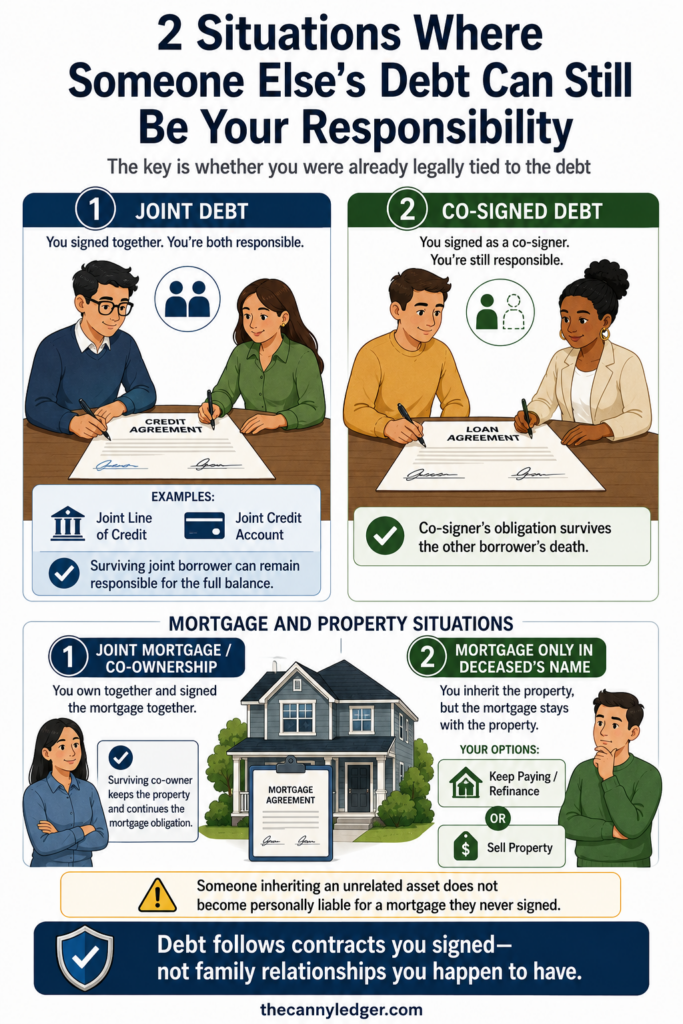
Real exceptions exist, and they share one thing in common, they only apply if you actively agreed to the debt yourself at some point, not because of a family relationship alone. Joint debt is the clearest example. If you co-signed a loan, held a joint credit card, or were a joint holder on a line of credit with someone who has since died, you remain fully responsible for the entire remaining balance, not half of it, since joint liability doesn’t split proportionally the way people sometimes assume, a distinction worth understanding against the broader picture of debt most Canadian households actually carry.
Mortgages work through a related but slightly different mechanic. A mortgage held jointly with right of survivorship passes the property, and the obligation to keep paying it, directly to the surviving co-owner. A mortgage in the deceased’s name alone stays attached to the property itself rather than to any person, meaning whoever inherits that specific house has to keep the payments current, refinance it, or sell the property, but someone who inherits a different asset entirely from the same estate isn’t personally on the hook for a mortgage they were never party to.
The RRSP Exception Almost Nobody Knows About
This is the detail that surprises people most, since it doesn’t fit the general rule the rest of this article has been building toward, and it’s backed by an actual Canadian tax court case rather than a hypothetical. When someone dies holding an RRSP or RRIF, the fair market value generally gets included as income on their final tax return, creating a real tax liability at exactly the moment they can no longer personally pay it. According to the Canada Revenue Agency’s own guidance on the death of an RRSP annuitant, that liability normally falls to the estate, but whoever was named the direct beneficiary of that specific RRSP or RRIF can be held jointly liable for the associated tax, up to the value of what they actually received.
That’s not a theoretical risk. According to an analysis of this exact issue published by CIBC Wood Gundy, a real Tax Court of Canada case, O’Callaghan v The Queen, saw a woman named as the sole beneficiary of her late brother’s RRSP receive the full account value directly, with no tax withheld at source, then get assessed personally for a share of the tax owing on that RRSP even after she’d already sent a substantial portion of the money to the estate’s executor. The court held her liable specifically because she’d received a direct financial benefit from the RRSP, regardless of what she’d done with the money afterward. Anyone named as a direct RRSP or RRIF beneficiary, rather than having those accounts flow through the estate itself, is worth flagging this specific exception to before assuming the general “debt dies with the estate” rule covers every situation without qualification.

What This Means If You’re the Executor
Executors carry a real personal liability risk of their own, distinct from anything beneficiaries face, and it comes from moving too fast rather than from the debts themselves. Distributing estate assets to beneficiaries before all debts are settled and before creditors have had a proper opportunity to come forward can leave an executor personally responsible for covering the shortfall if a legitimate creditor surfaces afterward. Requesting a Clearance Certificate from the CRA before making final distributions protects against this specifically for tax debt, confirming the deceased’s tax account is fully settled before any inheritance actually changes hands, though the processing time for that certificate commonly runs several months, which is worth planning around rather than treating as a quick formality. The CRA’s own guidance on settling an estate confirms directly that a legal representative who distributes property without that certificate can be held personally liable for whatever the deceased still owed.
Notifying every known creditor directly, and in many provinces publishing a formal notice to creditors, gives unknown claims a defined window to surface before assets get distributed rather than after. Executors who skip this step and distribute early are the ones actually exposed here, not beneficiaries who simply receive what the will provides for them once the process has been done properly.

Quebec Runs This Differently in Name, Not in Substance
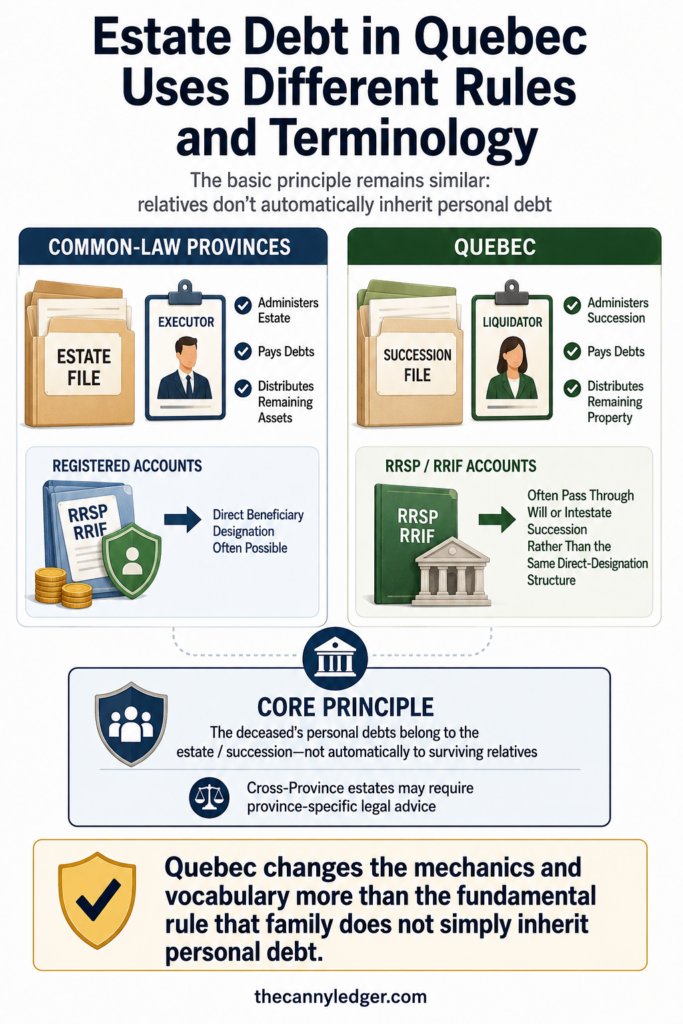
Quebec’s civil law system uses different terminology for the same underlying process, and it’s worth knowing if you’re dealing with an estate that crosses provincial lines. Instead of an executor, Quebec calls this role a liquidator, and RRSPs and RRIFs in Quebec generally pass through the will or through intestate succession rather than through a direct beneficiary designation the way they typically do in the rest of Canada. The core principle, that personal debt becomes an obligation of the estate rather than of surviving relatives, holds in Quebec too, even though the specific legal mechanics and vocabulary differ from the common law provinces.
Planning Around This Before You Need To
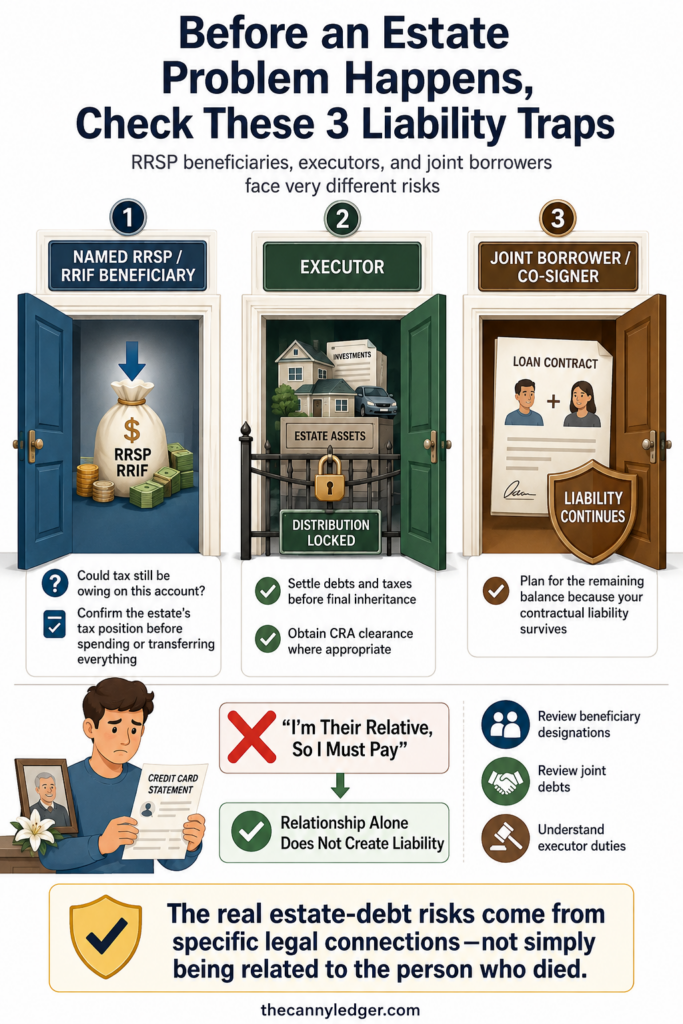
Anyone named as a direct beneficiary on someone’s RRSP or RRIF specifically, rather than having it flow through their estate, should understand that the O’Callaghan case shows this comes with real tax exposure attached, worth a conversation with the estate’s executor before spending or transferring that money. Serving as an executor means not rushing distributions before debts are confirmed settled and the CRA clearance process is complete, since that’s the actual point where personal liability attaches specifically to you. And carrying joint debt or a co-signed loan with someone whose health or finances are a real concern means your own liability on that specific debt survives their death, even though a parent’s unrelated personal debt wouldn’t touch you at all, which is worth planning around now rather than discovering later.
Questions Worth Sorting Out Before You Need This
Does my credit score get affected by a parent’s unpaid debt after they die? No, not unless you were a joint account holder or co-signer on that specific debt. A parent’s individual debt, even if it goes unpaid entirely because the estate couldn’t cover it, has no connection to your own credit file.
Can debt collectors legally contact me about a deceased relative’s debt? A collector can contact you to ask how to reach the executor or the estate, but they cannot legally pressure you personally to pay a debt that isn’t yours simply because you’re related to the deceased, the same protections covered under Canada’s debt collection rules generally.
If an estate is insolvent, is there a specific order that determines which creditors get paid first? Yes, secured creditors with a specific asset backing their claim generally come first, followed by amounts owed to the CRA, with unsecured creditors like credit card companies and personal loan providers paid from whatever remains, in rough proportion to their claims if there isn’t enough to cover everyone in full.
Is there any government benefit that helps cover final expenses when someone dies? Yes, the CPP death benefit pays up to $2,500 to the estate or another eligible individual on behalf of a deceased CPP contributor, though this is meant to help with costs like a funeral rather than to cover the full range of debts an estate might owe.