
- The Rate You See Advertised Probably Isn’t Your Rate
- Where Rates Actually Sit Right Now
- Why Fixed and Variable Have Flipped Places
- The Stress Test Still Applies Even at These Rates
- Big Banks vs Manitoba’s Own Credit Unions
- Assiniboine Credit Union’s Down-Payment Matching Programs
- What Actually Determines Your Personal Rate
- Locking In: Fixed vs Variable for Winnipeg Buyers Right Now
- Common Questions
- Get an Actual Rate Hold Before You Shop for a Home
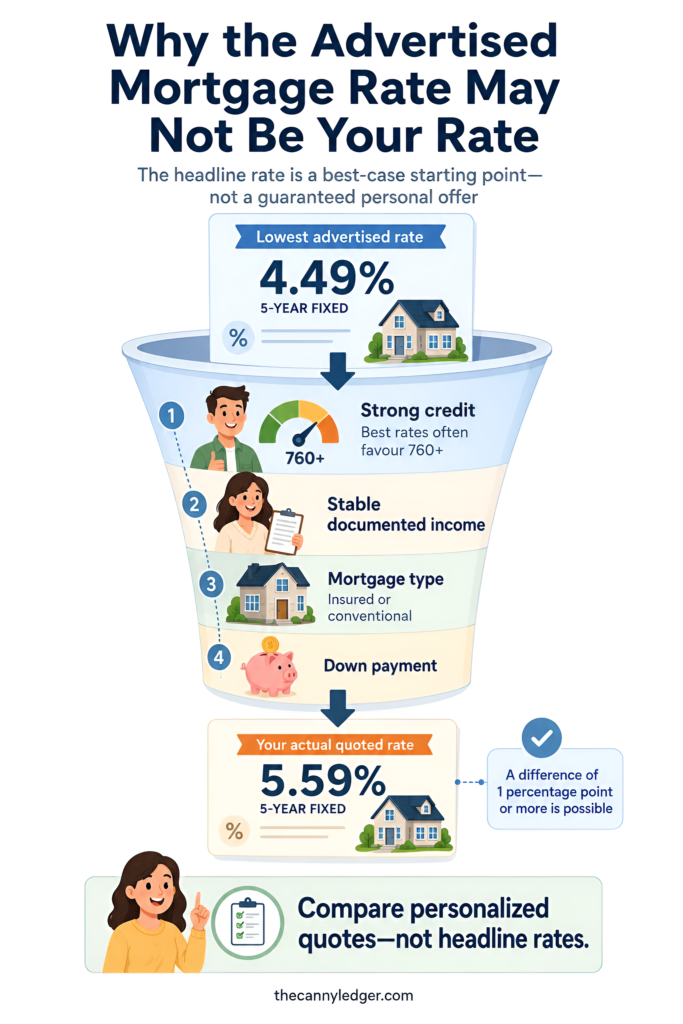
The rate a mortgage website advertises as “lowest in Canada” almost never matches what a specific Winnipeg buyer actually qualifies for, and the gap between those two numbers can run a full percentage point or more depending on your credit score, down payment, and whether you’re insured or conventional. That gap isn’t dishonest marketing exactly, it’s just how rate advertising works everywhere, the number shown is the floor, not a guarantee, and understanding that distinction before you start shopping saves the frustration of falling for a headline rate that was never actually available to you.
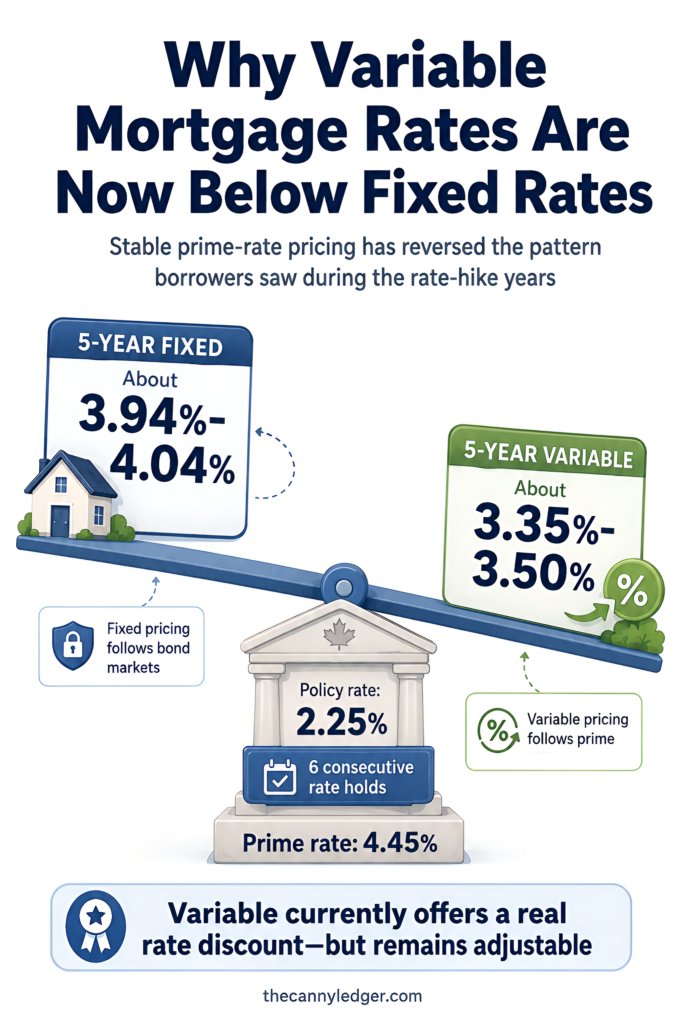
Current mortgage rates in Winnipeg, as of late July 2026, sit at roughly 3.94 to 4.04 percent for the best available insured 5-year fixed term and 3.35 to 3.50 percent for the best available insured 5-year variable term, with the Bank of Canada holding its policy rate at 2.25 percent for six consecutive announcements and Canada’s prime rate steady at 4.45 percent. Variable is currently pricing meaningfully cheaper than fixed, a genuine reversal from the pattern most Canadian borrowers got used to over the past few years.
The Rate You See Advertised Probably Isn’t Your Rate
Every rate comparison site and lender publishes a “best available” rate, and that number specifically describes the lowest rate the site or lender is currently offering to the most qualified possible borrower, generally someone with a credit score above 760, a stable, well-documented income, and often an insured mortgage with less than a 20 percent down payment. If your situation doesn’t match that profile exactly, your actual quoted rate will run higher, sometimes by a meaningful margin. This isn’t unique to any one lender or comparison site, it’s simply how advertised rates work across the entire industry, and treating a headline number as your personal starting point rather than your actual likely rate sets expectations that don’t survive contact with an actual application.
Where Rates Actually Sit Right Now
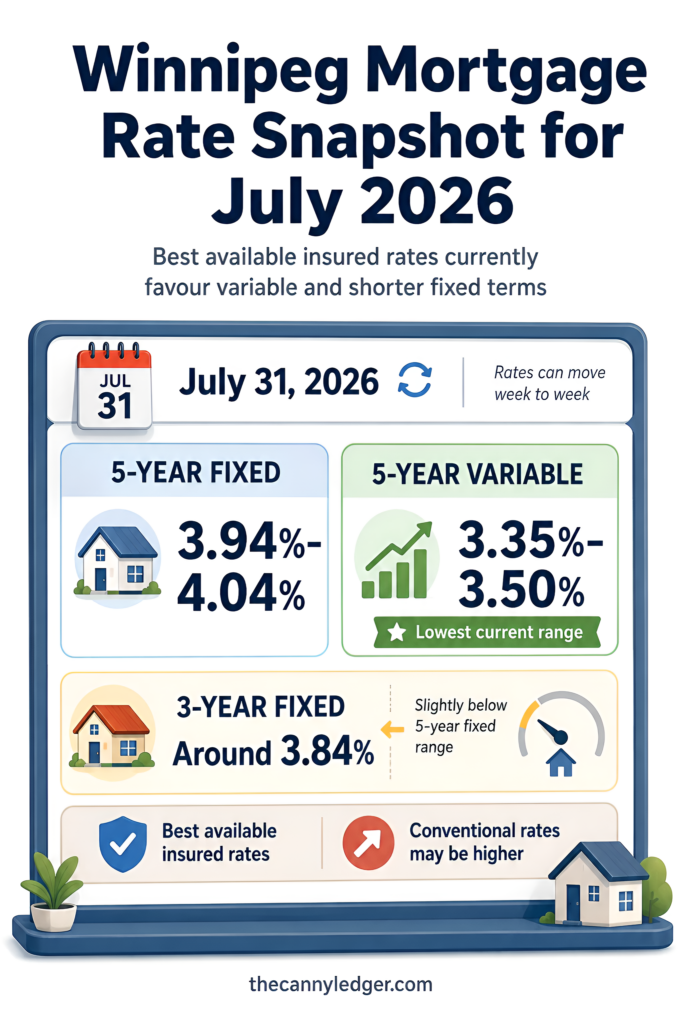
As of July 31, 2026, the lowest available insured 5-year fixed mortgage rate in Canada runs around 3.94 to 4.04 percent depending on the specific lender, while the lowest available insured 5-year variable rate sits considerably lower, around 3.35 to 3.50 percent. For conventional, uninsured mortgages, meaning a down payment of 20 percent or more, rates typically run somewhat higher than the insured figures above, since insured mortgages carry less risk for the lender and price accordingly. Shorter terms tell a slightly different story: the lowest available 3-year fixed rate currently sits around 3.84 percent, actually cheaper than the equivalent 5-year fixed term, reflecting how lenders are pricing in the expectation that rates could shift meaningfully within the next few years.
These figures move regularly, sometimes week to week, based on bond market movements and lender competition even between Bank of Canada announcements, so treating any specific number in this article as locked in place rather than a snapshot of where things stood as this was written matters for anyone actually shopping rather than just researching.
Why Fixed and Variable Have Flipped Places
For a long stretch through 2022 and 2023, variable rates ran meaningfully higher than fixed rates, a direct consequence of the Bank of Canada’s aggressive rate hikes during that period pushing prime rate, and therefore variable mortgage pricing, up faster than fixed rates tied to longer-term bond yields. That relationship has now reversed. With the Bank of Canada holding its policy rate at 2.25 percent since its July 15, 2026 announcement, its sixth consecutive hold, and prime rate steady at 4.45 percent across Canada’s major banks, variable rates have settled at a genuine discount to fixed, roughly half a percentage point cheaper on the best available 5-year terms.
This matters practically because variable rate mortgages are typically quoted as prime plus or minus a specific percentage, so a rate environment where prime itself sits at a stable, moderate level gives variable borrowers real month-to-month payment certainty even though the rate technically remains adjustable, a genuinely different psychological and financial situation than locking into variable during a period of active rate hikes.
The Stress Test Still Applies Even at These Rates
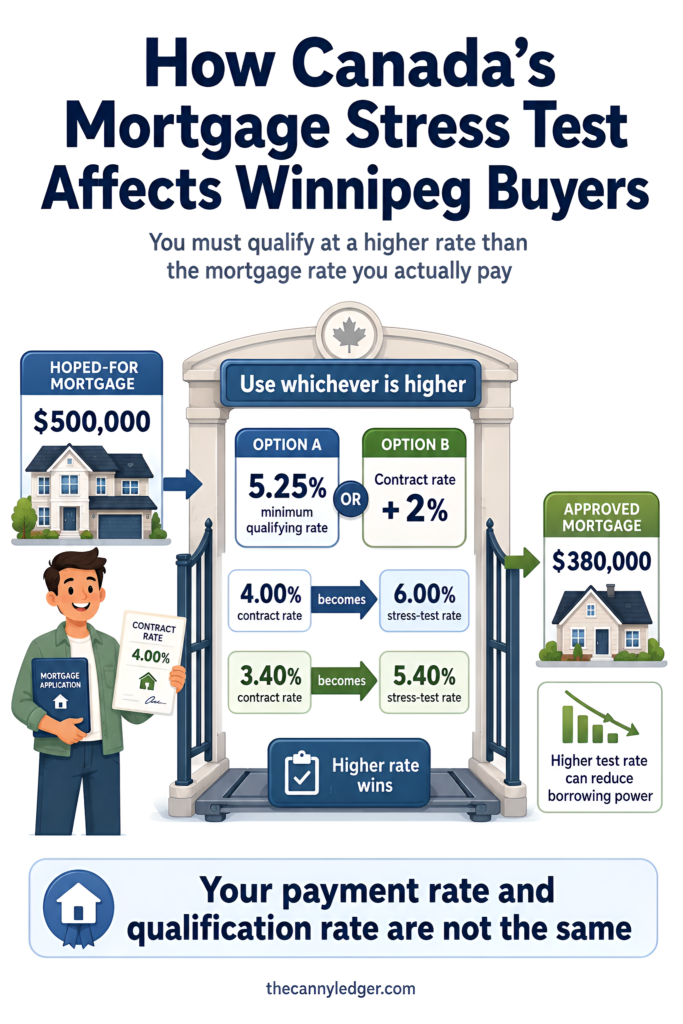
Regardless of whether you choose fixed or variable, or which specific lender offers your best rate, every Canadian mortgage application runs through the federal stress test, and it’s worth understanding exactly how that number gets calculated rather than assuming your contract rate alone determines what you qualify for. You need to qualify at whichever is higher: the Bank of Canada’s minimum qualifying rate, currently 5.25 percent, or your actual contract rate plus 2 percentage points. At today’s rates, your contract rate plus 2 percent generally exceeds the 5.25 percent floor for both fixed and variable options, meaning the stress test in practice runs on your actual rate plus that 2-point buffer rather than the flat 5.25 percent floor by itself. This is exactly why a rate that looks affordable on paper can still leave you qualifying for less mortgage than you expected, the bank isn’t just checking whether you can afford today’s payment, it’s checking whether you could still afford it at a meaningfully higher rate.
Big Banks vs Manitoba’s Own Credit Unions
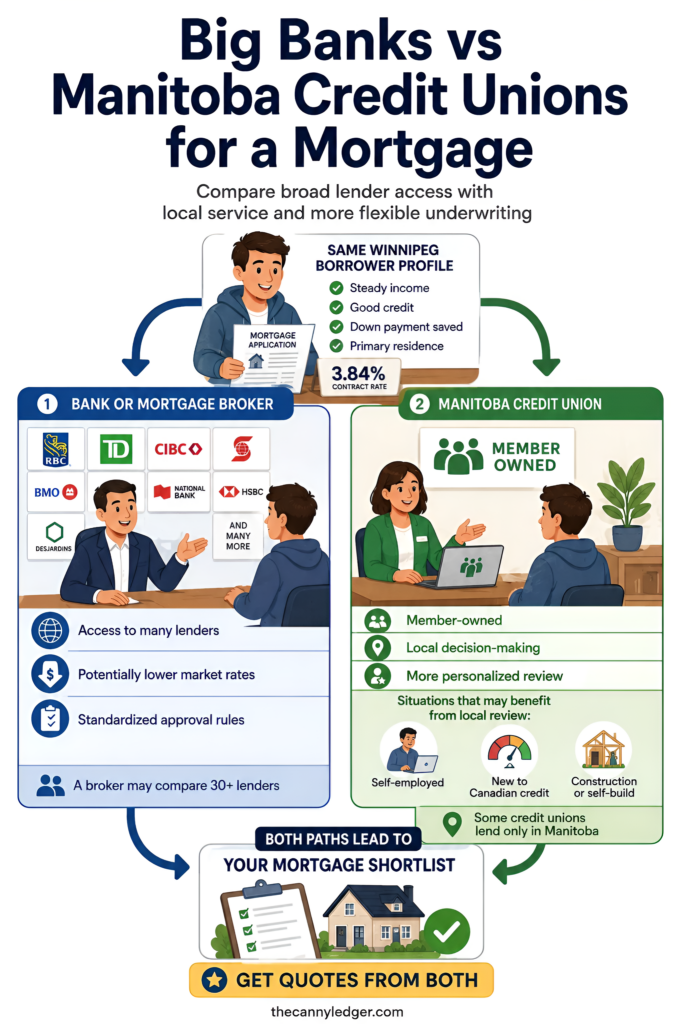
Winnipeg sits in a genuinely different competitive landscape than a lot of Canadian cities, since Manitoba is home to 18 credit unions, several headquartered right here in the city, competing directly against the Big Six national banks for mortgage business. Assiniboine Credit Union, founded in Winnipeg in 1943 and now the province’s second-largest credit union with 36 branches following its 2025 merger with Caisse Financial Group and Westoba Credit Union, publishes competitive posted rates directly, including a 3-year fixed rate at 3.99 percent as of this writing. Cambrian Credit Union, also headquartered in Winnipeg since 1959 with a dozen branches across the city and Selkirk, restricts its mortgage lending specifically to Manitoba residents, a genuine eligibility limitation worth knowing about if you’re comparing quotes from a national broker against local credit union pricing side by side.
The practical tradeoff between the two categories comes down to relationship versus scale. Credit unions like Assiniboine and Cambrian are member-owned, tend to offer more personalized underwriting for situations that don’t fit a big bank’s standard box, self-employed income, a newcomer without a long Canadian credit history, a construction or self-build project, but their posted rates aren’t always the absolute lowest available compared to what a mortgage broker can source from among 30 or more competing lenders. Getting quotes from both a local credit union and at least one broker before committing gives you a genuinely fuller picture than checking either category alone.
Assiniboine Credit Union’s Down-Payment Matching Programs
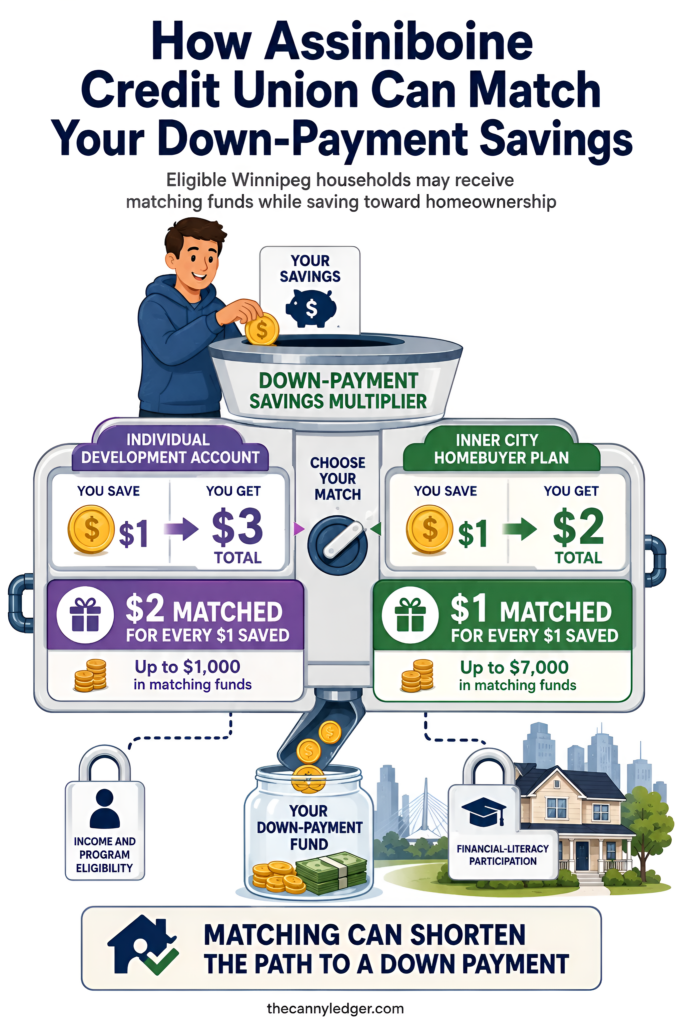
One detail worth knowing specifically if you’re a lower-income Winnipeg household saving toward a first home: Assiniboine Credit Union runs several matched-savings programs that most mortgage-shopping guides never mention because they’re specific to this one Manitoba institution. The Individual Development Account matches $2 for every $1 a member saves toward a specific goal, up to $1,000 in matched funds, while the Inner City Homebuyer Plan specifically matches $1 for every $1 saved toward a down payment, up to $7,000 in matching funds, aimed at supporting homeownership in Winnipeg’s inner-city neighbourhoods specifically. These programs won’t apply to every buyer, they’re built around specific eligibility criteria tied to income and often require completing a financial literacy component alongside the savings itself, but for a Winnipeg household that qualifies, matched down payment savings meaningfully changes the math on how long it takes to reach a workable down payment.
What Actually Determines Your Personal Rate
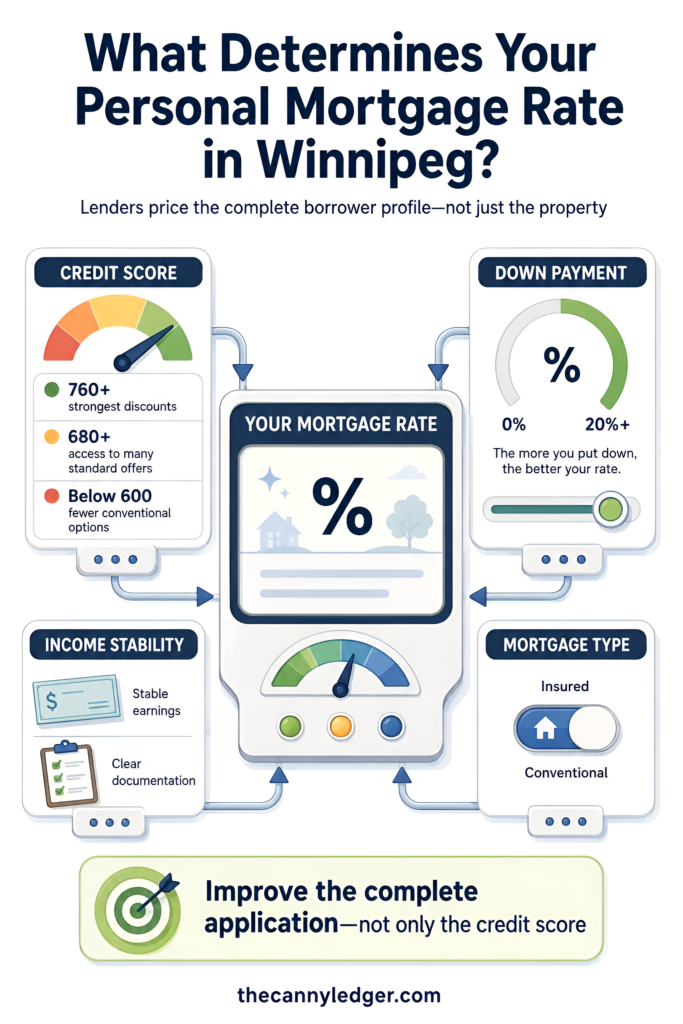
Beyond the general market rate environment, four factors do most of the work in determining what rate you’ll actually be offered: your credit score, your down payment size, your income stability and documentation, and whether you’re going with an insured or conventional mortgage. Generally, a credit score above 680 is needed to access most advertised rates at all, while scores above 760 can unlock additional discounts some lenders reserve specifically for their strongest-qualified borrowers. Below 680, approval remains possible but typically at a meaningfully higher rate, and below roughly 600, conventional lending options narrow considerably, often pushing a borrower toward alternative or private lending at rates well above anything covered in this guide.
Locking In: Fixed vs Variable for Winnipeg Buyers Right Now
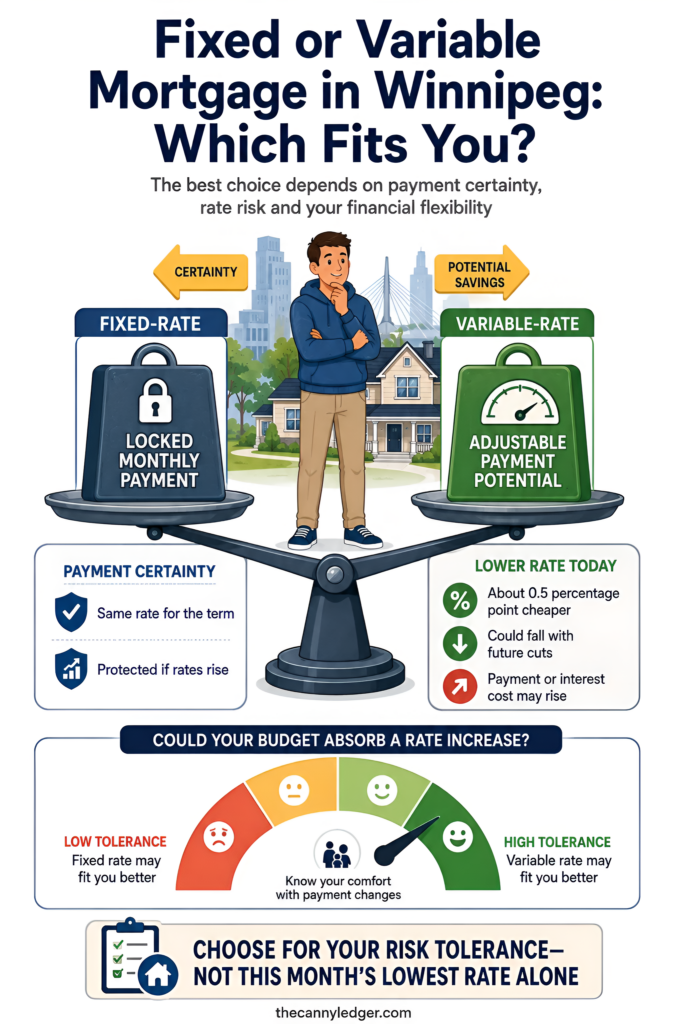
Given the current spread, roughly half a point cheaper for variable over fixed on 5-year terms, the honest answer to “which should I choose” depends on your own risk tolerance rather than a universal right answer. A fixed rate locks in payment certainty for the full term regardless of what the Bank of Canada does at its next six or more scheduled announcements, valuable if budget predictability matters more to you than optimizing for the lowest possible cost. A variable rate captures today’s real discount and could become even cheaper if the Bank of Canada cuts further, though it also carries genuine exposure if inflation surprises to the upside and forces the Bank back toward tightening, a risk that, while not the base case most economists currently expect, isn’t zero either. Neither choice is objectively wrong at today’s rates, they’re simply different bets on the next several years of Canadian monetary policy, and being honest with yourself about how much payment fluctuation you could actually absorb matters more than chasing whichever option is marginally cheaper this month.
Common Questions
Will mortgage rates in Winnipeg differ from rates advertised for Toronto or Vancouver? Base rates from national lenders are generally consistent across Canada, though local credit unions like Assiniboine and Cambrian offer Manitoba-specific pricing and programs that national comparison sites won’t always surface, which is exactly why checking local options alongside national ones matters here specifically.
When is the next Bank of Canada rate announcement that could move these numbers? September 2, 2026, is the next scheduled announcement date, and any change to the policy rate would flow through to prime rate, and therefore variable mortgage pricing, typically within one to two business days of the announcement.
Is now a good time to lock in a 5-year fixed rate given rates might drop further? Nobody can answer that with certainty, since it depends entirely on where inflation and the Bank of Canada’s policy path actually go over the next several years rather than anything knowable today, which is exactly why the fixed-versus-variable decision comes down to your own risk tolerance rather than a guaranteed right answer.
Get an Actual Rate Hold Before You Shop for a Home
Every figure in this guide is a market benchmark, not your personal quote, and the single most useful next step is getting pre-approved with an actual rate hold, typically good for 90 to 120 days, from at least one national lender or broker and one Manitoba credit union before you start seriously house hunting. That comparison, built on your real credit score and real income documentation rather than a generic advertised number, is the only way to know which of today’s rates actually applies to you. For a deeper look at the fixed-versus-variable decision itself, our guide to fixed vs variable mortgage rates in Winnipeg walks through that tradeoff in more depth, and our comparison of banks vs credit unions for Winnipeg mortgages covers the lender-type decision further. Once you’ve settled into a home, our Winnipeg property tax calculator covers another major recurring cost worth budgeting into your total monthly housing number alongside the mortgage payment itself.