
- The Safety Assumption Most People Have Backwards
- Who’s Actually Operating in Winnipeg
- Member Ownership Changes the Incentive Structure
- Rate Comparison: What Each Type Actually Offers Right Now
- Eligibility Restrictions Credit Unions Carry That Banks Don’t
- Where Big Banks Still Win
- Specialty and Values-Based Programs Worth Knowing About
- Making the Actual Comparison
- Common Questions
- Compare Both Categories Before You Decide
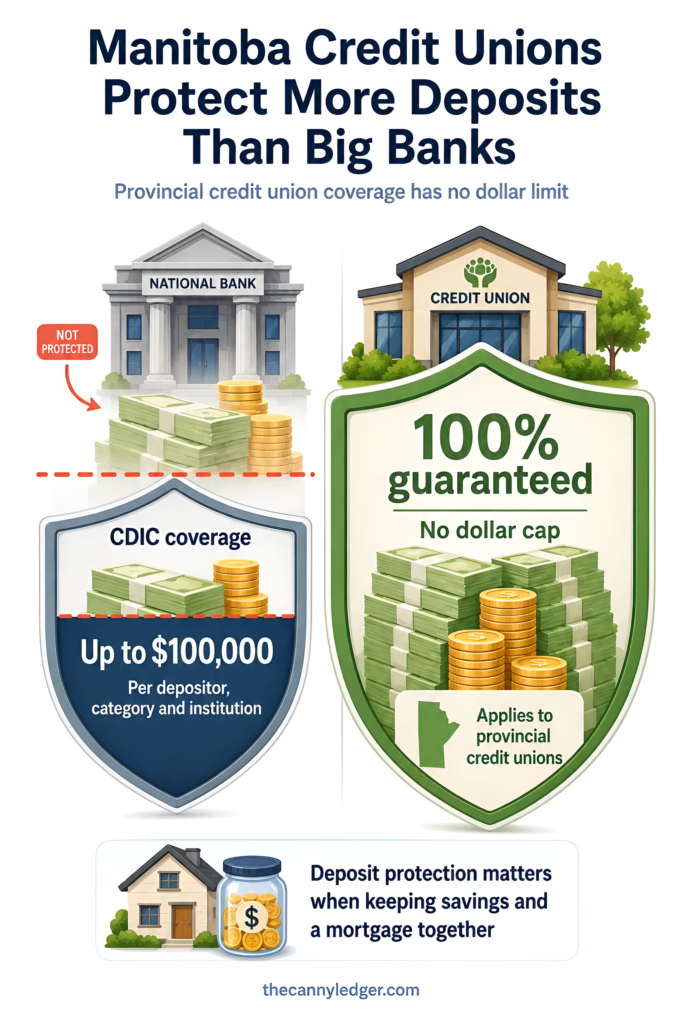
Most people assume a national bank is automatically the safer place to put their money than a local credit union, and in Manitoba specifically, that assumption runs backwards. The Canada Deposit Insurance Corporation, which backs deposits at RBC, TD, Scotiabank, BMO, CIBC, and National Bank, caps its coverage at $100,000 per depositor per category. The Deposit Guarantee Corporation of Manitoba, which backs every credit union chartered in this province, guarantees 100 percent of deposits with no cap at all, and that protection applies regardless of where the depositor actually lives. It’s one of the more genuinely surprising facts in Manitoba banking, and it’s rarely mentioned in generic “banks vs credit unions” content written for a national audience that doesn’t account for provincial differences like this one.
Bank versus credit union mortgage rates in Winnipeg come down to more than which posted number is lowest this week. Manitoba’s credit unions, Assiniboine and Cambrian chief among them, offer unlimited deposit insurance, member ownership with profit-sharing, and often more flexible underwriting for situations that don’t fit a big bank’s standard criteria, while the Big Six banks bring broader branch networks, more product breadth, and, through mortgage brokers specifically, sometimes more aggressive volume-based pricing.
The Safety Assumption Most People Have Backwards
Deposit insurance rarely factors into how people choose a mortgage lender, but it’s worth understanding clearly since it directly contradicts what most Canadians assume. CDIC protects deposits at federally regulated banks up to $100,000 per depositor, per insured category, per institution, meaning a large balance spread across multiple account types at one bank can exceed that cap without full protection unless it’s carefully structured. The Deposit Guarantee Corporation of Manitoba, by contrast, guarantees the full amount of every deposit at a Manitoba-chartered credit union, with no ceiling whatsoever, a level of protection genuinely stronger than what any CDIC member bank offers. This matters less for the mortgage itself and more for anyone considering keeping their full banking relationship, chequing, savings, and mortgage, together at whichever institution they choose, since a Manitoba credit union removes the deposit-cap math entirely.
Who’s Actually Operating in Winnipeg
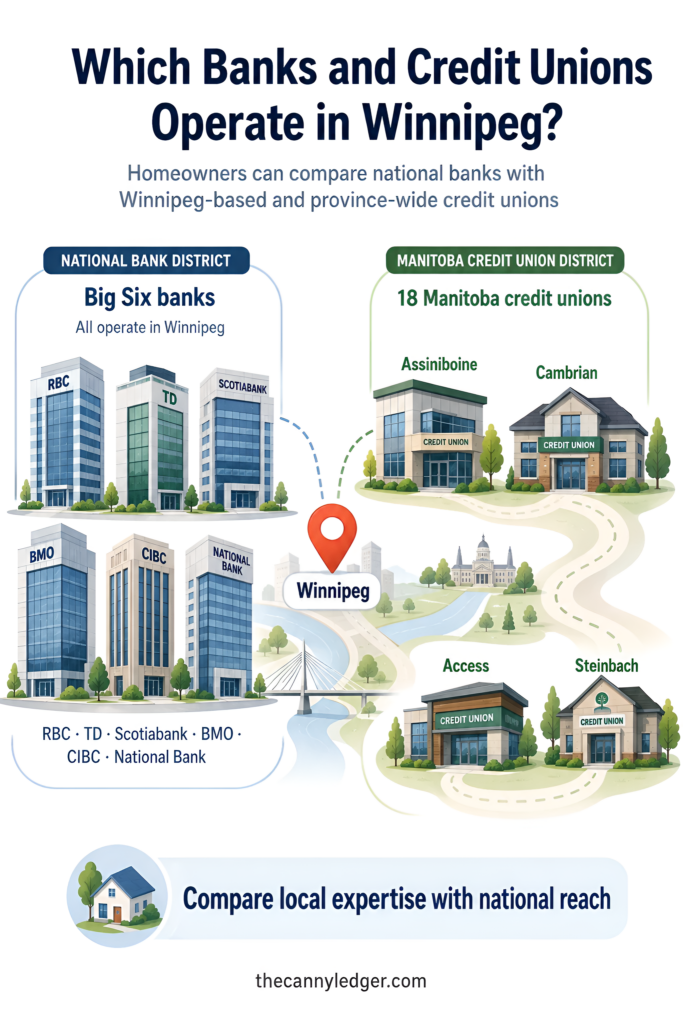
The Big Six national banks, RBC, TD, Scotiabank, BMO, CIBC, and National Bank, all operate branches in Winnipeg and offer the full range of standard mortgage products alongside broader banking, investment, and credit services. On the credit union side, Manitoba is home to 18 credit unions, a genuinely large number for a province this size, with Assiniboine Credit Union and Cambrian Credit Union standing as the two largest options headquartered directly in Winnipeg. Access Credit Union, Manitoba’s largest credit union overall with roughly 177,000 members across 54 locations, and Steinbach Credit Union, historically the province’s largest by membership with just over 100,000 members, round out the major provincial players, though both operate with a more rural and southern Manitoba footprint than Assiniboine or Cambrian’s Winnipeg-centred branch networks.
Member Ownership Changes the Incentive Structure
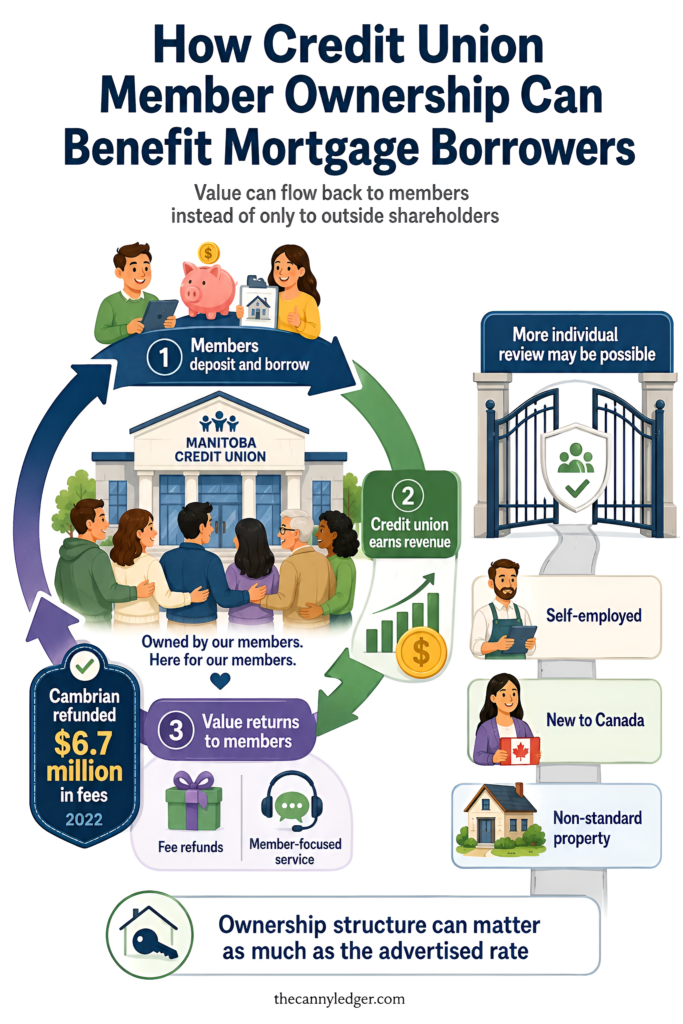
A credit union is owned by its members rather than shareholders, and that structural difference shows up in ways that go beyond marketing language. Cambrian Credit Union refunded $6.7 million in service fees back to members in 2022 alone through its Unfee program, a direct consequence of the credit union not needing to generate shareholder returns the way a publicly traded bank does. This member-ownership model tends to translate into more personalized underwriting too, since a credit union loan officer answers to the same membership base a borrower belongs to, rather than to a national head office optimizing for scale across millions of customers with a standardized risk model. For borrowers whose situation doesn’t fit neatly into a big bank’s automated approval criteria, self-employment income, a newcomer without an extensive Canadian credit history, or an unconventional property type, that difference in underwriting philosophy can matter more than a fraction of a percentage point on the rate itself.
Rate Comparison: What Each Type Actually Offers Right Now
National banks and Manitoba credit unions both price mortgages against the same underlying Bank of Canada policy environment, so headline rates tend to move in the same general direction, but the specific number offered can differ meaningfully between institution types. Assiniboine Credit Union publishes posted rates directly, including a 3-year fixed rate at 3.99 percent as of this writing, competitive with national bank posted rates for the same term. Where credit unions sometimes fall short of the absolute lowest available rate is against what a mortgage broker can source across dozens of lenders including monoline institutions that don’t operate retail branches at all, so a genuinely thorough comparison includes checking both a Manitoba credit union directly and a broker quote, rather than assuming either category automatically wins on price. Our guide to current mortgage rates in Winnipeg covers where national posted rates sit today for a fuller baseline comparison.

Eligibility Restrictions Credit Unions Carry That Banks Don’t
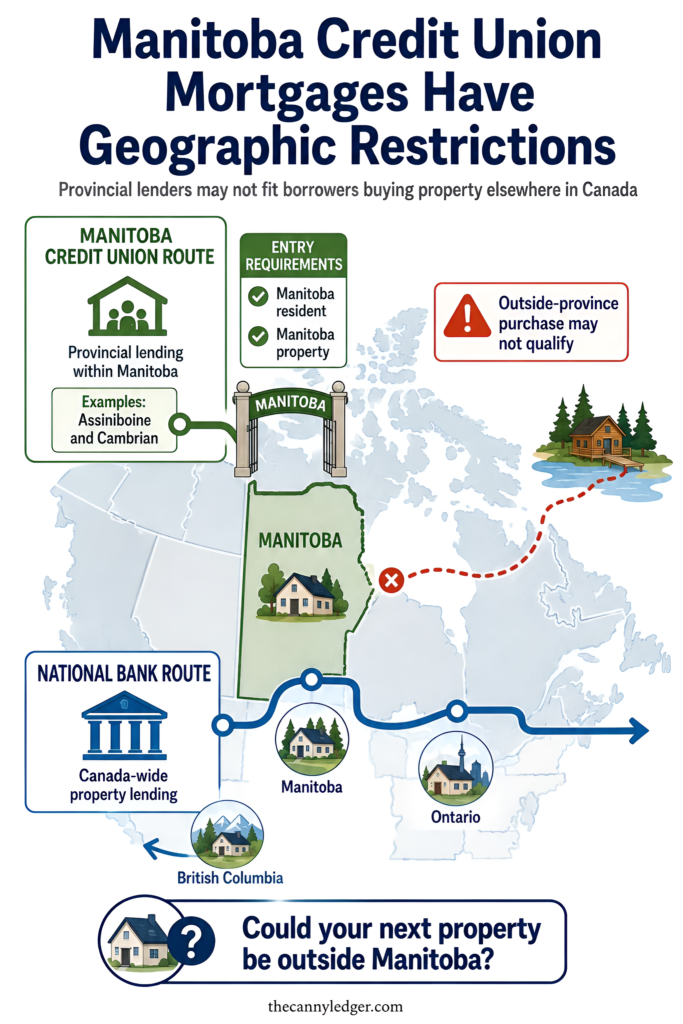
One genuine limitation worth knowing upfront: both Assiniboine and Cambrian restrict their mortgage lending specifically to Manitoba residents, an eligibility rule national banks simply don’t apply. This matters directly for anyone who owns or plans to purchase a second property outside the province, a cottage in Ontario or a rental property in another province, since a Manitoba credit union generally won’t finance that purchase even if you’re a longstanding Manitoba resident and member. National banks carry no such geographic restriction, financing properties across Canada regardless of where you personally live, which is a genuine structural advantage for anyone whose real estate plans extend beyond provincial borders.
Where Big Banks Still Win
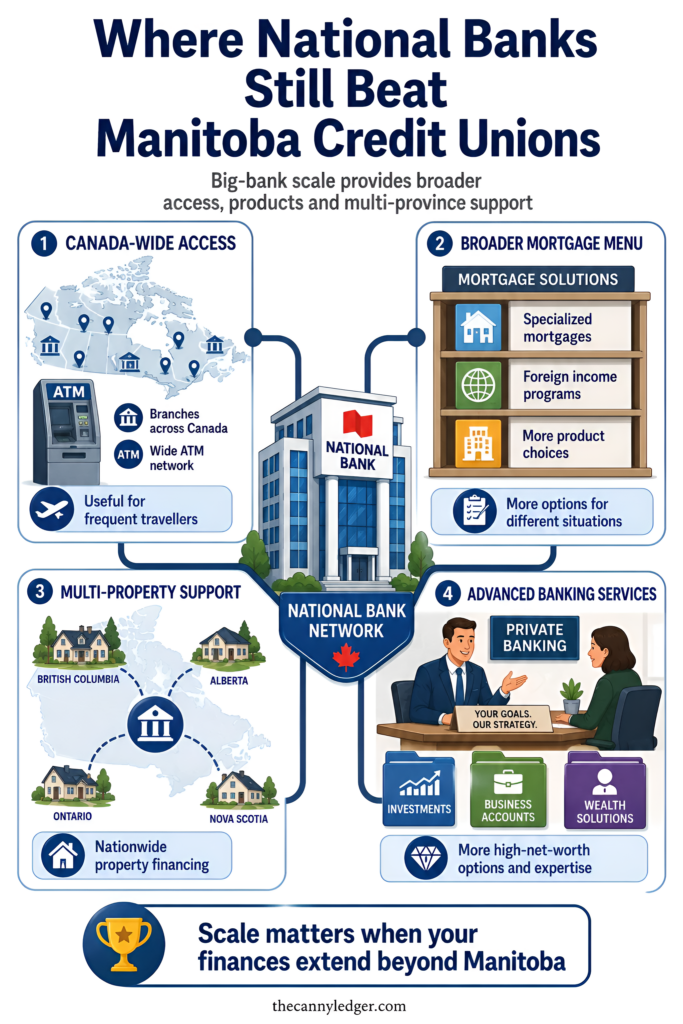
Credit unions don’t win on every dimension, and it’s worth being honest about where a national bank’s scale genuinely benefits a borrower. Broader branch and ATM networks matter for anyone who travels frequently or splits time between provinces, since a Manitoba credit union’s footprint stops at the provincial border in a way a national bank’s doesn’t. Product breadth runs deeper too, national banks typically offer a wider range of specialized mortgage products, foreign income qualification programs, larger investment property portfolios, and private banking services for high-net-worth clients, categories where a Manitoba-focused credit union’s more limited scale genuinely can’t match a national institution’s resources.
Specialty and Values-Based Programs Worth Knowing About
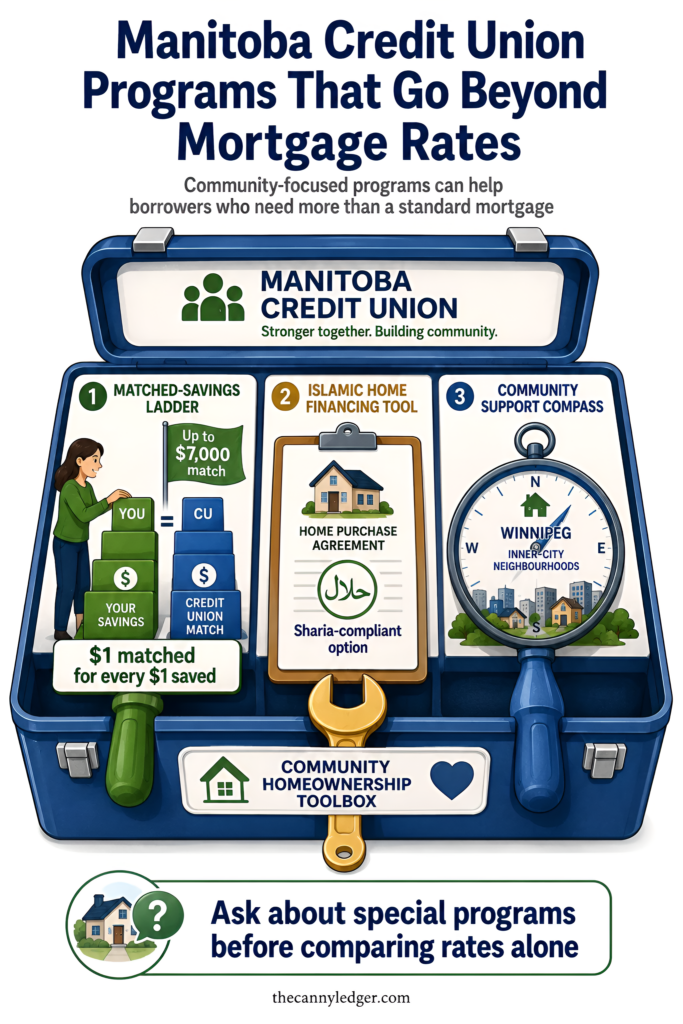
Beyond straightforward rate comparison, Manitoba’s credit unions run programs that don’t have a clean national-bank equivalent. Assiniboine Credit Union operates several matched-savings programs specifically for lower-income members working toward a down payment, including an Inner City Homebuyer Plan matching $1 for every $1 saved up to $7,000, aimed at supporting homeownership in Winnipeg’s inner-city neighbourhoods. Assiniboine also offers Islamic mortgage products structured to comply with Sharia principles around interest, a specialty offering that isn’t standard at most national banks. These kinds of targeted programs reflect a credit union’s community-focused mandate more directly than a national bank’s standardized product lineup typically can.
Making the Actual Comparison
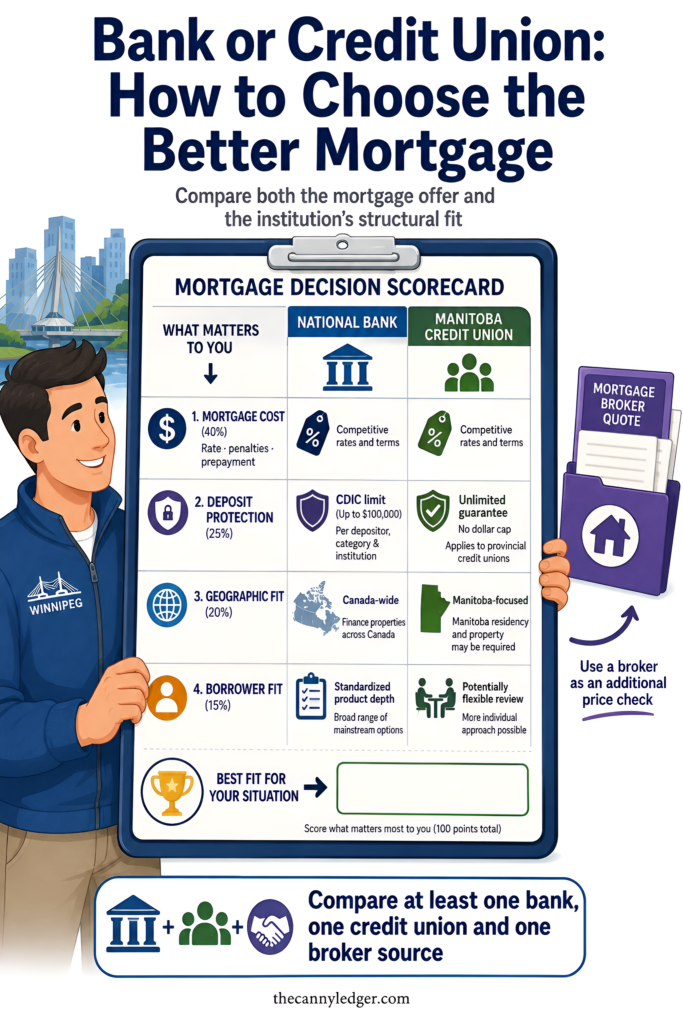
The practical approach treats bank versus credit union as a genuine two-part question rather than a single verdict. First, compare the actual numbers, rate, prepayment privileges, and penalty structure, between at least one national bank and one Manitoba credit union directly, since posted rates alone don’t capture the full cost of a mortgage over its term. Second, weigh the structural factors that don’t show up on a rate sheet at all: deposit insurance coverage if you’re consolidating significant savings at the same institution, whether Manitoba residency restrictions affect any property plans outside the province, and whether member-ownership underwriting flexibility matters for your specific financial situation. Our guide to shopping for the best mortgage rate in Winnipeg covers how to run that comparison process itself, including how a broker fits alongside both bank and credit union options.
Common Questions
Does a Manitoba credit union mortgage affect my eligibility for federal mortgage default insurance? No, Manitoba credit unions can still originate insured mortgages through the same national insurers, CMHC, Sagen, and Canada Guaranty, that banks use, so choosing a credit union doesn’t change your access to mortgage default insurance if your down payment is under 20 percent.
Is credit union membership required before I can get a mortgage there? Generally yes, credit unions require you to become a member, typically through a small one-time share purchase, before extending a mortgage or any other lending product, a step that doesn’t apply at a national bank.
Can I have my mortgage with a bank but keep my savings at a credit union for the unlimited deposit insurance? Yes, there’s no requirement to consolidate every financial product at one institution, and plenty of Manitobans split their banking relationship specifically to capture a credit union’s stronger deposit insurance for savings while shopping the mortgage itself across both categories.
Compare Both Categories Before You Decide
Treating this as a choice between “bank” and “credit union” as monolithic categories misses the actual decision, since the real comparison happens lender by lender, with genuine differences in rate, eligibility, underwriting flexibility, and deposit protection that vary by your specific situation. Pull a direct quote from at least one Manitoba credit union and one national bank, ask both about prepayment privileges and penalty formulas in writing, and let the actual numbers and terms decide rather than a general assumption about which category is automatically better. Our guide to fixed vs variable mortgage rates in Winnipeg covers the term-type decision worth making before comparing lenders in the first place, and our breakdown of GIC and savings interest rates in Winnipeg covers how that same deposit insurance distinction plays out on the savings side of your banking relationship.