


Most Canadians with a variable rate mortgage assume their monthly payment moves up and down with interest rates, and for roughly three-quarters of them, that assumption is simply wrong. The majority of variable rate mortgages in Canada come with a fixed, static monthly payment, the interest rate genuinely floats, but the dollar amount you pay each month stays exactly the same. What actually shifts behind the scenes is how that fixed payment gets split between interest and principal, and during 2022’s aggressive rate hikes, that quiet mechanical detail turned into a genuine financial shock for hundreds of thousands of Canadian homeowners who discovered their payment was suddenly covering interest only, with nothing left over to pay down the loan itself.
- Most “Variable Rate” Mortgages Don’t Actually Have a Variable Payment
- What a Trigger Rate Actually Means
- Adjustable Rate Mortgages Are the Other Variable Option
- Where Rates Actually Sit Right Now, and Why Trigger Rate Risk Is Low Today
- Fixed Rate Mortgages Trade Flexibility for Certainty
- What Locking In Actually Costs You
- Comparing the Two Head to Head
- Who Should Actually Choose Fixed
- Who Should Actually Choose Variable
- Common Questions
- The Real Decision Isn’t Just About the Rate
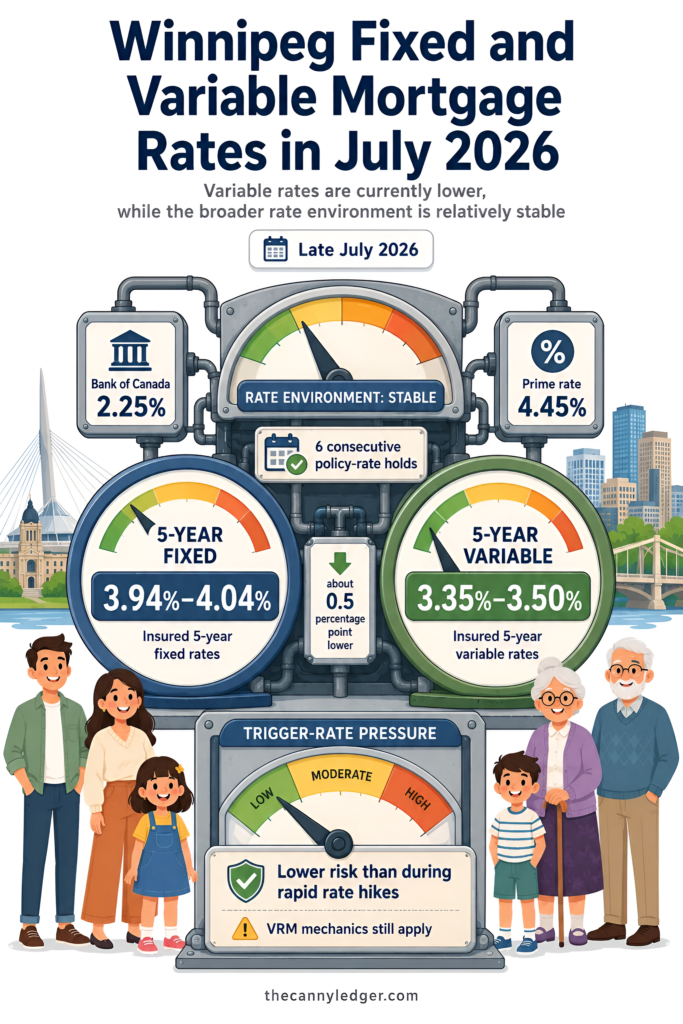
Fixed and variable mortgage rates in Winnipeg currently sit at roughly 3.94 to 4.04 percent and 3.35 to 3.50 percent respectively for the best available 5-year insured terms, with variable pricing meaningfully cheaper right now. The decision between them comes down to more than just which number is lower today, since variable rate mortgages carry a structural mechanic, the trigger rate, that fixed mortgages simply don’t have to worry about at all.
Most “Variable Rate” Mortgages Don’t Actually Have a Variable Payment
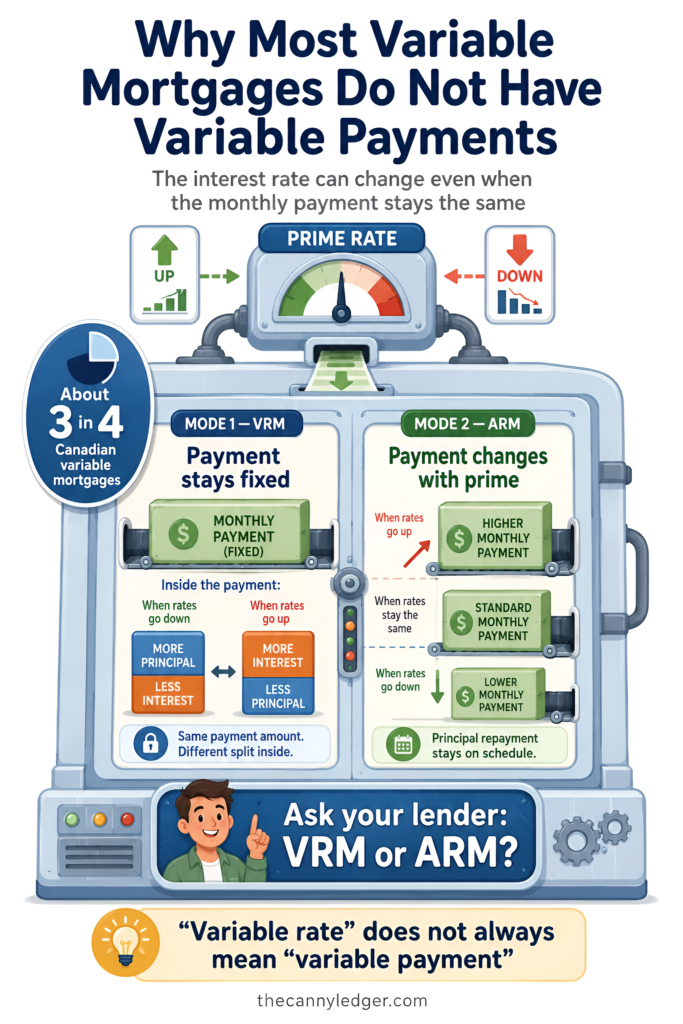
Canadian variable mortgages actually split into two genuinely different products that get lumped under the same “variable” label constantly. A Variable Rate Mortgage, commonly abbreviated VRM, keeps your monthly payment fixed for the entire term, similar in feel to a fixed-rate mortgage, while the interest rate itself moves with the prime rate behind the scenes. An Adjustable Rate Mortgage, or ARM, works the way most people actually picture a variable mortgage working: the payment itself rises and falls directly alongside prime rate changes, keeping the underlying amortization schedule intact regardless of which direction rates move.
The split between these two types matters enormously, and most Canadian variable mortgages, an estimated three-quarters of them according to Bank of Canada analysis, are the static-payment VRM type rather than the payment-adjusting ARM type. If you have a variable rate mortgage and aren’t sure which type you actually have, that’s worth confirming directly with your lender, since the two carry meaningfully different risk profiles during a period of rising rates.
What a Trigger Rate Actually Means
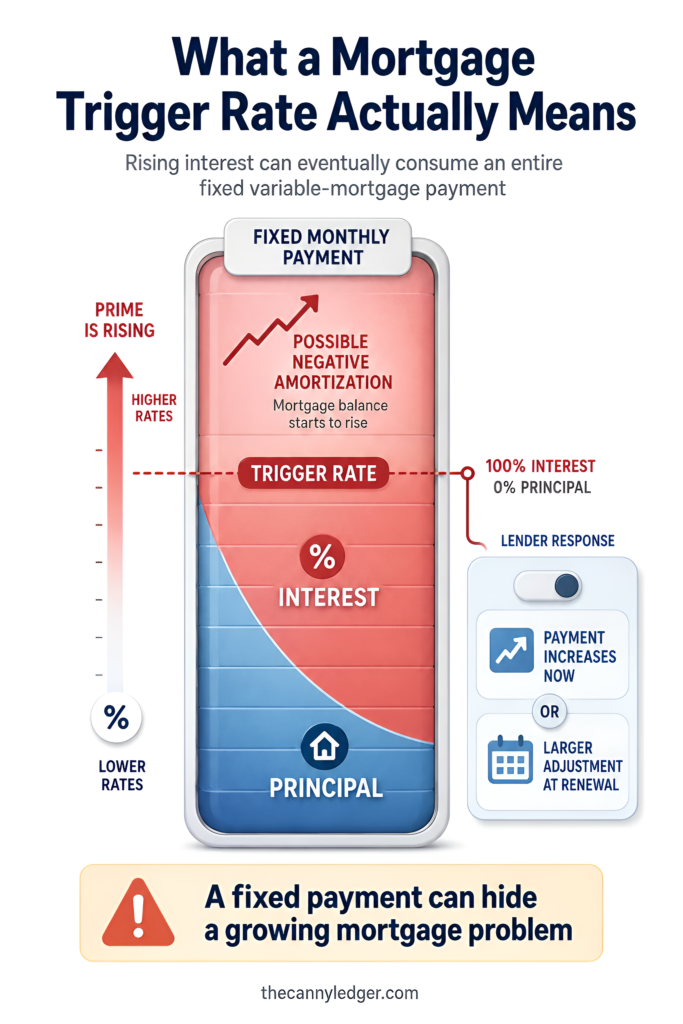
Here’s where the static-payment VRM structure creates a real risk that ARM holders and fixed-rate holders simply don’t face. As prime rate rises, more of your fixed monthly payment gets allocated to interest and less to principal, since the payment amount itself never changes to reflect the new rate. Eventually, if rates rise enough, you hit what’s called the trigger rate, the specific rate at which your entire fixed payment covers interest only, with zero going toward principal. Push past that point, and some lenders allow what’s called negative amortization, where the interest owed actually exceeds your payment, meaning your mortgage balance grows larger each month instead of shrinking, the opposite of how a mortgage is supposed to work.
This isn’t a hypothetical risk invented for this article. The Bank of Canada’s own staff analysis, published during the 2022 rate-hiking cycle, estimated that roughly half of all variable-rate mortgages had already reached their trigger rate by November 2022, with mortgages originated in 2021 at especially low rates hitting that point earliest, since a lower starting rate means a lower trigger rate and less room before payments stop covering principal entirely. Lenders handle a borrower reaching their trigger rate differently. Some automatically increase the required payment to keep covering the interest portion, functionally converting the mortgage to behave like an ARM from that point forward, while others permit the negative amortization scenario to continue, deferring the reckoning to renewal, when the amortization typically resets and the borrower faces a genuinely significant payment increase all at once.

Adjustable Rate Mortgages Are the Other Variable Option
ARMs sidestep the trigger rate problem entirely by design, since the payment itself moves with the rate in real time rather than staying fixed while the interest and principal split shifts underneath it. This means an ARM holder feels rate increases immediately, in a higher monthly payment, but never faces negative amortization or a trigger rate, and never gets the unpleasant surprise of a payment that quietly stopped covering principal months or years earlier. The tradeoff is straightforward: ARMs offer more predictable long-term amortization at the cost of less predictable month-to-month cash flow, while VRMs offer stable monthly payments at the cost of a structural risk that only becomes visible when rates rise significantly.

Where Rates Actually Sit Right Now, and Why Trigger Rate Risk Is Low Today
The trigger rate concern that dominated headlines through 2022 and 2023 reflects a specific historical moment, rapid, aggressive rate hikes from an unusually low starting point, not a permanent feature of every variable mortgage environment. With the Bank of Canada holding its policy rate at 2.25 percent for six consecutive announcements and prime rate steady at 4.45 percent, the current environment looks nothing like the sharp hiking cycle that pushed so many borrowers toward their trigger rates a few years ago. Our guide to current mortgage rates in Winnipeg covers exactly where fixed and variable pricing sits today, but the practical takeaway here is that choosing variable in a stable or gently declining rate environment carries a genuinely different risk profile than choosing it during an active hiking cycle, even though the underlying mechanics of a static-payment VRM haven’t changed at all.
Fixed Rate Mortgages Trade Flexibility for Certainty
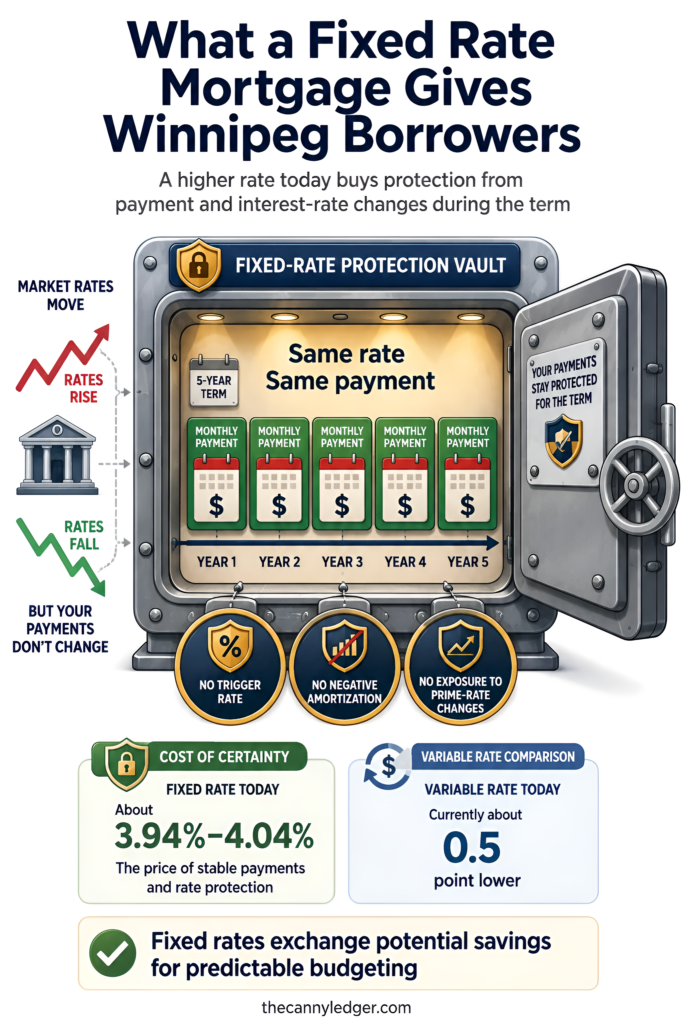
A fixed rate mortgage locks in both your interest rate and your payment for the entire term, full stop, with no trigger rate mechanic, no negative amortization risk, and no exposure to the Bank of Canada’s next six or more scheduled rate announcements during your term. That certainty comes at a real cost right now specifically, since the best available 5-year fixed rate runs meaningfully higher than the best available 5-year variable rate in the current environment, a genuine reversal from the pattern of the past couple of years. For a household that values knowing exactly what a mortgage payment will be every month for years at a stretch, regardless of what happens with inflation, oil prices, or global trade tensions, that premium buys real peace of mind rather than being pure waste.
What Locking In Actually Costs You
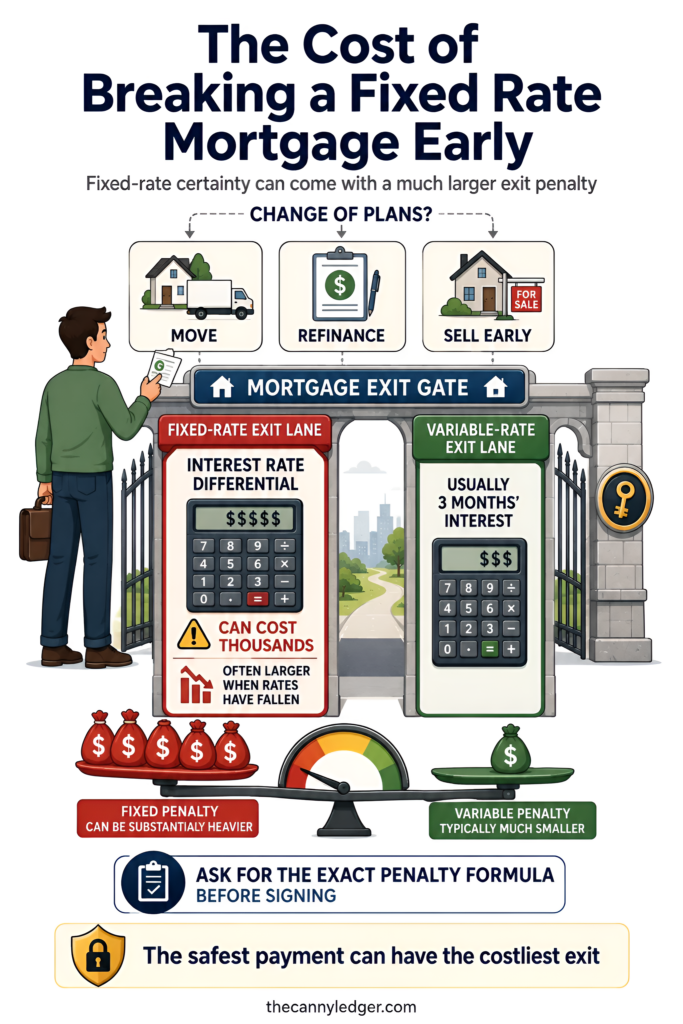
Breaking a fixed-rate mortgage early carries a real penalty, and it’s worth understanding this cost before assuming fixed is the “safer” choice in every sense. Fixed mortgage penalties are typically calculated using an interest rate differential, comparing your contract rate against the current rate for a similar remaining term, and in a falling-rate environment specifically, that differential can produce a penalty running into the thousands of dollars, sometimes considerably more than the simpler three-months-interest penalty variable mortgages typically use. If there’s any real chance you’ll move, refinance, or otherwise need to break your mortgage before the term ends, understanding your specific lender’s penalty formula for both fixed and variable options matters just as much as comparing the headline rates themselves.
Comparing the Two Head to Head
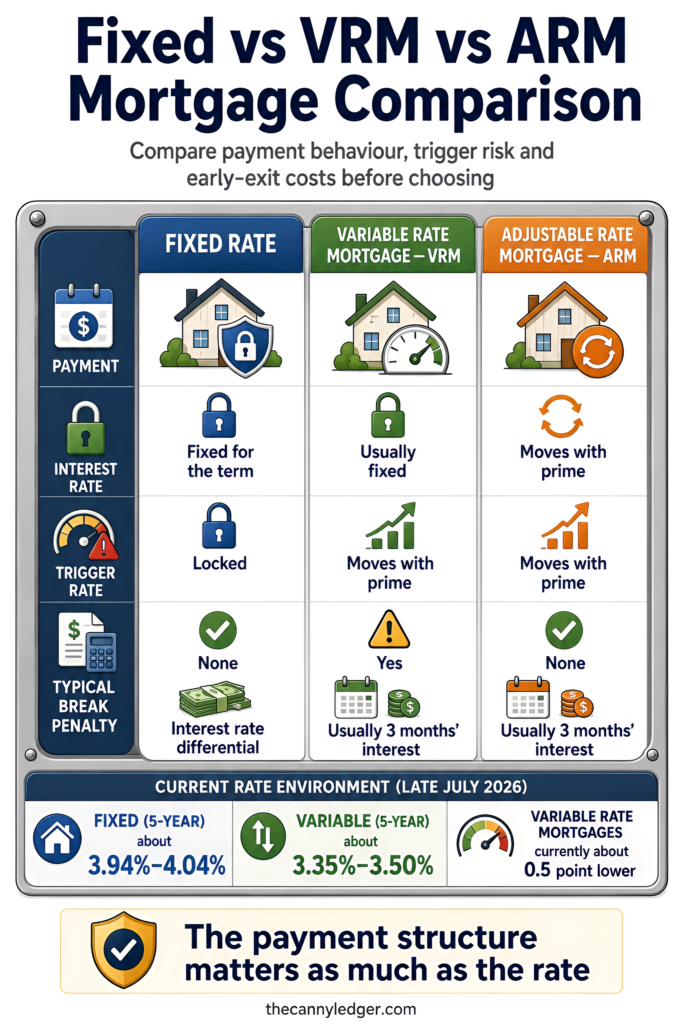
| Title | Fixed Rate | Variable Rate (VRM) | Adjustable Rate (ARM) |
|---|---|---|---|
| Payment stability | Fixed for full term | Fixed, but principal/interest split shifts | Changes with prime rate |
| Rate stability | Locked for full term | Floats with prime rate | Floats with prime rate |
| Trigger rate risk | None | Yes | None |
| Typical break penalty | Interest rate differential (can be significant) | Three months’ interest (typically lower) | Three months’ interest (typically lower) |
| Best current 5-year rate | Roughly 3.94-4.04% | Roughly 3.35-3.50% | Roughly 3.35-3.50% |
Who Should Actually Choose Fixed
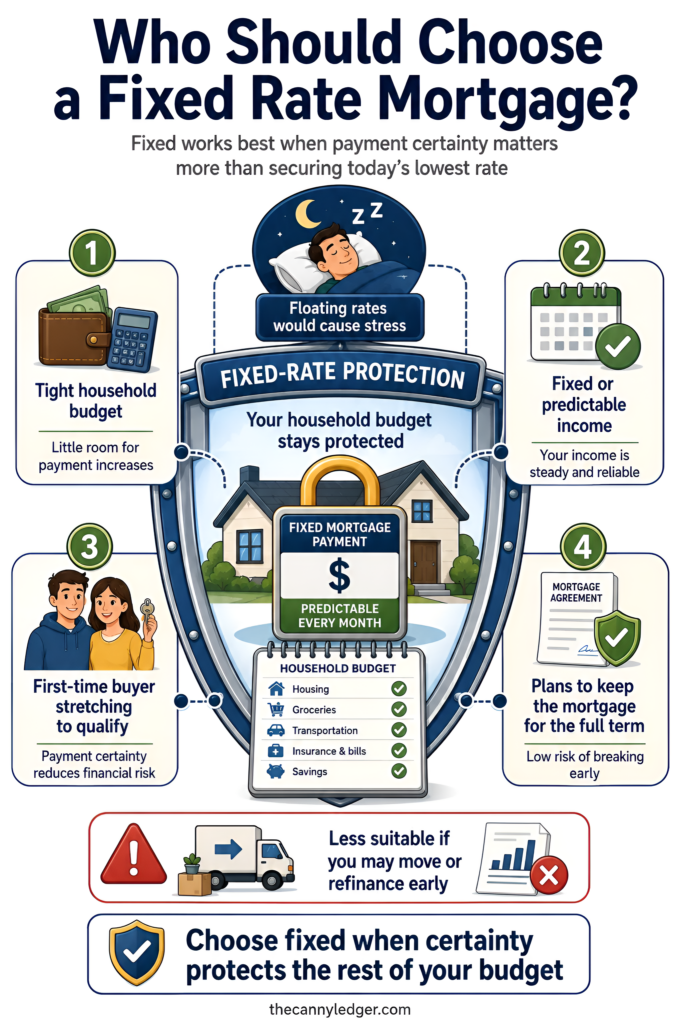
Fixed rate mortgages tend to fit households where budget certainty genuinely matters more than optimizing for the lowest possible cost, first-time buyers stretching to qualify who can’t absorb a payment increase, anyone with a fixed or tight household income where an unexpected rate jump would create real hardship, or simply someone who knows they’d lose sleep over a floating rate regardless of the math. Fixed also fits well for anyone who’s confident they won’t need to break the mortgage early, since that’s precisely the scenario where a fixed rate’s penalty structure can turn expensive.
Who Should Actually Choose Variable
Variable rate mortgages, particularly in the current environment where they’re pricing meaningfully cheaper than fixed, fit households with enough financial cushion to genuinely absorb a rate increase without real hardship, borrowers who understand and are comfortable monitoring their trigger rate if they choose the static-payment VRM type specifically, and anyone who places real value on the historically lower break penalty if their plans might change before the term ends. An ARM specifically suits someone who wants variable’s typical rate advantage without the trigger rate mechanic at all, accepting a payment that moves with the market directly rather than staying artificially stable while amortization quietly shifts underneath it.

Common Questions
Can I switch from a VRM to an ARM, or from variable to fixed, mid-term? Many lenders allow converting a variable rate mortgage to a fixed rate at any point during the term without penalty, though converting between VRM and ARM structures, or locking in specifically once you’re near your trigger rate, depends on your specific lender’s policies and is worth confirming directly rather than assuming it’s automatic.
How do I find out if my current variable mortgage is a VRM or an ARM? Check your original mortgage documents for language about “fixed payment” versus “adjustable payment,” or call your lender directly and ask specifically, since this single detail determines whether trigger rate risk applies to your mortgage at all.
Does my Manitoba credit union offer both VRM and ARM options? It varies by institution, and not every lender offers both structures, so if the VRM versus ARM distinction matters to your decision specifically, confirming which type a given lender, whether a big bank or a Manitoba credit union, is actually quoting you before signing anything is worth the extra question. Our guide to current mortgage rates in Winnipeg covers where local credit unions fit into the broader rate landscape.
The Real Decision Isn’t Just About the Rate
Choosing between fixed and variable ultimately comes down to how much rate uncertainty your specific household can genuinely absorb, not just which number looks better on a rate comparison page today. If you go variable, find out directly from your lender whether you’re getting a VRM or an ARM, and if it’s a VRM specifically, ask what your trigger rate actually is before you sign rather than discovering it years into the term. That single conversation, five minutes at most, tells you more about your real exposure than any rate comparison alone ever could. Our guide to shopping for the best mortgage rate in Winnipeg covers how to compare offers from multiple lenders once you’ve settled on fixed or variable, and if you’re approaching the end of an existing term, our guide to mortgage renewal in Winnipeg covers what happens if a VRM’s amortization needs to reset at that point.