
A healthy 35-year-old man buying $500,000 of 20-year term life insurance in Canada pays somewhere around $30 to $45 a month. The same coverage amount through a whole life policy runs $350 to $600 a month, roughly 8 to 15 times more for what looks, on paper, like the same death benefit. That gap isn’t a pricing error or an upsell. Term and whole life are solving two different problems, and the price difference reflects a real structural difference in what each policy actually does, not just how long it lasts.
Canadian life insurance splits first into term and permanent coverage, and permanent coverage then splits further into several distinct products, each built around a different tradeoff between cost, flexibility, and what happens to the money if you don’t die on schedule.
Term Life Insurance
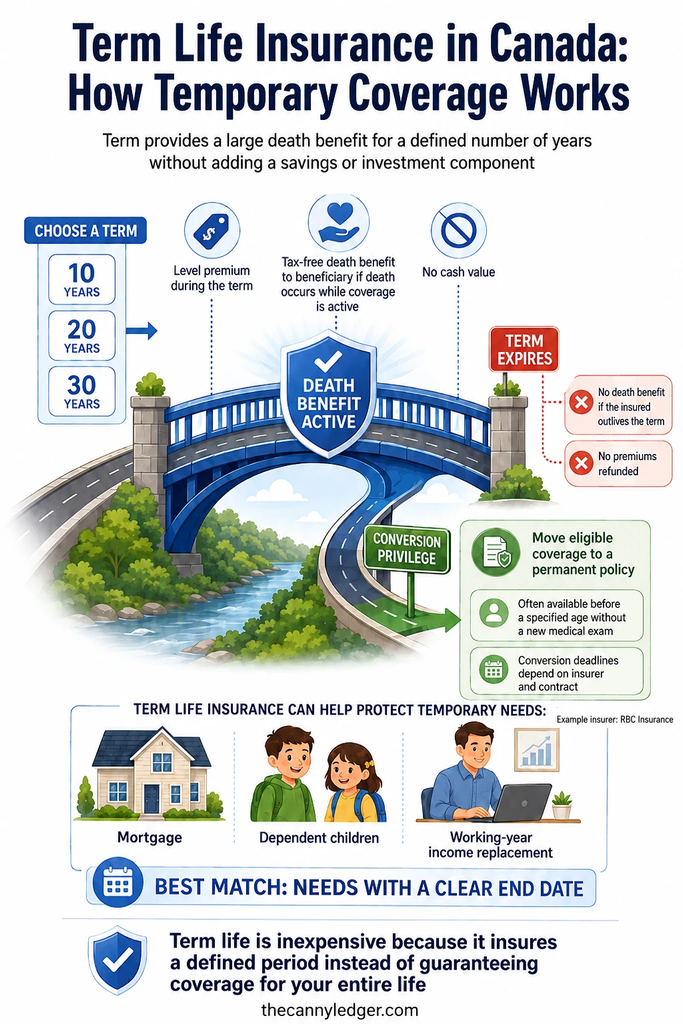
Term life insurance covers you for a fixed period, typically 10, 20, or 30 years, and pays a tax-free death benefit if you die during that window. There’s no cash value, no investment component, and no payout if the term expires before you do. This structure is exactly why it’s the cheapest option available, since the insurer is pricing pure risk over a defined period rather than also managing decades of accumulated savings on your behalf.
Almost every Canadian term policy includes a conversion privilege, letting you switch some or all of the coverage to a permanent policy before a set age, usually somewhere between 65 and 70, without a new medical exam. This matters if your health changes partway through a term and buying fresh coverage later would otherwise mean requalifying medically at a worse rate, or not qualifying at all.
Whole Life Insurance
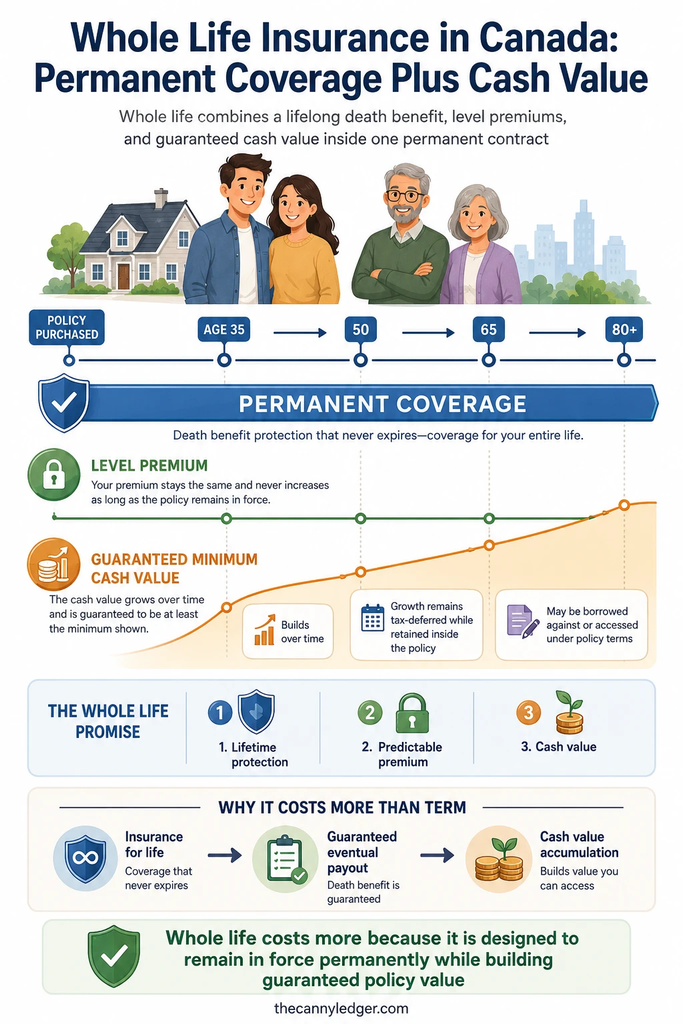
Whole life insurance covers you for your entire life rather than a fixed term, with premiums that stay level and a guaranteed minimum cash value that builds inside the policy over time. That cash value can generally be borrowed against or withdrawn while you’re alive, and it grows tax-deferred as long as it stays inside the policy. Because the insurer is guaranteeing coverage for your entire lifespan and building a savings component alongside it, the premium reflects that added certainty and complexity, which is the core reason it costs so much more than term.
Participating Whole Life Insurance
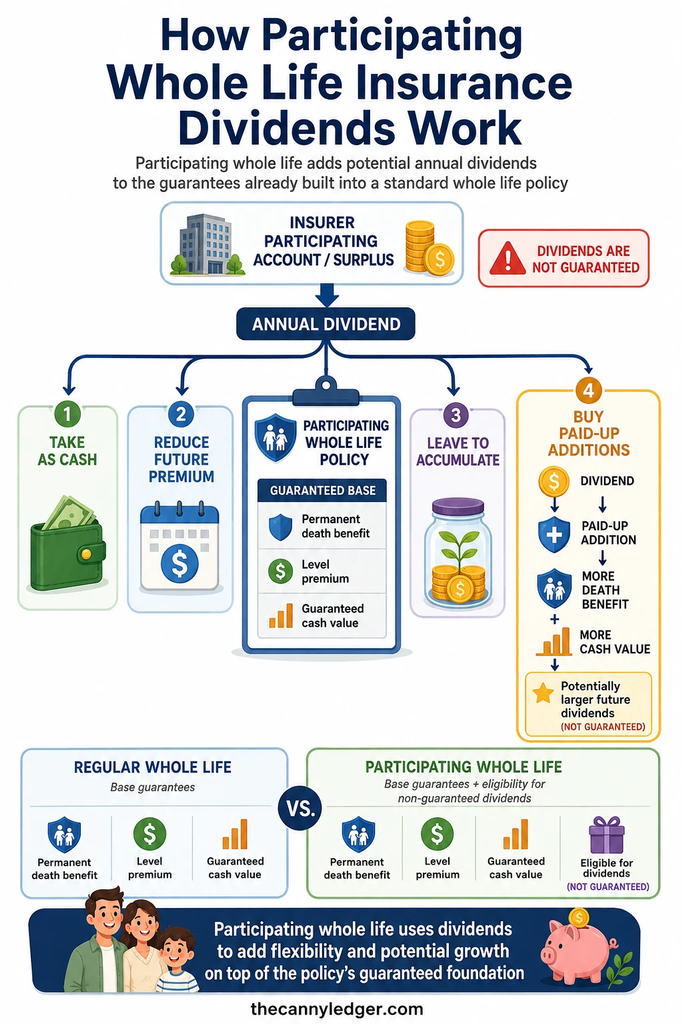
A participating whole life policy works the same way as ordinary whole life, with one addition. As a policyholder, you become eligible for annual dividends declared by the insurer, generally paid out of the insurance company’s surplus earnings. These dividends aren’t guaranteed the way the base cash value is, but insurers with a long track record of paying them treat this as a core feature rather than an occasional bonus. You can typically take the dividend as cash, use it to reduce future premiums, let it accumulate with interest inside the policy, or use it to buy paid-up additions, which increase both the death benefit and the cash value going forward without any new underwriting.
Universal Life Insurance
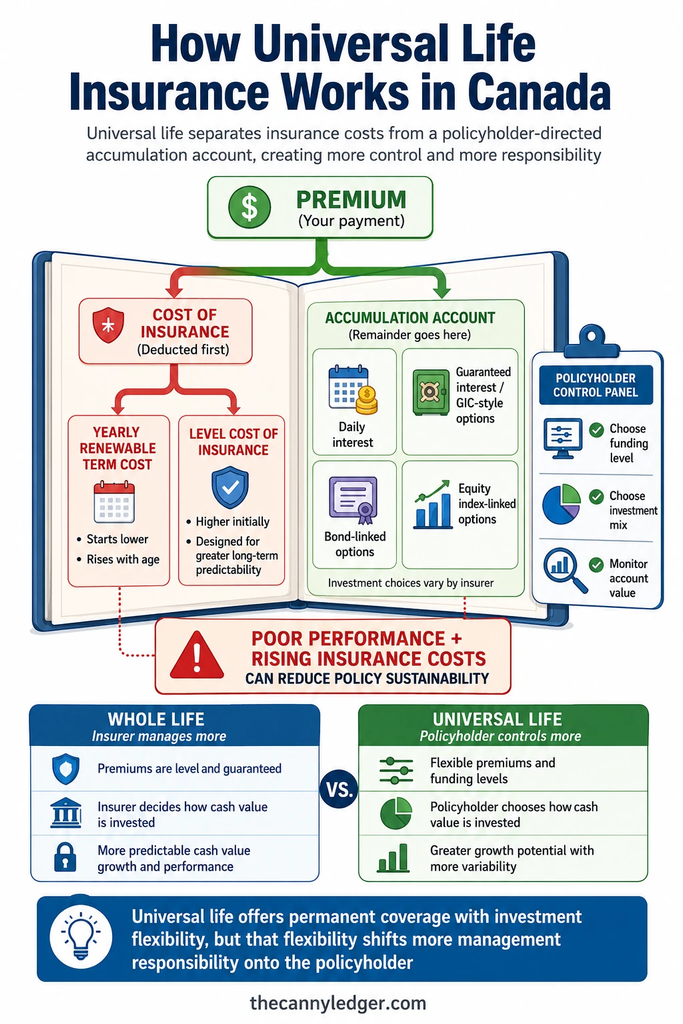
Universal life insurance separates the death benefit from the savings component more explicitly than whole life does. Each month, the insurer deducts the cost of insurance from a separate accumulation account, and whatever balance remains grows tax-deferred, sheltered under the exempt policy rules in the Income Tax Act. You typically choose how that account is invested, from a guaranteed daily interest account to GICs to equity or bond index-linked funds, which gives you far more control than a whole life policy but also puts more of the investment decision-making, and risk, in your own hands, a tradeoff worth weighing directly against the alternative before deciding. The cost of insurance itself can be structured as yearly renewable term, starting low and rising as you age, or as a level cost fixed for life, which costs more early on but avoids the steep increases yearly renewable term brings later.
Term-to-100 Life Insurance
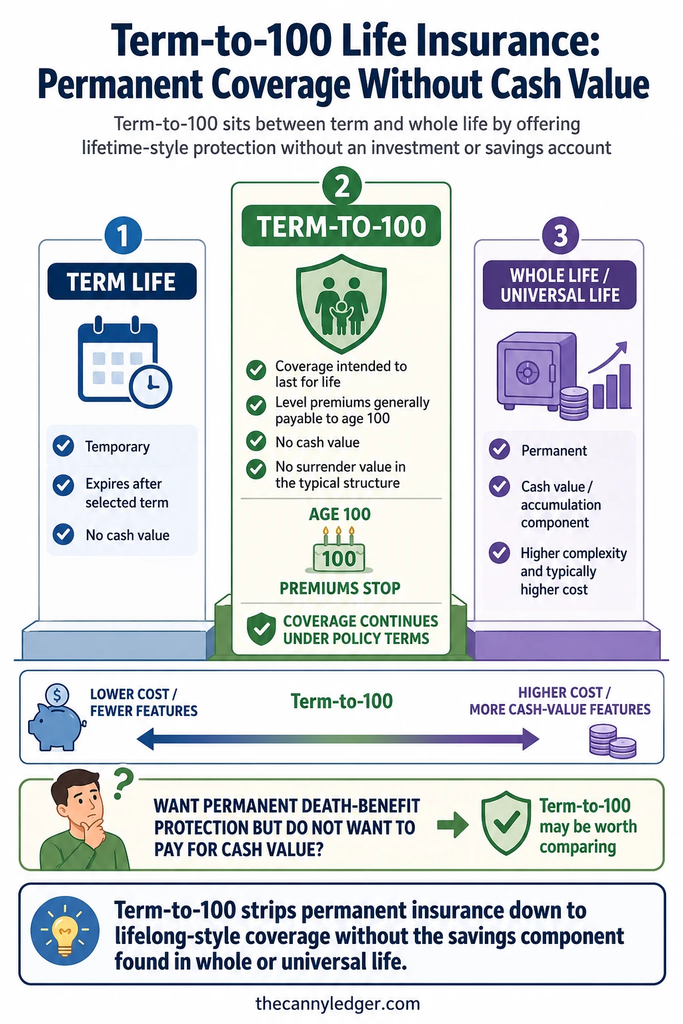
Term-to-100 sits in an odd middle ground. It provides coverage for your entire life, like whole or universal life, with premiums that stay level until age 100, after which no further premiums are required. Unlike whole or universal life, though, it builds no cash value at all, and surrendering the policy before death typically returns nothing. This makes it simpler to understand and often cheaper than other permanent options, appealing to someone who wants coverage that never expires without paying for a savings component they don’t plan to use.
No-Medical and Guaranteed Issue Policies
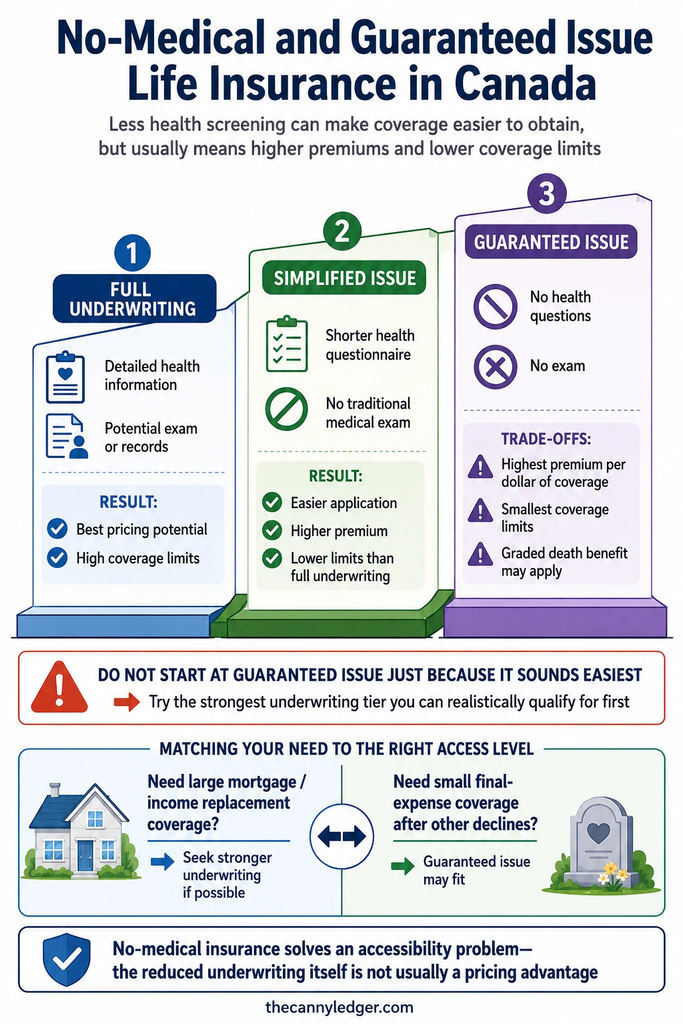
Simplified issue and guaranteed issue policies skip the traditional medical exam, relying instead on a short health questionnaire or, in the case of guaranteed issue, no health screening at all, an approach covered in full in the no-medical life insurance guide. This makes them accessible to people who wouldn’t qualify for medically underwritten coverage, but it comes at a real cost. Premiums run noticeably higher for the same coverage amount, and maximum coverage limits are typically much lower than what a fully underwritten policy would allow. These policies exist specifically to serve people who genuinely can’t get coverage any other way, not as a shortcut for someone who could qualify through the standard process at a better rate.
Joint Life Insurance
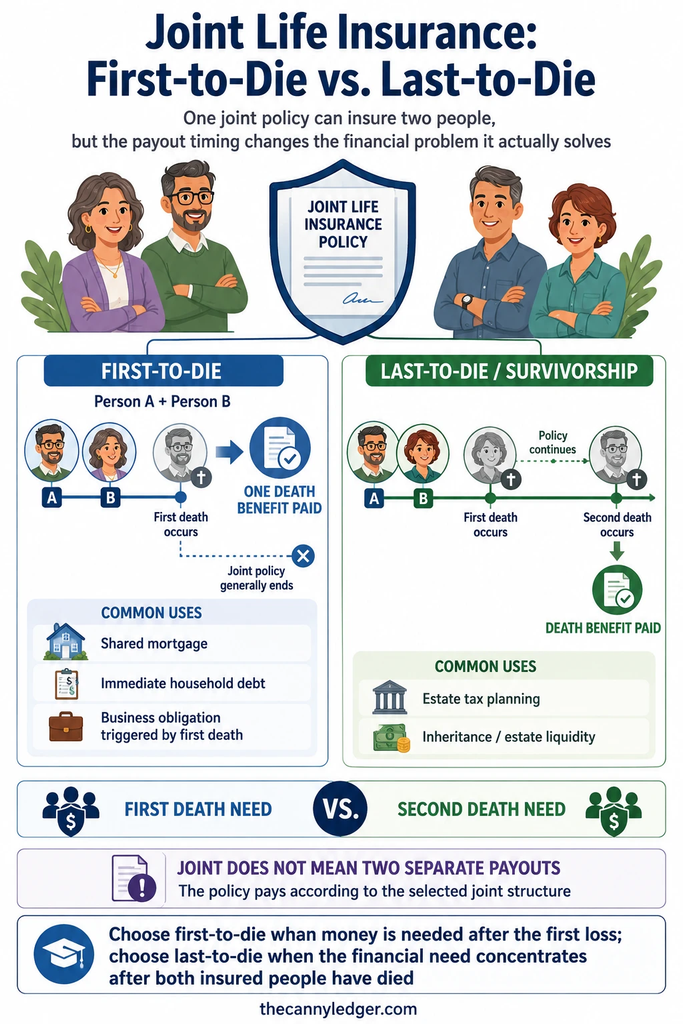
A joint life policy covers two people, typically spouses, under a single contract rather than two separate policies. A first-to-die structure pays out when the first of the two people dies, which can work for covering a shared debt like a mortgage. A second-to-die, or survivorship, structure pays only after both people have died, and shows up most often in estate planning, since it’s specifically timed to help cover a tax bill that comes due on the death of the second spouse rather than the first.
Group and Business Life Insurance
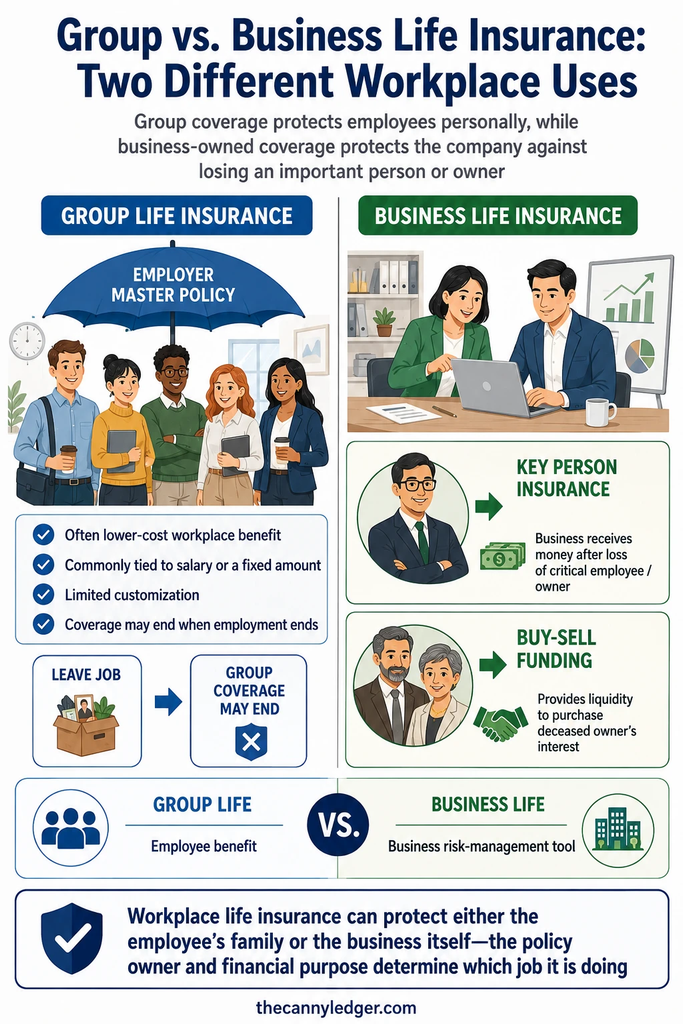
Group life insurance is typically offered through an employer, covering employees under a master policy, usually at a lower per-person cost than individual coverage but with less flexibility and coverage that generally ends if you leave the job. Business life insurance covers a different need entirely, often insuring a key employee or business partner so the company can absorb the financial impact of losing them, or funding a buy-sell agreement between partners so a surviving owner can buy out a deceased partner’s share without a cash crunch.
What Happens if Your Insurer Fails
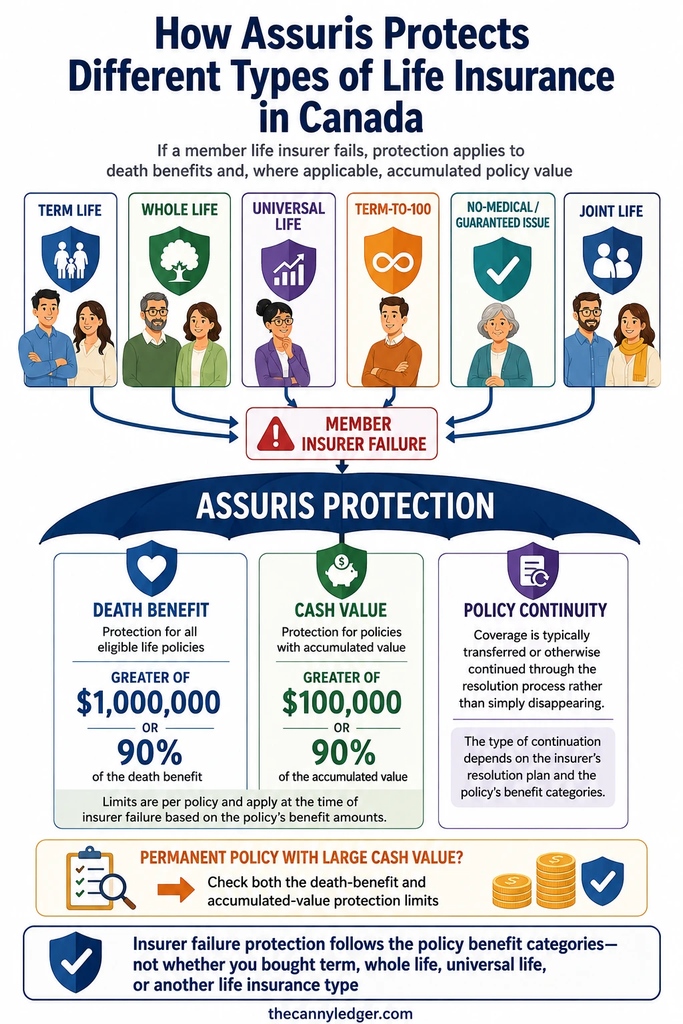
This is worth knowing regardless of which type you choose. Every life insurer licensed to sell policies in Canada has to belong to Assuris, the industry-funded body that protects policyholders if a member company becomes insolvent. If that happens, Assuris guarantees you’ll retain the greater of $1,000,000 or 90 percent of your death benefit, and for a whole or universal life policy with cash value, the greater of $100,000 or 90 percent of that cash value as well. Coverage doesn’t just disappear if an insurer fails. It typically transfers to another insurer with these guarantees intact.
Choosing the Right Type
Start by asking whether the need is temporary or permanent. A mortgage, a young family’s income replacement, or debt that will eventually be paid off points toward term, since there’s a clear end date after which the coverage genuinely isn’t needed anymore. Estate planning, a permanent tax liability at death, or a desire to build tax-deferred savings alongside coverage points toward one of the permanent options instead, and the choice between whole life’s guarantees and universal life’s flexibility usually comes down to whether you want the insurer managing the investment decisions or want to manage them yourself. Whatever you choose, confirm the actual cost for your age and health situation directly with a licensed advisor or broker before assuming any of the figures above apply exactly to your own circumstances, since underwriting classifications shift the real premium considerably from one applicant to the next.