
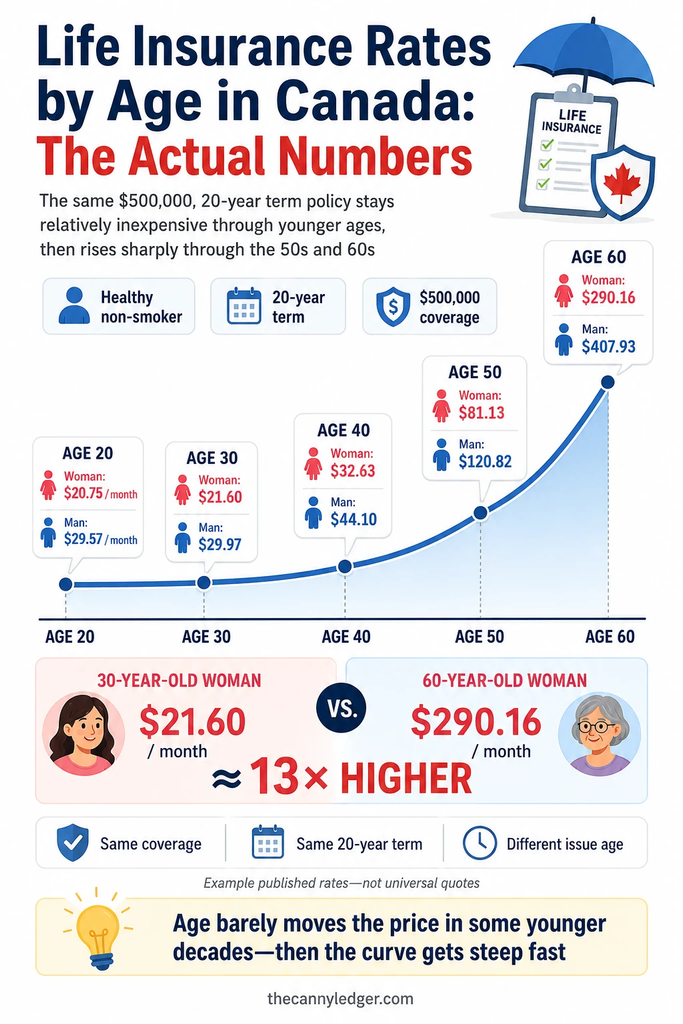
A 30-year-old woman buying a 20-year, $500,000 term policy pays $21.60 a month. A 60-year-old woman buying the exact same policy, same coverage, same term length, pays $290.16 a month, according to RBC Insurance’s own published Simplified Term Life Insurance rates as of February 2026. That’s not a rounding difference or a market fluctuation. It’s a thirteen-fold jump for identical paperwork, and it captures something most general advice about “buying life insurance early” never quite puts into a real number, which is exactly how much waiting actually costs.
- What the Actual Numbers Look Like
- Why Age Carries So Much Weight in the Price
- The Gap Between Men and Women, in Actual Dollars
- What Smoking Does to Every Number Above
- What Waiting a Decade Actually Costs
- Coverage Amount Moves the Number Too, Just Not Proportionally
- What Happens Once You’re Past 60
- The Actual Decision This Data Points To
- Frequently Asked Questions
Life insurance rates climb with age because insurers price coverage against mortality risk, and that risk rises steeply after your mid-40s. For a $500,000, 20-year term policy, a healthy 30-year-old non-smoker might pay $20 to $30 a month, while the same policy for a 60-year-old can run well over $290 a month, with the steepest jumps happening after age 50.
What the Actual Numbers Look Like
Insurers don’t publish identical rate cards, so any age breakdown is only as good as the specific source behind it, and the full picture of what drives life insurance cost includes several other factors beyond age alone. Using RBC Insurance’s published rates for its Simplified Term Life Insurance product, current as of February 2026, for a healthy non-smoker buying a 20-year term policy with $500,000 in coverage, the monthly premium looks like this by age. At 20, $20.75 for a woman and $29.57 for a man. At 30, $21.60 and $29.97. At 40, $32.63 and $44.10. At 50, $81.13 and $120.82. At 60, $290.16 and $407.93. Notice how flat the line stays from 20 to 30, a decade that barely moves the price, before it starts climbing steadily through the 40s and then steeply through the 50s and 60s.
Why Age Carries So Much Weight in the Price
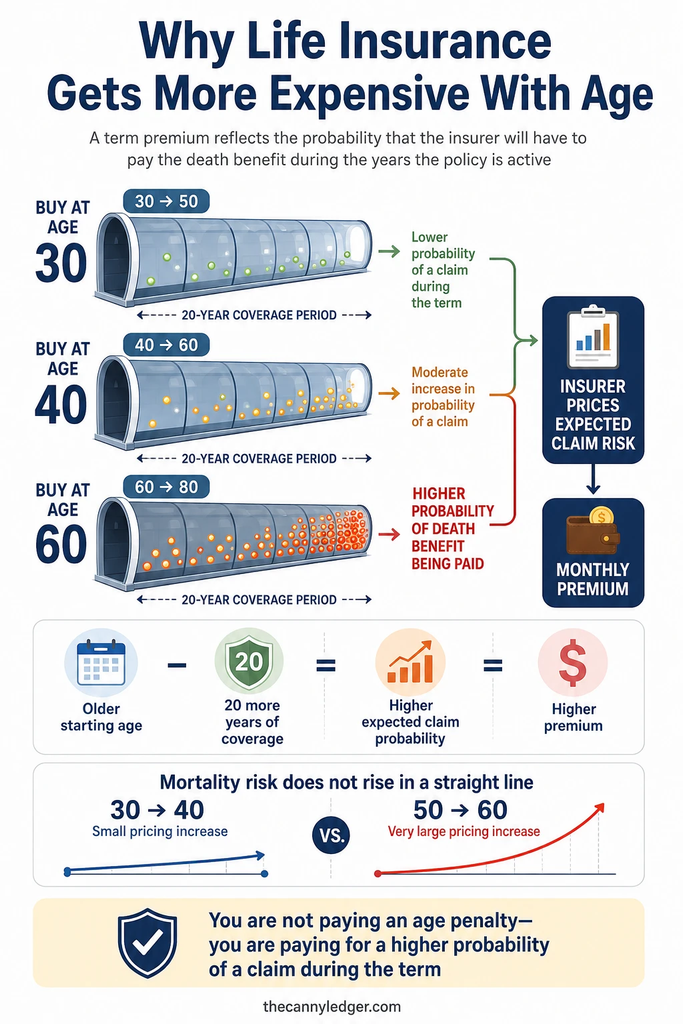
The mechanics behind this curve aren’t arbitrary. An insurer pricing a 20-year term policy is estimating the odds that a specific death benefit gets paid out sometime in the next two decades, and that probability isn’t remotely linear with age. A healthy 30-year-old and a healthy 40-year-old carry fairly similar short-term mortality risk, which is why the premium gap between those two decades is real but modest. By the time someone is 60, a 20-year term stretches the coverage out to age 80, a window where the statistical odds of a claim are meaningfully higher, and the premium reflects that compounding risk rather than a simple age-based markup. It’s the same underlying logic covered in more depth when looking at how term life insurance is priced generally, just made concrete with an actual rate card instead of general ranges.
The Gap Between Men and Women, in Actual Dollars
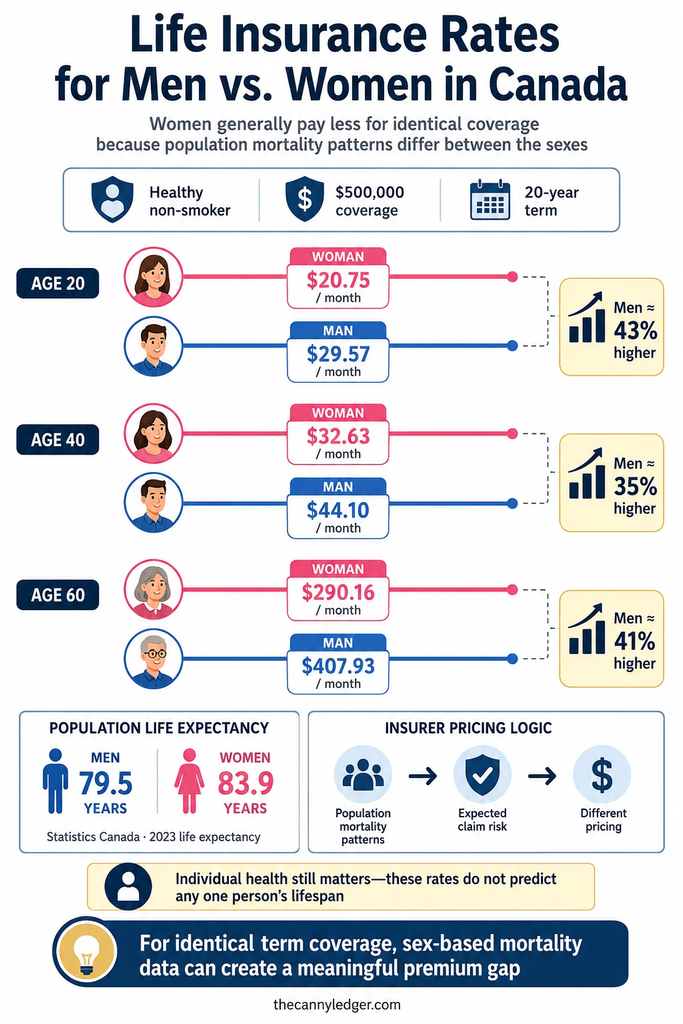
The RBC table also makes the sex-based pricing gap easy to see rather than just describe. At age 20, men pay about 43 percent more than women for identical coverage. At age 40, that gap narrows slightly to around 35 percent. By age 60, it widens back out to about 41 percent. This isn’t arbitrary either. Statistics Canada’s most recent life expectancy data puts men at 79.5 years and women at 83.9 years as of 2023, a gap of more than four years, and insurers price mortality risk against exactly that kind of population-level data rather than any individual’s actual health.
What Smoking Does to Every Number Above
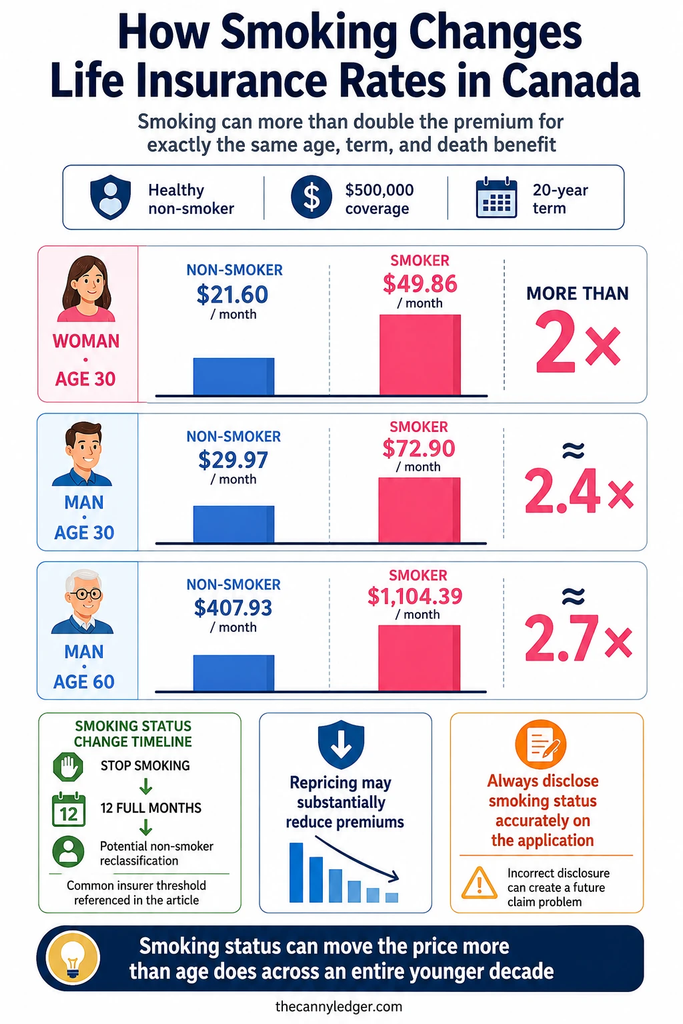
Smoking status changes these figures more dramatically than almost any other factor, and the RBC smoker rates for the same $500,000, 20-year policy make the size of that jump concrete. At 30, a female smoker pays $49.86 a month against $21.60 for a non-smoker, more than double. At 30, a male smoker pays $72.90 against $29.97, closing in on triple. By 60, a male smoker’s premium reaches $1,104.39 a month against $407.93 for a non-smoker of the same age. Smoking remains the leading cause of preventable death in Canada, and insurers price that risk aggressively enough that quitting for a full 12 months, the threshold most insurers use to reclassify someone as a non-smoker, can cut a premium by more than half.
What Waiting a Decade Actually Costs
Here’s the calculation that rarely gets spelled out plainly. Using the RBC figures above, a 30-year-old woman locking in a 20-year term today pays $21.60 a month, for a total of $5,184 over the full 20-year term. Wait until 40 to buy the identical 20-year, $500,000 policy, and the monthly premium jumps to $32.63, for a total of $7,831.20 over that term, an extra $2,647.20 in total premium purely from waiting a decade, even before accounting for the fact that the later-purchased policy also expires 10 years sooner in absolute terms, at age 60 instead of 50. That gap only grows if the decade of waiting includes any new health diagnosis serious enough to affect underwriting, which can turn a delay into something closer to a permanent rate increase rather than a temporary one.
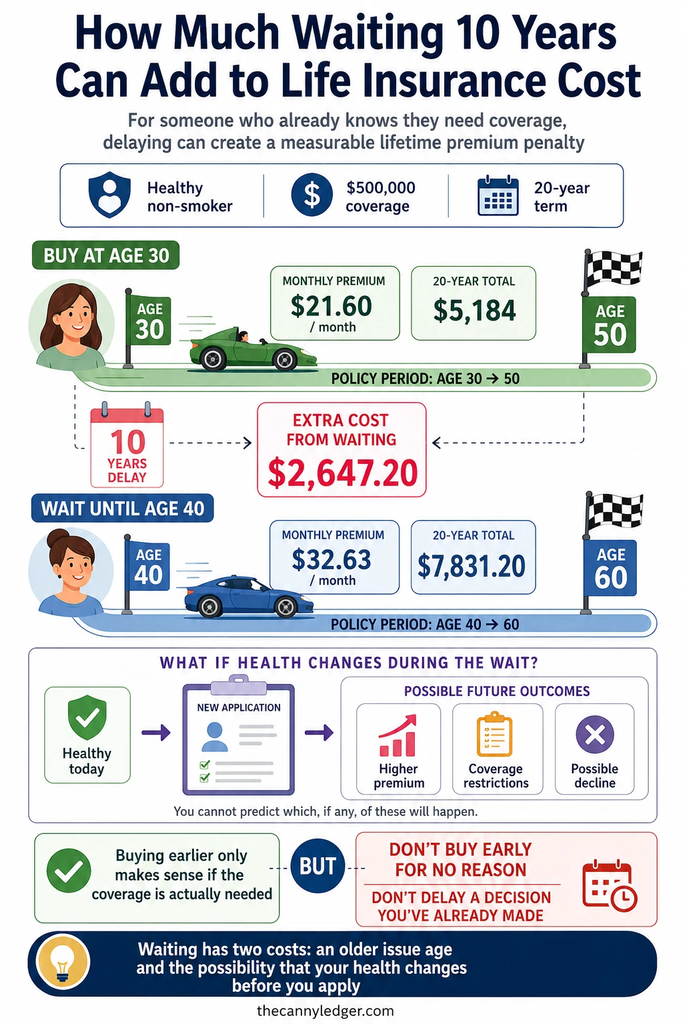
Coverage Amount Moves the Number Too, Just Not Proportionally
Age isn’t the only lever, and it’s worth understanding how coverage amount interacts with it. RBC’s own coverage table for a 40-year-old non-smoker shows a $500,000 policy costing $44.10 a month for a man, while a full $1,000,000 in coverage costs $81.99, not the $88.20 a straight doubling would suggest. A portion of every premium covers fixed administrative cost rather than pure mortality risk, so buying more coverage per dollar spent becomes progressively more efficient at higher amounts, a detail worth factoring in before defaulting to a round coverage number just because it sounds sufficient.
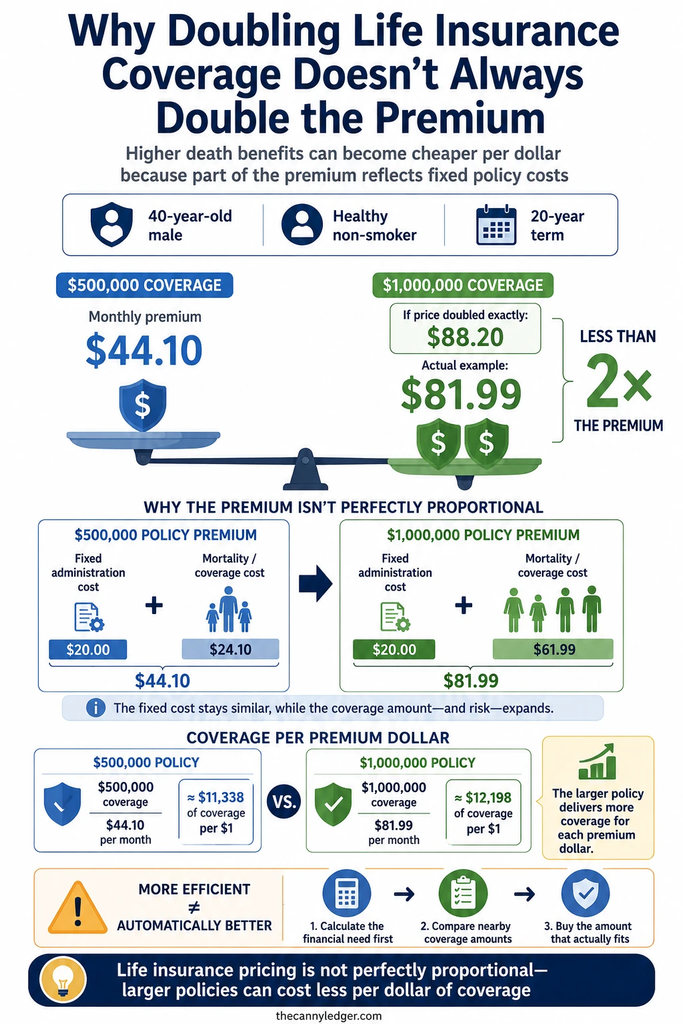
What Happens Once You’re Past 60
The steep climb shown in the table above doesn’t level off after 60, it keeps accelerating, and term coverage becomes both harder to qualify for and less commonly offered past certain ages depending on the insurer. Anyone still shopping for coverage later in life is working with a meaningfully different set of options than someone buying in their 30s, often trading term length for a shorter window or shifting toward guaranteed-issue products that skip medical underwriting entirely in exchange for a higher price per dollar of coverage. For those specifically past 70, the calculus shifts again, since fewer insurers offer new term policies at all beyond that point.
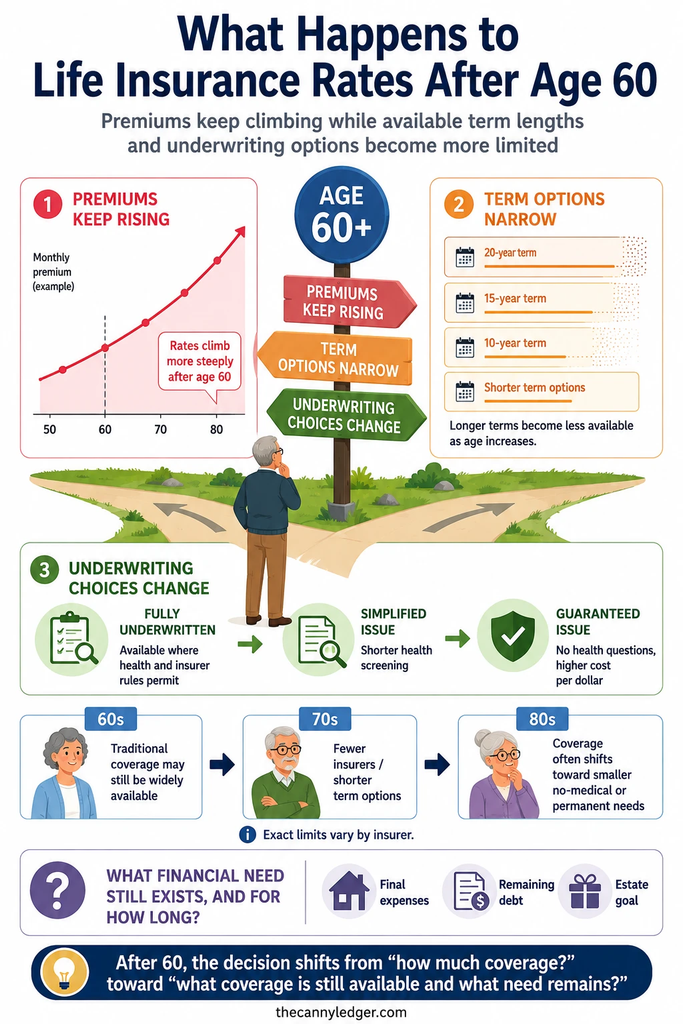
The Actual Decision This Data Points To
None of this means everyone should rush to buy the largest policy available the moment they turn 20. It does mean that delaying a purchase that’s already been decided on, simply because there’s no urgent deadline forcing the decision, has a real, calculable cost that gets larger every year it’s postponed. Industry-wide data compiled by CLHIA confirms these age-based pricing patterns hold across the sector rather than being unique to one insurer’s rate card, so the underlying lesson applies regardless of which company someone eventually buys from. Someone who knows they’ll eventually need coverage, whether for a mortgage, dependents, or income replacement, is better served locking in today’s rate for their current age than waiting for a more convenient moment that only makes the eventual premium more expensive.
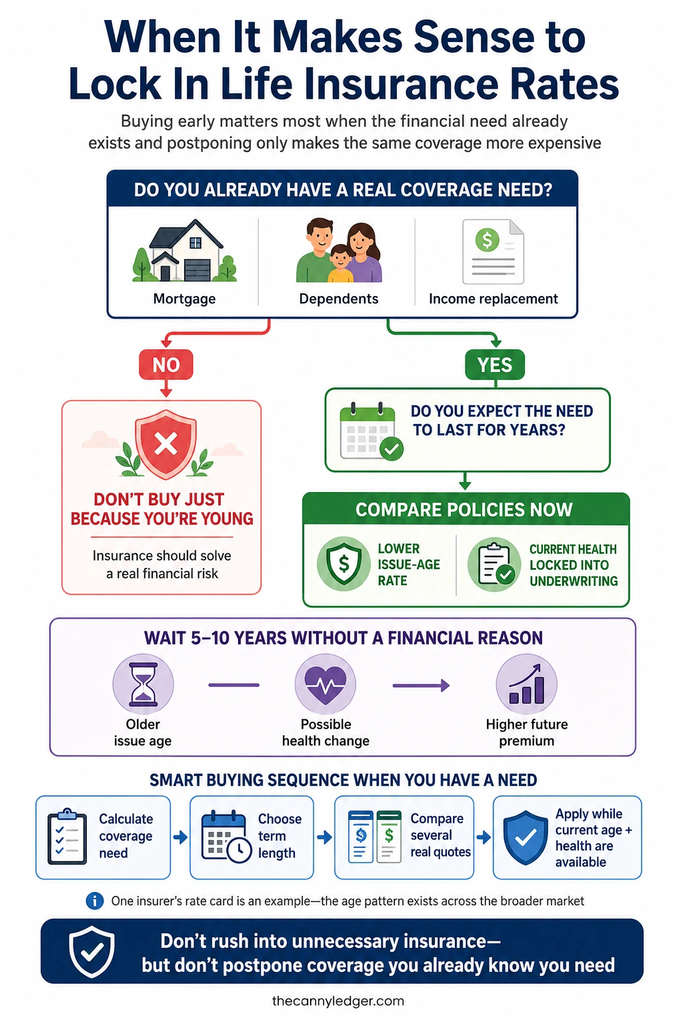
Frequently Asked Questions
Do these age-based rates apply the same way to permanent life insurance? The same underlying principle, higher age means higher price, applies to whole life and universal life insurance too, but the dollar amounts are substantially higher across every age band since permanent coverage also has to fund guaranteed lifetime coverage and cash value rather than pure term protection.
Can locking in a rate today protect against future rate increases? Yes, for the length of the term. A level term policy keeps the same premium for the entire term length regardless of what happens to age-based pricing in the broader market, which is exactly why the timing of the initial purchase matters as much as it does, and why coverage that never expires, such as Assuris-protected permanent policies, locks that certainty in for life rather than just for a term.
Is it worth getting quotes from more than one insurer given how much rates vary by company? Yes. Since each insurer builds its own rate tables, the same age, coverage amount, and health profile can produce noticeably different premiums between companies, and comparing quotes directly rather than relying on one insurer’s numbers is one of the more reliable ways to find a lower rate for identical coverage.
Does a rate ever get cheaper as you get older? Rarely, and only in specific circumstances like a confirmed 12-month non-smoking milestone or a health improvement that moves someone into a better rate class, neither of which relates to age itself moving in the buyer’s favour.