

Two people earning the exact same $80,000 salary can have completely different life insurance needs, and a flat multiple of income has no way of telling them apart. One has a paid-off house, a working spouse, and grown kids. The other has a $500,000 mortgage, a spouse who stays home with two toddlers, and twenty years of parenting still ahead. The “10 times your salary” rule that gets repeated everywhere hands both of them the same $800,000 number, which is either far too much or nowhere near enough depending on which person we’re talking about.
- Why the Income Multiple Gets Repeated Anyway
- Building the Real Number, Piece by Piece
- What to Actually Subtract, and What Not To
- The Underinsurance Problem This Solves
- Why This Number Isn’t Meant to Stay the Same Forever
- Two Directions to Get This Wrong
- A Few Situations That Don’t Fit the Standard Formula
- Where to Go From Here
- Frequently Asked Questions
The amount of life insurance you actually need in Canada is best calculated from your specific debts, income replacement years, and future costs, minus your existing savings and coverage, not from a flat multiple of your salary. A common starting formula covers outstanding debt, income replacement for a set number of years, remaining mortgage balance, and future costs like education, then subtracts what you already have in savings and existing coverage.
Why the Income Multiple Gets Repeated Anyway
Rules of thumb exist because they’re easy to say out loud, and “seven to ten times your income” is the version most commonly cited by Canadian insurers as a rough starting point, not a finished answer, a caveat Sun Life itself makes plainly when it notes that the multiple works for some households but not everyone. It works reasonably well as a first estimate precisely because income correlates loosely with lifestyle and typical family size, but it ignores everything that actually varies between two households earning the same amount. It doesn’t know whether the mortgage is paid off or brand new. It doesn’t know whether there’s a second income in the house or one income supporting everyone. It doesn’t know whether retirement savings are already substantial or barely started. Treating the multiple as a ceiling to reach rather than a rough sanity check is where the rule of thumb stops being useful and starts being actively misleading.

Building the Real Number, Piece by Piece
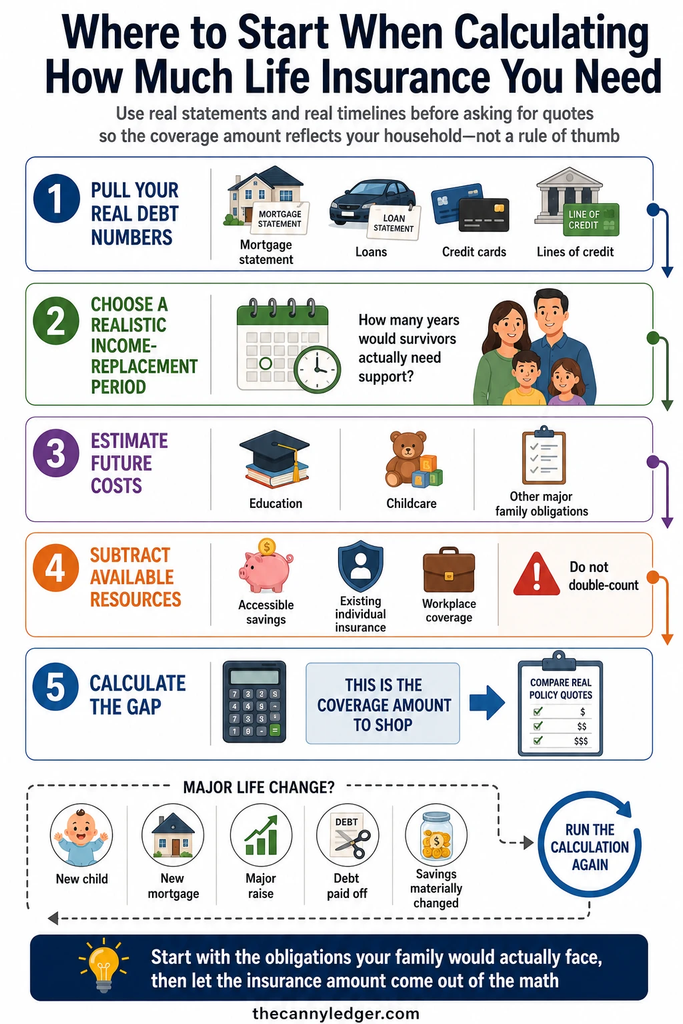
A more accurate starting point adds up four categories of need and then subtracts what’s already covered elsewhere. Start with outstanding debt, every loan, credit card balance, and line of credit that would otherwise fall to an estate or a surviving spouse. Add income replacement, calculated as annual income multiplied by the number of years that income would need to be replaced, commonly five to fifteen years depending on the ages of any dependents and how far off retirement is. Add the remaining mortgage balance specifically, since it’s often the single largest debt and deserves its own line rather than getting buried inside general debt. Add anticipated future costs, most commonly a realistic estimate for children’s post-secondary education.
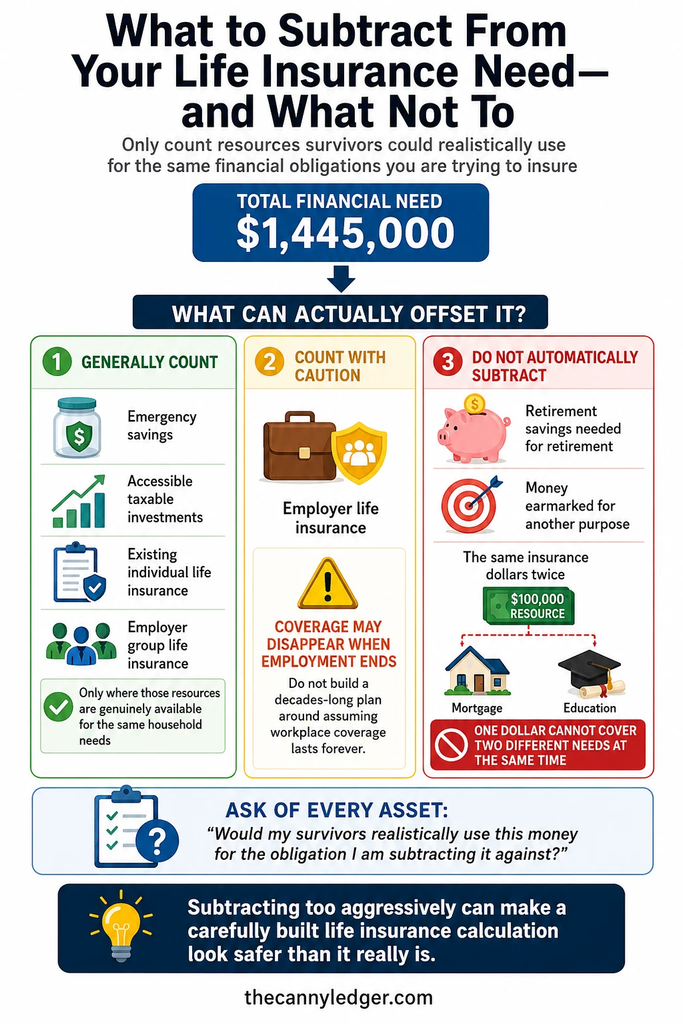
Picture a 38-year-old with $15,000 in car and credit card debt, a $350,000 remaining mortgage balance, an $85,000 income they want replaced for 12 years, and two kids they’d like to set aside $30,000 each for post-secondary costs. That’s $15,000 in debt, $1,020,000 in income replacement, $350,000 in mortgage, and $60,000 in education, adding up to $1,445,000 before subtracting anything. From that total, subtract accessible savings and investments that aren’t earmarked for retirement, and subtract any existing life insurance already in place, including a workplace group policy. If that household has $40,000 in accessible savings and a $150,000 group policy through work, the actual gap left to cover with an individual policy comes out to $1,255,000, a specific number built from that household’s real situation rather than borrowed from a generic multiple.

What to Actually Subtract, and What Not To
Getting the subtraction half of this calculation right matters as much as the addition half. Accessible savings means money that could realistically be used quickly, a taxable investment account or an emergency fund, not retirement accounts that would trigger tax consequences or long-term savings earmarked for something else entirely. Existing life insurance means the full picture, not just an individual policy if one exists. A group life insurance policy through an employer counts here too, though it’s worth remembering that coverage typically ends the day employment does, which is a reason to size an individually owned term policy around the assumption that the group coverage might not always be there, rather than leaning on it permanently. What shouldn’t get subtracted is coverage that’s specifically earmarked for something else already accounted for elsewhere in the calculation, since double-counting the same dollar against two different needs understates what’s actually required.
The Underinsurance Problem This Solves
This isn’t a hypothetical exercise. According to LIMRA’s Canadian Insurance Barometer research, 31 percent of Canadian adults, roughly 8.4 million people, say they need life insurance or need more of it than they currently have. A meaningful share of that gap traces back to exactly this kind of miscalculation, a policy bought years ago against an old mortgage and an old salary that never got revisited as both grew. Canada Life’s own consumer guidance cites average household life insurance protection well below what a full needs calculation typically recommends for a family carrying a mortgage and dependent children, which lines up with how often the flat multiple undershoots what a specific household’s real obligations actually add up to.

Why This Number Isn’t Meant to Stay the Same Forever
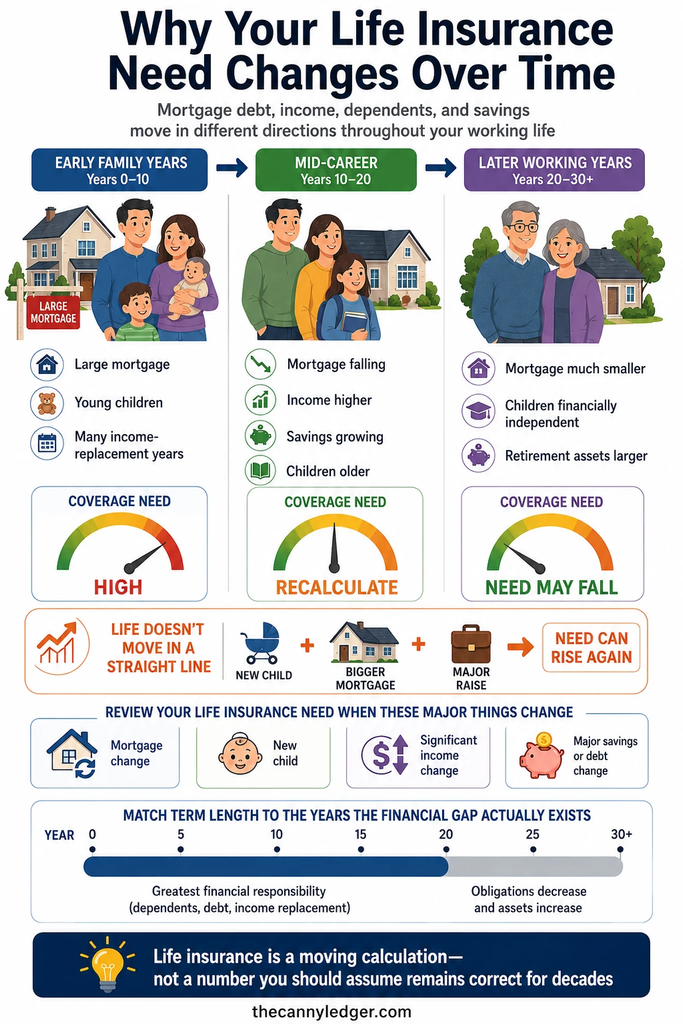
The figure calculated today reflects today’s mortgage balance, today’s income, and today’s number of dependent years remaining, all of which shift over a working life. A mortgage gets paid down. An income grows. Kids age out of the years where income replacement matters most for them specifically. This is exactly why matching term length to actual need rather than buying one large policy and assuming it’s permanently correct tends to serve most households better, and it’s worth rerunning this calculation after any major life event, a mortgage renewal, a new child, a significant raise, rather than treating the number from a decade ago as still accurate. Reviewing how the total cost of coverage changes as the death benefit shifts at the same time makes it easier to see whether an adjustment is actually affordable before committing to it.
Two Directions to Get This Wrong
Underbuying is the more commonly discussed mistake, and the consequence is obvious, a family left without enough to cover what the calculation would have called for. Overbuying gets less attention but carries its own real cost. Coverage padded well beyond what the actual numbers support means paying an ongoing premium for protection that was never sized against a real need, money that could otherwise go toward the same savings and investments that would eventually reduce how much coverage is even necessary. Neither direction is really about being cautious or reckless. Both come from skipping the actual calculation and defaulting to a round number that feels safe without being checked against anything specific.

A Few Situations That Don’t Fit the Standard Formula
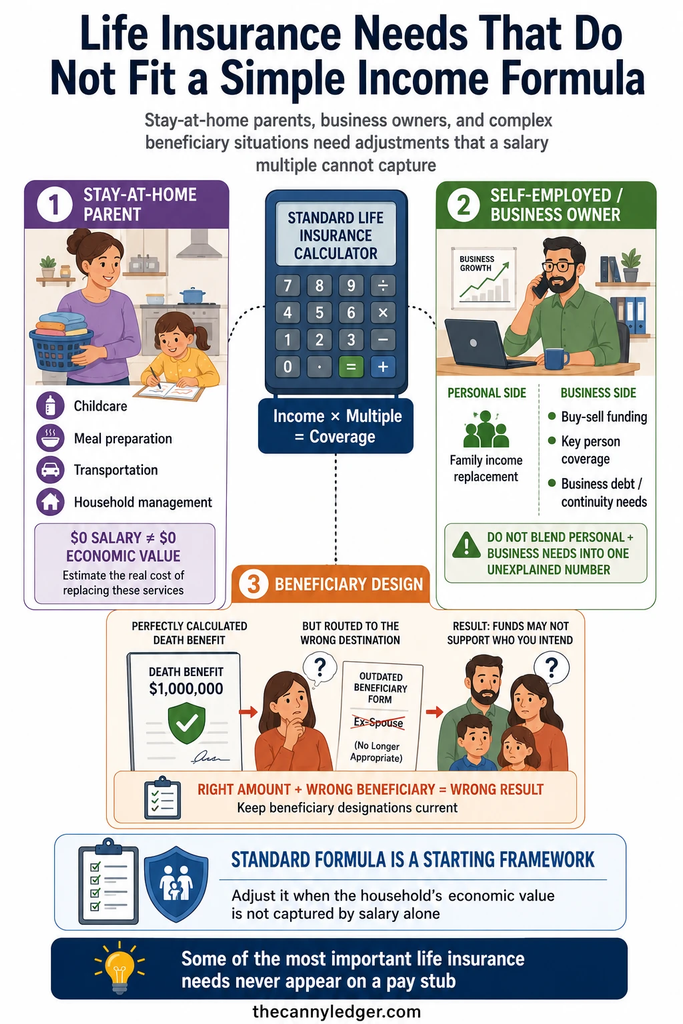
A stay-at-home parent with no salary still has a real economic value worth insuring, since replacing childcare, household management, and everything else that role covers costs real money even without a paycheque attached to it, a point the Financial Consumer Agency of Canada touches on when describing who life insurance protects, and skipping that calculation because there’s no income line to multiply is a common oversight. Self-employed individuals and business owners face a related wrinkle, where business-specific coverage needs for things like a buy-sell agreement or key person protection sit entirely separate from personal income replacement and shouldn’t get blended into the same total. And naming the right beneficiary on whatever coverage gets purchased matters just as much as getting the amount right, since even a perfectly calculated policy doesn’t help the intended people if the payout is routed somewhere else.
Where to Go From Here
Run the actual numbers rather than defaulting to a multiple of income, using real figures for current debt, a realistic number of income replacement years, the actual remaining mortgage balance, and a genuine estimate for future costs like education. Subtract what’s already covered through savings and existing policies, including anything through work, and treat the result as the number to actually shop for rather than rounding it to something that sounds more familiar. A life insurance calculator can speed up this process, but the output is only as accurate as the real numbers entered into it, so it’s worth pulling an actual mortgage statement and a real sense of income replacement years before running it rather than guessing at the inputs.
Frequently Asked Questions
Should both spouses in a household carry the same amount of coverage? Not necessarily. Coverage should reflect what each person’s income or economic contribution would actually cost to replace, which can differ significantly between two spouses even in the same household, particularly when one income is meaningfully higher or one spouse handles unpaid work like childcare.
Does this calculation change once a mortgage is paid off? Yes, substantially, since the mortgage line disappears entirely from the total and income replacement years typically shrink as retirement gets closer, which is part of why the number calculated in someone’s 30s usually looks very different from the number that makes sense in their 50s.
How many years of income replacement is realistic to include? TD Insurance’s own needs framework points to replacing income for a period tied to how long dependents will actually need it, commonly 10 years, though the right number depends on the ages of any children and how far a surviving spouse is from their own retirement.
Is it worth including funeral and final expenses in this total? Yes, since these costs land immediately rather than over time, and they’re easy to overlook when the calculation focuses mainly on mortgage and income figures, even though the amount involved is usually small relative to the rest of the total.

