

Ask most Canadians what critical illness insurance actually does and you’ll usually get some version of “it’s like life insurance but for getting sick instead of dying.” That description misses the one detail that actually matters most. Critical illness insurance pays you, while you’re alive, so you can deal with a serious diagnosis without your finances collapsing at the same time. Life insurance pays your beneficiaries after you’re gone. These aren’t two versions of the same idea with different triggers attached. They’re built to solve opposite financial problems, and treating them as interchangeable is exactly how people end up with a gap in coverage nobody notices until it’s too late to fix.
- What Life Insurance Actually Insures Against
- What Critical Illness Insurance Actually Insures Against
- The Survival Period Almost Nobody Reads Closely
- Comparing the Two Products Directly
- Why the Definitions Matter More Here Than With Life Insurance
- Why Many Canadians End Up With Both
- What Happens if Your Insurer Fails
- What Drives the Cost Difference
- Mistakes People Make Comparing the Two
- Common Questions About Life Insurance vs Critical Illness Insurance
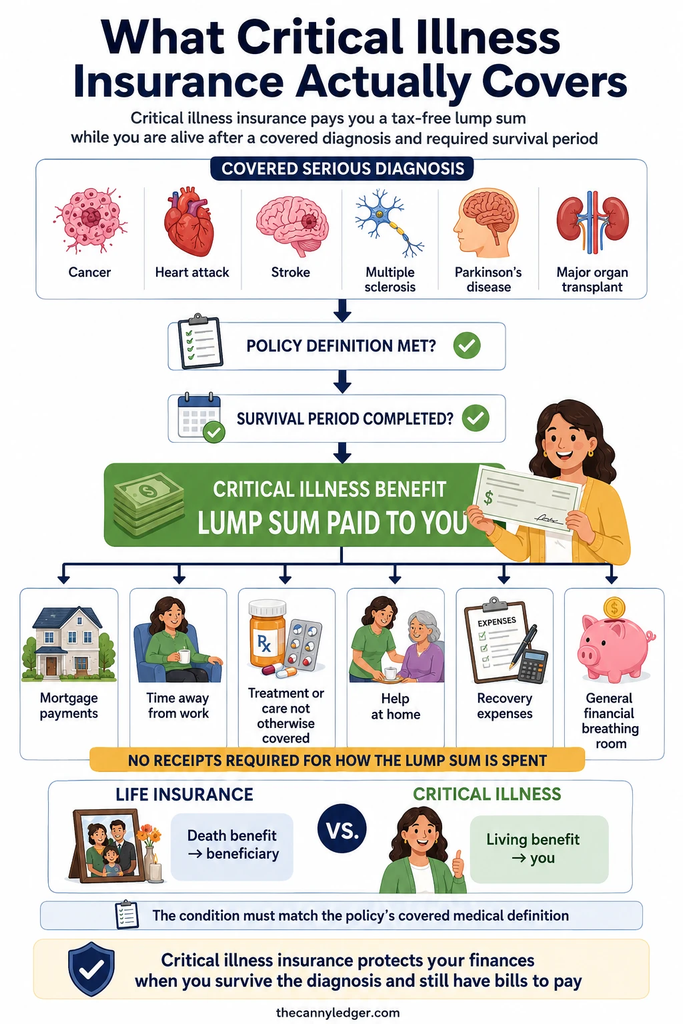
Life insurance provides a tax-free death benefit to your named beneficiaries when you die, protecting the people who depended on your income. Critical illness insurance provides a tax-free lump sum to you directly if you’re diagnosed with a covered serious condition and survive a required waiting period, protecting your own finances while you’re the one living through the illness and its aftermath, a distinction worth keeping in mind alongside what life insurance actually covers more broadly.
What Life Insurance Actually Insures Against
Life insurance exists to replace what disappears the moment you die, whether that’s income your family relied on, a mortgage that still needs paying, or the cost of raising children who suddenly have one less parent contributing financially. The insurer pays a fixed death benefit to whoever you’ve named as beneficiary, and that person can use the money for absolutely anything, since a life insurance payout comes with no restrictions on how it’s spent. This is the product most people already understand at least loosely, and the mechanics of term and permanent life insurance are covered in more depth elsewhere on this site.
What life insurance doesn’t do is help you if you survive a serious diagnosis. A cancer diagnosis, a heart attack, or a stroke that leaves you unable to work for months or years doesn’t trigger a life insurance payout at all, since nobody has died. This gap is exactly the space critical illness insurance was built to fill, and it’s a real gap, not a hypothetical one, given how often Canadians actually survive conditions that once would have been fatal.

What Critical Illness Insurance Actually Insures Against
Critical illness insurance pays a lump sum directly to you if you’re diagnosed with one of the specific conditions your policy covers, and unlike a health or disability claim, there’s no requirement to submit receipts or prove how the money gets spent. Canada Life describes this structure plainly, calling it a living benefit rather than a death benefit, a payment made to you while you’re alive rather than to your beneficiaries after you die. You might use it to cover a mortgage payment while you’re off work, pay for treatment not covered by your provincial health plan, bring in outside help at home, or simply give yourself breathing room to focus on recovery instead of finances.
The conditions covered aren’t left to each insurer’s imagination. The Canadian Life and Health Insurance Association publishes benchmark definitions for critical illness conditions, standardizing language across the industry so that terms like cancer, heart attack, and stroke mean roughly the same thing from one insurer’s policy to the next. Most Canadian critical illness policies cover conditions well beyond the big three, extending to multiple sclerosis, Parkinson’s disease, major organ transplant, and other serious diagnoses, though the exact list and the precise wording of each definition still varies by insurer even where CLHIA’s benchmark language is used as a starting point.
The Survival Period Almost Nobody Reads Closely
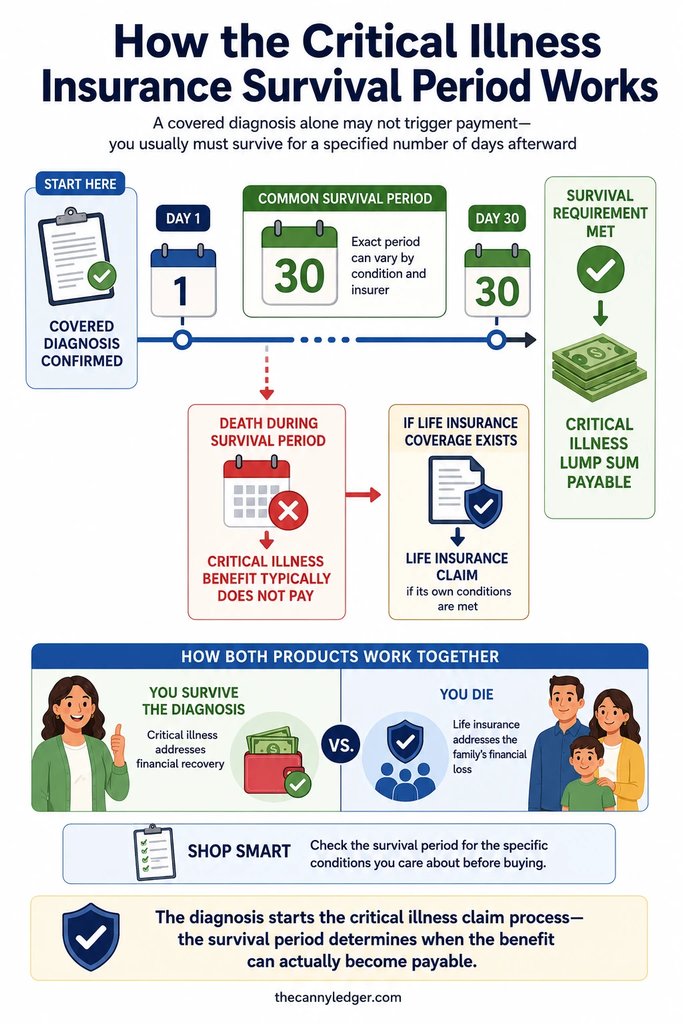
This is the part of critical illness insurance that catches people off guard, and it’s worth understanding before you ever need it rather than during a claim. Nearly every Canadian critical illness policy includes a survival period, a minimum number of days you have to live past your diagnosis before the benefit actually pays out. Thirty days is the most common length, though it can run shorter or longer depending on the specific condition and insurer, and if you die during that window, the critical illness benefit typically doesn’t pay at all.
The logic behind this rule isn’t arbitrary, even though it feels harsh at first read. If someone doesn’t survive the diagnosis long enough to actually experience the financial strain of recovery, medical bills, or missed income, the insurer treats life insurance as the more appropriate product to respond, since that’s precisely the scenario life insurance exists for. This is exactly why the two products are designed to complement each other rather than duplicate coverage, one steps in if you don’t survive, the other steps in if you do and now have to live with the financial fallout.
Comparing the Two Products Directly
Laid out side by side, the split between the two products is easier to see than it is in a sales conversation that treats critical illness insurance as an afterthought bolted onto a life insurance policy.
| Life Insurance | Critical Illness Insurance | |
|---|---|---|
| Who receives the payout | Your named beneficiaries | You, the policyholder |
| What triggers payment | Your death | Diagnosis of a covered condition, after a survival period |
| Restrictions on how the money is used | None | None |
| Tax treatment | Tax-free to beneficiaries | Tax-free lump sum to you |
| Definitions that determine a valid claim | Straightforward, death is not disputable | Strict, condition-specific medical definitions |
| Assuris protection if your insurer fails | Up to $1,000,000 or 90% of the benefit | Up to $250,000 or 90% of the benefit |

Why the Definitions Matter More Here Than With Life Insurance
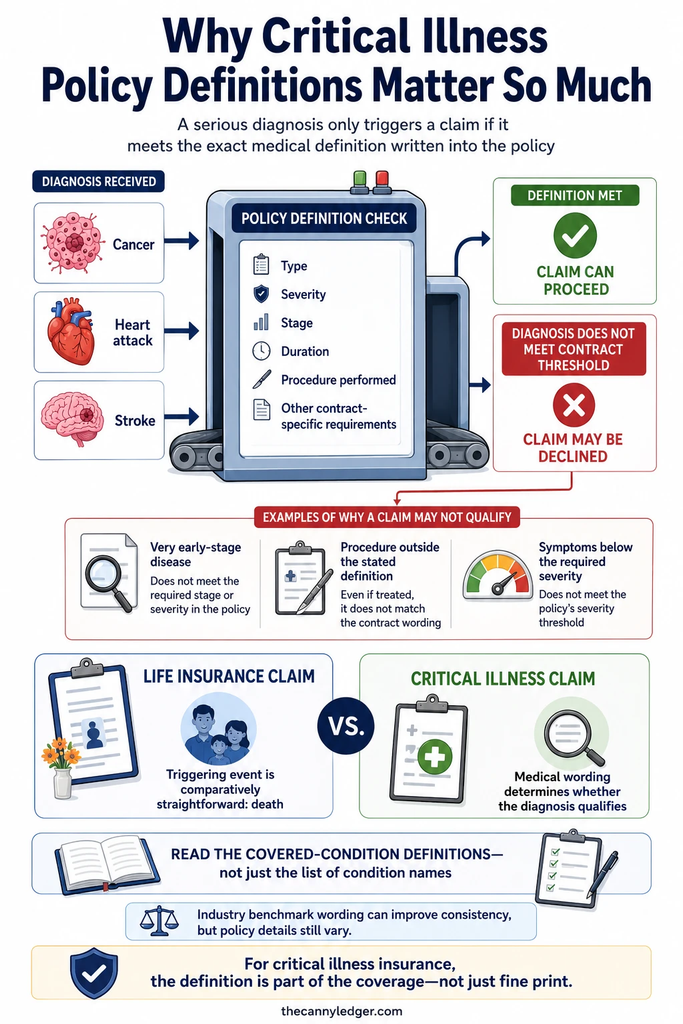
A death certificate leaves little room for interpretation, which is part of why life insurance claims rarely turn into disputes over whether the triggering event actually happened. Critical illness claims work differently, since the condition has to match the specific medical definition written into your policy, not just a general diagnosis from your doctor. A cancer that’s caught extremely early, a heart procedure that doesn’t meet the exact surgical definition in your contract, or a stroke that falls short of the severity threshold written into the policy can all result in a declined claim even though the underlying diagnosis feels serious enough to the person living through it.
This is precisely why the CLHIA’s standardized definitions matter so much to anyone shopping for this coverage. Reading the actual condition definitions in a policy before buying it, rather than assuming cancer means cancer and a heart attack means a heart attack, is the single most useful thing a buyer can do to avoid an unpleasant surprise at claim time. An insurer isn’t being unreasonable by applying a strict definition, since the entire pricing model depends on those definitions staying consistent, but that consistency is exactly why the fine print deserves more attention here than it does on most other insurance purchases.
Why Many Canadians End Up With Both
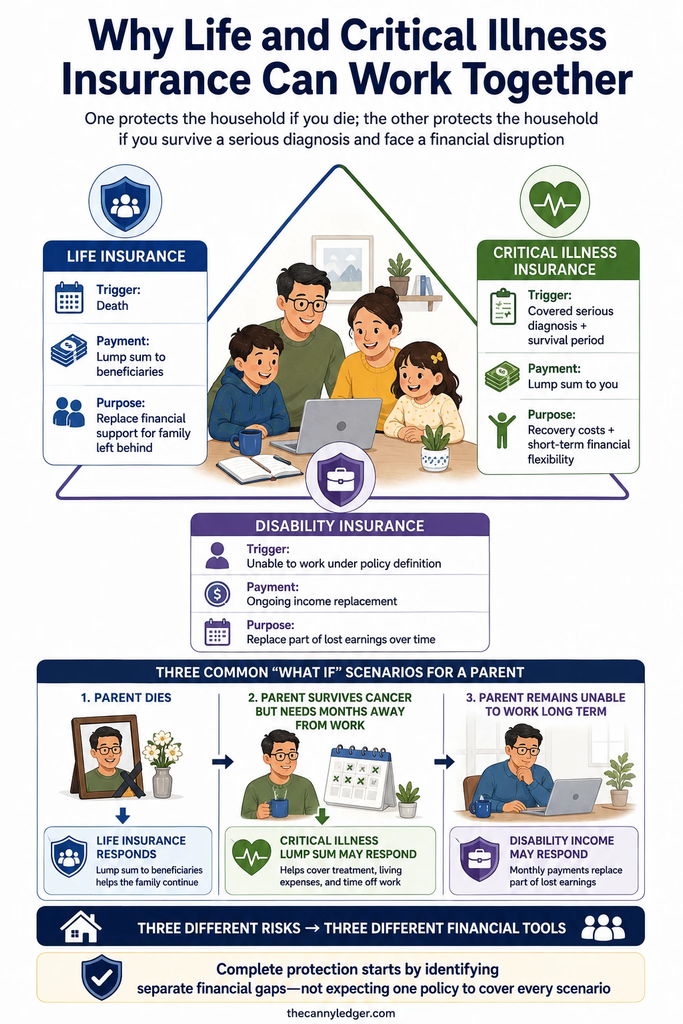
Life insurance and critical illness insurance aren’t competing for the same insurance budget in the way that whole life and universal life compete with each other. They’re addressing two different moments in a family’s financial timeline, and a household that’s only protected against one of them still has a real, unaddressed gap. A parent who dies leaves a family without their income, which life insurance solves directly. A parent who survives cancer treatment but can’t work for eight months leaves a family in exactly the same cash crunch, without life insurance paying out a single dollar, since nobody died.
This is also a distinct product from disability insurance, which replaces a portion of lost income for as long as you’re unable to work, rather than paying a single lump sum tied to a specific diagnosis. Someone building a complete personal insurance plan is often looking at three separate products working together, life insurance for the family left behind, critical illness insurance for a lump sum during a serious diagnosis, and disability insurance for ongoing income replacement during a longer recovery, rather than assuming any single product covers all three risks at once.
What Happens if Your Insurer Fails
The Assuris protection framework treats these two products differently, and it’s one of the clearest ways to see how differently regulators categorize the actual risk each one represents. Assuris classifies critical illness insurance as a health expense benefit, guaranteeing policyholders will retain up to $250,000 or 90 percent of their benefit amount, whichever is higher, if a member insurer becomes insolvent. Life insurance death benefits sit under a separate, higher category, guaranteeing the greater of one million dollars or 90 percent of the benefit.
For most individual critical illness policies, which tend to be sized in the tens or low hundreds of thousands of dollars rather than the seven-figure range some life insurance policies reach, that $250,000 threshold comfortably covers the full benefit amount. It only becomes a real consideration for someone holding an unusually large critical illness policy, in which case knowing the lower protection ceiling on this specific product is worth factoring into how much coverage to hold with a single insurer.

What Drives the Cost Difference
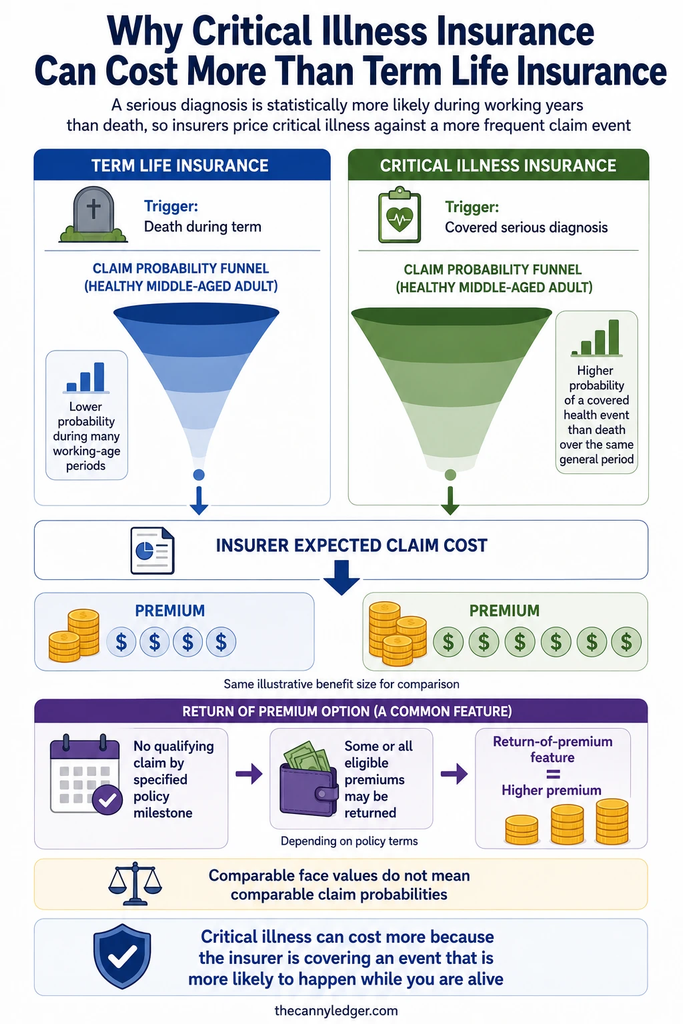
Critical illness insurance tends to cost noticeably more than term life insurance for a comparable benefit amount at the same age, and the reason comes down to raw probability rather than any pricing quirk. The Financial Consumer Agency of Canada’s own overview of insurance basics groups critical illness alongside health insurance rather than life insurance for exactly this reason, since the pricing and claim mechanics behave more like a health product than a mortality-based one. A healthy person in their forties is statistically far more likely to be diagnosed with a covered critical illness before retirement than to die during the same window, which means the insurer is pricing against a claim event that happens more often, not less. Someone shopping for both products for the first time is often surprised that a critical illness policy costs more than a life insurance policy with a similar face value, when most people’s intuition runs the opposite direction.
Permanent critical illness policies, as opposed to term versions that expire at a set age, often include a return-of-premium option. Sun Life’s own critical illness product documentation describes this feature directly, refunding some or all of the premiums paid if no claim is ever made by the time the policy reaches its expiry age. This feature adds meaningfully to the cost but appeals to buyers uncomfortable with the idea of paying for coverage for decades and never seeing any of that money again if they stay healthy, a concern that doesn’t really have an equivalent conversation on the life insurance side of the comparison.
Mistakes People Make Comparing the Two
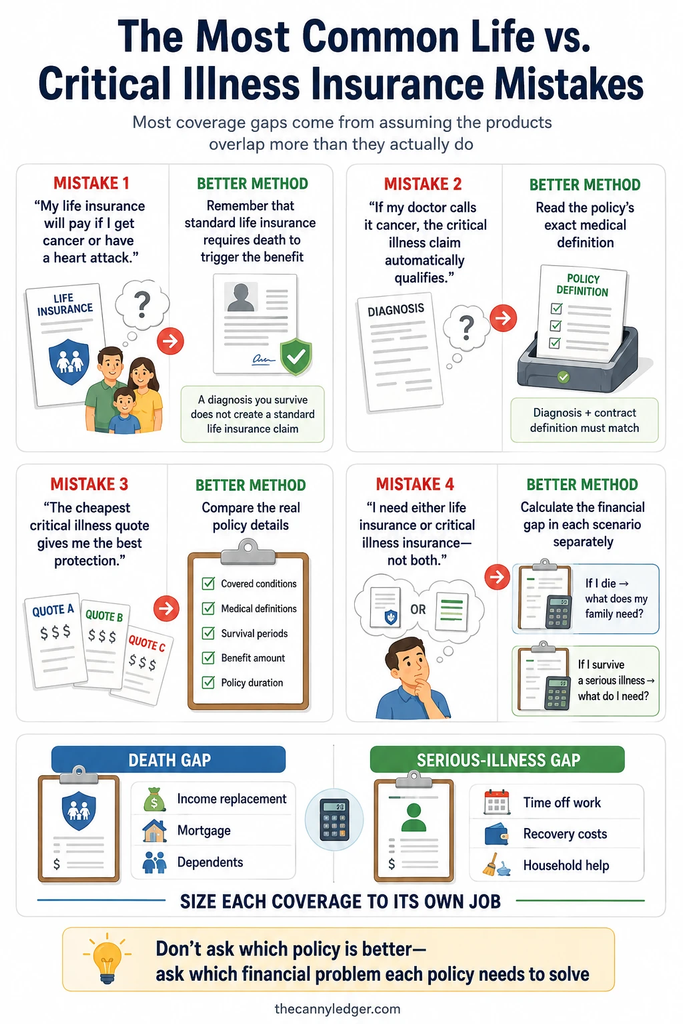
The most common mistake is treating critical illness insurance as a nice-to-have add-on to a life insurance policy rather than evaluating it as a distinct product addressing a distinct risk. Someone who assumes their term life insurance already has them covered if they get seriously ill is going to be caught badly off guard the first time they try to file a claim for a diagnosis rather than a death, since that claim simply doesn’t exist under a standard life insurance contract.
A second mistake is skipping the fine print on covered condition definitions, assuming a plain-language diagnosis from a doctor automatically satisfies whatever the policy requires. Because critical illness claims hinge on meeting a specific medical definition rather than a general diagnosis, this is the one place in the entire comparison where reading the contract carefully before buying actually changes the odds of a claim being paid. A third mistake is forgetting the survival period entirely when comparing quotes, since a policy with a longer survival period on the specific conditions you’re most concerned about is offering less real protection than the premium alone would suggest.
If you’re weighing whether you need one of these products, both, or neither, the practical next step is working out what financial gap would actually open up in each scenario separately, your death and your survival of a serious diagnosis, rather than assuming one policy is meant to answer both questions at once.
Common Questions About Life Insurance vs Critical Illness Insurance
Can I get critical illness insurance without life insurance, or do I need both? Yes, they’re sold as entirely separate products and can be purchased independently. Many Canadians do carry both, but there’s no requirement to hold one in order to qualify for the other.
Does critical illness insurance pay out more than once if I’m diagnosed with a second covered condition? It depends on the policy. Some critical illness plans pay a single lump sum and then terminate, while others offer a limited number of additional partial payouts for different unrelated conditions. This varies enough by insurer that it’s worth confirming directly in your specific contract rather than assuming.
Is critical illness insurance worth it if I already have solid health coverage through my provincial plan? Provincial health coverage pays for medical treatment itself, not for the income you lose while recovering, out-of-pocket costs your plan doesn’t cover, or the flexibility to bring in help at home. Critical illness insurance fills that gap specifically, which is worth weighing against your overall coverage picture the same way any other protection decision deserves a real look at your specific situation.