

Punch your details into an online life insurance calculator and you’ll get a number in about thirty seconds. Most people treat that number as their price. It isn’t, not yet. That instant figure is a quote built on assumptions about your health that haven’t been confirmed by anyone, and the gap between what you’re quoted and what you’re actually approved for is exactly where a lot of Canadians get an unpleasant surprise weeks into the process.
- What a Quote Actually Assumes About You
- Where Quotes Actually Come From
- Who’s Actually Allowed to Give You a Quote
- What Actually Moves Your Quote Up or Down
- From Quote to Approved Policy, What Actually Happens
- Why Your Final Premium Can Differ From Your Original Quote
- How to Actually Compare Quotes Fairly
- Red Flags Worth Watching For
- Mistakes People Make While Comparing Quotes
- Common Questions About Getting Life Insurance Quotes in Canada
A life insurance quote in Canada is an estimated premium based on the information you provide upfront, typically your age, sex, smoking status, and a general health category, before the insurer has verified any of it through underwriting. The quoted number becomes your actual premium only after the insurer confirms your health class, which can happen through a short questionnaire, a medical exam, or a full underwriting review depending on the type of policy you’re applying for.
What a Quote Actually Assumes About You
Every online quoting tool has to start somewhere, and most default to assuming you’ll qualify for a specific health category unless you tell it otherwise. Insurers typically sort applicants into tiers such as Preferred Plus, Preferred, and Standard, and an instant quote usually reflects Standard health unless the tool specifically asks enough questions to place you in a better category. Someone in excellent health who skips past those extra questions can end up comparing a quote that doesn’t reflect the lower rate they’d actually qualify for.
There’s a second quiet assumption built into every quote that catches people off guard once they see their actual policy documents. Canadian insurers price coverage based on your nearest birthday rather than your exact current age, so someone who’s 34 years and eight months old gets quoted and rated as though they were already 35. This isn’t an error or a hidden fee, it’s a standard industry convention, but it explains why a quote obtained a few months before a birthday can look slightly different from one obtained just after.

Where Quotes Actually Come From
Three distinct paths lead to a life insurance quote in Canada, and they aren’t interchangeable even though the number at the end can look similar. Going directly to a single insurer’s website gets you a quote for that company’s products only, with no visibility into whether a competitor would offer better terms for the same coverage. Using a comparison platform or working with an independent broker pulls quotes across dozens of insurers at once, since brokers use the same actuarial software insurers themselves rely on to generate accurate, apples-to-apples premium illustrations.
A licensed broker in Canada is paid through a commission built into the premium structure by the insurer, not through a separate fee charged to you, so working with one doesn’t cost more than buying directly. One of Canada’s larger online brokerages describes this arrangement plainly on its own site, confirming that customers pay the same price as buying directly from an insurer while the brokerage is compensated through a standard commission. What it does add is access to more of the market at once, along with someone who can flag features like conversion privileges or renewal terms that a bare online quote tool won’t necessarily surface on its own. The Financial Consumer Agency of Canada advises confirming that any insurance company or intermediary you’re dealing with is actually licensed to do business in your province before moving forward, a step worth taking regardless of which of these three paths you choose.

Who’s Actually Allowed to Give You a Quote
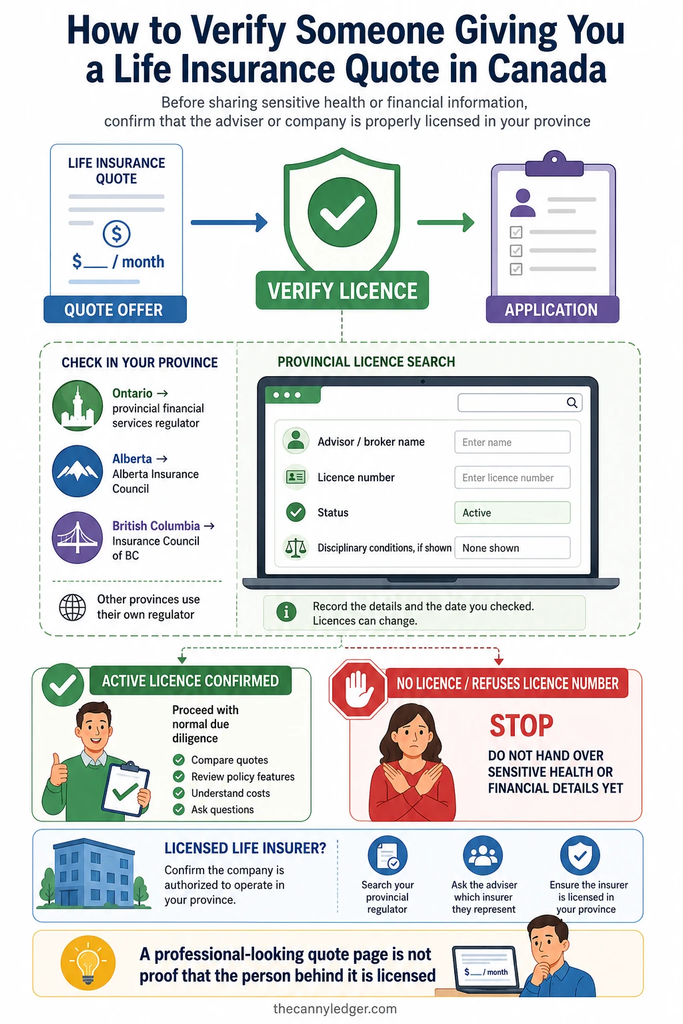
Every person or platform quoting you life insurance in Canada is supposed to be licensed by a provincial regulator, and the specific body differs depending on where you live. Ontario’s licensing falls under its financial services regulator, Alberta uses the Alberta Insurance Council, and British Columbia uses the Insurance Council of BC, each maintaining a public registry where you can confirm a specific advisor’s licence is active and free of disciplinary history. This matters because an unlicensed lead-generation site collecting your personal details isn’t the same thing as a licensed broker quoting you real, actuarially accurate premiums, even when both look similar on the surface.
Checking a licence takes a few minutes and is worth doing before handing over sensitive health and financial details to anyone, especially through a site you found via an ad rather than a direct search for a known brokerage or insurer. The same government guidance also notes that a licensed insurance company is required to be a member of Assuris, which is part of why dealing with a licensed company matters beyond just getting an accurate quote. A legitimate broker or agent should have no hesitation providing their licence number when asked, and hesitation on that specific point is itself a signal worth paying attention to.
What Actually Moves Your Quote Up or Down
The core inputs behind any quote are your age, sex, smoking status, and desired coverage amount and term length, but several less obvious factors can shift the number meaningfully once you get further into the process. Your occupation and hobbies matter if either involves elevated risk, a private pilot or a commercial diver will see a different quote than someone in an office job even with identical age and health. Family medical history, particularly for conditions with a hereditary component, can also factor into the final rating even when your own personal health history is clean.
Accuracy at the quoting stage saves time later, since an insurer’s underwriting team will independently verify most of what you report, and a quote built on incomplete or optimistic answers just gets revised once that verification happens. Providing your actual smoking status, an honest account of any medications, and a realistic estimate of your health category from the outset gets you a number that’s far more likely to survive the underwriting process intact.

From Quote to Approved Policy, What Actually Happens
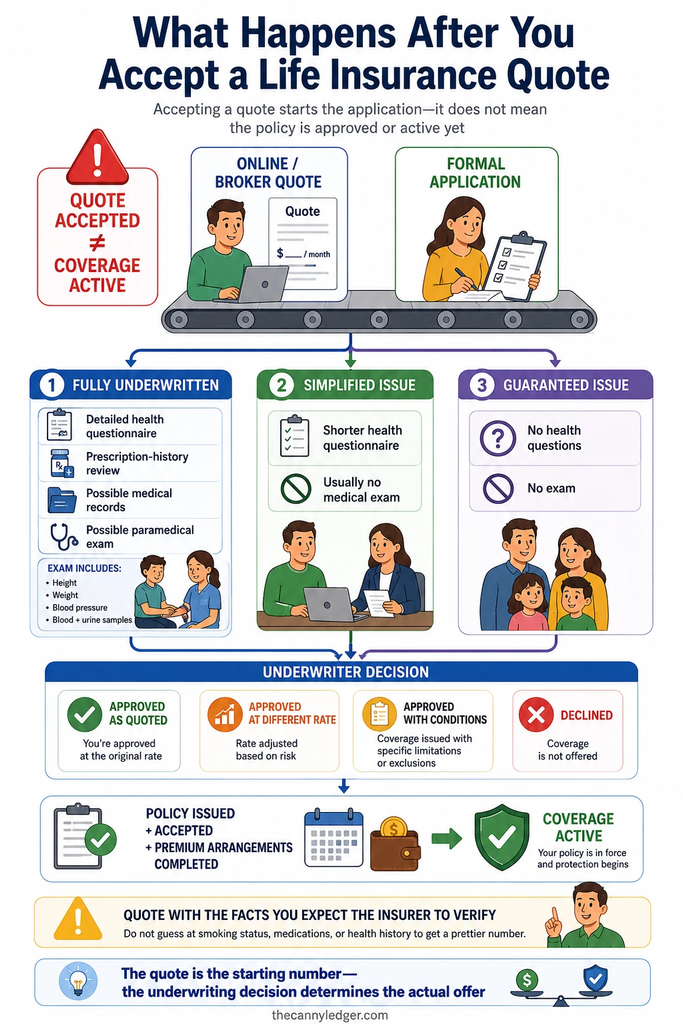
Accepting a quote doesn’t mean you’re covered, it means you’re ready to start a formal application, and the steps between application and an active policy vary depending on how much underwriting the policy requires. Underwriting itself is described plainly by Canadian insurance sources as a data-based risk assessment process, where each insurer applies its own formulas and guidelines to the information you’ve provided, which is exactly why identical applicants can receive different quotes from different companies. A fully underwritten application typically includes detailed health questions, a review of your prescription drug history, and often a brief paramedical exam covering height, weight, blood pressure, and a blood and urine sample, usually arranged at your home or office at no cost to you.
Simplified issue applications skip the exam in favour of a shorter health questionnaire, while guaranteed issue skips health questions altogether, and each tier trades a faster, less invasive process for a higher premium and lower coverage ceiling. Once the insurer has everything it needs, an underwriter reviews the full file and issues a final decision, which in the majority of cases confirms the rate you were originally quoted, though a health finding during the exam or records review can shift you into a different rate class.
Why Your Final Premium Can Differ From Your Original Quote
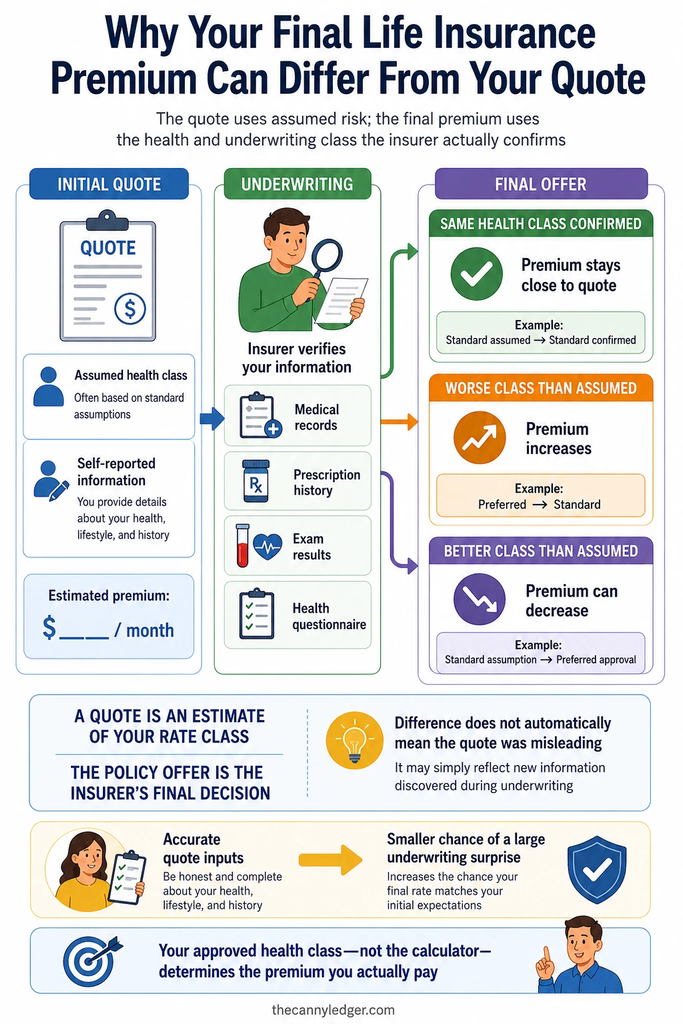
This is the gap that catches people off guard, and understanding why it happens removes most of the frustration when it does. A quote reflects an assumed health category based on limited, self-reported information, while your final premium reflects what underwriting actually confirms once your blood work, medical records, and prescription history are reviewed. Someone who assumed they’d qualify for a Preferred rate but gets placed in Standard after underwriting will see a higher final premium than their original quote suggested, not because anything went wrong, but because the quote was never a guarantee in the first place.
The reverse can happen too, though less often. An applicant who underestimated their own health, perhaps assuming a controlled condition would push them into a worse category than it actually does, can occasionally end up with a better final rate than their initial quote implied. Either direction is a normal part of how underwriting works rather than a sign that the quoting tool or the insurer made an error.
How to Actually Compare Quotes Fairly
Comparing quotes only works if you’re comparing the same thing across every insurer, and it’s surprisingly easy to end up comparing apples to oranges without realizing it. Every quote in your comparison set needs to reflect identical coverage amounts, identical term lengths, and the same underwriting type, since a simplified issue quote from one insurer sitting next to a fully underwritten quote from another will always favour whichever one required less verification, not necessarily whichever one is actually cheaper for equivalent protection.
Price shouldn’t be the only column you’re comparing either. Conversion privileges, which let you switch a term policy into permanent coverage later without new medical underwriting, and renewal terms, which determine what happens to your premium if you keep the policy past the original term, both affect the long-term value of a policy in ways a monthly premium number doesn’t capture on its own. Two policies quoted at the same monthly price can differ substantially in what they actually let you do five or fifteen years down the road, which is exactly the kind of detail a breakdown of what life insurance costs by policy type can help put in perspective before you commit to one option over another.

Red Flags Worth Watching For
A handful of warning signs show up often enough in the Canadian life insurance shopping process that they’re worth naming directly. Pressure to decide immediately, especially paired with claims that a quoted rate expires within hours, doesn’t match how actual insurer pricing works, since an accurate quote generally holds for a reasonable window while you complete an application. Refusal or reluctance to provide a licence number when asked is another signal worth treating seriously, since a legitimate, licensed advisor has no reason to avoid that question.
A third pattern worth watching for is submitting your information to what looks like a single comparison tool, only to receive calls from several unrelated agents in the days that follow. Some lead-generation sites operate this way, selling your contact details to multiple licensed agents rather than functioning as a single broker quoting across insurers themselves, which isn’t necessarily dishonest but is a very different experience than what most people expect when they fill out one form.

Mistakes People Make While Comparing Quotes
The most common mistake is stopping after a single quote, either from a bank offering coverage tied to a mortgage or from the first result in a search, without seeing what a real comparison across several Canadian insurers would have turned up. Given how much premiums for identical coverage can vary between Canadian insurers, settling for one number without a second opinion routinely costs more over the life of a policy than the time it takes to gather two or three additional quotes.
A second mistake is comparing quotes built on different assumptions without realizing it, treating a simplified issue quote and a fully underwritten quote as directly comparable purely because the monthly numbers look similar. A third mistake is choosing based on the lowest quoted premium without confirming the coverage amount and term length actually match what your household actually needs, since the cheapest policy on paper is a poor deal if it’s sized for a need you don’t actually have.
If you’re ready to start comparing quotes for real, the practical next step is gathering your actual health information, current medications, and a realistic coverage target before requesting anything, since a quote built on accurate inputs from the start is far more likely to survive underwriting intact than one built on optimistic guesses you’ll need to correct later.

Common Questions About Getting Life Insurance Quotes in Canada
Do I have to take a medical exam to get a quote? No. The initial quote is based on self-reported information alone. A medical exam, if your policy type requires one, only happens after you’ve moved from a quote into a formal application.
Can I get quotes from multiple insurers without hurting my chances of approval? Yes. Requesting quotes doesn’t involve any credit check or formal underwriting, so comparing as many as you’d like carries no downside. Only submitting a full application triggers the underwriting process, and being declined by one insurer generally has no bearing on a separate application to a different one for fully underwritten coverage.
Is it worth using a broker instead of going directly to one insurer? For most people, yes, since a broker’s access to multiple insurers at once costs nothing extra and gives you a far better view of the market than a single company’s own quote tool ever could, though going direct can still make sense if you already know exactly which insurer and product you want.