

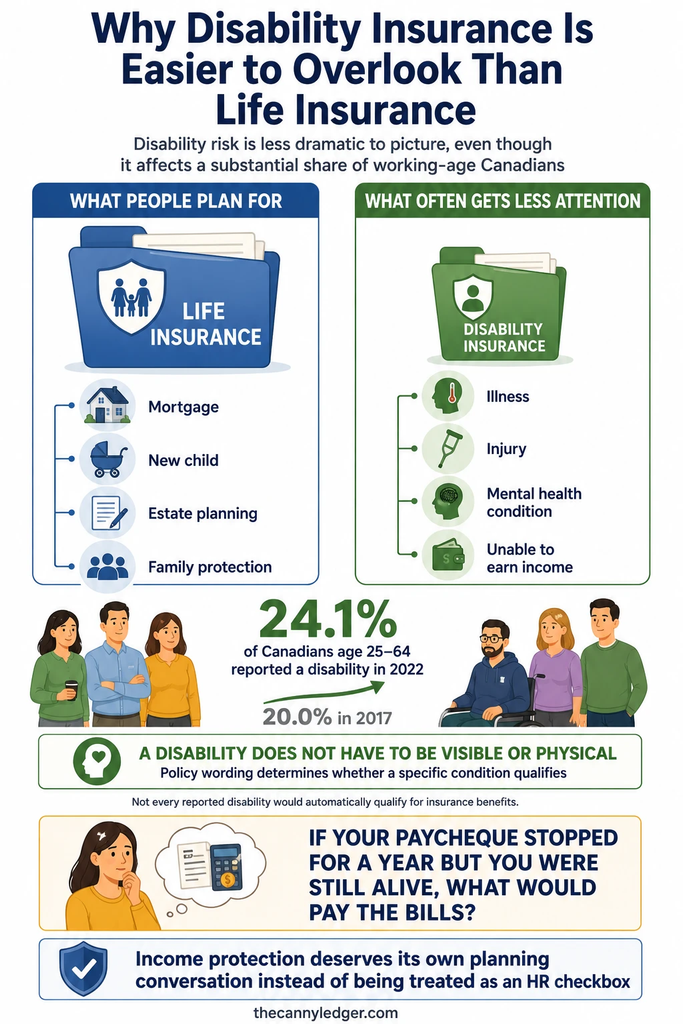
Nearly one in four working-age Canadians, 24.1 percent of people between 25 and 64, reported having a disability in 2022, according to Statistics Canada’s Canadian Survey on Disability, up from 20.0 percent just five years earlier in 2017. Put next to that, dying during your working years is comparatively rare. Most people still spend far more time thinking about life insurance than disability insurance, which is backwards given how the actual odds break down over a career. Nobody plans a budget around the more statistically likely outcome, and that gap in attention costs people real money when illness or injury, not death, is what actually interrupts their income.
- What Each One Is Actually Solving For
- Short-Term, Long-Term, and the Words That Actually Matter in the Definition
- The Tax Rule That Runs Backwards From What Most People Expect
- The Government Safety Net Is Thinner Than It Looks
- Why This Gets Overlooked So Consistently
- How the Two Actually Work Together, Not Against Each Other
- Where People Actually Get Caught Short
- What to Actually Check Before Assuming You’re Covered
- Frequently Asked Questions
Life insurance pays a lump sum to your beneficiary when you die, protecting the people who depend on your income after you’re gone, while disability insurance pays you directly, replacing a portion of your income while you’re alive but unable to work due to illness or injury. One protects your family from your absence. The other protects you and your family from a lost paycheque while you’re still very much present.
What Each One Is Actually Solving For
Life insurance exists to answer a single question. If you die, does the money your family relied on disappear with you, or does a policy replace it. The answer, structurally, is simple, a death benefit paid once, to someone else, after you’re no longer around to need it yourself, and what a standard policy actually pays out for is a broad list of causes rather than a narrow one.
Disability insurance answers a completely different and, for most working years, more frequently relevant question. If illness or injury stops you from earning an income but doesn’t kill you, who pays the mortgage next month. It replaces part of your own paycheque, paid to you, for as long as you remain unable to work and the policy stays in force. The two products aren’t competing for the same job. They’re covering opposite ends of what can go wrong.

Short-Term, Long-Term, and the Words That Actually Matter in the Definition
Disability coverage in Canada typically splits into two stages that hand off from one to the other. Short-term disability generally covers the first few weeks up to about six months of an inability to work, often replacing a higher share of income during that window. Long-term disability picks up where short-term ends, typically replacing 60 to 70 percent of pre-disability income, and can continue for years or all the way to a specified retirement age depending on the policy.
The detail that actually decides most claims disputes isn’t the percentage, it’s how the policy defines disability itself. An “own occupation” definition pays out if you can’t perform the specific job you were doing, even if you could technically work in some other field. An “any occupation” definition, which many long-term policies switch to after an initial period, only pays if you can’t perform any job you’re reasonably suited for by education and experience, a meaningfully harder bar to clear. Someone assuming their coverage protects their specific career the entire time, only to discover the definition quietly narrowed after the first two years, is one of the more painful surprises in this entire category of insurance.

The Tax Rule That Runs Backwards From What Most People Expect
This is the detail that makes disability insurance genuinely different from life insurance rather than just a variation on the same theme. A life insurance death benefit is tax-free to the beneficiary no matter who paid the premiums, whether that was the deceased person personally or their employer. Disability insurance flips that logic entirely. The Financial Consumer Agency of Canada states the rule plainly, if you pay the entire disability premium yourself, your benefit is tax-free, but if your employer pays all or part of that premium, the disability benefit you eventually receive becomes taxable income.
This single distinction explains why two employees at the same company, both covered under what looks like an identical group long-term disability plan, can end up with very different amounts landing in their bank account during a real claim. Someone whose employer covers the full LTD premium sees their benefit taxed as income when a claim actually happens, often reducing what they expected to receive by a meaningful margin at exactly the moment they can least absorb a surprise, a wrinkle that doesn’t exist on the premium side of a personal life insurance policy since those premiums are never deductible regardless of who pays them. Someone paying that premium personally, even through a payroll deduction rather than a fully employer-funded plan, keeps the entire benefit tax-free. It’s worth finding out, in advance rather than during a claim, which side of that line an existing group plan actually falls on.

The Government Safety Net Is Thinner Than It Looks
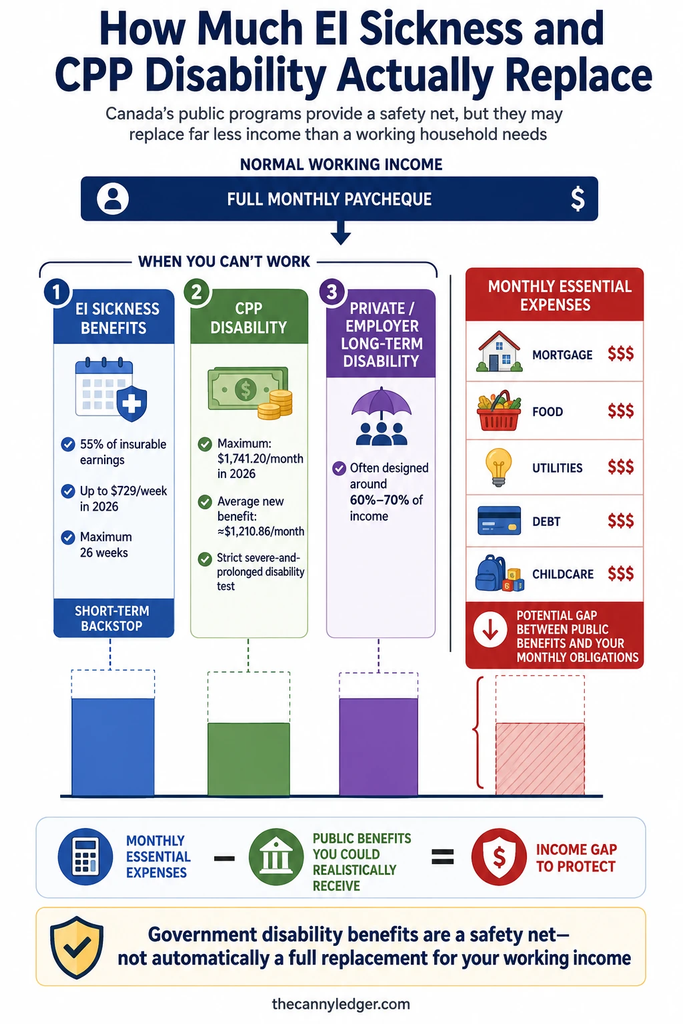
Before assuming Employment Insurance or the Canada Pension Plan will simply catch anyone who becomes disabled, it’s worth knowing exactly how much ground those programs actually cover. EI sickness benefits pay 55 percent of insurable earnings, up to a maximum of $729 a week in 2026, for a maximum of 26 weeks, a program built for short absences rather than a genuine long-term income replacement plan. Once that runs out, the next backstop is the Canada Pension Plan disability benefit, but it pays considerably less. The maximum CPP disability payment is $1,741.20 a month in 2026, with the average new recipient actually receiving closer to $1,210.86 a month, an amount that covers a fraction of most household budgets and requires meeting a strict definition of a severe and prolonged disability to even qualify. For comparison, a federal public service employee’s mandatory long-term plan replaces 70 percent of salary once approved, a figure worth keeping in mind as the kind of benchmark private coverage should be aiming to match rather than fall well short of. Anyone relying entirely on the two federal programs as their disability plan is working with a much smaller number than they probably assume, and the gap between that number and an actual mortgage payment is exactly what private disability coverage exists to close.
Why This Gets Overlooked So Consistently
Life insurance gets talked about openly, in estate planning conversations, at the birth of a child, whenever a mortgage gets signed. Disability insurance rarely comes up outside of an HR onboarding packet, and even there it’s usually presented as one checkbox among many rather than something worth understanding in detail. Part of that is psychological. Dying feels like a single, dramatic, easy-to-picture event, while becoming disabled feels vague, gradual, and easier to assume won’t happen. The Statistics Canada numbers say otherwise. A disability serious enough to limit daily activities affects roughly a quarter of the working-age population, and mental health conditions specifically have been the fastest-growing category behind that increase, which matters since a disability doesn’t need to be visible or physical to qualify for coverage under most policies.
How the Two Actually Work Together, Not Against Each Other
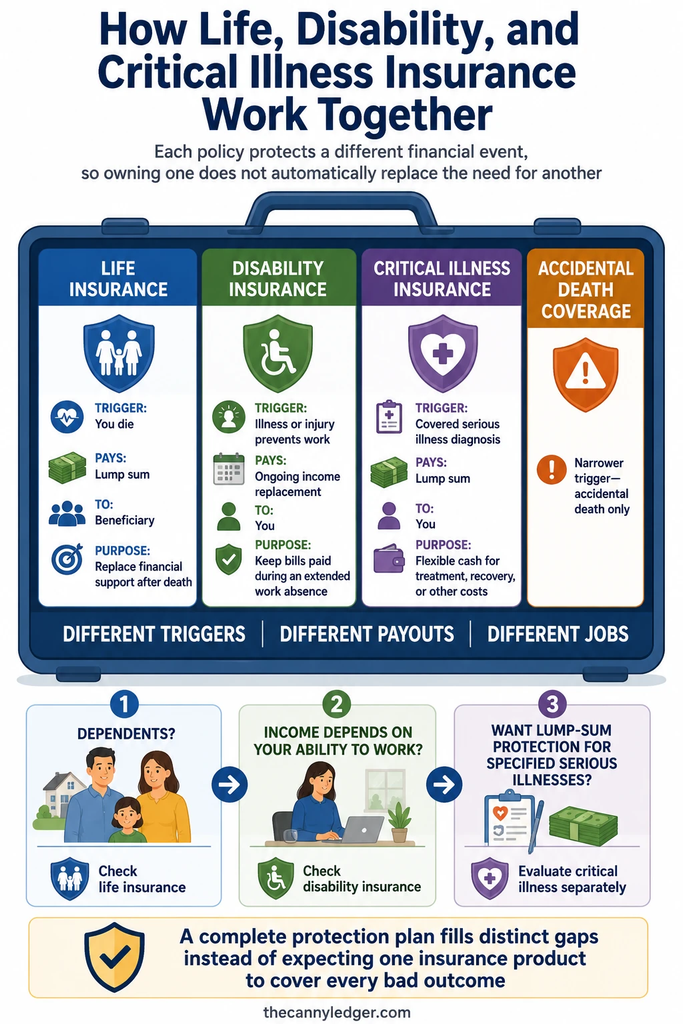
Unlike some insurance comparisons where the honest answer is pick one, this isn’t really that kind of choice. A household with dependents and a mortgage typically needs both, and cutting either one to afford the other usually means leaving a real gap rather than making a smart tradeoff. Figuring out how much life insurance coverage actually makes sense protects against the death scenario. Disability insurance, sized to replace enough of a paycheque to cover fixed costs, protects against the far more statistically common scenario of an extended inability to work. Where they connect most directly is with a group benefits plan through an employer, where both often get bundled under one enrollment, sometimes alongside related but distinct coverage like critical illness insurance, which pays a lump sum on diagnosis of a specific serious illness rather than replacing ongoing income the way disability insurance does. None of these three products substitute for each other, and treating any single one, or a fourth like accidental death coverage, as sufficient protection against all of these risks is how gaps quietly form.
Where People Actually Get Caught Short
The most common gap isn’t having zero disability coverage, it’s assuming group coverage through work is enough without checking the actual numbers. Group long-term disability plans frequently cap the maximum monthly benefit regardless of income, which means a higher earner can end up replacing a much smaller percentage of their actual salary than the plan’s stated percentage suggests. Group coverage also typically doesn’t follow someone if they leave the job, unlike an individually owned policy, which stays in force as long as premiums are paid regardless of who someone works for. Someone whose entire sense of security rests on a workplace LTD plan is carrying more risk than they realize, both from the benefit cap and from what happens the day that job ends.

What to Actually Check Before Assuming You’re Covered
Pull the actual plan document for any group disability coverage through work, not just the summary slide from an onboarding presentation, and confirm three things. Whether the definition of disability is own occupation or any occupation, and for how long the own occupation period lasts before it switches. Whether the employer pays the premium in full, in part, or not at all, since that answer determines whether a real claim would be taxed. And what the maximum monthly benefit cap actually is, checked against real take-home pay rather than assumed to scale automatically with salary. Anyone whose group coverage falls short on any of those three points has a genuine reason to look at a supplemental individual policy rather than treating the workplace plan as the whole answer, the same way relying entirely on workplace life insurance without an individually owned policy leaves a gap the moment employment ends.

Frequently Asked Questions
Does disability insurance cover mental health conditions like anxiety or depression? Generally yes, provided the condition meets the policy’s definition of a disability severe enough to prevent working, and mental health claims have become an increasingly common category, particularly among younger working-age adults.
Can someone who is self-employed buy disability insurance? Yes. Self-employed individuals can purchase individual disability policies directly, and doing so matters more for this group specifically since there’s no employer-sponsored group plan or EI sickness benefit backstop available to most self-employed workers.
Does a critical illness diagnosis automatically also trigger a disability insurance claim? No. The two run on separate definitions, and a serious diagnosis under a critical illness policy doesn’t automatically mean someone also meets a disability policy’s definition of being unable to work, though many people end up qualifying for both around the same time.
Is there a waiting period before disability benefits start after a claim? Yes, called the elimination period, commonly ranging from a couple of weeks up to several months depending on the policy, and it functions similarly to a deductible in that no benefit is paid for that initial window regardless of how the claim is eventually resolved.

