

A common assumption is that life insurance never pays out if someone dies by suicide. That’s not accurate, and the actual rule is narrower and more specific than most people realize. Canadian life insurance policies generally include a time-limited exclusion, not a permanent one, meaning the answer to whether a policy pays out depends entirely on when the death occurs relative to when the policy started.
- How the Standard Exclusion Period Actually Works
- What Happens Once the Two Years Pass
- What Restarts the Two-Year Clock
- Why Mental Health History Affects the Application, Not This Clause
- Medical Assistance in Dying Is Treated Completely Differently
- What Else Could Still Cause a Claim to Be Investigated
- Group and Employer-Provided Coverage May Work Differently
- Common Misconceptions Worth Correcting
- Common Questions About Suicide and Life Insurance in Canada
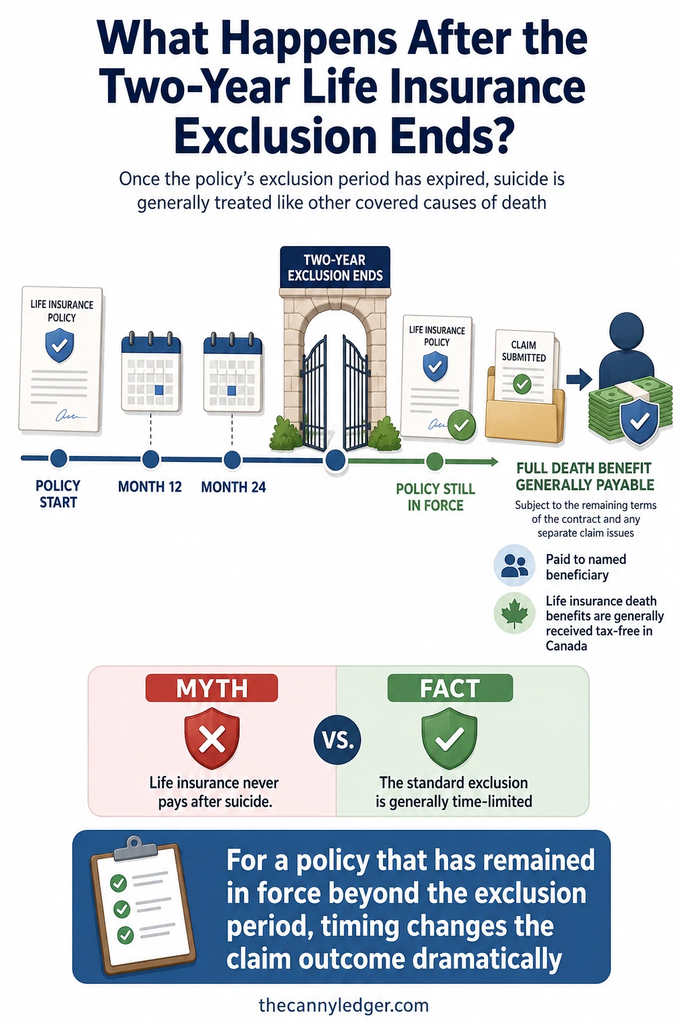
Most Canadian life insurance policies include a suicide exclusion that applies only during the first two years after the policy takes effect. If the exclusion period has passed, a death by suicide is treated the same as any other cause of death, and the full death benefit is paid to the named beneficiary.
How the Standard Exclusion Period Actually Works
The two-year window found in nearly every Canadian life insurance policy limits what the insurer owes if the insured person dies by suicide within that specific timeframe from the policy’s effective date. Legal analysis of Canadian suicide clause case law confirms this exclusion is typically written to apply regardless of whether the insured was, in the language courts have examined, sane or insane at the time of death, underscoring that the clause is about timing rather than intent or mental state. During this period, most policies limit the insurer’s obligation to returning the premiums paid rather than denying the claim outright with nothing paid at all, though the exact wording can vary by insurer and is worth confirming in your own policy documents.
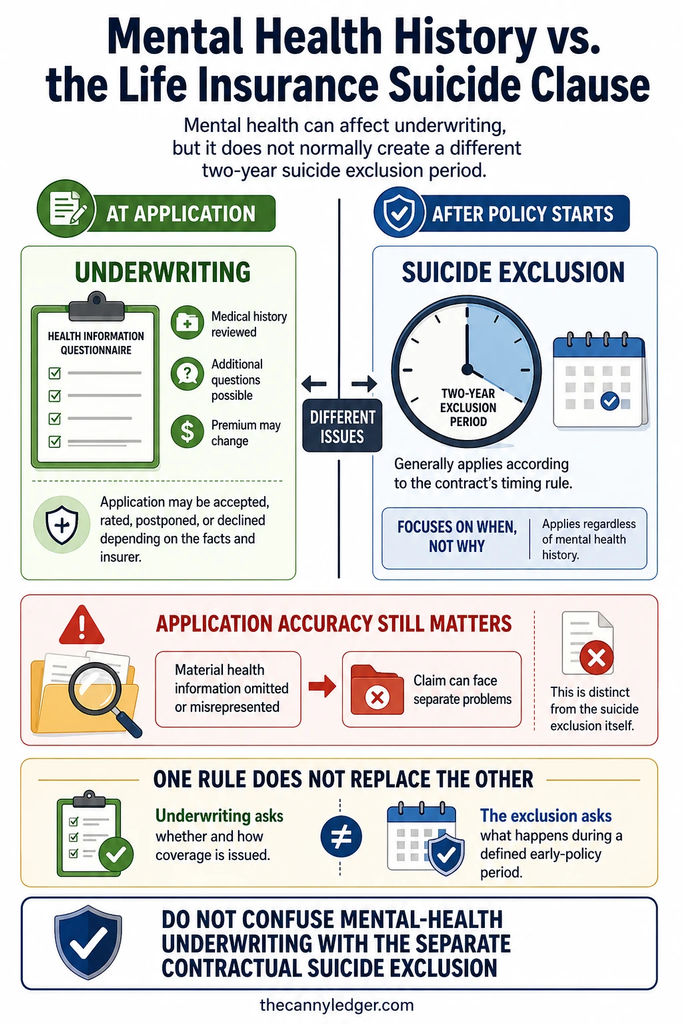
This provision applies the same way regardless of whether the person had a documented mental health history, and it isn’t a judgment about the circumstances of the death. The clause exists to address a narrow insurance risk, someone purchasing a large policy with foreknowledge of their own death shortly after, rather than to single out mental illness specifically. A person with no mental health history at all who dies by suicide within the first two years faces the identical exclusion as someone with a long-documented history.

What Happens Once the Two Years Pass
Once a policy has been in force for more than two years from its effective date, a death by suicide is paid the same way any other death would be, in full and tax-free to the named beneficiary. There’s no separate application or waiting period beyond the initial two years, and no requirement to prove anything different about the circumstances once that window has closed.
This is the part of the rule that surprises people most, since the common assumption treats the exclusion as a blanket, permanent condition of the policy rather than a narrow window tied to timing. A term or permanent policy purchased in 2022 and still in force today, for example, would no longer fall under this exclusion for a death occurring now, since more than two years have passed since the policy took effect.
What Restarts the Two-Year Clock
A handful of specific events reset this exclusion period rather than letting the original two years carry through the life of the policy indefinitely. If a policy lapses due to missed payments and is later reinstated, most insurers restart the two-year exclusion from the reinstatement date rather than counting from the original issue date. Increasing your coverage amount on an existing policy typically restarts the clock only for the additional amount of coverage, leaving the original coverage amount’s exclusion period untouched if it had already passed.
This detail matters for anyone who let a policy lapse years ago and brought it back into force more recently, since the relevant date for this exclusion becomes the reinstatement, not the original purchase. Confirming your policy’s actual effective date, rather than assuming it matches when you first applied years earlier, is worth doing if you’re at all uncertain which date actually governs your coverage.

Why Mental Health History Affects the Application, Not This Clause
It’s worth separating two entirely different things that often get confused together. The two-year exclusion itself doesn’t change based on mental health history, applying identically to every policyholder regardless of documented conditions. What mental health history can affect is the underwriting decision at the point of application, potentially resulting in a higher premium, additional questions, or in some cases a decline, depending on the specific condition, its stability, and how the individual insurer’s guidelines treat it.
Being honest about mental health history on an application matters for a separate reason entirely. If a serious health condition, mental or physical, was misrepresented or omitted on the original application, an insurer can potentially deny a claim on those grounds even after the suicide exclusion period has passed, since that’s a different issue tied to the accuracy of the application itself rather than the suicide clause specifically.
Medical Assistance in Dying Is Treated Completely Differently
This is an important distinction that a lot of general explanations of the suicide clause skip entirely. The Canadian Life and Health Insurance Association’s own 2016 position statement confirms that if medical assistance in dying takes place in accordance with the legislated rules and processes, it will not be considered suicide for life insurance purposes, regardless of how recently the policy was purchased. This means a death under a legally followed medical assistance in dying process doesn’t trigger the two-year exclusion at all, even if the policy is brand new.
Ontario has gone further than relying purely on the industry’s voluntary position, enacting legislation specifically preventing insurance benefits from being denied solely because a death occurred through medical assistance in dying. Medical assistance in dying itself remains a federally regulated process with specific eligibility criteria that must be followed for this distinction to apply, and the same CLHIA position notes that insurers can still rely on other standard claim defences, such as misrepresentation on the original application or a specifically excluded pre-existing condition, entirely separate from the suicide question itself.

What Else Could Still Cause a Claim to Be Investigated
Beyond the suicide exclusion specifically, any death occurring within a policy’s broader contestability period, also typically the first two years, can trigger a more thorough review of the original application for accuracy. This is a related but distinct concept from the suicide clause, and understanding how this broader review affects claim timing is worth reading alongside this specific exclusion, since both provisions tend to overlap in the same early window of a policy’s life.
An insurer investigating a death within this period isn’t necessarily suspicious of fraud in every case, it’s confirming that what was disclosed at application matches the actual circumstances on record. A claim within this window that turns up no discrepancies proceeds normally, while one that reveals a significant undisclosed condition can be denied on those separate grounds regardless of the actual cause of death.

Group and Employer-Provided Coverage May Work Differently
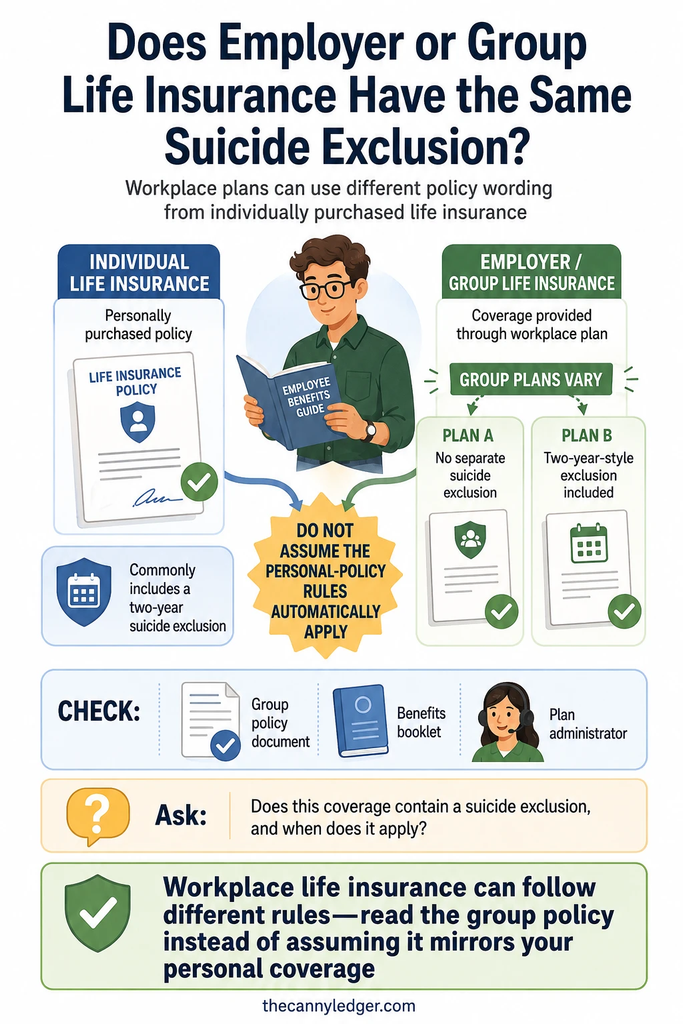
Life insurance provided automatically through an employer doesn’t always include the same suicide provision found in individually purchased policies, and this varies enough by plan that it’s worth confirming directly rather than assuming your workplace coverage mirrors a personal policy. Some group plans include no suicide exclusion at all, particularly for coverage that’s provided automatically without individual underwriting, while others mirror the standard two-year structure found in personal policies.
If workplace coverage represents a meaningful part of your overall protection, confirming the specific terms with your plan administrator or the group policy document itself removes any uncertainty rather than assuming either way. This is separate from how life insurance is taxed generally, though group coverage carries its own distinct tax treatment worth understanding alongside its claim provisions.
Common Misconceptions Worth Correcting
The most common misconception is treating the suicide exclusion as permanent rather than time-limited, which leads some people to avoid buying coverage altogether under the mistaken belief that it would never pay out under those circumstances regardless of how long the policy had been active. A second misconception is assuming a documented mental health history automatically triggers a longer or different exclusion period, when the actual two-year window applies uniformly regardless of health history, with mental health only factoring into the separate underwriting decision at application.
A third misconception conflates medical assistance in dying with suicide for insurance purposes, when the industry’s own position and Ontario’s legislation both treat these as distinct categories with different claim outcomes. If you’re uncertain how your specific policy handles any of these provisions, requesting a copy of your full policy document from your insurer and checking what your coverage actually covers resolves any doubt faster than relying on general assumptions about how these clauses typically work.

Common Questions About Suicide and Life Insurance in Canada
Does the suicide exclusion apply to every type of life insurance policy? The standard two-year exclusion is common across term and permanent individual policies in Canada, though exact wording can differ by insurer, and group or employer-provided coverage sometimes handles this differently, which is worth confirming directly with your specific plan.
If a claim is denied under the suicide exclusion, is there any payout at all? Most policies limit the insurer’s obligation during the exclusion period to a return of premiums paid rather than paying nothing, though the specific wording in your policy is the only way to confirm exactly what applies to your coverage.
Does disclosing a mental health condition when applying make a claim more likely to be denied later? No, the opposite is generally true. Honest disclosure at application protects a future claim from being denied for misrepresentation, while an undisclosed condition creates a separate risk of denial unrelated to the suicide exclusion itself.
This is a sensitive topic, and if you or someone you know is struggling, 9-8-8: Suicide Crisis Helpline offers free, confidential support anywhere in Canada, 24 hours a day, by calling or texting 988.

