
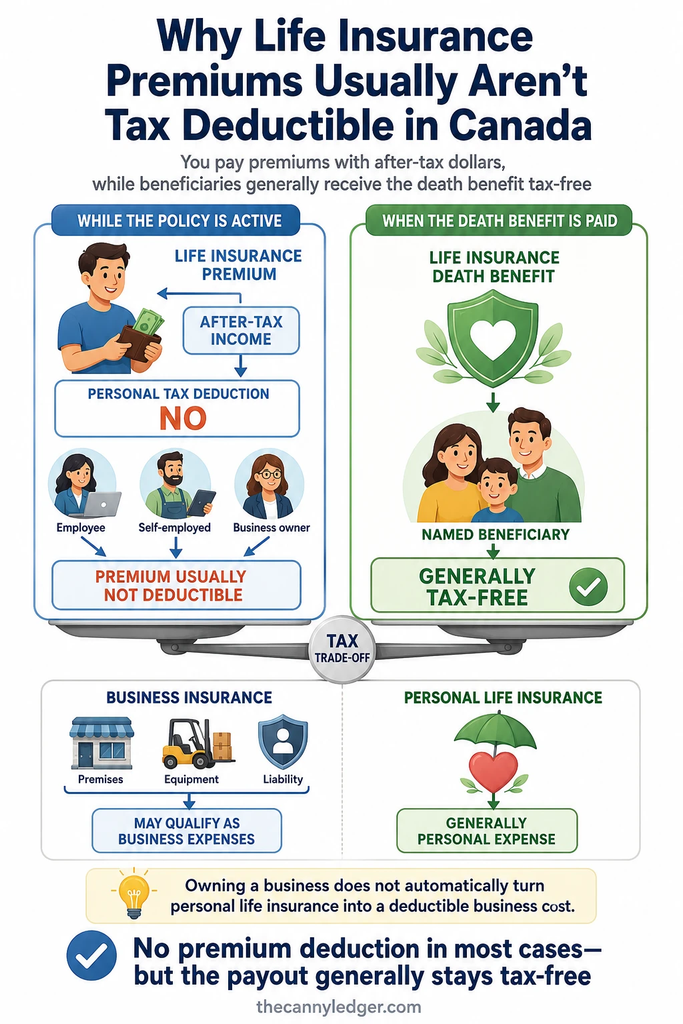
The tax-free death benefit and the non-deductible premium are two halves of the same deal, and understanding that trade-off explains more about this topic than memorizing the rule itself. If Canada let you deduct your life insurance premiums the same way you deduct a business expense, the government would have every reason to tax the payout your family eventually receives. Instead, the system works the opposite way. You pay premiums with after-tax dollars and get nothing back at filing time, and in exchange your beneficiaries collect the full death benefit without owing a cent of income tax on it.
- Why the General Rule Exists This Way
- The One Real Exception, Collateral Loans
- What the Deduction Actually Looks Like in Practice
- Corporate-Owned Policies Don’t Get Around This Either
- Employer-Paid Group Life Insurance Isn’t Free Either
- Donating a Policy to Charity Changes the Calculation
- Mistakes People Make With This Topic
- Common Questions About Life Insurance Premium Deductibility
In most cases, life insurance premiums are not tax deductible in Canada, whether you’re an employee, self-employed, or running a corporation. The Canada Revenue Agency states this plainly on its own guidance for business expenses, confirming that in most cases you cannot deduct your life insurance premiums, with one specific exception for policies used as collateral on a business loan. This holds true regardless of whether the policy is term or permanent.
Why the General Rule Exists This Way
Personal life insurance is classified as a personal expense under Canadian tax law, in the same category as groceries or a haircut, regardless of how responsible or necessary the purchase feels. This holds true even for self-employed people filling out a business expense form, since owning a business doesn’t retroactively convert a personal insurance policy into a business cost simply because the policyholder happens to run a company.
The logic isn’t arbitrary. Life insurance exists to protect people who depend on your income, and that protection is fundamentally a personal financial decision rather than something that generates business revenue the way advertising or equipment does. The same CRA guidance on business insurance costs draws this line directly, treating life insurance premiums as ineligible for the general business insurance deduction that covers premises, equipment, and liability coverage, a distinction that surprises some self-employed Canadians who assume all business-related insurance works the same way.
The One Real Exception, Collateral Loans
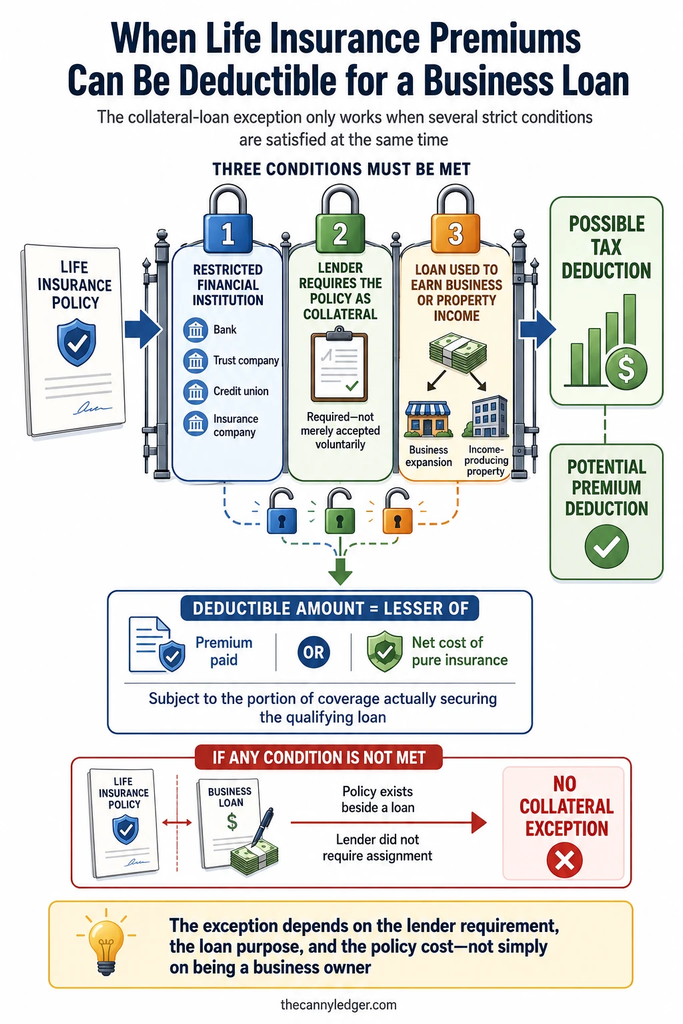
There’s exactly one situation where a portion of your life insurance premiums can actually reduce your taxable income, and it’s narrower than most people expect. Under paragraph 20(1)(e.2) of the Income Tax Act, you can deduct the lesser of the premiums you paid or the policy’s net cost of pure insurance, but only if a restricted financial institution, meaning a bank, trust company, credit union, or insurance company, required you to assign the policy as collateral for a loan, and that loan is itself being used to earn income from a business or property.
All three conditions have to line up before this exception applies, and missing any one of them means the deduction doesn’t exist regardless of how the arrangement feels in practice. The lender has to actually require the assignment as a loan condition, not simply accept it as a voluntary gesture from the borrower. Canada Revenue Agency’s Income Tax Folio on interest deductibility confirms the baseline position that interest on a loan taken specifically to acquire a life insurance policy isn’t deductible at all, which is exactly why the collateral exception is built around the loan’s purpose and the insurer’s requirement rather than the mere existence of a policy sitting alongside a business loan.
What the Deduction Actually Looks Like in Practice
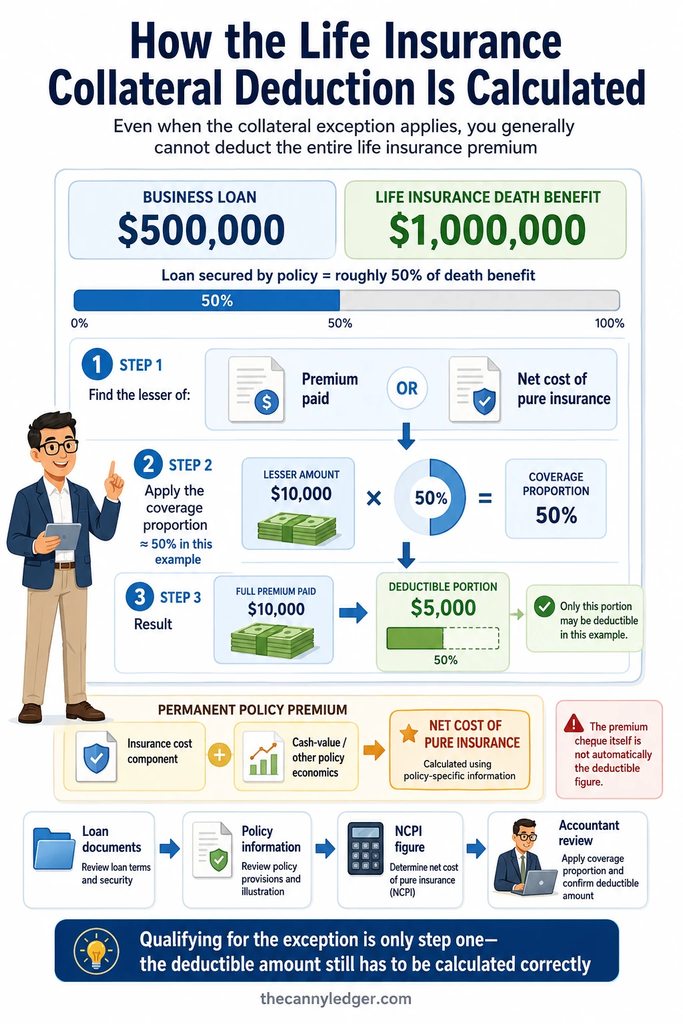
A business owner who takes out a $500,000 loan to expand operations, and whose lender requires a life insurance policy with a $1,000,000 death benefit as collateral, doesn’t get to deduct the full premium on that policy. The deduction gets prorated based on how much of the death benefit the loan actually represents, so in this example, roughly half the lesser of the premium or the net cost of pure insurance becomes deductible, reflecting that only half the policy’s coverage is actually securing the loan.
This calculation requires knowing the policy’s net cost of pure insurance, a figure the insurer calculates and reports, which frequently comes in lower than the actual premium paid, especially on a permanent policy building cash value alongside its insurance component. Someone in this situation is generally better off working with an accountant familiar with this specific provision, since getting the proration or the net cost of pure insurance figure wrong is exactly the kind of error that draws CRA scrutiny on an otherwise legitimate deduction.
Corporate-Owned Policies Don’t Get Around This Either
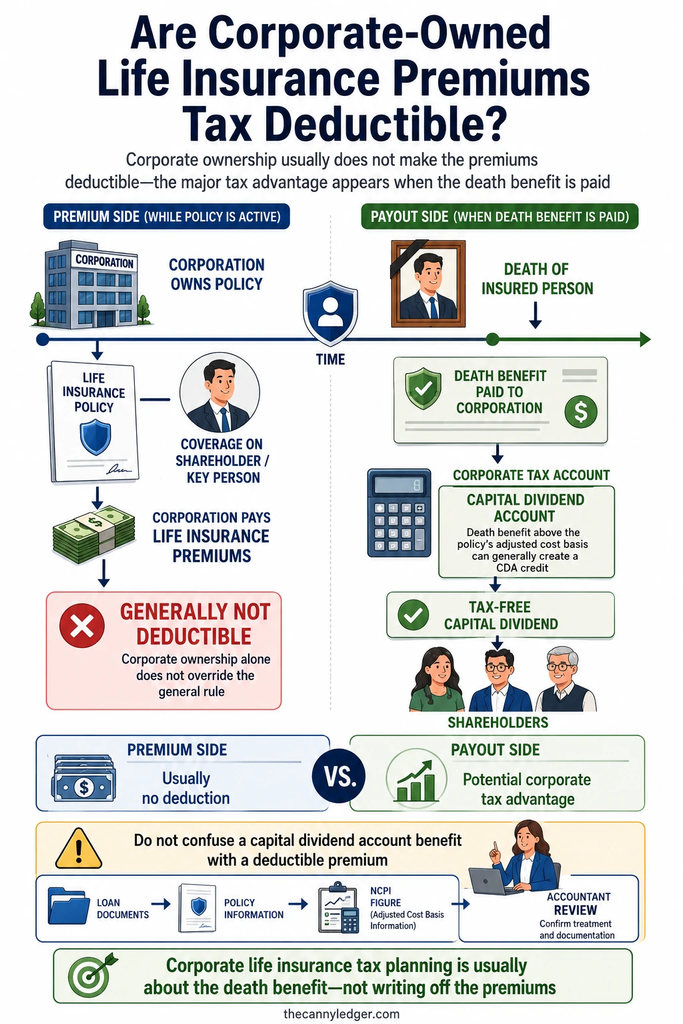
Business owners sometimes assume that having a corporation own a life insurance policy, rather than owning it personally, changes the deductibility picture. It doesn’t, at least not through the front door. A corporation paying premiums on a policy insuring a key employee or shareholder faces the same general non-deductibility rule as an individual, since the underlying logic, personal protection rather than a cost of earning business income, doesn’t change just because a corporation is the one writing the cheque.
Where corporate ownership does change the picture is on the other end of the transaction, not the premium side. When a private corporation owns a policy and receives the death benefit, the amount exceeding the policy’s adjusted cost basis gets credited to the corporation’s capital dividend account, letting that amount flow out to shareholders as a tax-free capital dividend. This is a real tax advantage worth knowing about, but it’s a benefit on the payout side, not a premium deduction, and conflating the two is a common source of confusion for business owners exploring corporate-owned coverage for the first time.
Employer-Paid Group Life Insurance Isn’t Free Either
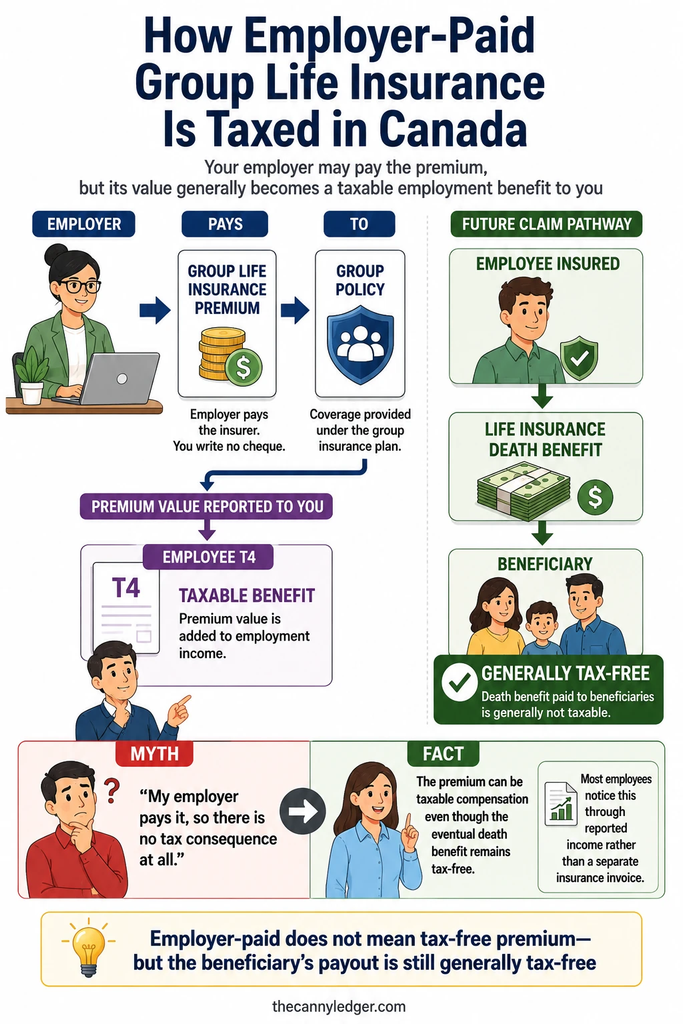
Plenty of employees assume that life insurance coverage provided through work costs them nothing at all, since they never see a premium invoice or write a cheque themselves. The Canada Revenue Agency’s own guidance on taxable benefits confirms that when an employer pays premiums for group life insurance coverage, the value of those premiums is a taxable benefit to the employee, added to income and reported on the employee’s T4 slip each year.
The distinction worth remembering here mirrors the personal policy rule in reverse. The premium your employer pays on your behalf is taxable income to you, but the eventual death benefit your beneficiaries would receive remains entirely tax-free, exactly the same tax-free treatment that applies to any other Canadian life insurance payout. Most employees never notice this taxable benefit beyond a small annual bump in reported income, since group life premiums are typically modest relative to total compensation, but it’s worth understanding rather than assuming employer-provided coverage carries zero tax consequence.
Donating a Policy to Charity Changes the Calculation
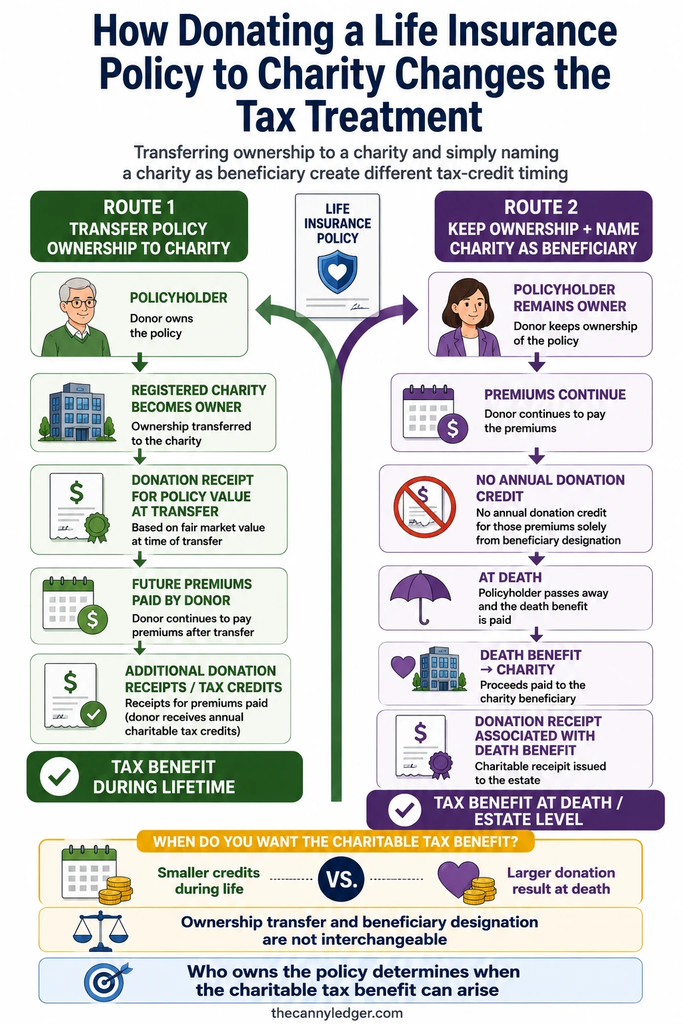
There’s a legitimate way to turn ongoing life insurance premiums into an annual tax credit, though it requires giving up ownership of the policy entirely rather than simply naming a charity as beneficiary. If you transfer ownership of an existing policy to a registered charity, the charity can issue a donation receipt for the policy’s value at the time of transfer, and any premiums you continue paying afterward generate additional annual donation tax credits, since the charity now owns the policy and those payments function as ongoing gifts.
Simply naming a charity as your policy’s beneficiary, while keeping ownership yourself, produces a different result entirely. You receive no tax credit for premiums paid during your lifetime under that structure, and instead your estate receives a donation receipt for the full death benefit after you die, which can help offset tax owing on your final return. The two approaches aren’t interchangeable, and choosing between smaller annual credits now versus one larger credit at death is a decision worth making deliberately rather than assuming beneficiary designation and ownership transfer produce the same tax outcome.
Mistakes People Make With This Topic
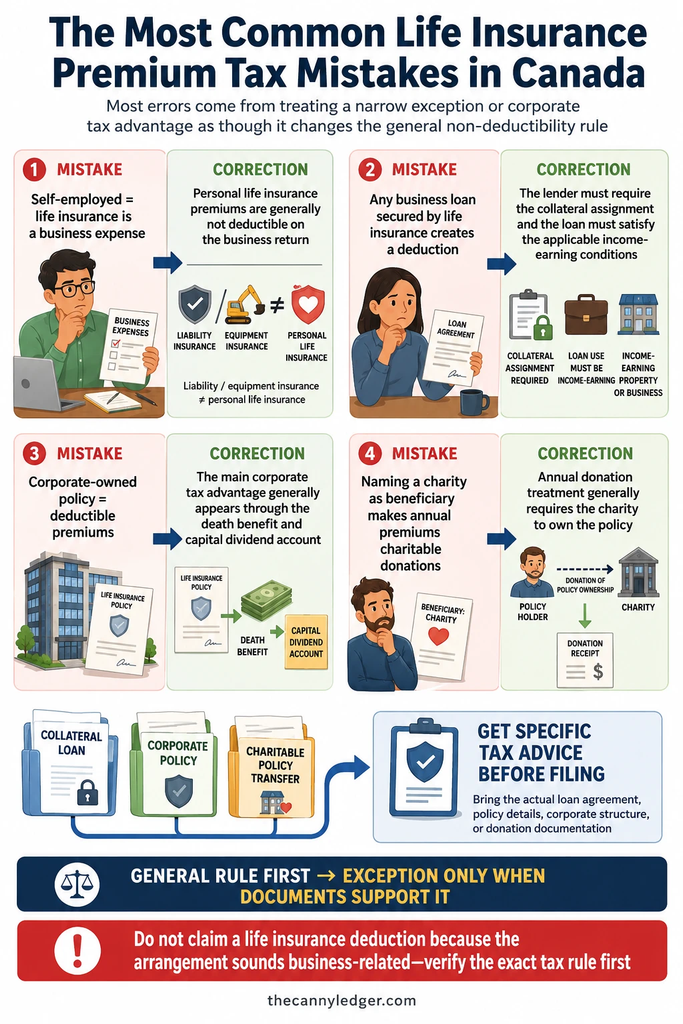
The most common mistake is a self-employed person lumping life insurance premiums in with legitimate business insurance costs on their T2125 form, assuming that because the policy protects their family’s financial stability, it qualifies the same way liability or equipment insurance does. This is exactly the kind of claim that draws CRA attention on an otherwise clean return, since the line between personal and business insurance costs is one of the more commonly misunderstood aspects of self-employment tax filing.
A second mistake is business owners assuming a collateral loan arrangement automatically qualifies for the paragraph 20(1)(e.2) deduction without confirming all three conditions are actually met, particularly the requirement that the lender demand the assignment rather than accept it voluntarily. A third mistake is assuming corporate ownership of a policy makes the premiums deductible, when the real corporate advantage sits entirely on the death benefit side through the capital dividend account rather than anywhere in the premium payments themselves.
If you’re in a situation involving a collateral loan, corporate ownership, or a policy donation, the practical next step is bringing your specific documentation to an accountant familiar with these provisions before filing, since the exceptions covered here all depend on details, exact loan terms, corporate structure, or donation mechanics, that a general explainer can’t verify for your individual situation.
Common Questions About Life Insurance Premium Deductibility
Can I deduct life insurance premiums if I’m self-employed and the policy protects my business income? No. Being self-employed doesn’t change the classification of a personal life insurance policy into a business expense, even if losing your income would seriously harm the business. The only deduction path runs through the specific collateral loan exception, not general business necessity.
Does the type of policy, term versus whole life, affect deductibility? No. The non-deductibility rule applies equally to term and permanent policies. The collateral loan exception also applies to both, though the net cost of pure insurance calculation tends to differ between term and permanent coverage.
Is disability insurance treated the same way as life insurance for tax purposes? Not entirely. Employer-paid disability premiums generally aren’t a taxable benefit to the employee the way group life premiums are, but any disability benefit later received would then be taxable, the reverse of how life insurance premiums and death benefits are treated, which is worth keeping straight if you hold both types of coverage through work.