A workplace benefits statement listing “$100,000 Life Insurance and AD&D” reads like one bucket of protection. It isn’t. That single line usually hides two separate policies with two separate sets of rules, and the family of someone who dies of a heart attack at 52 sometimes only discovers the difference at the worst possible moment, when a claim gets filed and the AD&D half of that number turns out to pay nothing at all. Nobody explains this distinction clearly at open enrollment, and the wording on most benefits statements does nothing to fix that.
- What Life Insurance Actually Promises
- What AD&D Actually Promises, and the Word That Changes Everything
- The Full List of What Won’t Get Paid
- How the Two Products End Up Bundled Together
- Why AD&D Costs So Much Less
- How Each One Gets Taxed
- The Mistake That Started This Article
- Who Actually Gets Real Value from Adding It
- Before You Assume Your Coverage Is Bigger Than It Is
- Frequently Asked Questions
Life insurance pays a death benefit regardless of what causes death, whether that’s illness, an accident, or old age, while accidental death and dismemberment insurance, known as AD&D, only pays out when death or a serious injury results directly from an accident, and pays nothing for death from illness, disease, or natural causes. They’re frequently sold together and often confused for the same coverage, but they protect against genuinely different risks.
What Life Insurance Actually Promises
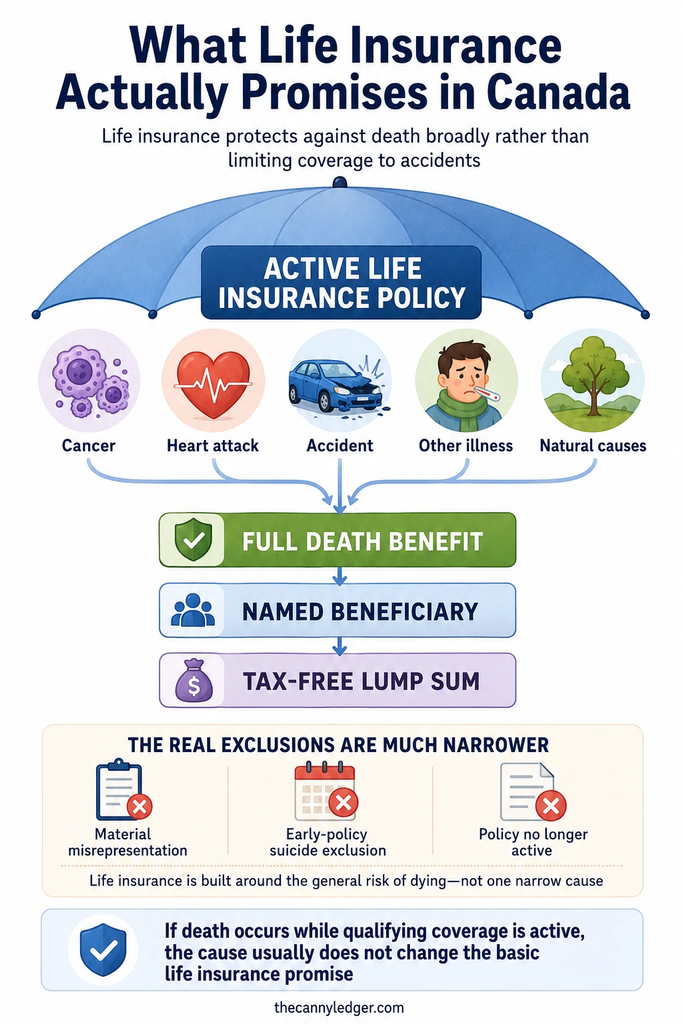
Life insurance in Canada is built around one simple, broad promise. Die while the policy is active, for almost any reason, and your named beneficiary receives the full death benefit as a tax-free lump sum. Whether the cause is cancer, a heart attack, a car accident, or something else entirely doesn’t change the payout, a breadth of coverage the Financial Consumer Agency of Canada’s own insurance guidance confirms applies regardless of cause of death. What a standard policy actually excludes is a short, specific list, mostly limited to misrepresentation on the original application or death by suicide within the first two years of the policy, not a long table of qualifying causes. That breadth is exactly what makes life insurance the right foundation for figuring out how much coverage a family actually needs, since it’s protecting against the general risk of dying, not one narrow category of it.
What AD&D Actually Promises, and the Word That Changes Everything
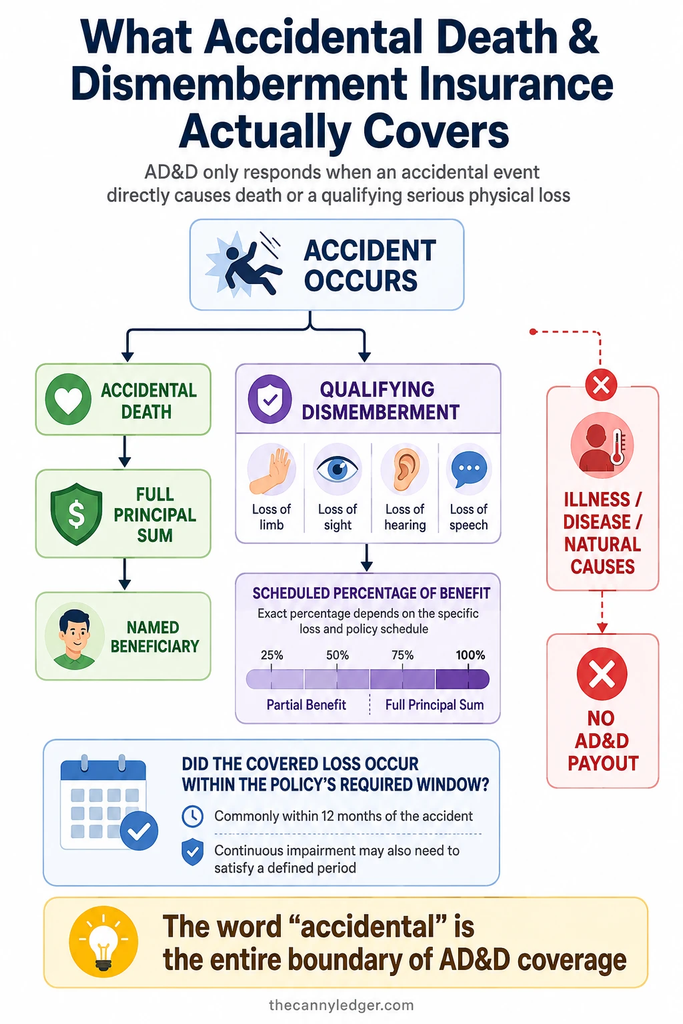
Accidental death and dismemberment insurance narrows that promise down to a single word, accident. RBC Insurance describes it plainly, pointing out that death or injury caused by illness, disease, or natural causes simply isn’t covered under an AD&D policy, no matter how sudden or unexpected it might feel to the family involved. What it does cover splits into two categories. Accidental death pays the full coverage amount, called the principal sum, to a named beneficiary. Dismemberment covers survivable but serious injuries, the loss or loss of use of a limb, sight, hearing, or speech, and pays according to a schedule that assigns each type of loss a percentage of that same principal sum. Losing both hands, both feet, or the sight in both eyes typically triggers the full payout. Losing a single limb or the sight in one eye typically pays somewhere in the range of a quarter to half of the coverage amount, though the exact percentage for each specific loss varies by insurer and needs to be checked against the actual policy schedule rather than assumed.
There’s a timing rule buried in most policies worth knowing before it matters. The loss, whether death or dismemberment, generally has to occur within a set window after the accident, commonly 12 months, and for a loss of use rather than an outright physical loss, that impairment usually has to be continuous for the same 12-month period before it qualifies. An injury that eventually proves fatal or permanently disabling well outside that window can fall outside what the policy actually pays for, even when the original accident is the same one that ultimately caused it.
The Full List of What Won’t Get Paid
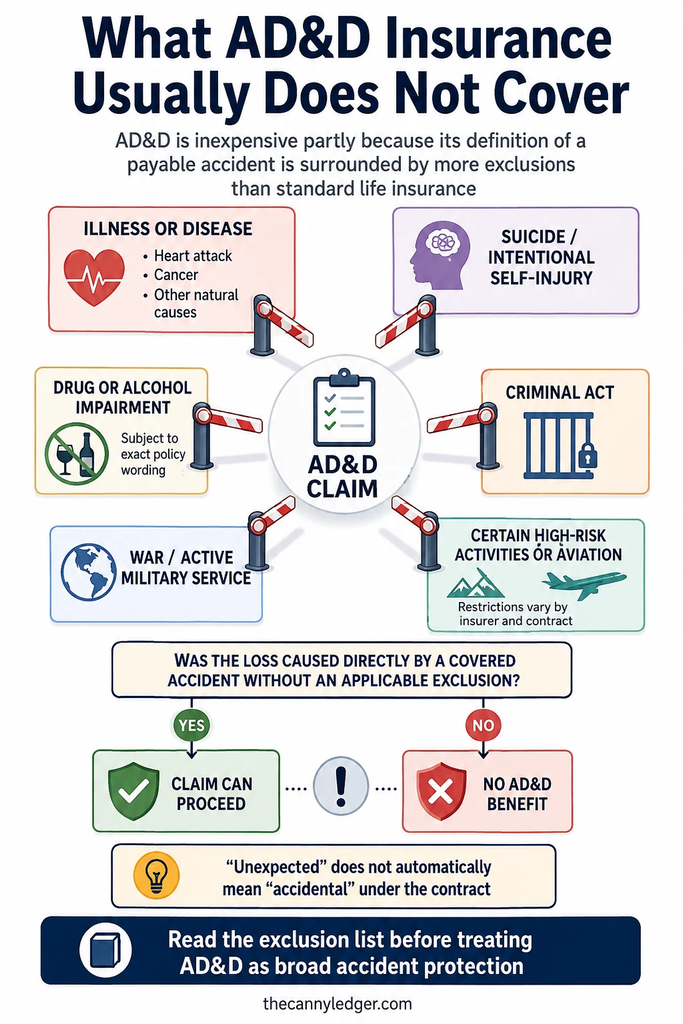
This is where AD&D earns its reputation as a narrower, occasionally frustrating product, and it’s worth reading through the actual exclusions rather than assuming “accident” covers everything the word implies. Standard exclusions across Canadian AD&D policies typically include death or injury from illness or disease of any kind, suicide or intentional self-inflicted injury, death or injury while impaired by drugs or alcohol, injury sustained while committing a criminal act, and death or injury connected to war or active military service. Many policies also exclude or limit coverage for certain high-risk activities, and coverage while operating or riding in aircraft outside of standard commercial travel sometimes carries its own separate restrictions. None of this is unusual or predatory. It’s simply the tradeoff for a product priced narrowly enough to cost far less than comprehensive life insurance, and reading the specific exclusion list on any policy before assuming broad protection is the only way to actually know what’s covered.
How the Two Products End Up Bundled Together
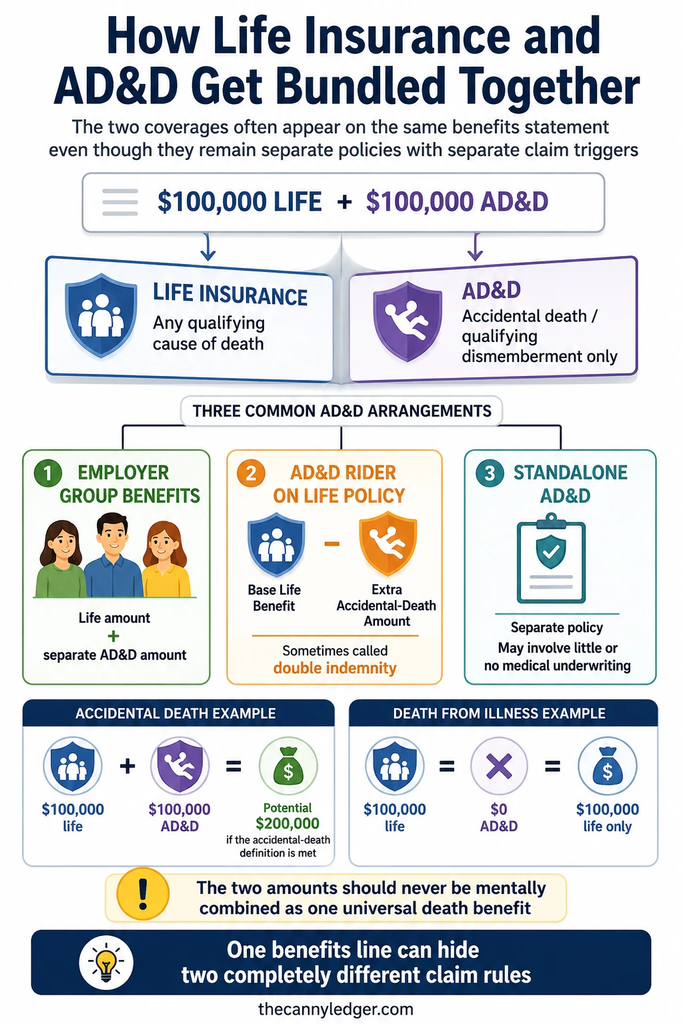
AD&D shows up in three common arrangements, and knowing which one applies changes what a person is actually holding. Most employer group benefits plans bundle a life insurance amount and an AD&D amount together under one combined benefits statement, frequently at the same dollar figure, which is exactly the confusion that opened this article. AD&D can also be added as a rider directly onto an individual life insurance policy, sometimes described as a double indemnity feature, since an accidental death in that structure pays the base death benefit plus the additional AD&D amount on top of it, a structure Canada Life describes on its own consumer page explaining that AD&D is never meant to substitute for a full life insurance policy. Finally, AD&D can be purchased entirely on its own as standalone coverage, independent of any life insurance policy at all, which some insurers offer with guaranteed acceptance and no medical underwriting since claims eligibility is judged entirely on the cause of the loss rather than the applicant’s health history. Sun Life’s own standalone accidental death product, for one example, offers coverage in $25,000 units up to $500,000 with automatic acceptance, available up to age 70.
Why AD&D Costs So Much Less
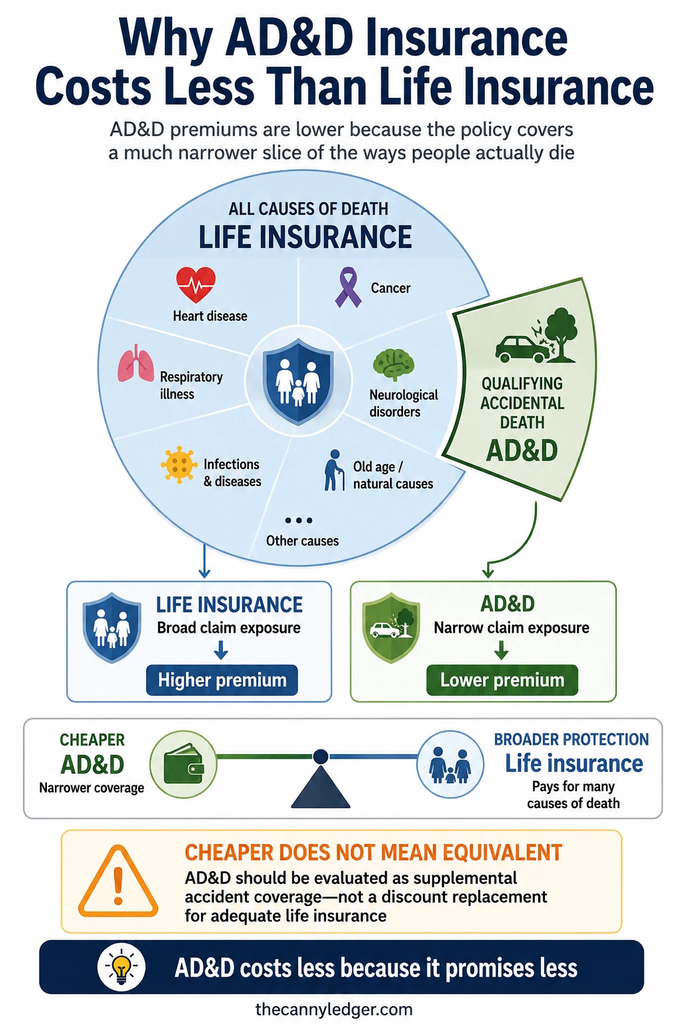
The narrower the risk being insured, the cheaper the coverage, and AD&D sits at the far end of that spectrum compared to life insurance. Because it only pays out for a specific category of death, one that represents a small share of all deaths in Canada, insurers can price it well below the cost of coverage that pays regardless of cause. That’s the entire economic logic behind seeing a modest AD&D amount attached to a much smaller premium line on a benefits statement, and it’s also the reason AD&D should never be treated as a cheaper substitute for adequate life insurance. It’s priced cheaply because it’s covering a narrow slice of risk, not because it’s doing the same job as life insurance for less money.
How Each One Gets Taxed
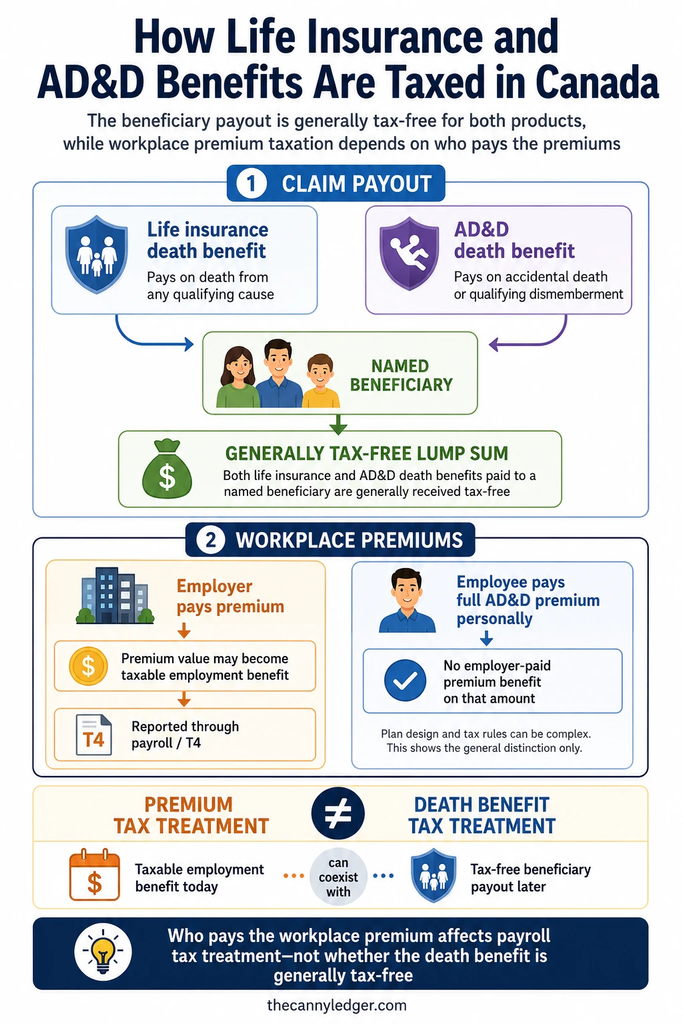
The death benefit from both products follows the same rule. Whether the payout comes from a life insurance policy or an AD&D policy, the lump sum reaches a named beneficiary completely tax-free, with no income tax owed on either type of payout. Where the two can differ is on the premium side, specifically inside a workplace group benefits plan. When an employer pays the premiums for group life insurance, AD&D, or both, the Canada Revenue Agency generally treats those premium payments as a taxable benefit added to the employee’s income and reported on their T4 slip, the same treatment that applies to group life insurance premiums an employer pays on someone’s behalf. If the employee pays the full AD&D premium themselves through payroll deduction rather than the employer covering it, that particular taxable benefit generally doesn’t apply.
The Mistake That Started This Article
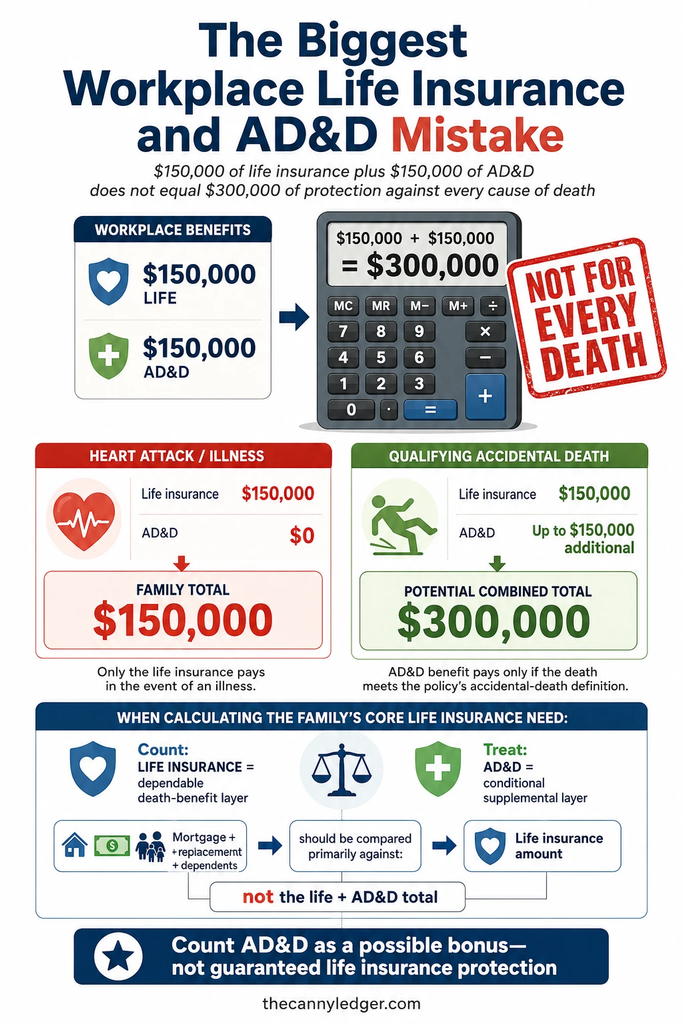
Treating a combined “life insurance and AD&D” number on a benefits statement as one interchangeable pool of protection is the single most common misunderstanding around this coverage, and it has real financial consequences for a family that assumes otherwise. A $150,000 life insurance amount paired with a separate $150,000 AD&D amount does not mean $300,000 of protection against any cause of death. It means $150,000 for any cause of death and up to $150,000 more only if that specific death qualifies as accidental under the policy’s own definition. Anyone building out how much coverage their family actually needs should count only the life insurance portion toward that total, treating any AD&D amount as a bonus that might apply rather than a guaranteed layer of protection sitting on top.
Who Actually Gets Real Value from Adding It
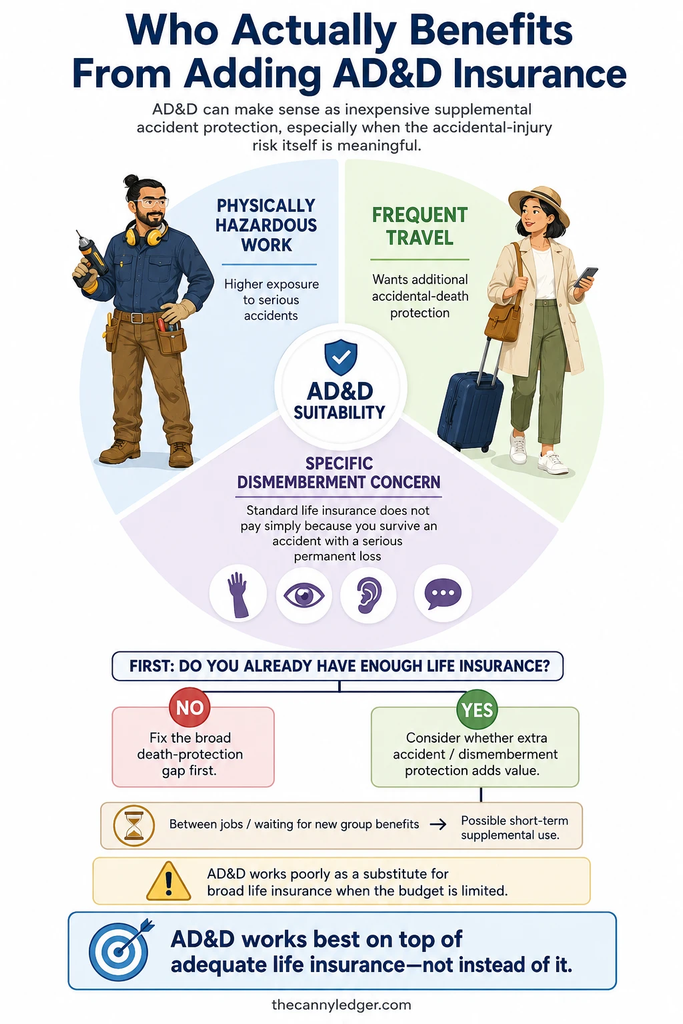
AD&D earns its place for a specific set of people rather than as a universal add-on. Someone working in a physically hazardous trade, a frequent traveler, or someone who wants meaningful supplemental coverage at low cost for a specific window, say, between jobs while a new employer’s group benefits are still pending, can get real value from a modest AD&D layer on top of properly sized life insurance. It also works well as a genuinely inexpensive way to add dismemberment protection specifically, a risk that standard life insurance and even critical illness coverage don’t address directly, since surviving a serious accident with a lasting physical loss creates its own financial strain that a death benefit alone doesn’t solve. It works poorly as a way to stretch a limited insurance budget further, since the coverage that actually matters most, protection against dying from any cause, is exactly what a term or permanent policy already provides and AD&D simply doesn’t.
Before You Assume Your Coverage Is Bigger Than It Is
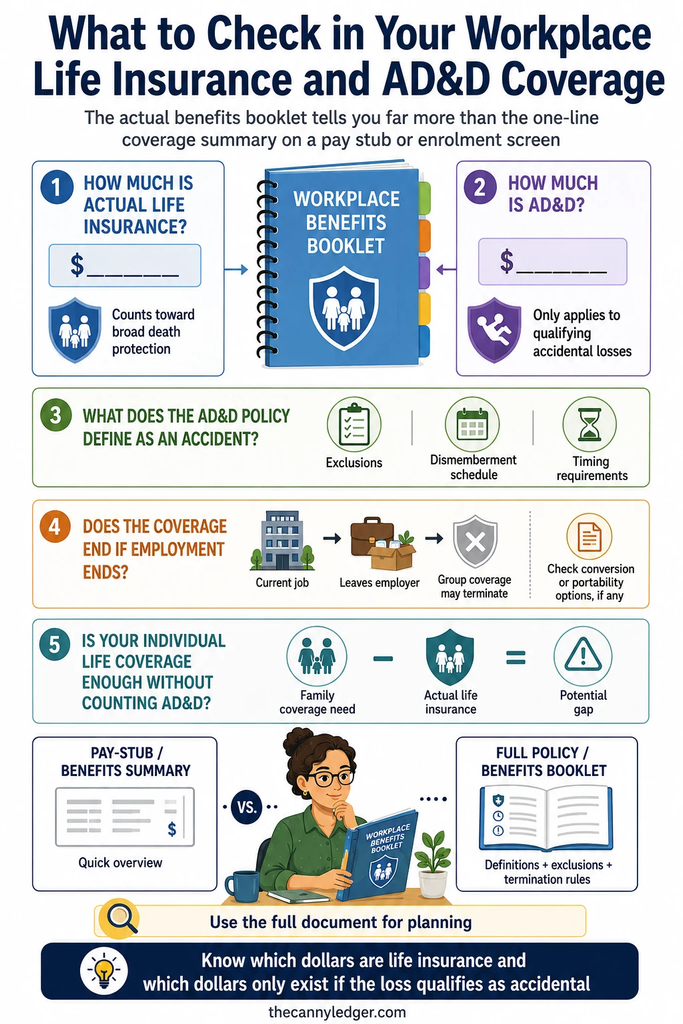
Pull up the actual benefits booklet or policy document, not just the summary line on a pay stub or onboarding email, and confirm which dollar figure is life insurance and which is AD&D specifically. If the two numbers are identical, that’s worth double-checking rather than assuming, since it’s easy to mentally combine them into a single total that overstates what a family would actually receive if death happened from an illness rather than an accident. For anyone relying heavily on a workplace AD&D amount as part of their overall coverage plan, it’s also worth checking what happens to that coverage if employment ends, since group AD&D, like group life, typically doesn’t follow a person out the door the way an individually owned policy would.
Frequently Asked Questions
Does AD&D cover death from a heart attack that happens during physical activity? No. A heart attack is classified as death from illness or a medical event rather than an accident, so it falls under the same natural causes exclusion that applies to any illness-related death, even if it occurs unexpectedly during exercise or exertion.
Can someone buy AD&D coverage without also having a life insurance policy? Yes. Standalone AD&D policies exist specifically for this purpose and are sold independently of any life insurance product, often with simplified or guaranteed acceptance since eligibility depends on the cause of a future claim rather than current health.
Does AD&D pay out if someone dies from a drug overdose or while intoxicated? Generally no. Most policies specifically exclude death or injury connected to intoxication or the use of illegal drugs, regardless of whether the underlying event itself, such as a fall or accident, would otherwise have qualified.
What happens if someone has AD&D coverage through two separate sources at the same time? Both policies typically pay out independently for a qualifying claim, since AD&D coverage through an employer and a separately purchased individual AD&D policy are usually treated as distinct contracts rather than coordinated benefits, though this should be confirmed against the specific terms of each policy.