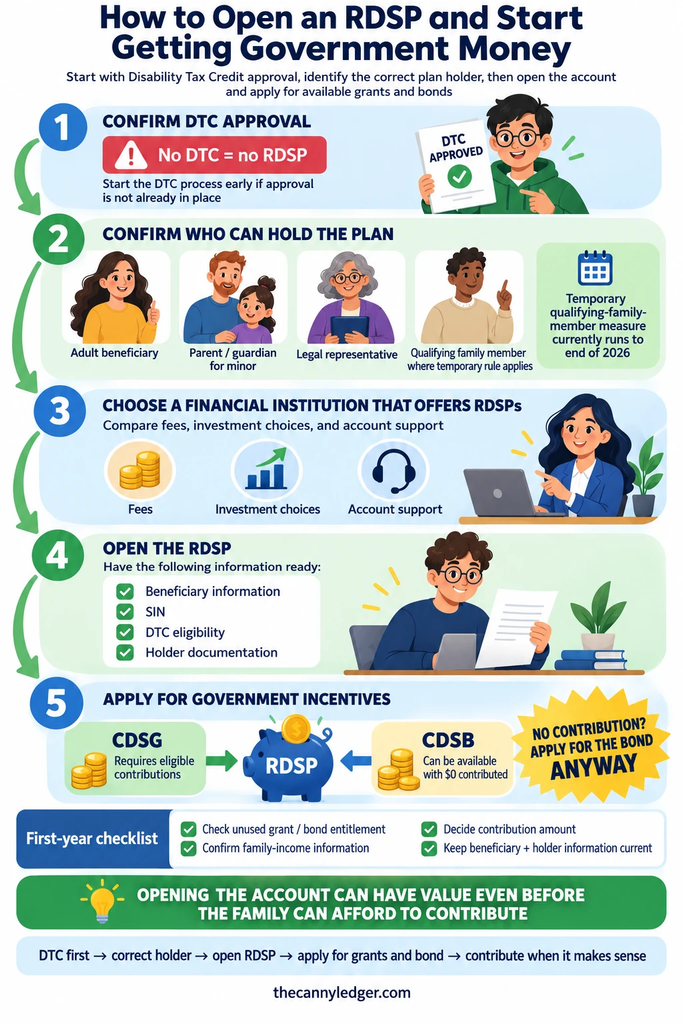
Fewer than a third of Canadians who qualify for a Registered Disability Savings Plan (RDSP) have actually opened one, according to Employment and Social Development Canada’s own program statistics. Part of the reason is simple unfamiliarity. Part of it is a genuine misconception, that an RDSP requires money a family doesn’t have. It doesn’t. A beneficiary with no contributions at all can still receive up to $1,000 a year in government money through the Canada Disability Savings Bond, deposited into an account that didn’t cost the family a cent to fund.
An RDSP is a long-term savings plan for a person approved for the Disability Tax Credit (DTC), built to hold private contributions alongside two kinds of federal government money, a matching grant and an income-tested bond, growing tax-deferred until the beneficiary eventually withdraws it. It isn’t retirement savings in the traditional sense, and it isn’t restricted to any specific use once money comes out. It exists simply to build long-term financial security for someone the program was designed around from the start.
Who Actually Qualifies
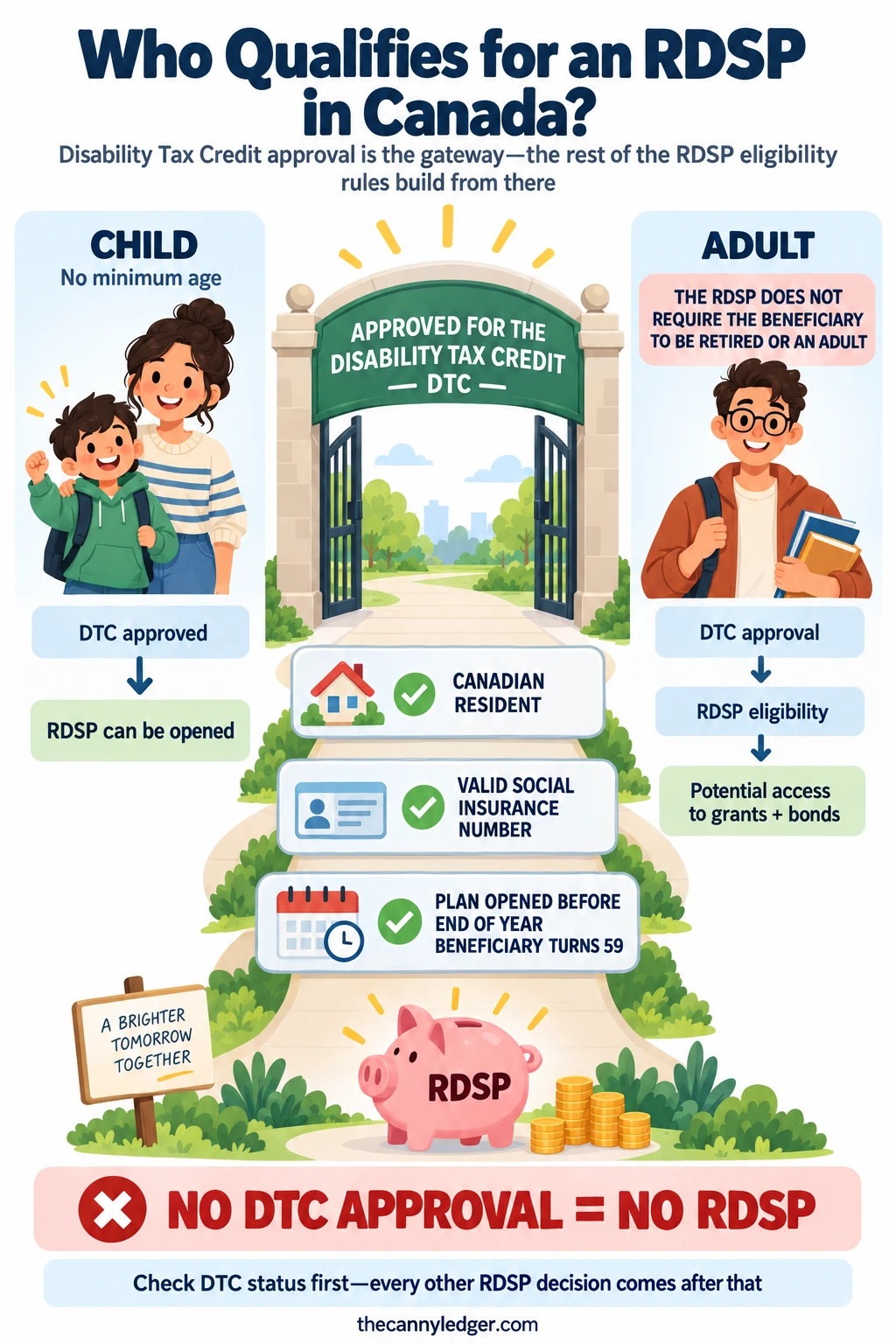
The core requirement is approval for the Disability Tax Credit, and everything else about the RDSP flows from that single condition. The beneficiary has to be a Canadian resident with a valid Social Insurance Number, and the plan itself has to be opened before the end of the year the beneficiary turns 59, one of several age-based rules that shape the account throughout its life. There’s no minimum age. An RDSP can be opened for a child the same year they’re approved for the DTC, which for many families happens well before school age.
Who Can Actually Hold the Plan
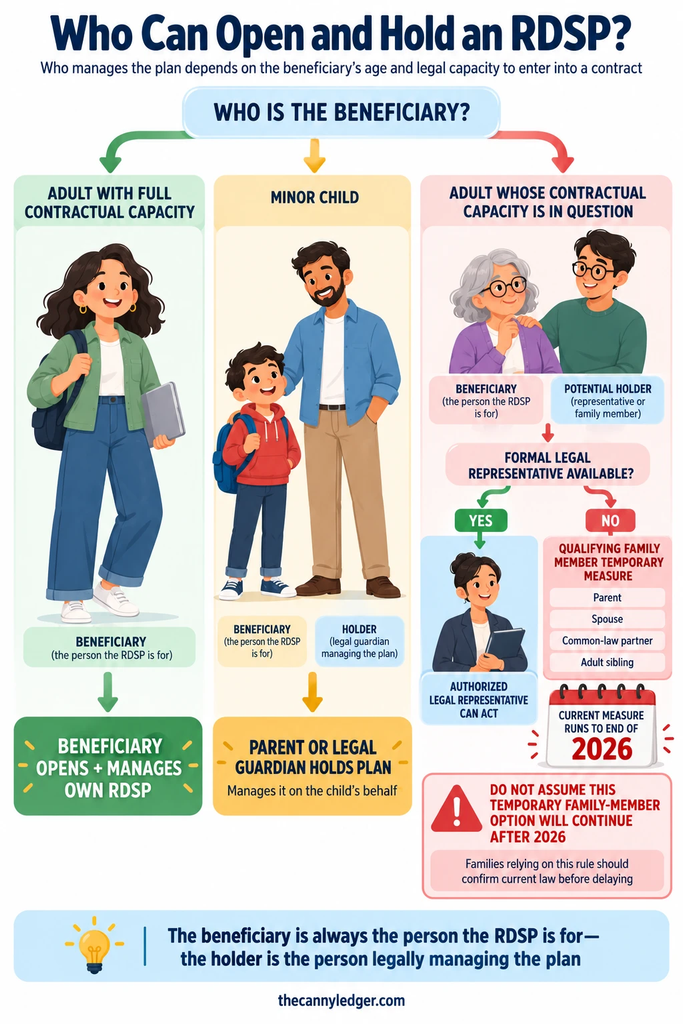
An adult with full contractual capacity opens and manages their own RDSP. For a minor, a parent or legal guardian holds the plan on the child’s behalf. For an adult beneficiary whose capacity to enter into a contract is genuinely in question and who has no formal legal representative in place, a temporary measure allows a qualifying family member, meaning a parent, spouse, common-law partner, or, since Budget 2023 expanded the definition, an adult sibling, to open and hold the plan instead. This measure has already been extended several times since it was first introduced, and the most recent extension runs only until the end of 2026, which means any family relying on it should treat this year as the moment to act rather than assume the option will still be there afterward.
The Two Kinds of Government Money
This is the part of the RDSP that sets it apart from every other registered account in Canada, and it comes in two distinct forms rather than one.
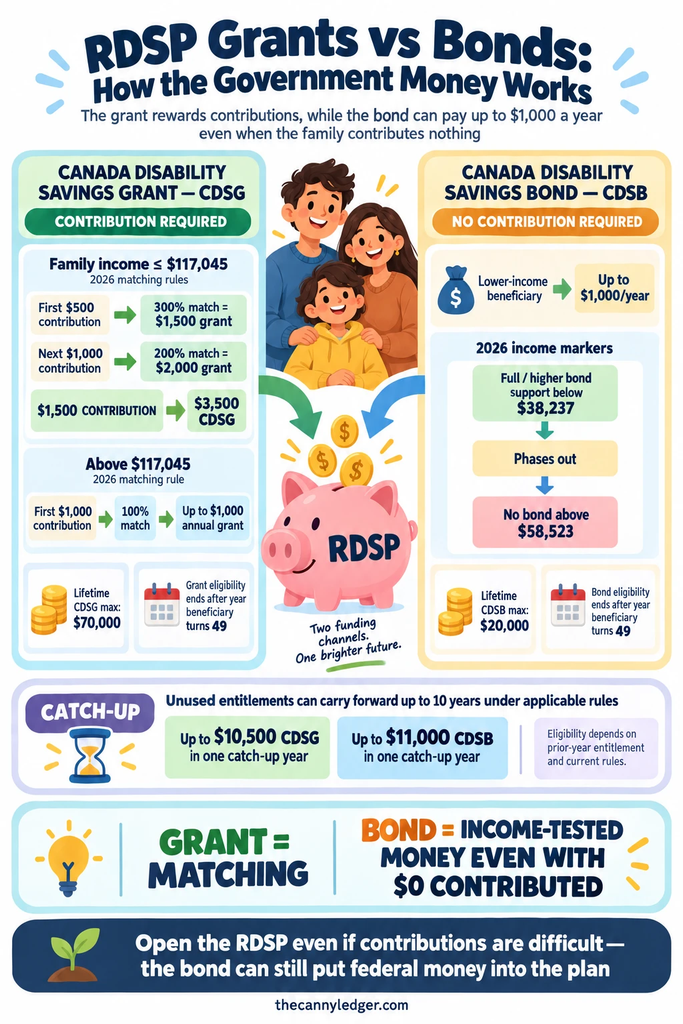
The Canada Disability Savings Grant (CDSG) matches contributions at rates tied to the beneficiary’s family income. For 2026, families at or below $117,045 in adjusted net income receive 300 percent matching on the first $500 contributed in a year and 200 percent on the next $1,000, meaning a $1,500 contribution can attract $3,500 in matching grant money in a single year. Families above that threshold still receive matching, just at a flat 100 percent on the first $1,000 contributed, capping their annual grant at $1,000 rather than $3,500. Either way, the lifetime CDSG maximum is $70,000 per beneficiary, and grants stop being payable after the year the beneficiary turns 49.
The Canada Disability Savings Bond (CDSB) works completely differently, since it requires no contribution at all. A beneficiary in a lower-income household can receive up to $1,000 a year in bond money simply by having the RDSP open and applying, with the amount phasing out gradually for families above $38,237 in 2026 and disappearing entirely above $58,523. The lifetime CDSB maximum is $20,000, and like the grant, it stops accumulating after the year the beneficiary turns 49.
Both the grant and the bond allow unused entitlements to carry forward for up to 10 years once a beneficiary turns 18, which matters enormously for a family that couldn’t contribute in earlier years, or whose DTC approval came through later than expected. A single year of catch-up contribution can pull in up to $10,500 in CDSG rather than the standard $3,500, and carried-forward bond entitlements can add up to $11,000 in a single year rather than the usual $1,000 cap.
How Much You Can Actually Contribute
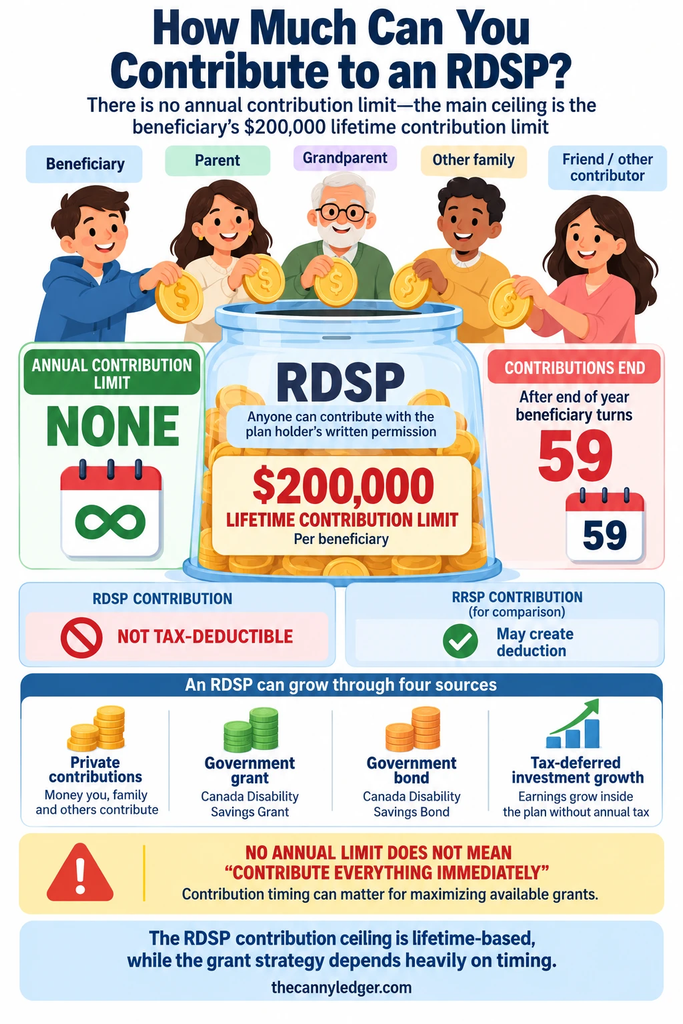
Anyone can contribute to an RDSP with the plan holder’s written permission, not just family members, and there’s no annual contribution cap at all. The only real ceiling is a $200,000 lifetime limit per beneficiary, and contributions have to stop by the end of the year the beneficiary turns 59. Unlike an RRSP, an RDSP contribution is never tax-deductible. The benefit comes entirely from the matching grant and bond money layered on top, plus the tax-deferred growth on everything sitting inside the account.
The Ten-Year Rule That Protects the Program
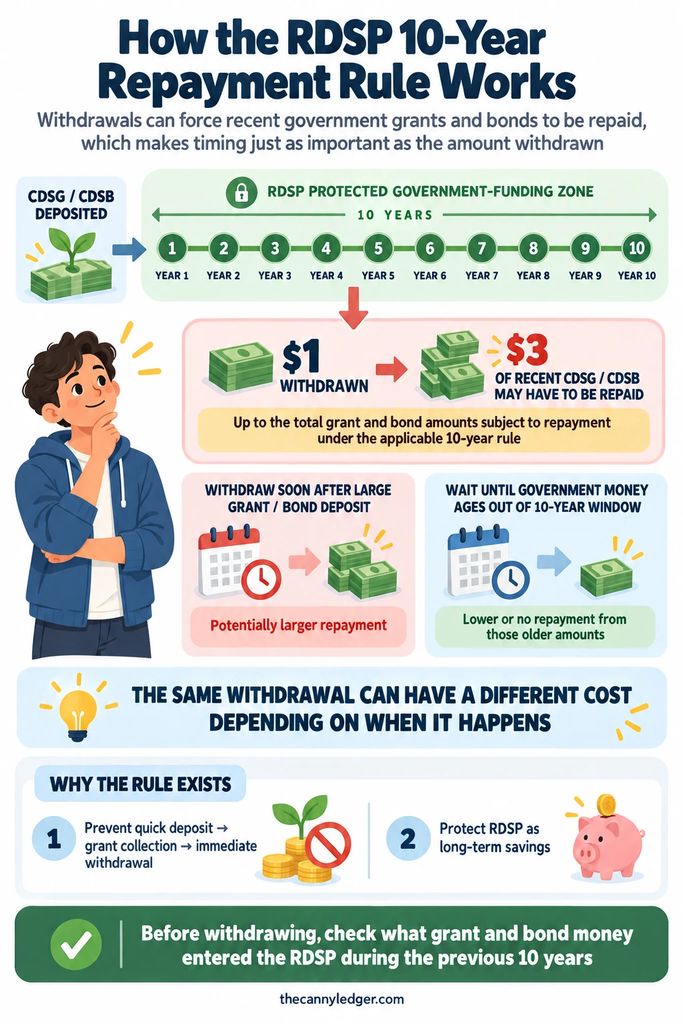
Withdraw money too soon after receiving grant or bond payments and the program claws some of it back. For every $1 withdrawn from an RDSP, $3 of any CDSG or CDSB paid into the plan during the preceding 10 years has to be repaid to the government, up to the total amount of grants and bonds received in that window, the mechanic covered in detail in the full breakdown of the 10-year rule. This exists specifically to stop someone from opening an account, collecting a large matching grant, and withdrawing the money almost immediately, which would defeat the entire long-term purpose of the plan. It also means the timing of a withdrawal matters as much as the amount, since a withdrawal taken a year or two after a large grant deposit can trigger a bigger repayment than the same withdrawal taken a decade later.
Getting Money Out
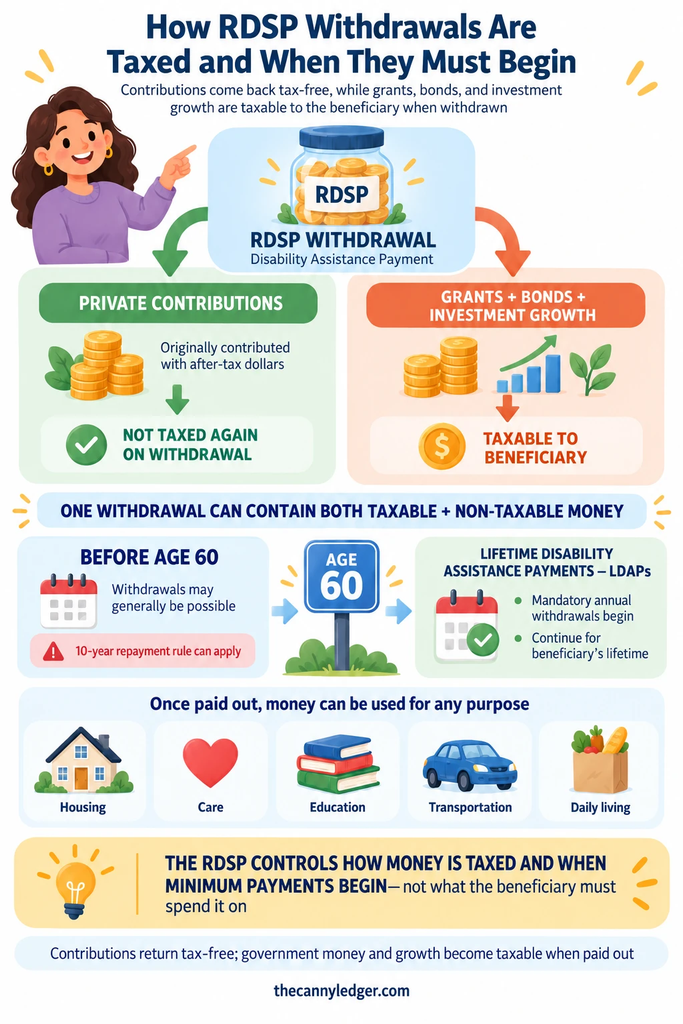
Withdrawals from an RDSP, called Disability Assistance Payments, can generally start at any point once the plan exists, subject to the 10-year holdback rule above, and the full set of withdrawal rules covers exactly how the taxable and non-taxable portions get calculated. Once the beneficiary turns 60, these shift to mandatory annual Lifetime Disability Assistance Payments, which have to begin that year and continue for as long as the beneficiary lives. There’s no restriction on what the money gets used for once it’s paid out. Whatever portion of a withdrawal comes from contributions is never taxed, since that money was never deducted in the first place, while the portion made up of grants, bonds, and investment growth is taxable to the beneficiary when it comes out.
What Happens to Money From Elsewhere
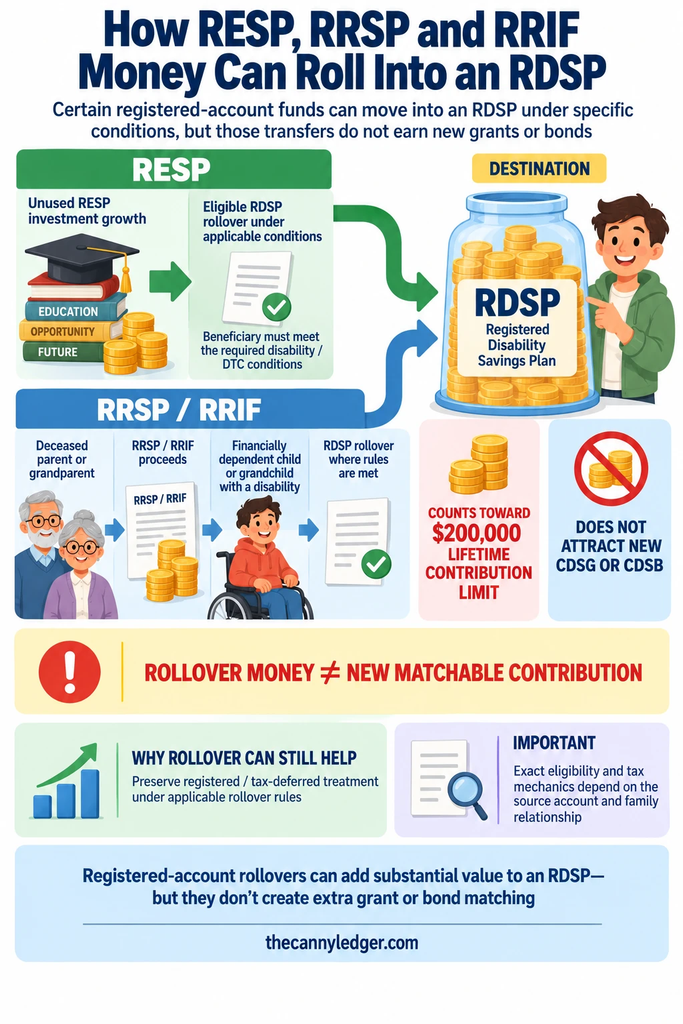
An RDSP doesn’t only grow from direct contributions and government matching. Money can also arrive from other registered accounts under specific conditions, most notably an RESP’s unused investment growth rolling over into an RDSP for a beneficiary who qualifies for the DTC, or RRSP and RRIF proceeds from a deceased parent or grandparent flowing into the RDSP of a financially dependent child or grandchild with a disability. These rollovers count toward the same $200,000 lifetime contribution limit and don’t attract additional CDSG or CDSB matching of their own, since the grant and bond only respond to new money contributed directly.
Opening One
Confirm the DTC approval is in place first, since nothing about the RDSP works without it, and apply well before assuming the process will be quick if the disability isn’t already documented with the CRA. If a qualifying family member arrangement is the only realistic way to open the account for an adult beneficiary, treat 2026 as the year to act rather than wait, given how close that measure is to its current expiry. And once the account exists, apply for the bond immediately even if a contribution isn’t possible yet, since that $1,000 a year doesn’t wait for anyone’s finances to catch up.