
The word “dividend” does most of the damage here. Say it to someone who owns a few index funds and they picture a cheque showing up every quarter, guaranteed, tied to a company’s profits. Insurance companies use the exact same word for something that works differently enough to catch people off guard years into owning a policy, usually right around the time a dividend scale gets trimmed and the annual statement shows a smaller number than the glossy illustration promised at the sales meeting. Participating whole life insurance is built almost entirely around this one mechanism, so getting it wrong at the start means misunderstanding the product for decades.
- How the Participating Account Actually Works
- What You Can Actually Do With a Dividend
- The Illustration Trap Almost Everyone Falls Into
- How You Pay For It
- What Happens If You Stop Paying
- The Tax Treatment That Makes This Product Different From a Savings Account
- Where This Actually Fits, and Where It Doesn’t
- If Your Insurer Fails
- Before You Sign Anything, Ask for This
- Frequently Asked Questions
Participating whole life insurance is a permanent life insurance policy that gives you lifelong coverage, a guaranteed minimum cash value, and a share of the insurer’s participating account surplus in the form of annual dividends. Unlike term insurance, it never expires as long as premiums are paid. Unlike non-participating whole life, its cash value can grow beyond the guaranteed minimum, based on how the insurer’s pooled investment fund performs each year.
How the Participating Account Actually Works
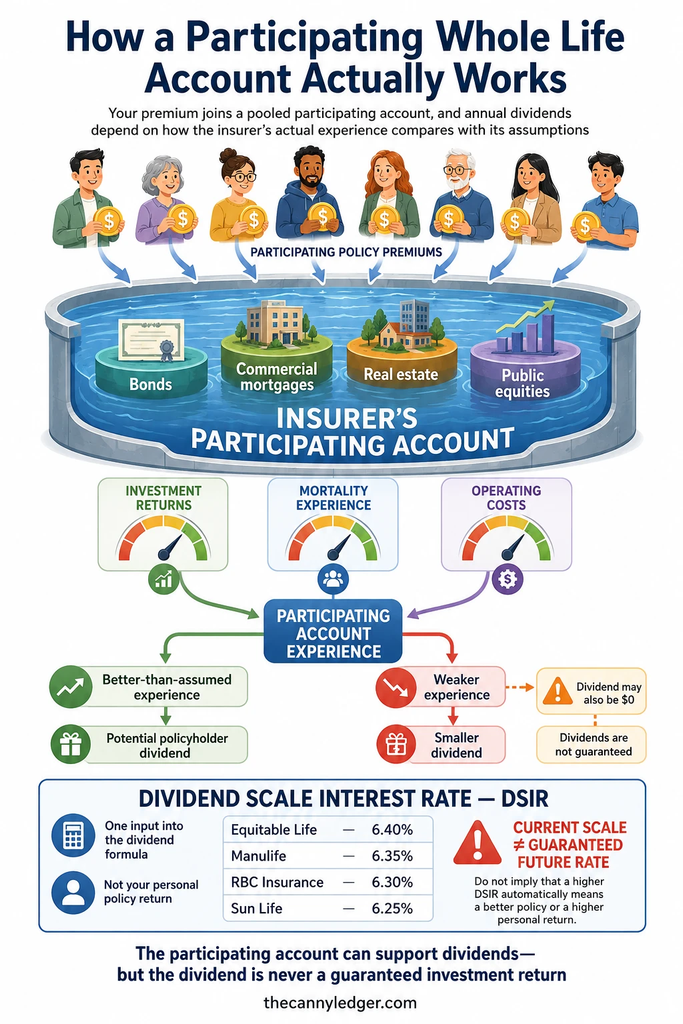
Every dollar you pay in premium doesn’t go toward your policy alone. It gets pooled with premiums from every other participating policyholder at that insurer into a single fund, invested across a mix of bonds, commercial mortgages, real estate, and public equities. That fund is managed the way a pension fund is managed, by a dedicated investment team aiming for steady, long-horizon returns rather than short-term gains. When the fund does better than the insurer needed it to (through stronger investment returns, fewer death claims than expected, or lower operating costs than budgeted), the surplus gets shared back with policyholders as dividends. When performance falls short, dividends shrink, and in a genuinely bad year, an insurer can decide not to declare one at all, though outright skipped dividends are rare among Canada’s major insurers.
The number insurers actually publish each year is called the dividend scale interest rate, sometimes shortened to DSIR. It’s one input into the dividend formula, not the return you personally earn on your policy, and it’s worth understanding that distinction before comparing insurers on this figure alone. As of 2026, Equitable Life holds the highest published dividend scale interest rate among major Canadian insurers at 6.40 percent, maintained through June 2027. Manulife sits at 6.35 percent, effective from September 2026 for policies issued on or after June 2018. RBC Insurance is at 6.30 percent for the period running April 2026 through March 2027. Sun Life maintained 6.25 percent for its 2026 to 2027 scale, Empire Life held its scale at the same 6.25 percent through June 2026, and Canada Life’s board approved dividend scale changes for its combined open participating account effective July 2026. None of these rates are locked in. Every insurer reviews its scale annually, and a rate that looks attractive this year carries no promise about where it sits five or twenty years from now.
What You Can Actually Do With a Dividend
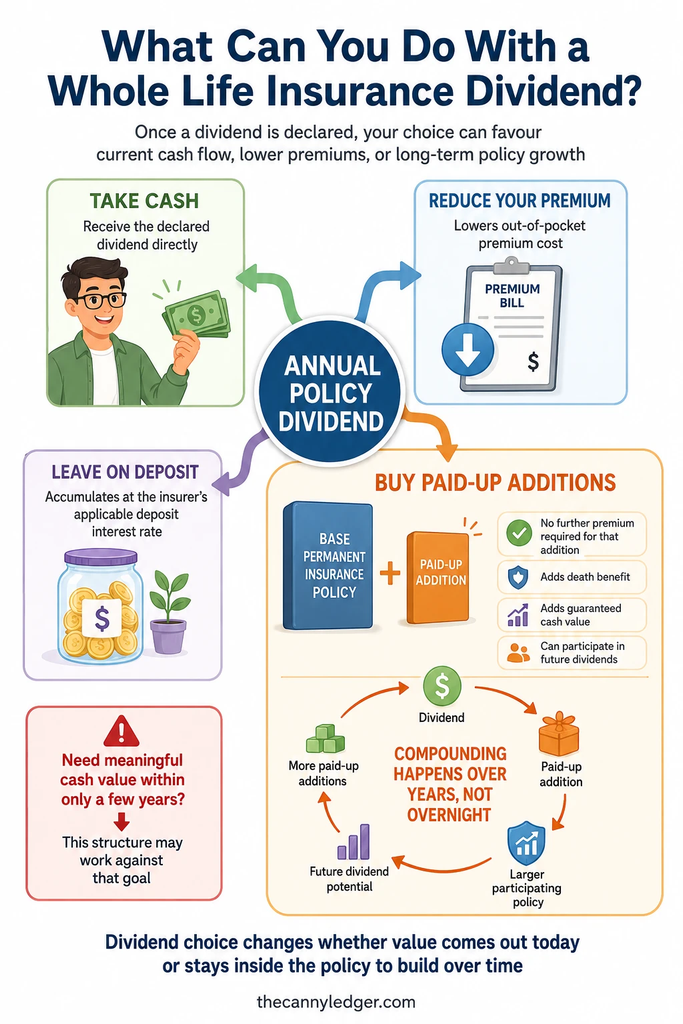
Once a dividend is declared on your policy, you generally get to choose what happens to it, and this choice matters more than most first-time buyers realize. You can take it as cash, paid out to you directly each year. You can apply it against your next premium, lowering what you owe out of pocket. You can leave it on deposit with the insurer to accumulate at a set interest rate, similar to a savings account sitting inside the policy, an option RBC Insurance lists among its standard dividend choices for its participating products. Or, the option most participating policies are actually designed around, you can use the dividend to buy paid-up additions.
A paid-up addition is a small, fully paid, permanent slice of extra life insurance layered onto your existing policy. It requires no further premium, ever, and it comes with its own guaranteed cash value and its own eligibility to earn future dividends. Buy enough paid-up additions over enough years and both your death benefit and your cash value compound on top of each other, since each addition is itself generating new dividends that can buy still more additions. This compounding effect is the entire reason participating whole life gets pitched as a long-term wealth tool rather than pure protection, and it’s also why the strategy rewards patience far more than it rewards buying the policy and expecting fast results. Someone buying a participating policy at 60 with a plan to access meaningful cash value within five years is working against the product’s actual design, not with it.
The Illustration Trap Almost Everyone Falls Into
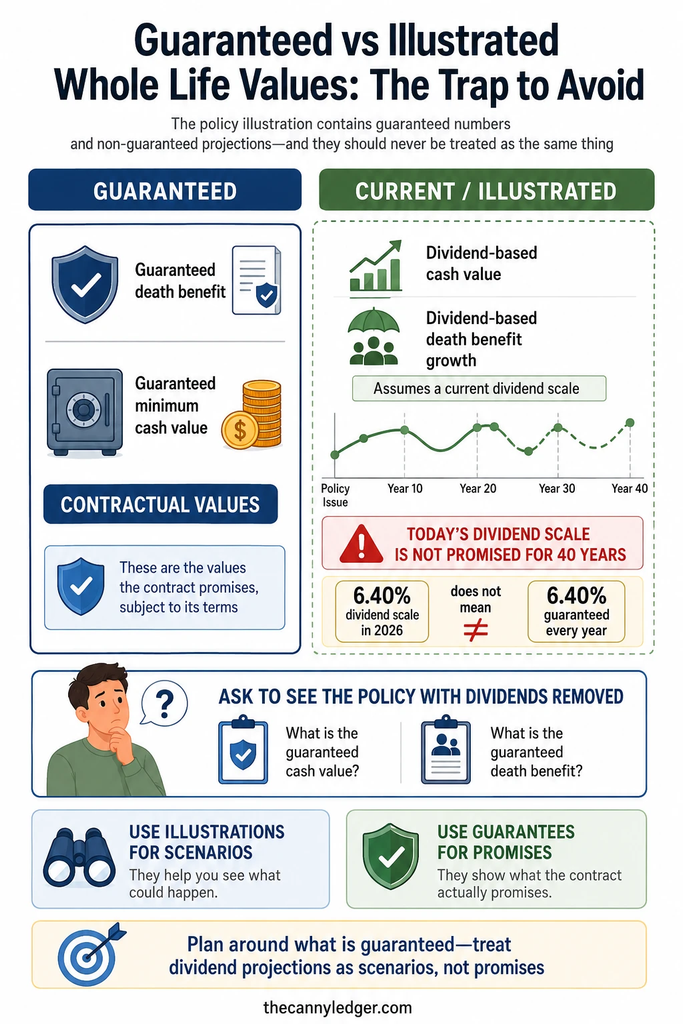
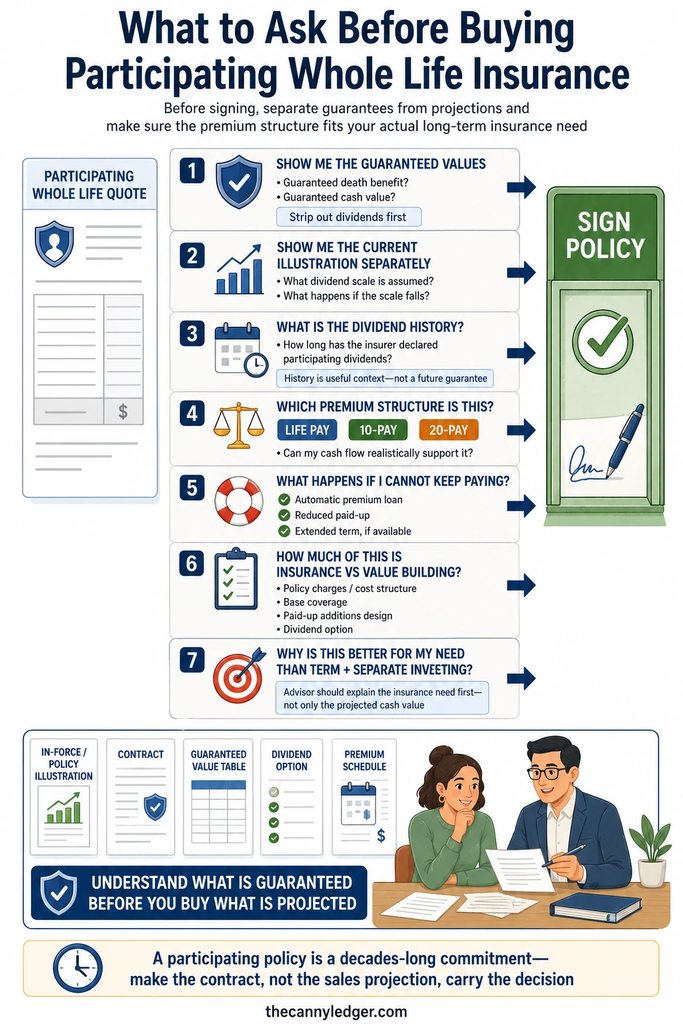
Every participating whole life quote comes with a projection showing two columns of numbers side by side, usually labelled something like “guaranteed” and “current” or “illustrated.” The guaranteed column is the only part of that document your insurer is contractually obligated to deliver. The current or illustrated column assumes today’s dividend scale holds steady for the entire life of the policy, sometimes projected out 40 or 50 years, and that assumption almost never survives contact with reality over that kind of timeframe. Interest rates shift, mortality experience changes, and dividend scales get revised, sometimes upward and sometimes down.
This is the single most common misunderstanding in participating whole life sales conversations, and it’s rarely explained clearly at the point of sale. A policy illustrated with a 6.40 percent dividend scale in 2026 is not promising 6.40 percent for the next four decades. It’s showing what today’s rate would produce if nothing ever changed, which is a useful benchmark for comparing insurers against each other in the same year, but a poor basis for planning your retirement income forty years out. Before signing anything, ask specifically what your guaranteed cash value and guaranteed death benefit look like with dividends stripped out entirely. That number, not the illustrated one, is what the contract actually promises you.
How You Pay For It
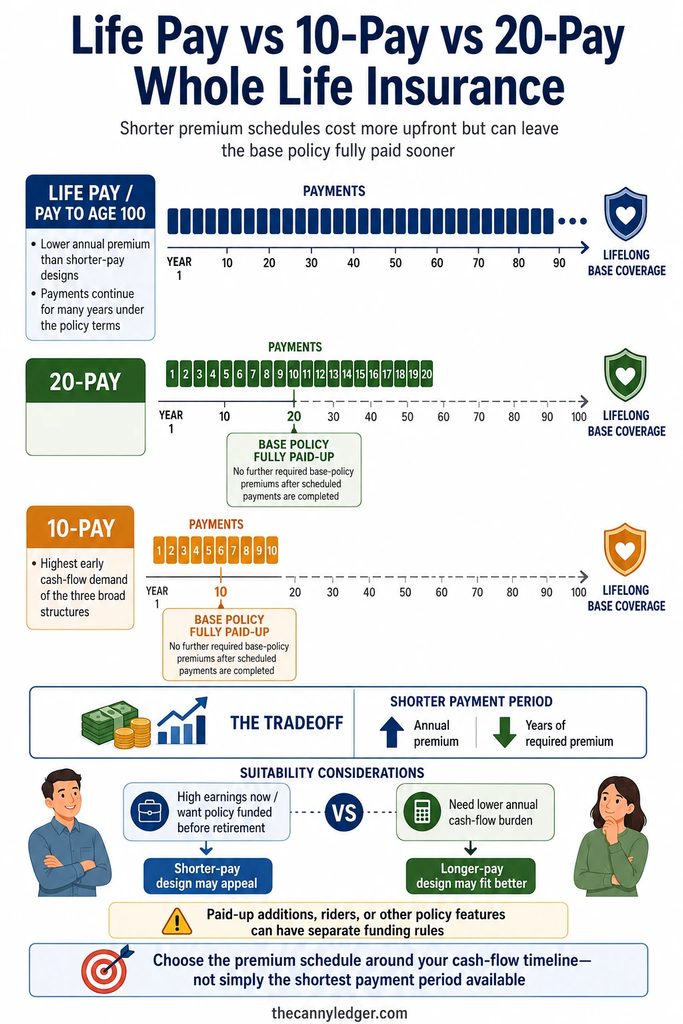
Participating whole life doesn’t force you into a single payment structure, and the choice you make here changes both your short-term cash flow and how quickly the policy builds cash value. The most common option, sometimes called life pay or pay to age 100, spreads level premiums across your entire life or until age 100, whichever the insurer defines as the endpoint. A 10-pay structure compresses the entire required premium schedule into your first 10 years of ownership, after which the base policy is fully paid up and no further premiums are required to keep the original coverage in force, though any paid-up additions or riders may have their own separate rules. A 20-pay structure does the same thing over 20 years. Shorter pay periods mean noticeably higher premiums in the early years in exchange for being done paying much sooner, which appeals most to people who expect their highest earning years to happen relatively early, or who specifically want the policy fully funded before retirement.
What Happens If You Stop Paying
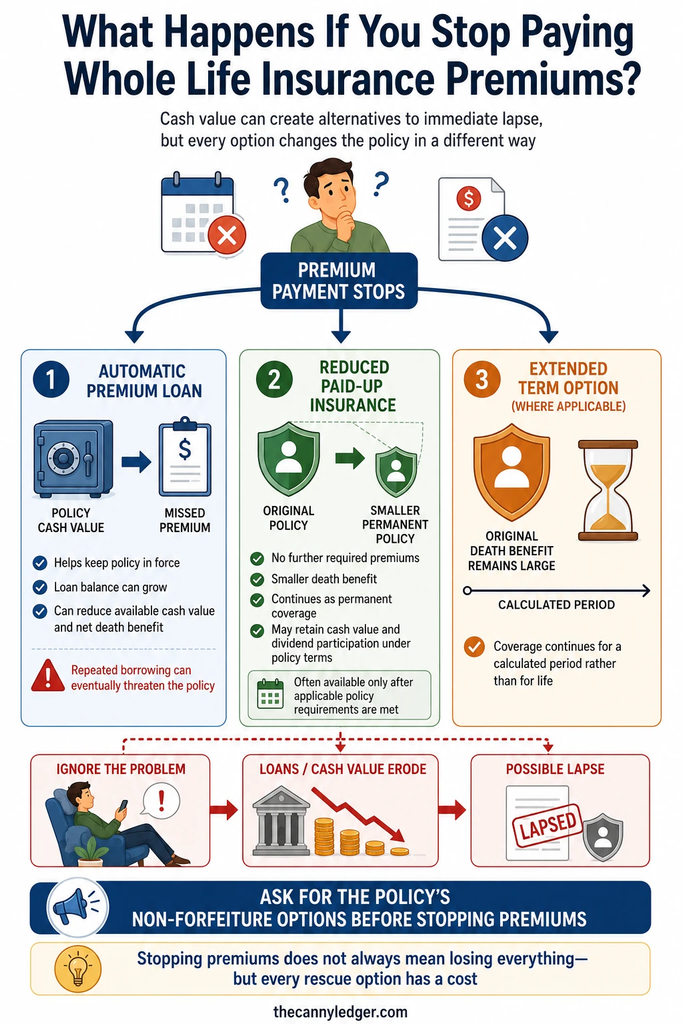
Life changes, and not everyone who buys a participating whole life policy in their 30s is still able or willing to pay the same premium decades later. Because these policies build cash value, stopping payment doesn’t automatically mean losing everything the way it would with term insurance. Most policies include what’s called an automatic premium loan provision, which quietly borrows against your own cash value to cover a missed premium so the policy doesn’t lapse, a useful safety net but one that slowly erodes your cash value and death benefit if payments stay missed for a long stretch. If you decide deliberately to stop paying rather than miss a payment by accident, most insurers offer a reduced paid-up option once the policy has been active long enough, typically a minimum of three years. Reduced paid-up insurance converts your existing cash value into a smaller death benefit that requires no further premiums for the rest of your life, and unlike some other non-forfeiture options, that reduced policy keeps growing cash value and generally stays eligible for future dividends. A few insurers also still offer extended term insurance as a non-forfeiture option, which keeps your original death benefit fully intact but only for a calculated number of years rather than for life.
The Tax Treatment That Makes This Product Different From a Savings Account
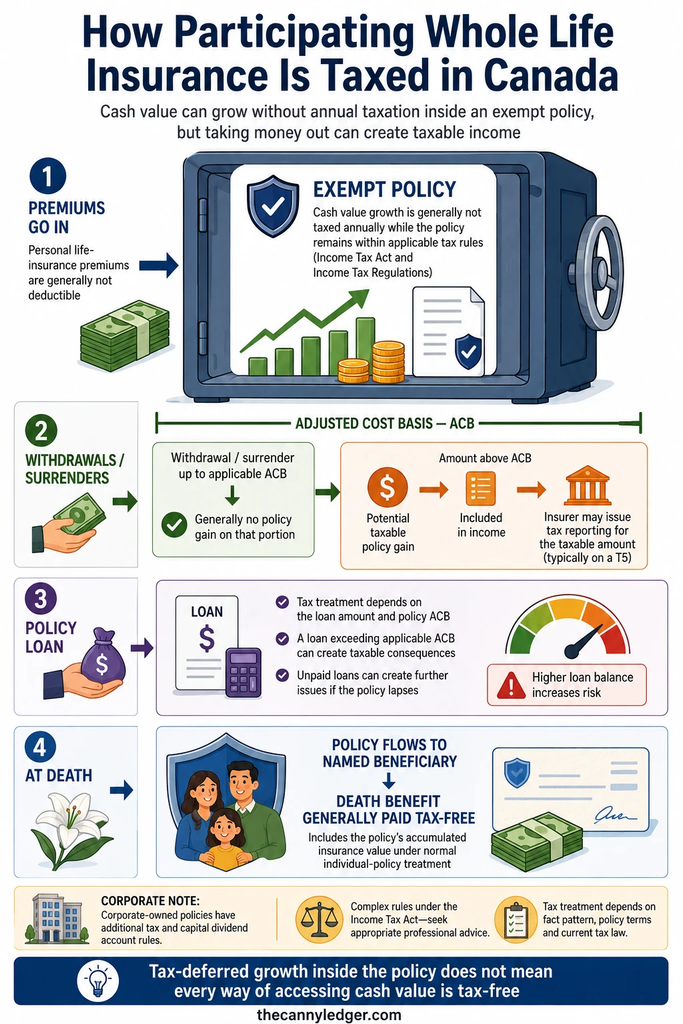
Cash value growth inside a participating whole life policy accumulates without annual tax, as long as the policy stays within limits set out in Canada’s Income Tax Act under what’s formally called the exempt policy test. Your insurer tracks this automatically in the background, and as a policyholder you generally don’t need to calculate it yourself, but it’s worth knowing the limit exists, since it’s the entire reason cash value inside a life insurance policy grows differently than cash value inside a taxable investment account.
The exempt policy test itself is set out in the federal Income Tax Regulations, and while the mechanics are technical enough that most people never need to read the actual regulation, it’s the legal basis for every tax-deferred growth claim an insurer makes about a participating policy. The number the Canada Revenue Agency actually cares about when money comes out of the policy is called the adjusted cost basis, or ACB. Withdraw or surrender cash value up to your ACB and there’s no tax owed, since that portion represents a return of what you’ve already paid in after-tax premiums. Take out more than your ACB, whether through a full surrender or a partial withdrawal, and the excess gets added to your income for that tax year, with the insurer issuing a T5 slip for the taxable portion, a detail worth confirming against your own policy statement rather than assuming every withdrawal is automatically tax-free. Borrowing against the policy through a policy loan generally doesn’t trigger immediate tax as long as the loan stays within your ACB, though a loan that exceeds ACB, or one left unpaid when the policy eventually lapses, can create a tax bill you weren’t necessarily expecting. None of this changes how the death benefit itself is taxed. When the insured person dies, the full death benefit, including all the cash value and paid-up additions built up inside the policy, passes to a named beneficiary completely tax-free, the same treatment a straightforward term policy gets, just with more accumulated value riding along with it. Premiums themselves are a separate question. Personal premiums for a participating policy generally aren’t deductible on your own tax return, regardless of how the cash value inside the policy is taxed.
Where This Actually Fits, and Where It Doesn’t
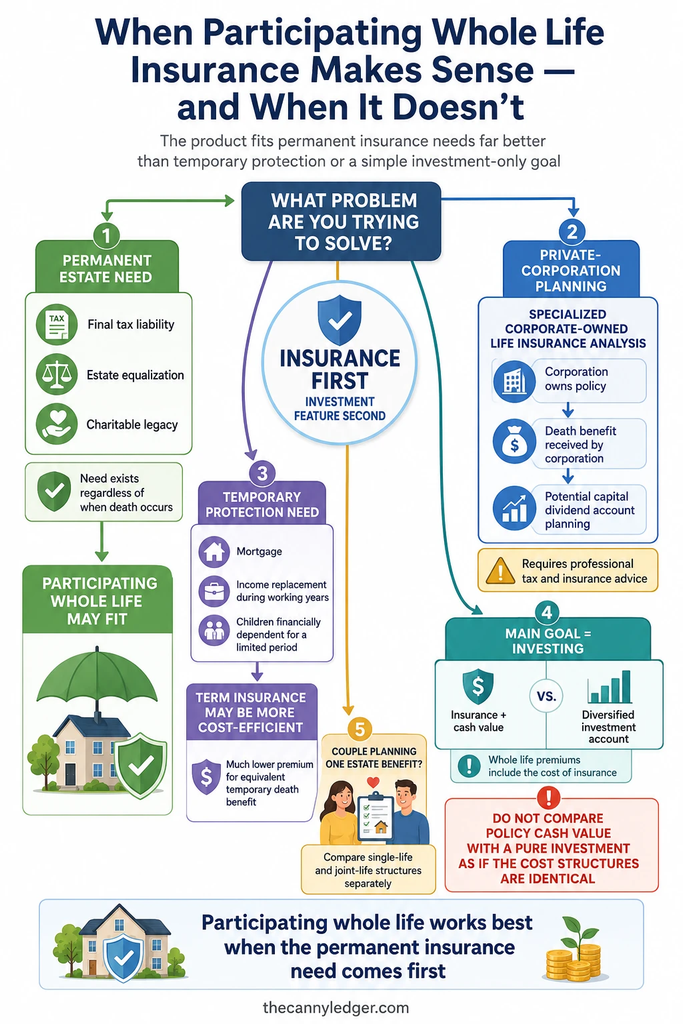
Participating whole life gets recommended for a genuinely narrow set of situations, and it gets oversold into a much wider set of situations than that. It fits well when someone has a permanent need for coverage rather than a temporary one, most commonly for estate planning, where the goal is guaranteeing money exists at death to cover a final tax bill, equalize an inheritance between children, or fund a charitable gift regardless of when death happens. It also shows up frequently in corporate-owned life insurance structures, where a private corporation owns the policy on a shareholder, since the death benefit received by the corporation can flow out to shareholders’ estates through the capital dividend account largely tax-free, a tool specific to business owners rather than employees. Two people insured under a single policy, a structure sometimes used by spouses for estate purposes, follow slightly different rules again, which is worth a separate conversation about joint life insurance before assuming a single-life participating policy is the right shape for a couple’s plan.
Where it fits poorly is as a substitute for straightforward, temporary protection needs like covering a mortgage or replacing income during working years, since the premium for the same death benefit runs many times higher than a comparable policy priced purely on mortality risk, with a meaningful chunk of that extra cost funding guaranteed cash value and the participating account instead. It also gets marketed occasionally as a general-purpose investment alternative, and while the tax-deferred growth is real, comparing a participating policy’s long-run return directly against a diversified investment portfolio ignores the insurance cost embedded in every premium, a cost that isn’t present in a pure investment account at all. Anyone being pitched this as primarily an investment, rather than primarily insurance with an investment feature attached, is worth a second, more skeptical conversation.
If Your Insurer Fails
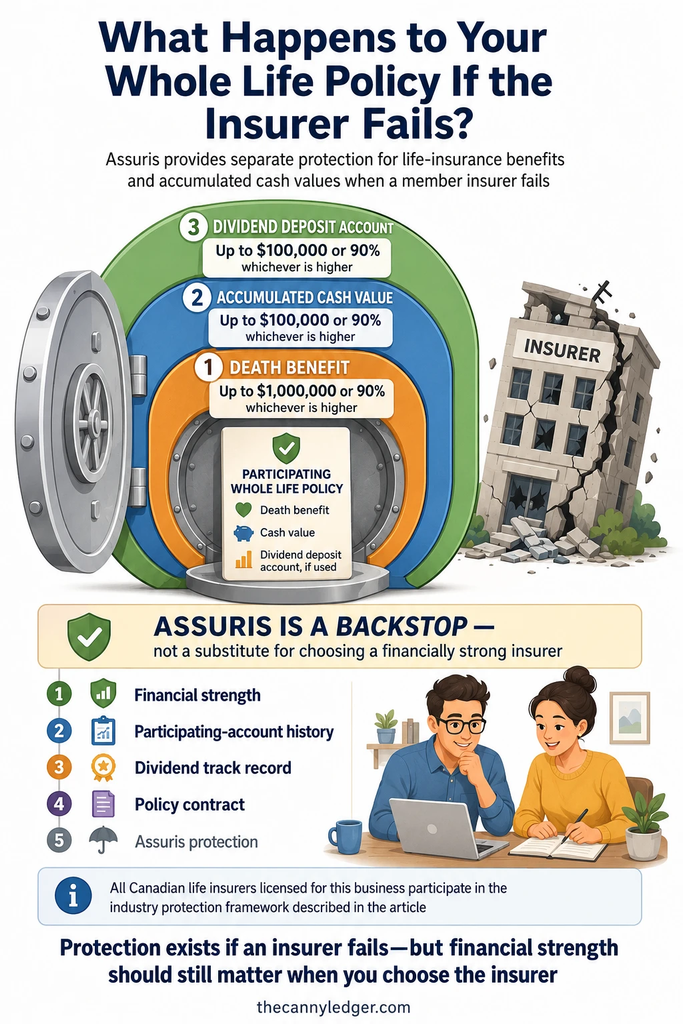
The protection here goes further than it does on a term policy, since a participating whole life policy has both a death benefit and accumulated cash value to protect. Every insurer licensed in Canada must belong to Assuris, and under its current guarantee levels, a participating whole life policyholder retains up to $1,000,000 or 90 percent of the death benefit, whichever is higher, plus separately up to $100,000 or 90 percent of the accumulated cash value, whichever is higher. If your policy has an associated dividend deposit account holding cash dividends left to accumulate at interest, that gets its own separate protection under the same 90 percent or $100,000 threshold. It’s a rare enough scenario that it shouldn’t be the deciding factor in choosing an insurer, but it does mean the cash value you’ve spent decades building isn’t entirely unprotected if the company behind it runs into serious trouble. Anyone weighing multiple insurers on this basis is usually better served comparing dividend track record and financial strength across providers than relying on Assuris protection as the primary safeguard.
Before You Sign Anything, Ask for This
Any advisor presenting a participating whole life quote should be able to hand over an in-force illustration that clearly separates the guaranteed values from the current dividend scale projection, line by line, for every year of the policy, not just a summary chart at the end. Ask how long the insurer has paid a dividend without interruption, since a company with a century of consistent payments through multiple recessions tells you something a five-year track record can’t. Ask specifically whether you’re looking at a life pay, 10-pay, or 20-pay design, since the wrong choice for your income timeline can mean straining to cover premiums during years when cash flow is already tight. And if the pitch leans heavily on the investment story rather than the insurance story, ask directly what the policy’s internal cost of insurance looks like, since that’s the number that tells you how much of your premium is actually building value for you.
Frequently Asked Questions
Can a dividend scale go down after I’ve already bought the policy? Yes. Insurers review their dividend scale every year and can raise, lower, or hold it based on the participating account’s performance, and a reduction applies going forward rather than clawing back dividends you’ve already received.
Are dividends themselves taxed when I use them to buy paid-up additions? No. Dividends used to purchase paid-up additions inside an exempt policy aren’t treated as taxable income at the time they’re applied, since the value stays inside the policy rather than being paid out to you.
Is participating whole life the same thing as universal life insurance? No. Both are permanent policies with cash value, but a universal life policy separates the cost of insurance from an investment account you actively choose and manage, while a participating policy pools your premium into the insurer’s own managed fund and pays dividends based on that fund’s collective results.
Do I need a medical exam to qualify for a participating whole life policy? In most cases yes, particularly for larger death benefits, following the same underwriting categories used for term coverage, though some insurers offer simplified or guaranteed issue versions of permanent coverage at reduced amounts and higher cost per dollar of coverage.