
A business owner sets up a life insurance policy through the corporation, has the company pay every premium, and assumes the accountant will simply write it off at tax time the way office rent or a laptop gets written off. Then the T2 comes back and the premium isn’t deductible at all, and the explanation from the accountant sounds almost backwards, since the business paid real money for something with a clear business purpose. This surprises far more owners than it should, given how often corporate-owned life insurance gets recommended by advisors without anyone walking through why the tax treatment works the way it does.
- Why a Business Actually Buys This
- Key Person Insurance in Practice
- Funding a Buy-Sell Agreement, and the Three Ways to Structure It
- The Premium Deduction Myth, Explained Properly
- How the Capital Dividend Account Actually Gets Money to Shareholders
- The Risk Nobody Mentions at the Sales Meeting
- Personal Ownership or Corporate Ownership, and Why the Answer Isn’t the Same for Everyone
- Choosing Term or Permanent for a Corporate Policy
- Where to Start This Conversation
- Frequently Asked Questions
Corporate-owned life insurance is a policy where a private corporation, rather than an individual, is both the owner and usually the beneficiary, most often used to fund a buy-sell agreement, protect against the loss of a key person, or move money out of the company tax-free through the capital dividend account. The premium generally isn’t a deductible business expense, but the death benefit can pass to shareholders with very little tax, which is the actual trade the structure is built around.
Why a Business Actually Buys This
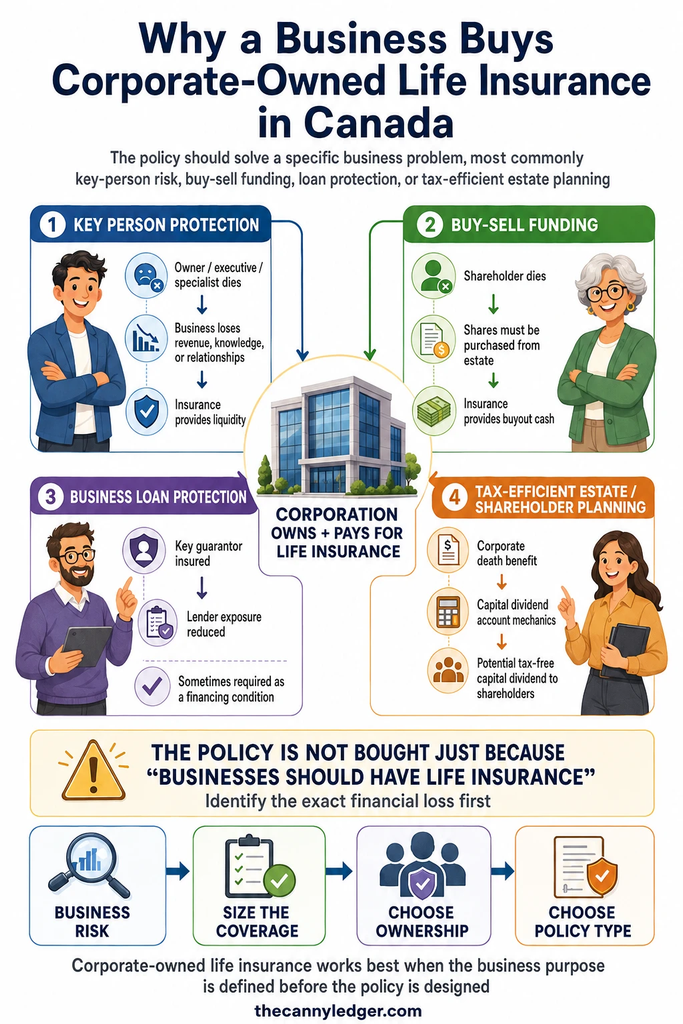
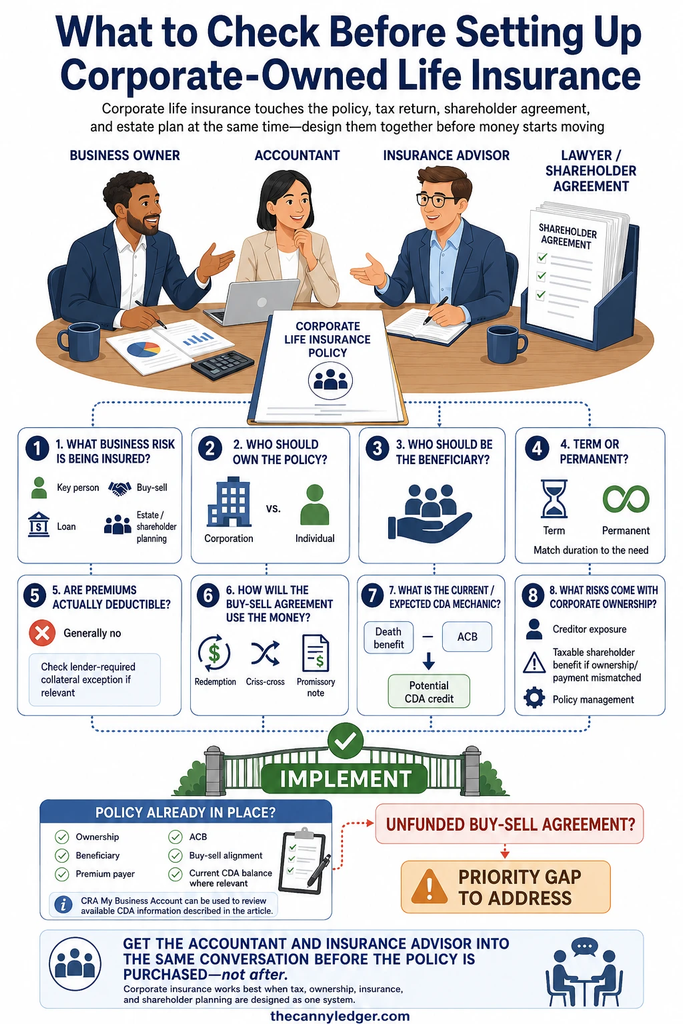
The reasons a company puts a life insurance policy on its books tend to cluster around four situations, and understanding which one applies changes almost every other decision about the policy. The first is key person coverage, protecting the business against the financial hit of losing an owner, executive, or specialist employee whose knowledge or relationships genuinely keep revenue flowing. The second is funding a buy-sell agreement, so that when one shareholder dies, the surviving shareholders or the corporation itself has the cash on hand to buy out that person’s shares from the estate rather than scrambling for financing or diluting ownership. The third is loan protection, since a lender providing business financing sometimes requires life insurance on a key guarantor as a condition of the loan. The fourth, often layered on top of the others, is using the death benefit as a tax-efficient way to move value out of the corporation to the next generation or to a surviving spouse, a use case that leans heavily on how the capital dividend account actually works.
Key Person Insurance in Practice
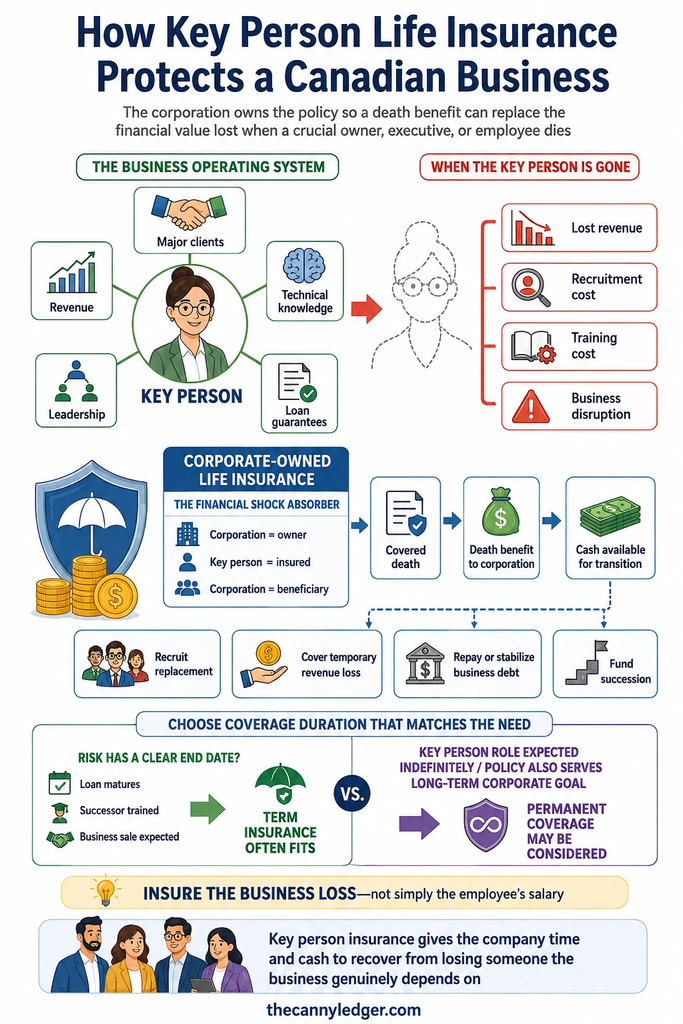
The pitch for key person insurance is straightforward. If a co-founder, top salesperson, or the one person who holds every important client relationship dies unexpectedly, the business absorbs real costs beyond grief, including lost revenue while a replacement gets found, recruitment and training expenses, and possibly a lender getting nervous about the company’s ability to keep operating. A policy owned by the corporation, insuring that person’s life, with the corporation as beneficiary, gives the business a cash cushion sized to whatever that risk is actually worth, whether that’s a multiple of the person’s contribution to revenue or the cost of an outstanding loan they personally guaranteed.
Most key person policies use term coverage rather than permanent, since the risk being insured against is usually tied to a defined period, a loan term, a stretch until a successor is trained, or the years until the business is sold or restructured. That said, a business expecting the key person’s importance to persist indefinitely, or one that wants the policy to double as a long-term corporate asset, sometimes opts for permanent coverage instead, accepting the higher premium in exchange for coverage that never expires and cash value the corporation can access if needed.
Funding a Buy-Sell Agreement, and the Three Ways to Structure It
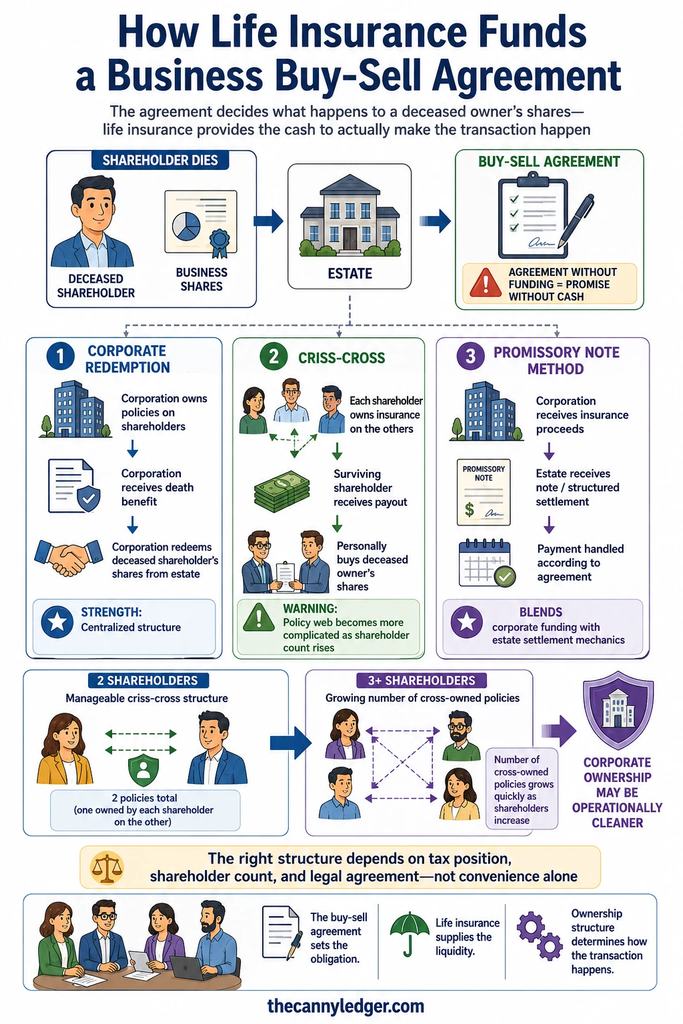
A buy-sell agreement is a contract between business partners setting out what happens to a deceased owner’s shares, and without funding behind it, that agreement is just a promise with no way to actually keep it. The surviving partners might have every intention of buying out the estate, but if the business doesn’t have spare cash sitting around, they’re left borrowing money, selling assets, or negotiating with a grieving family under financial pressure. Life insurance solves the funding problem by guaranteeing cash shows up at exactly the moment it’s needed.
There are three common ways to structure this, and the right one depends on the number of shareholders, the corporate structure, and the tax position everyone’s in. Under a corporate redemption, the corporation itself owns a policy on each shareholder and, at death, uses the payout to redeem the deceased’s shares directly from the estate. Under a criss-cross arrangement, each shareholder personally owns and is the beneficiary of a policy on every other shareholder, and at death, the surviving shareholders use their own payout to buy the deceased’s shares personally rather than through the company. A promissory note method blends elements of both, with the corporation receiving the proceeds and issuing a note to the estate that gets settled over time or immediately, depending on how it’s structured, a distinction laid out in detail in CIBC Wood Gundy’s own comparison of ownership structures. Criss-cross arrangements get complicated fast once there are more than two shareholders, since protecting multiple lives under separate personally owned policies means tracking a growing web of coverage rather than one clean corporate policy, which is part of why corporate redemption tends to be the more common choice for businesses with three or more owners.
The Premium Deduction Myth, Explained Properly
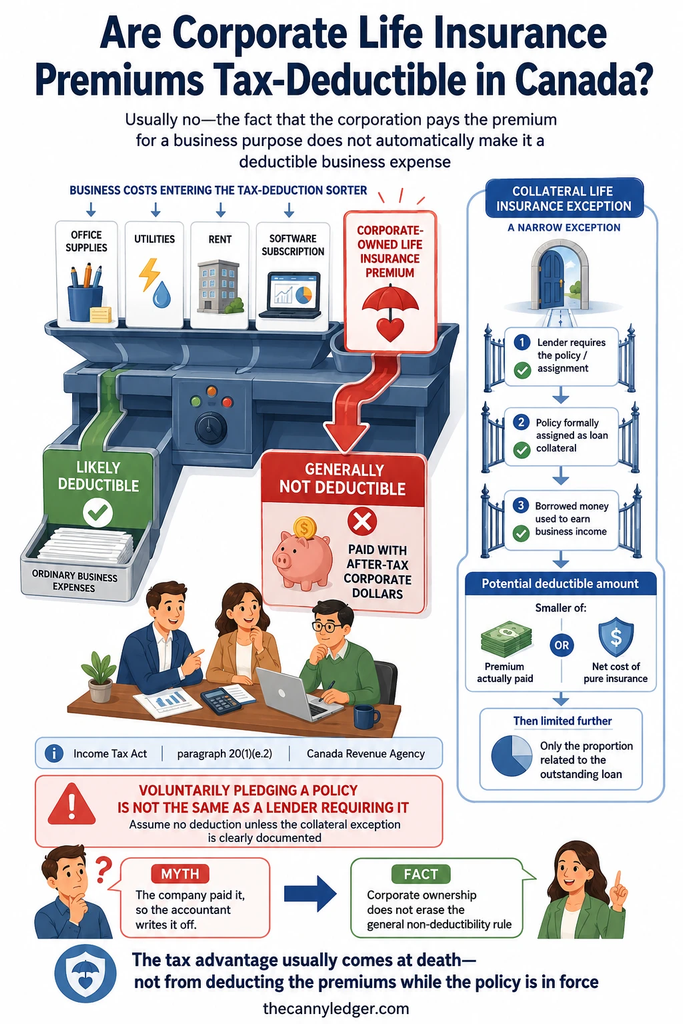
Here’s the rule almost every new business owner gets wrong on their first pass. Personal life insurance premiums have never been deductible in Canada, and putting the policy inside a corporation doesn’t change that by default. A corporation paying premiums on a policy it owns is spending after-tax corporate dollars on coverage, the same way an individual spends after-tax personal income on it, and the general non-deductibility of life insurance premiums applies regardless of whose name is on the policy.
There’s exactly one meaningful exception, and it’s narrower than most people assume. Under paragraph 20(1)(e.2) of the Income Tax Act, if a policy is required by a lender and formally assigned as collateral for a loan used to earn income from the business, a portion of the premium can become deductible, limited to whichever is smaller between the premium actually paid and the policy’s net cost of pure insurance, and further reduced to reflect only the part of the coverage that relates to the outstanding loan balance. The Canada Revenue Agency’s current position on interest deductibility confirms this collateral exception is still the only real doorway into any premium deduction, and it only opens when the lender is the one requiring the assignment, not when a business owner decides on their own to pledge a policy as security. Assume your policy doesn’t qualify unless a lender specifically required it in writing.
How the Capital Dividend Account Actually Gets Money to Shareholders
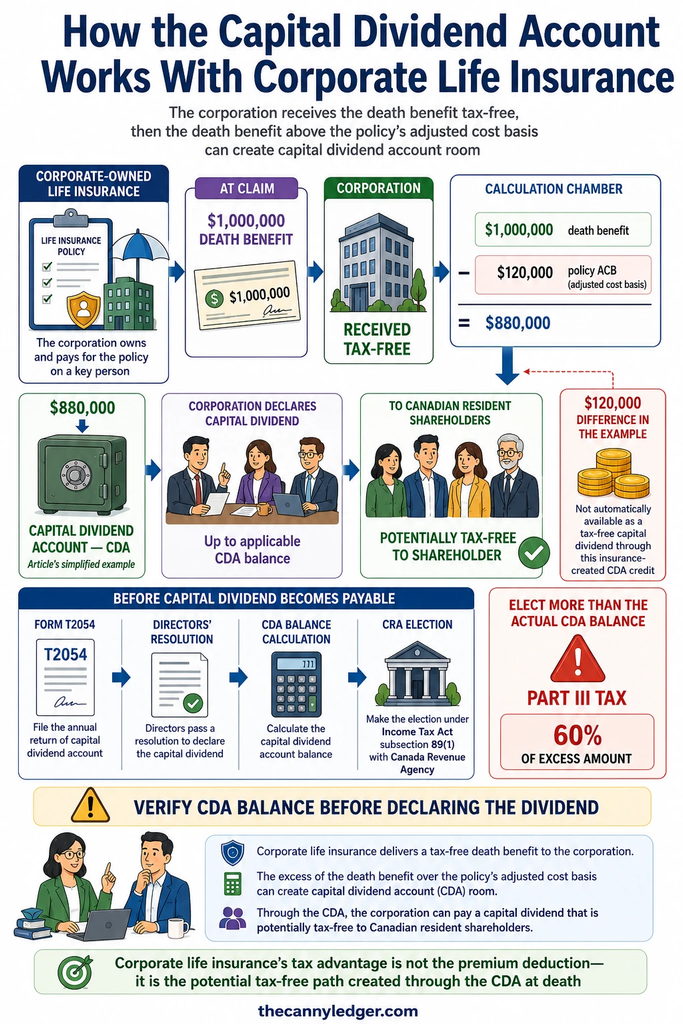
This is the mechanism that makes corporate ownership worth the trade-off on the premium side, and it deserves a concrete walk-through rather than a vague description. When a corporate-owned policy pays out at death, the full death benefit lands in the corporation tax-free. From there, the amount by which the death benefit exceeds the policy’s adjusted cost basis gets credited to the corporation’s capital dividend account, a running notional balance the Income Tax Act defines under subsection 89(1). Picture a policy with a $1,000,000 death benefit and an adjusted cost basis of $120,000 at the time of death. The $880,000 difference gets added to the capital dividend account, and that entire $880,000 can then be paid out to Canadian resident shareholders as a capital dividend, meaning no personal income tax on that portion at all. Only the remaining $120,000, if it’s ever paid out as a regular dividend later, gets taxed the normal way.
None of this happens automatically. The corporation has to formally elect to treat the payout as a capital dividend by filing Form T2054 with the CRA, due on or before the day the dividend becomes payable, along with a certified copy of the directors’ resolution authorizing it and a schedule showing the account balance calculation, for which the CRA has a dedicated balance verification form available if there’s any doubt about the number. Get the calculation wrong and elect to pay out more than the account’s actual balance, and the corporation owes Part III tax equal to 60 percent of the excess amount, a penalty steep enough that verifying the exact capital dividend account balance with the CRA before filing isn’t optional paperwork, it’s the difference between a clean tax-free payout and a costly correction.
The Risk Nobody Mentions at the Sales Meeting
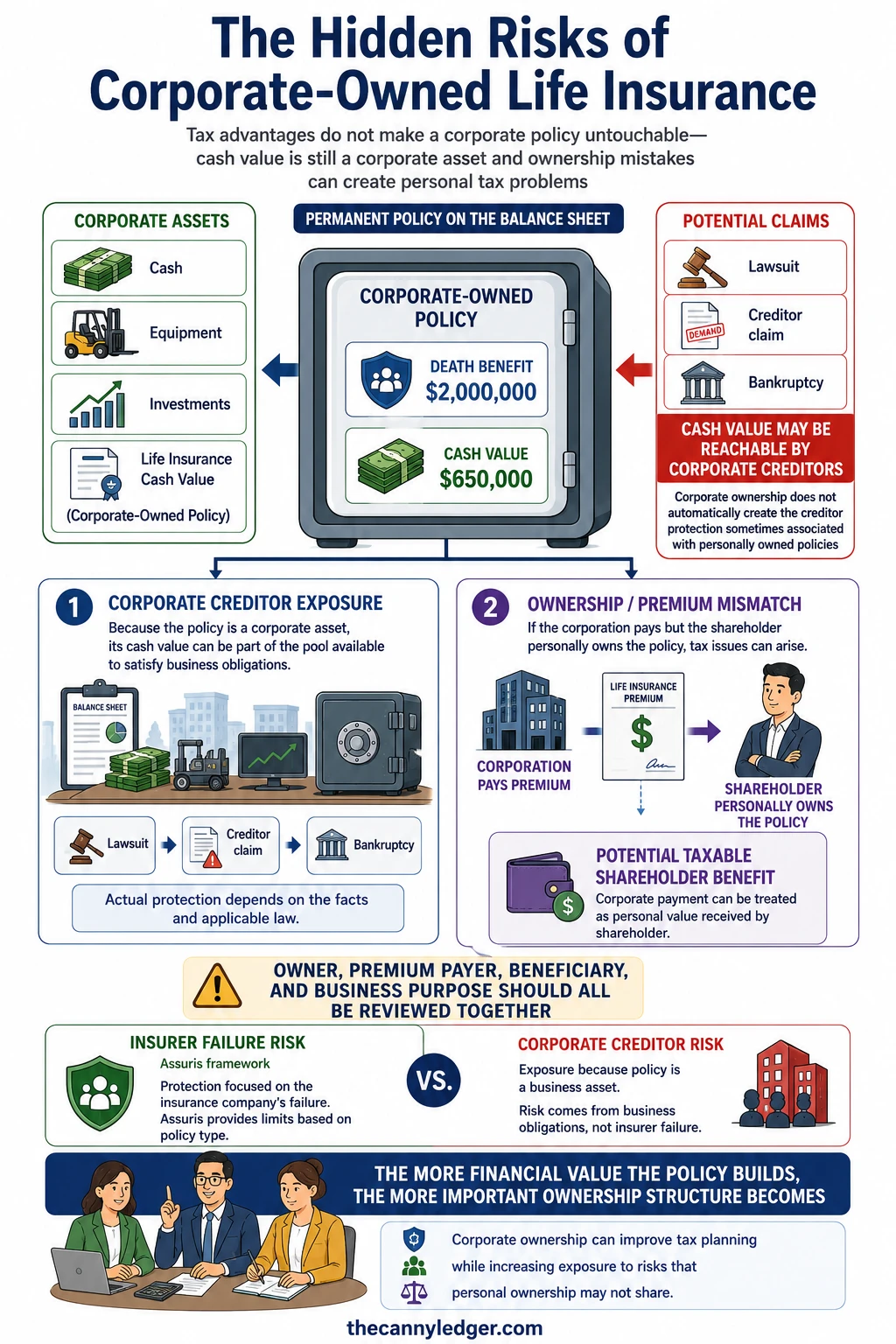
A corporate-owned policy is a corporate asset, full stop, which means it’s exposed to whatever the corporation is exposed to. If the business gets sued, faces a creditor claim, or ends up in bankruptcy proceedings, the cash value sitting inside a corporate-owned permanent policy is generally reachable by those creditors the same way any other corporate asset would be, unlike a personally owned policy with a named beneficiary, which typically sits outside an individual’s estate and away from personal creditors. The insurer itself failing is a separate and much smaller risk, still covered under Assuris protection regardless of whether the policyholder is a corporation or an individual, but for a business in a higher-risk industry, carrying significant debt, or operating in a litigious space, the creditor exposure on a healthy insurer’s own policy is the more realistic concern worth weighing against the tax advantages before defaulting to corporate ownership.
There’s a second trap that catches family businesses specifically. If a corporation pays premiums on a policy that’s actually owned personally by a shareholder rather than by the company itself, the CRA generally treats those premium payments as a taxable benefit added to that shareholder’s personal income, the same principle covered in more depth when working through how life insurance gets taxed in Canada. Ownership and who pays the premium need to match, and a business that’s been paying premiums on a policy technically owned by the founder personally, without anyone flagging it as a taxable benefit along the way, has a cleanup problem waiting to surface at the next audit.
Personal Ownership or Corporate Ownership, and Why the Answer Isn’t the Same for Everyone
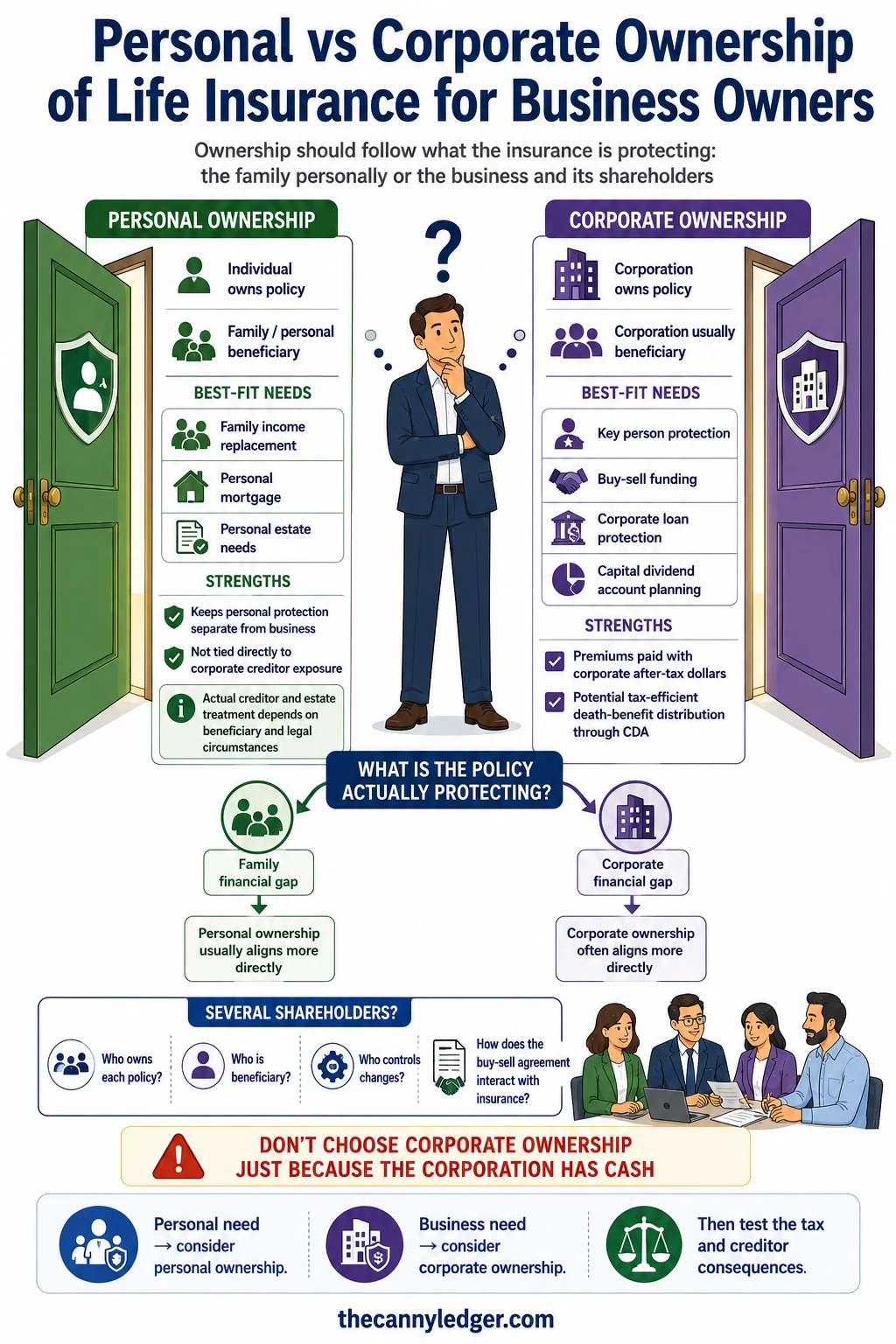
Every business owner eventually asks whether the policy should sit inside the corporation or be owned personally, and the honest answer is that it depends on what the coverage is actually protecting. If the goal is straightforward income replacement for a family, unrelated to the business itself, personal ownership usually wins, since it avoids entangling personal protection needs with corporate assets and creditor exposure. If the goal is specifically business continuity, funding a buy-sell agreement, or maximizing what moves out of a corporation tax-free through the capital dividend account, corporate ownership tends to make more sense, accepting the non-deductible premium as the cost of that tax-efficient exit at death. Businesses with several shareholders also need to think carefully about who gets named as beneficiary, since a corporate-owned policy naming the company itself avoids the messier beneficiary designation questions that come up when multiple individual shareholders are each personally named on separate policies insuring each other.
Choosing Term or Permanent for a Corporate Policy
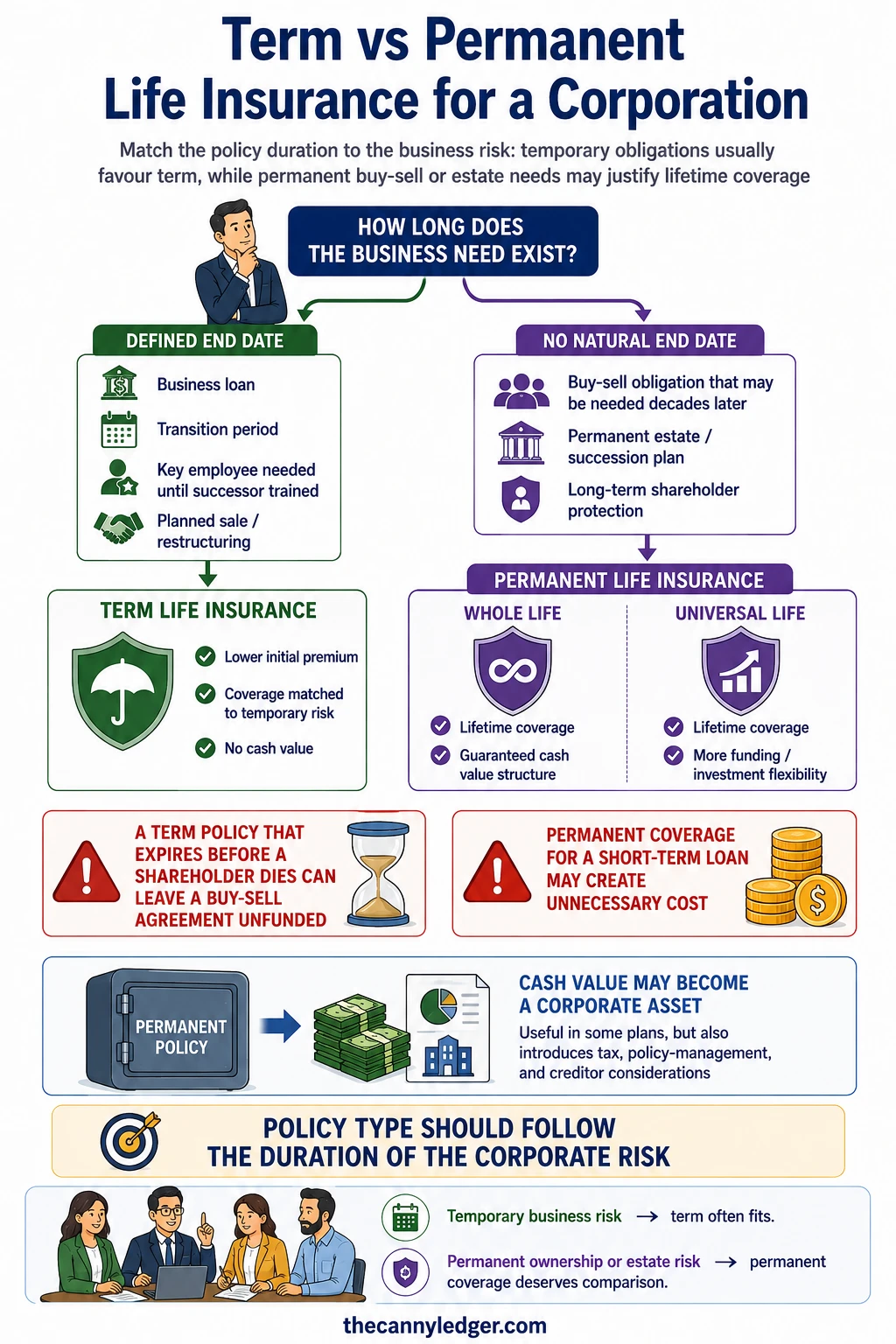
The type of policy matters as much as who owns it. Key person coverage tied to a specific loan, a transition period, or a defined business risk usually fits a straightforward term policy, since the need has a natural expiry date and there’s little reason to pay permanent insurance premiums for temporary protection. Buy-sell funding leans the other way, since nobody knows when a shareholder will actually die, and a term policy that expires while everyone involved is still very much alive leaves the buy-sell agreement unfunded exactly when it might finally be needed. This is a major reason permanent policies, whether whole life or universal life, show up so often in corporate ownership structures specifically for buy-sell purposes, alongside the added benefit of cash value the corporation can access for other purposes while everyone involved is still alive and well.
Where to Start This Conversation
Corporate-owned life insurance touches tax law, corporate structure, and shareholder agreements at the same time, which means it’s genuinely one of the areas where a single advisor working alone tends to miss something. Bring an accountant and an insurance advisor into the same conversation before setting anything up, not sequentially after the fact, since the accountant needs to weigh in on ownership structure and capital dividend account mechanics while the insurance advisor is still designing the policy, not after it’s already been purchased. If a buy-sell agreement already exists without funding behind it, that’s the more urgent gap to close first, since an unfunded agreement provides no actual protection no matter how well the legal wording reads. And if a policy is already in place, pull up the corporation’s capital dividend account balance through CRA My Business Account at least once to confirm the number matches what everyone’s assuming it is, since a mismatch discovered years later is a far more expensive problem than one caught early.
Frequently Asked Questions
Can a sole proprietor use corporate-owned life insurance? No. Corporate ownership requires an actual incorporated business, since the structure depends on the corporation itself being the legal owner and beneficiary. A sole proprietor without a corporation would own any policy personally.
Does it matter whether the business is a Canadian-controlled private corporation or a public company? Yes, meaningfully. The capital dividend account mechanism and the strategies built around it are designed for private corporations. Public companies generally don’t use this structure the same way, since their shareholder base and tax considerations differ substantially.
What happens to a corporate-owned policy if a shareholder leaves the business while still alive? The corporation typically retains ownership of the policy, and the shareholder agreement usually addresses whether coverage on that person continues, gets cancelled, or gets transferred, which is exactly why buy-sell agreements should be reviewed whenever ownership changes, not just left as-is from when the business started.
Does the capital dividend account credit only apply to permanent policies, or does term insurance qualify too? Both qualify. The credit is based on the death benefit received minus the policy’s adjusted cost basis, regardless of whether the underlying policy is term or permanent, though term policies typically have a lower adjusted cost basis, which can mean a larger portion of the payout becomes eligible for the capital dividend account.