
Search “whole life insurance” on any Canadian personal finance forum and you’ll find the same argument playing out. One camp calls it one of the worst financial products sold to ordinary people. The other calls it a forced savings plan with a death benefit attached, and swears by the version their parents bought them at birth. Both sides are describing the same product and reaching opposite conclusions, which is usually a sign that the actual mechanics got skipped over in favour of the fight.
- How Your Premium Actually Gets Split Up
- Participating Whole Life and How Dividends Work
- What Happens to the Cash Value While You Are Alive
- How Death Benefits and Withdrawals Are Taxed
- What Whole Life Insurance Actually Costs
- Where a Company Failure Actually Leaves You
- The Mistakes People Actually Make Buying This
- When Whole Life Actually Makes Sense
- Common Questions About Whole Life Insurance in Canada
Whole life insurance is a type of permanent life insurance that combines two things a term policy doesn’t offer, a savings component called cash value and a premium that never increases for the life of the contract. In exchange for paying more than you would for term coverage of the same size, part of every payment builds equity inside the policy that you can eventually borrow against, withdraw from, or leave to grow. The death benefit is guaranteed as long as premiums stay current, and it’s paid to your beneficiaries tax-free.
How Your Premium Actually Gets Split Up
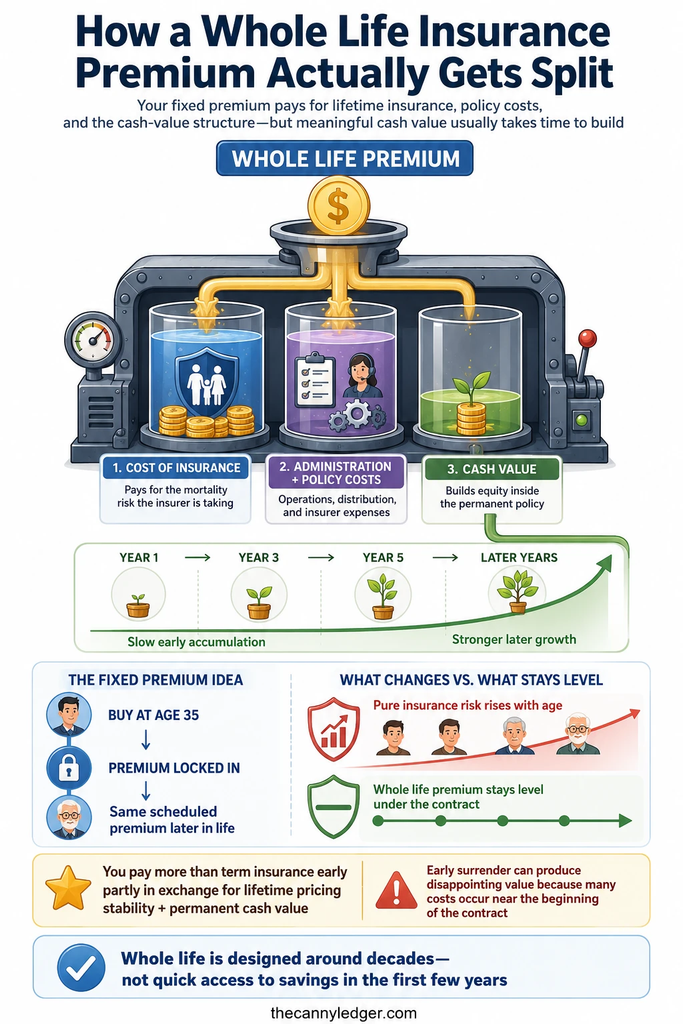
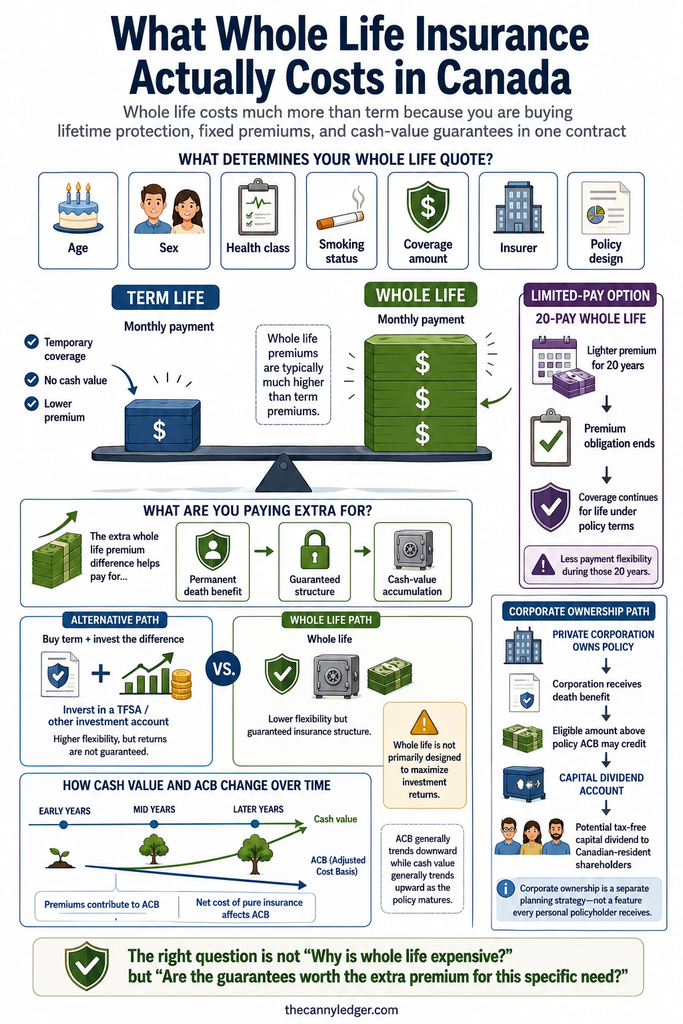
Every dollar you send an insurer for a whole life policy gets divided into three buckets before it does anything else. One portion covers the actual cost of insuring you that year, calculated the same way it would be for a term policy at your age. Another portion covers the insurer’s administrative costs and profit margin. What’s left, once those two are covered, goes into the policy’s cash value.
In the early years of a policy, that third bucket is small. Insurers front-load the mortality and administrative costs of a lifetime contract into the first several years, which is why a policy surrendered in year three or four often has little to no cash value even though you’ve been paying premiums the whole time. This surprises a lot of people who assume the savings portion grows on a straight line from day one. It doesn’t. The growth curve is closer to flat for several years and then accelerates once the early-year costs have been absorbed.
The fixed premium is the other half of the trade. Because your rate is locked in based on your age and health at the time you buy the policy, you’re effectively pre-paying for insurance costs that would otherwise rise sharply as you age. A 35-year-old buying whole life is paying more upfront than pure term coverage would cost them at 35, but noticeably less than what term coverage would cost them at 65, since the insurer is averaging the cost across your entire expected lifetime and charging you the same amount every year.
Participating Whole Life and How Dividends Work
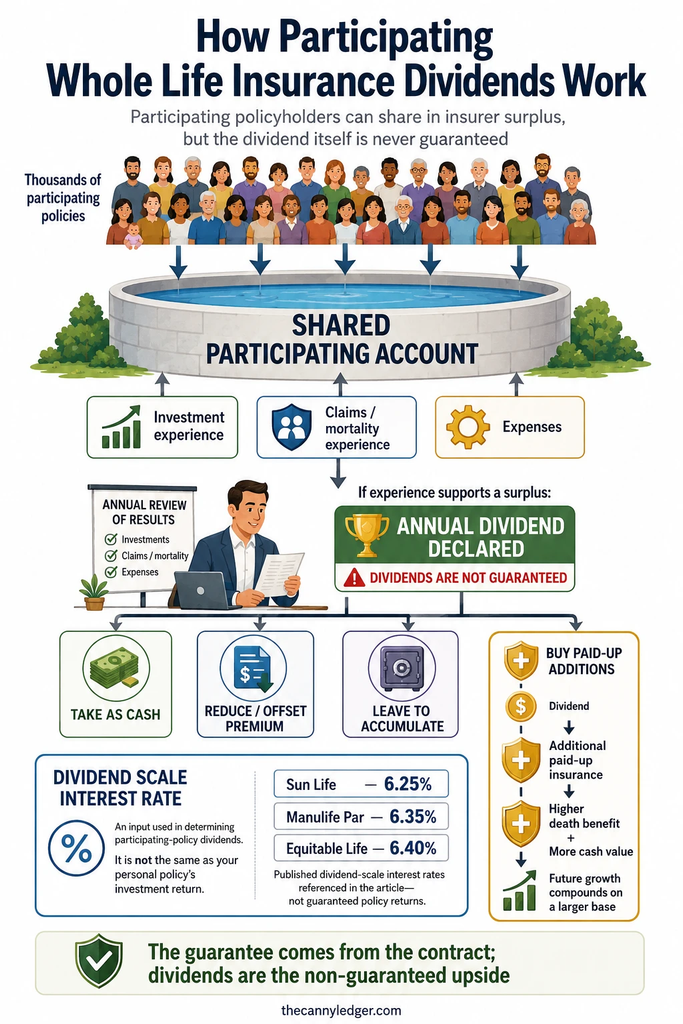
Most whole life policies sold in Canada today are participating policies, meaning the policyholder shares in the insurer’s profits from the pool of similar policies. When claims come in lower than expected, expenses run under budget, or the insurer’s investment portfolio performs well, a portion of that surplus gets returned to policyholders as a dividend. This is not the same as a stock dividend and it is never guaranteed, no matter how consistently an insurer has paid one in the past.
The dividend scale interest rate is the figure insurers publish each year to describe how that year’s investment experience is being credited into policyholder dividends. It isn’t the same as the actual return you’ll see on your policy statement, since mortality, lapse, and expense experience also factor into the final number, but it’s the headline figure insurers use to signal how their participating account performed. Sun Life is maintaining its 2026-2027 dividend scale at a 6.25 percent interest rate, effective April 1, 2026. Manulife has confirmed its dividend scale interest rate for Manulife Par policies dated on or after June 23, 2018 stays at 6.35 percent through August 31, 2027. Equitable Life kept its dividend scale interest rate unchanged at 6.40 percent, effective July 1, 2025, according to its own advisor materials.
What you do with a declared dividend matters more than the rate itself. Most insurers let you take it as cash, apply it against your next premium, leave it to accumulate interest, or use it to buy paid-up additional insurance, which permanently increases both your death benefit and your cash value without any new underwriting. That last option is the one advisors lean on most heavily for long-term growth, since paid-up additions compound on themselves in a way a cash payout doesn’t.
What Happens to the Cash Value While You Are Alive
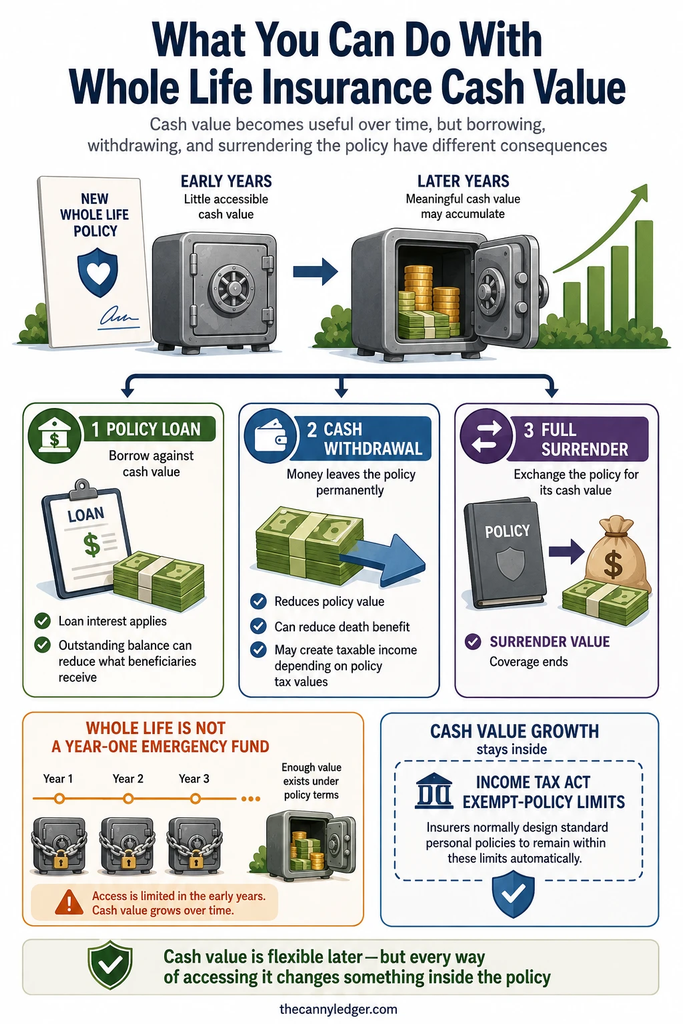
Cash value is often described as if it works like a savings account you can dip into whenever you want, and that’s only partly true. You can borrow against it through a policy loan, which the insurer treats as a loan secured by the policy rather than a withdrawal, meaning it doesn’t reduce your death benefit directly as long as it’s repaid, though any outstanding balance at death gets subtracted from what your beneficiaries receive. You can also withdraw cash value directly, which does reduce the death benefit and, depending on the amount, can trigger a tax bill.
The catch most people miss is timing. Cash value typically doesn’t reach a meaningful amount for several years, and insurers commonly require a minimum waiting period, often two to three years, before a policy loan is even available. A policy bought as a source of emergency liquidity in year one won’t function that way. It only becomes a flexible financial tool once enough time has passed for the early-year costs to be absorbed and the savings component to actually accumulate.
There’s also a structural limit built into every Canadian policy, whether the owner ever notices it or not. The Income Tax Act restricts how much cash value can build up relative to the size of the death benefit before a policy stops qualifying for tax-sheltered growth. Insurers design their whole life products to stay inside that limit automatically, so for the overwhelming majority of personal policyholders this rule is invisible. It only becomes relevant if a policy is deliberately overfunded well beyond standard premium levels, a strategy used occasionally in corporate or estate planning contexts rather than in a typical personal policy.
How Death Benefits and Withdrawals Are Taxed
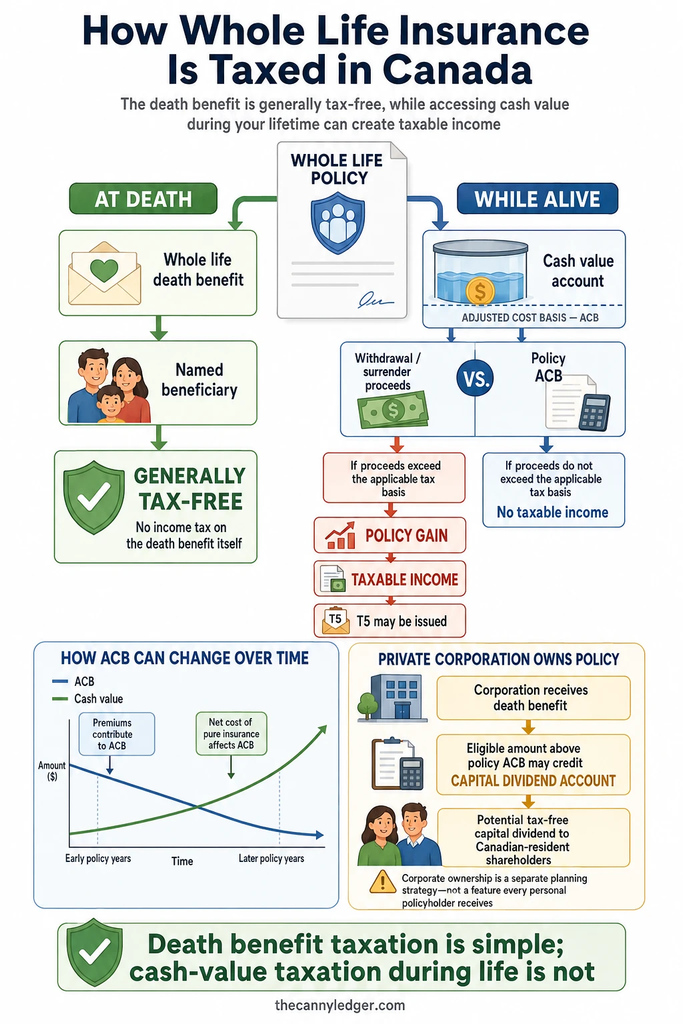
The death benefit itself is straightforward. When a named beneficiary receives a life insurance payout in Canada, that money is not taxable income to them, regardless of how large the policy is or how much cash value had built up inside it. This is one of the few simple rules in an otherwise complicated area of tax law, and it applies to term and whole life policies equally.
What’s less simple is whether your cash value is taxable while you’re still alive. The Canada Revenue Agency tracks something called the adjusted cost basis of your policy, which represents the amount you could withdraw or surrender without triggering tax. Roughly speaking, it’s your total premiums paid minus the internal cost of the pure insurance coverage the policy has provided over time, and that internal cost, called the net cost of pure insurance, rises as you age. Your adjusted cost basis actually shrinks over the decades even as your cash value grows. If you surrender the policy or withdraw more than your adjusted cost basis, the excess is taxed as income, and your insurer issues a T5 slip for that amount.
Corporate ownership changes the picture in a way that’s worth knowing even if you’re buying a personal policy, since it explains why business owners often get pitched whole life so aggressively. When a private corporation owns the policy and receives the death benefit, that payout comes in tax-free, and the amount exceeding the policy’s adjusted cost basis gets credited to the corporation’s capital dividend account. The Canada Revenue Agency’s own guidance on capital dividends confirms those tax-free surpluses can then be distributed to Canadian-resident shareholders, which is why corporate-owned whole life shows up so often in small business succession and estate planning conversations. None of this applies if you’re buying a policy personally, but it’s worth knowing if a corporate structure ever gets suggested to you as part of the pitch.
What Whole Life Insurance Actually Costs
Premiums for whole life insurance vary enormously based on age, sex, health class, smoking status, the insurer’s own underwriting philosophy, and how the policy is structured, so any single number thrown around online should be treated as a rough illustration rather than a quote you can rely on. That said, the gap between whole life and term life insurance for the same death benefit is large enough to be worth understanding before you talk to an advisor. A healthy non-smoking applicant in their thirties buying a modest amount of coverage might pay well over a hundred dollars a month for whole life protection that would cost a fraction of that as a term policy, and the gap widens further for older applicants or those with health or smoking risk factors.
That premium gap is the entire trade-off in a sentence. You’re paying more every month, for the rest of your life, in exchange for a policy that never expires and that builds equity you can eventually access. Whether that trade is worth it depends entirely on what you’d otherwise do with the difference. Someone disciplined enough to invest the premium gap in a TFSA or other registered account will, in most modelled scenarios over a long enough time horizon, come out ahead of the whole life cash value, because market returns over decades have historically outpaced the guaranteed and dividend-supported growth inside a par policy. The whole life pitch has never really been about maximizing returns. It’s about guaranteeing a specific outcome regardless of what markets do, which is a different goal entirely.
Limited-pay versions of whole life change the cost picture further. A 20-pay policy compresses your entire premium obligation into 20 years instead of spreading it across your whole life, which means a much higher monthly payment during those two decades but nothing owed after that, while coverage continues for as long as you live. This appeals to people who want their insurance obligations finished before retirement, but it also means less flexibility if your income drops during the payment period, since the premium doesn’t shrink to match a leaner year.
Where a Company Failure Actually Leaves You
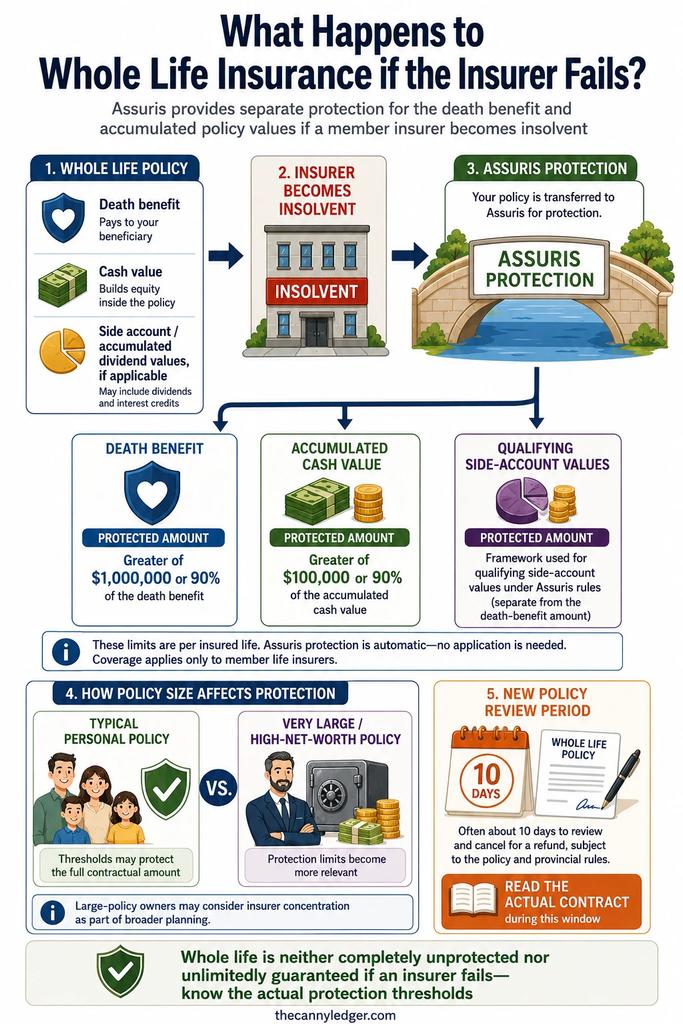
This is the part of whole life insurance that almost nobody asks about until something goes wrong, and it’s worth knowing before you sign anything. Assuris, the industry-funded body that protects Canadian policyholders if a life and health insurer fails, guarantees you’ll retain the greater of one million dollars or 90 percent of your death benefit, and the greater of one hundred thousand dollars or 90 percent of your accumulated cash value. If your whole life policy has a side account holding pre-paid premiums or accumulated cash dividends, that’s protected separately under the same hundred-thousand-dollar or 90 percent threshold.
For most personal policies, those limits mean full protection, since a typical individual death benefit and cash value balance rarely exceeds either threshold. It only becomes a real planning consideration for high-net-worth individuals stacking multiple large policies or holding one very large corporate-owned contract, in which case spreading coverage across more than one insurer is a reasonable hedge. There hasn’t been a life insurance company failure in Canada since Confederation Life in 1989, which was absorbed by Canada Life with policyholders made whole, so this is a low-probability scenario in absolute terms. It’s still worth knowing the actual numbers rather than assuming your policy is either fully guaranteed or entirely at risk, since neither extreme is accurate.
One related protection applies at the point of purchase rather than at the insurer’s failure. Canadian life insurance buyers have a right to cancel a new policy within a set period, usually 10 days, and get a full refund of premiums paid. That window exists specifically so you or an advisor you trust can review the actual contract wording before you’re locked in, and it’s underused by people who assume that once they’ve signed, they’re committed.
The Mistakes People Actually Make Buying This
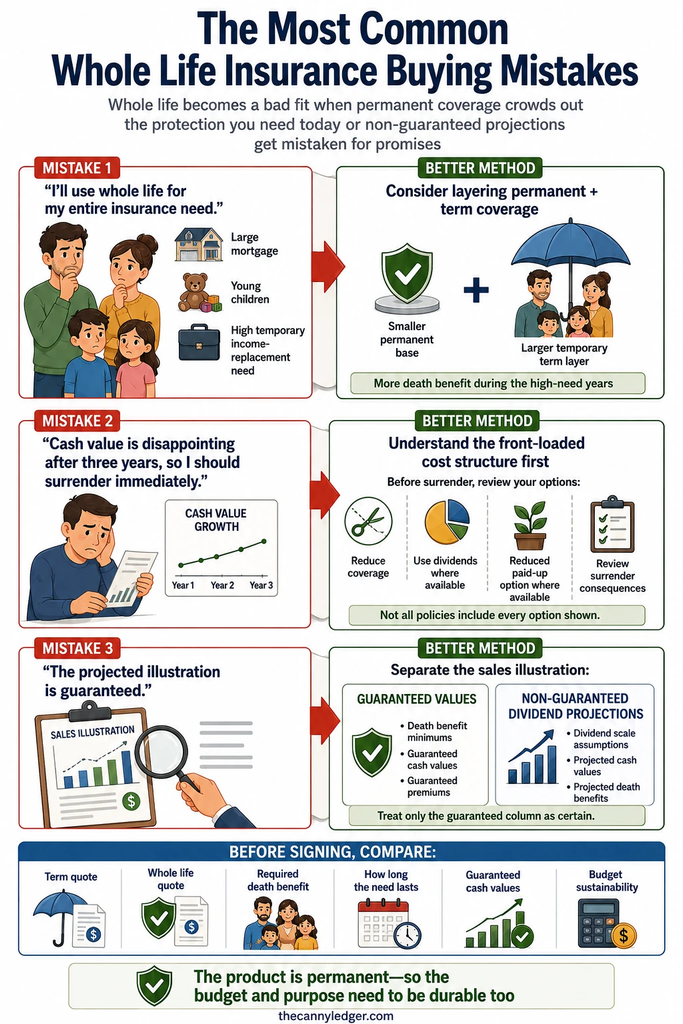
The most common mistake isn’t buying whole life insurance itself, it’s buying it as the only form of coverage during the years when the family needs the most protection for the least money. A young parent with a mortgage and small children typically needs a large death benefit for a couple of decades, not necessarily forever, and stretching a limited insurance budget to cover that entire need with whole life instead of term often means ending up underinsured during the exact window where being underinsured is most dangerous. Many advisors recommend layering, a smaller permanent policy alongside term coverage that handles the temporary, larger need, rather than treating the two as an either-or decision.
The second mistake is surrendering a policy in the early years out of frustration that the cash value isn’t growing the way it was pitched. Because of the front-loaded cost structure described earlier, giving up in year three or four locks in the worst possible version of the math, all of the insurance cost paid and none of the compounding that happens later. If a policy no longer fits your budget, reducing the death benefit, using accumulated dividends to cover premiums, or converting to a reduced paid-up policy are usually better options than a straight surrender, and a good advisor should walk through all of them before letting a lapse happen by default.
A third and quieter mistake is treating the illustration an advisor shows you at the point of sale as a guarantee. Dividend-based projections in a sales illustration are built using the insurer’s current dividend scale, and that scale is reviewed and can change every year based on actual investment and mortality experience. The guaranteed portion of the illustration, the minimum cash value and death benefit the insurer promises regardless of dividend performance, is the only number in that document you should treat as certain.
When Whole Life Actually Makes Sense
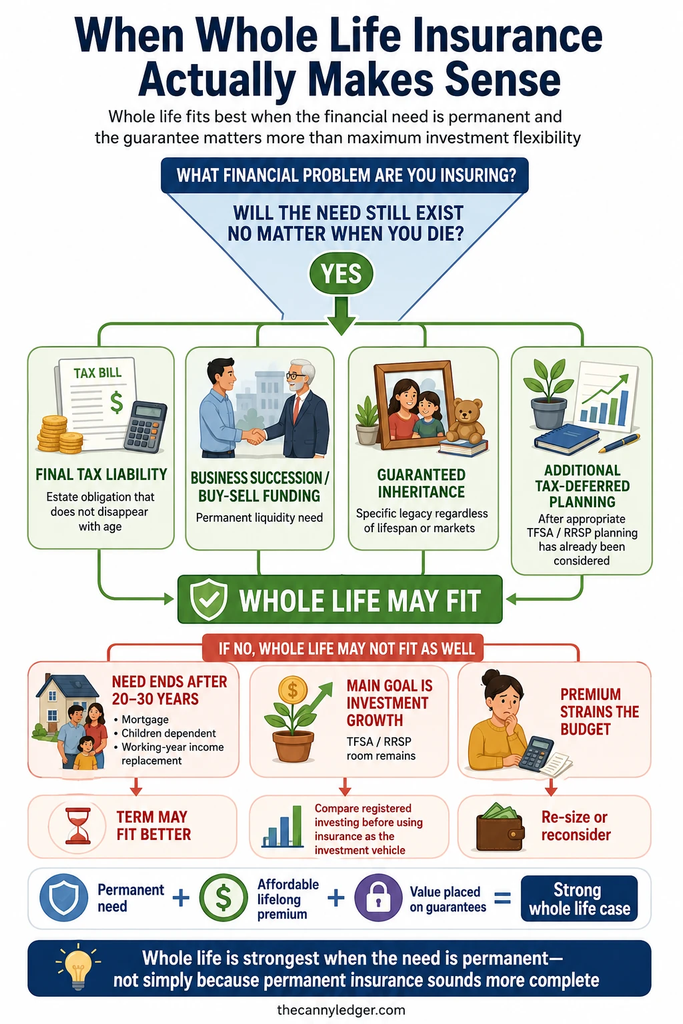
Whole life earns its premium in a fairly narrow set of situations, and being honest about which one applies to you matters more than the sales conversation usually allows for. It makes the most sense when you have a permanent insurance need that won’t disappear on its own, most commonly covering a tax liability that will exist no matter when you die, funding a business succession or buy-sell agreement, or leaving a guaranteed inheritance to a beneficiary regardless of how long you live or how markets perform between now and then. It also fits people who have already maxed out their TFSA and RRSP room and want another vehicle for tax-deferred growth, provided they understand they’re trading investment flexibility for guaranteed structure.
It makes less sense as a stand-in for term coverage during your working years, as your only investment vehicle if you haven’t first used up registered account room, or as a product you’re buying primarily because an advisor described it as forced savings you’ll thank yourself for later. Forced savings is a real behavioural benefit for some people, but it’s an expensive way to solve a discipline problem when a pre-authorized contribution into a TFSA accomplishes much the same thing without the mortality charges layered on top.
If you’re weighing this against the alternative, actually running your specific numbers, current health class, how much coverage you actually need, and how long that need realistically lasts, against both a term quote and a whole life quote from a licensed advisor is the only way to know which side of that line you’re on. For a broader sense of whether permanent coverage fits your situation at all, our piece on whether life insurance is worth it walks through that decision from the ground up. No general guide, including this one, can tell you which product wins for your household, because the answer depends entirely on inputs that are unique to you.
Common Questions About Whole Life Insurance in Canada
Can I get a loan against my whole life insurance policy? Yes, once your cash value has built up enough to meet the insurer’s minimum, which often takes two to three years of premium payments. The loan is secured by your policy’s cash value, accrues interest, and any unpaid balance is deducted from the death benefit if you pass away before repaying it.
Is whole life insurance a good investment compared to just investing the difference? For most people the honest answer is no, since long-term market returns have historically outpaced the guaranteed and dividend growth inside a participating policy. Whole life earns its keep on certainty and permanence, not on maximizing returns, which is a different job than an investment account is meant to do.
What happens to my whole life policy if I stop paying premiums? Depending on how much cash value has built up, most policies let you convert to a reduced paid-up policy with a smaller, fully paid death benefit rather than lapsing entirely, or use accumulated dividends to keep the original policy in force for a while longer. Letting it lapse outright without exploring those options usually forfeits value you’ve already paid for. If you’re still comparing insurers at this stage, our roundup of the best life insurance companies in Canada is a reasonable next stop.