
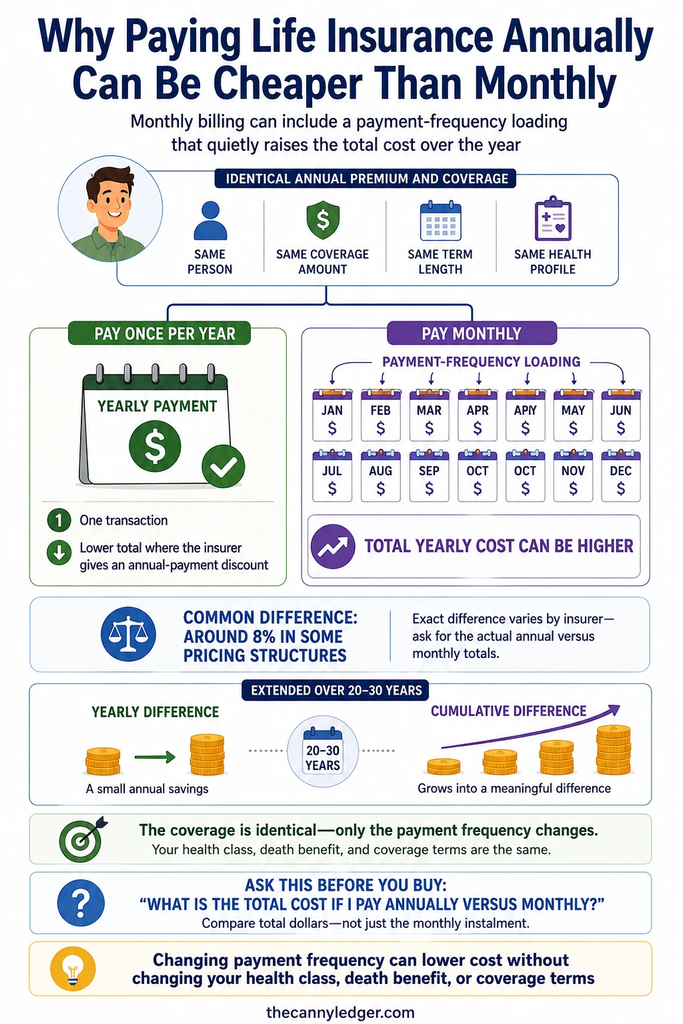
Two people can get quoted the exact same premium for the exact same policy and still end up paying different totals over the life of that policy, purely based on how often they choose to pay. Most insurers apply a loading fee to monthly payments, since collecting twelve smaller payments costs more to administer than collecting one, a detail Canada Life’s own explanation of how premiums work touches on, and that loading typically adds somewhere around 8 percent to the total annual cost compared to paying the whole year upfront. Nobody mentions this at the point of sale because it doesn’t change the headline number on the quote, only the total that quietly adds up behind it.
- Start With Term, Unless a Permanent Need Actually Exists
- Size the Term Length to the Actual Timeline, Not a Round Number
- Apply Before a Health Change Forces a Worse Rate Class
- Choose the Right Underwriting Path for the Situation
- Get Quotes From More Than One Insurer
- Pay Annually Rather Than Monthly
- Buy the Coverage the Numbers Actually Support, Not a Guess
- Be Selective About Riders
- The Mistake That Undoes Every Other Strategy on This List
- What to Actually Do With This
- Frequently Asked Questions
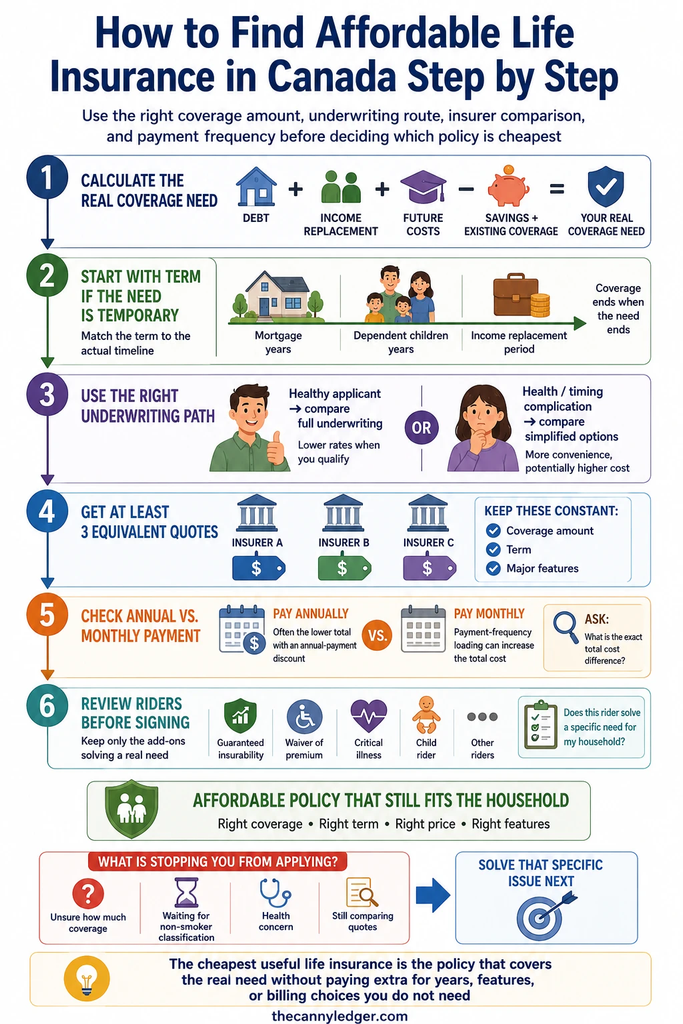
The most reliable ways to find affordable life insurance in Canada are choosing term coverage sized to an actual, specific need, applying while healthy and before any smoking-cessation clock needs to run, comparing quotes across several insurers rather than one, and paying annually instead of monthly. None of these require sacrificing coverage, just being deliberate about a handful of choices most people make on autopilot.
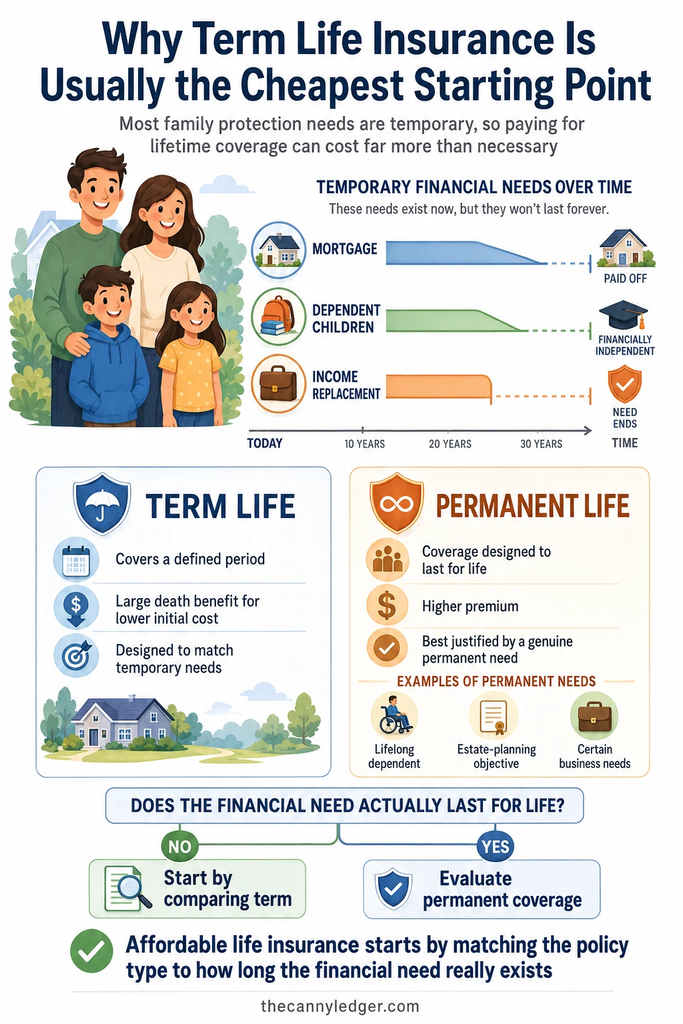
Start With Term, Unless a Permanent Need Actually Exists
This is the single largest lever, and it isn’t close. Term life insurance covers a temporary need at a fraction of what permanent coverage costs for the same death benefit, a gap the Financial Consumer Agency of Canada describes plainly when comparing how the two categories are structured, and for most Canadians in their working years, the actual financial obligations being protected against, a mortgage, dependent children, years of income replacement, are temporary by nature. Permanent coverage earns its higher price in specific situations, a lifelong dependent, an estate planning goal, a business structure that needs it, and understanding exactly when that tradeoff makes sense is worth doing before assuming term is automatically the right call. For everyone else, starting from term and only adding permanent coverage where a genuine ongoing need justifies it keeps the entire foundation of the policy affordable.
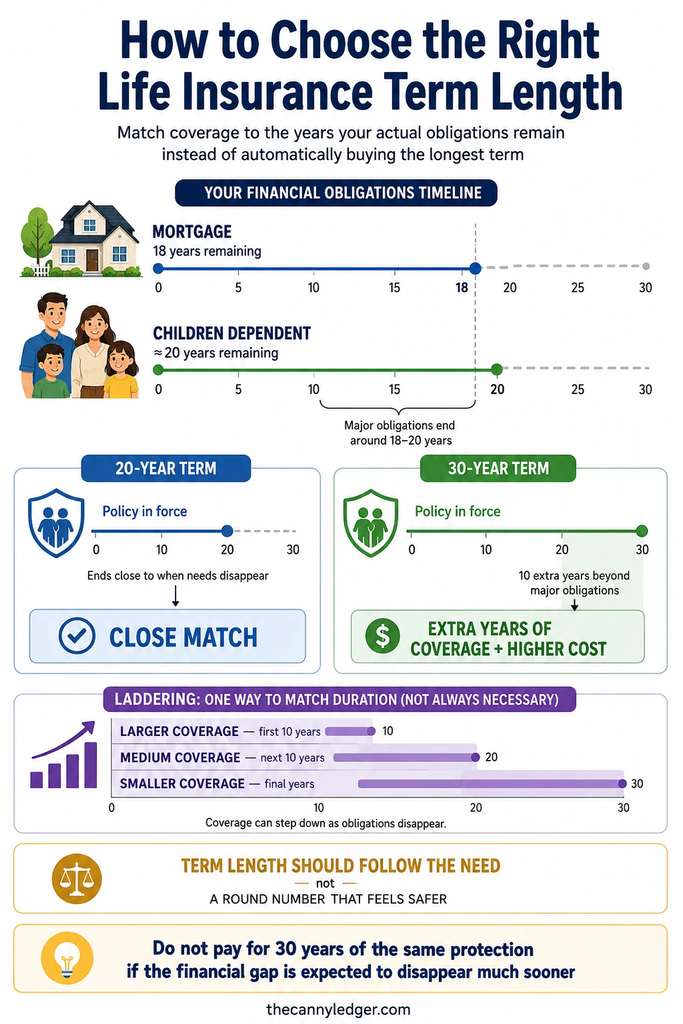
Size the Term Length to the Actual Timeline, Not a Round Number
A 30-year term sounds like a safe, generous choice, and it usually costs more than it needs to for exactly that reason. If a mortgage will be paid off in 18 years and the kids will be financially independent in 20, a 20-year term matches that timeline more precisely than a 30-year term does, and the shorter commitment costs less for identical coverage in the years it’s actually needed. Layering a few different term lengths against different obligations, sometimes called laddering, takes this further, letting the total coverage step down naturally as each specific need expires rather than paying for a flat amount of protection for years after part of it stops being necessary.
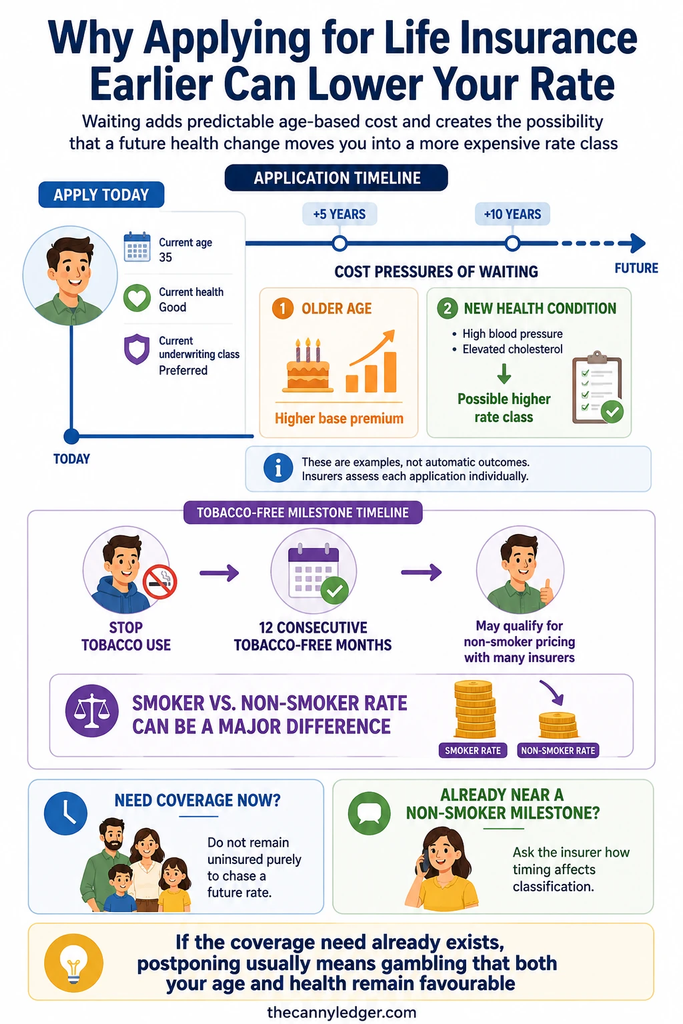
Apply Before a Health Change Forces a Worse Rate Class
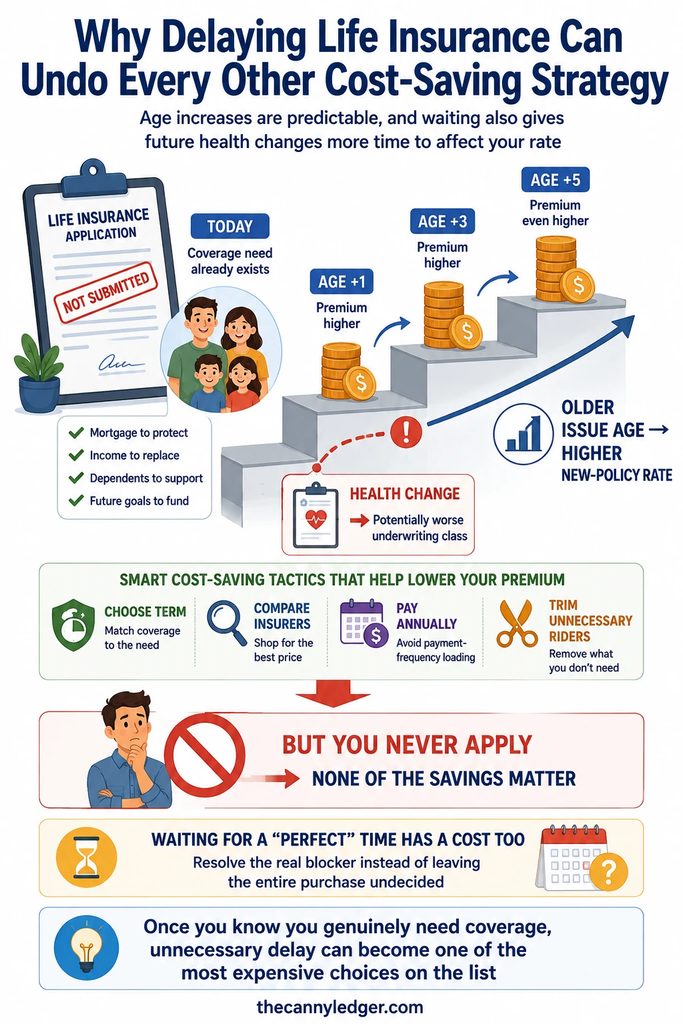
Timing the application itself is one of the more overlooked cost levers. Health conditions that develop later, even manageable ones like high blood pressure or elevated cholesterol, can move an applicant into a higher-rated premium class or trigger exclusions that wouldn’t have applied a few years earlier. Someone who’s been meaning to buy coverage and keeps pushing it back isn’t just facing the ordinary age-based rate increase, they’re also gambling on their health staying exactly where it is in the meantime. For smokers specifically, RBC Insurance notes that most insurers reclassify an applicant as a non-smoker after 12 consecutive tobacco-free months, and applying right at that 12-month mark rather than before it can meaningfully lower the quoted rate, sometimes by more than half compared to a smoker rate on identical coverage.
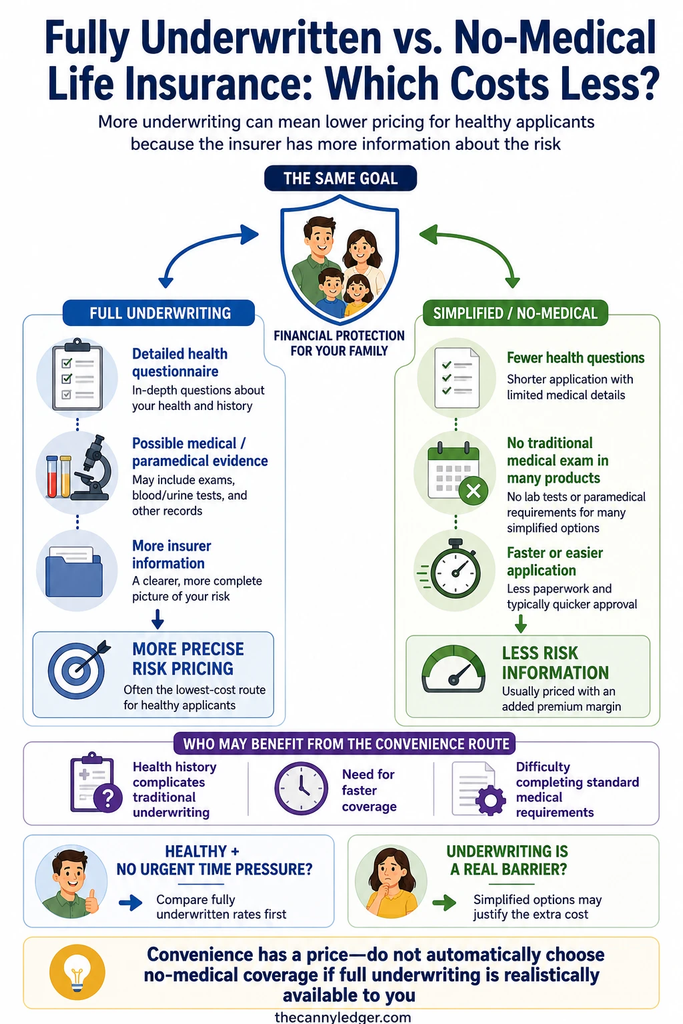
Choose the Right Underwriting Path for the Situation
Fully underwritten policies, the ones involving a health questionnaire and often a paramedical exam, produce the lowest rates for healthy applicants precisely because the insurer has the most information to price the risk accurately. Simplified issue and no-medical policies skip that process in exchange for a real premium markup, since the insurer is pricing against less certainty, and Sun Life’s own guidance on reducing life insurance costs points to full underwriting as one of the more direct ways healthy applicants can access lower rates in the first place. That tradeoff makes sense for someone with a health condition that would complicate traditional underwriting, or someone who needs coverage in place immediately and can’t wait for exam scheduling and results. For a healthy applicant with no time pressure, going through full underwriting rather than defaulting to the convenience option is one of the more direct ways to avoid paying a premium for information the insurer simply chose not to collect.
Get Quotes From More Than One Insurer
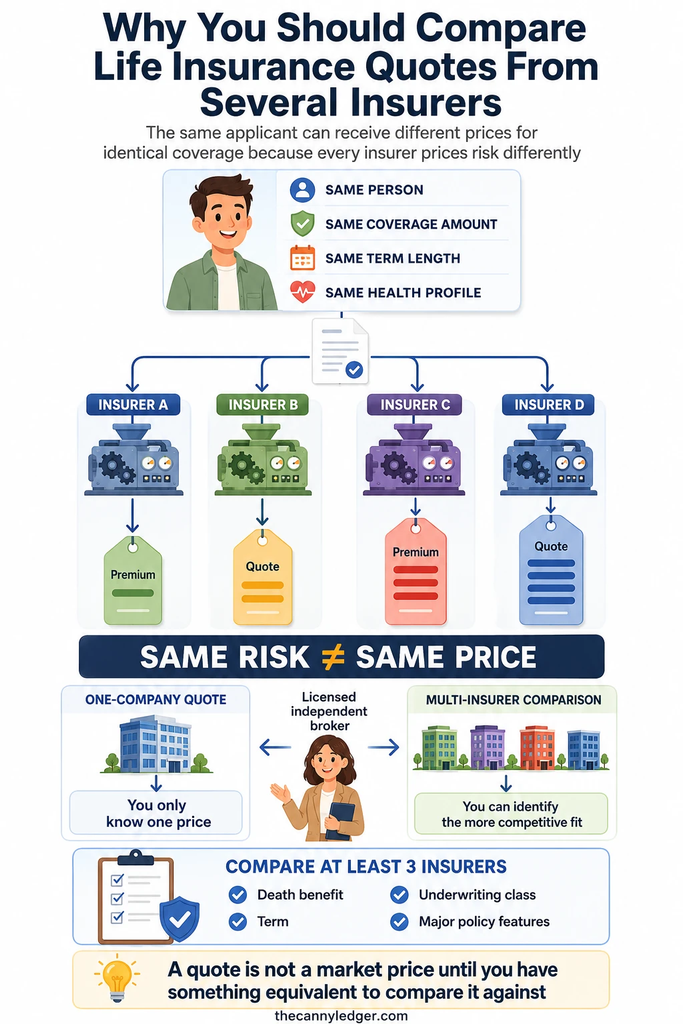
Each insurer builds its own mortality tables and pricing models, and identical applicants routinely see meaningfully different premiums between companies for the exact same coverage amount, term length, and health profile, a pattern industry-wide data compiled by CLHIA reflects across the sector rather than as an isolated quirk of any single company. Relying on a single company’s quote, especially a bank’s in-house life insurance arm reached through an existing account relationship, skips the comparison step entirely. Working through a licensed broker who can pull quotes from several of Canada’s leading insurers at once, or gathering a handful of independent quotes directly, turns what would otherwise be a guess into an actual comparison.
Pay Annually Rather Than Monthly
Going back to the fact that opened this piece, choosing to pay the full annual premium in one payment rather than spreading it across twelve monthly installments typically saves somewhere in the range of 8 percent over the course of a year, simply by avoiding the processing loading most insurers build into monthly billing. On a $50 monthly premium, that’s a relatively small amount in any single year, but compounded across a 20 or 30-year term, it adds up to a meaningful total, and it’s one of the only savings available that requires no underwriting change, no health improvement, and no shopping around, just a different box checked on the application.
Buy the Coverage the Numbers Actually Support, Not a Guess
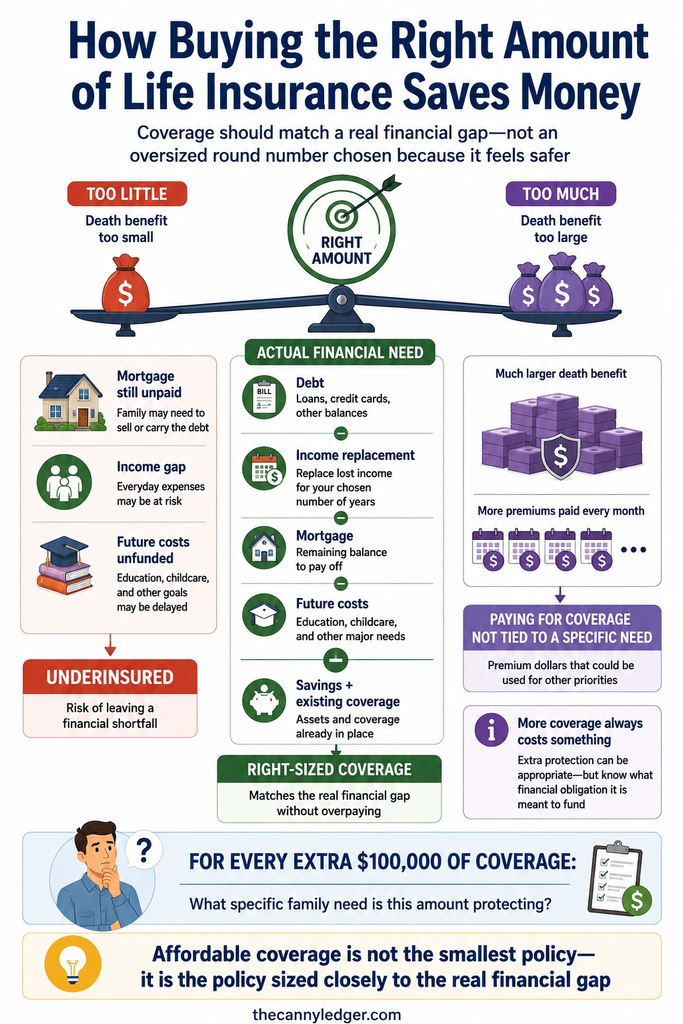
Overbuying coverage is its own quiet cost. Working out an actual coverage number based on real debts, real income replacement years, and real future costs rather than a generic multiple of salary keeps the death benefit sized to what a family would genuinely need, rather than padded with extra coverage that sounds reassuring but costs real money every month it’s carried. This works in both directions. Underbuying leaves a real gap, but buying meaningfully more than the actual need requires is paying an ongoing premium for protection that was never going to be used the way it was priced.
Be Selective About Riders
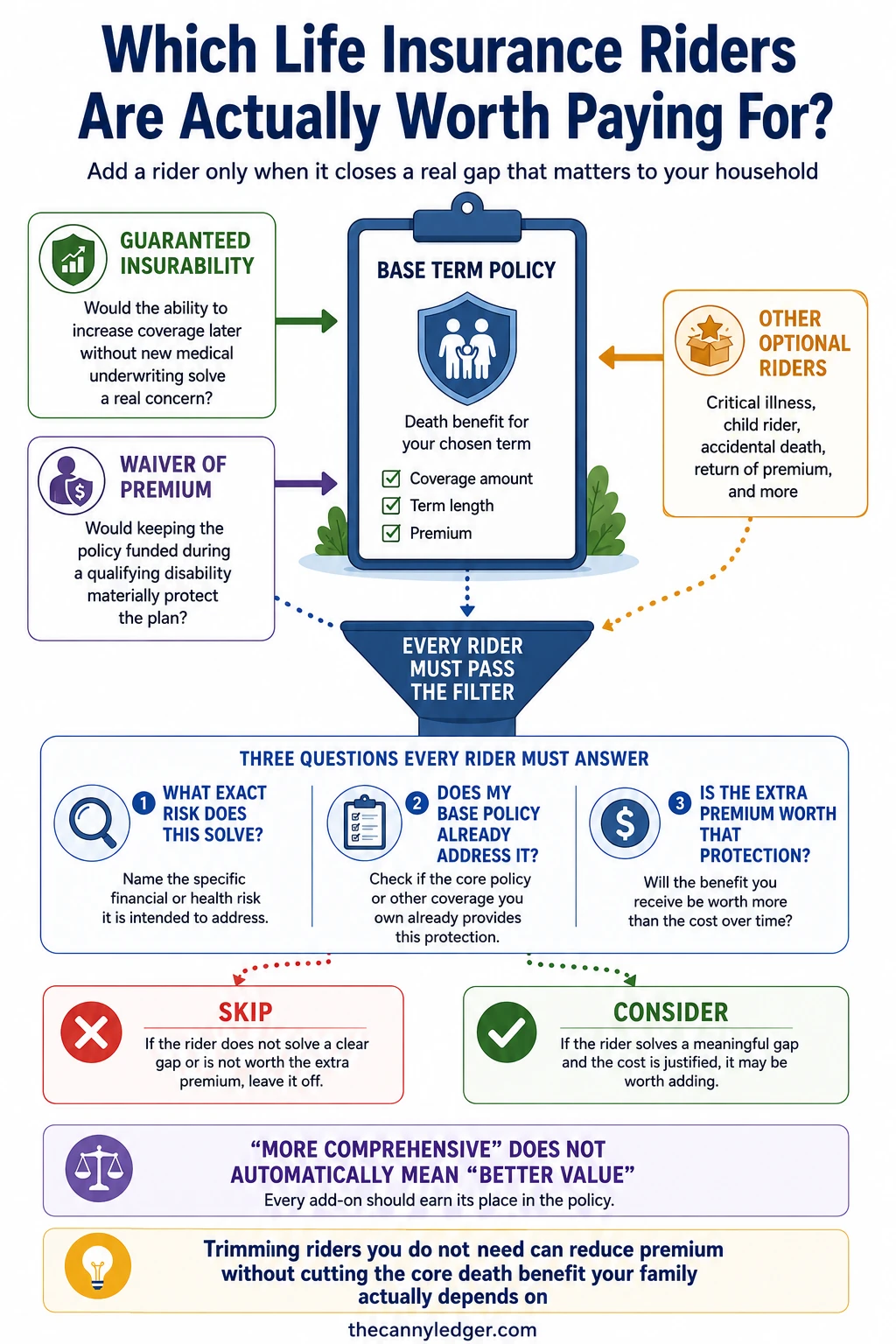
Add-ons attached to a base policy can genuinely earn their cost or quietly inflate it, and the difference comes down to whether a specific rider solves a real problem for the specific person buying it. A guaranteed insurability rider, letting coverage increase later without new medical underwriting, or a waiver of premium rider, keeping the policy active if a disability prevents working, both address real gaps in what a base term policy covers. Riders bundled in mostly because they sound comprehensive, without a clear scenario where they’d actually get used, are one of the easier places to trim cost without giving up anything that actually protects the household.
The Mistake That Undoes Every Other Strategy on This List
None of the levers above matter much if the actual purchase keeps getting delayed. Premiums climb with age in a way that’s entirely predictable once the actual numbers are laid out by decade, and every year spent waiting for a more convenient moment to apply locks in a permanently higher rate for whatever term gets purchased afterward. The cheapest version of any policy is almost always the one bought today rather than the theoretically better-timed one bought later, and comparing quotes, choosing term over permanent, and paying annually all matter far less than simply not letting the purchase itself sit unresolved for another few years.
What to Actually Do With This
Start by getting quotes from at least three insurers for a term policy sized to a real number, not a round guess, using the current health profile rather than waiting for it to improve first. Ask specifically whether the annual payment option is available and what the exact savings amount is compared to monthly billing, since that number varies by insurer and is worth confirming rather than assuming. And if a health condition, a lapsed non-smoker milestone, or a genuine uncertainty about coverage amount is the actual reason for delay, treat resolving that specific blocker as the priority, rather than letting the whole decision sit untouched while the price quietly climbs in the background.
Frequently Asked Questions
Does a shorter term always cost less than a longer term for the same coverage amount? Generally yes, for identical coverage and health profile, since the insurer is pricing a shorter window of risk, though the difference narrows or can reverse if the shorter term needs to be replaced later at an older age and worse rate class.
Can switching insurers later reduce the cost of an existing policy? Not directly. An existing policy’s premium is locked in for its term regardless of what a competitor charges, so any switch means applying fresh with a new insurer, new underwriting, and a rate based on the current age rather than the age when the original policy was purchased.
Is it worth using an insurance broker instead of buying directly from one company? Often yes, specifically because a broker can compare quotes across multiple insurers at once rather than presenting only one company’s pricing, though it’s still worth confirming which insurers a specific broker actually works with before assuming full market coverage.
Does improving health after a policy is already in place lower the premium? Rarely, since most level term policies lock in the premium for the full term regardless of health changes afterward. The benefit of improved health mainly applies at the next application, whether that’s a renewal, a new policy, or a rate class review specifically offered by the insurer.