
An advisor pitching permanent life insurance will often present whole life and universal life as two flavours of the same product, differing mainly in price and a few optional features. That framing causes more bad purchase decisions than almost anything else in Canadian permanent insurance, because the two products don’t just differ in cost. They hand control of your money to completely different parties, and picking the one that fits your actual temperament matters more than picking the one with the lower headline premium.
- Who’s Actually Steering the Investment Side
- How the Two Products Actually Compare
- What Each One Actually Costs
- Who Actually Bears the Investment Risk
- The Tax Risk That Only Shows Up in One of These Products
- What Happens if Your Insurer Fails
- Who Each Product Actually Suits
- The Verdict
- Mistakes People Make Choosing Between Them
- Common Questions About Whole Life vs Universal Life Insurance
Whole life insurance puts the insurer in charge of your policy’s investment side, guarantees a minimum cash value regardless of markets, and pays dividends that vary but never turn negative. Universal life insurance hands that control to you, letting you choose the investment mix and the cost of insurance structure yourself, with no floor protecting your account value if you underfund it or your chosen investments perform badly. Everything else that separates these products, cost, tax risk, and how each behaves decades into the contract, flows from that one structural choice.
Who’s Actually Steering the Investment Side
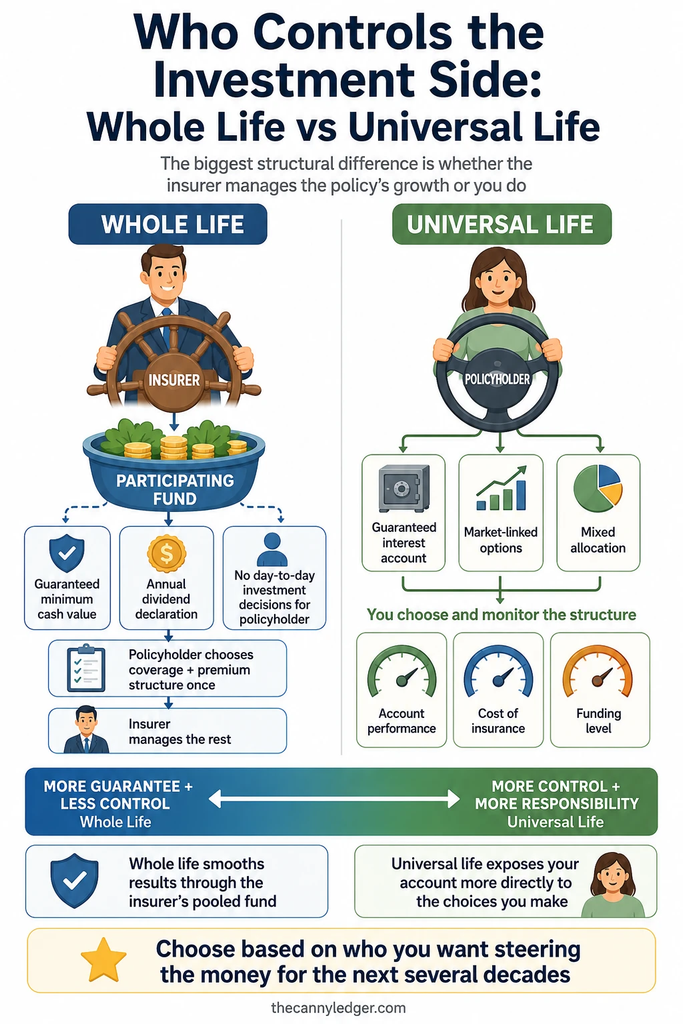
This is the single fact that should drive most of the decision, and it gets buried under feature comparisons far too often. With whole life insurance, the insurer manages a shared participating fund on behalf of every policyholder, declares an annual dividend based on how that fund performed, and guarantees your cash value will never fall below a stated minimum no matter what happens in the markets that year. You make one decision at the point of purchase, how much coverage and which premium structure, and the insurer handles everything after that.
With universal life insurance, you’re the one choosing between guaranteed interest accounts, market-linked funds, or some mix of both inside your own investment account, and you’re the one who has to notice if that account is underperforming or if the cost of insurance has quietly outgrown what your premium covers. There’s no shared fund smoothing out a bad year, and there’s no insurer guarantee sitting under your account value the way there is with whole life’s minimum cash value. The trade-off is real, more potential upside if your chosen investments perform well, against the very real possibility of a policy that requires active management for decades to avoid collapsing.
How the Two Products Actually Compare
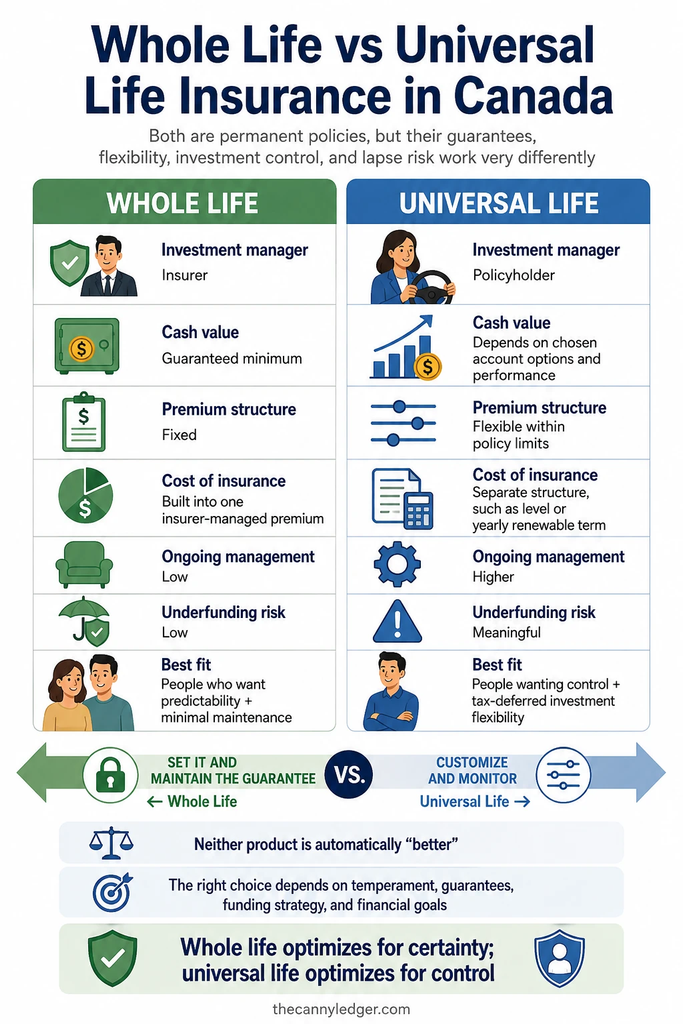
| Whole Life | Universal Life | |
|---|---|---|
| Who manages investment growth | Insurer, through a shared participating fund | Policyholder, choosing from insurer-offered accounts |
| Cash value guarantee | Minimum cash value guaranteed regardless of markets | No guarantee on market-linked account options |
| Premium structure | Fixed for the life of the policy | Flexible, adjustable up or down within limits |
| Cost of insurance | Built into a single premium, insurer-managed | Chosen separately, level or yearly renewable term |
| Risk of policy lapse from underfunding | Low, insurer manages the shared fund | Real, especially with yearly renewable term cost of insurance |
| Best suited for | People who want one decision and zero ongoing management | People who’ve maxed registered accounts and want control |
What Each One Actually Costs
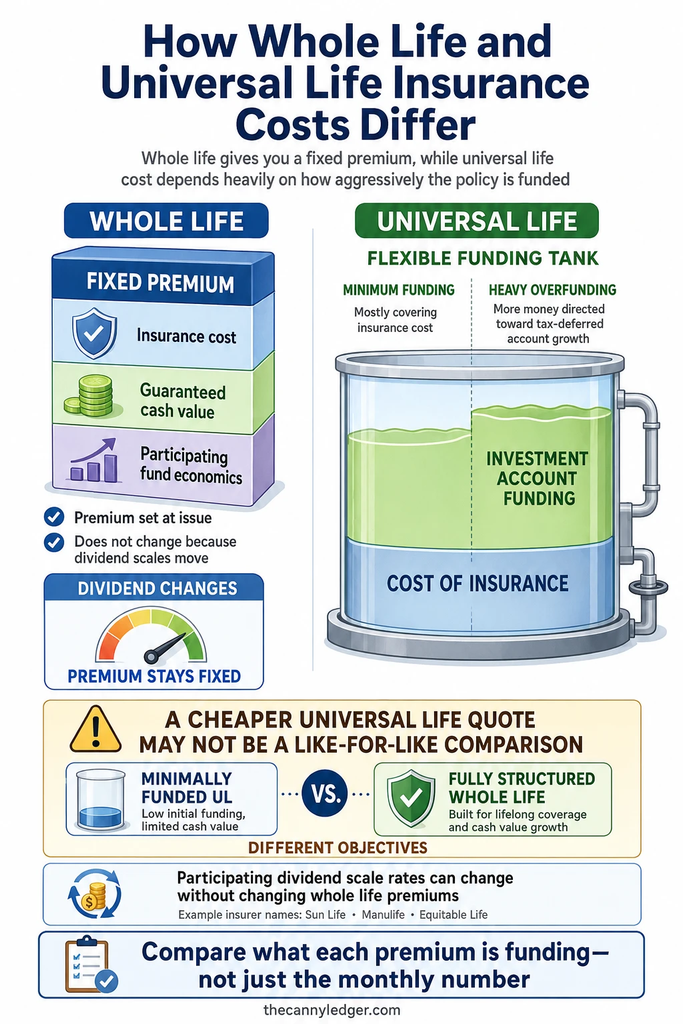
Whole life premiums are set once and never move, built around a dividend scale interest rate the insurer reviews annually but which affects your dividend, not your premium. Canadian insurers have kept these rates fairly stable through 2026. Sun Life is maintaining its 2026 to 2027 dividend scale at 6.25 percent effective April 1, 2026, Manulife is holding its Manulife Par dividend scale interest rate at 6.35 percent through August 31, 2027, and Equitable Life has kept its rate unchanged at 6.40 percent since July 1, 2025. None of that changes what you pay each month, only what your policy’s dividend looks like.
Universal life premiums work differently because the number you’re quoted depends heavily on how you fund the policy, not just your age and health. A policy funded at the bare minimum to cover the cost of insurance behaves financially similar to renting term coverage for life, while a heavily overfunded policy aimed at maximizing tax-deferred growth costs considerably more, since more of each dollar is going toward investment rather than pure insurance. This makes head-to-head premium comparisons between the two products slippery unless you’re comparing a minimally funded universal life policy against whole life, in which case whole life typically costs more for the same death benefit, since part of that higher whole life premium is paying for the insurer’s guarantee.
Who Actually Bears the Investment Risk
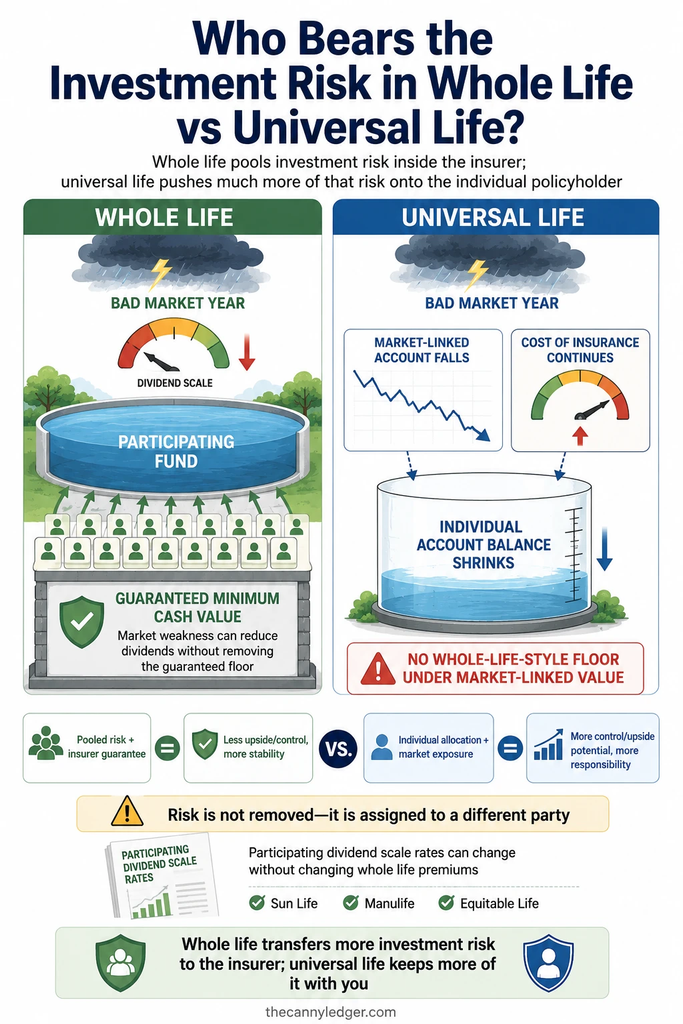
Every dollar of underperformance in a whole life policy is absorbed by the insurer’s much larger, professionally managed participating fund pooled across every policyholder, which is precisely why the dividend can shrink in a bad year but the guaranteed minimum cash value never does. That pooling effect is the entire reason whole life can promise a floor. Spreading risk across thousands of policyholders and decades of investment cycles lets an insurer smooth out short-term volatility in a way no individual policyholder managing their own account ever could.
Universal life removes that pooling entirely for the market-linked portion of your account. If you choose an indexed or managed fund option and markets have a poor decade, your account value reflects that directly, with no insurer stepping in to guarantee a floor the way whole life does. This isn’t a flaw in the product, it’s the direct cost of the control universal life hands you, but it means the person holding a universal life policy needs to actually understand and accept market risk in a way a whole life policyholder never has to.
The Tax Risk That Only Shows Up in One of These Products
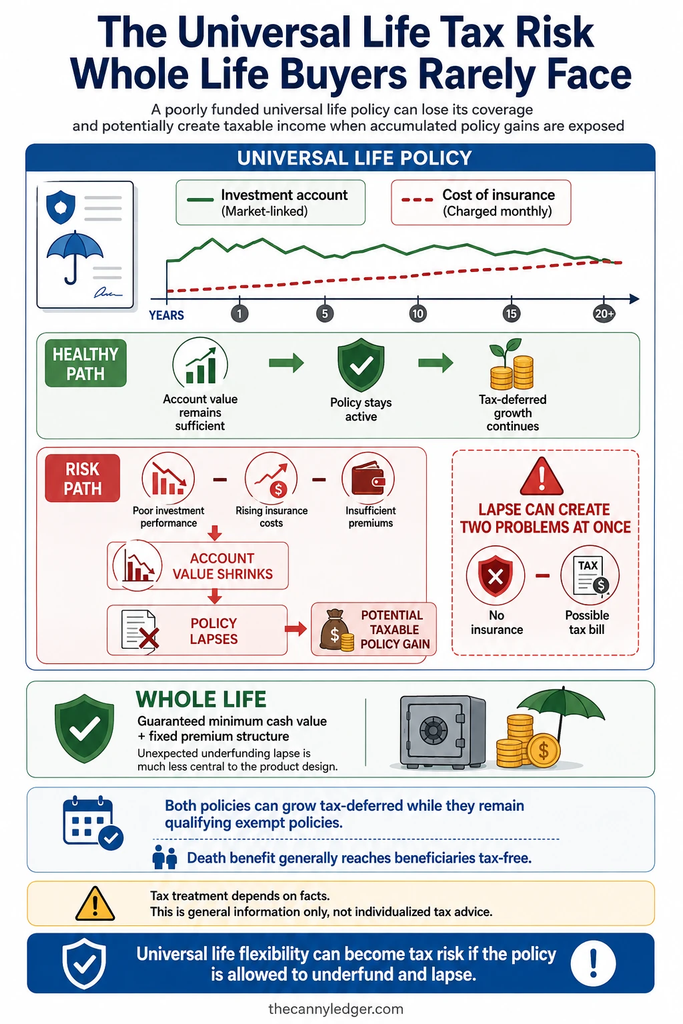
Both products share the same core tax advantage. As long as the policy stays within the exempt-policy limits set by the Income Tax Act, growth inside either one compounds without annual tax, and the death benefit reaches beneficiaries tax-free regardless of which product you chose. Where the two diverge is what happens if things go wrong.
A whole life policy’s guaranteed minimum cash value makes an unexpected lapse with an outstanding tax bill extremely unlikely, since the insurer’s guarantee keeps the policy funded even through a rough patch. A universal life policy holding market-linked investments carries a specific risk that doesn’t exist in whole life at all. If the account has grown substantially and the policy then lapses because the cost of insurance overtook a shrinking account balance, the accumulated gain becomes taxable income in that single year, under the same section 148 surrender rules that govern any Canadian life insurance policy’s adjusted cost basis, the same rule the Canada Revenue Agency applies to capital property transfers more broadly, with no cash left inside the lapsed policy to actually cover that tax bill. That combination, a lapsed policy and a surprise tax bill, is a risk unique to how universal life structures its investment growth, and it’s worth weighing seriously against the extra control the product offers.
What Happens if Your Insurer Fails
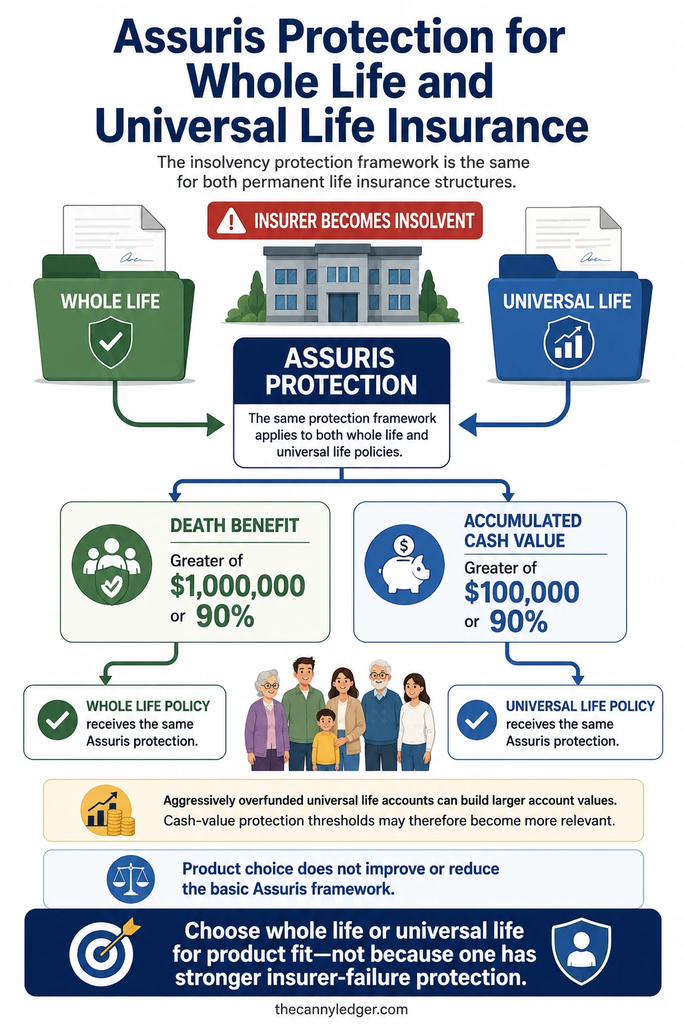
Assuris protects both products under an identical framework, so the choice between whole life and universal life has no bearing on how well your policy would be protected if your insurer became insolvent. Either way, you’d retain the greater of one million dollars or 90 percent of your death benefit, and the greater of one hundred thousand dollars or 90 percent of your accumulated cash value. Universal life policies that have been aggressively overfunded for years toward the exempt-policy maximum are more likely to actually approach that hundred-thousand-dollar cash value threshold than a typical whole life policy, simply because larger investment balances tend to accumulate inside universal life accounts that are deliberately funded beyond the minimum.
Who Each Product Actually Suits
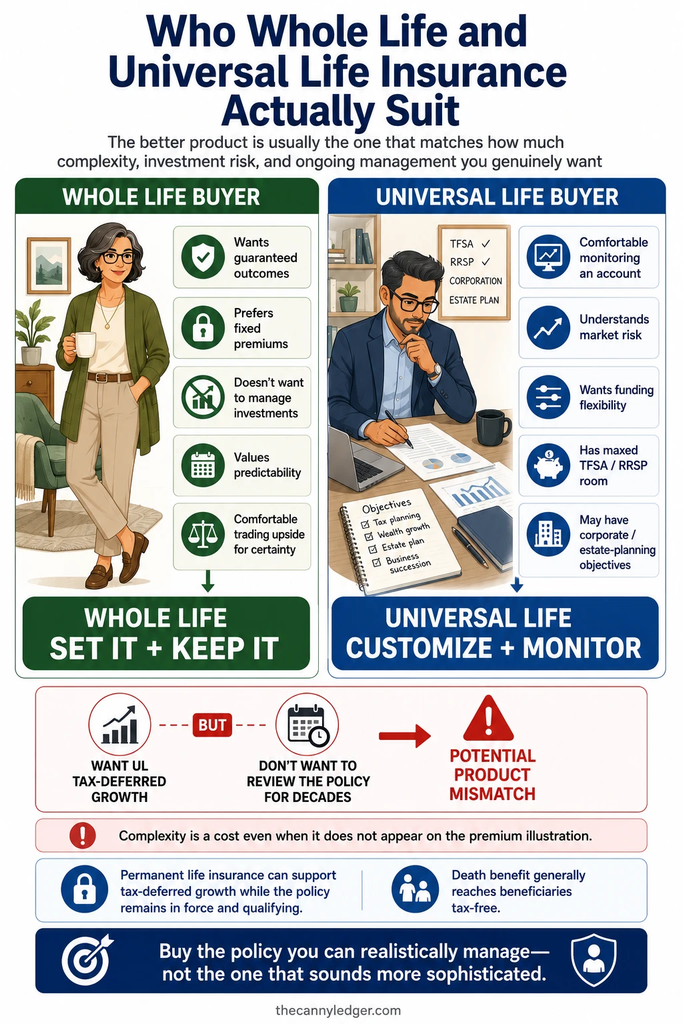
Whole life fits people who want a single decision at purchase and nothing else to manage for the rest of their life, along with anyone who values a guaranteed outcome over the possibility of a better one. It also suits people uncomfortable with financial complexity or unwilling to monitor an account for decades, since the insurer is doing that work on your behalf through the shared participating fund.
Universal life fits people who’ve already maxed out their TFSA and RRSP contribution room and want another tax-deferred vehicle, business owners running income through a corporation who benefit from the capital dividend account treatment at death, and anyone comfortable enough with investment risk to actually monitor an account over the long haul rather than setting it up once and forgetting about it. Someone who wants tax-deferred growth but has no interest in reviewing an insurance statement every few years is describing whole life’s target buyer, even if they don’t realize it during the sales conversation.
The Verdict
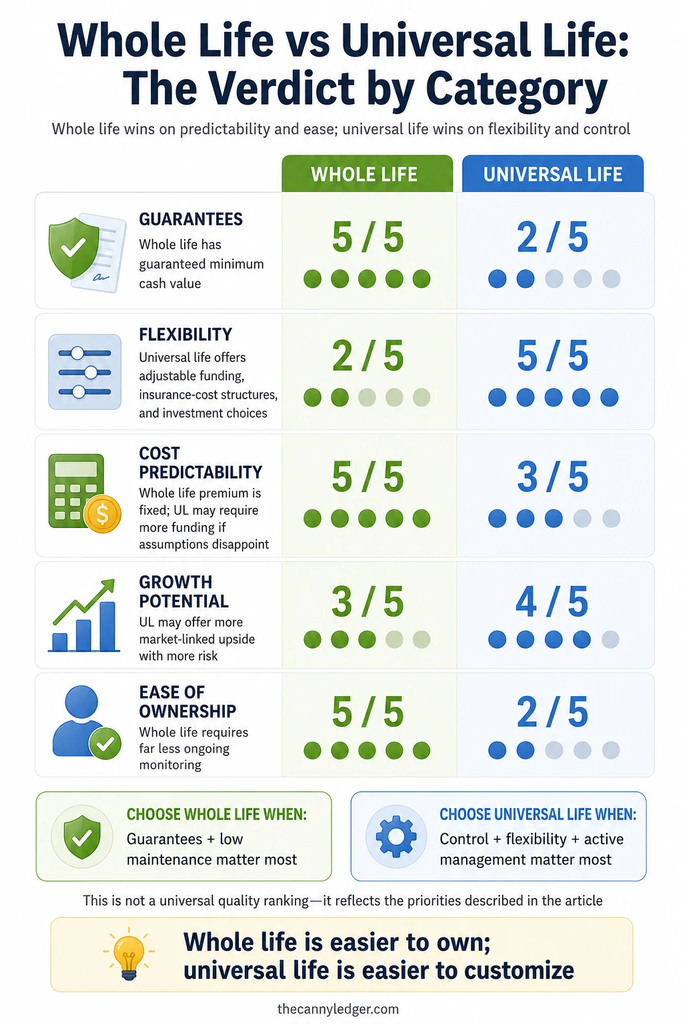
If you’re choosing purely on which product does more work for you with less ongoing attention, whole life wins, and that’s not a small thing given how many universal life policies quietly underfund themselves over twenty or thirty years without anyone noticing until a lapse notice arrives. If you’re choosing based on which product offers more control, more potential upside, and a better fit for someone who has already exhausted their registered accounts, universal life is built for exactly that situation and does it better than whole life ever could.
Guarantees: Whole life 5/5, Universal life 2/5. The guaranteed minimum cash value is whole life’s entire reason for existing, while universal life offers almost none beyond the death benefit itself.
Flexibility: Whole life 2/5, Universal life 5/5. Universal life’s adjustable premiums, choice of cost of insurance structure, and investment options simply have no equivalent in a fixed whole life contract.
Cost predictability: Whole life 5/5, Universal life 3/5. A whole life premium never changes. A universal life premium can, in effect, need to increase if the account underperforms or costs rise faster than expected.
Growth potential: Whole life 3/5, Universal life 4/5. Dividend-based growth is steady but rarely dramatic. Market-linked universal life accounts can outperform it, at the cost of the guarantee whole life provides.
Ease of ownership: Whole life 5/5, Universal life 2/5. This is the category most people underweight when comparing the two, and it’s often the one that matters most a decade after the purchase.
Mistakes People Make Choosing Between Them
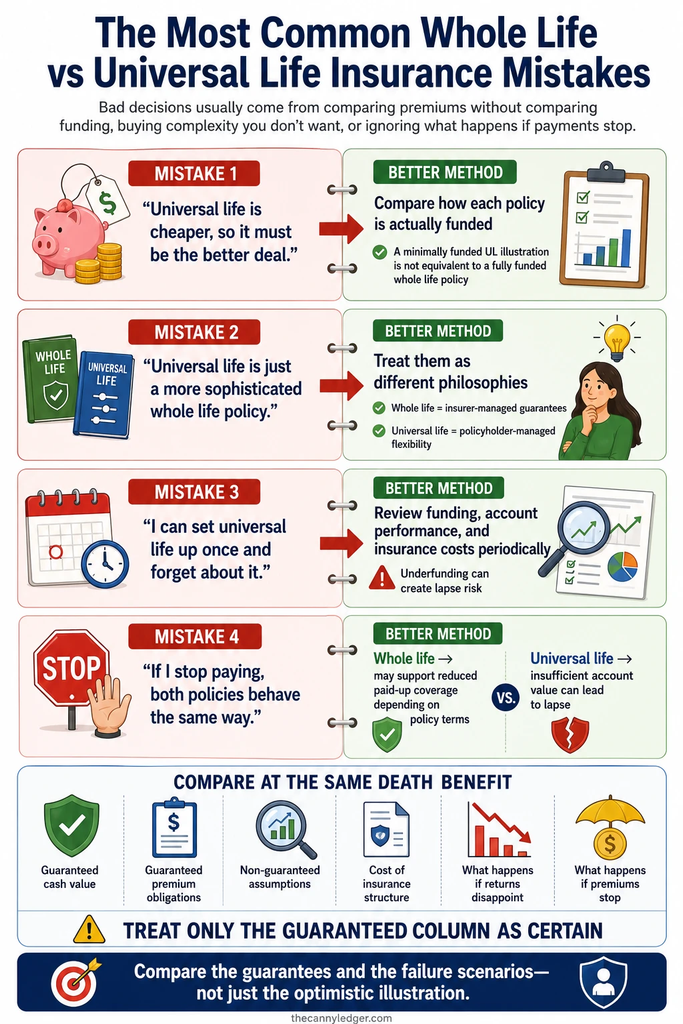
The most common mistake is choosing based on the lowest quoted premium without accounting for how that premium was structured. A minimally funded universal life quote can look far cheaper than whole life for the same death benefit, but that comparison only holds if the buyer understands they’re getting bare insurance coverage with little to no investment growth, not a like-for-like comparison against a fully funded whole life policy.
A second mistake is assuming one product is simply the upgraded version of the other, when they’re built around opposite philosophies rather than a hierarchy of quality. Someone who chooses universal life because an advisor called it more sophisticated, without actually wanting to manage an investment account for the next thirty years, ends up with a policy that requires more attention than they ever intended to give it. A third mistake, less obvious than the first two, is failing to ask what happens to either policy if premiums stop. Whole life policies can typically convert to a reduced paid-up benefit that protects at least some coverage, while a universal life policy funded only at the bare minimum can lapse outright if a payment is missed at the wrong moment, a difference that matters enormously if your income ever becomes unpredictable.
If you’re actually deciding between the two right now, the practical next step is working out how much coverage you actually need, then getting quotes for both structures at that same death benefit and comparing the guaranteed, non-dividend-dependent numbers side by side, since the guaranteed column in either illustration is the only figure you should treat as certain before signing anything.
Common Questions About Whole Life vs Universal Life Insurance
Can I convert a universal life policy into whole life later, or the other way around? Generally not directly. Each is a distinct contract type, so switching typically means applying for a new policy, which could require new medical underwriting depending on your insurer and current health.
Which one is cheaper for the same death benefit? It depends entirely on how the universal life policy is funded. A bare-minimum universal life policy usually costs less than whole life for identical coverage, but a heavily funded universal life policy built for tax-deferred growth can end up costing as much or more.
Is one of these a better fit for business owners than the other? Universal life tends to get recommended more often to incorporated professionals and business owners specifically because of the flexibility to overfund toward the exempt-policy maximum and the capital dividend account treatment at death, though whole life remains a reasonable choice for straightforward buy-sell funding needs.