
Plenty of Canadian homebuyers sign the mortgage insurance form their lender hands over at closing without realizing they had a choice at all. It isn’t a choice most people are told about clearly, and it isn’t mandatory the way some buyers assume. Federally regulated lenders in Canada cannot force you to buy mortgage life insurance as a condition of getting your mortgage, and require your express consent before enrolling you in it, a rule that exists specifically because so many buyers were signing up for coverage they didn’t fully understand and might not have needed.
- How Mortgage Life Insurance Actually Works
- How Individual Life Insurance Compares
- Comparing the Two Directly
- The Underwriting Difference That Actually Matters Most
- What Happens When You Switch Lenders or Renew
- Two Types of Mortgage Insurance People Mix Up
- What Actually Drives the Cost Difference
- What Happens if Your Insurer Fails
- The Case for Mortgage Life Insurance Anyway
- Mistakes People Make With This Decision
- Common Questions About Mortgage Life Insurance vs Life Insurance
Mortgage life insurance is a policy sold by your lender that pays off your outstanding mortgage balance if you die, with the bank as the beneficiary rather than your family. Individual life insurance, whether term or permanent, pays a fixed death benefit directly to whoever you name as beneficiary, and that person can use the money however they need to, mortgage or otherwise. The two products solve overlapping problems in very different ways, and the differences matter far more than the sales conversation at your mortgage closing usually lets on.
How Mortgage Life Insurance Actually Works
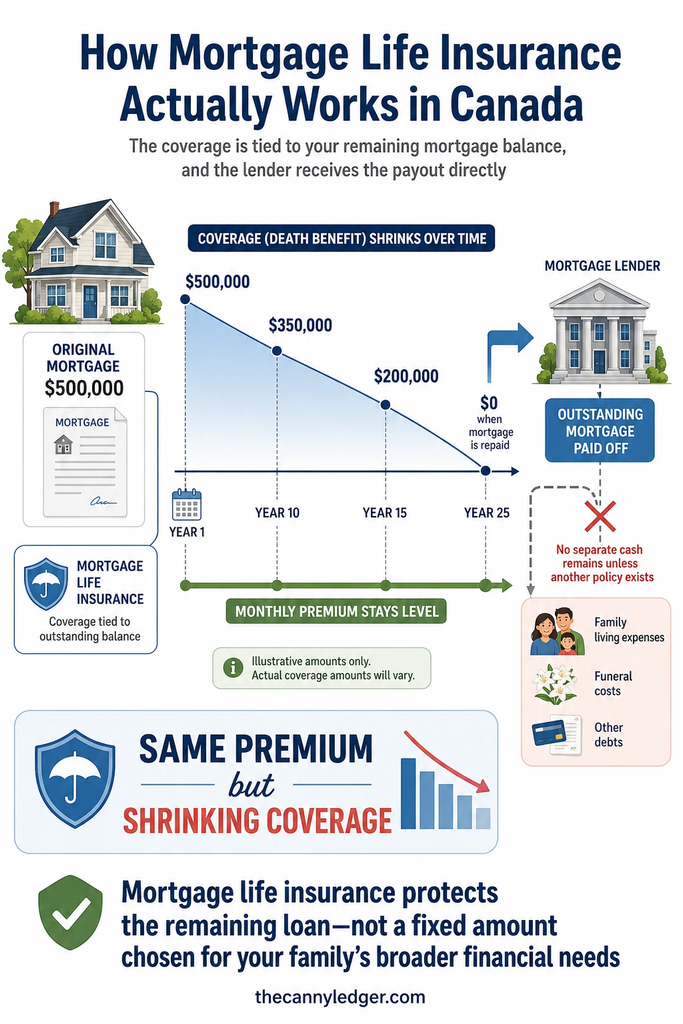
Your lender’s mortgage life insurance is tied directly to your loan balance, not to a fixed coverage amount you chose. Sun Life’s own comparison of the two products confirms that mortgage insurance pays off the outstanding principal balance of your mortgage up to a certain amount if you die, with the money going directly to the bank or lender rather than to any beneficiary you’d name yourself. There’s no extra money for funeral costs, remaining debts, or ongoing living expenses, since the payout stops the moment the mortgage is settled.
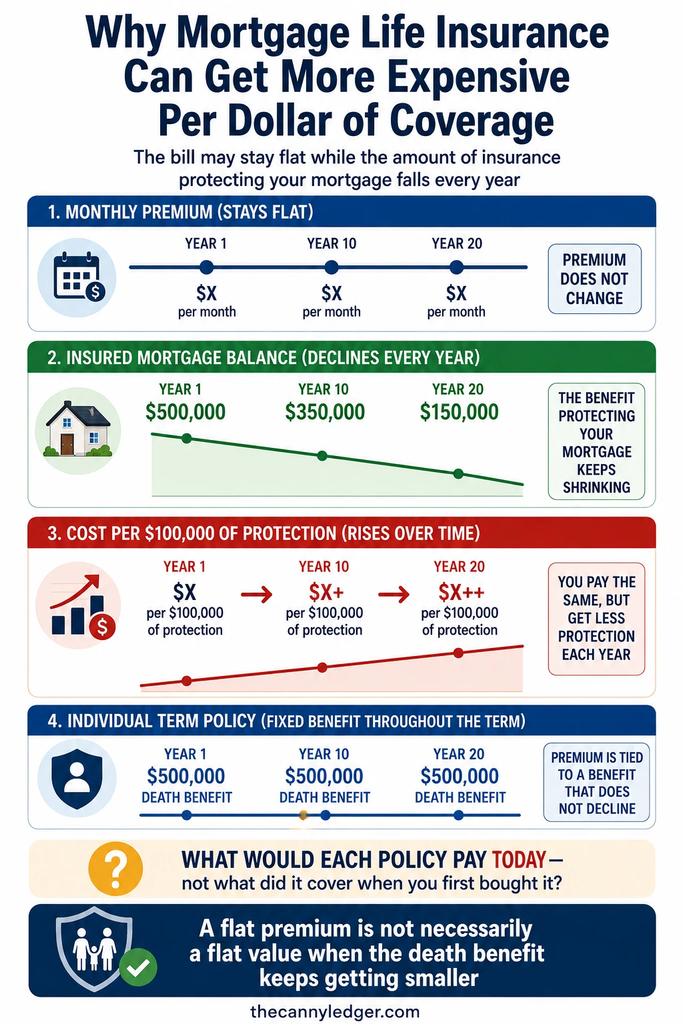
The premium on this coverage stays level for as long as you hold the policy, but the death benefit doesn’t. As you pay down your mortgage, the amount the policy would actually pay out shrinks right along with your remaining balance, while you keep paying the same monthly cost for a shrinking benefit. Someone who buys mortgage life insurance in year one of a twenty-five-year amortization is protecting a much larger number than the same policy protects by year fifteen, even though the bill on their statement hasn’t moved at all.
How Individual Life Insurance Compares
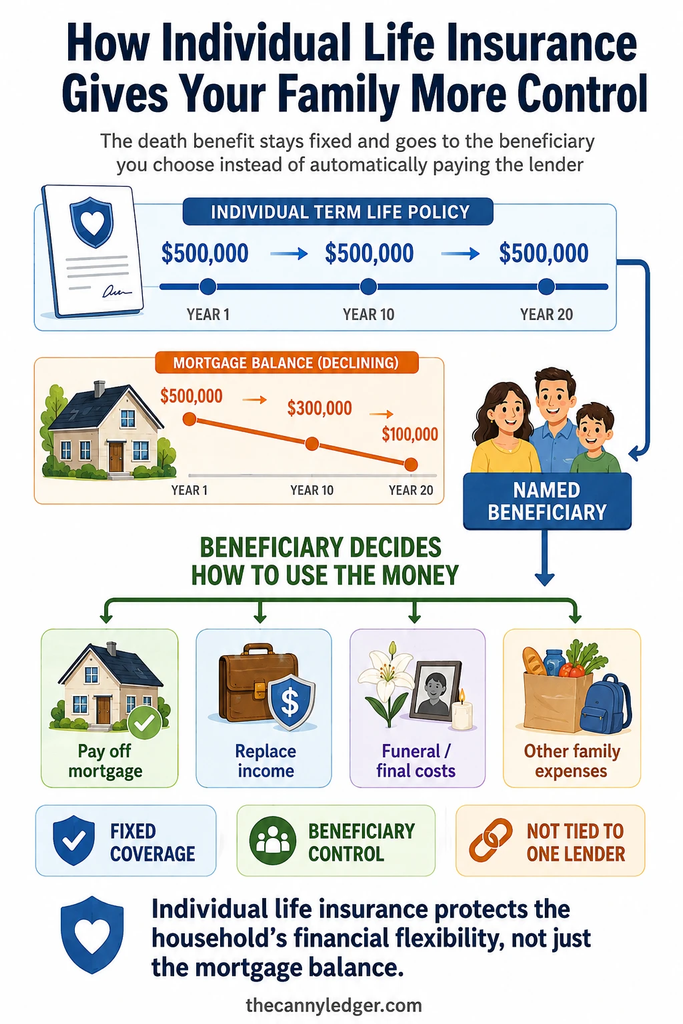
A term or permanent life insurance policy works on entirely different terms. You choose the coverage amount at the outset, and that amount stays fixed for the length of the term regardless of how your mortgage balance changes, which means a $500,000 term policy still pays $500,000 whether you bought it the week you closed on your house or twelve years into paying it down. Sun Life describes this plainly on the same comparison page, noting that with individual life insurance the amount of coverage doesn’t decrease over time, even as you repay your mortgage.
More importantly, that money goes to the beneficiary you name, not automatically to a lender. Your beneficiary can use a term life insurance payout to pay off the mortgage in full, cover funeral costs, replace lost income while they adjust, or handle whatever else comes up in the aftermath, since the insurer places no restriction on how a tax-free death benefit gets spent once it’s paid out.
Comparing the Two Directly
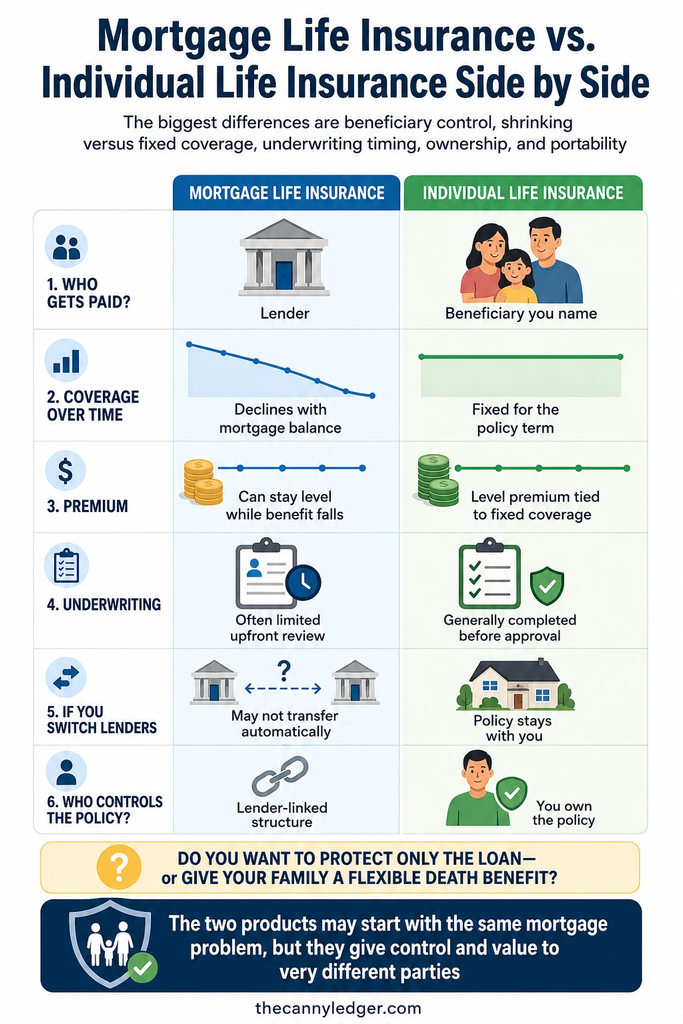
Laid out side by side, the structural differences are easier to see than they are in a sales conversation focused mainly on the monthly premium. Anyone working out how much coverage they actually need should look at this table before comparing quotes for either product.
| Mortgage Life Insurance | Individual Life Insurance | |
|---|---|---|
| Beneficiary | Your mortgage lender | Whoever you name |
| Coverage amount over time | Declines as your mortgage balance drops | Stays fixed for the length of the term |
| Premium | Level, but pays for shrinking coverage | Level, tied to a fixed coverage amount |
| Underwriting timing | Often after a claim is filed | At the time of application |
| Portability if you switch lenders | Typically does not transfer automatically | Stays with you regardless of lender |
| Who owns the policy | The lender | You |
The Underwriting Difference That Actually Matters Most
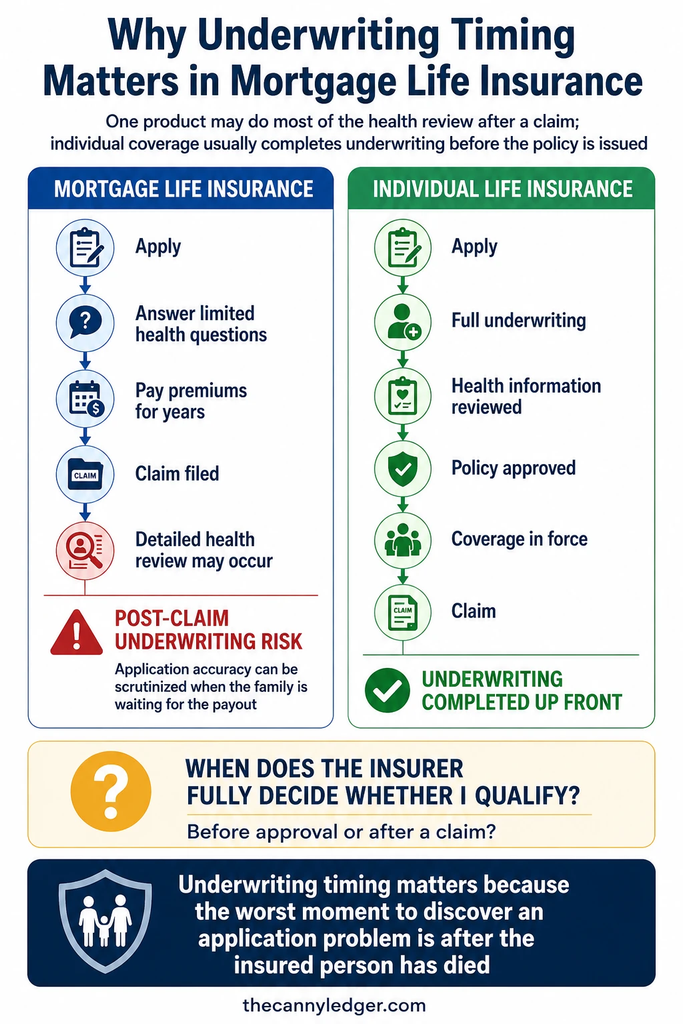
This is the single biggest reason advisors and consumer groups steer people away from bank-sold mortgage insurance, and it has nothing to do with price. Engineers Canada’s own comparison of the two products explains that mortgage life insurance typically involves minimal health questions at the time of application, with full medical underwriting only happening after a claim is submitted, a practice known in the industry as post-claim underwriting. Individual life insurance works the opposite way, with underwriting completed before you’re ever approved, so once you’re covered, the insurer has already reviewed everything it needs to and can’t reopen that review later.
The practical risk is straightforward. A mortgage life insurance policyholder can pay premiums faithfully for years without ever having their health history fully reviewed, and then discover during a claim, at the worst possible moment for their family, that an undisclosed or misunderstood condition gives the insurer grounds to deny the payout. With a fully underwritten individual policy, that review already happened at the point of approval, so a claim isn’t an opportunity for the insurer to revisit whether you should have qualified in the first place.
What Happens When You Switch Lenders or Renew
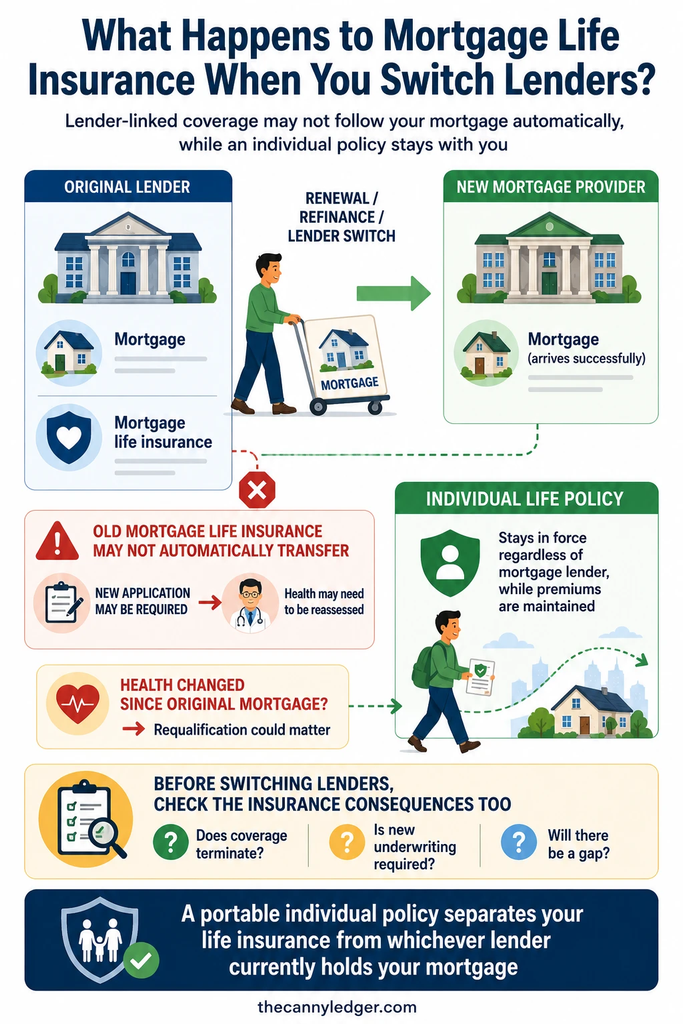
Mortgages move. People renew with a different bank for a better rate, refinance, or transfer their mortgage entirely, and mortgage life insurance doesn’t always follow along quietly when that happens. Sun Life confirms that mortgage insurance doesn’t automatically move with you if you change mortgage providers, and that you may have to prove your health is still good enough to qualify again with the new lender. Someone who developed a health condition between their original mortgage and a later renewal could find themselves unable to get equivalent coverage from the new lender at exactly the point they might need it most.
An individually owned life insurance policy has no such dependency on which bank holds your mortgage. Once approved, the policy is yours, and it stays in force through a mortgage renewal, a refinance, or a full switch to another lender without any need to reapply or requalify. This portability is easy to overlook while shopping for a mortgage, since the mortgage insurance conversation usually happens quickly at closing, but it becomes one of the more consequential differences the longer you actually hold the coverage.
Two Types of Mortgage Insurance People Mix Up
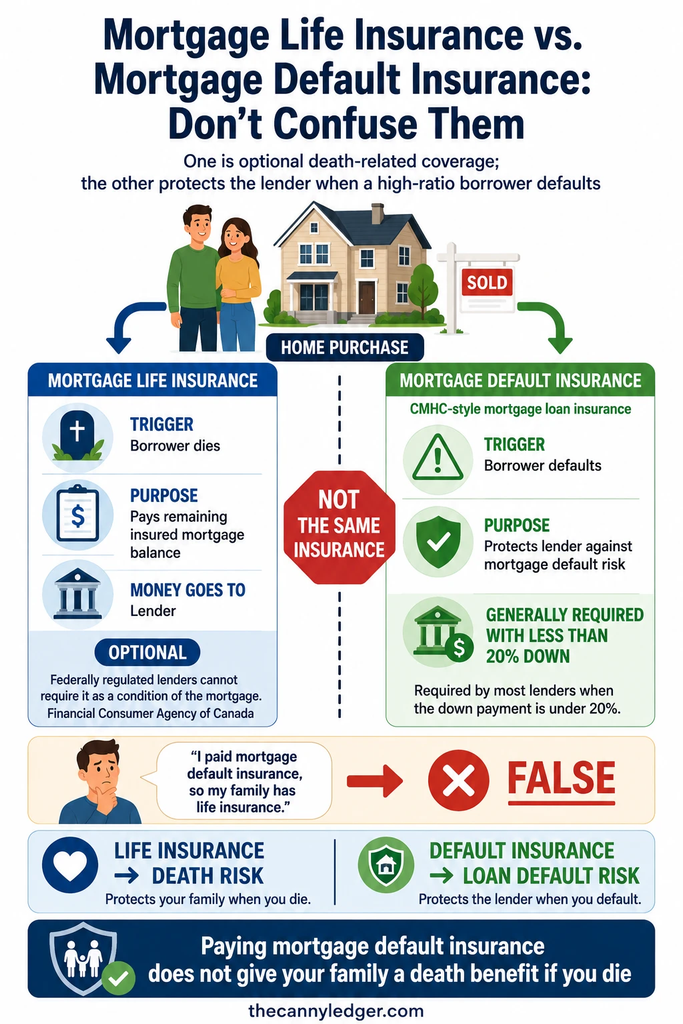
There’s a separate source of confusion worth clearing up before going any further, since it trips up a lot of homebuyers reading about this topic for the first time. Mortgage life insurance, the product this article is about, is not the same thing as mortgage default insurance, sometimes called CMHC insurance after Canada’s largest provider. CMHC’s own consumer guidance is direct about this, stating plainly that mortgage loan insurance should not be confused with mortgage life insurance, since mortgage loan insurance protects the lender if a high-ratio borrower defaults, while mortgage life insurance covers your family if you die before the mortgage is paid off.
Mortgage default insurance is mandatory whenever a buyer puts down less than 20 percent, protects the lender against your default, and has nothing to do with what happens to your family if you die. Mortgage life insurance, the subject of this comparison, is entirely optional and exists for the opposite reason, to protect your family rather than your lender’s exposure to risk. Confusing the two leads some buyers to assume they’ve already got death benefit protection through their required default insurance premium, when in fact that premium is doing something else entirely.
What Actually Drives the Cost Difference
Mortgage life insurance premiums are priced against a shrinking, bank-owned risk pool rather than a fixed, individually underwritten one, and that pricing model tends to work against the buyer over time. Because the coverage amount declines every year while the premium doesn’t, the effective cost per thousand dollars of protection climbs steadily throughout the life of the policy, even though the number on your bill never changes. A term life insurance policy priced against the same starting coverage amount, held flat for the length of the term, delivers more protection per premium dollar in every year after the first, simply because the death benefit isn’t quietly shrinking underneath a frozen price tag.
This dynamic explains why term life insurance so often comes out ahead in a straight cost comparison against mortgage life insurance for the same starting coverage amount, particularly for buyers early in a long amortization who would otherwise be paying a flat premium against a balance that keeps dropping every single year. The gap tends to widen the longer someone holds a mortgage without reviewing whether their coverage still matches what they’re actually trying to protect.
What Happens if Your Insurer Fails
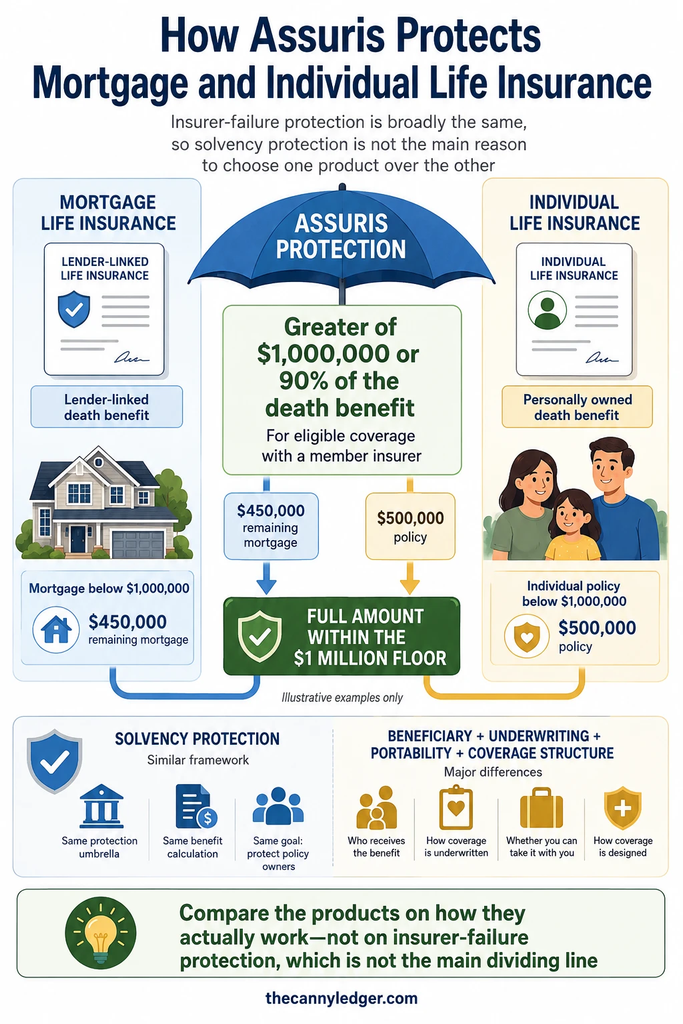
Both mortgage life insurance and individually owned life insurance fall under the same Assuris protection framework that covers the Canadian life insurance industry, so an insurer’s insolvency wouldn’t leave either type of policyholder without recourse. Policyholders would retain the greater of one million dollars or 90 percent of their death benefit, regardless of which product they held or who the named beneficiary happened to be. For most homeowners, whose mortgage balances sit well under that threshold, this protection covers the full amount either way.
This is one area where the choice between the two products doesn’t actually matter much, since the insurer failure protection is identical regardless of which one you hold. It’s worth knowing mainly so you don’t treat insurer solvency as a reason to prefer one product over the other, when the real differences lie entirely in beneficiary control, underwriting timing, and how the coverage amount behaves over the years you actually hold it.
The Case for Mortgage Life Insurance Anyway
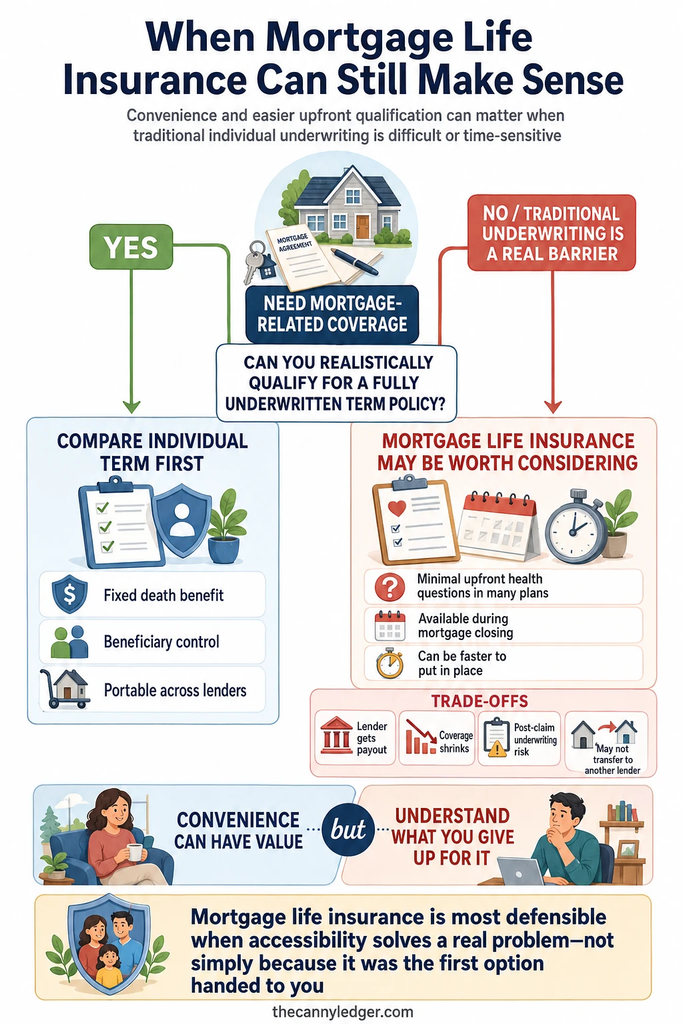
None of this makes mortgage life insurance a bad product for every situation, and it’s worth being fair about where it still fits. Someone who’s been declined for fully underwritten term coverage due to a health condition, or who wants coverage in place immediately without waiting on a medical exam and underwriting review, may find mortgage life insurance easier to obtain even with its post-claim underwriting risk attached, since the abbreviated application at the front end does let some people qualify who wouldn’t clear traditional underwriting. It also requires no separate shopping process, since it’s offered right at the point of closing.
The trade-off is accepting the underwriting risk and the shrinking coverage in exchange for that convenience, which is a reasonable trade for some buyers and a poor one for others. Someone in good health who’s simply defaulting to the lender’s offer because it’s the path of least resistance is usually leaving better, cheaper, more portable protection on the table by not at least comparing a term quote first.
Good stuff about mortgage life insurance: minimal upfront health questions can help people who might not qualify for fully underwritten term. No separate shopping process is required at the time of closing. Coverage can start immediately without waiting on underwriting to complete.
Bad stuff about mortgage life insurance: the lender, not your family, is the named beneficiary. Coverage shrinks every year while the premium stays flat. Post-claim underwriting creates real denial risk after years of paid premiums. Coverage typically doesn’t transfer automatically if you switch lenders.
Mistakes People Make With This Decision
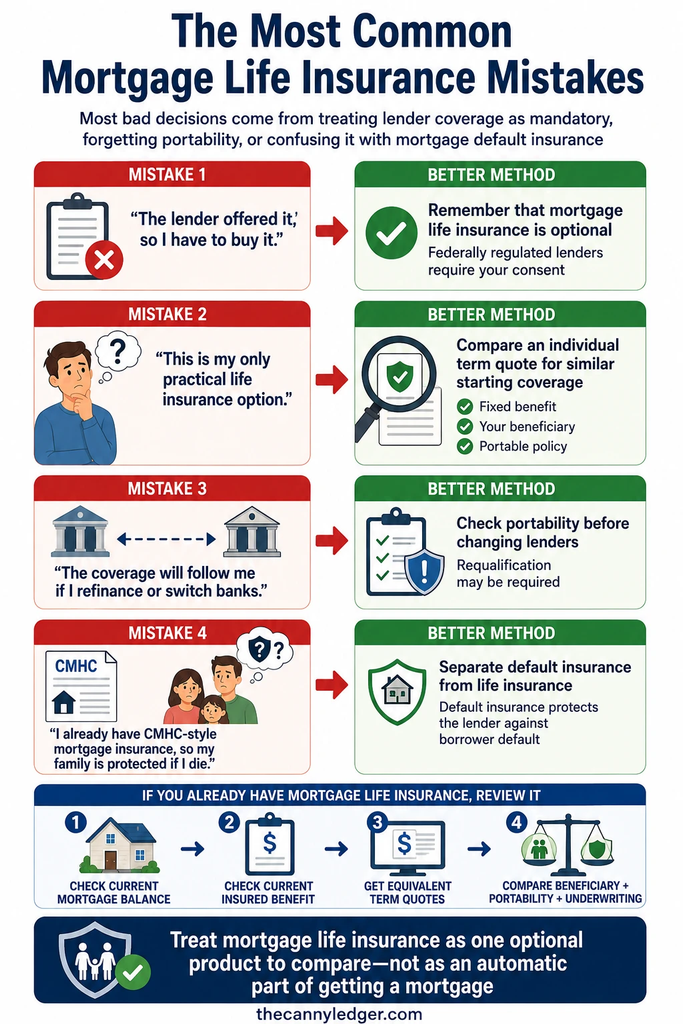
The most common mistake is treating the mortgage insurance offer at closing as the only option, rather than as one option worth comparing against a term quote before signing anything. Because the mortgage insurance conversation happens in the middle of an already overwhelming closing process, plenty of buyers sign up simply because it’s in front of them, without ever comparing quotes from a few different insurers to see what equivalent term coverage would have cost for a fixed, portable death benefit instead.
A second mistake is assuming coverage automatically carries over at renewal or when refinancing with a new lender, only to discover during that process that requalification is required and health has changed enough to matter. A third mistake, less obvious but just as costly, is confusing mortgage default insurance with mortgage life insurance and assuming the mandatory CMHC-style premium already provides death benefit protection for the family, when it’s actually protecting the lender against an entirely different risk.
If you’re currently holding mortgage life insurance and haven’t compared it against a term quote for the same amount, getting a quote based on your current mortgage balance and comparing the guaranteed, fixed death benefit against what your existing coverage would actually pay out today is a worthwhile hour, especially if it’s been several years since you last looked at either number.
Common Questions About Mortgage Life Insurance vs Life Insurance
Can my lender require me to buy mortgage life insurance to approve my mortgage? No. Lenders cannot make mortgage life insurance a condition of approving your mortgage, and they need your express consent before enrolling you in it. If a lender implies otherwise, that’s worth pushing back on directly.
Is mortgage life insurance the same as the mortgage default insurance I’m required to buy with a small down payment? No, and confusing the two is common. Mortgage default insurance protects your lender if you default on payments and is mandatory below a 20 percent down payment. Mortgage life insurance protects your family if you die and is entirely optional.
Does canceling my mortgage life insurance affect my mortgage approval? No. Since it’s optional coverage separate from your mortgage agreement itself, canceling it has no bearing on your mortgage terms or your standing with your lender, though you’d want term or permanent life insurance in place before dropping any existing coverage if you still have a need to protect.