
A life insurance death benefit is one of the cleanest tax-free transactions in the entire Canadian tax system, no income inclusion, no T-slip, nothing to report on a return, a treatment RBC Insurance confirms directly when explaining what beneficiaries can expect. That’s the part everyone already knows. What almost nobody mentions is the one scenario where a life insurance payout genuinely does get taxed, and it has nothing to do with the death benefit itself. If a beneficiary chooses to leave the proceeds parked with the insurer instead of taking the lump sum right away, the interest that accumulates on that balance while it sits there is fully taxable income, even though the original death benefit underneath it never was.
- The Core Rule, and Why the Premium Payer Doesn’t Matter
- Where Tax Actually Shows Up: Cash Value
- Policy Loans Follow the Same Ceiling
- Transferring Ownership Isn’t Automatically Tax-Free
- The Group Life Wrinkle That Shows Up During Someone’s Lifetime
- What About Interest on Proceeds Left With the Insurer
- The Probate Question, Which Isn’t Really a Tax Question
- Corporate Ownership Adds a Layer, Not a New Tax
- The Myth Worth Retiring
- What to Actually Check
- Frequently Asked Questions
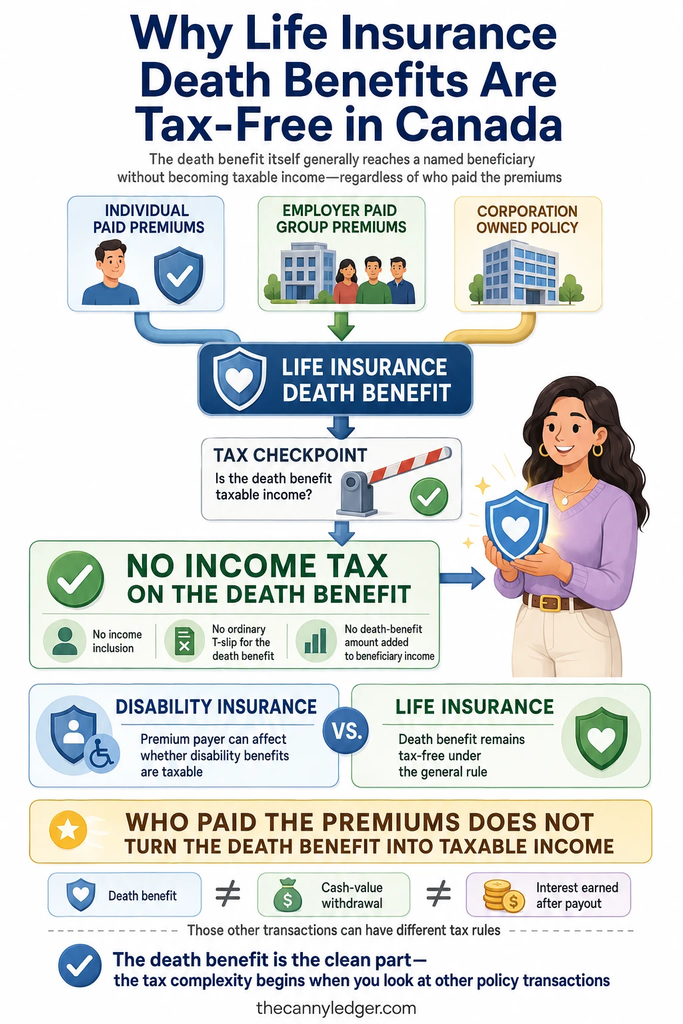
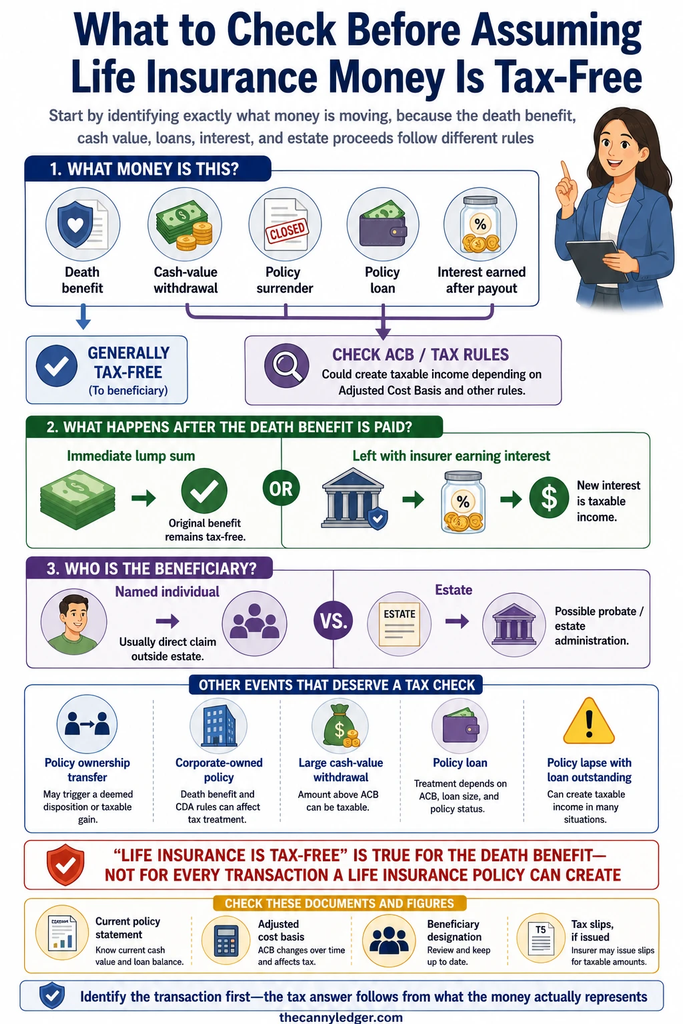
A life insurance death benefit paid to a named beneficiary in Canada is not taxable income, regardless of whether the deceased or their employer paid the premiums. Tax can still apply in specific situations, cash value withdrawn above a policy’s adjusted cost basis, interest earned on proceeds left on deposit with the insurer, employer-paid group premiums treated as a taxable benefit during someone’s lifetime, and ownership transfers of a policy.
The Core Rule, and Why the Premium Payer Doesn’t Matter
Whether an individual paid their own premiums, an employer covered a workplace group policy, or a corporation owned the policy entirely, the death benefit itself reaches the beneficiary tax-free in every case, a rule the Financial Consumer Agency of Canada states plainly as part of its general life insurance guidance. This is worth stating plainly because it runs opposite to how a related product gets taxed. With disability insurance, whether the eventual benefit is taxable depends entirely on who paid the premiums, self-paid premiums produce a tax-free benefit, employer-paid premiums produce a taxable one. Life insurance doesn’t work that way. The death benefit is tax-free across the board, which is exactly why it’s worth being precise about which parts of a policy actually can trigger tax, since the death benefit itself essentially never does.
Where Tax Actually Shows Up: Cash Value
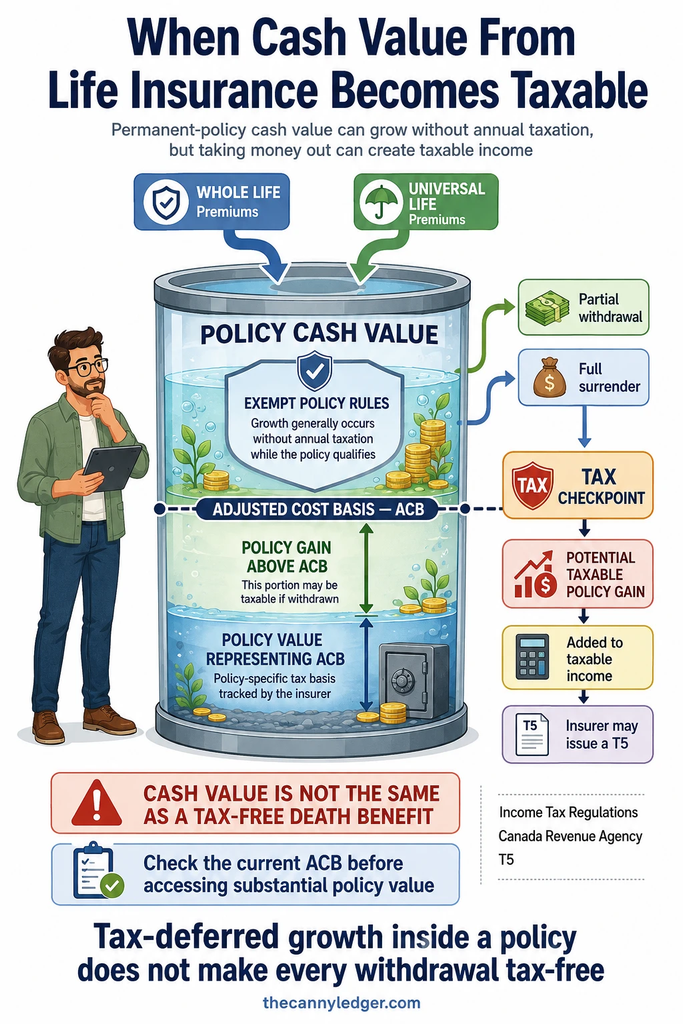
Permanent policies, whole life and universal life among them, build cash value that grows without annual tax as long as the policy stays within limits set by the exempt policy rules under the Income Tax Regulations, a structure that also underpins how participating policies specifically build and pay out dividends inside that same tax-sheltered environment. That tax-sheltered growth stops being invisible the moment money actually comes out. The number that determines what’s taxable is the adjusted cost basis, generally the total premiums paid minus the portion that covered pure insurance cost over the years. Withdraw or surrender cash value up to that adjusted cost basis and no tax applies, since that portion is treated as a return of money already paid in after-tax dollars. Take out more than the adjusted cost basis, whether through a partial withdrawal or a full surrender, and the excess gets added to income for that tax year, with the insurer issuing a T5 slip reporting the taxable amount.
Policy Loans Follow the Same Ceiling
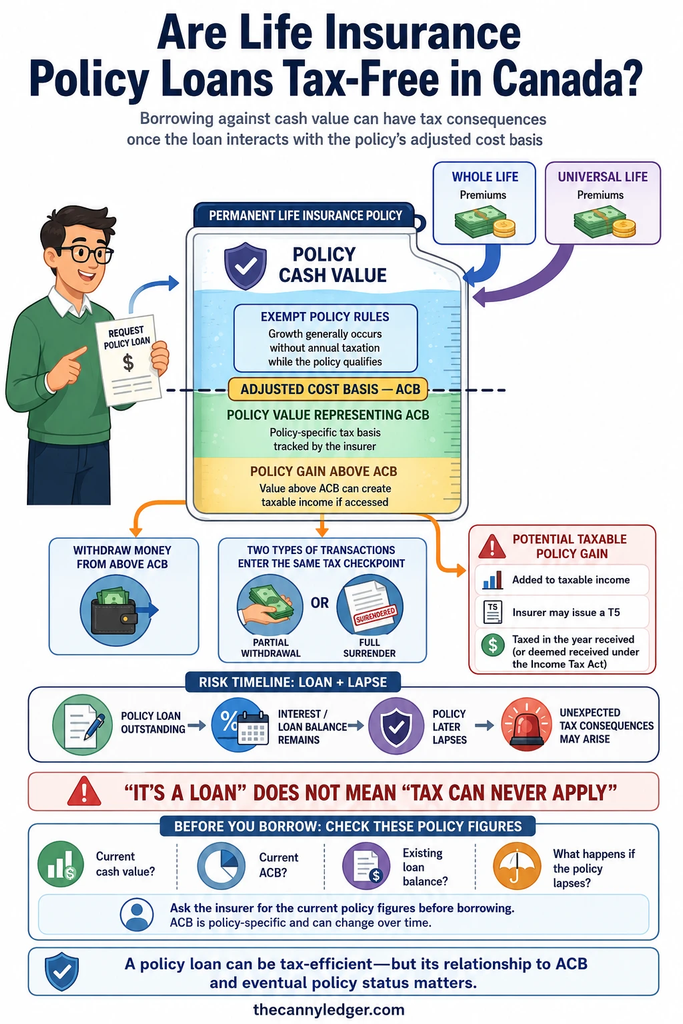
Borrowing against a policy’s cash value generally doesn’t trigger tax as long as the loan stays within the adjusted cost basis, since a loan against your own asset isn’t income in the way a withdrawal can be. The moment a loan exceeds that ceiling, the excess gets treated similarly to a withdrawal above the adjusted cost basis, and a policy that lapses with an outstanding loan still attached can create an unexpected tax bill at exactly the moment there’s no coverage left to explain the surprise. This is a detail worth confirming with an insurer directly before assuming a policy loan is automatically a tax-free way to access funds, since the answer depends entirely on where the loan balance actually sits relative to that specific policy’s adjusted cost basis.
Transferring Ownership Isn’t Automatically Tax-Free
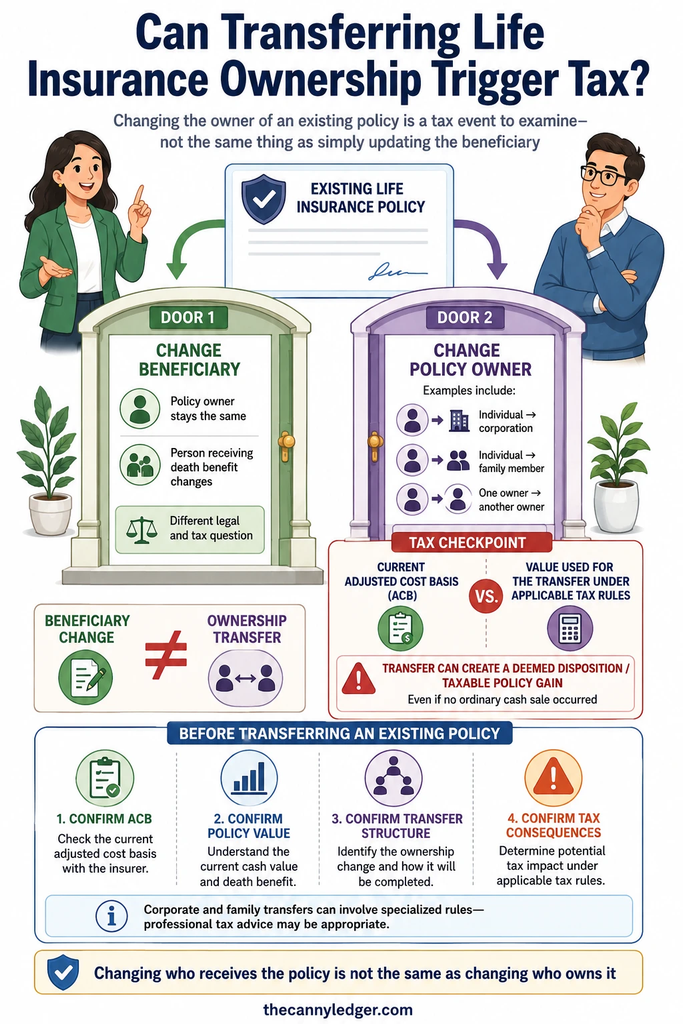
Changing who owns a policy, moving it from an individual to a corporation, for instance, or between family members, can trigger a deemed disposition if the policy’s fair market value exceeds its adjusted cost basis at the time of transfer, creating a taxable gain even though no cash actually changed hands in the transaction itself. This catches people off guard specifically because nothing about a straightforward ownership change feels like a sale, yet the tax system treats it similarly to one whenever value has built up inside the policy. Anyone considering transferring an existing policy, rather than simply changing a beneficiary designation, which carries no such consequence, should confirm the current adjusted cost basis and fair market value before assuming the transfer is a non-event.
The Group Life Wrinkle That Shows Up During Someone’s Lifetime
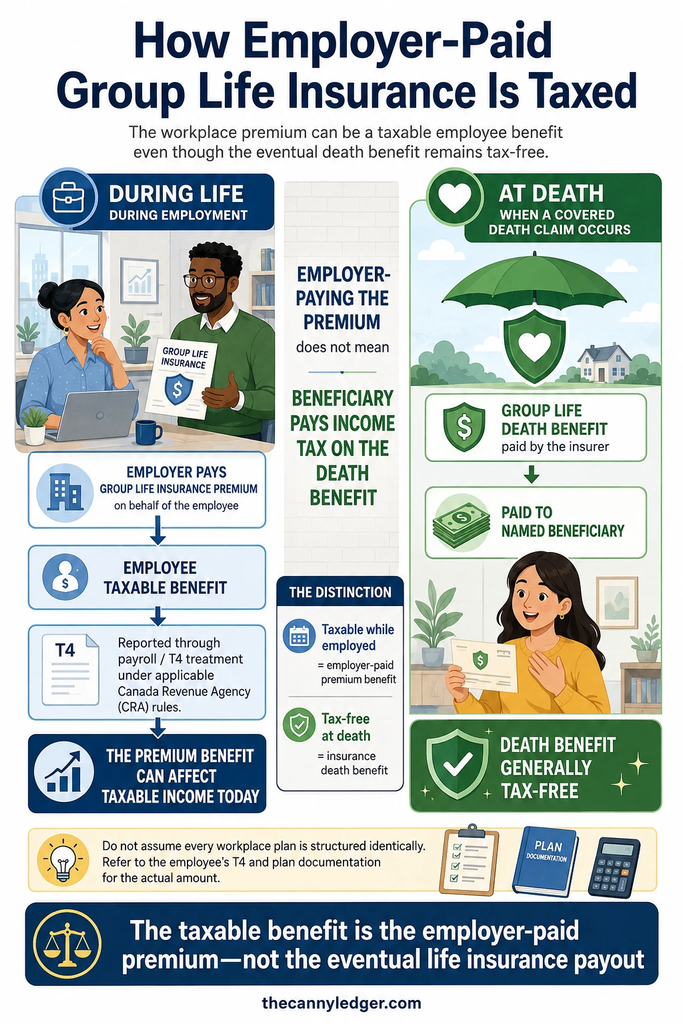
This one applies before death rather than after it, and it’s easy to miss since it never touches the death benefit itself. When an employer pays premiums for group life insurance on an employee’s behalf, the Canada Revenue Agency generally treats those premium payments as a taxable benefit, added to the employee’s income and reported on their T4 slip each year the coverage is in place. None of this changes what happens at death, the payout still reaches the beneficiary tax-free regardless of who covered the premiums, but it does mean the “free” coverage many workplaces offer isn’t entirely free from a tax standpoint while it’s being provided.
What About Interest on Proceeds Left With the Insurer
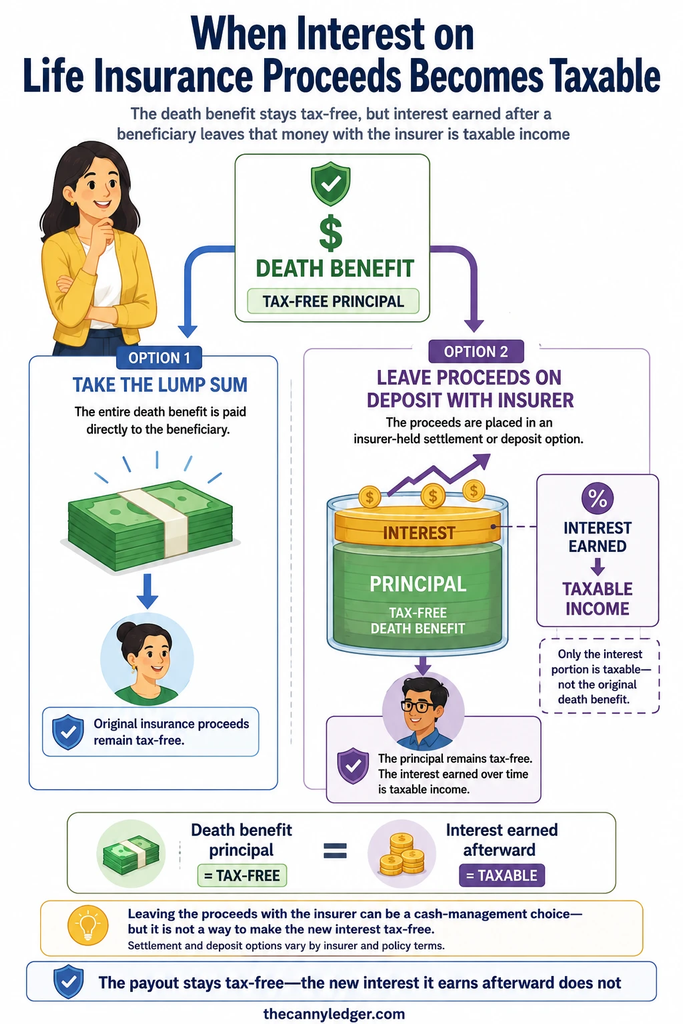
This is the exception that opened this article, and it deserves a full explanation since it’s genuinely counterintuitive. When a beneficiary chooses not to take the death benefit as an immediate lump sum, opting instead to leave it on deposit with the insurer where it accumulates interest over time, the principal amount, the actual death benefit, remains untouched by tax exactly as it always would. The interest that builds up on top of that principal while it sits with the insurer is a different story entirely, treated as ordinary taxable income to whoever is entitled to it, the same way interest earned in any other account would be. It’s a genuinely useful option for a beneficiary who isn’t ready to manage a lump sum immediately, but it’s not a way to defer or avoid tax altogether, only the growth on top of the principal becomes taxable, not the underlying benefit itself.
The Probate Question, Which Isn’t Really a Tax Question
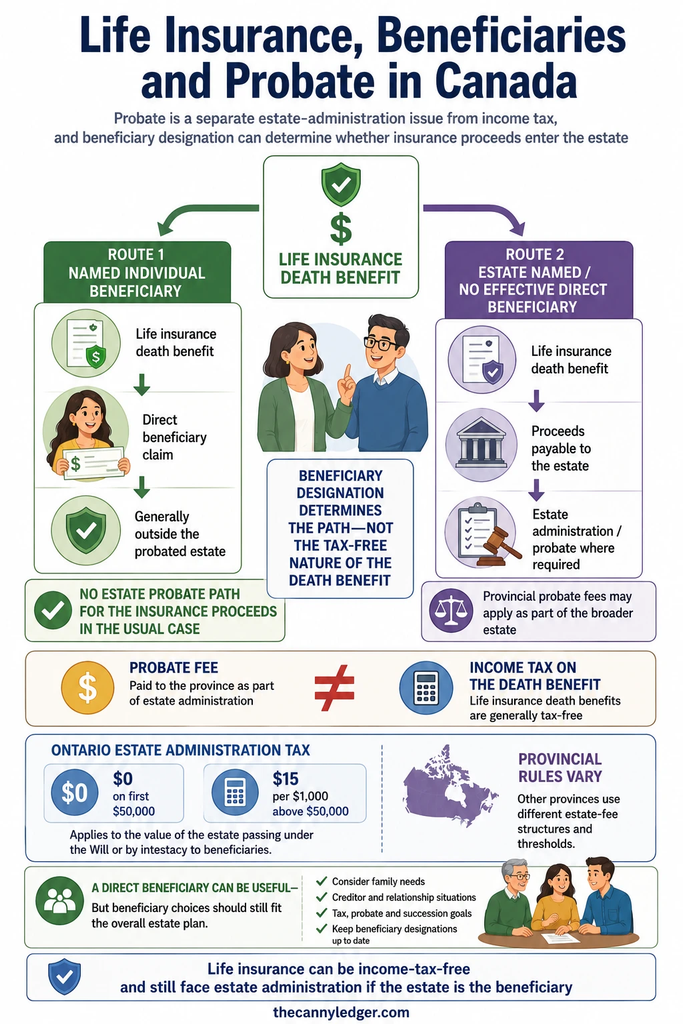
Naming a specific person as beneficiary rather than leaving that field blank, or naming the estate directly, keeps the death benefit outside of probate in most provinces, and this matters even though probate itself is a provincial fee rather than an income tax. Ontario’s Estate Administration Tax charges nothing on the first $50,000 of an estate’s value, then $15 for every $1,000 above that, an effective rate of 1.5 percent, calculated on the total value of everything that passes through the estate. A life insurance policy with a named individual beneficiary bypasses that calculation entirely, since the proceeds never become part of the probated estate in the first place. Other provinces handle this differently, with some charging comparable percentage-based fees and others, Alberta among them, capping the charge at a low flat amount regardless of estate size, which makes naming a beneficiary directly a meaningfully bigger deal in some provinces than others, even though the payout itself would have been tax-free either way.
Corporate Ownership Adds a Layer, Not a New Tax
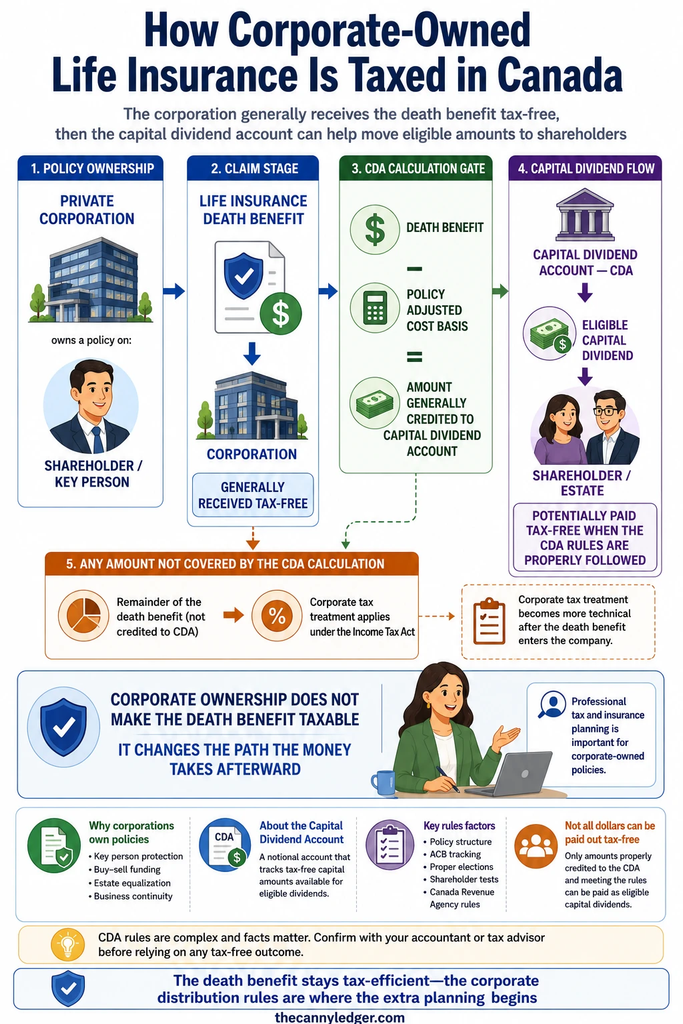
When a corporation owns a policy on a shareholder or key employee, the death benefit still arrives at the corporation completely tax-free, exactly as it would for an individual. What changes is what happens next. The amount by which the death benefit exceeds the policy’s adjusted cost basis gets credited to the corporation’s capital dividend account, which then allows that amount to be paid out to shareholders as a tax-free capital dividend, a mechanism covered in more depth when looking at how corporate-owned life insurance actually works end to end. The core tax-free nature of the death benefit doesn’t change based on who owns the policy. What changes is the path the money takes afterward and how efficiently it can eventually reach an individual shareholder.
The Myth Worth Retiring
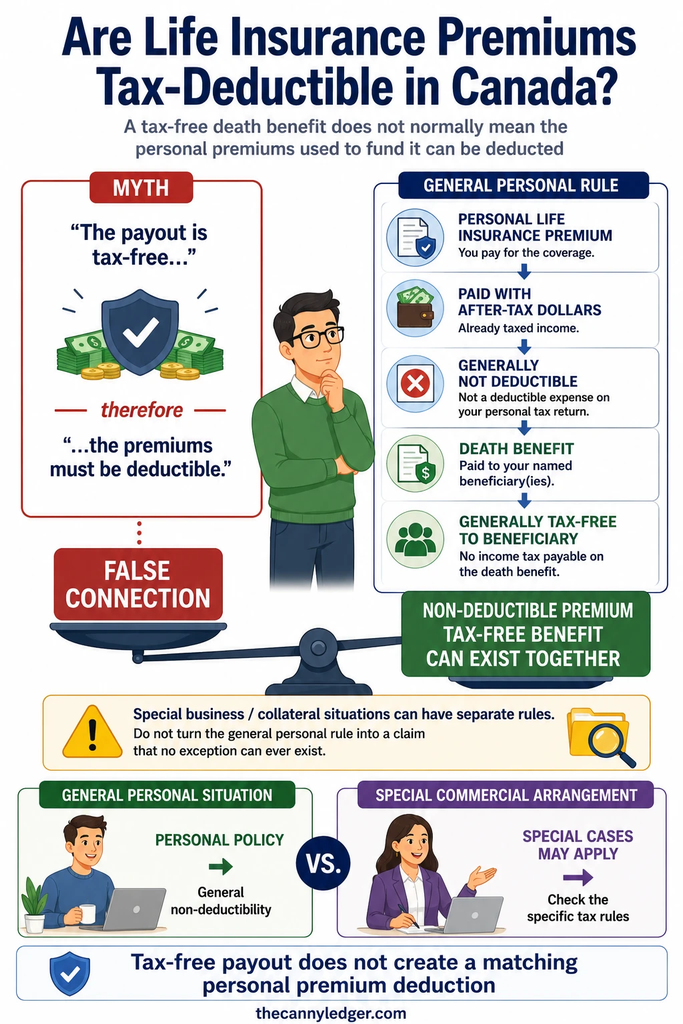
A surprising number of people assume that because the death benefit is tax-free, the premiums that fund it must be deductible, on the logic that tax-free income and deductible cost usually travel together elsewhere in the tax system. They don’t here. Personal life insurance premiums are never deductible, regardless of how the death benefit itself gets taxed, and treating the two as connected is one of the more common mix-ups in this entire area.
What to Actually Check
Before assuming a specific scenario falls under the general tax-free rule, confirm three things. Whether the money in question is the death benefit itself, which is essentially always tax-free, or cash value activity like a withdrawal, loan, or surrender, which isn’t automatically exempt. Whether a beneficiary is choosing to leave proceeds on deposit rather than taking a lump sum, since that choice specifically introduces a taxable interest component that a straight payout never would. And whether the named beneficiary designation on file is actually current, since that single detail determines whether the payout also has to navigate provincial probate on top of the tax question, an added cost that a five-minute beneficiary update can avoid entirely.
Frequently Asked Questions
Does the beneficiary need to report the death benefit anywhere on their tax return? No. A tax-free death benefit paid to a named beneficiary doesn’t get reported as income and doesn’t generate a tax slip, unlike the taxable interest scenario described above, which does require reporting whatever interest income was actually earned.
Is a life insurance payout treated differently if the beneficiary lives in a different province than the deceased? No, for the income tax treatment specifically, since that’s federal and applies uniformly across the country. Probate rules differ by the deceased’s province, not the beneficiary’s, which is a separate question from whether the payout itself is taxed.
Does naming a minor child as beneficiary change any of this? The death benefit itself remains tax-free regardless of the beneficiary’s age, though additional legal steps typically apply when a named beneficiary is a minor, since funds generally can’t be paid directly to a child without a trustee or court-appointed guardian in place to manage them.
How long does it typically take to actually receive a tax-free death benefit? Processing time depends on the insurer and how quickly a complete claim is submitted, and understanding the typical payout timeline separately from the tax question helps set realistic expectations for a beneficiary managing an estate during an already difficult period.