
A surprising number of Canadians find out their life insurance disappeared on the same day they cleaned out their desk. The group policy through work felt like coverage. It wasn’t really theirs. It belonged to the employer, and when the job ended, so did the protection, often with no way to carry it forward at the same price. That gap is exactly what personal term life insurance is built to close, and it’s why so many people end up shopping for it the moment they realize their family’s financial safety net was borrowed, not owned.
- How a Term Policy Actually Works
- What Term Life Insurance Actually Costs
- How Much Coverage You Actually Need
- Matching Term Length to Your Actual Timeline
- Term Versus Permanent Life Insurance
- Medical Exam Policies Versus No Medical Coverage
- The Fine Print Worth Actually Reading
- Is the Payout Actually Taxed?
- What Happens If Your Insurance Company Fails
- Common Mistakes Worth Avoiding
- A Few Questions People Ask Afterward
- Now What
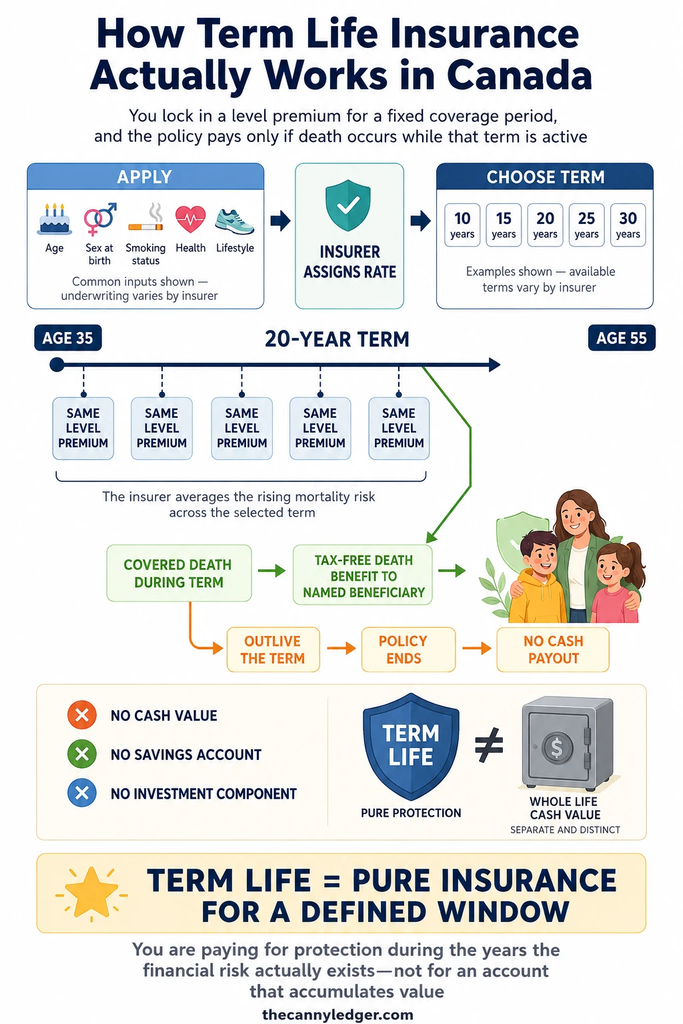
Term life insurance is a policy that pays a tax-free lump sum to your named beneficiary if you die during a fixed period, usually 10, 15, 20, 25 or 30 years. You pay a set premium for that entire period. If you die within the term, your family gets the payout. If you outlive the term, the policy simply ends and nothing is paid out, the same way car insurance doesn’t refund you for a year without a crash. It’s the cheapest form of life insurance available in Canada because it only covers a defined window of risk instead of guaranteeing a payout no matter when you die.
How a Term Policy Actually Works
The mechanics are simpler than most people expect once the mystery is stripped away. You apply, answer health and lifestyle questions (and often complete a medical exam), and the insurer assigns you a rate class based on age, sex at birth, smoking status and overall health. That rate gets locked in for the length of the term you chose. A 35-year-old who buys a 20-year term pays the same monthly premium in year one and year twenty, even though the actual risk of dying obviously climbs with age. The insurer is essentially averaging that risk across the whole term and smoothing it into one flat number.
Nothing accumulates behind the policy. There’s no savings component, no cash value, no investment account growing quietly in the background. That’s the trade-off for the low price. Whole life insurance builds cash value specifically because part of every premium goes toward it, which is a large part of why it costs several times more for the same death benefit. Term is pure protection, nothing else, and for most households in their income-earning years, that’s precisely what’s needed rather than an accompanying investment account.
What Term Life Insurance Actually Costs
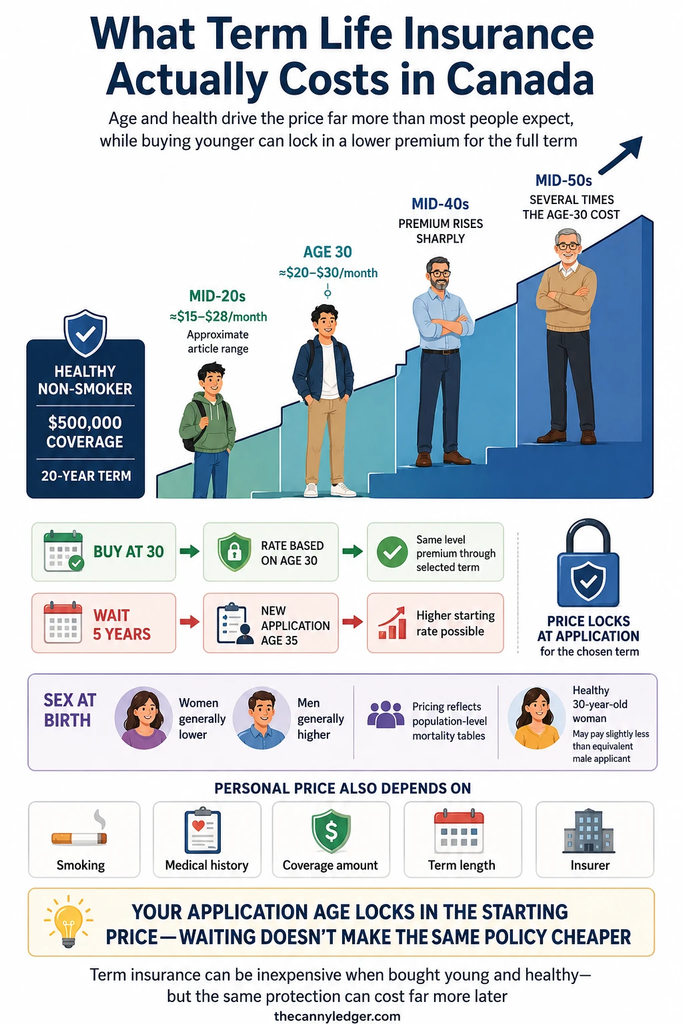
The number people usually want first is the price, and the honest answer is that it varies more by age and health than almost any other product Canadians buy. For a healthy 30-year-old non-smoker, a 20-year term policy worth $500,000 typically runs somewhere between $20 and $30 a month. Compare that to a monthly streaming bundle or a couple of coffees a week and the cost starts to look almost absurdly small for what it buys.
Age changes that number dramatically. A healthy applicant in their mid-20s might pay closer to $15 to $28 a month for similar coverage, since insurers price in decades more of statistically low mortality risk. By the mid-40s and beyond, premiums climb sharply, and by the mid-50s, the same coverage can cost several times what a 30-year-old pays, simply because the actuarial odds of a claim within the term have shifted. This is the single biggest argument for buying earlier rather than later. Waiting five years to “get finances in order” before applying can permanently lock in a materially higher premium, since the rate is set at the age you apply, not adjusted downward later.
Sex at birth also factors into pricing, since women statistically live longer than men on average, which lowers their expected claim risk within a given term. A healthy 30-year-old woman might pay a dollar or two less per month than a man of the same age and health profile for identical $100,000 coverage, and that gap widens as coverage amounts and ages increase. None of this is arbitrary. It’s the same actuarial logic that sets car insurance rates by driving history, just applied to mortality tables instead.
For a clearer sense of how your own age bracket compares, our breakdown of life insurance rates by age walks through the ranges in more detail, and our general cost guide covers how smoking status, health conditions and coverage amount each move the number up or down.
How Much Coverage You Actually Need
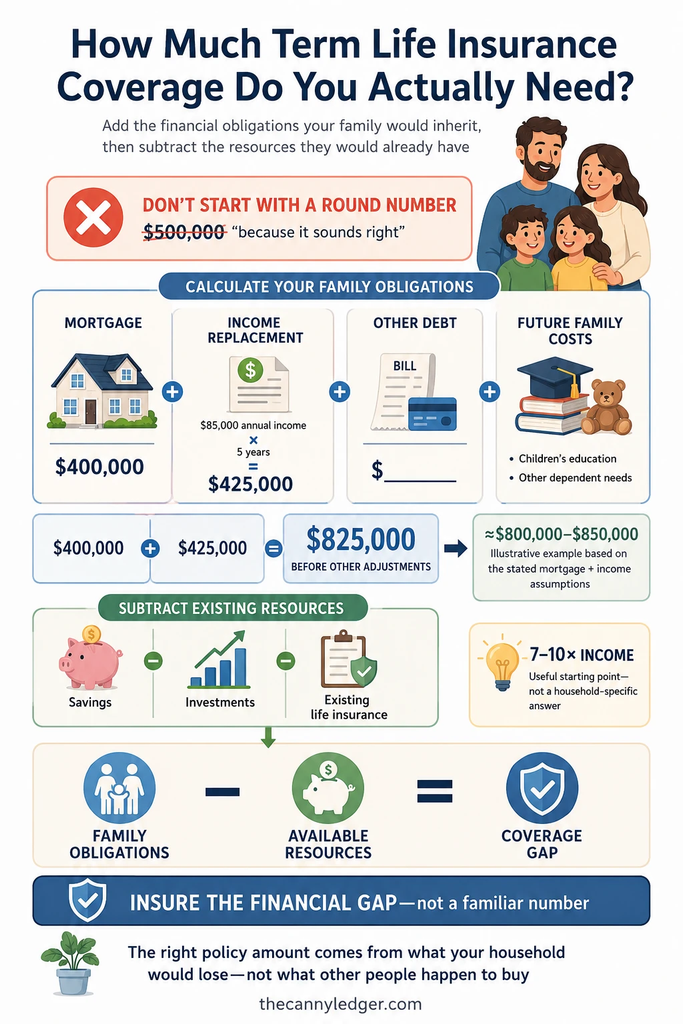
This is where a lot of people either drastically underbuy or overspend on coverage they don’t need, usually because they picked a round number that felt reasonable rather than doing any actual math. A common industry rule of thumb suggests insuring for seven to ten times your annual income, but that’s a starting point, not a formula that fits every household.
Here’s a more useful way to think about it. Add up what your family would actually need to replace or pay off if you died tomorrow: the remaining mortgage balance, any other debts, a reasonable number of years of income replacement for your dependents, and future costs like a child’s education. Say a family has $400,000 left on their mortgage, a household income of $85,000 from the primary earner, and wants roughly five years of income replacement for two young kids. That’s $400,000 in mortgage payoff plus $425,000 in income replacement, landing around $825,000 in total need before subtracting existing savings or investments. A policy sized closer to $800,000 or $850,000 actually matches the real financial gap, rather than a generic $500,000 figure picked because it sounded like a lot of money.
It’s worth running your own numbers rather than borrowing someone else’s example, since a $30,000 income and no mortgage looks completely different from a $150,000 income with a young family and a large home loan. Our coverage calculator guide and how much life insurance do you actually need breakdown both walk through this math with more scenarios if you want to stress-test your own figure before getting quotes.
Matching Term Length to Your Actual Timeline
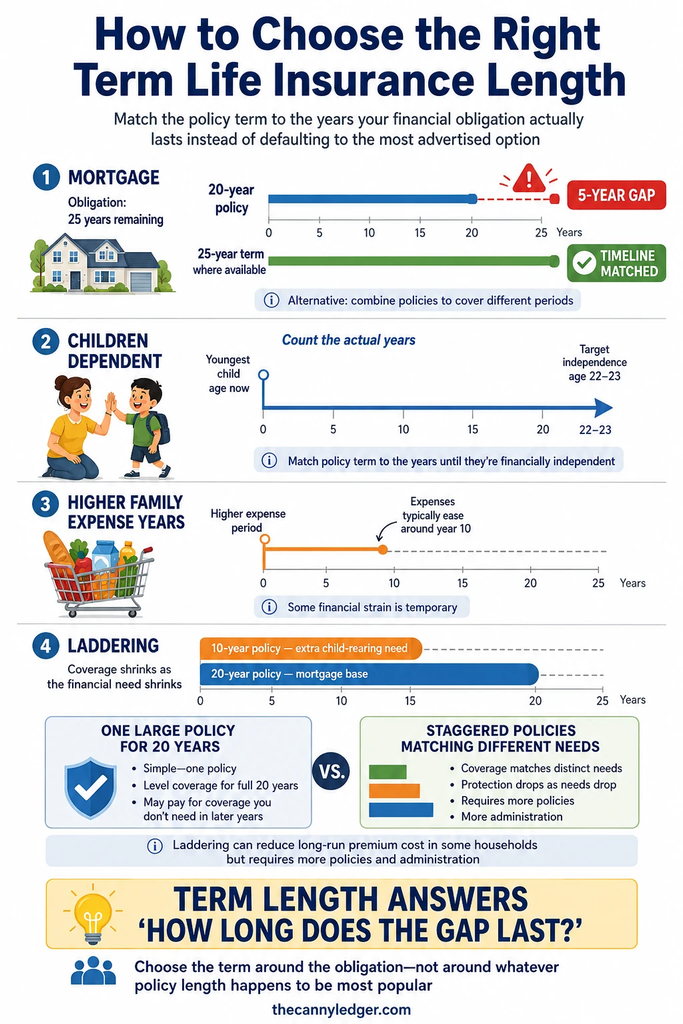
Most people default to a 20-year term because it’s the most commonly advertised length, without ever checking whether 20 years is actually the right number for their situation. The better approach is matching the term to the specific obligation you’re covering. If the goal is protecting a 25-year mortgage, a 25-year term (where available) or a 20-year term paired with a shorter secondary policy makes more sense than an arbitrary 20-year default that leaves five years of the mortgage uncovered. If the priority is making sure young kids are financially secure until they’re independent adults, count the actual years until your youngest turns 22 or 23, not a round number.
Some households buy two or three smaller policies with staggered term lengths instead of one large policy, a strategy sometimes called laddering. A 20-year term for mortgage protection alongside a 10-year term covering the higher-expense child-rearing years can cost less in total than one large 20-year policy sized for the peak coverage need, since the smaller policy drops off once that particular obligation shrinks. It takes more paperwork upfront, but it can meaningfully reduce what you pay over the full stretch.
Term Versus Permanent Life Insurance
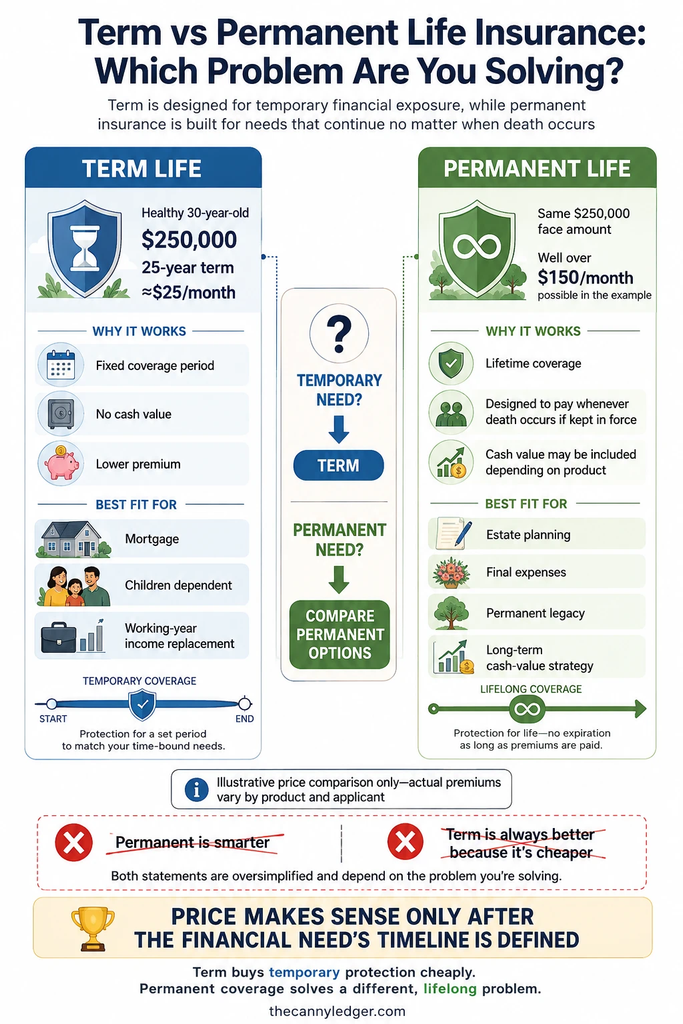
Term and permanent (whole or universal) life insurance solve genuinely different problems, and the price gap between them reflects that. A healthy 30-year-old might pay around $25 a month for a 25-year, $250,000 term policy, while the same $250,000 in permanent coverage from the same insurer could run well over $150 a month, largely because permanent policies are designed to pay out eventually (since everyone dies someday) and build cash value along the way.
Term makes sense for covering a defined period of financial exposure, a mortgage, the years dependents are financially reliant on you, a specific debt. Permanent coverage tends to fit different goals: guaranteeing a payout for estate planning regardless of when you die, covering final expenses without worrying about outliving a term, or building tax-advantaged cash value as part of a longer financial strategy. Neither is objectively better. They’re built for different jobs, and buying permanent coverage because an advisor implied it’s “smarter” without matching it to an actual estate or cash-value goal is a common way to overpay for protection you didn’t need in that form. Our comparison of term versus permanent life insurance and term versus whole life go deeper into when each one actually fits.
Medical Exam Policies Versus No Medical Coverage
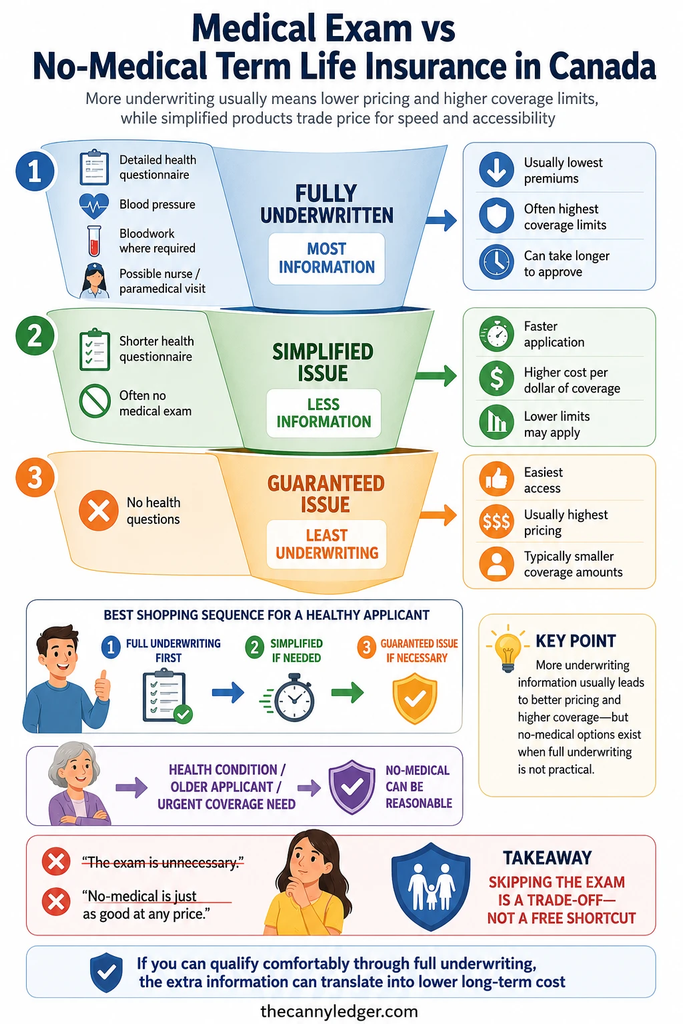
Most term policies in Canada fall into two broad underwriting categories. Fully underwritten policies require a medical exam (blood pressure, bloodwork, sometimes a paramedical nurse visit) and a detailed health questionnaire, and in exchange, they typically offer the lowest premiums and highest coverage limits, since the insurer has the most information to price the risk accurately.
Simplified issue and guaranteed issue policies skip the exam and rely on a shorter health questionnaire or no health questions at all. These exist for people who can’t easily get a fully underwritten policy, someone managing a chronic condition, an older applicant, or simply someone who wants coverage in place within days rather than the several weeks a full medical underwriting process can take. The trade-off is real. No-medical coverage generally costs noticeably more per dollar of coverage than a fully underwritten policy for someone in the same health bracket, and maximum coverage amounts tend to be capped lower. It’s a reasonable option when speed or health circumstances make the traditional route difficult, but for a healthy applicant with no urgency, going through the medical exam almost always saves money over the life of the policy. Our guide to no medical life insurance covers who this category actually makes sense for.
The Fine Print Worth Actually Reading
A few contract features quietly matter more than most people realize when they sign up, and skipping past them is how surprises happen years later.
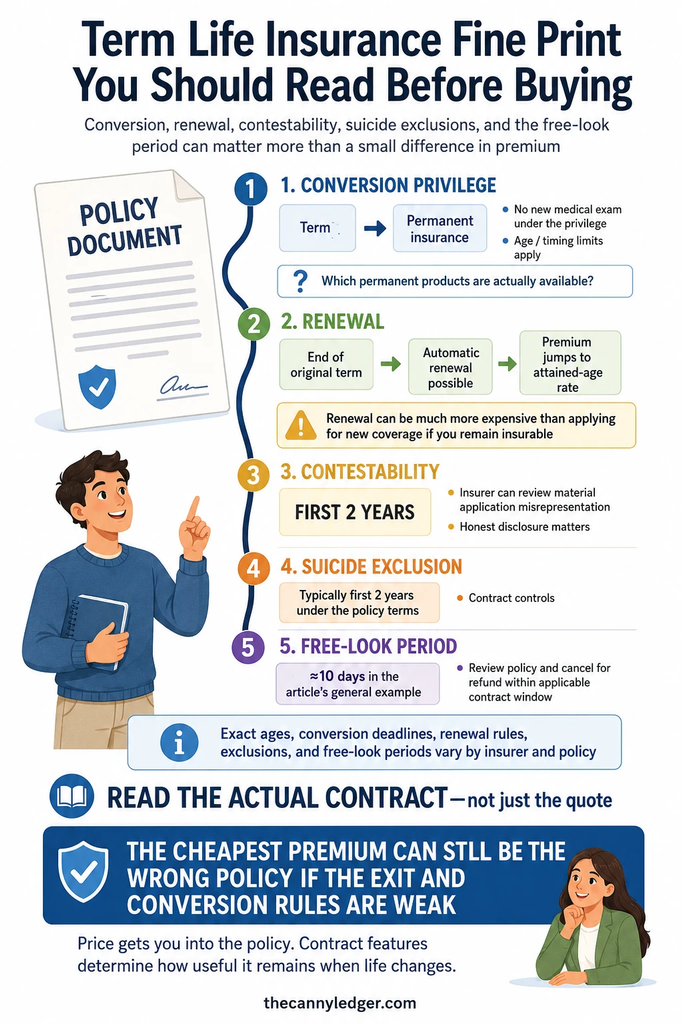
Conversion privilege. Most term policies let you convert some or all of the coverage into a permanent policy without a new medical exam, usually up until a set age (often somewhere around 65 to 71) or before the original term ends. This matters most if your health declines during the term. Someone diagnosed with a serious condition partway through a 20-year term could otherwise struggle to qualify for new coverage at any price, but a conversion privilege lets them lock in permanent protection based on their original health rating.
Renewal. Term policies typically renew automatically at the end of the term without a new medical exam, but the renewed premium jumps to reflect your current age, and that increase can be dramatic. Renewing a 20-year term at 55 instead of shopping for a new policy at 55 (assuming good health) usually costs meaningfully more, since renewal rates skip the preferred pricing tiers available to new fully underwritten applicants.
Contestability and the suicide clause. Canadian term policies generally include a two-year contestability period, during which the insurer can investigate and potentially deny a claim if the application contained a material misrepresentation. Term policies also typically exclude death by suicide within the first two years of the policy, after which it’s treated the same as any other covered cause of death. Answering health and lifestyle questions honestly at the application stage is what protects a beneficiary’s claim later, since inaccuracies discovered within that window are the most common reason a payout gets challenged.
Free look period. After the policy is delivered, you typically get about 10 days to cancel it entirely for a full premium refund if you change your mind, no explanation required. It’s a short window, so reading the actual policy document during that period, not just the sales illustration, is worth the half hour it takes.
Is the Payout Actually Taxed?
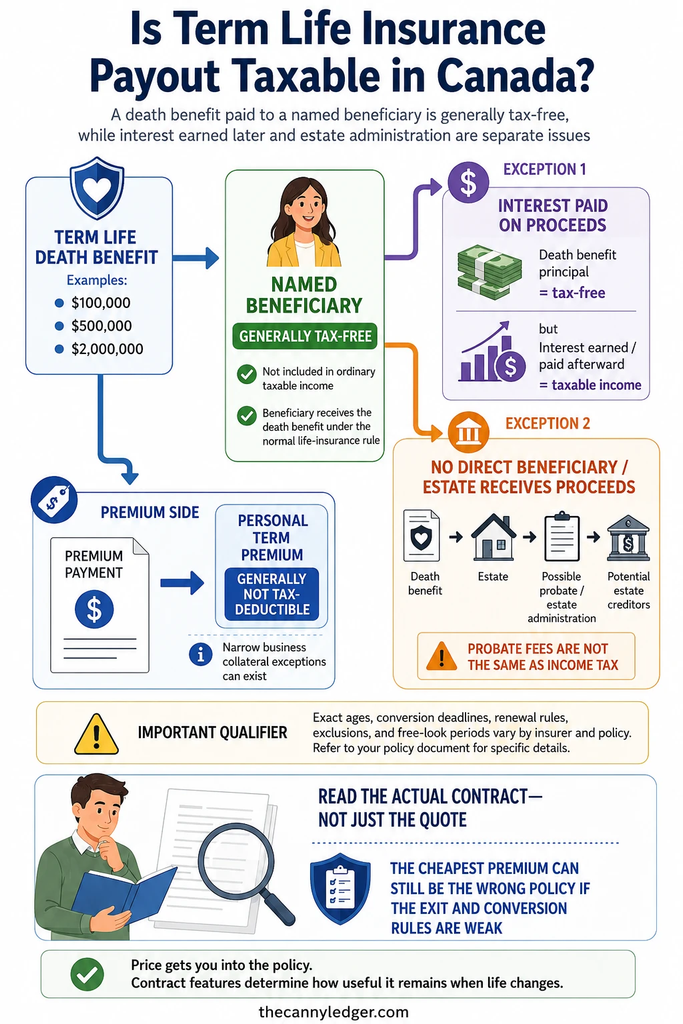
This is one of the most reassuring facts about life insurance in Canada, and also one of the most misunderstood. A death benefit paid to a named beneficiary is not considered taxable income under the Income Tax Act, which means your family doesn’t report it on a tax return or hand any of it over to the Canada Revenue Agency (CRA). The full amount, whether it’s $100,000 or $2 million, goes to the beneficiary tax-free.
There are two situations where taxes can enter the picture, and both are edge cases rather than the norm. If the insurer holds the payout for a period before releasing it and pays interest on that delay, the interest portion (not the death benefit itself) is taxable income to the beneficiary. And if no beneficiary is named, the payout defaults to your estate, where it can become subject to probate fees and potentially estate creditors before reaching your intended heirs, depending on the province. Naming a specific person or people, rather than leaving it to default to the estate, avoids both the delay and the fee exposure.
On the premium side, personal term life insurance premiums are not tax deductible for individuals. The CRA treats them as a personal expense, similar to home or auto insurance, with a narrow exception for certain business-owned policies used as loan collateral. Our full breakdown of how life insurance is taxed in Canada and premium deductibility rules cover the less common scenarios, including corporate-owned policies, in more detail. Our guide to beneficiary rules is also worth a look before you finalize who’s named on the policy, since that single decision affects both speed of payout and tax exposure.
What Happens If Your Insurance Company Fails
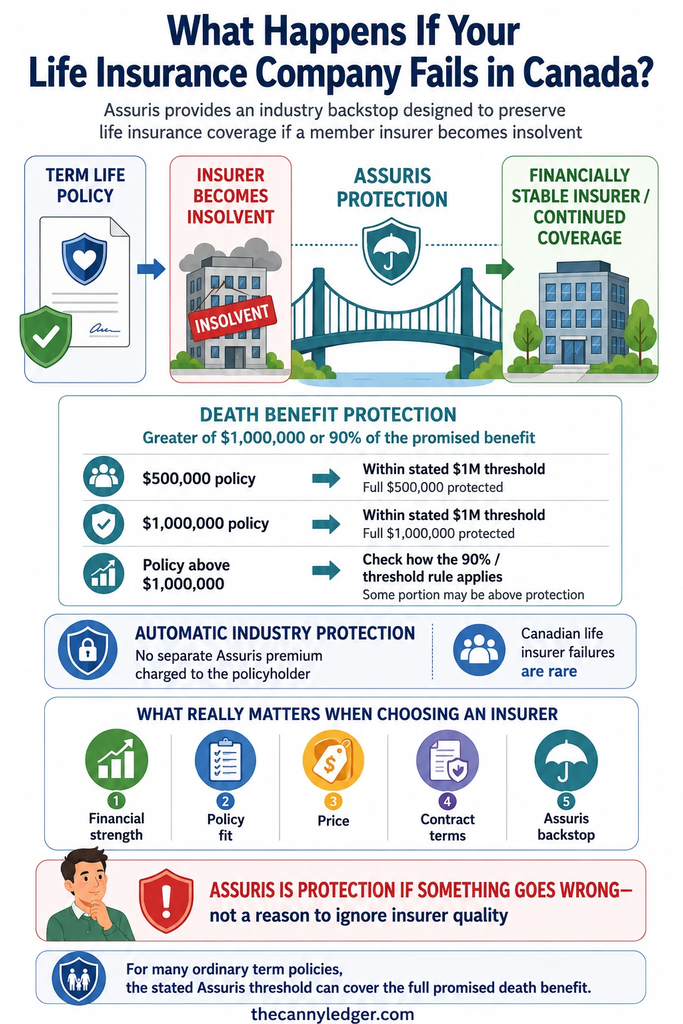
It’s a fair question, and a rarer event than most people assume. Life insurance company failures in Canada are uncommon; there have only been a small handful in the industry’s modern history. Every life and health insurer authorized to sell policies in Canada is required to belong to Assuris, an industry-funded, not-for-profit organization created specifically to protect policyholders if a member company becomes insolvent. If your insurer fails, Assuris works to transfer your policy to a financially stable insurer and guarantees you’ll retain the greater of $1,000,000 or 90% of your promised death benefit, automatically and at no additional cost to you. For the vast majority of personal term policies, which fall well under that $1,000,000 threshold, that means full protection of the death benefit even in the unlikely event of a failure.
Common Mistakes Worth Avoiding
A few patterns show up again and again in how people approach term life insurance, and most of them are easy to sidestep once you know to watch for them.
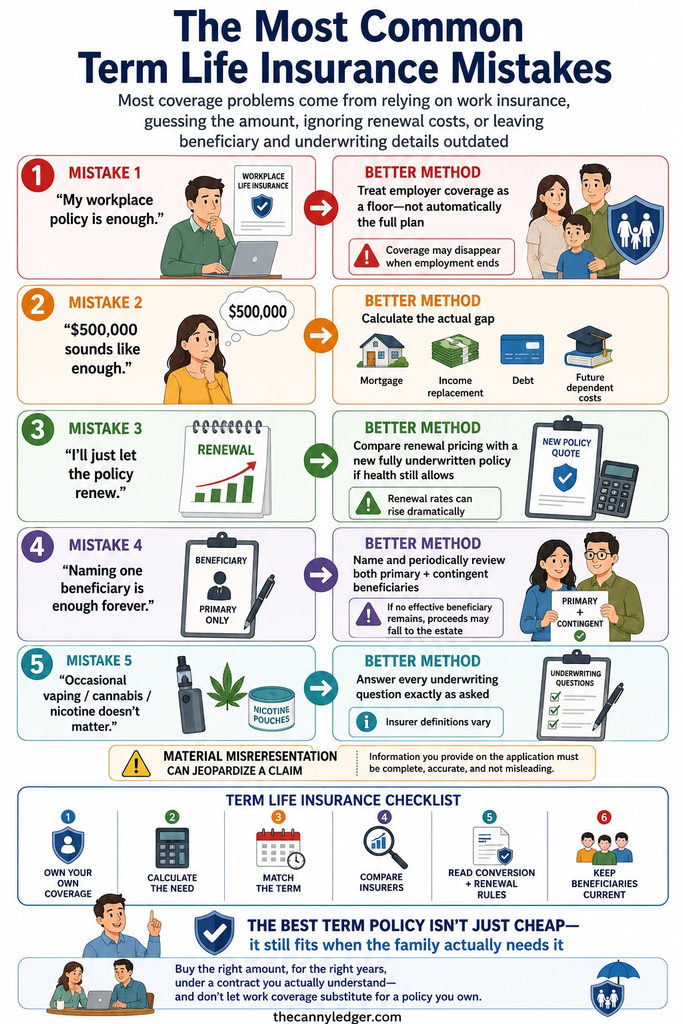
Relying entirely on workplace group life insurance is the big one. It’s usually a modest multiple of salary, it typically isn’t portable if you change jobs, and it disappears the day your employment ends, sometimes with no option to convert it into an individual policy at all. Treating it as a floor rather than the whole plan is safer than assuming it covers what your family would actually need.
Picking a coverage amount because it’s a familiar round number, rather than actually calculating the mortgage balance, income replacement need and future costs, is another common shortcut that leaves families underinsured. So is letting a policy renew automatically at attained-age rates instead of comparing what a brand-new fully underwritten policy would cost at the same age, especially if your health hasn’t changed. And forgetting to name a contingent (backup) beneficiary means that if your primary beneficiary predeceases you or dies alongside you, the payout can default to your estate anyway, undoing the entire point of naming someone directly.
One more worth flagging: vaping and cannabis use are increasingly treated the same as smoking by many insurers, even occasional or social use, and not disclosing it accurately on an application is exactly the kind of material misrepresentation that can jeopardize a claim during the contestability period.
A Few Questions People Ask Afterward
What happens if I outlive my term? The policy simply ends. No refund, no payout, nothing carried forward, unless you added a return-of-premium rider when you purchased it, which is a different (and considerably more expensive) product. Most people either let the coverage lapse because the original need has passed, or apply for a new term at their current age if they still need protection.
Can I hold more than one term policy at once? Yes, and laddering multiple policies with different term lengths, as mentioned earlier, is a legitimate strategy rather than something insurers frown on. There’s no rule limiting you to a single policy, as long as your total coverage across all policies is reasonable relative to your income and financial obligations.
Does term life insurance cover accidental death the same way it covers natural causes? In almost all cases, yes, a term policy pays out the same death benefit regardless of whether the cause was illness, accident or most other circumstances, with the suicide clause during the first two years being the main standard exclusion. For more on that specific clause and how it’s applied, our dedicated piece on suicide and life insurance coverage walks through it directly. If you’re personally dealing with thoughts of suicide or a mental health crisis right now, please reach out to 9-8-8, Canada’s Suicide Crisis Helpline, or a trusted person in your life. You deserve support, not just information.
Is mortgage life insurance the same thing as a personal term policy? No, and this trips people up constantly. Mortgage life insurance sold through a lender is typically tied to the loan itself, with the death benefit declining as your mortgage balance shrinks, and the payout goes to the bank rather than your family. A personal term policy pays a fixed amount directly to whoever you name, regardless of what you still owe on the house. Our comparison of mortgage life insurance versus a personal term policy breaks down why most people end up better served by the personal policy.
Now What
If you’ve made it this far, the actual next step is straightforward even if the decision feels big. Get quotes from at least three insurers using your real numbers, not a guess, since premiums for identical coverage can vary noticeably between companies for the same health profile. Check whether your workplace group coverage is portable if you leave your job, and if it isn’t, treat your personal policy as the coverage that actually stays with you. Name a primary and a contingent beneficiary directly on the policy rather than defaulting to your estate, and put a reminder on your calendar to revisit your coverage amount after any major life change, a new child, a bigger mortgage, a marriage or separation, since the number that made sense five years ago may not match your situation today.