

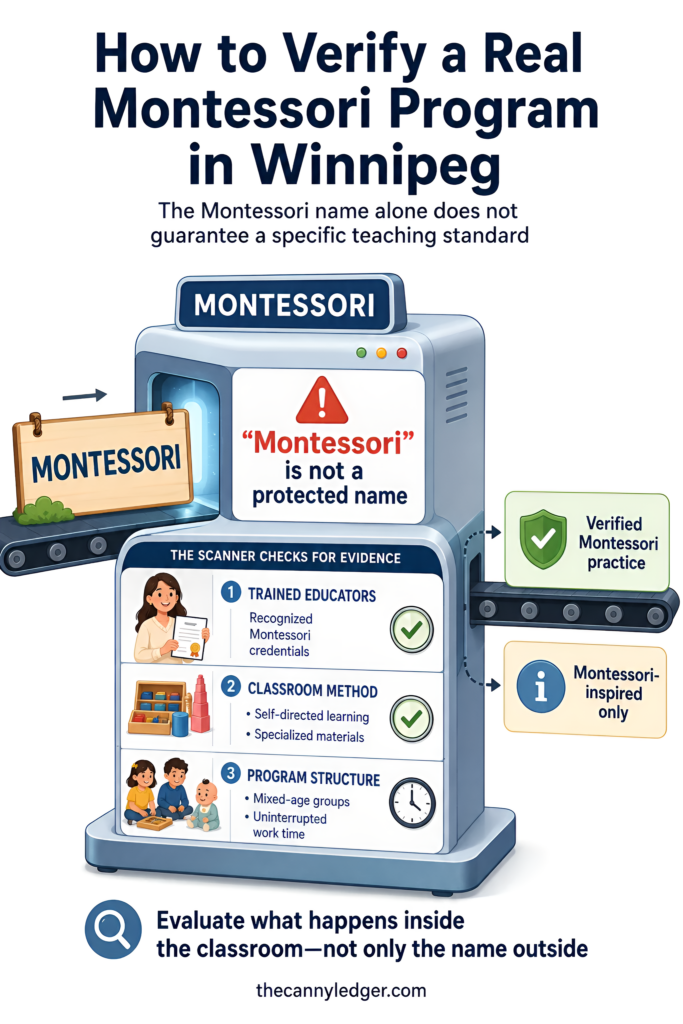
Any daycare in Winnipeg could legally name itself “Montessori” tomorrow without changing a single thing about how it actually operates. The word isn’t trademarked or copyrighted anywhere in Canada, a fact the Association Montessori Internationale states plainly on its own website, and it means the name alone tells you nothing certain about whether a program actually follows Maria Montessori’s educational method or simply borrowed a recognizable, appealing word for its sign. For a parent comparing options, that single detail changes how you should actually shop for Montessori care in this city, since the name itself can’t do the verification work a lot of parents assume it does.
- “Montessori” Isn’t a Protected Name, Which Changes How You Should Shop
- What AMI and AMS Accreditation Actually Verifies
- Winnipeg’s Montessori Options
- Licensed Child Care vs Private Preschool: A Different Distinction Than You’d Expect
- Why Montessori Programs Often Sit Outside the $10-a-Day System
- What to Actually Ask Before Enrolling
- Age Ranges and What Montessori Actually Looks Like Day to Day
- Common Questions
- Verify Before You Commit to the Name
Montessori daycare and preschool options in Winnipeg include a handful of established, dedicated programs like Winnipeg Montessori School, Bambini Montessori Preschool, Paradise Montessori Preschool, and Nova Montessori Preschool, alongside general child care centres that incorporate Montessori-branded programming into a broader licensed offering. Cost and funding status vary significantly between these options, since standalone Montessori preschools often operate outside Manitoba’s licensed, funded child care system entirely, while Montessori-branded programs inside a licensed centre may fall under the same $10-a-day structure covered elsewhere on this site.
“Montessori” Isn’t a Protected Name, Which Changes How You Should Shop
Since no legal or regulatory body controls who can use the word Montessori, quality and authenticity vary enormously between programs carrying the same label. A genuinely trained Montessori educator running a classroom built around the specific materials, mixed-age groupings, and self-directed learning philosophy Maria Montessori developed looks completely different day to day from a general preschool that’s simply borrowed some Montessori-style materials and the name itself without the underlying training or philosophy behind it. Neither approach is automatically wrong for every family, some children thrive in either setting, but walking in assuming the name guarantees a specific pedagogical standard is exactly the mistake this naming gap makes easy to fall into.
What AMI and AMS Accreditation Actually Verifies
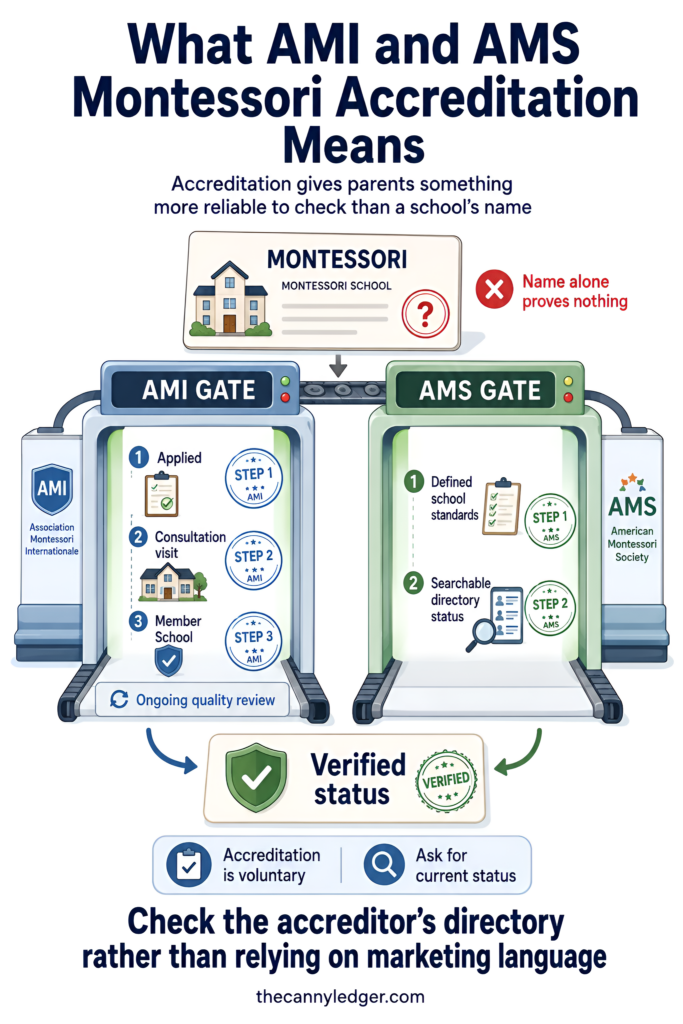
Two main accrediting bodies exist specifically to give parents something more concrete than the name alone to check. The Association Montessori Internationale, or AMI, runs a Canadian quality assurance program that certifies schools meeting its Essential Characteristics of AMI Environments, with schools progressing from an initial “Applied” status through a consultation visit before becoming a recognized “Member School” maintaining ongoing annual review. The American Montessori Society, or AMS, runs a parallel accreditation system with its own school directory and standards. Neither accreditation is legally required to use the Montessori name, which is precisely the point, a program’s AMI or AMS status is the actual verification a parent can check, rather than trusting the name on the sign or website to mean anything specific on its own.
Winnipeg’s Montessori Options
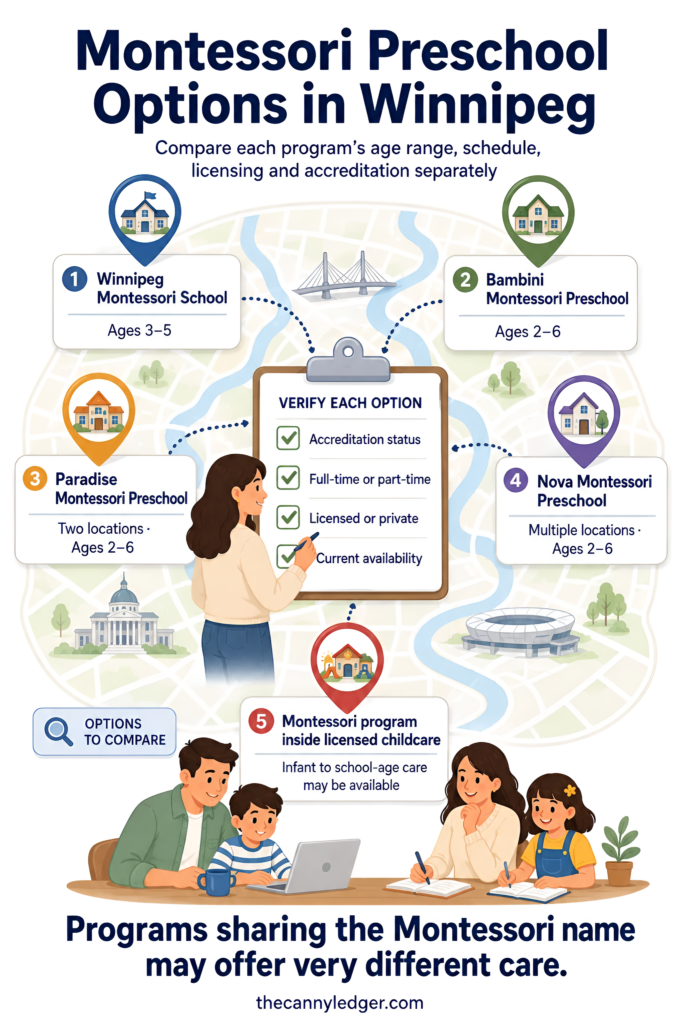
Several dedicated Montessori programs operate in Winnipeg, each worth checking individually for accreditation status, age range, and philosophy fit rather than assuming any one of them matches another simply because they share the name. Winnipeg Montessori School describes itself as one of the city’s oldest and most established Montessori programs, offering preschool for children age 3 to 5 and a Montessori Kindergarten program with a maximum class size of 10 children, alongside geography and cultural arts programming that rotates through a different world region each year. Bambini Montessori Preschool serves children ages 2 to 6 with small class sizes and both full-time and part-time scheduling options. Paradise Montessori Preschool runs two locations across the city for children ages 2 to 6, and Nova Montessori Preschool operates multiple locations, including a recently expanded site on Bannatyne Avenue, also serving the 2 to 6 age range. None of these program descriptions on their own confirm AMI or AMS accreditation, which is exactly the detail worth asking about directly rather than assuming from the name and marketing materials alone.
Beyond these dedicated Montessori-only programs, some licensed general child care centres incorporate Montessori branding or elements into a broader offering. Mini-Skool & Montessori Academy, for instance, operates as a licensed child care centre in Winnipeg offering infant, preschool, and school age care, meaning it’s part of Manitoba’s regulated child care system in a way a standalone private Montessori preschool may not be.

Licensed Child Care vs Private Preschool: A Different Distinction Than You’d Expect
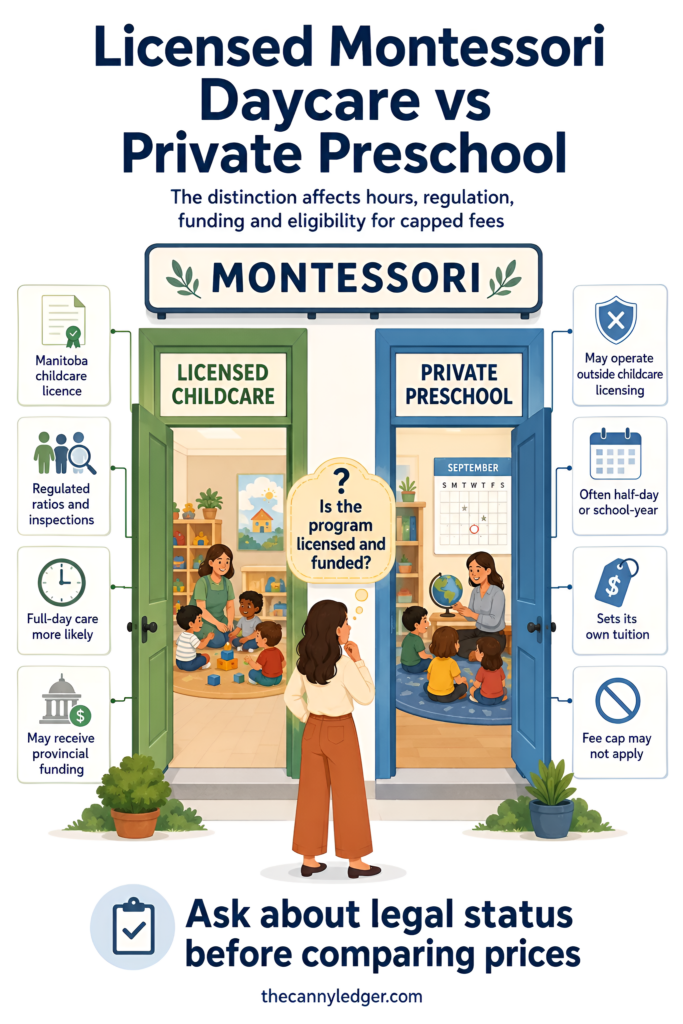
This is where Montessori options split in a way that catches parents off guard. Some Montessori programs operate as licensed child care facilities under Manitoba’s Community Child Care Standards Act, the same regulatory framework covering standard daycares and home care, subject to the same licensing, ratios, and inspection requirements. Others operate as private preschools or early learning programs outside that specific child care licensing framework entirely, particularly programs structured around a half-day or academic-calendar schedule rather than the full-day, year-round care a licensed child care facility typically provides. This distinction matters for far more than terminology, since it directly determines whether a program can access provincial operating grant funding at all, and therefore whether the $10-a-day fee cap applies to it in the first place.
Why Montessori Programs Often Sit Outside the $10-a-Day System
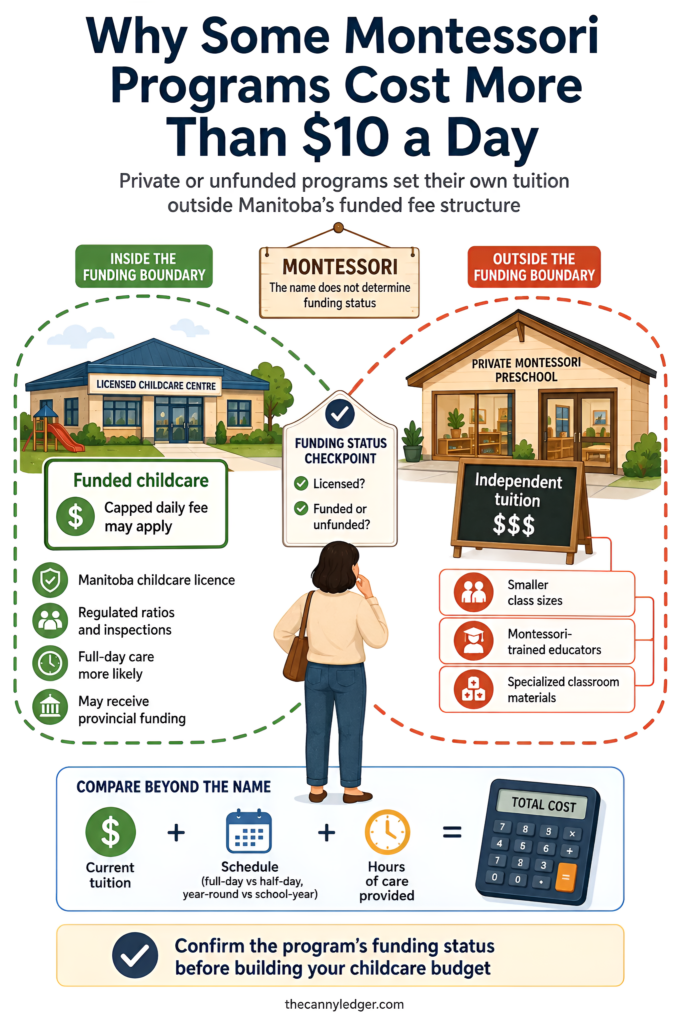
Our guide to daycare costs in Winnipeg covers Manitoba’s funded-versus-unfunded distinction in full, and it applies directly here. A private, standalone Montessori preschool operating independently of the licensed child care funding system generally sets its own tuition rather than following the regulated maximum fee, meaning cost can run well above what a funded daycare charges, since Montessori programs typically emphasize smaller class sizes, specialized materials, and specifically trained educators, all of which cost more to deliver than a standard program. This doesn’t make a private Montessori program a bad value, smaller classes and specialized training are genuinely part of what families are paying for, but it does mean comparing a private Montessori preschool’s tuition against a funded daycare’s $10-a-day rate isn’t a fair apples-to-apples comparison, since they’re operating under entirely different funding structures with different cost bases. Confirming a specific program’s actual current tuition and funding status directly, rather than assuming Montessori automatically costs a certain amount, is the only way to budget accurately for your specific situation.
What to Actually Ask Before Enrolling
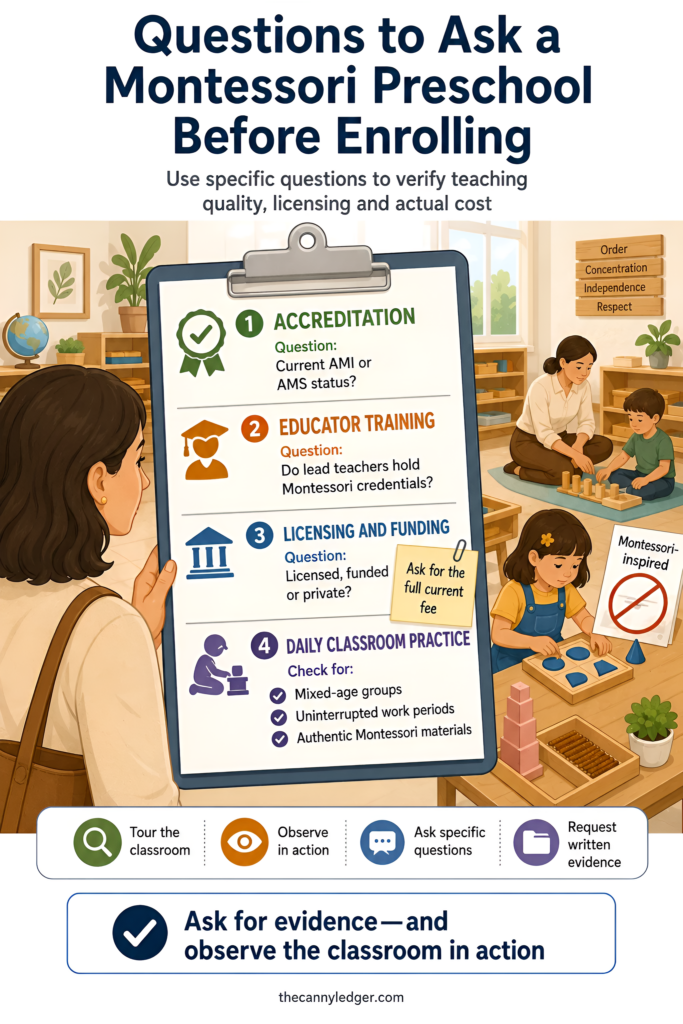
Given how little the name alone confirms, a short, specific set of questions gets you real information a tour or brochure often won’t. Ask directly whether the program holds current AMI or AMS accreditation, or is working toward it, rather than accepting “Montessori-inspired” or “Montessori-based” language as equivalent to full accreditation. Ask whether lead educators hold a recognized Montessori teaching credential specifically, separate from general early childhood education credentials, since the two aren’t the same qualification. Ask whether the facility is licensed under Manitoba’s child care regulations and, if so, whether it’s a funded or unfunded facility, since that single answer determines whether the $10-a-day cap could apply at all. And ask about actual daily structure, uninterrupted work periods, mixed-age groupings, and the specific Montessori materials in use, since genuine Montessori classrooms follow a distinctive rhythm that’s worth observing directly during a tour rather than taking on faith from a website description.
Age Ranges and What Montessori Actually Looks Like Day to Day
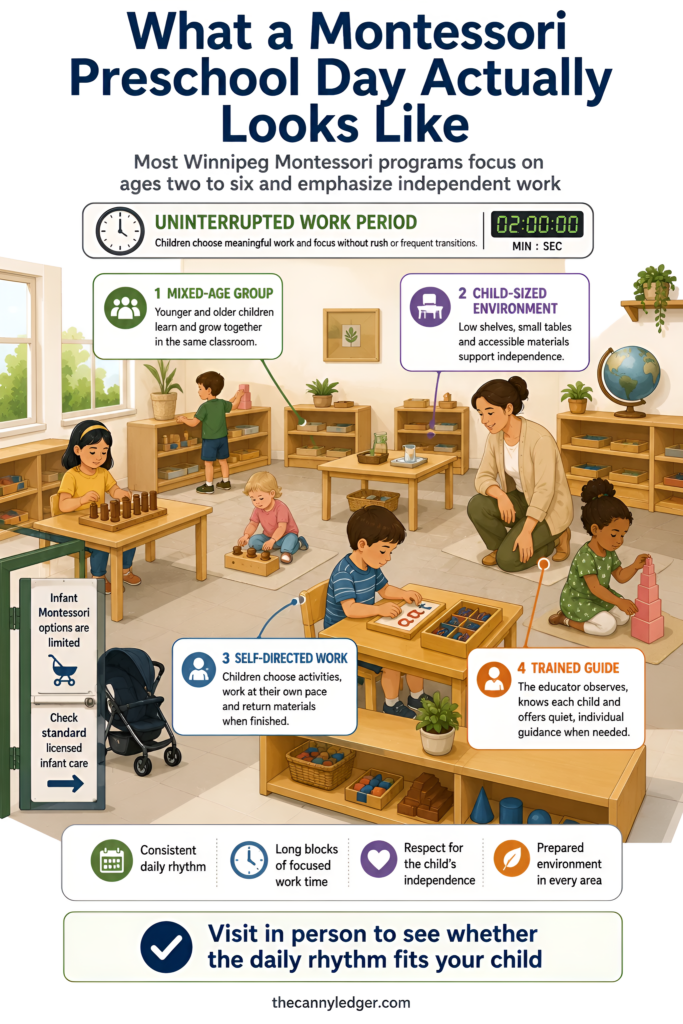
Most Winnipeg Montessori programs cluster around the 2 to 6 age range, reflecting the traditional Montessori “Casa dei Bambini” or Children’s House model built around toddlers and preschoolers specifically, rather than infant care, which most dedicated Montessori programs in the city don’t offer at all. Our guide to infant daycare in Winnipeg covers that specific younger age range, which typically requires a standard licensed daycare or home provider rather than a Montessori-specific program given how few Montessori options extend down to infant care. A genuine Montessori classroom for the toddler and preschool range typically features mixed-age groupings within a three-year band, child-sized furniture and materials designed for independent use, long uninterrupted blocks of self-directed work time rather than a rotating schedule of adult-led activities, and a trained guide who observes and redirects rather than instructs in the traditional sense, a genuinely different rhythm from a standard daycare day that’s worth seeing in person before enrolling.
Common Questions
Does a Montessori program need to be licensed child care to legally operate in Manitoba?
Not necessarily. A program operating as a private preschool on a limited daily or academic-year schedule, rather than full-day, year-round care, may fall outside the specific licensing requirements that apply to child care facilities, though this varies by program structure and is worth confirming directly.
Is a more expensive private Montessori program automatically better than a funded daycare with Montessori elements?
Not automatically, cost reflects funding structure and program model more than it guarantees quality, and a licensed, funded centre with genuine Montessori-trained staff can offer real value a private, unaccredited program with the name alone doesn’t necessarily match.
Can I get on a waitlist for these Montessori programs the same way as a standard daycare?
Generally yes, though since many operate independently rather than through Manitoba’s Child Care Search tool, contacting each Montessori program directly for its own registration process is the practical approach. Our guide to daycare waitlists in Winnipeg covers the broader registration landscape this fits within.
Verify Before You Commit to the Name
The single most useful thing a Winnipeg parent can do before enrolling in any program carrying the Montessori name is ask directly about accreditation, staff credentials, and licensing and funding status, rather than trusting the name to have already done that verification. A program that answers those questions confidently and specifically is showing you something real about its actual quality, while vague or evasive answers to the same questions tell you just as much, regardless of how polished the branding looks. Our broader overview of daycare in Winnipeg and comparison of home daycare versus centre-based daycare round out the full range of care structures worth weighing alongside a Montessori-specific choice.