



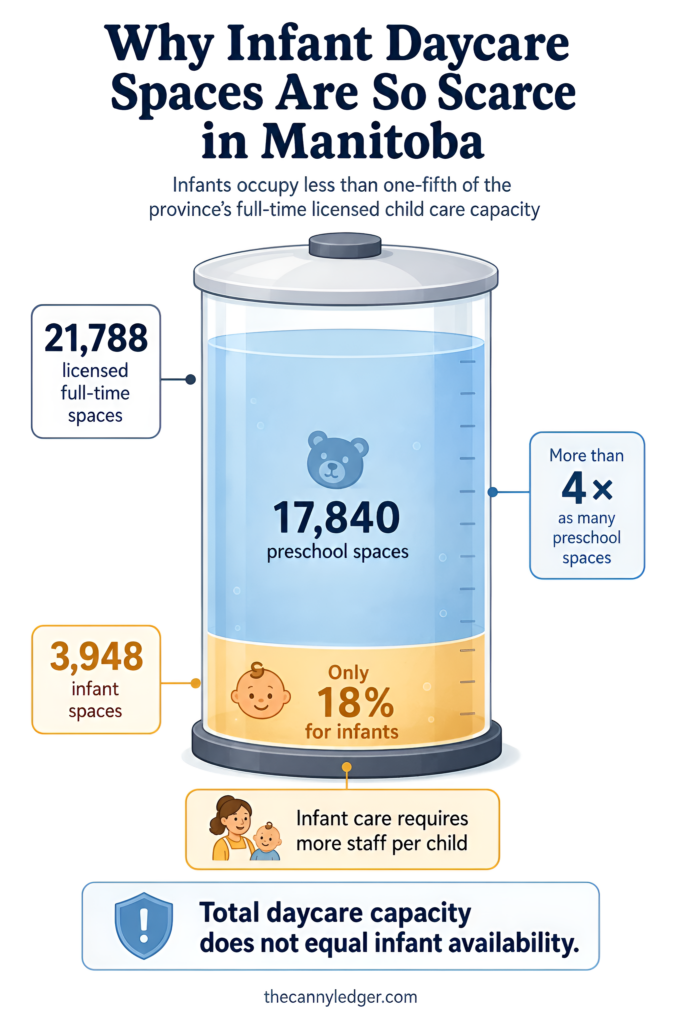
Of the roughly 21,788 full-time licensed child care spaces Manitoba reported operating, only 3,948 of them are infant spaces, according to the province’s own submission under the Canada-Wide Early Learning and Child Care Agreement. That works out to just under 18 percent of total capacity serving the age group parents often need care for soonest after returning to work. This isn’t a random gap or a symptom of general daycare shortage alone, it reflects a specific, structural reason infant care costs more to provide than any other age category, and understanding that reason is the first real step toward planning around it rather than being blindsided by it.
- Only 18 Percent of Manitoba’s Licensed Spaces Are for Infants
- What Actually Counts as “Infant” in Manitoba
- Why the Ratio Itself Makes Infant Care More Expensive to Provide
- What You’ll Actually Pay
- Home vs Centre for Infant Care Specifically
- The Relationship-Based Curriculum Behind Infant Programs
- Timing Registration Against Your Parental Leave
- What Happens When Your Child Ages Out of Infant Care
- Common Questions
- Register Before You Need It, Not When You Do
Infant daycare in Winnipeg is available at licensed centres, family child care homes, and group child care homes, with the province defining infants as children between 12 weeks and two years old. Funded facilities charge the same $10-a-day rate that applies to other age groups, but infant spots are the scarcest category across the entire system, driven by a mandatory one-to-four staff ratio that makes infant care meaningfully more expensive for a facility to deliver than preschool or school-age care.
Only 18 Percent of Manitoba’s Licensed Spaces Are for Infants
That 3,948-out-of-21,788 figure comes directly from Manitoba’s own action plan filed with the federal government, and it explains the lived reality a lot of Winnipeg parents run into headfirst: even in a system with meaningful total capacity, infant spaces make up a genuinely small slice of it. Preschool spaces, by comparison, account for 17,840 of that total, more than four times the infant capacity, reflecting both higher demand once children exit infancy and the fact that facilities can serve more preschoolers per staff member than infants under the province’s own ratio rules.
What Actually Counts as “Infant” in Manitoba
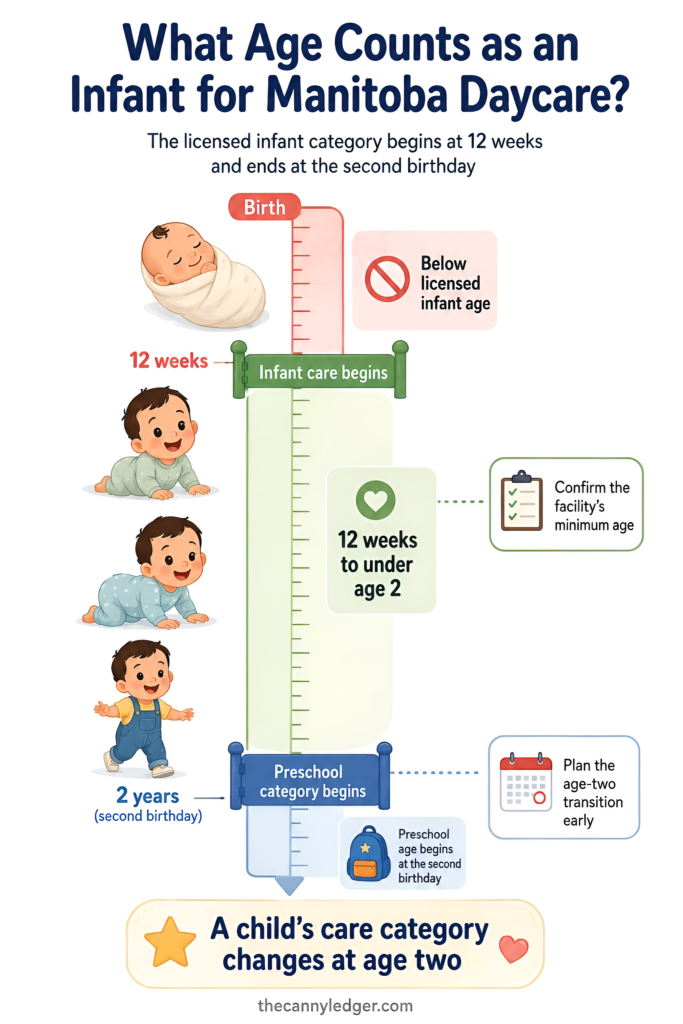
Manitoba’s regulations define an infant as a child between 12 weeks and two years of age, with “preschool age” beginning precisely at the two-year mark under the province’s own Early Learning and Child Care Act. This matters for planning purposes on both ends. On the front end, most licensed facilities won’t accept an infant younger than 12 weeks, which lines up reasonably well with the tail end of standard parental leave timing for many families, though it’s worth confirming a specific facility’s actual minimum age directly rather than assuming every provider accepts children right at that 12-week floor. On the back end, your child ages out of the infant category, and typically transitions to a different room or a different facility entirely, right around their second birthday, a transition worth planning for well before it actually happens.
Why the Ratio Itself Makes Infant Care More Expensive to Provide
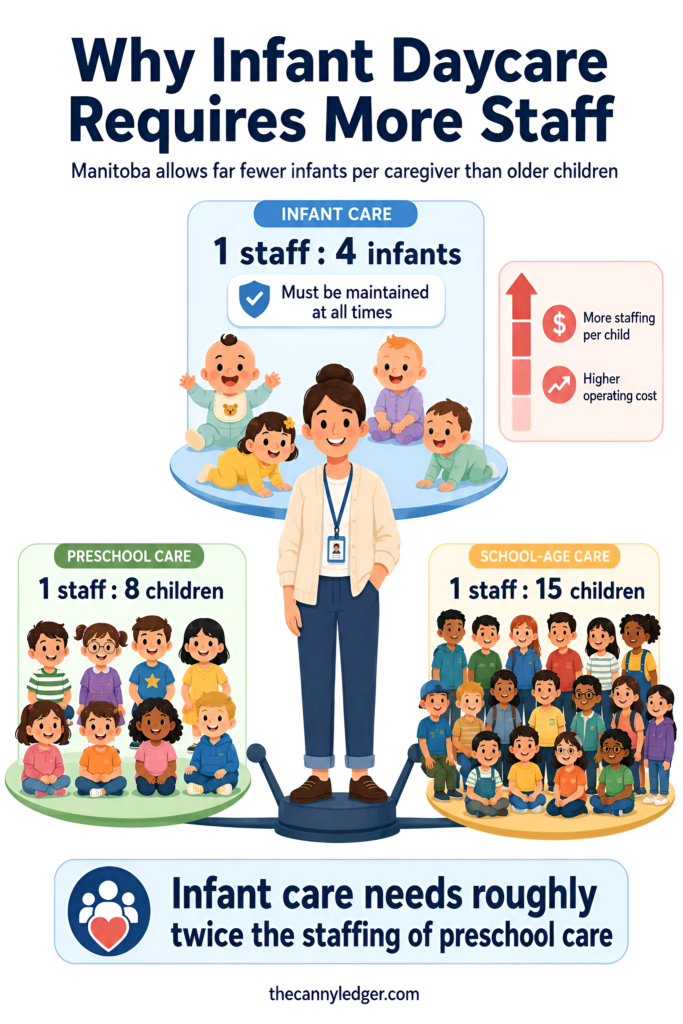
Manitoba’s child care funding model calculates operating grants based on staffing units specific to each age category, and the numbers explain the cost gap directly. One staff member can be responsible for four infants, eight preschool-age children, or 15 school-age children under the province’s ratio structure, meaning a facility needs roughly twice the staffing per child for infants compared to preschoolers, and nearly four times the staffing per child compared to school-age care. That 1:4 infant ratio is enforced strictly too, the province’s own licensing guidance specifically notes it must be maintained at all times, with no flexibility for temporary adjustment the way some other ratios allow during specific parts of the day. More staff per child means higher labour costs per infant space, which is precisely why infant spaces cost facilities more to operate and, in the unfunded market, why infant fees tend to run higher than any other age category.
What You’ll Actually Pay
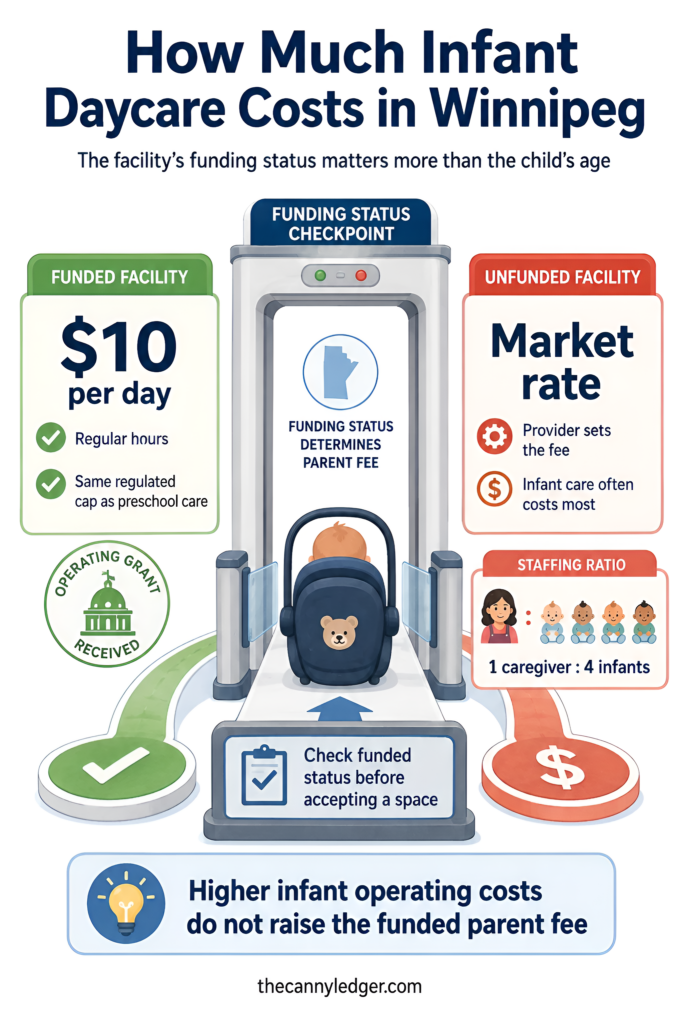
Our guide to daycare costs in Winnipeg covers Manitoba’s funded-versus-unfunded fee structure in depth, and the distinction applies directly to infant care. At a funded facility, infant care falls under the same $10-a-day regulated maximum that applies to preschool and nursery programs, meaning the province’s fee cap doesn’t scale up for infants despite the higher cost to deliver that care, a genuine benefit built into the funding model specifically to keep infant care affordable for families rather than passing the higher staffing cost through as a higher parent fee. At an unfunded facility, where providers set their own rates for non-subsidized families, infant care is typically the single most expensive age category on the fee schedule, directly reflecting that 1:4 ratio’s real staffing cost.

Home vs Centre for Infant Care Specifically
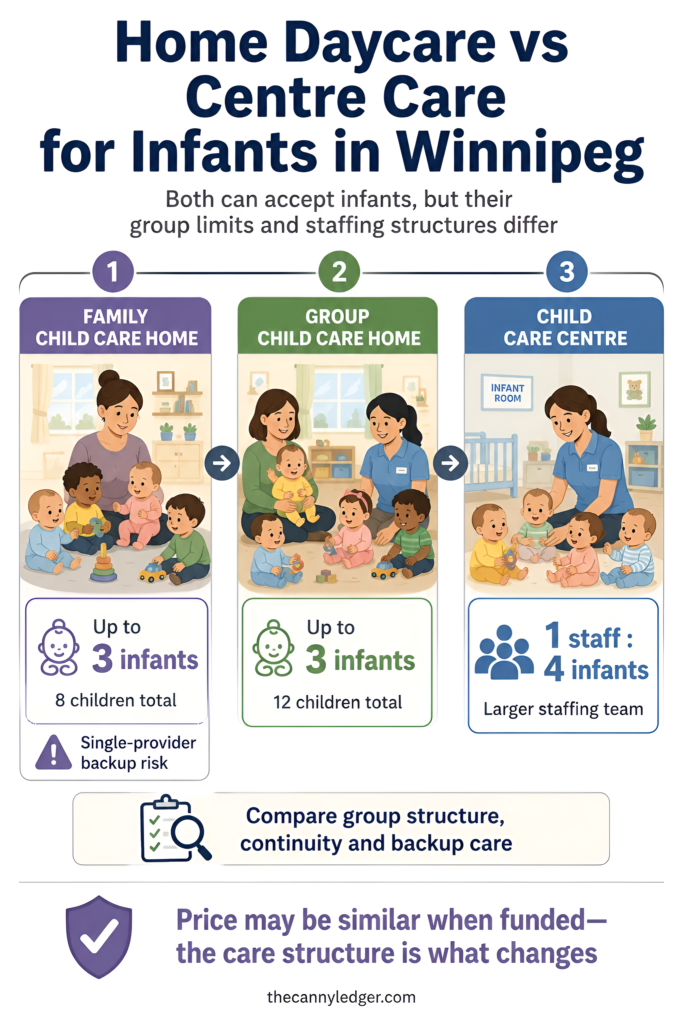
Both licensed home settings and centres can care for infants, though the specific caps differ by setting. Many full-time centres offer child care for infants from three months to two years old, and a family child care home can enrol up to three infants within its overall group of eight children, run by a single resident provider, while a group child care home permits the same three-infant cap within its larger group of 12, split across two providers. Centres apply the strict 1:4 ratio described above rather than a flat cap tied to overall group size. Our comparison of home daycare versus centre-based daycare in Winnipeg covers the broader tradeoffs between these settings, including the backup care risk specific to a single-provider home arrangement, a factor that matters even more for infant care given how much closer, hands-on attention this age group typically needs.
The Relationship-Based Curriculum Behind Infant Programs
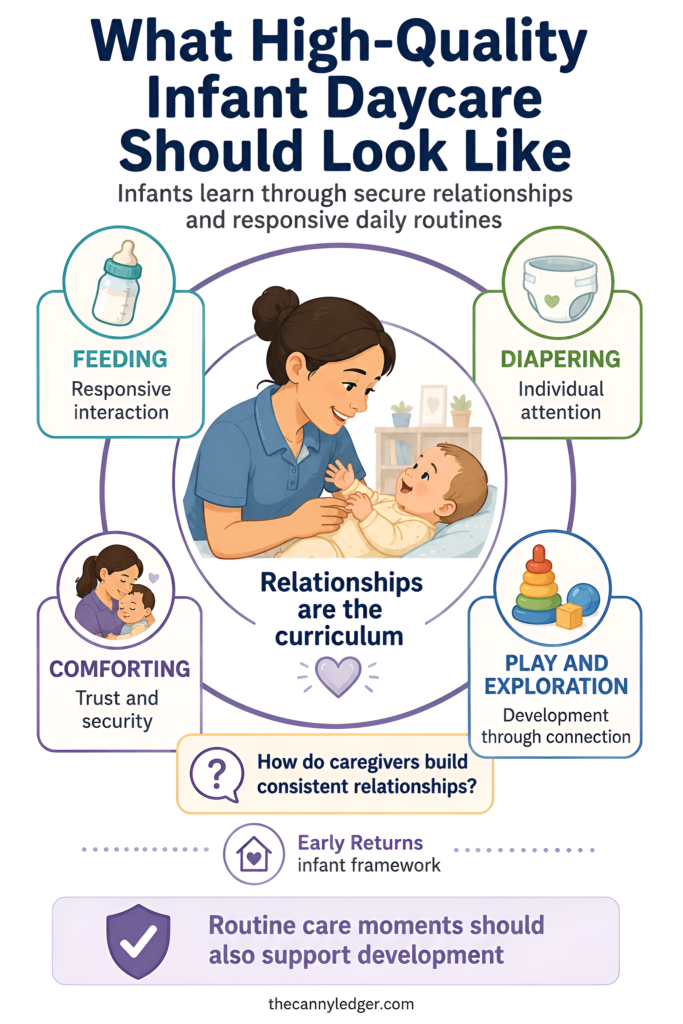
Manitoba’s Department of Education has developed a specific curriculum framework for infant programs, called Early Returns, built around the understanding that infant learning happens primarily through relationships and consistent caregiving routines rather than structured activities the way an older preschool curriculum might look. This framework is optional for facilities to adopt formally, but it reflects the broader philosophy Manitoba’s licensing standards apply to infant care specifically, treating diapering, feeding, and comforting routines as genuine developmental interactions rather than simply tasks to get through between more meaningful activities. Asking a specific facility how they approach this relationship-based caregiving during a tour gives you a real sense of program quality that a fee schedule or ratio number alone won’t capture.
Timing Registration Against Your Parental Leave
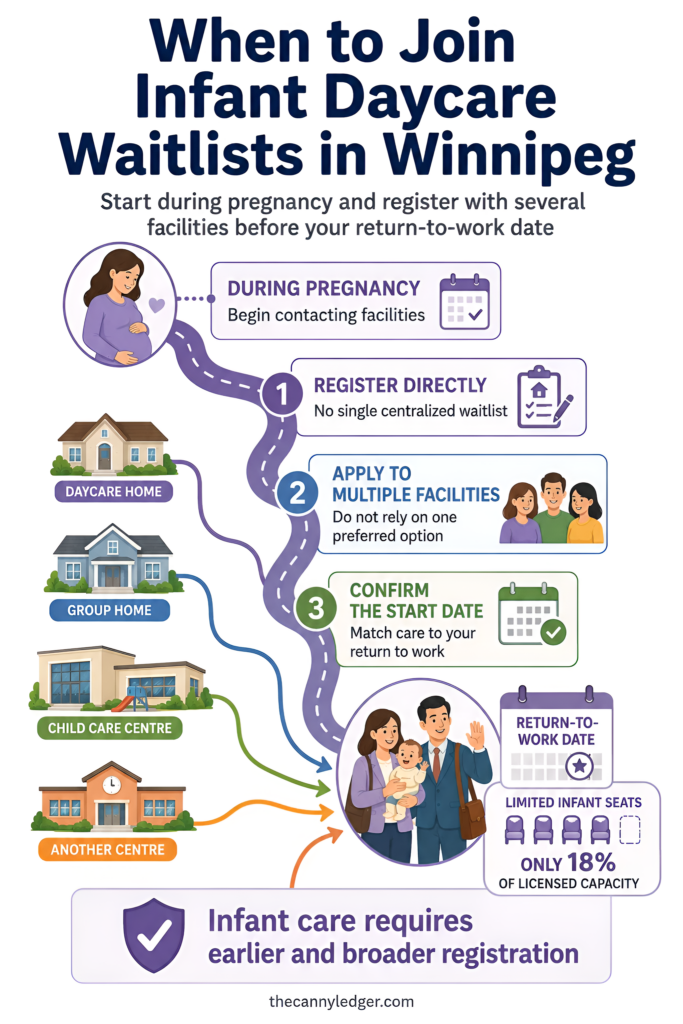
Given how scarce infant spots genuinely are, timing your registration to your actual return-to-work date matters more here than for almost any other age category. Our guide to daycare waitlists in Winnipeg covers the mechanics of registering with individual facilities directly, since Manitoba no longer runs a single centralized waitlist, but the practical infant-specific advice is to start that registration process during pregnancy itself rather than waiting until your child is born, given the scarcity this specific age category faces relative to preschool or school-age spots. Registering with multiple facilities simultaneously, rather than waiting on one preferred option, matters even more for infant care than for other ages precisely because that 18 percent capacity figure means fewer total options exist to begin with.
What Happens When Your Child Ages Out of Infant Care
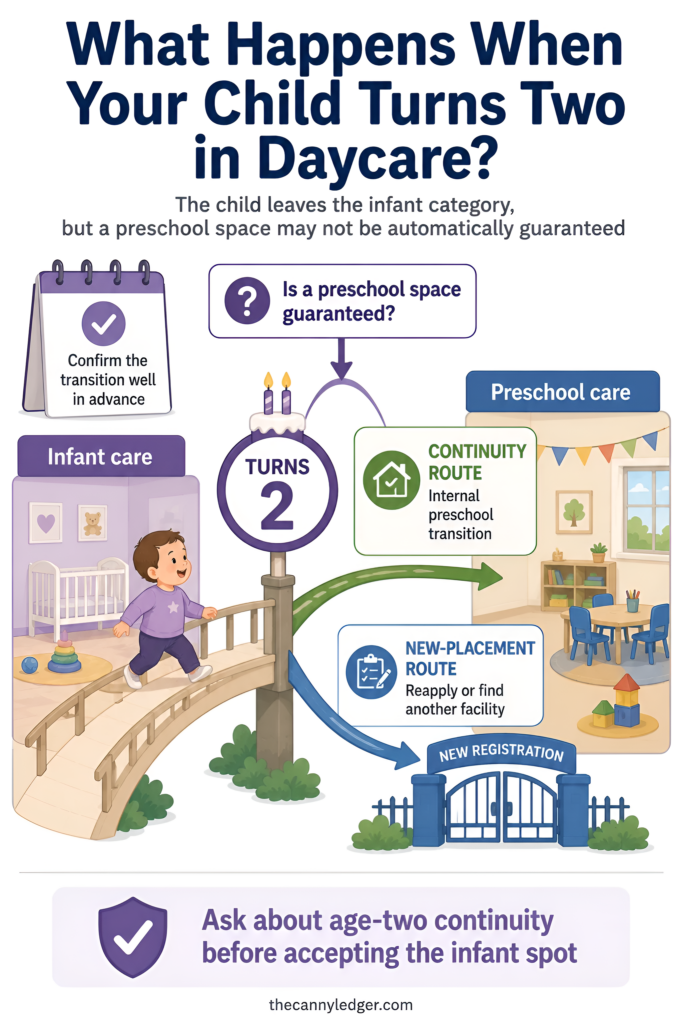
Since infant capacity is genuinely the tightest across the system, a lot of facilities structure their enrollment specifically so a child transitions into a preschool-age spot at the same facility once they turn two, rather than requiring a family to find an entirely new placement. Confirming this directly with any facility you’re considering, whether a child automatically moves into an available preschool spot at the same location or whether you’d need to re-register elsewhere once your child ages out of the infant category, is worth doing before you commit, since assuming continuity that isn’t actually guaranteed can leave you scrambling for a second placement right as your child turns two.
Common Questions
Can I use unlicensed home care as a bridge until an infant spot opens? Yes, unlicensed private home child care in Manitoba can legally care for up to two children under age two, though it operates entirely outside provincial monitoring and isn’t eligible for the $10-a-day cap or subsidy support. Our guide to babysitters in Winnipeg covers informal care options that can bridge a gap while a licensed spot remains pending.
Do Montessori programs in Winnipeg typically accept infants? Generally no. Our guide to Montessori daycare options in Winnipeg covers how most dedicated Montessori programs in the city start at age two, reflecting the traditional Montessori model built around toddlers and preschoolers rather than infants specifically.
Does the Child Care Subsidy Program apply to infant care the same way as other ages? Yes, subsidy eligibility runs from 12 weeks to 12 years of age, covering the full infant range, and applies regardless of whether the facility is a home or a centre.
Register Before You Need It, Not When You Do
Given that infant spaces make up less than a fifth of Manitoba’s total licensed capacity, treating registration as something to handle after your child arrives is the single most common and most costly mistake a family can make in this specific category. Start registering with multiple facilities during pregnancy, confirm each provider’s actual minimum intake age and their transition process once your child turns two, and treat the scarcity of this specific age category as the reason to move early rather than a reason to feel discouraged about your odds.