
The question itself is a little broken, and it’s worth saying that before trying to answer it. Asking whether term or whole life insurance is better is a bit like asking whether renting or buying a home is better without knowing how long someone plans to stay in the city. Both products exist to solve genuinely different problems, and the entire reason this comparison generates so much confusion is that most explanations jump straight to price without explaining why the prices are so different in the first place.
- What Each One Actually Is, in Brief
- Why the Price Gap Is So Large, and Why It’s Not Really a Fair Comparison
- What the Extra Money on Whole Life Is Actually Buying
- The Buy Term and Invest the Difference Debate
- When Term Is Almost Always the Right Call
- When Whole Life Actually Earns Its Higher Price
- The Middle Path Almost Nobody Mentions
- The Mistake That Shows Up on Both Sides
- How to Actually Decide
- Frequently Asked Questions
Term life insurance covers you for a fixed period, usually 10 to 30 years, and pays a tax-free death benefit only if you die during that window, while whole life insurance covers you permanently and builds guaranteed cash value, at a much higher premium for the same coverage amount. Term suits temporary financial obligations like a mortgage or years of dependent children. Whole life suits a need that never actually goes away.
What Each One Actually Is, in Brief
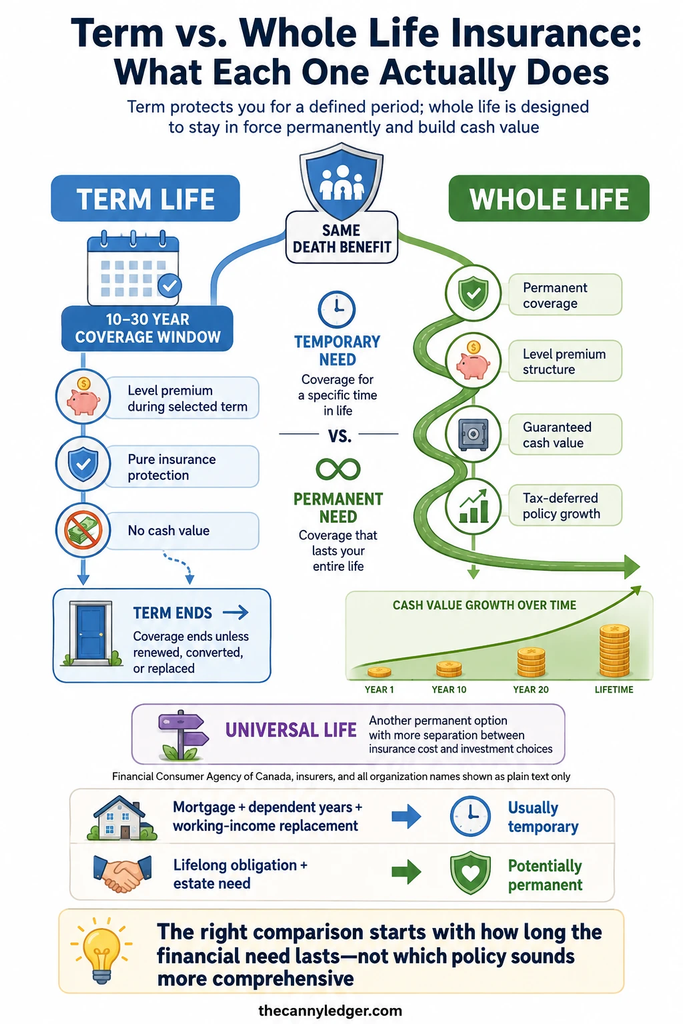
Term life insurance is pure protection with an expiry date. You pick a coverage amount and a term length, pay a level premium for that entire term, and the policy pays out only if death happens while it’s active. Outlive the term, and the policy simply ends with nothing paid out and nothing refunded. Whole life insurance, by contrast, never expires as long as premiums keep getting paid, and a portion of every premium builds cash value inside the policy, value that grows on a tax-deferred basis and that the policyholder can eventually borrow against or draw from while still alive, a distinction the Financial Consumer Agency of Canada lays out clearly for anyone comparing the two for the first time. Both types of coverage exist under the wider umbrella most people mean when they say life insurance in Canada, and both belong to a family of product types that also includes universal life, a more flexible permanent option that separates the investment component from the insurance cost rather than pooling it the way whole life does.
Why the Price Gap Is So Large, and Why It’s Not Really a Fair Comparison
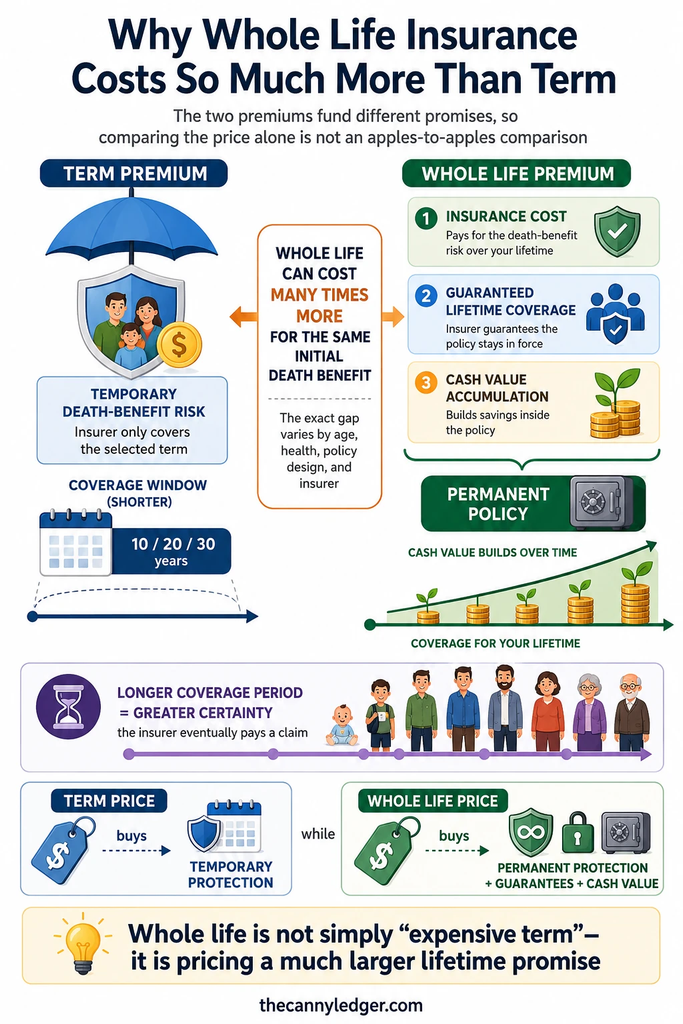
The premium difference between the two products routinely runs five to fifteen times higher for whole life compared to an identical term policy on the same person, and that gap surprises almost everyone shopping for coverage for the first time. The reason isn’t that whole life is a worse deal dollar for dollar. It’s that the two policies are pricing entirely different promises. A term premium covers nothing but the statistical cost of insuring a defined number of years, priced against the real chance you die during that specific window. A whole life premium has to fund three separate things at once, the same mortality cost, a guarantee that a payout happens eventually no matter how long you live, and a cash value account building in the background. Comparing the sticker prices without understanding what each one is actually buying is the single biggest reason this decision gets made poorly.
There’s a mortality reality underneath all of this worth sitting with for a moment. Canadian life expectancy at birth reached 81.7 years as of the most recent data StatCan has published, and while that number describes averages rather than individual outcomes, it does explain why a term policy renewed or replaced at 65 costs dramatically more than the same coverage bought at 35. The insurer isn’t guessing. It’s pricing against a genuinely higher probability of a claim in a shorter window, which is exactly the risk a whole life policy locks in against permanently the moment it’s purchased.
What the Extra Money on Whole Life Is Actually Buying
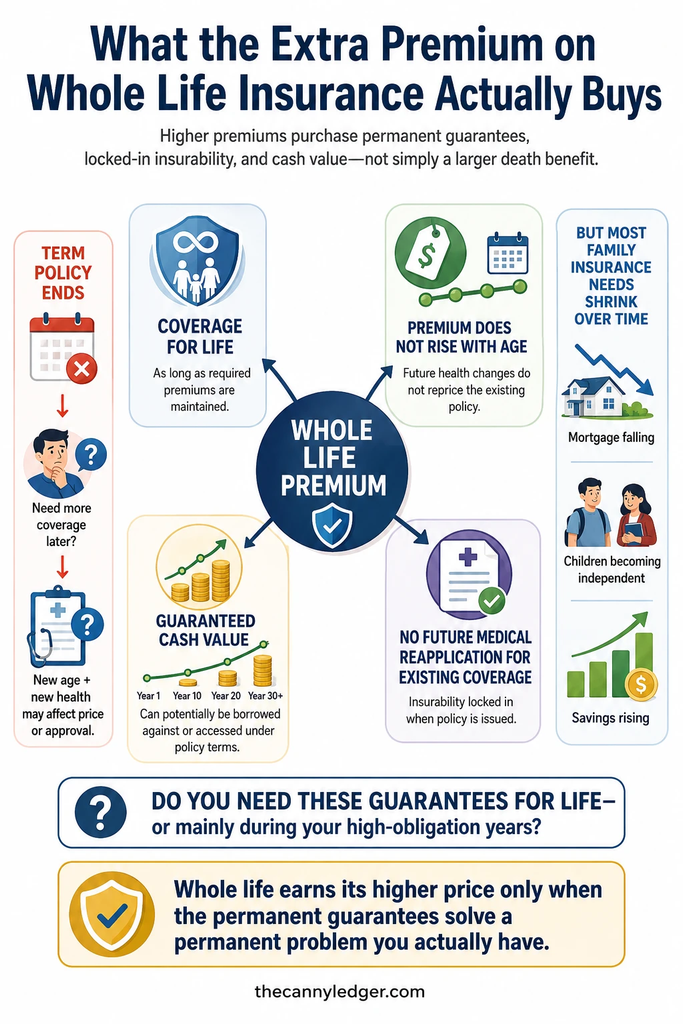
Once the price gap makes sense, the harder question is whether what it buys is worth it for a specific situation. Whole life guarantees the policy can never be cancelled by the insurer for health reasons after it’s issued, locks in a premium that never rises no matter what happens to your health later, and builds a cash value component that grows on a tax-deferred basis and can be borrowed against for almost any purpose. None of that exists on a term policy. Once a term ends, getting new coverage means reapplying at your current age and current health, and if something significant has changed in the meantime, a serious diagnosis, a new medication, a health scare, you might face a much higher premium than expected or, in a worse case, find yourself unable to get approved for meaningful coverage at all.
That risk is the honest argument in favour of permanent coverage, and it’s a real one, not a sales pitch. The counterargument is just as real. Most people’s actual need for life insurance shrinks over time rather than staying level. A mortgage gets paid down, kids grow up and become financially independent, and the specific obligations a 30-year-old is protecting against usually don’t look anything like what a 60-year-old still needs covered. Paying decades of dramatically higher premiums to guard against a risk that may never require that level of coverage is a real cost too, just one that’s easy to underweight because it’s spread out quietly over years rather than showing up as a single dramatic number.
The Buy Term and Invest the Difference Debate
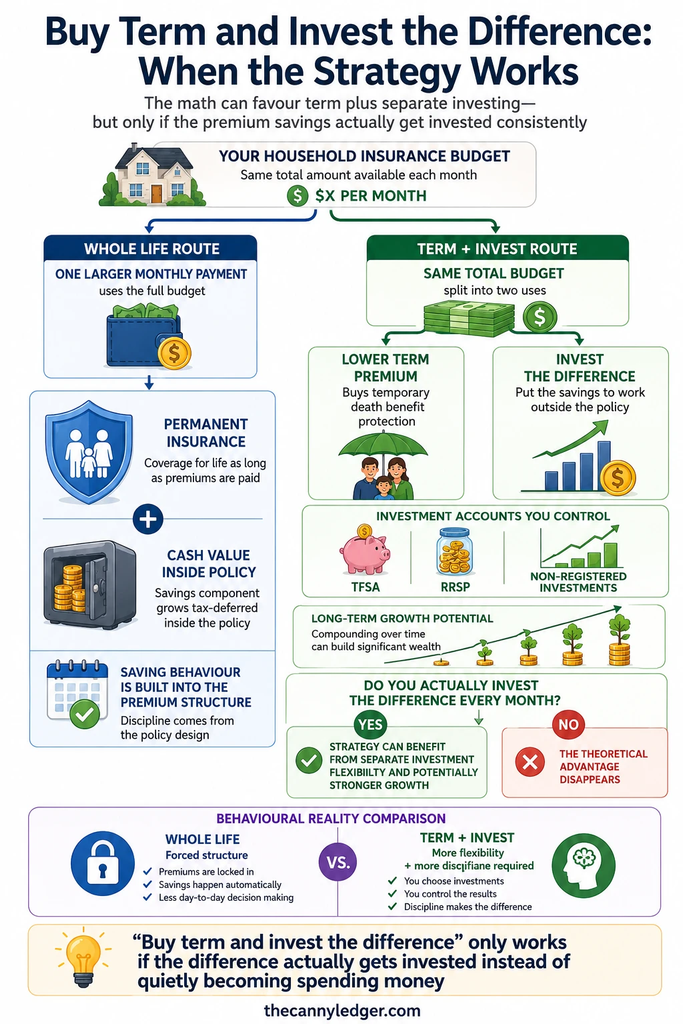
This is one of the longest-running arguments in personal finance, and it deserves a fair hearing on both sides rather than a quick verdict. The idea is straightforward. Buy the cheaper term policy, and instead of paying the much larger whole life premium, invest the difference yourself in a TFSA, RRSP, or non-registered account. Done consistently over 20 or 30 years, disciplined investing in a diversified portfolio has historically outperformed the guaranteed, more conservative growth rate built into a whole life policy’s cash value, and the money stays fully liquid and accessible the entire time rather than tied to an insurance contract.
The strategy’s biggest weakness isn’t the math, it’s the word “disciplined.” Whole life insurance forces the savings behaviour through a structured, non-optional premium. Buy term and invest the difference only works if the difference actually gets invested every single time rather than absorbed into everyday spending. CLHIA, the Canadian Life and Health Insurance Association, compiles annual sales data across the industry, and the sustained demand for both product types year after year suggests plenty of Canadians land on each side of this decision for reasons that make sense for them specifically. Plenty of people who set out with good intentions never build the habit of consistently redirecting a saved premium into an account they don’t touch. My honest read is that this comes down to knowing yourself. Someone with a strong, established habit of investing consistently is very likely better off financially with term and a separate investment account. Someone who’s tried and failed to keep up disciplined saving in the past is arguably better served by a structure that makes the saving automatic, even at a lower long-term return, because a savings plan that actually gets followed beats a theoretically superior one that doesn’t.
When Term Is Almost Always the Right Call
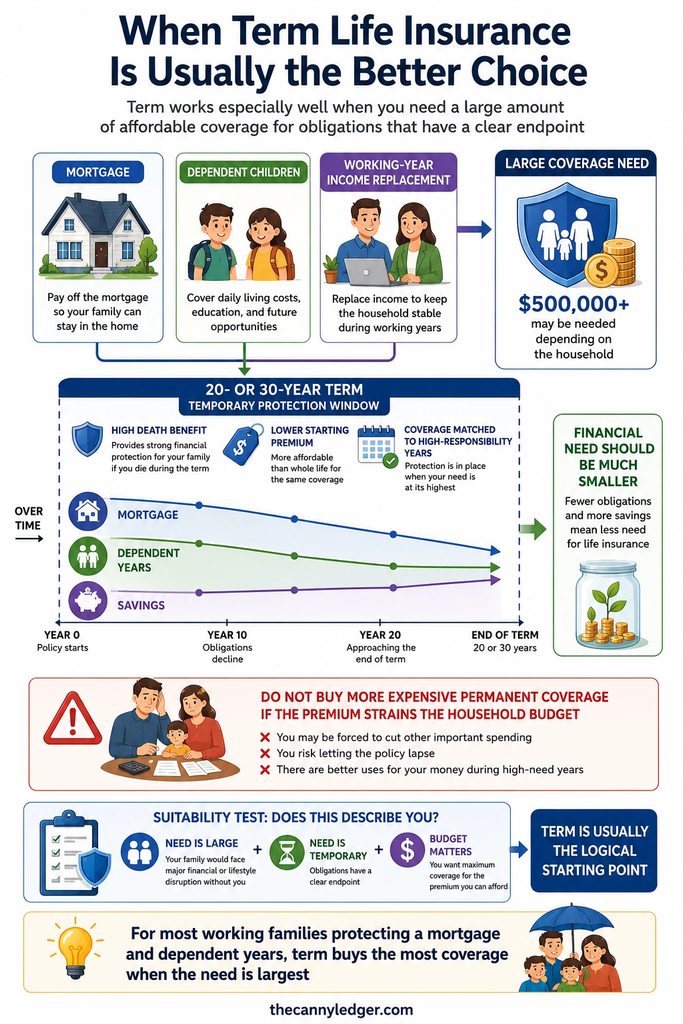
For the majority of Canadians in their 20s through 40s carrying a mortgage, raising kids, or replacing income during their working years, term is the more sensible default, and it’s not close. The coverage amount most people actually need tends to be large, often $500,000 or more once a mortgage and years of income replacement get factored in, and buying that much coverage as whole life would mean a premium large enough to strain a lot of household budgets, sometimes to the point where the policy gets cancelled a few years in when money gets tight, losing every dollar paid in along the way. A mortgage-specific policy is one common variation worth understanding here too, since a standalone term policy sized to the mortgage balance is usually more flexible and often cheaper than mortgage protection insurance sold directly through a lender.
When Whole Life Actually Earns Its Higher Price
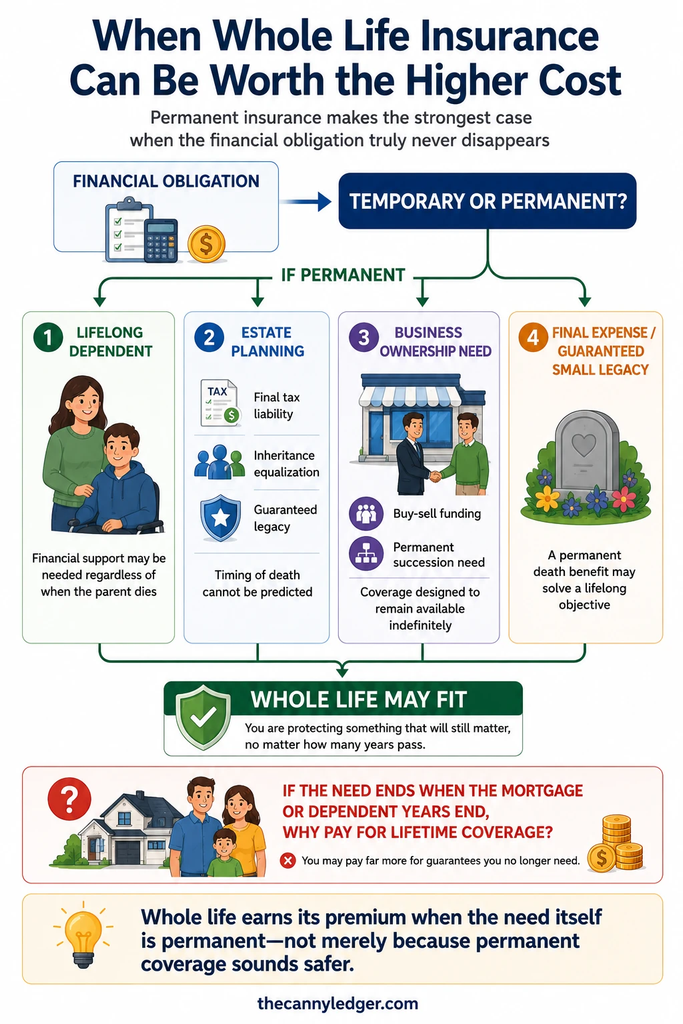
The scenarios where permanent coverage genuinely makes sense are narrower than the industry’s marketing suggests, but they’re real. A parent supporting a child with a lifelong disability, where the financial responsibility for that child’s care won’t end at a predictable age the way it does for most kids, has a permanent need that a term policy structurally can’t match, since there’s no point at which the coverage should safely lapse. Estate planning is another legitimate case, particularly for guaranteeing money exists to cover a final tax bill or equalize an inheritance regardless of when death actually happens, since nobody can time that with any precision decades in advance. Business owners funding a buy-sell agreement face a similar problem, and it’s worth understanding how corporate-owned coverage changes the calculation further, since permanent policies dominate that specific use case for reasons that have nothing to do with a family’s personal insurance needs.
The Middle Path Almost Nobody Mentions
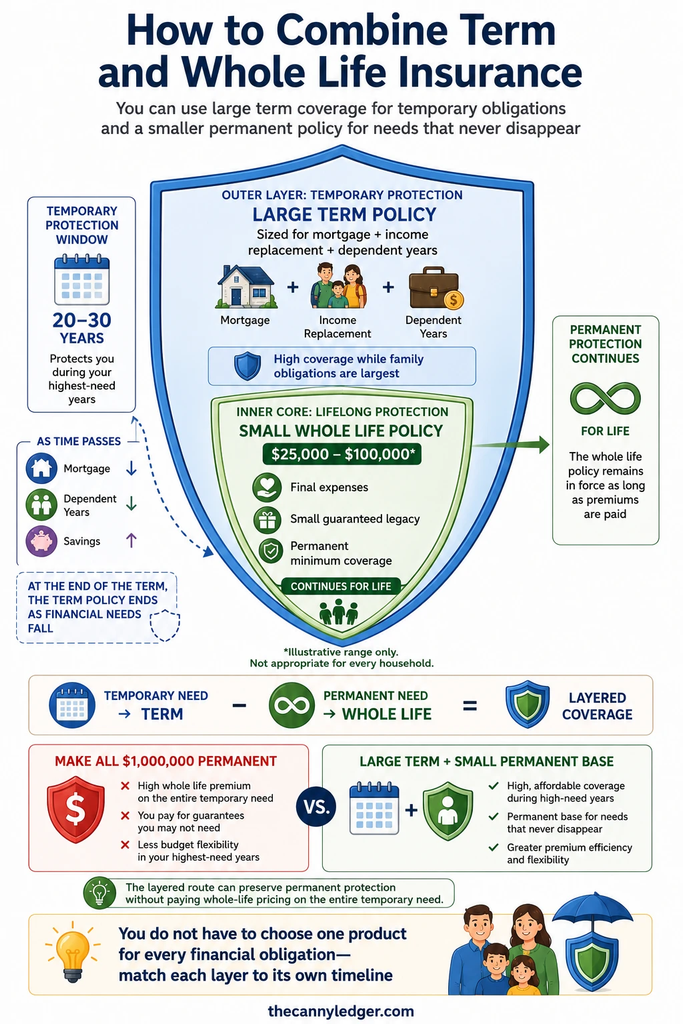
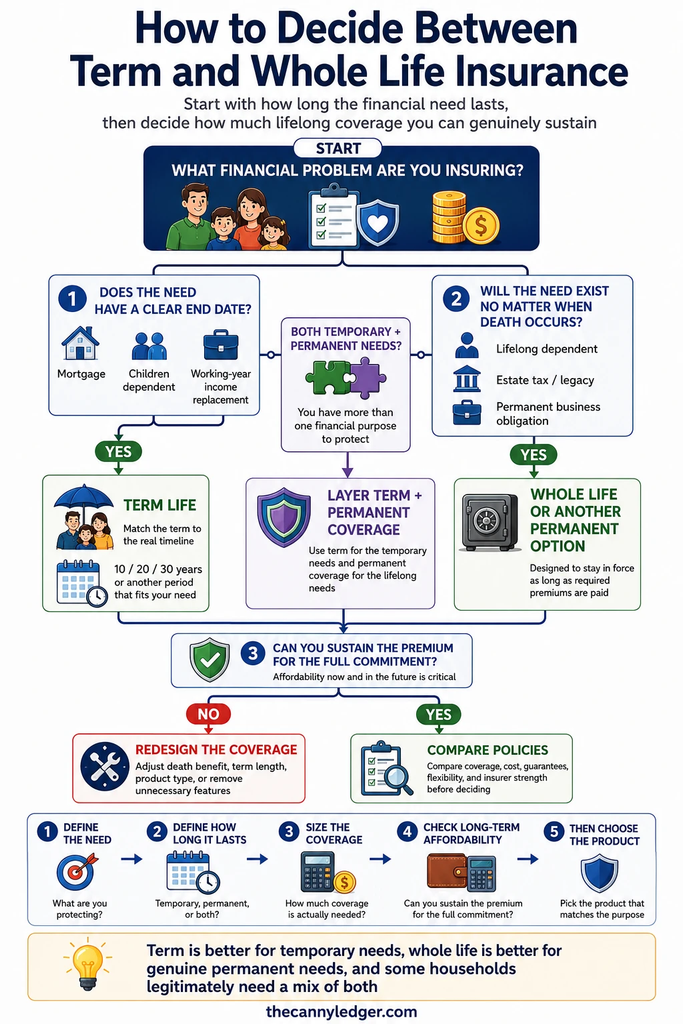
Term and whole life aren’t mutually exclusive, and layering both is a genuinely underused strategy for people who don’t fit neatly into either camp. A common approach pairs a large term policy, sized to cover the mortgage and years of income replacement, with a much smaller permanent policy, often in the $25,000 to $100,000 range, that stays in force for life to cover final expenses or leave a modest guaranteed legacy no matter how long someone lives. This gets the bulk of the coverage need met affordably through term while still locking in a small amount of coverage that can never lapse or become unaffordable later, a combination that costs meaningfully less than making the entire death benefit permanent while still closing the gap that pure term leaves wide open in someone’s later years.
The Mistake That Shows Up on Both Sides
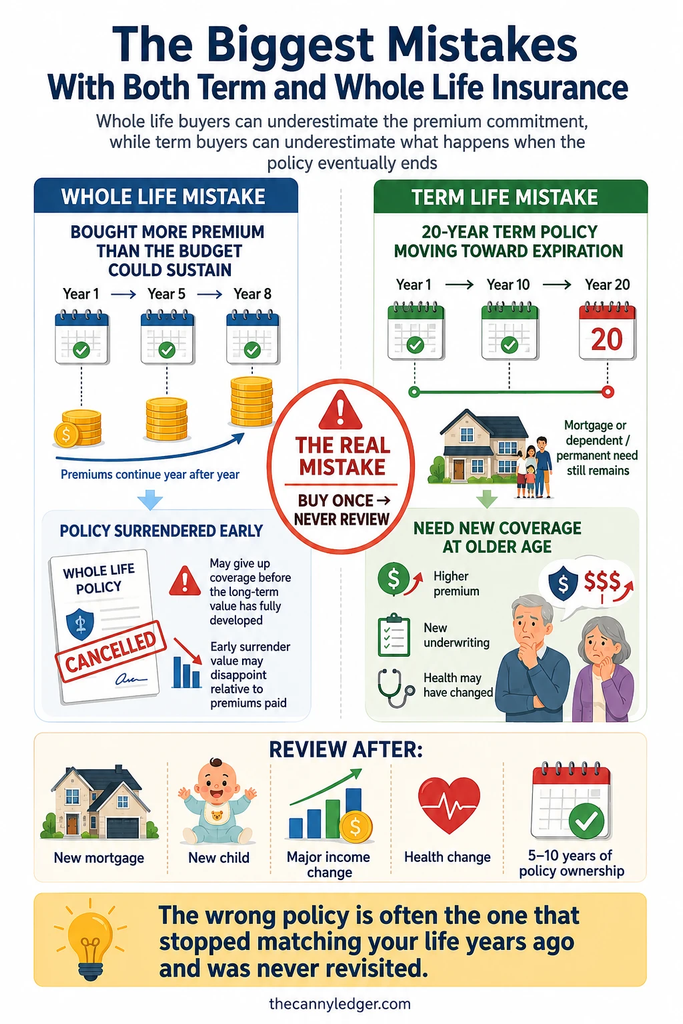
People buying whole life often overestimate their ability to sustain the premium for decades, and a policy surrendered early, before enough cash value has built up, can mean losing a significant portion of what was paid in, sometimes with a surrender charge on top depending on how early the cancellation happens. People buying only term make the opposite mistake, treating the coverage as a permanent solution and never revisiting it, only to reach the final years of the term still carrying a mortgage or dependents, at an age and health status where new coverage is either far more expensive or impossible to get approved for. Neither mistake is really about the product itself. Both come from picking a policy once and never checking back in as life actually unfolds.
How to Actually Decide
Start by asking how long the specific financial obligation the coverage is protecting against will actually last. A mortgage, young kids, or a spouse’s income replacement during working years all have a natural endpoint, which points toward term. A dependent who will need support indefinitely, a wish to guarantee money for final expenses no matter when death happens, or a business ownership structure that needs permanent funding all point toward whole life, or at least a meaningful permanent component layered onto a base of term. From there, decide what you can actually sustain as a premium for the full length of the commitment, since a policy that gets cancelled halfway through, whether it’s a 20-year term lapsed at year twelve or a whole life policy surrendered at year eight, defeats the entire purpose regardless of which type it was.
Frequently Asked Questions
Can a term policy be converted into whole life later without a new medical exam? Many term policies include a conversion privilege allowing exactly this, usually up to a specified age like 70 or 71, a feature RBC Insurance and most other major Canadian carriers build into their term products specifically for this scenario, which matters most for someone whose health has changed since the original term was purchased and who wants permanent coverage without requalifying medically.
Does whole life insurance protect the cash value if the insurer becomes insolvent? Yes, separately from the death benefit. Canadian insurers belong to Assuris, which protects accumulated cash value up to a set threshold in addition to the death benefit, a form of protection that doesn’t apply to term policies since term has no cash value to protect in the first place.
Is it possible to have both a term and a whole life policy at the same time? Yes, and layering the two is a common and often sensible strategy rather than an unusual one, covering the bulk of a temporary need through cheaper term coverage while keeping a smaller permanent policy in force for life.
Does the cost gap between term and whole life shrink at older ages? Not really. Term becomes proportionally more expensive as a percentage of whole life’s cost the older someone gets, since term at an advanced age is pricing a much higher near-term mortality risk, though whole life purchased for the first time at an older age also costs substantially more than the same policy bought decades earlier.