


For a domestic student in Winnipeg, “finding a student job” is mostly a question of where to look. For a growing share of the city’s international student population, it’s a genuinely different and higher-stakes question first: how many hours am I actually allowed to work, and what happens if I get that wrong. Both questions matter, but they’re not remotely the same conversation, and treating them as one is how international students end up accidentally violating study permit conditions over something as routine as an extra shift picked up during a busy week. This guide splits the two apart deliberately, covering where the work actually is for any student, then walking through Canada’s current federal work authorization rules for international students in real detail, since getting this wrong carries consequences that go well beyond a bad shift.
- Where the actual jobs are, for any student
- On-campus work: unlimited hours, no separate permit needed
- Off-campus work: the 24-hour rule, explained precisely
- Scheduled breaks: where the cap disappears
- The major 2026 change: co-op and work placements no longer need a separate permit
- After you finish: the window before your PGWP decision
- What actually happens if you go over the limit
- Getting set up to work legally
- Fitting work into your broader financial picture
- The bottom line
Where the actual jobs are, for any student
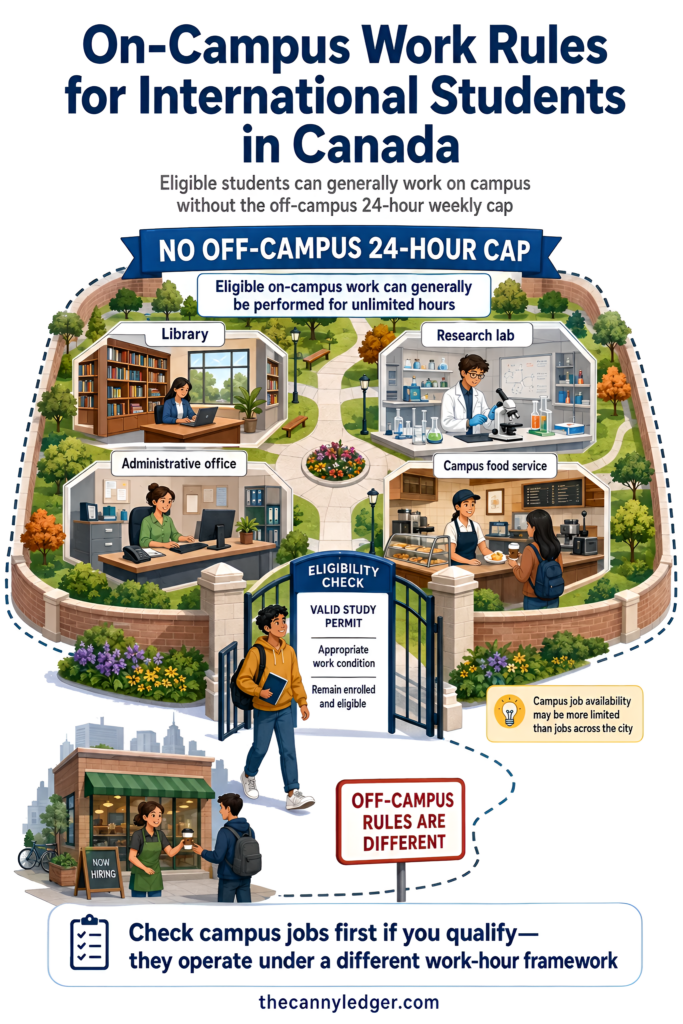
Our companion guide, part-time jobs in Winnipeg, covers the sector-by-sector breakdown in depth, retail at the city’s major malls, food service, grocery and big-box employers, call centres, and gig work, along with the practical strategy of applying in person for high-turnover roles rather than relying on online applications alone. Everything in that guide applies equally to international students who are eligible to work, with one addition worth knowing specifically: campus job boards and student employment centres at the University of Manitoba, the University of Winnipeg, and Red River College Polytechnic often list on-campus positions, library assistant roles, research assistantships, food service within campus buildings, and administrative support roles, that don’t require navigating the off-campus work rules described below at all, since on-campus work operates under a separate, generally more flexible authorization.

On-campus work: unlimited hours, no separate permit needed
If you’re an eligible international student with a valid study permit, working on campus doesn’t require a separate work permit and isn’t subject to the hourly cap that applies to off-campus jobs. You can generally work unlimited hours at a job physically located on your institution’s campus, provided your study permit includes the appropriate work condition and you remain enrolled as a student in good standing. This makes on-campus employment worth checking first specifically because it sidesteps the more complex off-campus rules entirely, though the actual volume of available positions tends to be smaller than what’s available across the wider city.
Off-campus work: the 24-hour rule, explained precisely
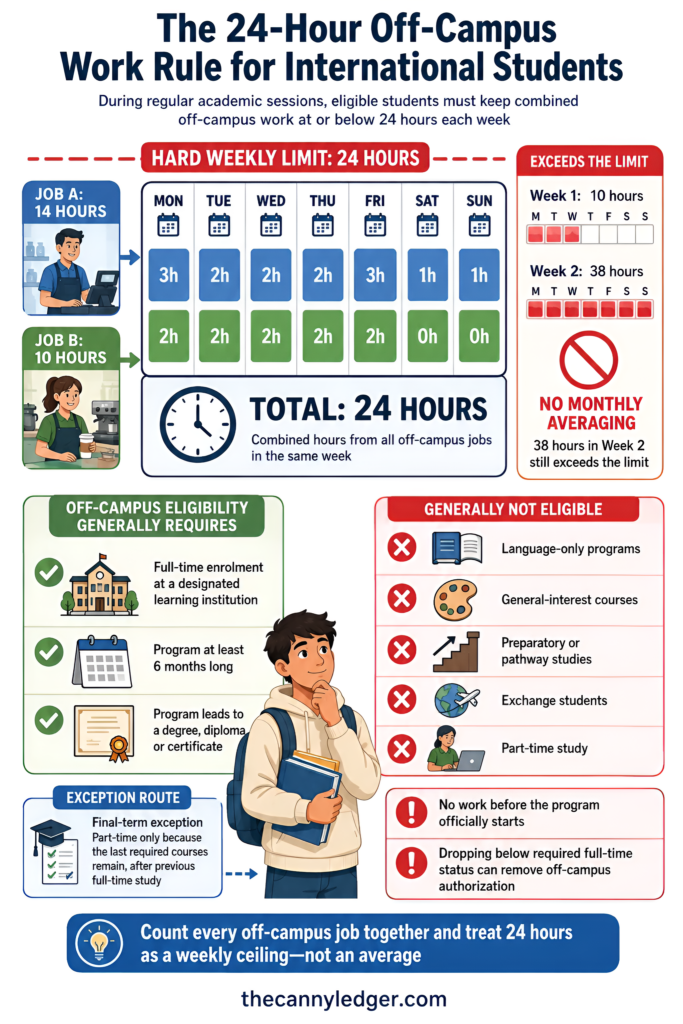
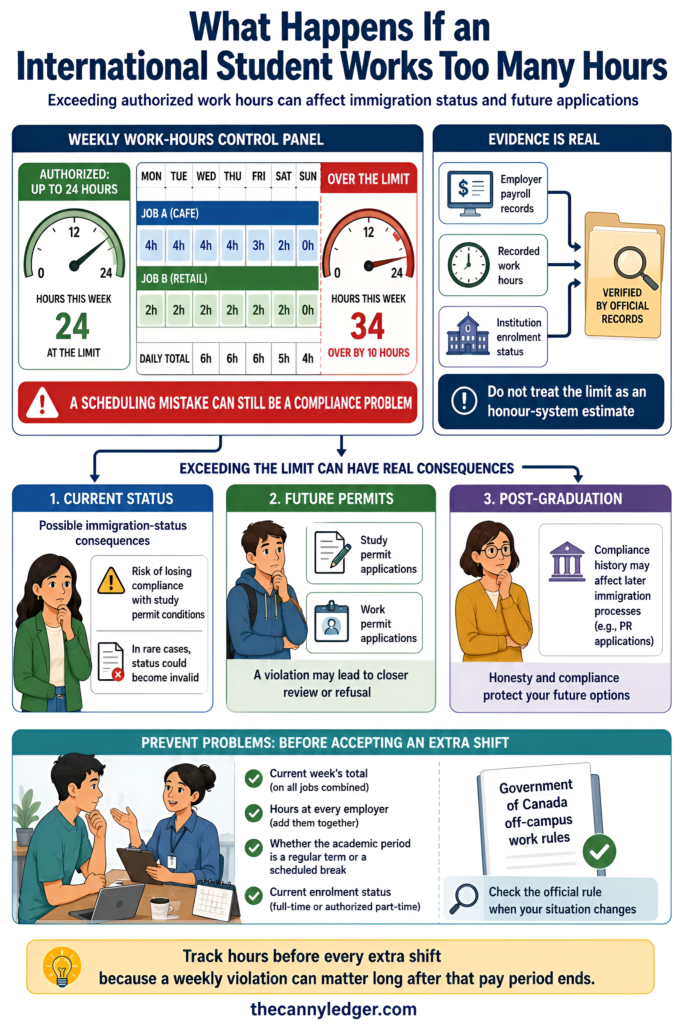
This is the number that matters most, and it’s worth understanding exactly rather than approximately. Eligible international students can work up to 24 hours a week off campus during a regular academic session, a limit that became permanent on November 8, 2024, replacing what had previously been a 20-hour cap. This is a hard weekly ceiling, not an average you can balance out over a month; working 10 hours one week and 38 the next doesn’t average out to compliance, it constitutes a violation in the week you exceeded the limit. You can combine hours across more than one employer to reach that 24-hour total, as long as your combined hours across every job stay under the cap.
Eligibility for off-campus work isn’t automatic just because you hold a study permit. You generally need to be enrolled full-time at a designated learning institution in a program that’s at least six months long and leads to a degree, diploma, or certificate. Several categories of students are specifically excluded from off-campus work eligibility: those enrolled solely in English or French as a second language programs, students in general-interest or self-improvement courses, students in preparatory or pathway programs taken before a subsequent program begins, and exchange students studying at a Canadian institution through a foreign-institution exchange arrangement. Part-time students are also generally ineligible, with one specific exception: a student who is only part-time because they’re finishing their final required courses in their last term can continue working under the standard off-campus rules, provided they were full-time in every term before that.
You also can’t work before your program has officially started, even if your study permit is already valid and issued, and dropping below the full-time course load your institution defines partway through a semester removes your off-campus work authorization immediately for that term, not just going forward.
Scheduled breaks: where the cap disappears
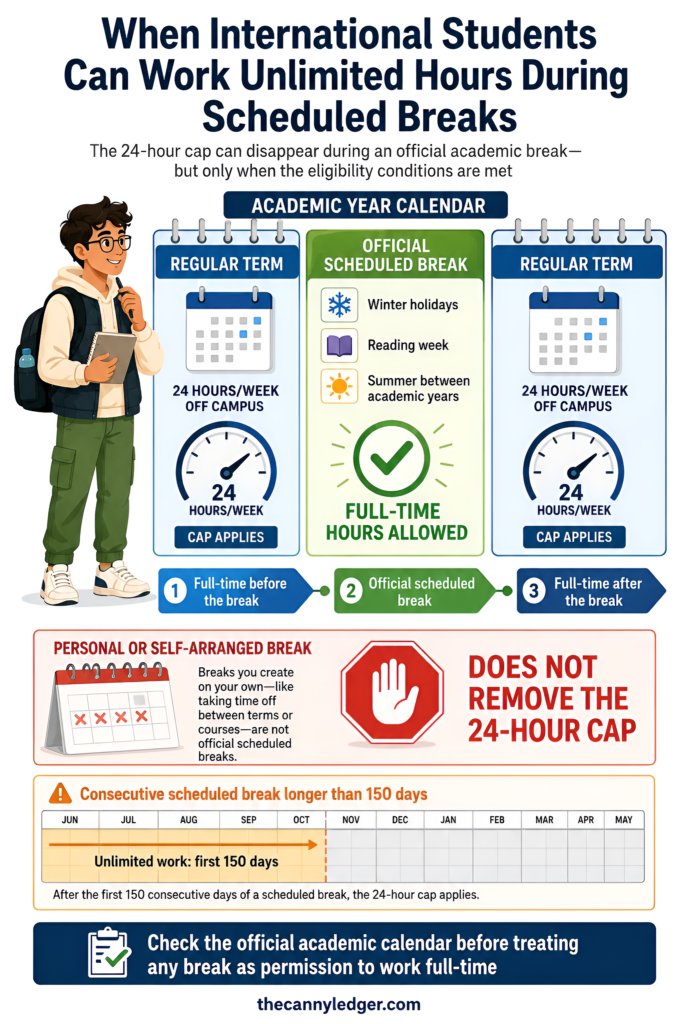
During a genuinely scheduled break in your academic program, winter holidays, summer between school years, or a formal reading week, the 24-hour cap doesn’t apply, and eligible students can work full-time or more, provided they were enrolled full-time in the term immediately before the break and will be again immediately after it. One detail worth flagging specifically: if your institution’s scheduled breaks stack back to back in a way that creates a single gap longer than 150 consecutive days, unlimited work hours only apply during the first 150 days of that stretch, a distinction unlikely to affect most students on a standard academic calendar but worth knowing if your program’s schedule is unusual. It’s also worth knowing that a break you arrange for yourself, rather than one built into your institution’s official academic calendar, doesn’t count as a scheduled break under these rules and doesn’t unlock full-time work eligibility.
The major 2026 change: co-op and work placements no longer need a separate permit
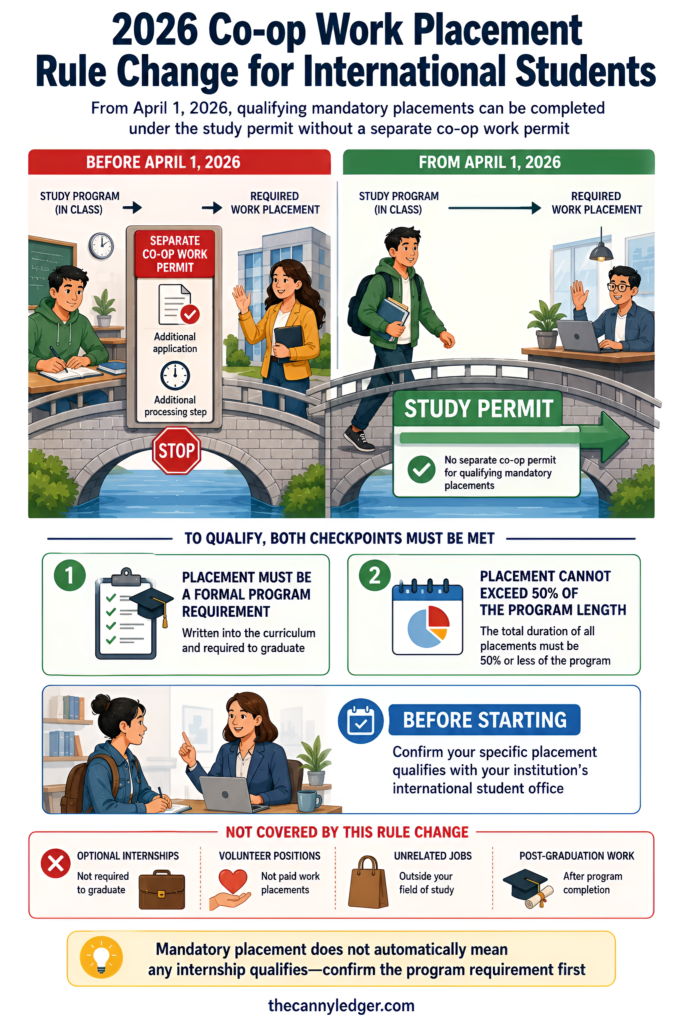
Here’s a genuinely significant, recent change worth knowing about if your program includes a mandatory work placement. Effective April 1, 2026, Immigration, Refugees and Citizenship Canada eliminated the separate co-op work permit requirement that previously applied to students completing a required co-op term or internship as part of their program. Students in programs with a mandatory work placement can now complete that placement under their existing study permit alone, without applying for and waiting on a distinct work permit, provided the placement is a formal requirement of the program and doesn’t make up more than half of the program’s total length. This removes a genuine processing bottleneck that used to add real time and cost for students whose programs required this kind of placement, and it’s worth confirming with your institution’s international student office that your specific program and placement qualify under the new rule before assuming the older process still applies.
After you finish: the window before your PGWP decision
Once you’ve completed your program and received written confirmation of that completion, work authorization generally continues, unlimited hours, until either your study permit’s printed expiry date or 90 days after your program’s completion, whichever comes first. This matters specifically for the gap many graduates face between finishing their studies and receiving a decision on a Post-Graduation Work Permit application, and it’s worth applying for that PGWP before your study permit expires to preserve your ability to keep working through that transition window.

What actually happens if you go over the limit
Exceeding your authorized hours, even briefly, even due to a scheduling mistake by an employer rather than a deliberate choice, is treated by IRCC as a violation of your study permit conditions. The consequences are real and can follow you well beyond the immediate situation: potential loss of student status, denial of future study or work permit applications, and complications for a future Post-Graduation Work Permit specifically, since IRCC reviews your work history and compliance record when assessing later applications. Employers are required to verify your work eligibility and the institution reports enrollment status, and payroll records can be cross-referenced, meaning this isn’t functioning on an honour system even if no one is actively checking your hours week to week. If you’re ever uncertain whether a specific situation, a second job, an unusual break schedule, a switch to part-time status, keeps you within your authorized limits, checking directly against the official Government of Canada work off-campus page before accepting additional hours is worth the ten minutes it takes, given what’s actually at stake.
Getting set up to work legally
Before your first shift, you’ll need a Social Insurance Number, which you can apply for once your study permit includes the appropriate work authorization condition and you’ve confirmed your program has started. Our social insurance number in Winnipeg guide covers exactly how and where to apply locally. Employers will ask for this before you can be added to payroll, so it’s worth handling early rather than waiting until you’ve already been offered a position and need it immediately.

Fitting work into your broader financial picture
For international students specifically, work income is rarely the whole financial picture, particularly given that most government student aid programs described in our Manitoba Student Aid, student loans in Winnipeg, and student grants in Winnipeg guides are restricted to Canadian citizens, permanent residents, and protected persons. Our cost of living in Winnipeg for international students guide covers the realistic budget picture worth planning against, and it’s worth running your expected part-time income, capped at 24 hours during term as described above, honestly against that budget rather than assuming work alone will cover a shortfall left by ineligibility for most government funding.
If you’re navigating the broader Winnipeg job market for the first time, whether as a student or looking ahead to post-graduation employment, our career counselling for newcomers in Winnipeg and jobs for new immigrants in Winnipeg guides cover resources worth knowing about beyond the immediate question of a part-time student job.

The bottom line
Finding a job in Winnipeg as a student is the easier half of this question; staying compliant with your specific work authorization, if you’re studying here on a study permit, is the half that actually carries risk if you get it wrong. Know precisely which category of student you fall into, confirm your specific eligibility before accepting hours, and treat the 24-hour weekly cap as a hard line rather than a rough guideline, since the consequences of crossing it reach well past your paycheque and into every future immigration application you’ll ever file in this country.