

Most renters assume their damage deposit is doing more work than it actually is. In Manitoba, that deposit is capped by law at half of one month’s rent, meaning a renter paying $1,200 a month can never be asked for more than $600 upfront, no matter how the lease is worded. Tenant insurance in Winnipeg exists precisely because that $600 doesn’t come close to covering a kitchen fire, a burst pipe that ruins a neighbour’s ceiling below you, or a lawsuit if someone gets hurt in your apartment. The gap between what your deposit protects and what you’re actually on the hook for is the entire reason this product exists.
- What Tenant Insurance Actually Covers
- Is Tenant Insurance Legally Required in Winnipeg?
- What It Actually Costs in Manitoba
- The Tax Break Most Renters Don’t Know About
- What’s Not Covered
- How Much Coverage You Actually Need
- How This Compares to Coverage You Might Already Have
- Is It Actually Worth It?
- What to Actually Do Next
Here’s the direct version: tenant insurance in Manitoba isn’t legally required by the province, but many landlords make it a condition of the lease. It typically costs close to the Canadian average of about $21.74 a month, covers your belongings, your personal liability, and temporary living costs if you’re displaced, and Manitoba renters get a tax break on it that most other provinces don’t offer.
That last part is worth sitting with for a second, because it’s the kind of detail that changes the actual math on whether this is worth adding to your monthly budget.
What Tenant Insurance Actually Covers
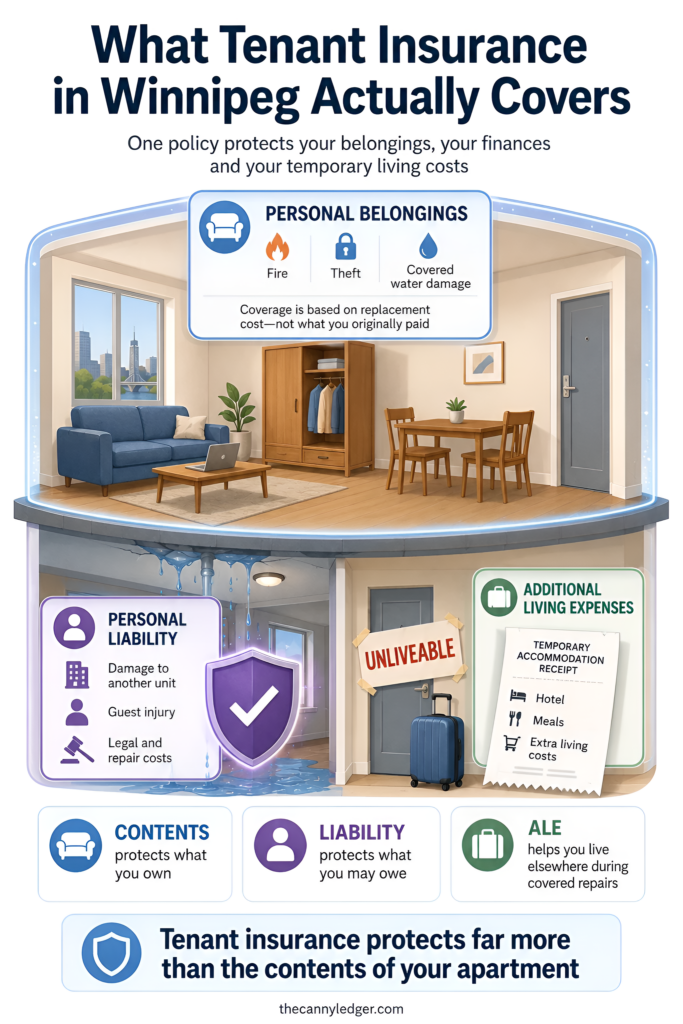
A standard tenant policy in Canada bundles together three distinct types of protection, and understanding what each one actually does clears up most of the confusion people have about this product.
Contents coverage protects your personal belongings, meaning furniture, electronics, clothing, and everything else you’d have to replace if a fire, theft, or covered water damage wiped out your apartment. This is the part most people think of first, and it’s genuinely the easiest to underestimate. Add up what it would actually cost to replace everything you own, not what you originally paid for it, and the number is almost always higher than people expect once they start listing furniture, a mattress, a laptop, and a closet full of clothes.
Liability coverage is the part that protects you financially, not your stuff. If you’re found responsible for injuring someone in your rental unit, or if your actions cause damage to someone else’s property, such as a bathtub overflow that soaks the unit below yours, liability coverage pays for the legal and repair costs that follow. This is arguably the more important half of the policy, since a liability claim can run into tens of thousands of dollars in a way that dwarfs the value of most renters’ personal belongings.
Additional living expenses, often shortened to ALE, covers the cost of temporary housing, meals, and related expenses if your unit becomes unliveable due to a covered event, like a fire that forces you out while repairs happen. Without this, a displaced tenant is paying for a hotel and their existing rent at the same time, with no source to recover either cost from.
Is Tenant Insurance Legally Required in Winnipeg?
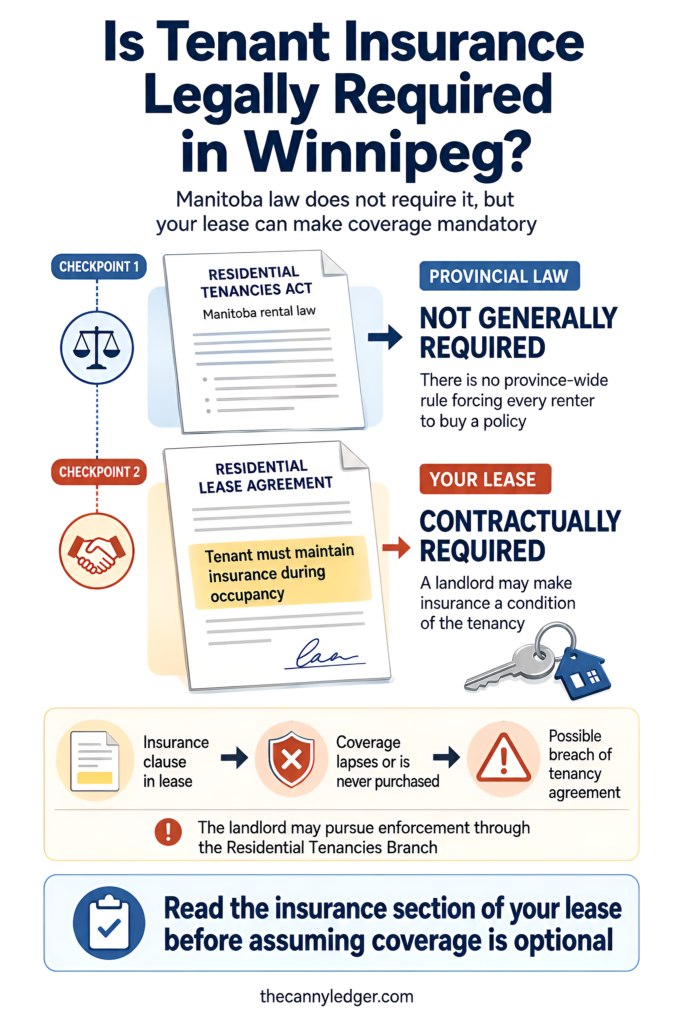
No. Manitoba’s Residential Tenancies Branch, which oversees rental disputes and administers the Residential Tenancies Act, doesn’t require tenants to carry insurance as a matter of provincial law. There’s no statute forcing you to buy a policy before you can legally rent an apartment in this province.
What changes the picture is your actual lease. Landlords in Manitoba are permitted to make tenant insurance a condition of occupancy, written directly into the lease agreement, and plenty of them do exactly that, particularly for larger apartment buildings and professionally managed properties. Once it’s written into your lease as a term, failing to maintain that coverage becomes a breach of the agreement, the same as failing to pay rent or violating a no-pets clause, and it can be grounds for the landlord to pursue an eviction through the Residential Tenancies Branch.
The practical takeaway is simple: read your lease before assuming this is optional. If the clause is there, it’s enforceable, whether or not the province itself requires it.
What It Actually Costs in Manitoba
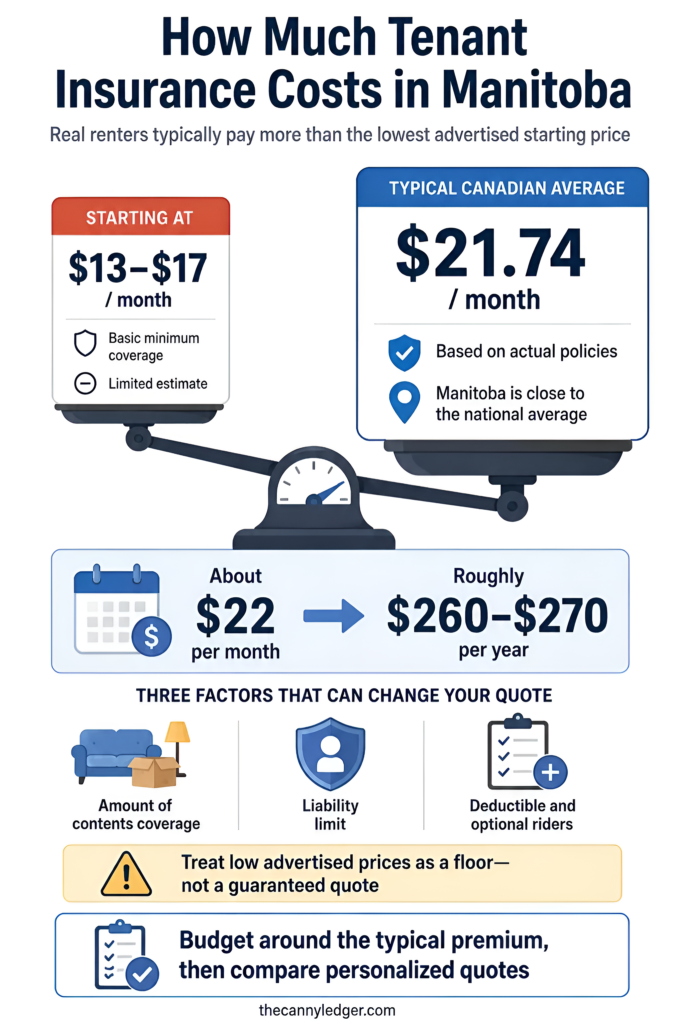
Real premium data, not marketing copy, tells a more useful story than the “starting at $13 a month” ads you’ll see everywhere. Based on actual policies issued across the country between July 2025 and June 2026, Canadian renters paid an average of $21.74 a month for tenant insurance. Manitoba sat within 36 cents of that national figure, putting it squarely in line with Ontario, British Columbia, and Alberta rather than standing out as unusually cheap or expensive. Across the provinces measured, the entire spread from lowest to highest average was under two dollars a month, which tells you location within Canada moves this price far less than most people assume.
That “starting at” language you’ll see from individual insurers, often quoting $13 to $17 a month, reflects a stripped-down minimum policy rather than what a typical renter actually pays once real coverage limits and a full inventory of belongings are factored in. Treat those low headline numbers as a floor, not a realistic estimate for your own situation.
The Tax Break Most Renters Don’t Know About
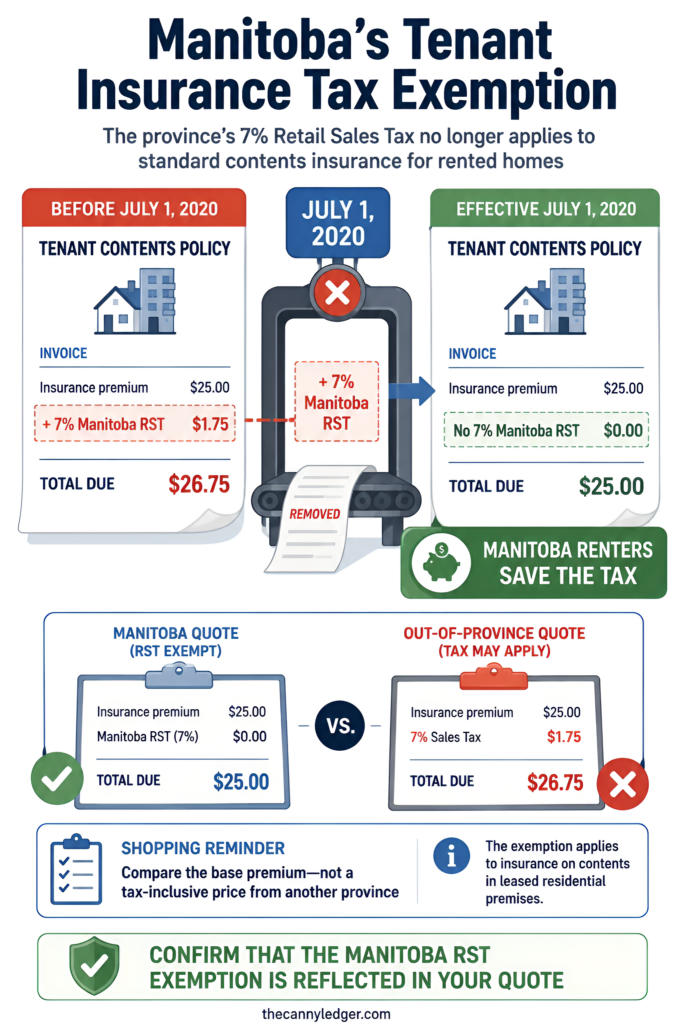
Since July 1, 2020, Manitoba has exempted insurance on the contents of leased residential premises from the province’s 7 percent Retail Sales Tax, a change confirmed directly in Manitoba Finance’s own bulletin on insurance taxation. Before that date, renters paid RST on top of their tenant insurance premium the same way they’d pay it on most retail purchases. That tax now doesn’t apply to a standard tenant contents policy.
This matters for comparison shopping specifically. If you’ve seen renters insurance pricing content built around other provinces, some of those provinces still apply their own provincial sales tax to insurance premiums, adding a real cost on top of the base rate that Manitoba renters simply don’t pay. It’s a genuine, if quiet, advantage to renting in this province rather than in a jurisdiction still taxing the premium itself.
What’s Not Covered
A policy that sounds comprehensive still has real gaps worth knowing before you assume you’re fully protected.
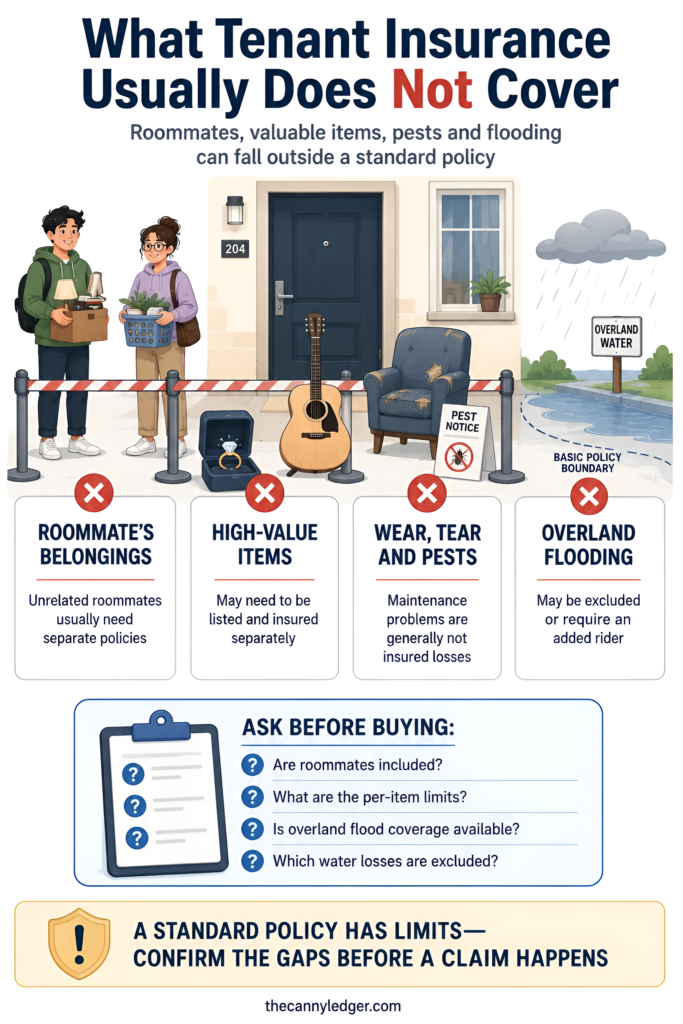
A roommate’s belongings generally aren’t covered under your policy unless they’re a family member living with you, which means two unrelated roommates splitting an apartment typically each need their own separate policy rather than assuming one covers both. High-value individual items, like a serious piece of jewelry or a specialized musical instrument, often exceed the standard per-item limit built into a base policy and need to be specifically scheduled, meaning listed and insured separately, for full coverage. Ordinary wear and tear on your own belongings, as well as pest issues like bed bugs, are treated as maintenance matters rather than insurable losses. And overland flood damage is frequently excluded or limited under a standard policy, requiring a separate rider in flood-prone areas, which is worth asking about directly given how often spring flooding comes up in Manitoba conversations more broadly.
How Much Coverage You Actually Need
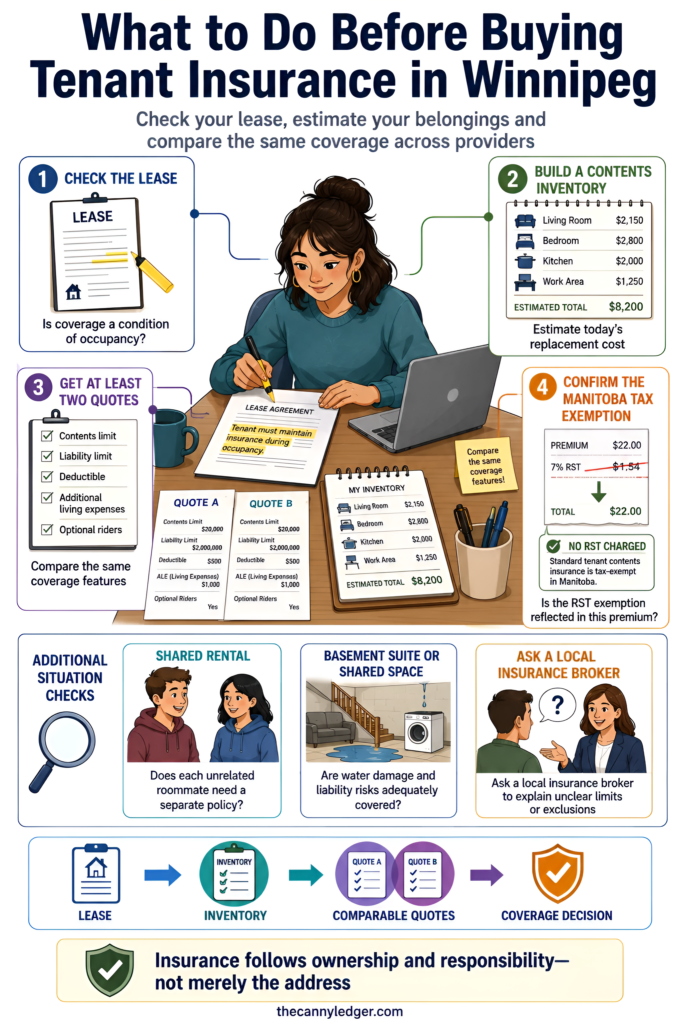
Walking through your apartment room by room and estimating what it would cost to replace everything at today’s prices, not what you originally paid, is the most reliable way to land on a realistic contents coverage amount rather than guessing at a round number. Most people are surprised by how quickly furniture, electronics, and a full wardrobe add up once they actually total it out.
For liability coverage, the standard minimum offered by most insurers tends to sit far below what a serious injury claim could actually cost, so it’s worth asking your insurer directly what raising that liability limit costs, since the incremental premium increase for meaningfully higher liability protection is often smaller than people expect relative to the added protection.

How This Compares to Coverage You Might Already Have
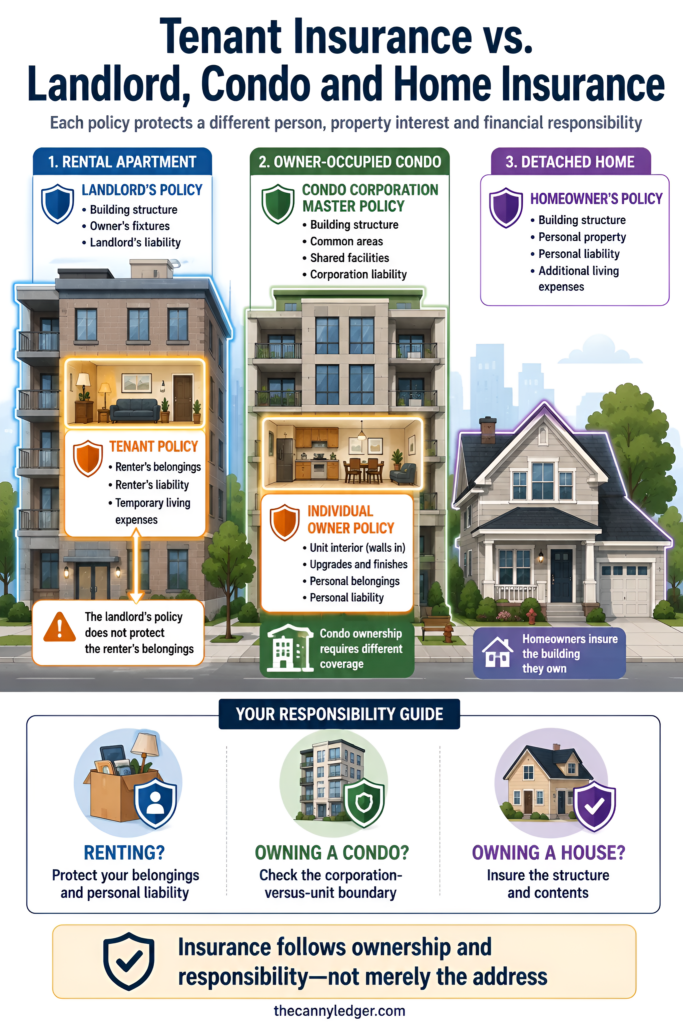
It’s worth being clear about what tenant insurance is not. Your landlord’s own insurance policy protects the building itself, meaning the structure, fixtures, and their own liability as the property owner, and it does not extend to your personal belongings or protect you personally if you’re found liable for an incident inside your unit. If you’re weighing this against landlord and rental property insurance in Winnipeg that a landlord might carry, understand these are two entirely separate products covering two entirely separate parties.
If you own a condo rather than renting a standard apartment, you’re in a different category entirely, closer to condo insurance in Winnipeg than to tenant coverage, since ownership changes what the condo corporation’s master policy covers versus what falls to you individually. And for anyone comparing renting against buying down the line, it’s worth understanding how tenant coverage differs structurally from home insurance in Winnipeg, which covers the physical structure a homeowner is responsible for in a way a renter simply isn’t.
Is It Actually Worth It?
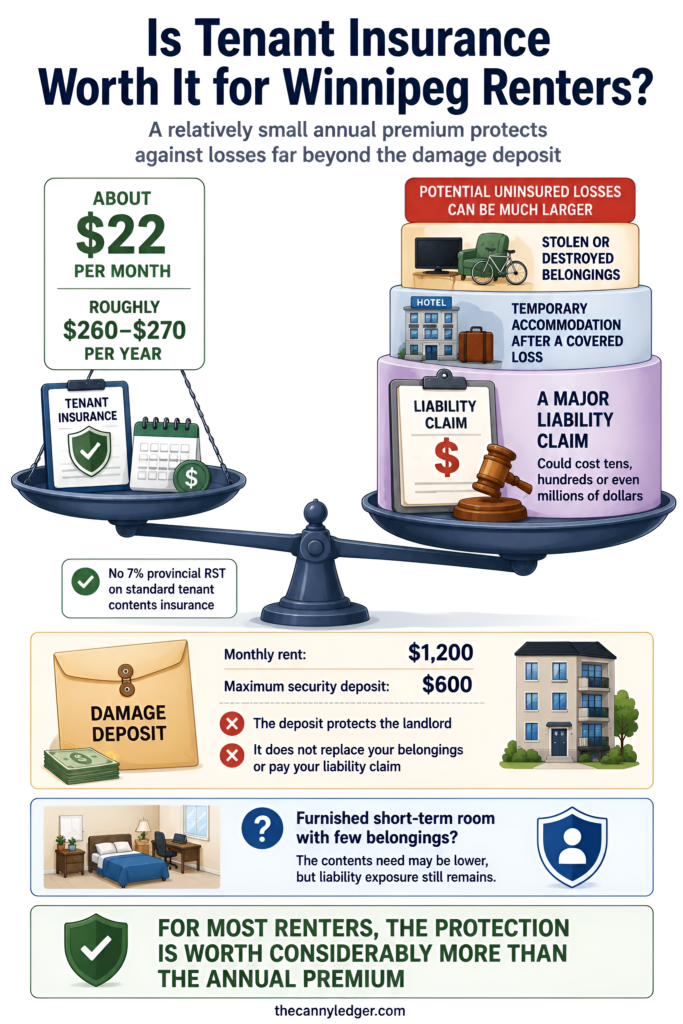
Running the numbers side by side makes this a fairly easy call for most renters. A policy averaging close to $22 a month, with no provincial sales tax added on top of it since 2020, works out to roughly $260 to $270 a year. Against that sits a security deposit capped at half a month’s rent that offers your landlord some protection but does nothing for you personally if you’re the one who needs to replace a stolen laptop or cover a liability claim after a guest gets hurt in your apartment. The math tilts firmly toward carrying coverage, independent of whether your specific lease happens to require it.
The one group where the calculation genuinely gets murkier is someone renting a furnished room short-term with very few personal belongings and minimal risk of hosting guests who could get injured. Even then, the liability half of the policy alone, protecting against a claim that could run into the tens of thousands of dollars, tends to justify the monthly cost on its own.
What to Actually Do Next
Pull out your lease and check specifically whether tenant insurance is listed as a condition of occupancy, since that answer determines whether this is optional or contractually required for you right now. If you’re shopping for a policy, get quotes from at least two providers and specifically ask each one to confirm the RST exemption is being applied to your contents coverage, since Manitoba’s own bulletin is clear that it should be. And if you’re weighing insurance costs against your total housing budget, it’s worth checking that figure against what renters typically pay across Winnipeg to see how a $20-a-month policy actually fits into your broader monthly numbers, or, if you’re in a shared living situation, against the specific math of budgeting for a basement suite in Winnipeg, where liability exposure and shared spaces raise the stakes of going without coverage.
If you’d rather work through your specific situation with a person instead of a quote calculator, Winnipeg’s local insurance companies and brokers can walk through coverage limits directly, and knowing how to choose an insurance broker in Winnipeg is worth reading first if you’ve never worked with one before.