

Manitoba’s minimum wage is $16.00 an hour as of this writing, scheduled to rise to $16.40 on October 1, 2026. That’s the direct answer, and if that’s all you came here for, you have it. What that single number doesn’t tell you, and what almost nobody researching this question stops to ask, is how far $16.40 an hour actually goes toward covering a real cost of living in this city. The honest answer is: not very far. Independent research pegs what a Winnipeg family actually needs to earn considerably higher than the legal floor, and the gap between those two numbers is arguably more useful to understand than the minimum wage figure on its own.
- How Manitoba actually sets this number
- Who this rate actually applies to, and who it doesn’t
- Overtime, and how it interacts with minimum wage
- Young workers face additional rules worth knowing
- The number that actually matters more: the living wage gap
- How Manitoba’s rate compares across the country
- What to do if you think you’re being paid incorrectly
- What this actually means for your budget
- The bottom line
How Manitoba actually sets this number
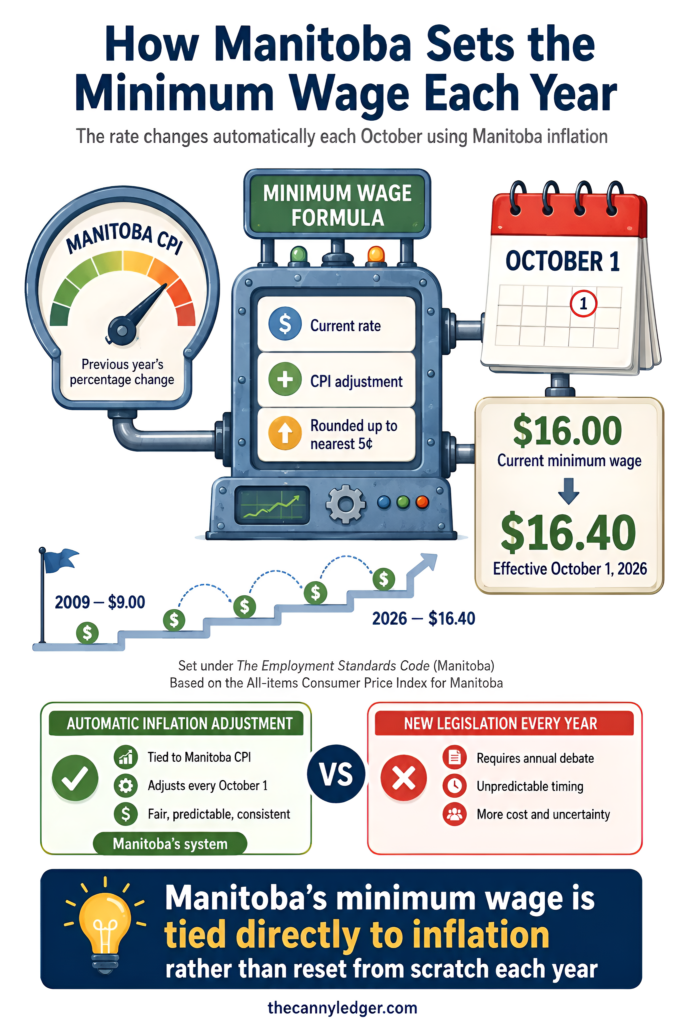
Manitoba’s minimum wage isn’t set through a political announcement each year so much as a formula written directly into The Employment Standards Code. Every October 1, the rate adjusts based on the percentage change in Manitoba’s Consumer Price Index from the previous year, rounded up to the nearest five cents. This year’s 40-cent increase to $16.40 reflects Manitoba’s 2025 inflation rate under that formula. It’s worth knowing this mechanism exists specifically because it means the minimum wage moves automatically with inflation rather than requiring fresh legislation or political will each time, a genuinely different approach from provinces where increases happen more sporadically and are more directly tied to election cycles.
The wage has climbed considerably faster in recent years than its earlier history suggests it might. Manitoba’s minimum wage sat at just $9.00 an hour as recently as 2009, and for a long stretch after that it moved up in small, predictable increments that roughly tracked a gentler cost-of-living curve. The sharper increases of the past several years reflect the same inflation spike that’s shown up across grocery bills, rent, and nearly every other line item covered elsewhere on this site.
Who this rate actually applies to, and who it doesn’t
Manitoba’s minimum wage applies broadly: full-time employees, part-time employees, commission-based and incentive-pay workers such as flat-rate mechanics, and most residential construction workers are all covered by the same floor. Two details are worth knowing specifically because they surprise a lot of people familiar with how other jurisdictions, particularly in the United States, structure wage law. Manitoba has no separate, lower minimum wage for tipped workers; a server or bartender’s base hourly wage before tips must still meet or exceed the full minimum, with tips treated as additional income rather than a substitute for base pay. Manitoba also has no separate student minimum wage, unlike some other provinces that permit a lower rate for younger or student workers specifically.
A handful of roles fall outside standard minimum wage and overtime protections entirely, including managers whose work is primarily supervisory or managerial in nature, certain professionals, salespeople paid primarily by commission in specific circumstances, domestic workers employed directly in a private home, and election officials during an election period. Independent contractors are also excluded, since the Employment Standards Code covers employees specifically, and a genuine independent contractor relationship, as opposed to someone misclassified as a contractor while actually functioning as an employee, falls outside its protections. If you’re unsure which category you fall into, that classification question is worth raising directly with Manitoba’s Employment Standards office rather than assuming based on how your employer has labelled the position.

Overtime, and how it interacts with minimum wage
Manitoba’s standard workweek is 8 hours a day and 40 hours a week, and hours worked beyond either threshold, whichever provides the greater entitlement, must be paid at 1.5 times the employee’s regular wage rate. This applies to minimum wage earners the same as anyone else; there’s no exemption that lets an employer pay straight minimum wage for overtime hours specifically. Employers and employees can agree to bank overtime instead of paying it out directly, accruing 1.5 hours of paid time off for every overtime hour worked, generally to be used within three months unless both parties agree in writing to extend that window. Overtime itself is meant to be voluntary rather than something an employer can simply mandate, outside limited emergency circumstances.

Young workers face additional rules worth knowing
Manitoba permits young people as young as 13 to work, but with real restrictions attached. Workers aged 13, 14, or 15 must complete the Young Worker Readiness Certificate Course and obtain a signed completion certificate, co-signed by a parent or guardian, before starting a job. During the school year, workers in this age bracket are capped at 20 hours a week, with no restriction during school breaks beyond the standard rules that apply to any other employee. Additional safety-specific restrictions apply to 13-year-olds specifically, including a prohibition on food preparation involving dangerous tools or machinery. Parents and teenagers both navigating a first job in Winnipeg should treat these rules as a genuine compliance checklist rather than a formality, since they’re specifically designed to protect younger workers in ways that don’t automatically occur to a first-time employer either.

The number that actually matters more: the living wage gap
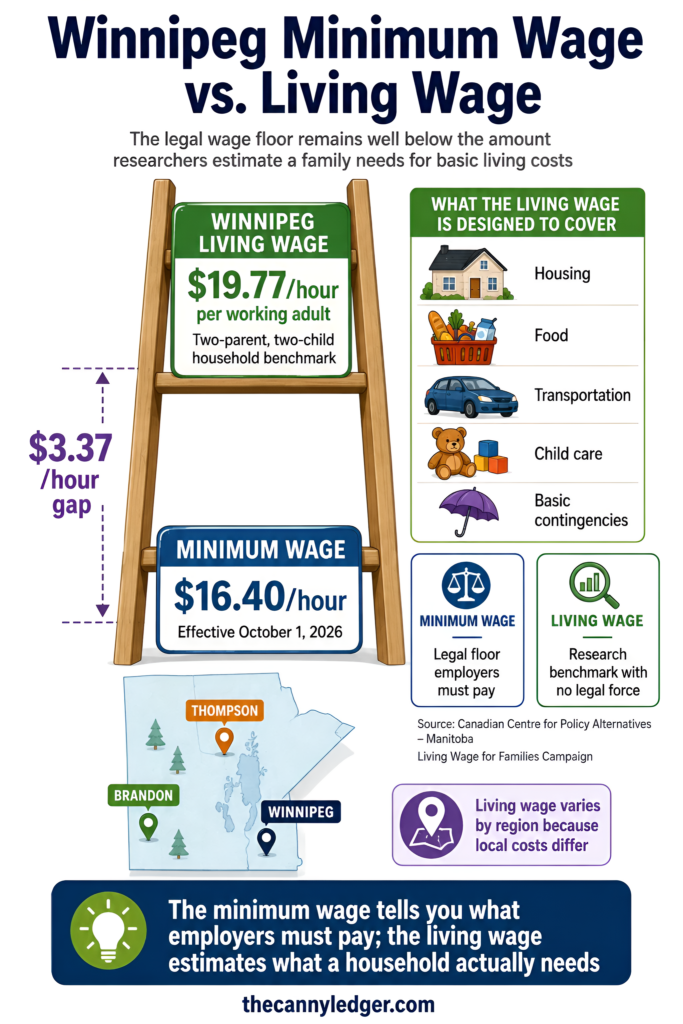
This is the part of the minimum wage conversation that gets skipped constantly, and it’s worth sitting with directly. The Canadian Centre for Policy Alternatives’ Manitoba office calculates a living wage annually, a figure representing what a family actually needs to earn per working adult to cover essentials, housing, food, transportation, child care, and modest contingencies, without falling into poverty. Their most recent update puts the Winnipeg living wage at $19.77 an hour per adult for a two-parent, two-child family with both parents working full-time. Compare that against the scheduled $16.40 minimum wage taking effect this October, and the gap sits at $3.77 an hour, meaning a full-time minimum wage worker in Winnipeg falls meaningfully short of what independent researchers calculate is actually needed to cover a bare-bones family budget in this city, one that doesn’t include savings, debt repayment, or a vacation.
It’s worth being precise about what these two numbers actually represent, since they measure genuinely different things. The minimum wage is a legal floor, the absolute least an employer is permitted to pay. The living wage is a calculated target based on real regional costs, housing chief among them, and it carries no legal force at all; no employer is required to pay it, and it functions as an advocacy benchmark rather than an enforceable standard. Manitoba’s living wage also varies meaningfully by region specifically because housing costs vary so much across the province, with Winnipeg’s figure sitting noticeably higher than Brandon’s or Thompson’s for exactly that reason.
How Manitoba’s rate compares across the country
Manitoba’s $16.00 current rate, rising to $16.40 in October, places the province roughly in the middle of the national pack. British Columbia and several other provinces currently sit meaningfully higher, while Saskatchewan sits lower. Manitoba’s rate also currently sits below the federal minimum wage of $18.15, though that federal rate only applies to employees of federally regulated industries, banking, telecommunications, and interprovincial transportation among them, rather than the vast majority of Manitoba workers who fall under provincial jurisdiction instead.

What to do if you think you’re being paid incorrectly
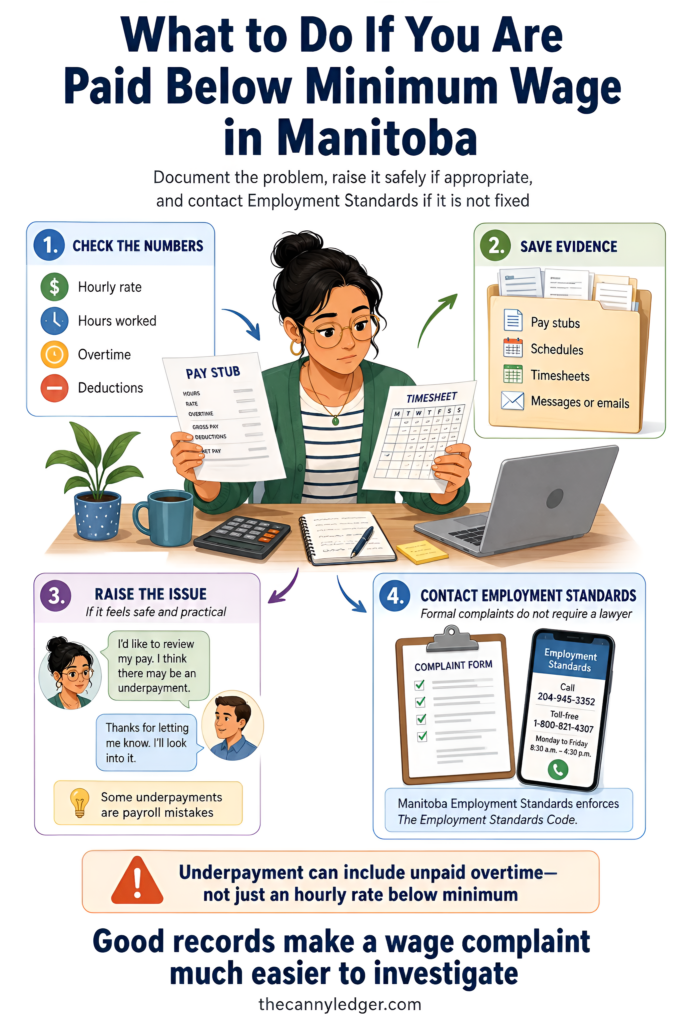
If you believe you’re being paid below the legal minimum, denied proper overtime, or otherwise not receiving what the Employment Standards Code entitles you to, Manitoba’s Employment Standards office investigates these complaints directly, and filing one doesn’t require legal representation. Documenting your hours, pay stubs, and any relevant communication with your employer before filing strengthens a complaint considerably, and it’s worth raising the issue with your employer directly first where that feels safe to do, since a genuine payroll error is more common than deliberate underpayment and can sometimes be resolved without a formal complaint at all.
What this actually means for your budget
If you’re earning minimum wage or close to it, or weighing whether a specific job offer clears a reasonable bar, it’s worth running the real numbers rather than assuming the legal minimum automatically covers a workable budget. Our living expenses in Winnipeg guide builds out full monthly budgets for a single person, a couple, and a family of four using current housing, utility, and grocery costs, and comparing a minimum wage income against those figures directly tends to be more useful than any abstract living-wage statistic on its own. Our average salaries in Winnipeg by profession guide is worth reading alongside this one if you’re weighing a career change or additional training specifically to move beyond the minimum wage floor, and our average income in Winnipeg guide gives a broader sense of where minimum wage sits relative to the citywide income picture as a whole.
If a minimum wage income is genuinely tight against your household’s needs, our how to qualify for Rent Assist in Manitoba guide covers a provincial program specifically designed to help close exactly this kind of gap, and our 211 Manitoba page can connect you to a broader range of support if housing costs are only part of what’s stretching your budget thin. And if you’re weighing whether additional training, a trade certification, or a career change could move you meaningfully past the minimum wage floor, our career counselling for newcomers in Winnipeg guide, while aimed specifically at newcomers, covers resources and approaches worth knowing about regardless of how long you’ve called Winnipeg home.

The bottom line
$16.40 an hour, arriving this October, is the legal answer to what minimum wage in Winnipeg is. The more useful answer, for anyone actually trying to live on it or budget against it, is that this figure sits close to four dollars an hour below what independent researchers calculate a Winnipeg family genuinely needs to cover the basics. Neither number is wrong, they’re simply measuring different things, a legal floor versus a real cost of living, and understanding both is what actually lets you plan around minimum wage honestly rather than assuming the legal minimum was ever designed to be enough on its own.

