

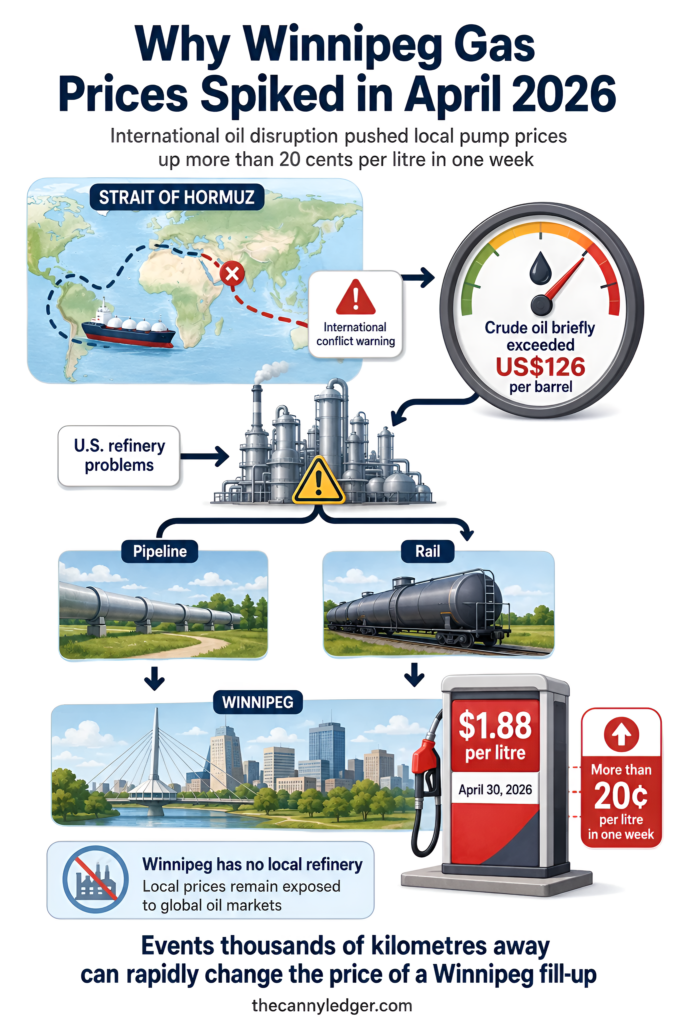
Winnipeg drivers watched gas prices climb more than 20 cents a litre in a single week at the end of April 2026, hitting $1.88 a litre by April 30, a jump sharp enough that Premier Wab Kinew publicly described the situation as pushing the average family into genuine financial strain. The spike traced back to global oil markets, not anything local, driven by escalating conflict affecting the Strait of Hormuz that briefly pushed crude prices above $126 US a barrel. For a Winnipeg household budgeting for fill-ups, that April episode is a useful reminder that local pump prices respond to events happening thousands of kilometres away far more than to anything specific to Manitoba.
- The April 2026 Price Spike, and Why It Happened
- What’s Actually Baked Into Every Litre: Manitoba’s Tax Structure
- The Weekly Cycle Almost Nobody Times Their Fill-Ups Around
- Costco and Red River Co-op Set the City’s Price Floor
- What a Typical Winnipeg Household Actually Spends on Gas
- How Winnipeg Compares to Other Prairie and Canadian Cities
- Could Another Gas Tax Holiday Happen Again?
- Common Questions
- Track the Cycle, Not Just the Sticker Price
Regular gasoline in Winnipeg has averaged around 170.7 cents a litre as of late July 2026, with prices in the high-160s typical across the city’s major stations, though Costco’s gas bar has run as low as 155 cents a litre, a genuinely significant gap for anyone willing to make that specific stop. Manitoba’s fuel taxes add 12.5 cents a litre provincially and 10 cents federally to every litre sold, with no provincial sales tax applied on top and no federal consumer carbon levy since it was eliminated in April 2025.
The April 2026 Price Spike, and Why It Happened
The jump that pushed Winnipeg gas to $1.88 a litre by April 30, 2026 came from a genuinely global disruption rather than anything happening in Manitoba specifically. Escalating conflict tied to the ongoing U.S.-Israel-Iran situation threatened the Strait of Hormuz, a critical global oil shipping route, briefly pushing crude prices to a four-year high above $126 US a barrel. Refinery issues in the United States compounded the pressure, and GasBuddy’s head of petroleum analysis pointed to that combination as the direct driver behind Winnipeg’s specific week-over-week jump. This is worth understanding since it illustrates a genuine pattern: even a city with no refinery of its own, receiving fuel entirely by pipeline and rail from Alberta and Saskatchewan, remains fully exposed to international events playing out on the other side of the planet.
What’s Actually Baked Into Every Litre: Manitoba’s Tax Structure
Every litre of gasoline sold in Manitoba carries a 12.5-cent provincial fuel tax, a rate the province made permanent in December 2024 after initially implementing it as a temporary reduction from the previous 14-cent rate. On top of that, a federal fuel excise tax adds 10 cents a litre when in effect. Manitoba charges no provincial sales tax on gasoline at all, and the federal consumer carbon levy that once added further cost per litre was eliminated in April 2025, meaning Manitoba drivers currently face one of the lighter overall tax loads on fuel compared to several other Canadian jurisdictions. This tax structure sits entirely separate from the wholesale price of the fuel itself, which is the portion that actually swings dramatically with global oil markets the way the April 2026 spike demonstrated. Our guide to recent Winnipeg tax increases covers how fuel taxes compare against other tax and fee changes Manitobans have faced over the same period.

The Weekly Cycle Almost Nobody Times Their Fill-Ups Around
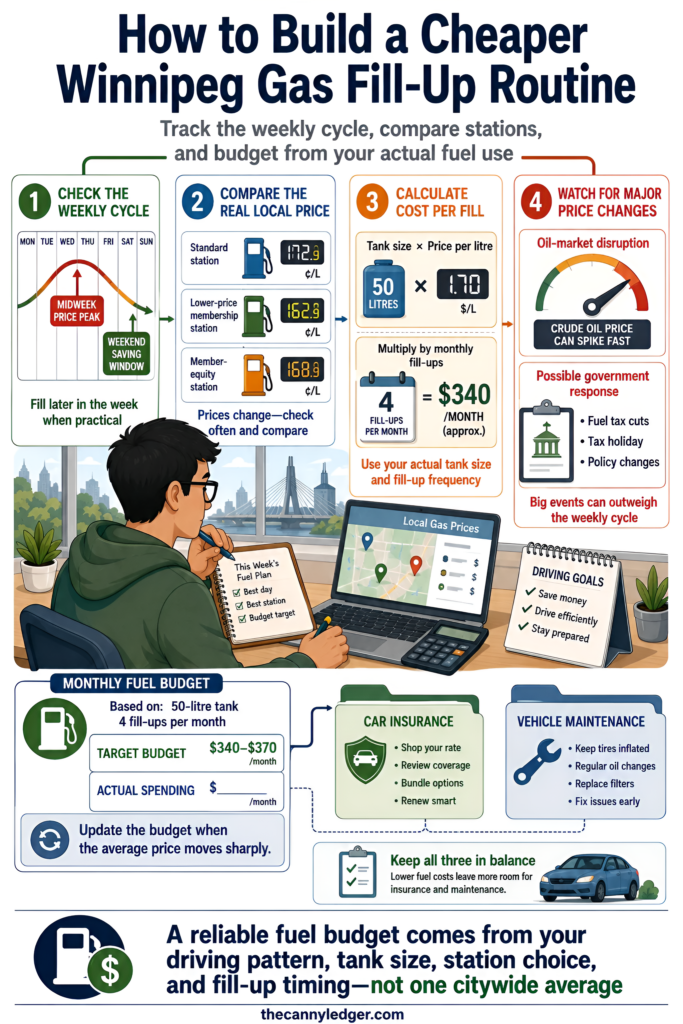
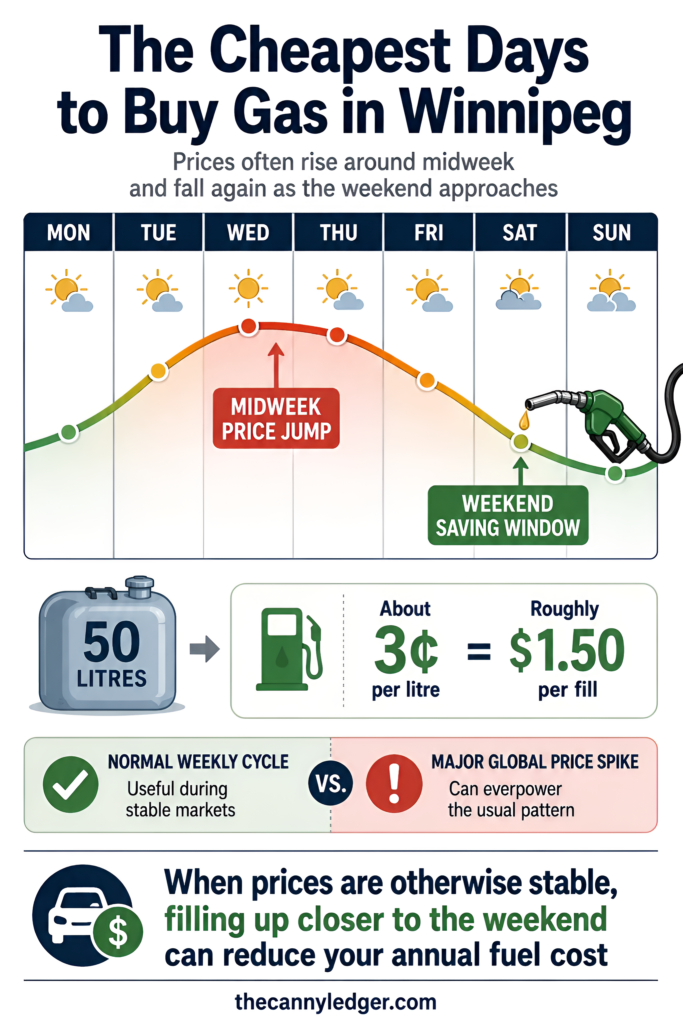
Winnipeg carries one of the strongest weekly gas price cycles in Canada, with prices consistently jumping around midweek and sliding back down heading into the weekend, a pattern that can shift the price you pay by roughly 3 cents a litre depending purely on which day you fill up. This cycle exists independent of the broader global price swings covered above, meaning even during a relatively stable stretch, timing your fill-up toward the weekend rather than midweek genuinely saves money over the course of a year for anyone filling up regularly. It’s a detail local price-tracking services monitor closely, and one that a driver moving to Winnipeg from a city without this kind of predictable weekly pattern might not think to watch for at all.
Costco and Red River Co-op Set the City’s Price Floor
Two specific retailers function as genuine price anchors in the Winnipeg market rather than simply competing at the same level as everyone else. Costco’s gas bar has consistently priced well below the citywide median, often by 10 cents a litre or more, though access requires a paid Costco membership, a real tradeoff worth weighing against how often you’d actually use it purely for fuel savings. Red River Co-op operates on a member equity model, where a portion of profits get returned to members over time, effectively rebating part of every fill-up indirectly even when the posted price at the pump doesn’t look dramatically different from competitors. Neither of these options requires a special trick to access, simply membership in one case and patronage in the other, but both meaningfully shift what a regular Winnipeg driver actually pays over a full year of fill-ups.

What a Typical Winnipeg Household Actually Spends on Gas
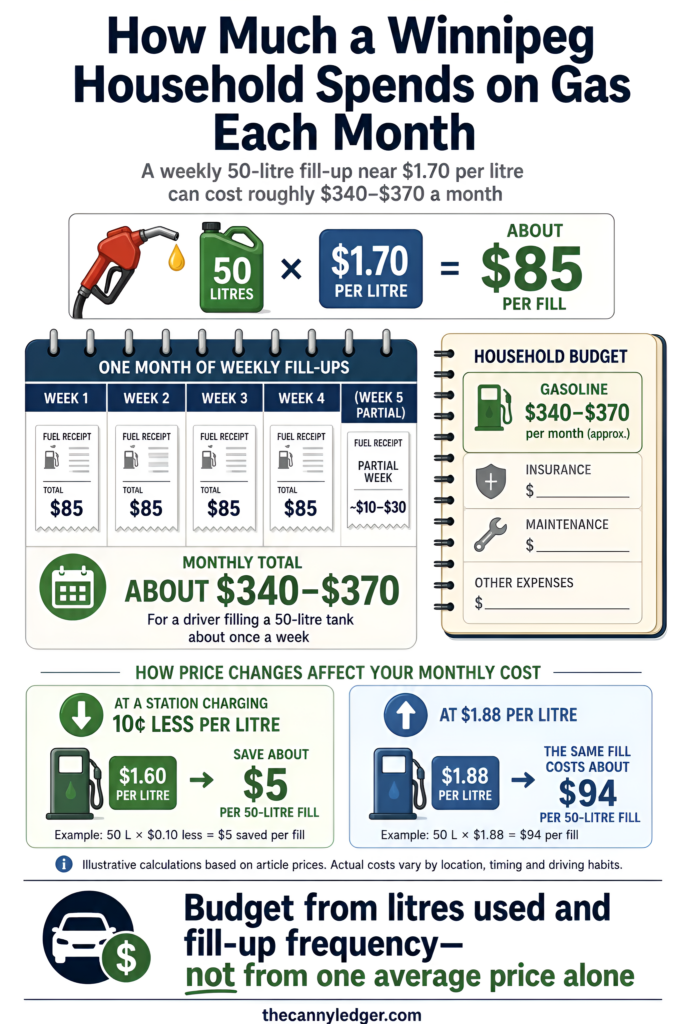
Using the current average of roughly 170 cents a litre, filling a typical 50-litre tank costs approximately $85, and a driver filling up weekly can expect to spend somewhere in the range of $340 to $370 a month on gasoline alone, before accounting for the meaningful savings available through Costco, Red River Co-op, or simply timing fill-ups toward the weekend cycle described above. This figure obviously scales directly with how much a specific household actually drives, but it provides a genuine anchor point for budgeting purposes, one that shifts noticeably during periods like the April 2026 spike, when the same fill-up would have cost meaningfully more for several weeks running.
How Winnipeg Compares to Other Prairie and Canadian Cities
As of July 2026, Winnipeg’s regular gas prices sit roughly tied with Calgary and well below Vancouver, landing Winnipeg in a genuinely mid-pack position among major Canadian cities despite carrying one of the lighter overall tax burdens on fuel. This positioning reflects Winnipeg’s specific supply chain, receiving fuel via pipeline and rail from Alberta and Saskatchewan refineries rather than a local source, which ties the city’s baseline pricing closely to prairie wholesale rack prices even as the specific retail landscape, driven by Costco and Red River Co-op’s pricing pressure, keeps Winnipeg from running meaningfully higher than comparable prairie cities.

Could Another Gas Tax Holiday Happen Again?
Manitoba has used a temporary provincial gas tax holiday as a direct response to price spikes before, and the province made that specific cut permanent in December 2024, and during the April 2026 spike specifically, Premier Kinew confirmed the government was actively considering a second such holiday without having made a final decision at the time. This history matters for budgeting purposes since it means Manitoba’s fuel tax rate, while currently set permanently at 12.5 cents a litre, has genuine precedent for temporary provincial intervention during periods of acute price pressure, a policy lever drivers in some other provinces don’t have available to them at all.

Common Questions
Does filling up at Costco actually save enough to justify a membership just for gas? It depends entirely on how much you drive, but for a household filling up weekly, the roughly 10-cent-per-litre gap on a 50-litre tank works out to about $5 saved per fill, which adds up to meaningful annual savings well beyond a standard Costco membership fee for anyone using it regularly.
Is Manitoba’s gas tax actually lower than other provinces right now? Yes, relative to several other jurisdictions, since Manitoba charges no provincial sales tax on gasoline and has no consumer carbon levy currently in effect, though the specific comparison varies province by province and is worth checking directly if you’re comparing costs before a cross-provincial move.
Should I wait for the weekend to fill up every single time? Generally yes if your schedule allows it, since Winnipeg’s documented weekly cycle consistently pushes prices lower heading into the weekend, though during a genuine global price spike like April 2026, that weekly pattern becomes a much smaller factor compared to the underlying crude price movement itself.
Track the Cycle, Not Just the Sticker Price
Rather than reacting to whatever price happens to be posted when your tank runs low, build Winnipeg’s predictable weekly cycle and the genuine gap between Costco, Red River Co-op, and standard stations into your actual fill-up routine. Watching for the next potential provincial response to a price spike, the way Manitoba has intervened before, is also worth keeping an eye on if pump prices climb sharply again the way they did in April 2026. Gas is only one piece of the total cost of driving in Winnipeg, and our guides to Winnipeg car insurance rates and Manitoba’s public auto insurance system cover the other major recurring expense worth budgeting alongside your regular fill-ups.