
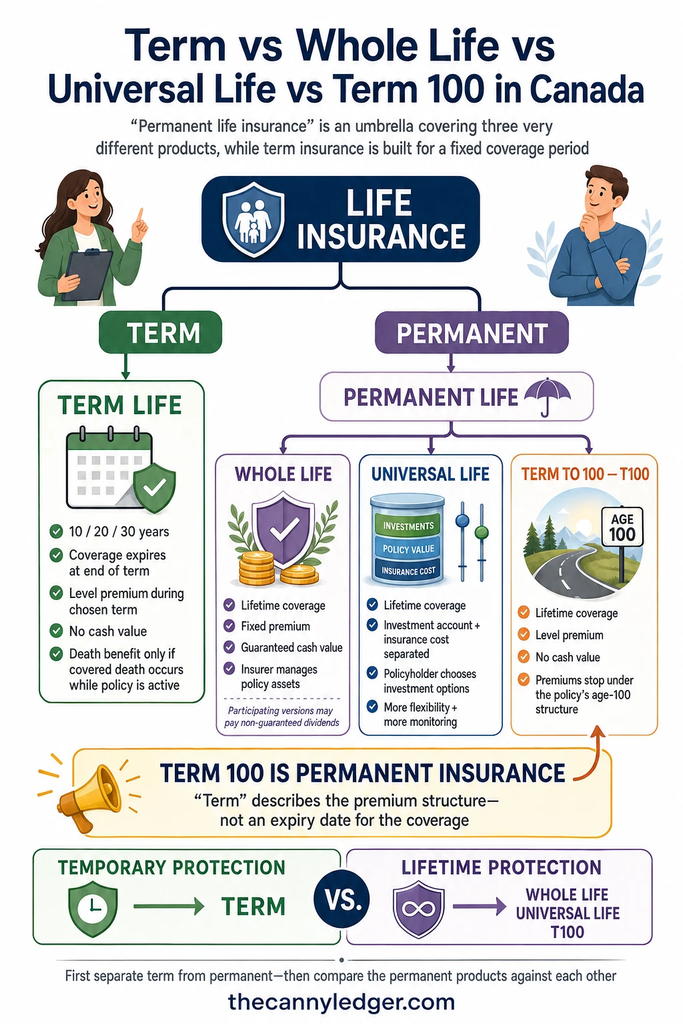
A product called Term 100 is, despite its name, permanent life insurance. It never expires, the death benefit is guaranteed no matter how old you get, and the only reason “term” appears in the name is that you stop paying premiums once you turn 100, not that the coverage itself runs out. That naming quirk is a decent entry point into why this comparison confuses people more than it should, since the word “permanent” gets used as if it describes one product, when it actually covers three genuinely different ones with very little in common besides never expiring.
- What Falls Under Each Umbrella
- The One Question That Actually Sorts Term from Permanent
- Three Very Different Trade-offs Once You’re Inside Permanent
- The Universal Life Trap Almost Nobody Explains Clearly
- Conversion Privileges Aren’t All the Same
- What Protects Each Type If an Insurer Fails
- Matching the Product to the Actual Problem
- Frequently Asked Questions
Term life insurance covers you for a set number of years and pays out only if death happens during that window, while permanent life insurance never expires as long as premiums are paid, and includes three distinct products, whole life, universal life, and term to 100, each of which handles cost and cash value very differently. Choosing between term and permanent starts with whether the need is temporary. Choosing within permanent starts with an entirely different set of questions.
What Falls Under Each Umbrella
Term life insurance is the simpler category by far. Pick a length, usually 10, 20, or 30 years, pay a level premium for that whole stretch, and the policy pays a death benefit only if you die while it’s active. There’s no cash value, no investment component, and nothing paid back if you outlive the term.
Permanent coverage is where the real variety lives. Whole life insurance locks in a fixed premium for life and builds guaranteed cash value inside the policy, managed entirely by the insurer, with participating versions adding the possibility of annual dividends on top of the guarantee. Universal life insurance also covers you permanently and builds cash value, but hands the policyholder direct control over how that cash value gets invested, keeping the cost of insurance and the investment account as two visibly separate pieces rather than one bundled guarantee, a structural difference laid out clearly on the Financial Consumer Agency of Canada’s own life insurance page. Term to 100, sometimes written T100, sits apart from both. It’s permanent in every sense that matters, coverage never expires and the premium never changes, but it carries no cash value at all, which keeps it noticeably cheaper than either whole life or universal life for the same death benefit.
The One Question That Actually Sorts Term from Permanent
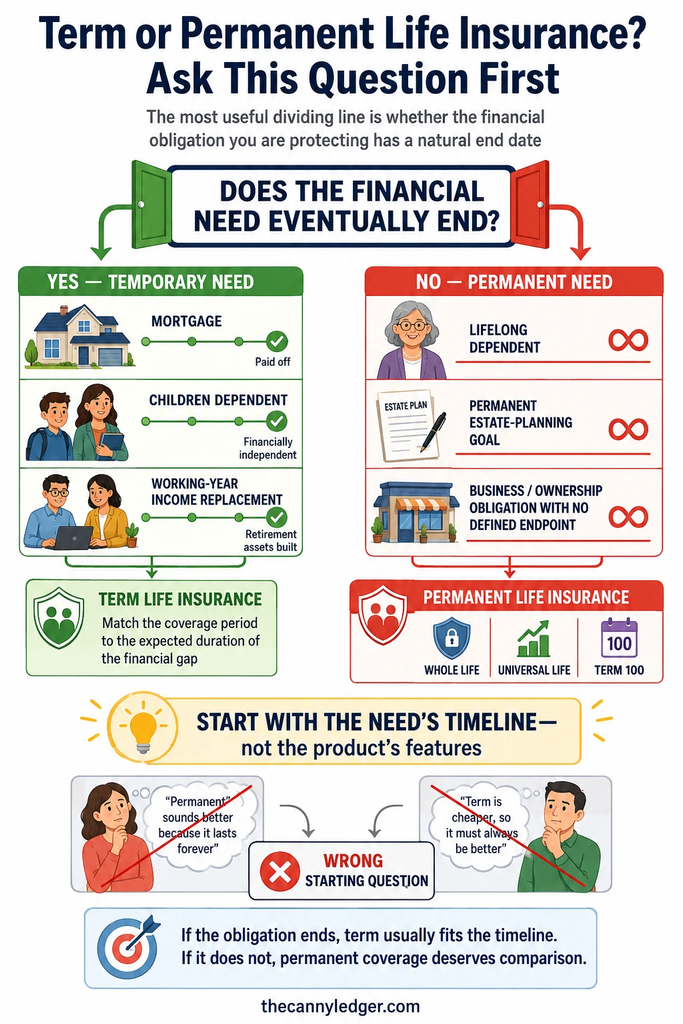
Before getting into which permanent product fits, it’s worth settling whether permanent coverage is needed at all, and that comes down to a single question rather than a long checklist. Does the financial obligation being protected against have a natural endpoint, or does it not? A mortgage gets paid off. Kids grow up and become financially independent. Most income replacement needs shrink as retirement savings build up over a career. All of that points toward term, and the actual coverage amount most people need tends to be sized around exactly those temporary obligations. A lifelong dependent, a permanent estate planning goal, or a business ownership structure with no defined end date don’t have that natural endpoint, and that’s the actual dividing line, not price, not product features, just whether the need itself is temporary or permanent. For a full breakdown of exactly how much the temporary route costs compared to going permanent, the cost gap between term and whole life specifically is worth reading in more depth, since the numbers involved are large enough to deserve their own explanation.
Three Very Different Trade-offs Once You’re Inside Permanent
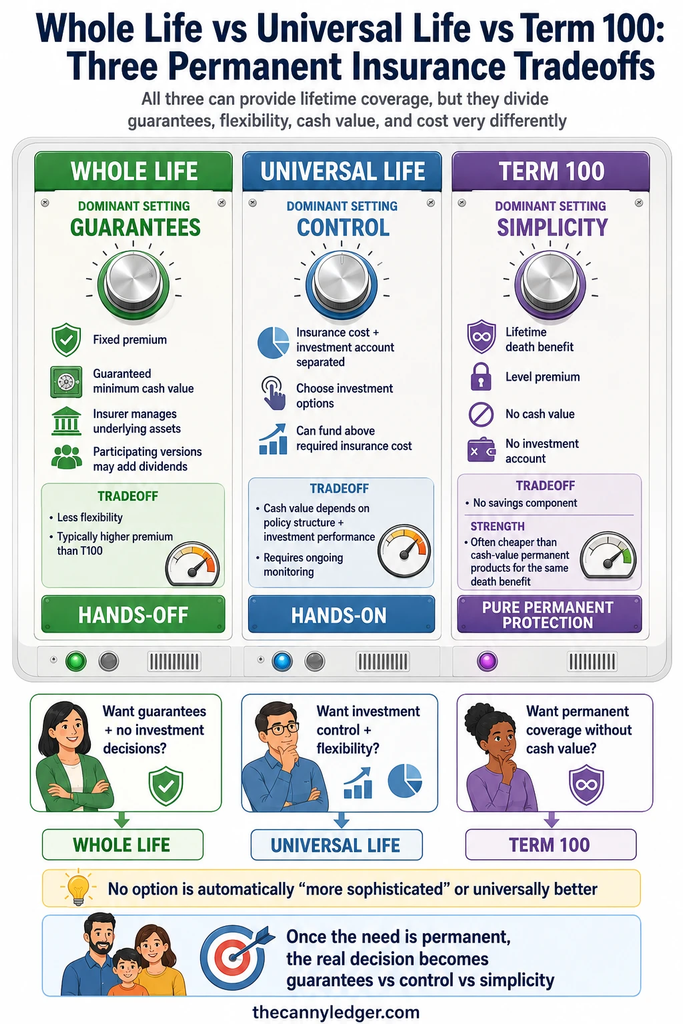
This is the part that gets skipped over constantly, and it’s arguably the more important decision once someone has already decided they need permanent coverage. Whole life is the guaranteed, hands-off option. The insurer manages the investment side entirely, the cash value grows at a contractually guaranteed minimum rate regardless of what markets do, and the tradeoff for that certainty is the least flexibility and, among the three, usually the highest premium relative to the coverage amount, especially early on.
Universal life flips that trade-off. The policyholder chooses how the cash value gets invested, from a conservative daily interest account up through equity-linked options, and can adjust how much gets paid in above the minimum required to cover the cost of insurance. That flexibility appeals to people who want more control and are comfortable with investment decisions, but it also means the cash value isn’t guaranteed the way it is in whole life, and poor investment choices or years of underfunding can leave the policy in worse shape than expected.
Term to 100 skips the investment question entirely. There’s no cash value to manage, no dividend scale to track, and no investment decisions to make, just a guaranteed level premium and a guaranteed death benefit for life, a structure RBC Insurance describes plainly as coverage with the premium paying for insurance protection only. That simplicity is exactly why it tends to be the cheapest of the three permanent options, and it suits someone who wants the certainty of permanent coverage without paying for or managing a savings component they may not need.
The Universal Life Trap Almost Nobody Explains Clearly
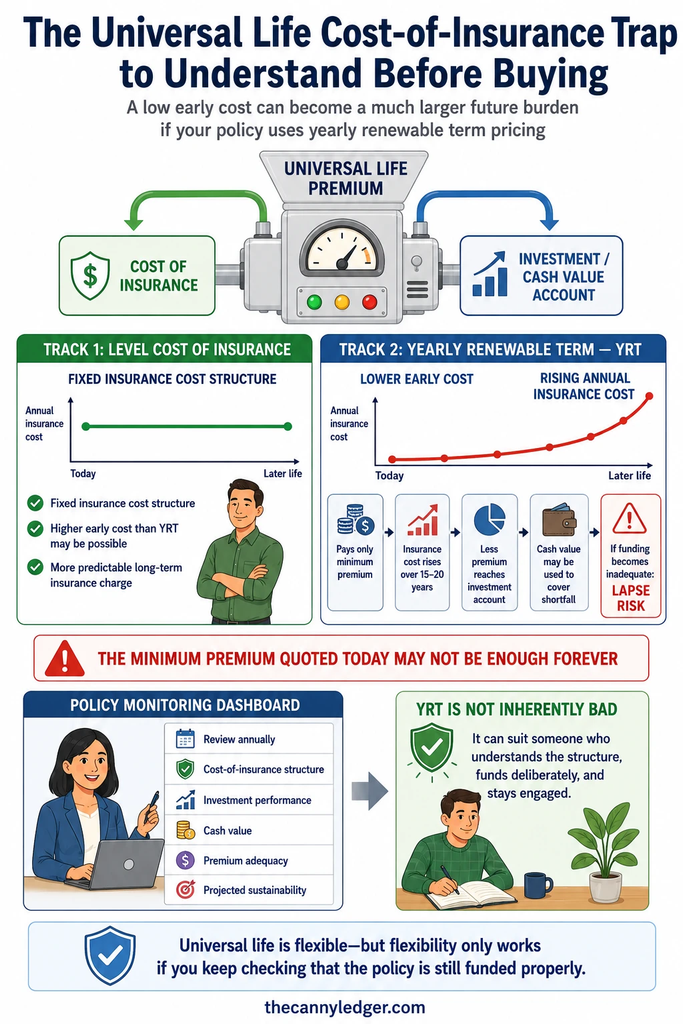
Universal life insurance in Canada comes with a choice buried in the fine print that has real consequences years down the road, and it’s one of the least understood parts of any permanent policy. The cost of insurance inside a universal life policy gets structured one of two ways. A level cost of insurance stays fixed for life, calculated once at issue and never changing, similar in spirit to how a term to 100 policy prices its coverage. A yearly renewable term cost of insurance, often shortened to YRT, starts noticeably lower but increases every single year as the insured person ages, the same way a policy that gets repriced annually naturally would.
The trap shows up when someone chooses YRT pricing because the early premiums look attractive, pays only the minimum required, and doesn’t fully account for what happens 15 or 20 years in, when the cost of insurance has climbed high enough to consume most or all of the premium being paid, leaving little or nothing flowing into the investment side. TD Insurance’s own explanation of policy types confirms this structural split between level and increasing cost of insurance is a standard feature of universal life products sold across the industry, not something unique to one insurer’s design. If the cash value that’s already built up isn’t large enough to cover the shortfall, the policy can lapse entirely, sometimes decades after it was purchased and often at an age when replacing that coverage is far more expensive or medically impossible. This isn’t a reason to avoid universal life outright, since someone who genuinely wants to actively manage the investment component and stays engaged with the policy over time can do very well with it. It is a reason to know exactly which cost of insurance structure a policy uses before signing anything, and to revisit that choice periodically rather than assuming the minimum premium quoted at purchase will still be enough decades later.
Conversion Privileges Aren’t All the Same
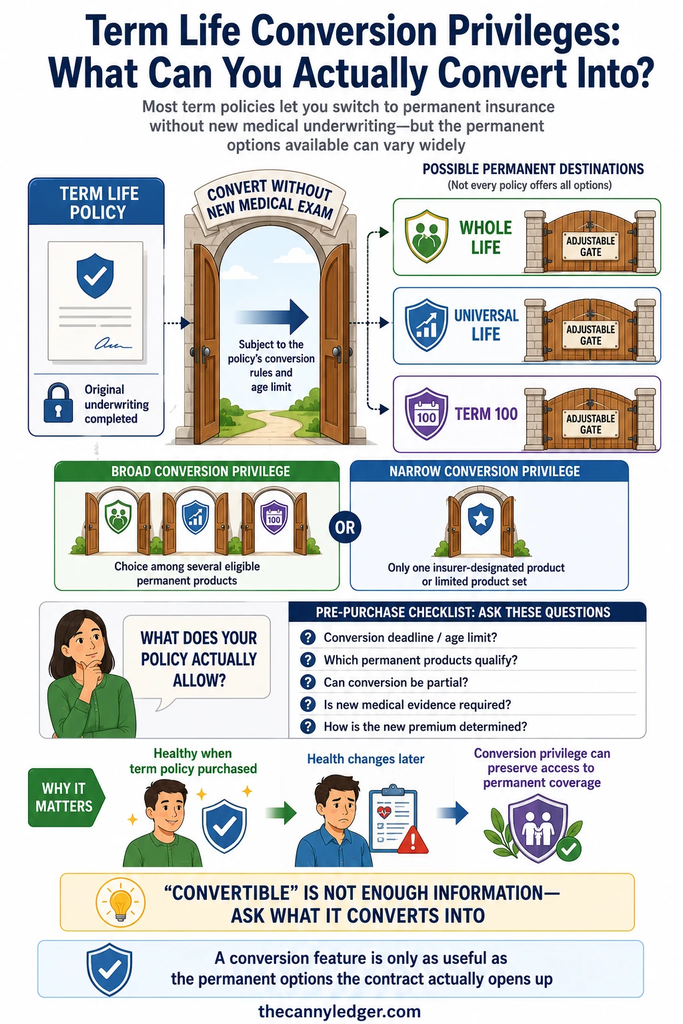
Most term policies include the right to convert to permanent coverage without a new medical exam, usually up to a specified age, but which permanent products that conversion actually leads to varies by insurer and by the specific term policy purchased. Some conversion privileges are written broadly enough to allow a choice between whole life, universal life, or term to 100 at the time of conversion. Others are narrower and route automatically into one specific permanent product the insurer designates. This detail rarely gets asked about at the point of buying term coverage, since conversion feels like a distant, unlikely-to-matter feature in the moment, but it’s worth confirming in writing which permanent options a specific policy’s conversion privilege actually opens up, particularly for anyone who suspects they might want the investment flexibility of universal life rather than being defaulted into whichever product the conversion clause happens to specify.
What Protects Each Type If an Insurer Fails
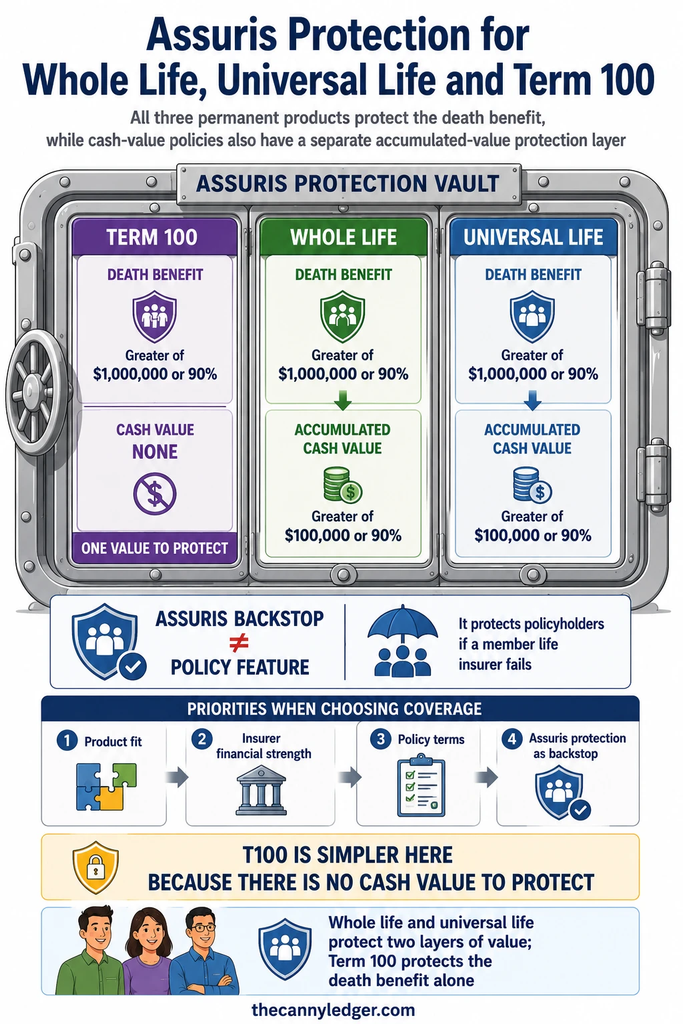
The protection picture differs across all three permanent products, and it’s worth understanding before assuming they’re all treated identically. Every Canadian insurer belongs to Assuris, and for a term to 100 policy specifically, that protection guarantees up to $1,000,000 or 90 percent of the death benefit, whichever is higher, but since T100 carries no cash value, there’s nothing beyond the death benefit to protect. Whole life and universal life policies get that same death benefit protection plus a separate guarantee on accumulated cash value, up to $100,000 or 90 percent of the cash value, whichever is higher. None of this should be the deciding factor between the three products, since insurer failures are rare, but it does mean the simplicity of term to 100 extends even to how little there is to worry about if the worst happened to the company behind it.
Matching the Product to the Actual Problem
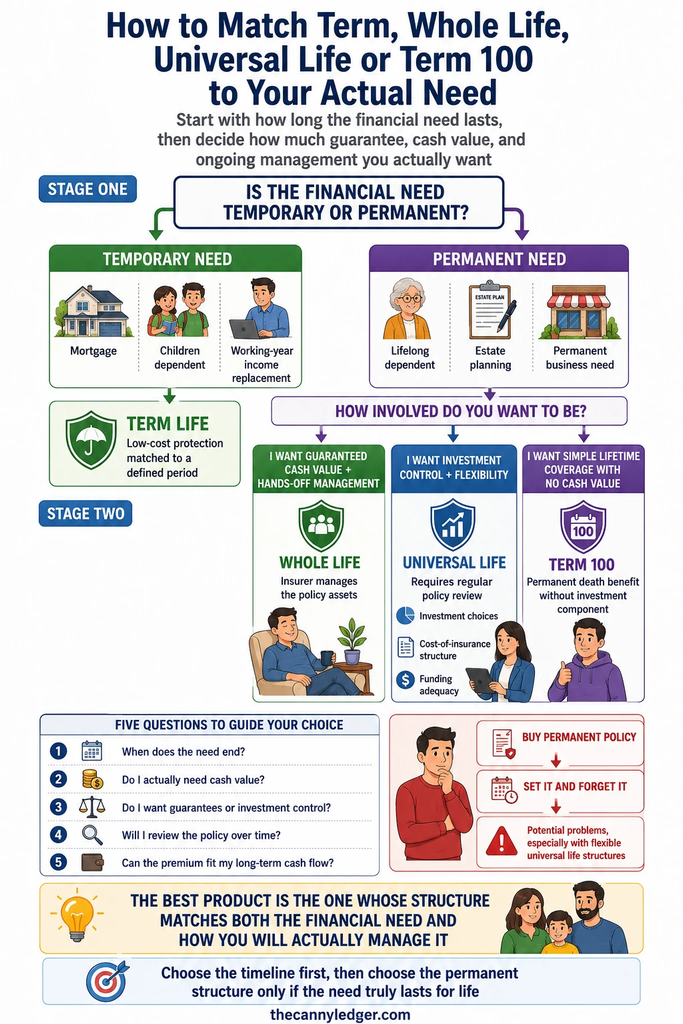
Start with the temporary versus permanent question first, since getting that wrong makes every downstream decision irrelevant. If the need is genuinely permanent, whether that’s a lifelong dependent, an estate planning goal, or a business structure with no natural end date, the next question is how much involvement makes sense with managing the coverage itself. Someone who wants the simplest possible permanent product, with nothing to monitor or adjust over the decades ahead, tends to land on term to 100 or a guaranteed whole life policy. Someone who wants more control over investment choices, is comfortable reviewing the policy periodically, and understands the cost of insurance structure they’ve chosen tends to be a better fit for universal life. Neither answer is more sophisticated than the other. The better one is whichever a person will actually stay engaged enough with to avoid the lapses and shortfalls that come from setting a permanent policy up once and never looking at it again.
Frequently Asked Questions
Is term to 100 still sold by major Canadian insurers? Yes. Several major Canadian insurers, including RBC Insurance and BMO Insurance, continue to offer term to 100 as a standard permanent product, typically available to applicants between 18 and 85 years old.
Can a universal life policy lapse even if premiums are always paid on time? Yes, particularly with a yearly renewable term cost of insurance structure, if the premium being paid only covers the minimum required and the rising cost of insurance eventually exceeds what’s being contributed, drawing down the cash value until nothing is left to cover the shortfall.
Does converting a term policy to permanent require requalifying for the same coverage amount? Generally no. Most conversion privileges allow the same coverage amount to carry over without new medical underwriting, though increasing the coverage amount at the time of conversion typically does require new underwriting.
Which permanent option is usually the cheapest? Term to 100 is typically the least expensive of the three, since it carries no cash value or investment component, followed by universal life with a yearly renewable term cost of insurance in the early years, with whole life and level-cost universal life generally the most expensive at the outset.