
A universal life policy can look completely healthy on a statement for fifteen years and then send a letter warning that it’s about to lapse within the year. That outcome catches people off guard more than almost anything else in Canadian life insurance, and it happens because the product was built around a promise of flexibility that quietly shifts the management burden onto the policyholder. Universal life insurance in Canada is permanent coverage split into two separate, trackable pieces, a death benefit and an investment account, and understanding how those two pieces interact is the difference between a policy that does exactly what you bought it for and one that unravels at the worst possible time.
- Two Separate Engines Running Inside One Policy
- Choosing How the Cost of Insurance Behaves
- What the Investment Account Actually Invests In
- The Death Benefit Choice Most People Never Think About
- How the Tax Treatment Actually Works
- What Coverage Actually Costs
- What Happens if Your Insurer Fails
- Whole Life or Universal Life, and Who Actually Benefits From Which
- Mistakes That Show Up Years Into a Policy
- Common Questions About Universal Life Insurance in Canada
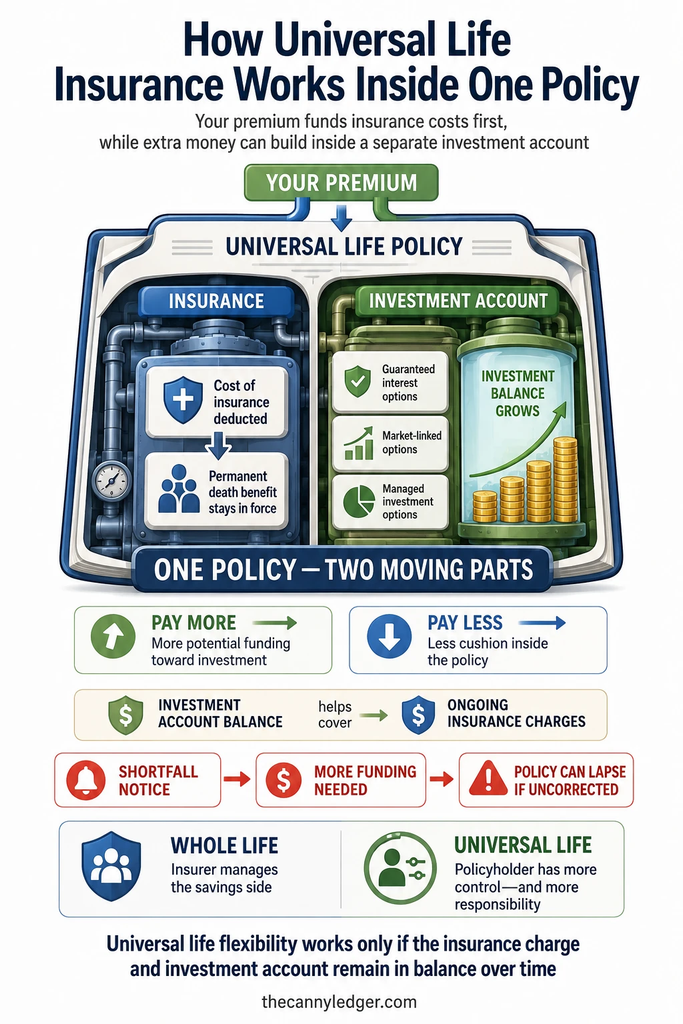
At its simplest, and as the Financial Consumer Agency of Canada frames permanent coverage generally, universal life pairs a permanent death benefit with a tax-sheltered investment account inside the same contract. Your premium covers the cost of insurance first, and anything paid above that cost gets deposited into the investment account, where it can grow in guaranteed interest options, market-linked funds, or a mix of both, all inside a policy the Income Tax Act treats as tax-exempt as long as it stays within set limits.
Two Separate Engines Running Inside One Policy
Whole life insurance bundles insurance and savings into a single number the insurer manages for you. Universal life splits them into components you can actually see and, to a real extent, control. The insurance side works on a cost of insurance charge deducted from your account, similar in principle to buying a fresh block of term coverage every period, while the investment side sits in an account you choose funds for and can move money between.
That separation is the entire sales pitch, and it’s a legitimate one. You decide how much to overfund the investment side beyond the minimum required to keep the policy in force, you pick from guaranteed interest accounts, indexed accounts, or actively managed funds depending on your risk tolerance, and you can adjust your premium payments up or down as your income changes from year to year. None of that flexibility exists in a whole life contract, where the insurer sets the terms once and you follow them for the life of the policy.
The trade-off is that nobody is watching the account for you the way a whole life insurer manages its own participating fund. If the investment side underperforms, if you pay only the bare minimum for several years, or if the cost of insurance rises faster than you expected, the account can shrink to the point where it can no longer cover the monthly charge. At that point the insurer sends a shortfall notice, and if it goes unanswered, the policy lapses. This is the single biggest structural difference from whole life, and it’s worth sitting with before comparing the two products on price alone.
Choosing How the Cost of Insurance Behaves
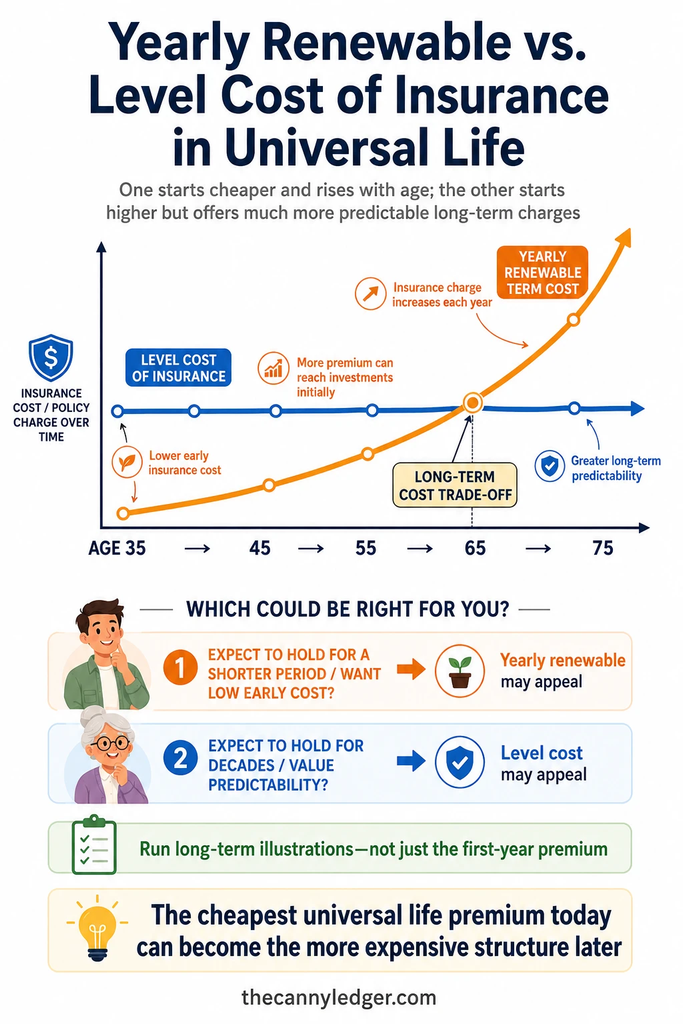
Every universal life policy in Canada requires you to pick between two ways the cost of insurance is charged, and this decision shapes the entire policy more than almost any other choice you’ll make at the application stage. Yearly renewable term cost of insurance starts low and rises every year as you age, the same way term insurance premiums would if you bought a fresh one-year policy annually for the rest of your life. Level cost of insurance charges more in the early years but locks that amount in for as long as you hold the policy, trading a higher starting cost for predictability decades down the road.
Neither option is objectively better, and Equitable Life’s own advisor materials list both the yearly renewable term and level cost of insurance choices side by side for exactly this reason, since the right pick depends entirely on how long the policyholder plans to keep the contract. Yearly renewable term suits someone who wants to overfund the investment account aggressively while the insurance charge is still cheap, since more of each premium dollar goes toward growth in the early years. Level cost of insurance suits someone planning to hold the policy for twenty years or more, since the rising cost under the yearly renewable structure eventually overtakes what a level charge would have cost, often somewhere in the policyholder’s fifties or sixties depending on the specific rate table. A policy sold with the wrong structure for how long you actually intend to keep it can end up costing meaningfully more over its lifetime, which is exactly the kind of detail that gets skipped in a sales conversation focused on the lowest starting premium.
What the Investment Account Actually Invests In
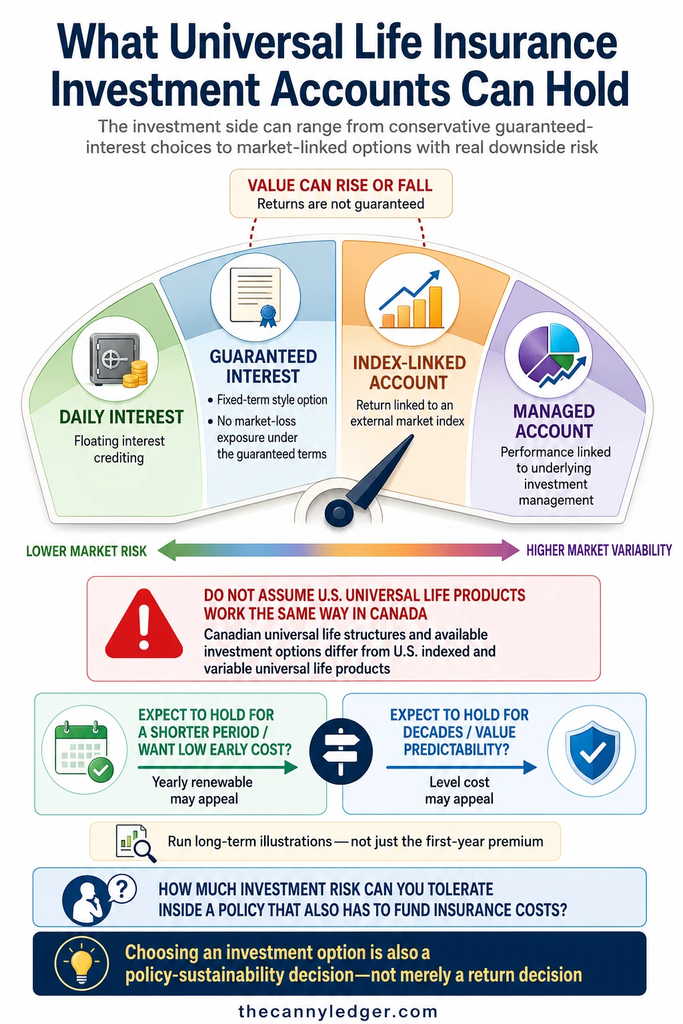
The account sitting inside a universal life policy isn’t a single generic pool of money. Depending on the insurer, you can typically choose among a handful of structures, and picking the wrong one for your temperament is a quieter but common mistake. Daily interest and guaranteed interest accounts function like a GIC inside the policy, crediting a fixed or floating rate with no risk of loss. Managed and indexed accounts track the performance of underlying investment funds or market indices, which means the account can grow faster in good years and shrink in bad ones, with no floor protecting the principal the way a guaranteed account does. Sun Life’s own SunSpectrum Universal Life II product page lays out exactly this range, from floating daily interest through to managed accounts tied to fund performance, with no guaranteed return on the market-linked side.
It’s worth being precise about what Canadian universal life is not, since marketing language sometimes borrows terminology from products that don’t actually exist here. Canadian insurers don’t offer the capped-and-floored indexed universal life structure sold in the United States, and variable universal life, where policyholders invest directly in segregated sub-accounts with full market exposure, was discontinued in the Canadian market years ago. What’s sold here sits somewhere in between, market-linked growth potential without the specific guarantee structures American products use, which matters if you’ve read about indexed or variable universal life from a US source and assumed the same mechanics apply north of the border.
The Death Benefit Choice Most People Never Think About
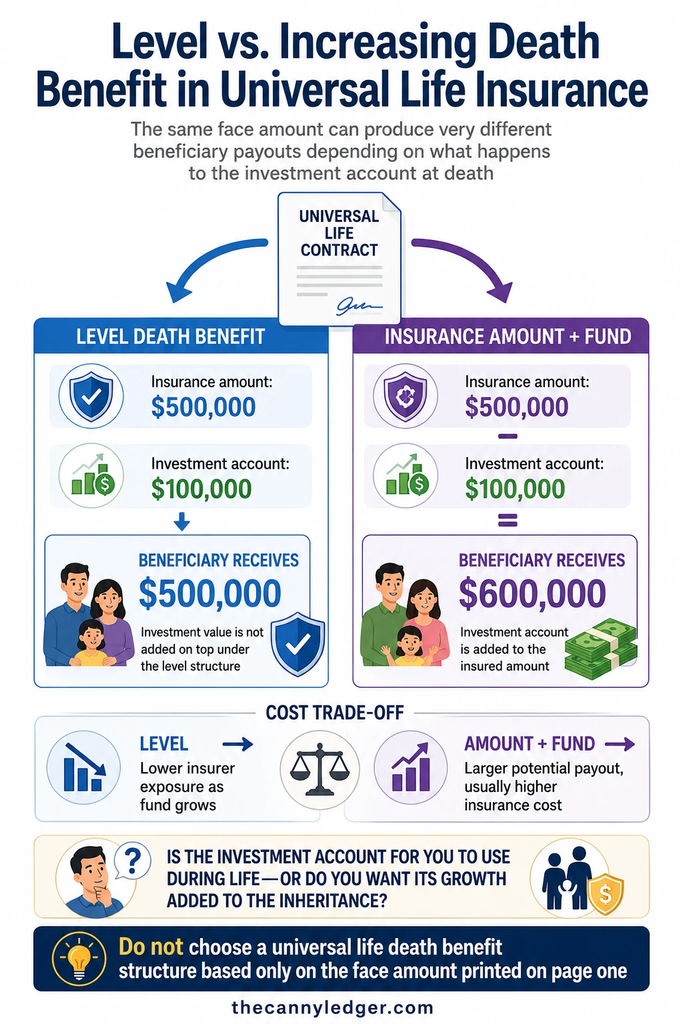
Alongside the cost of insurance decision, every universal life application asks you to choose a death benefit structure, and the two options pay out very differently even when the stated coverage amount looks identical on paper. With a level death benefit, your beneficiary receives the face amount of the policy, and the investment account effectively gets absorbed into that payout rather than added on top of it. With an insurance amount plus fund structure, sometimes called an increasing death benefit, your beneficiary receives the face amount and the investment account value combined, meaning a policy that has built up substantial cash value pays out considerably more than the number printed on the original contract.
The trade-off is cost. An insurance amount plus fund structure costs more to insure over time, since the insurer’s actual risk grows every year that the investment account grows, while a level structure keeps the insurer’s exposure roughly flat because the death benefit absorbs the account instead of adding to it. People who want a policy that behaves like an inheritance guarantee, where investment growth becomes an extra benefit to loved ones rather than a private nest egg, tend to lean toward insurance amount plus fund, while people using universal life primarily as a tax-sheltered savings vehicle they may eventually access themselves often choose the cheaper level option and treat the investment account as something they control separately.
How the Tax Treatment Actually Works
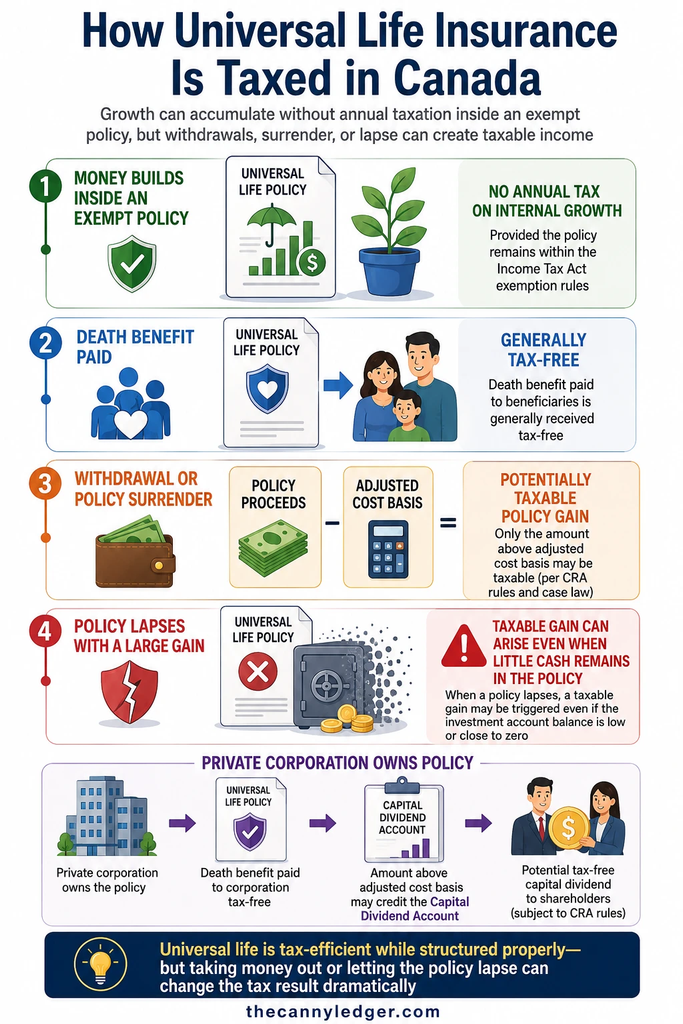
The core tax advantage of universal life mirrors the exempt-policy treatment available to whole life, though the mechanics feel different because you’re managing an actual visible investment balance rather than an insurer-controlled dividend pool. As long as the policy stays within the exemption limits set out in the Income Tax Act, the growth inside the investment account compounds without annual tax, similar in spirit to a Tax-Free Savings Account but without the same annual contribution cap, since the limit here is tied to the size of the death benefit rather than a fixed dollar figure. This is the feature that draws high-income earners and incorporated professionals who have already maxed out their registered account room and want another tax-deferred place to put money.
The death benefit itself, including any investment account value paid out alongside it, reaches beneficiaries tax-free, exactly as it does with any other type of Canadian life insurance. Where taxation actually shows up is on withdrawal or surrender. If you pull money out of the investment account or the policy lapses or is cashed in, the portion that exceeds the policy’s adjusted cost basis becomes taxable income in that year, the same rule that governs whole life cash value under section 148 of the Income Tax Act. For a universal life policy holding market-linked investments, this creates a specific risk worth naming plainly, if the account has grown substantially and the policy then lapses because premiums stopped or the cost of insurance overtook the account balance, the accumulated gain can become taxable in a single year with no cash left in the policy to actually pay that tax bill. That combination, a lapsed policy and a surprise tax bill, is one of the more painful outcomes in Canadian permanent insurance, and it’s specific to how universal life structures its investment growth compared to whole life.
Corporate ownership follows the same broad pattern as it does for whole life. When a private corporation owns the policy, the death benefit passes to the company tax-free, and the amount exceeding the adjusted cost basis is credited to the corporation’s capital dividend account, which the CRA’s own guidance confirms can then flow out to shareholders as tax-free capital dividends. This structure is a large part of why universal life gets pitched heavily to business owners running money through a corporation, since the combination of tax-deferred growth inside the policy and tax-free extraction at death solves a specific problem that a personal, non-registered investment account can’t match.
What Coverage Actually Costs
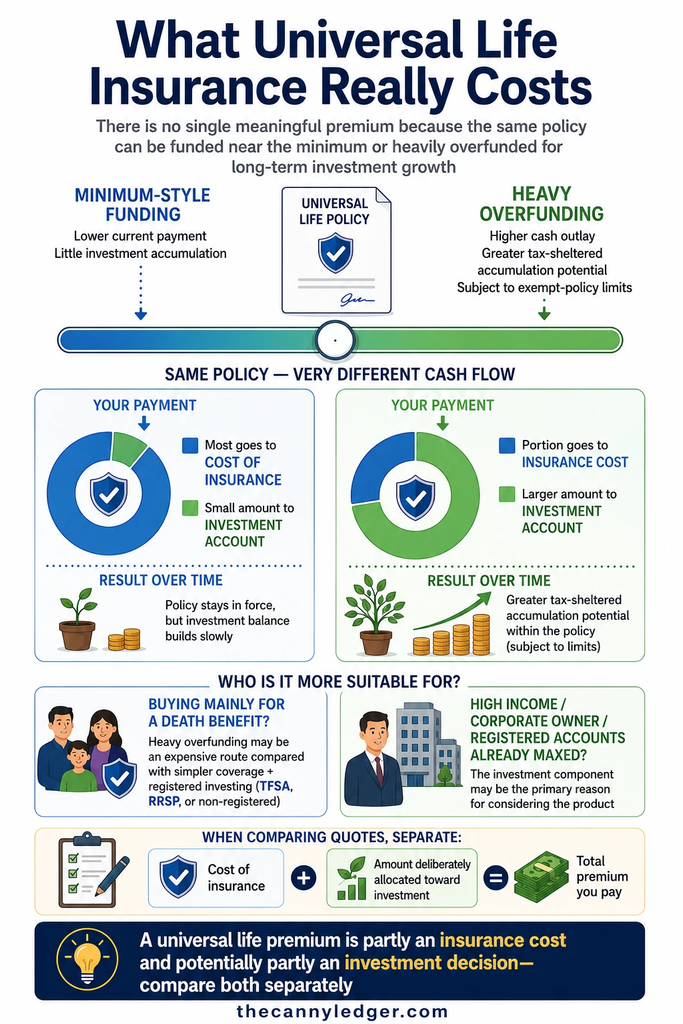
Cost comparisons for universal life are more complicated to state cleanly than they are for term or whole life, because the premium you’re quoted depends heavily on how much you plan to overfund the policy above the bare minimum. At the bare minimum, a universal life policy funded only enough to cover the cost of insurance behaves financially similar to renting term coverage for life, without meaningfully building an investment account. Overfunding it toward the maximum the exempt-policy rules allow turns the same policy into a much more expensive proposition, since a larger share of each payment is now going toward investment growth rather than pure insurance cost.
For business owners considering permanent coverage tied to a corporate structure, or for high-income individuals who’ve already exhausted their registered accounts, that higher funding level is often the entire point of buying the product, and the cost only looks expensive if you’re comparing it to term insurance rather than to what a non-registered, fully taxable investment account would have cost them in tax drag over the same period. For someone shopping primarily for a death benefit and treating any cash value as a bonus, universal life at a heavier funding level is rarely the cheapest way to get there, and a smaller policy paired with disciplined use of registered accounts usually wins on pure cost.
What Happens if Your Insurer Fails
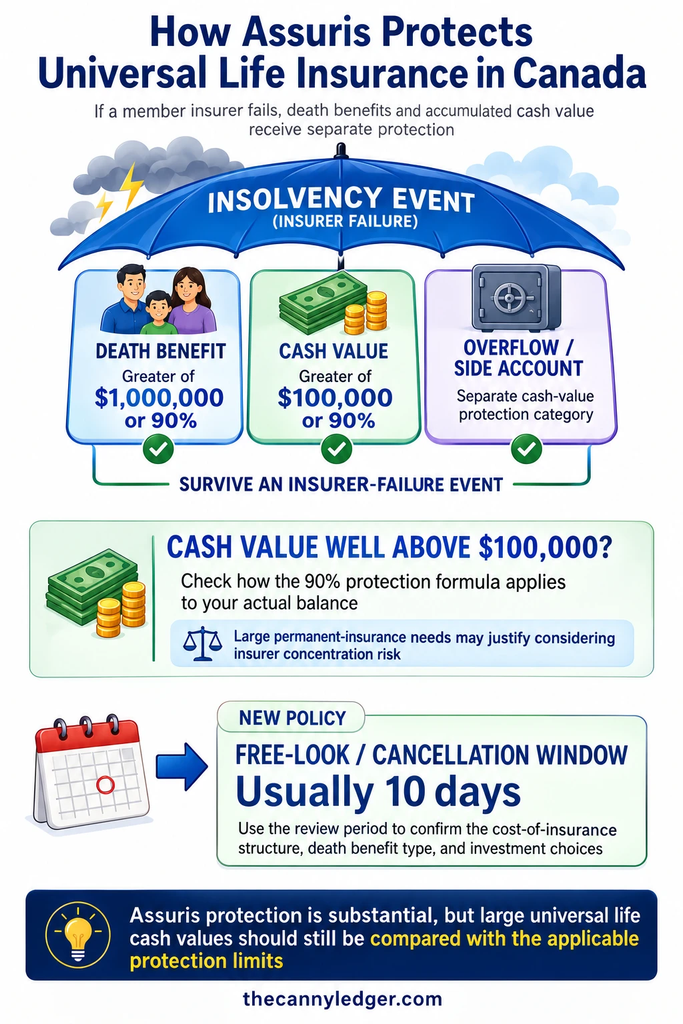
Universal life carries the same Assuris protection framework as whole life, though the specific components being protected are worth spelling out since the policy is structured differently underneath. Assuris guarantees policyholders will retain the greater of one million dollars or 90 percent of the death benefit, and the greater of one hundred thousand dollars or 90 percent of the policy’s cash value, if a member insurer becomes insolvent. If the policy has a separate overflow or side account holding additional accumulated funds, that’s protected under the same hundred-thousand-dollar or 90 percent threshold as a distinct category.
Because universal life policies often hold larger investment balances than a typical whole life contract, especially once a policyholder has been overfunding for a decade or more toward the exempt-policy maximum, it’s worth actually checking your account value against that hundred-thousand-dollar threshold rather than assuming the protection automatically covers whatever you’ve accumulated. A policyholder who has built up a large investment account inside a single universal life contract with one insurer is exposed on the amount above that threshold in the unlikely event of an insurer failure, which is a real, if uncommon, argument for spreading larger permanent coverage needs across more than one company. It’s also worth remembering that Canadian buyers get a right to cancel a new policy within the first 10 days, usually, for a full premium refund, a useful window for having the cost of insurance structure and death benefit type reviewed by a second set of eyes before that free look period closes.
Whole Life or Universal Life, and Who Actually Benefits From Which
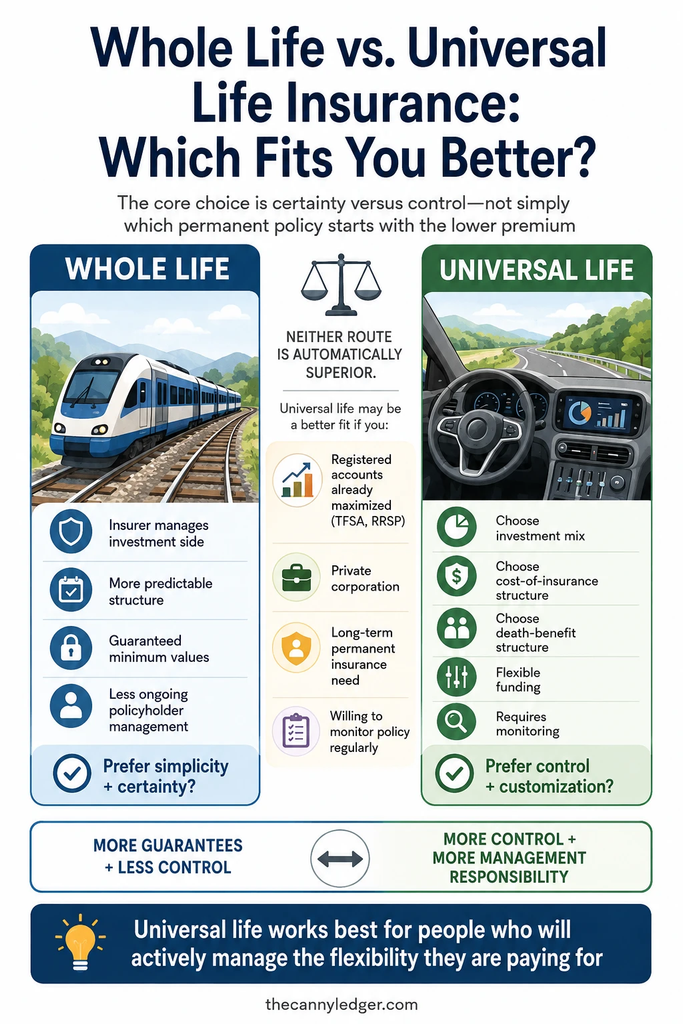
The honest answer to whether whole life or universal life fits your situation better usually comes down to how much you value certainty versus control. Whole life removes almost every decision from your hands after the initial purchase, the insurer manages the investment side, declares dividends, and guarantees a minimum cash value regardless of what happens in the market. Universal life hands you the wheel, letting you choose your cost of insurance structure, your death benefit type, and your investment mix, but that control comes with real responsibility to monitor the account over decades, not just at purchase.
People who have already maxed out their TFSA and RRSP room, who run income through a private corporation, or who want granular control over how their permanent coverage’s investment side is allocated tend to be better served by universal life, provided they or an advisor are actually willing to check on the policy periodically rather than treating it as a set-and-forget purchase. People who want the simplicity of one premium, one guaranteed outcome, and zero ongoing management tend to be better served by whole life insurance, even though it costs more upfront relative to a minimally funded universal life policy. Our comparison of whole life against universal life walks through the decision in more detail if you’re weighing the two directly against each other.
Mistakes That Show Up Years Into a Policy
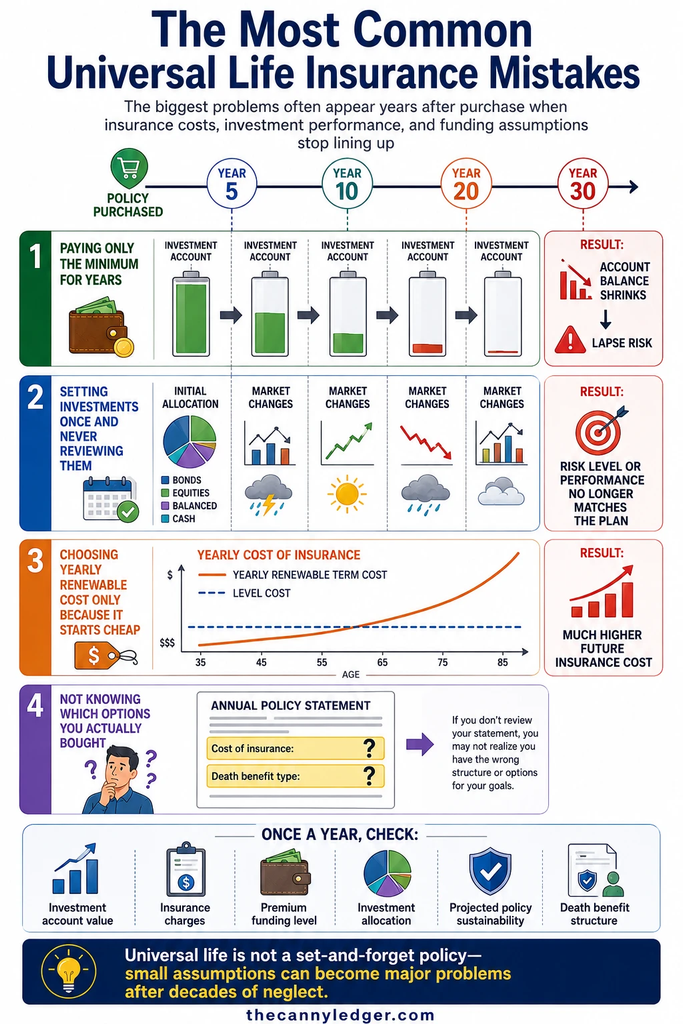
The most damaging mistake with universal life rarely shows up in year one, it shows up a decade or two in, when a policyholder who paid only the minimum premium every year discovers the cost of insurance has climbed past what the shrinking account can absorb. Because yearly renewable term charges rise every single year, a policy that looked perfectly affordable at thirty-five can require a dramatically larger payment by sixty to avoid lapsing, and policyholders who set up automatic minimum payments decades earlier and never revisited the policy are the ones most often caught off guard.
A second mistake is treating the investment side as a substitute for actual investment advice. The account inside a universal life policy is real money subject to real market risk if it’s allocated to managed or indexed options, yet it often gets set up once at the point of sale and never rebalanced or reviewed again, unlike a typical investment account most people at least glance at once a year. A third, quieter mistake is choosing yearly renewable term cost of insurance because the starting premium looks attractive, without running the math on where that annually increasing charge lands in the policyholder’s sixties or seventies, by which point the level cost of insurance option would very often have been cheaper overall.
If you already hold a universal life policy and aren’t certain which cost of insurance structure or death benefit option you selected, the answer is on your annual policy statement or available by calling your insurer directly, and it’s worth confirming rather than assuming, since the two structures behave so differently over the decades that follow.
Common Questions About Universal Life Insurance in Canada
Can a universal life policy actually expire or lapse even though it’s called permanent? Yes. Permanent refers to the type of coverage, not a guarantee that the policy will stay in force regardless of funding. If the investment account can no longer cover the cost of insurance and no additional premium is paid, the policy lapses just like an underfunded term policy would at renewal, and any coverage ends.
Is the investment account inside a universal life policy the same as owning mutual funds directly? No. The account tracks the performance of underlying funds or indices for the purpose of crediting interest to your policy, but you don’t directly own units the way you would in a non-registered or registered investment account, and the tax treatment, fees, and access rules are governed by the insurance contract rather than securities regulations.
Do I need to be wealthy or incorporated to benefit from universal life insurance? Not necessarily, but the tax-deferral advantage matters most to people who have already used up their TFSA and RRSP contribution room, or who are running income through a corporation. For most Canadians who still have registered account room available, maxing those accounts first is typically the simpler and cheaper path before a heavily funded universal life policy makes sense.