
A grandmother who comes into an inheritance and decides to open a Registered Education Savings Plan (RESP) for her grandchild with the full $36,000 in one deposit is trying to do something generous and smart. She’ll actually walk away with $500 in matching grant money that year, not the $7,200 she was expecting, and there’s no way to go back and claim the rest later. The Canada Education Savings Grant (CESG) matches contributions made in a given calendar year, not the total sitting in the account, and a single enormous deposit only ever counts as one year’s worth of contributing, no matter how large it is.
- The Math Behind the Right Amount
- Why a Windfall Doesn’t Work the Way People Expect
- The Smarter Way to Handle a Windfall
- Starting Early Versus Starting Late
- Additional CESG Changes the Priority Slightly
- What Happens to the Other $14,000 of Room
- Building an Actual Year-by-Year Plan
- Setting Up Your Own Schedule
The actual strategy for maximizing RESP grants isn’t about how much money eventually goes in. It’s about when it goes in, spread deliberately across enough calendar years to trigger the matching every single time, in line with the broader government grants an RESP can attract.
The Math Behind the Right Amount
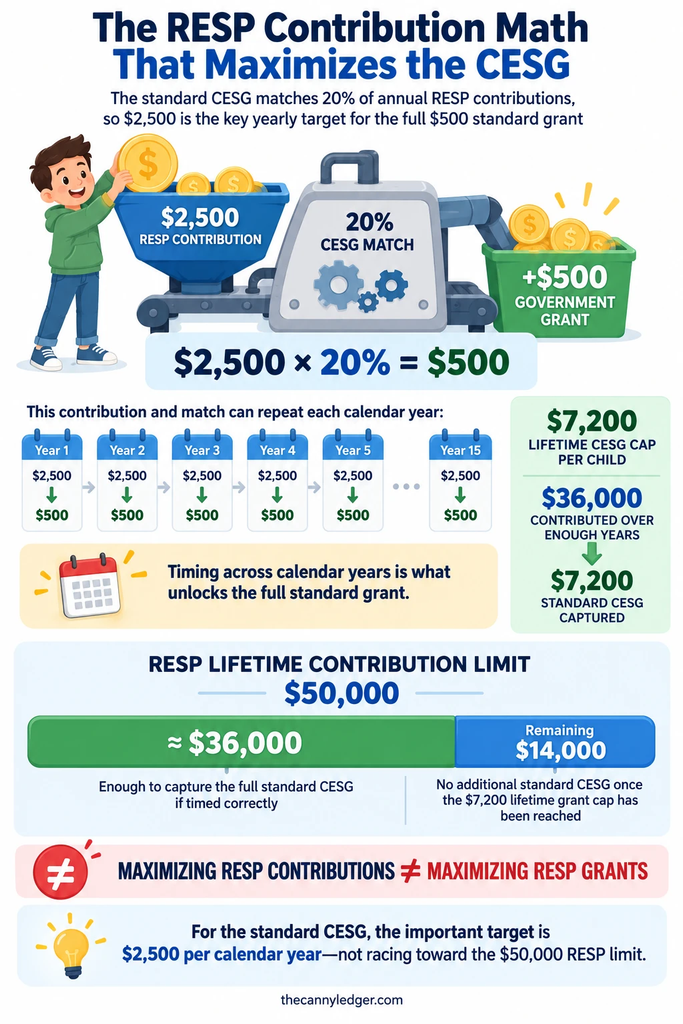
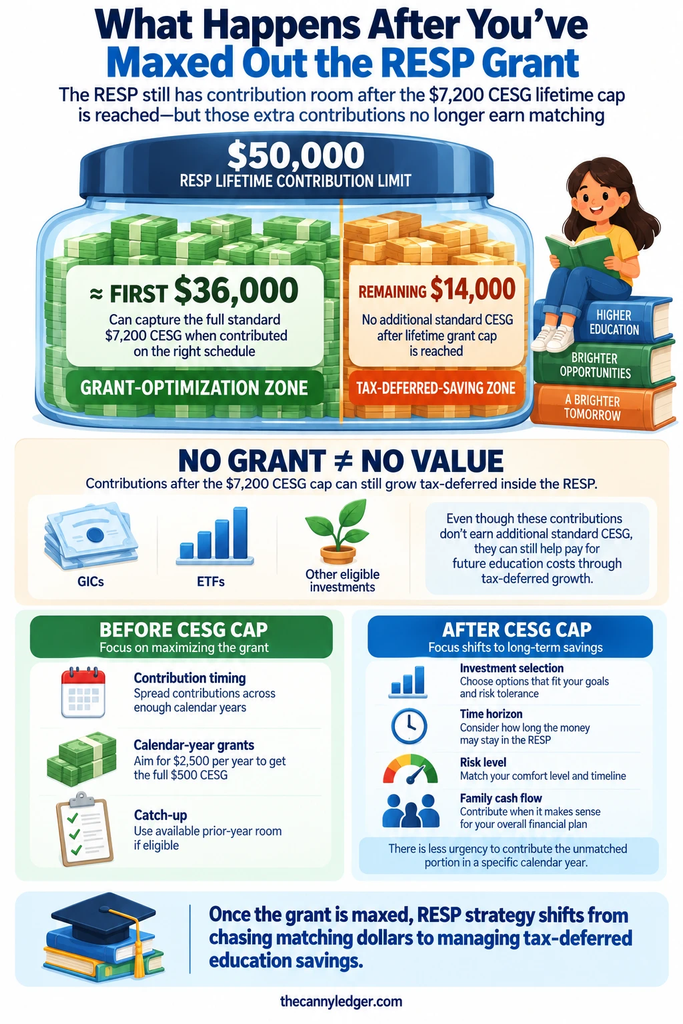
The CESG adds 20 percent to RESP contributions, capped at $500 a year, which means it takes exactly $2,500 of contributions in a calendar year to capture the full annual match. That $500 a year accumulates toward a $7,200 lifetime cap per child, and a bit of arithmetic shows exactly what that requires. $7,200 divided by $500 works out to 14.4 years of maxed-out contributions, which means $2,500 contributed every year for roughly 14 and a half years, or $36,000 total, is genuinely all it takes to capture every dollar of CESG a child is entitled to. The RESP’s overall lifetime contribution limit is $50,000, which means the last $14,000 of room a family could theoretically use earns no matching at all, since the grant stops accumulating well before the contribution room does.
This is worth sitting with, because it reframes the entire question. The goal isn’t reaching $50,000. It’s reaching $36,000 spread across the right number of years, and everything beyond that point is just ordinary tax-sheltered saving with no government match attached.
Why a Windfall Doesn’t Work the Way People Expect
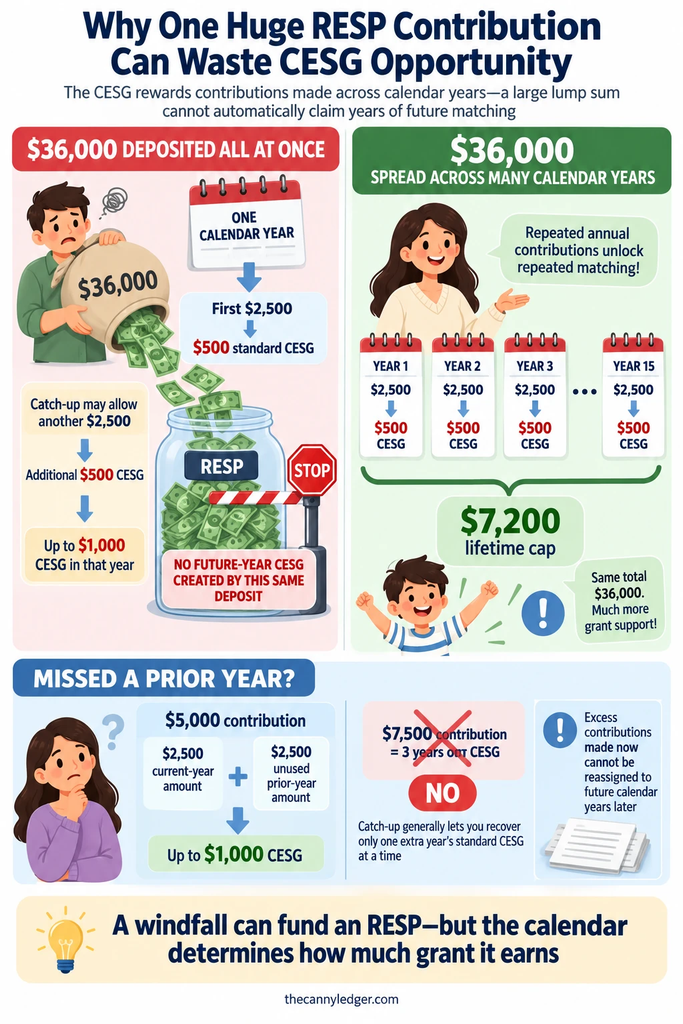
The grandmother’s mistake is common and easy to fall into, because it feels intuitively like putting in more money sooner should be better. For CESG specifically, it isn’t. The government’s own rules for how RESP grants accumulate tie the match to contributions actually made within a calendar year, and there’s a built-in catch-up mechanism for one missed year at a time, letting a family contribute up to $5,000 in a single year to capture $1,000 in CESG when a prior year went unfunded. That catch-up caps at one year’s worth of missed room per year going forward. A family can’t contribute $7,500 in one shot and claim three years of matching simultaneously. The excess beyond that single year’s catch-up room earns nothing.
This is exactly what happens to a lump sum. The first $2,500 of it earns the standard $500 match for that year. Depending on whether a prior year was left unfunded, another $2,500 of it might qualify as catch-up, bringing that single year’s total match to $1,000. Everything beyond that, the remaining tens of thousands of dollars sitting in the same deposit, simply becomes contribution room used up with no CESG attached to it at all, permanently, since there’s no mechanism to retroactively apply a single year’s excess contribution toward a future year’s matching.
The Smarter Way to Handle a Windfall
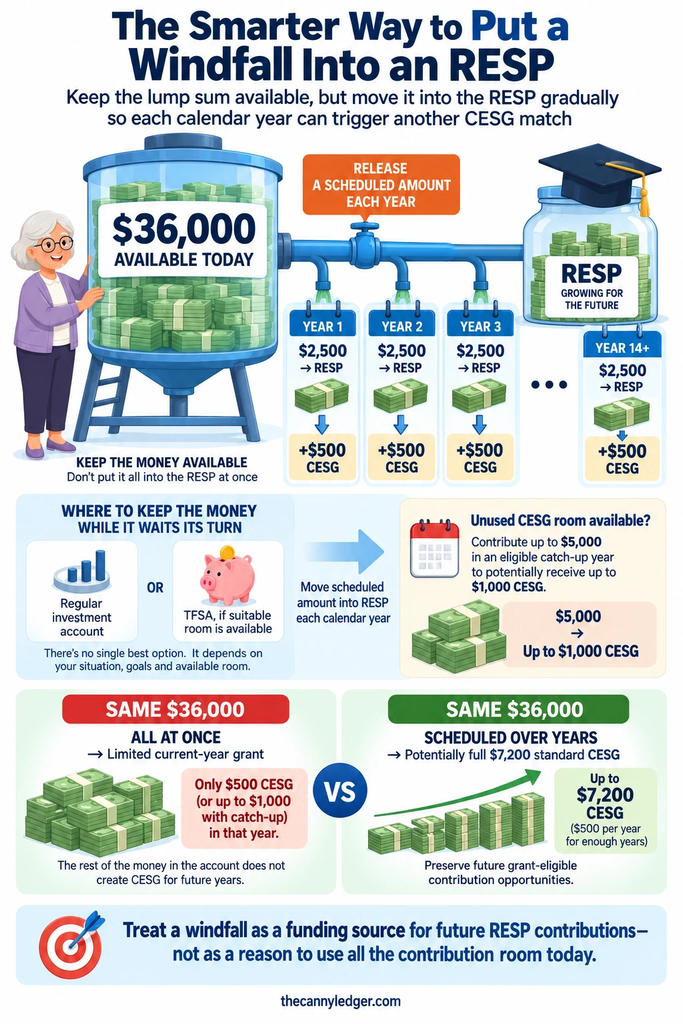
None of this means a family with a large sum available should avoid contributing it. It means the money should go in on a schedule rather than all at once. A family sitting on $36,000 and starting from zero should contribute $2,500 in the current year, then hold the rest back and contribute another $2,500 in each subsequent year, or use the catch-up provision to contribute $5,000 in a year that follows a deliberately skipped or under-funded one. Done this way, the same $36,000 that would have earned $500 or $1,000 as a lump sum instead earns the full $7,200 over time, with the uncontributed portion sitting in a regular investment account or a TFSA in the meantime, waiting its turn to move into the RESP on schedule.
Starting Early Versus Starting Late
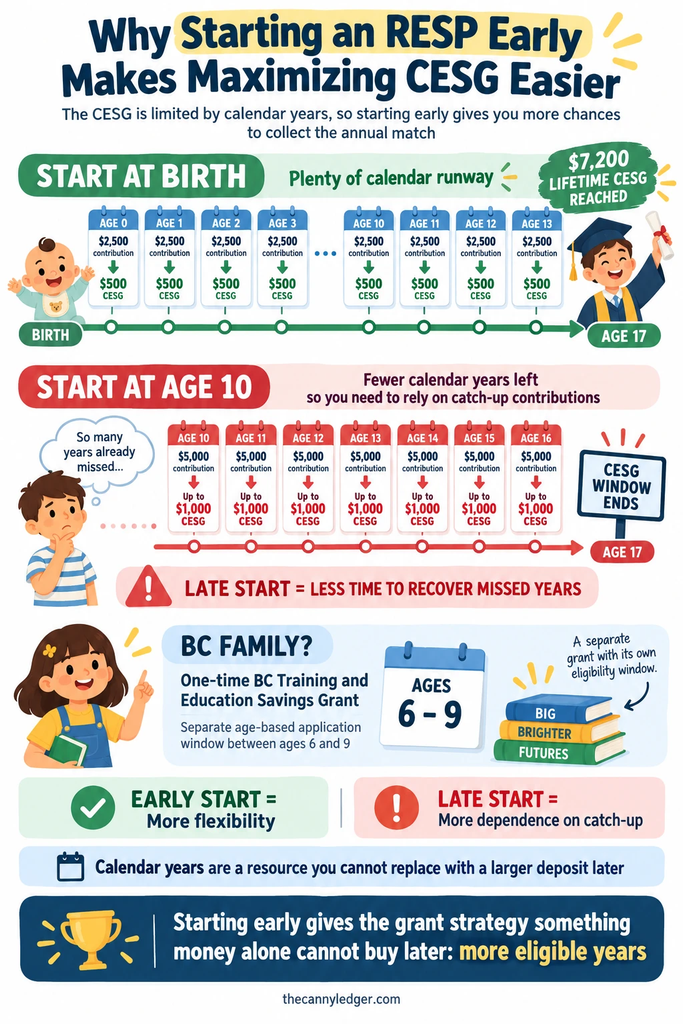
Time matters here in a very literal, arithmetic way. A family that opens an RESP the year a child is born and contributes $2,500 annually reaches the full $7,200 CESG cap sometime around the child’s fourteenth birthday, with several years of runway left before eligibility ends. Families in British Columbia have one more date to track on the same timeline, since the one-time BC grant has to be claimed between a child’s sixth and ninth birthday regardless of how the CESG contribution schedule is going. A family that doesn’t start until the child is 10 has only seven or eight years left before the CESG eligibility window closes at the end of the year the child turns 17, and even contributing the maximum $5,000 catch-up amount every single one of those remaining years won’t fully close a gap of more than a couple of missed years, since the one-year-at-a-time catch-up limit caps how fast lost ground can be recovered. Starting at birth isn’t just a nice-to-have. It’s the only path that guarantees enough calendar years exist to capture the entire $7,200 without needing perfect, aggressive catch-up contributions in every remaining year.
Additional CESG Changes the Priority Slightly
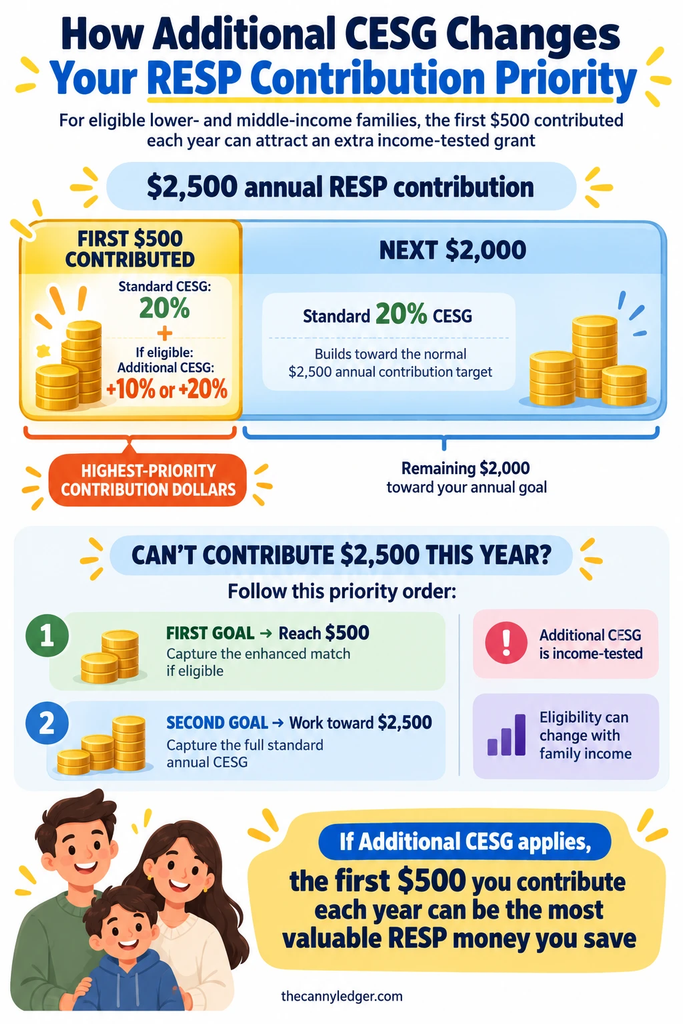
Families who qualify for the Additional CESG based on income get an extra 10 or 20 percent specifically on the first $500 contributed each year, on top of the standard match, which makes that very first $500 of annual contribution worth more than any dollar that follows it. For a lower-income family deciding how to sequence a limited amount of money across the year, getting to $500 contributed matters more urgently than reaching the full $2,500, since the enhanced rate only applies to that first slice. Once that first $500 is in, the remaining $2,000 needed to hit the full $2,500 annual contribution still earns the standard 20 percent, just without the income-tested boost.
What Happens to the Other $14,000 of Room
Once a family has contributed the roughly $36,000 needed to capture the full CESG, any further RESP contributions up to the $50,000 lifetime cap earn no government matching at all. That doesn’t make additional contributions pointless, since the money still grows inside the RESP without annual tax along the way, the same tax-deferred advantage that applies to the grant-matched portion. It does mean the urgency changes. Money beyond the CESG-earning threshold can go in whenever it makes sense for the family’s cash flow, rather than needing to hit a specific calendar year to avoid losing anything. What actually sits inside the account at that point, whether GICs, ETFs, or something else, matters more at that stage than the timing of the contribution itself.
Building an Actual Year-by-Year Plan
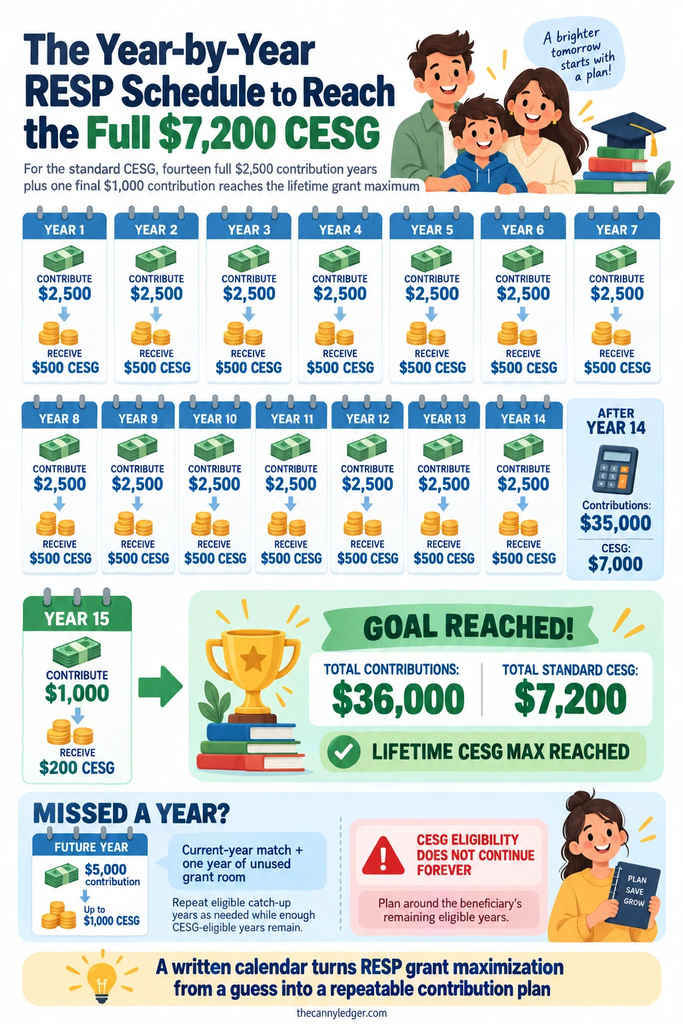
For a family starting at birth with no catch-up needed, the schedule is straightforward. Contribute $2,500 in each of the beneficiary’s first 14 years, which captures $500 in CESG every year and totals $35,000 contributed against $7,000 in grants. In year 15, a final contribution of $1,000 captures the remaining $200 of CESG, bringing the lifetime total to exactly $36,000 contributed and $7,200 in matching. Every dollar contributed after that point is grant-free but still tax-sheltered, useful for families with more to save but no longer urgent on any particular calendar year.
For a family that’s missed a year or started late, the schedule shifts to include occasional $5,000 contributions instead of $2,500, using the catch-up provision to recover one missed year at a time, always keeping in mind that the CESG eligibility window ends the year the beneficiary turns 17 and that there simply may not be enough remaining years to fully catch up if the gap is large.
Setting Up Your Own Schedule
Check how many years remain before your child turns 17, since that number, more than anything else, determines whether the full $7,200 is still realistically reachable. If you’re starting from scratch with a beneficiary already in their pre-teens or older, prioritize getting to $2,500 a year immediately rather than waiting to see if a bigger lump sum might come along later, since every year without a contribution is a year of matching that can only be partially recovered afterward. And if a windfall does arrive, whether an inheritance, a bonus, or a gift from a relative, resist the instinct to deposit all of it at once. Split it across the years still available before the eligibility window closes, and let the calendar do the work the money alone can’t.