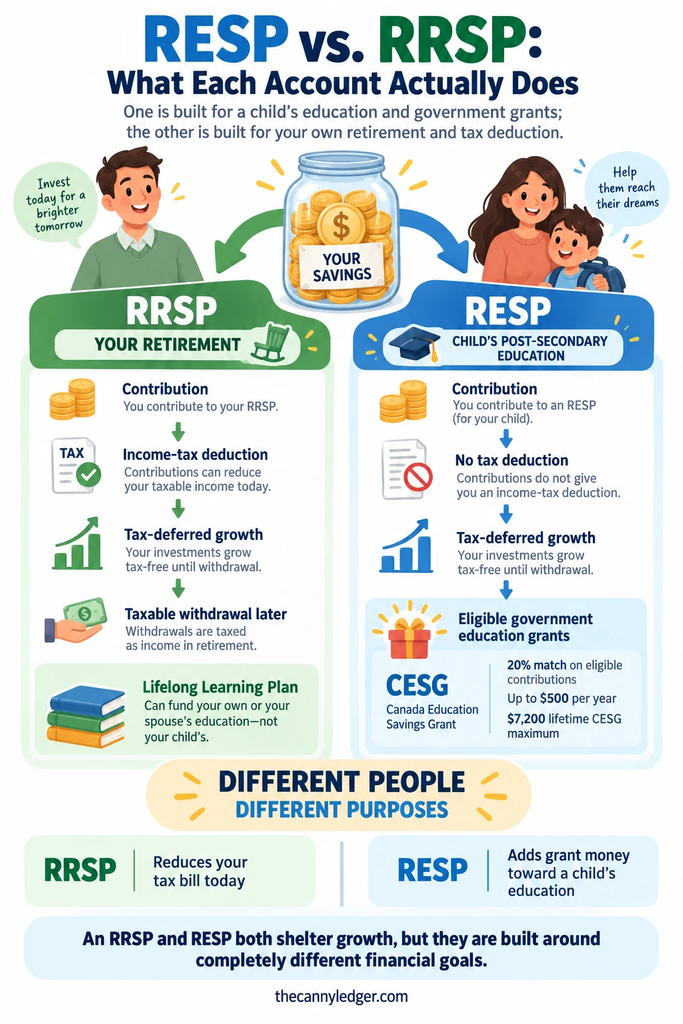
Plenty of parents assume that if they’re already maxing out a Registered Retirement Savings Plan (RRSP), some of that money can eventually double as education savings for their kids. It can’t, and the reason is built directly into the rules. The RRSP’s own education withdrawal program, the Lifelong Learning Plan, lets you pull up to $10,000 a year from your RRSP, tax-free at the time, specifically to fund your own or your spouse’s return to school. The Canada Revenue Agency (CRA) is explicit that this program cannot be used to finance a child’s education under any circumstance. Whatever an RRSP does for education, it does for the adult holding it, never for the next generation.
That single restriction is really the cleanest way to understand why a Registered Education Savings Plan (RESP) and an RRSP aren’t substitutes for each other, even though both let money grow without annual tax on the way up. They’re built around two completely different people’s futures, and the mechanics underneath reflect that.
What Each Account Actually Does
An RRSP exists to defer tax on retirement savings. You get a deduction against your income the year you contribute, the money grows without annual tax along the way, and everything eventually gets taxed as income when you withdraw it, ideally in retirement when your tax rate is lower. An RESP exists to attract government grant money specifically toward a named child’s post-secondary education, with the Canada Education Savings Grant matching 20 percent of what you contribute, up to $500 a year and $7,200 over that child’s lifetime. Nothing about an RRSP matches your contribution the way CESG does, and nothing about an RESP gives you a tax deduction the way an RRSP contribution does.
These aren’t two flavours of the same tool. One shelters your own future income. The other captures free money earmarked for someone else’s education.
The Deduction Most People Assume Both Accounts Have
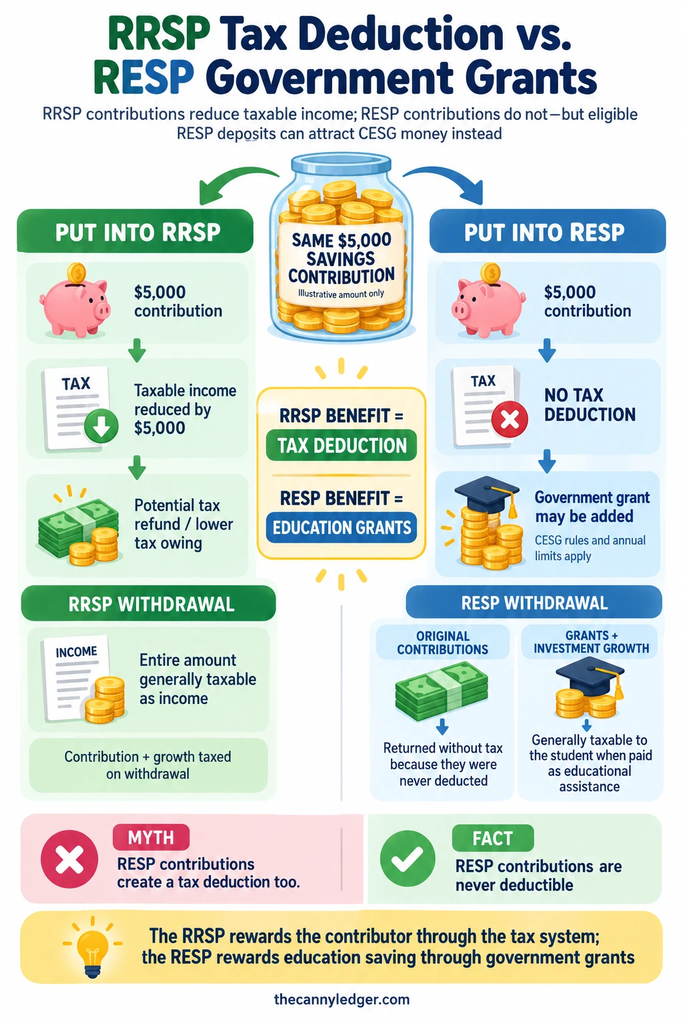
This is where the two genuinely diverge on tax mechanics, not just purpose. An RRSP contribution reduces your taxable income for the year, which is why so many people time contributions around tax season chasing a refund. An RESP contribution does nothing of the sort. It’s never deductible, full stop, no matter how much you put in or which province you’re in. What you get instead is the CESG match sitting on top of the contribution itself, a different kind of benefit that shows up as free money added to the account rather than a smaller tax bill in April.
The withdrawal side inverts the same logic. Pull money out of an RRSP and the entire amount gets taxed as income, contributions and growth together, with no split. Pull money out of an RESP and only the government’s had a hand in complicating it, contributions come back tax-free since they were never deducted in the first place, while the grants and investment growth get taxed as income in the student’s hands rather than yours.
Whose Room It Actually Is
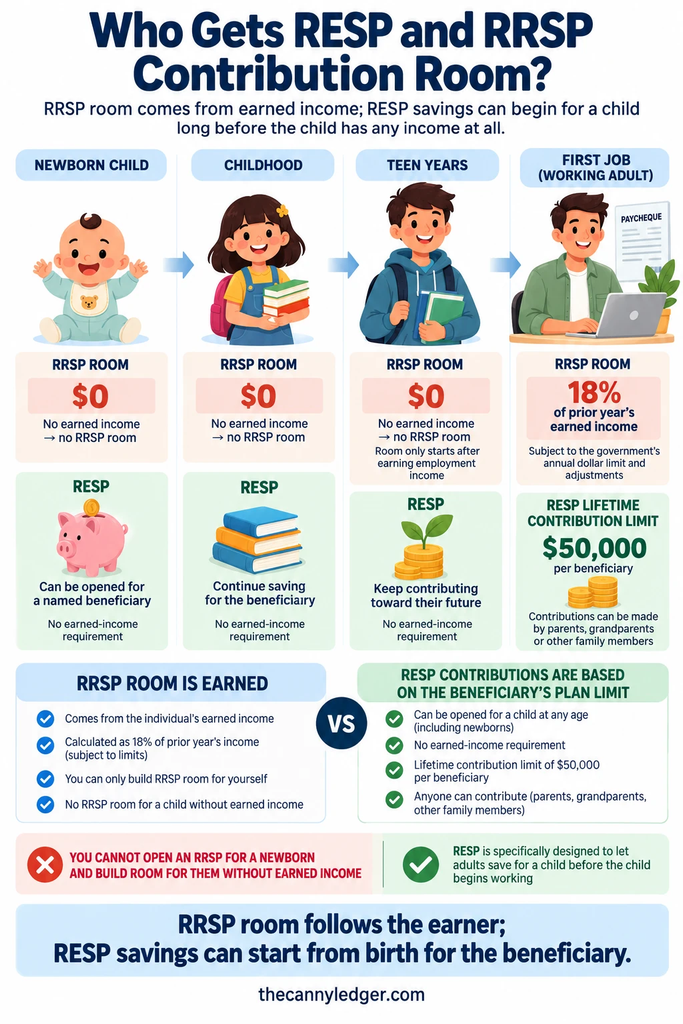
RRSP contribution room is earned, literally. It accumulates based on 18 percent of your prior year’s earned income, up to an annual dollar limit set by the government, which means a newborn, or anyone without employment income, has no RRSP room at all and never will until they start earning a paycheque. An RESP works on an entirely different basis. Contribution room belongs to the beneficiary from the day they’re named, up to a $50,000 lifetime cap, with no earned income requirement whatsoever, since the whole point is letting a parent or grandparent save on a child’s behalf starting at birth.
This is worth sitting with for a moment, because it explains why comparing the two accounts as if they’re competing for the same dollar rarely makes sense in the early years of a child’s life. There’s no version of an RRSP a parent can open in their newborn’s name. Whatever gets saved for that child in these early years either goes into an RESP or it doesn’t get the structural advantage of a registered account at all.
The Two Ways These Accounts Actually Connect
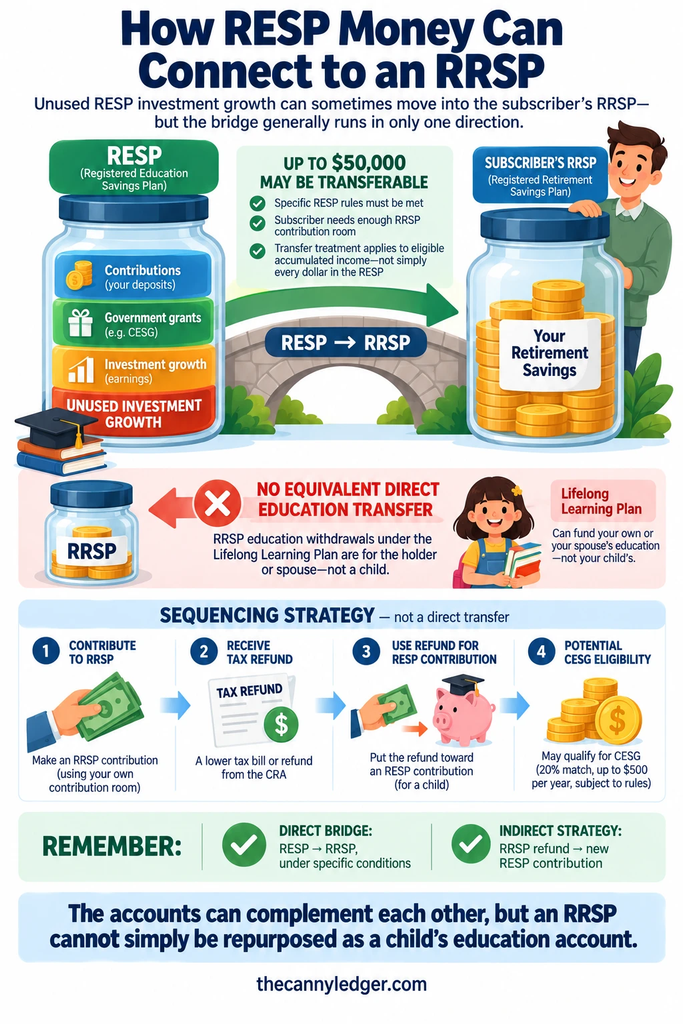
Despite everything separating them, there’s a genuine bridge between the two, and it only runs in one direction. If an RESP’s investment growth ends up unused for education, up to $50,000 of it can be rolled into the subscriber’s own RRSP without triggering the tax penalty that would otherwise apply, provided there’s enough contribution room to absorb it. This isn’t a two-way street. Money can move from an unused RESP into an RRSP under specific conditions, but nothing moves the other direction, since an RRSP was never built to feed education savings for anyone other than the account holder or their spouse.
There’s a second, less obvious connection worth knowing about if a family is trying to stretch a limited amount of money across both goals in the same year. Contributing to an RRSP first and using the resulting tax refund to fund that year’s RESP contribution is a sequencing trick some families use deliberately, since it effectively lets a single dollar do double duty, first reducing this year’s tax bill, then showing up again a few months later as fresh money for the CESG match.
Two Different Clocks
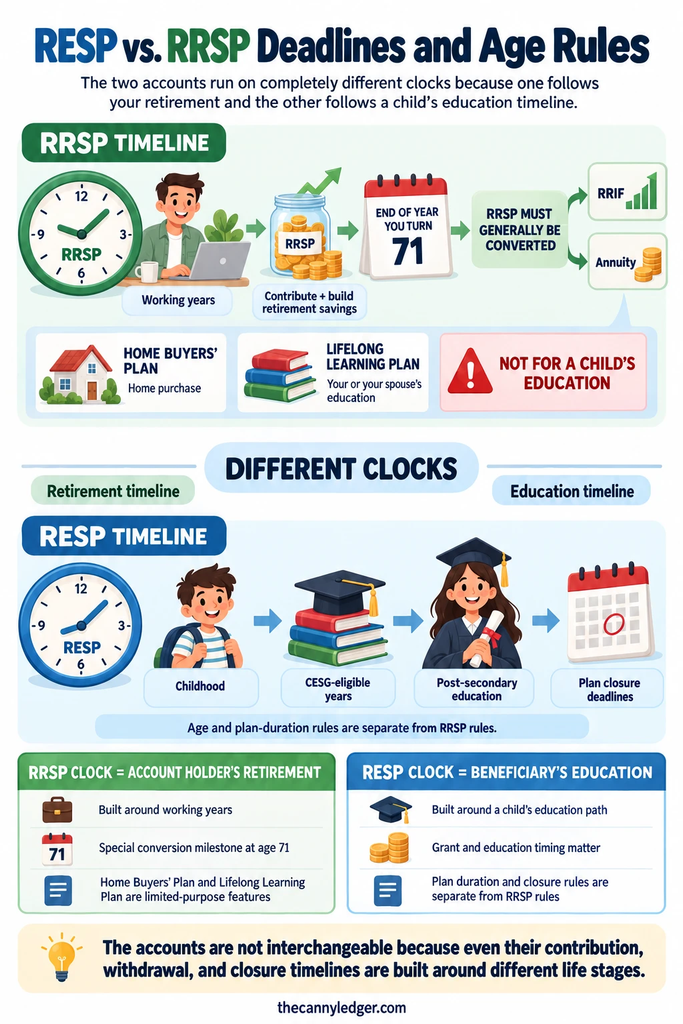
An RRSP has to be converted, generally into a Registered Retirement Income Fund or an annuity, by the end of the year the holder turns 71. An RESP runs on an entirely separate timeline tied to the beneficiary rather than the subscriber, with its own set of age-based deadlines governing everything from CESG eligibility to when the plan itself has to close. Neither clock has anything to do with the other, which is one more reason thinking of these as interchangeable savings vehicles for the same purpose doesn’t hold up. They’re not running on the same schedule because they were never meant to solve the same problem.
The RRSP does have its own equivalent of a life-stage withdrawal option beyond the Lifelong Learning Plan. The Home Buyers’ Plan lets a first-time buyer withdraw a meaningful sum tax-free toward a home purchase, repayable over time, the same structural idea as the LLP but aimed at buying a house instead of going back to school. It’s a reminder that an RRSP is a genuinely flexible account once you’re the one it belongs to, just never flexible enough to reach into your child’s education directly.
Where Your Dollars Should Actually Go
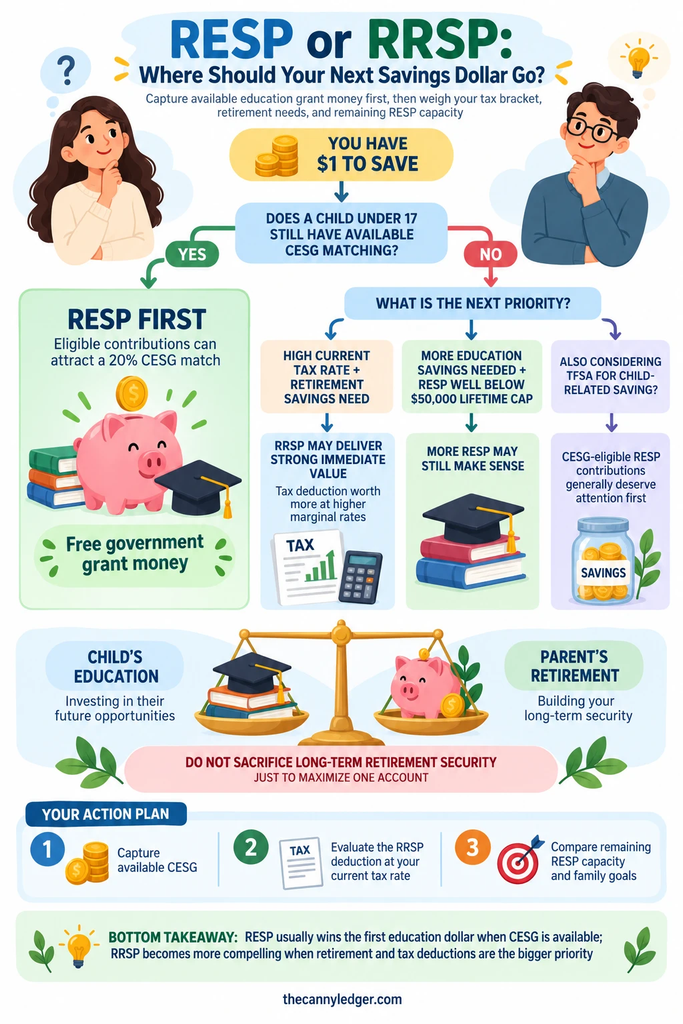
If a child under 17 hasn’t had this year’s CESG matching captured yet, that’s the priority, since it’s free money with no equivalent anywhere in an RRSP. Beyond that, whether your own RRSP or the RESP deserves the next dollar depends mostly on your current tax bracket and how close you are to the RESP’s $50,000 lifetime cap. A higher earner in a high tax bracket often gets more immediate value from the RRSP deduction, while a family still well under the RESP cap and eligible for CESG matching usually comes out ahead directing new savings there first. If you’re weighing the RESP against a TFSA as well, the CESG match still generally wins that comparison too, which makes the RESP the natural first stop for a child’s education dollars regardless of which second account you’re weighing it against.