
$14. That’s the legal ceiling on what a licensed lender in Manitoba can charge you for every $100 you borrow on a payday loan. Read quickly, it sounds almost reasonable, like a service fee at a bank machine. Run the actual math on a typical two-week term, and that $14 works out to an annualized interest rate north of 350 percent. Nothing else you can legally borrow in this province comes close to that number, and that gap is the entire reason this article exists.
- What a payday loan actually is, legally speaking
- The real cost, broken down in dollars instead of percentages
- The borrowing limit tied to your paycheque
- Your right to cancel, and other protections written into the law
- How the debt cycle actually forms
- Before you take one out: questions worth asking yourself
- Alternatives that cost meaningfully less
- If you’re already in a payday loan cycle
- The bottom line
Winnipeg has one of the higher concentrations of payday loan storefronts per capita of any Canadian city, clustered along corridors like Main Street, Portage Avenue, and Regent, often within walking distance of the neighbourhoods where incomes are lowest and banking options are thinnest. If you’ve ever walked past one on a rough week and wondered whether it was actually a reasonable stopgap or a trap dressed up as convenience, this is meant to answer that honestly: the real cost, the rules the province forces lenders to follow, the situations where a payday loan does the least damage, and the alternatives that almost always beat it.
What a payday loan actually is, legally speaking
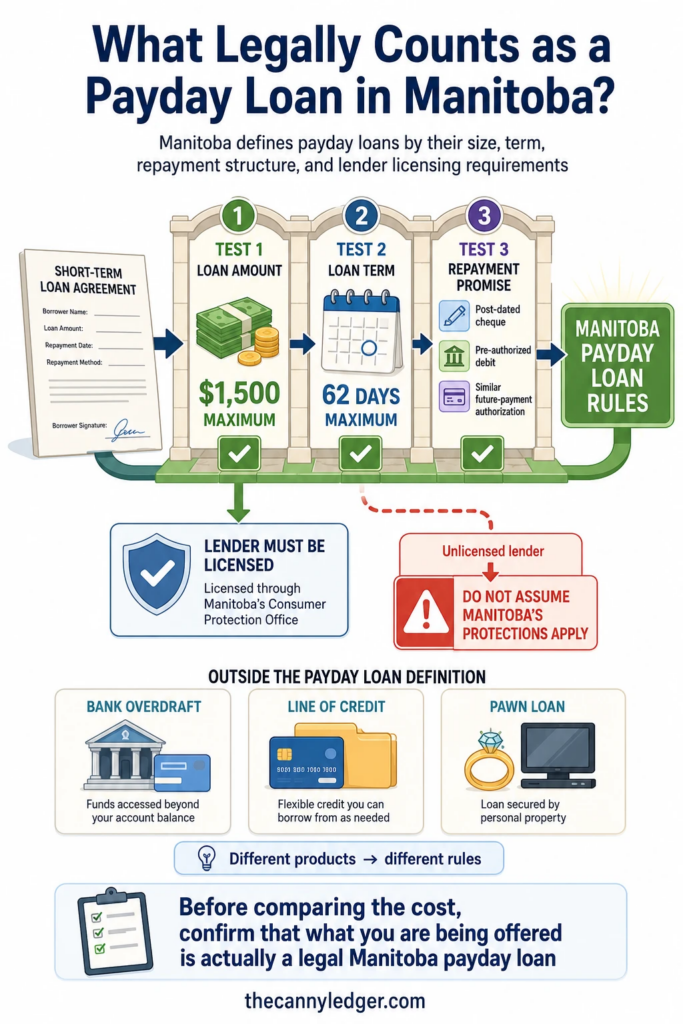
Manitoba law defines a payday loan narrowly. It’s a loan of no more than $1,500, for a term of no longer than 62 days, provided in exchange for a post-dated cheque, a pre-authorized debit, or a similar promise of future payment. That definition matters because it’s what separates a payday loan from an overdraft, a line of credit, or a pawn transaction, all of which get regulated differently. Anything sold to you as a “payday loan” that falls outside those boundaries either isn’t legally a payday loan or isn’t being sold to you legally at all.
Every payday lender operating in the province needs a licence from Manitoba’s Consumer Protection Office, and that licence isn’t cheap or automatic to keep. The office maintains oversight specifically because the product’s structure makes it easy to cause real harm to borrowers who are already under financial pressure, which is precisely the population most likely to reach for one.
The real cost, broken down in dollars instead of percentages
Manitoba currently caps the total cost of a payday loan at $14 per $100 borrowed, a figure the province lowered from a previous cap of $17 per $100 as part of a broader push to reduce how expensive these products can legally be. That $14 figure covers the total cost of credit, meaning every fee the lender charges, not just a headline interest rate with extra charges tacked on separately.
Here’s what that looks like in practice. A $300 loan taken out for a standard two-week term costs up to $42 in fees under the current cap. Borrow $500, and you’re looking at up to $70. Borrow the maximum allowed, $1,500, and the fee ceiling sits at $210, due in full on your next payday alongside the principal. None of this changes if you pay the loan back early. Manitoba’s rules explicitly state that the maximum charge can apply regardless of the loan’s actual term, so paying two days early doesn’t earn you a discount the way it might with certain lines of credit.
Converted to an annual percentage rate, the way credit cards and mortgages are typically quoted so you can compare them apples to apples, a two-week payday loan at the $14-per-$100 cap works out to somewhere in the range of 350 to 400 percent APR depending on the exact term. Compare that to a credit card’s typical 20 percent, a personal line of credit in the low double digits, or even a high-interest bad credit loan, and the gap isn’t subtle. It’s the difference between paying $14 to borrow $100 for two weeks and paying roughly the same $14 to borrow that money for an entire year through most other legal credit products.

The borrowing limit tied to your paycheque
Manitoba doesn’t let a payday lender hand out whatever amount you ask for. The maximum you can borrow is tied to a percentage of your net income from the previous month, generally capped around 30 percent of what you actually took home. If your monthly net income sits around $2,000, the lender is legally restricted from advancing much more than roughly $600, regardless of how much you say you need. First-time borrowers at a given lender are often held to an even lower limit until a repayment history is established, though this varies by lender within the provincial ceiling.
This rule exists for an obvious reason: without it, someone in genuine financial distress could be handed a loan sized well beyond their ability to repay from a single paycheque, setting up the exact debt spiral the regulations are designed to prevent.

Your right to cancel, and other protections written into the law
A few consumer protections are baked directly into Manitoba’s payday loan rules, and they’re worth knowing before you ever walk into a storefront or fill out an online application.
You have 48 hours from the moment you sign a payday loan agreement to cancel it at no cost, as long as you repay the principal in full within that window. This cooling-off period exists specifically so a decision made under pressure, late at night, or in a moment of panic isn’t automatically locked in.
Every agreement must clearly disclose the total cost of credit, the annual percentage rate, the exact fees and charges, and the date payment is due. A lender that hands you a vague verbal explanation instead of a document laying all of this out in writing isn’t following the law, and that alone is worth reporting to the Consumer Protection Office.
Rollover practices, taking a new payday loan specifically to pay off an existing one, are restricted under provincial rules precisely because that pattern is where the worst outcomes tend to start. If a lender is encouraging you to simply “renew” instead of repay, treat that as a warning sign rather than a convenience.

How the debt cycle actually forms
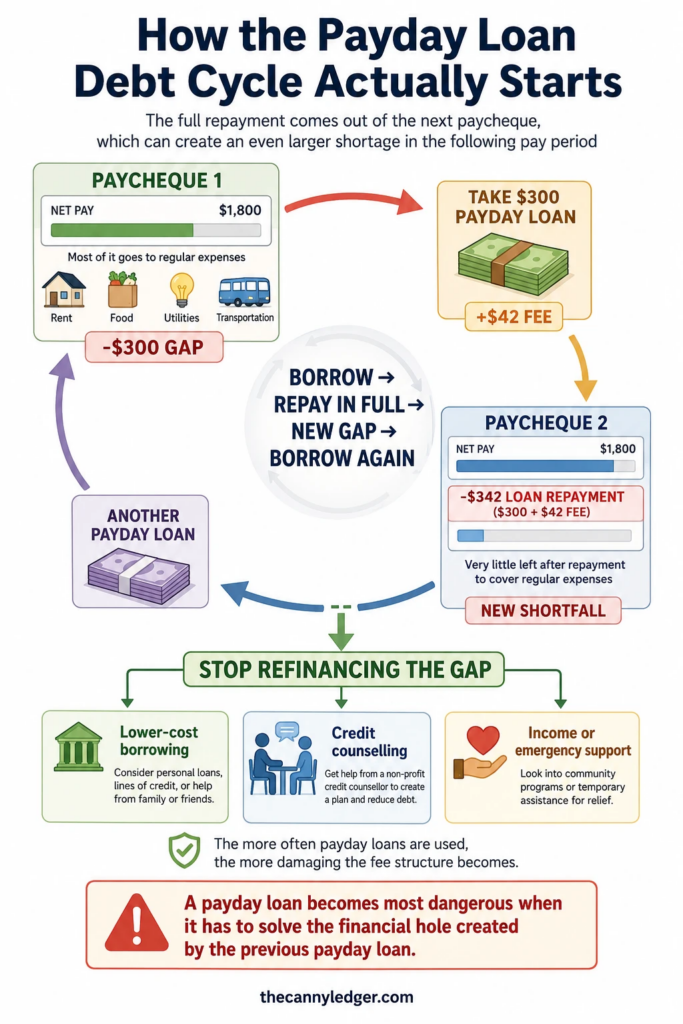
The math above explains why a single payday loan is expensive. It doesn’t fully explain why so many borrowers end up taking a second, a third, or a sixth. The mechanism is straightforward once you see it laid out: a payday loan is repaid in full, principal and fees together, out of your very next paycheque. If that paycheque was already stretched thin enough to need the loan in the first place, repaying the full amount in one lump sum often leaves an even bigger gap in the following pay period than the original problem did. That gap gets filled the same way the first one was, and the cycle compounds because every loan carries its own fee on top of the last one’s shortfall.
National research into payday lending patterns has repeatedly found that a majority of borrowers take out more than one loan within a few years of their first, and that people who end up filing for personal bankruptcy carry payday loan debt among their liabilities at a disproportionately high rate relative to the rest of the population. None of that means every payday loan ends in bankruptcy. It means the product is structurally more dangerous the more often it gets used, which is exactly the opposite of how a genuinely useful short-term tool should behave.
Before you take one out: questions worth asking yourself
If you’re seriously weighing a payday loan against your other options this week, a few honest questions tend to clarify the decision faster than a pros-and-cons list.
Is this a true one-time gap, or a signal that your monthly budget doesn’t balance? A payday loan can bridge a single unexpected car repair or a bill that landed on the wrong side of payday. It can’t fix a structural shortfall between what you earn and what you owe every single month, and using it to paper over that kind of gap tends to make next month worse, not better.
Have you actually confirmed the lender is licensed? Manitoba’s Consumer Protection Office maintains oversight of every legal payday lender in the province, and unlicensed operators, particularly some online lenders marketing directly to Manitobans, aren’t bound by the $14-per-$100 cap or any of the disclosure and cancellation rules described above. A quick call or check before signing anything protects you from a much worse version of an already expensive product.
Have you priced out the alternatives with actual numbers, not assumptions? This is the step people skip most often, usually because it feels slower in a moment that feels urgent. It’s almost always worth the extra twenty minutes.

Alternatives that cost meaningfully less
Credit unions and banks operating in Manitoba are required to disclose their lending terms clearly, and in nearly every case, a personal loan or line of credit from one of them will cost a fraction of what a payday loan does for the same amount of money. If you haven’t compared what’s available locally, our Winnipeg credit unions compared guide and our personal loans in Winnipeg breakdown are both good starting points, since credit unions in particular tend to be more willing to work with members on smaller, short-term borrowing needs than larger banks are.
If your credit history is part of what’s steering you toward a payday lender in the first place, it’s worth reading our bad credit loans in Winnipeg guide before assuming a payday storefront is your only option. Bad credit lenders charge more than prime borrowers get, but almost none of them come close to a 350 percent effective rate, and many report to credit bureaus in ways that can actually help you rebuild standing over time, something a payday loan never does since most payday lenders don’t report on-time repayment to the credit bureaus at all.
Employer pay advances are worth asking about directly, even if your workplace has never formally offered one. Many employers, especially larger ones, will quietly advance a portion of an already-earned paycheque to an employee dealing with a short-term crunch, and it costs the employee nothing beyond the awkwardness of asking.
Community Financial Counselling Services, a long-running non-profit based on Portage Avenue, offers free, confidential financial counselling to Manitobans dealing with exactly this kind of pressure, along with budgeting help, benefit access support, and free tax filing that can sometimes surface money you didn’t know you were owed. The Credit Counselling Society and Credit Canada both run comparable free services with a specific Winnipeg presence and can walk through debt consolidation options that replace multiple high-cost debts with a single manageable payment. If any of this is starting to sound like your situation extends beyond a single rough week, our credit counselling in Winnipeg and debt consolidation in Winnipeg pages go deeper into how those processes actually work.
211 Manitoba is worth calling before any of the above if you’re not sure where to start. It’s a free, confidential service that connects Manitobans to the right local resource, whether that’s emergency financial assistance, a food bank, or a settlement agency, and it exists specifically so people don’t have to research their own way through a crisis blind. Our 211 Manitoba page explains exactly how that service works and what it can connect you to. If the immediate pressure is closer to putting food on the table than covering a bill, our food banks in Winnipeg guide is a faster and completely free option than borrowing against next week’s paycheque.

If you’re already in a payday loan cycle
If you’re reading this with an existing payday loan, or several, already outstanding, the framing shifts from prevention to damage control, and that’s a different conversation with different urgency.
Stop taking new payday loans to cover old ones. This is the single highest-leverage decision available to you, even though it’s also the hardest one to make when a new loan feels like the only thing standing between you and a missed rent payment. Every rollover compounds the fees you’re already carrying.
Call a free credit counselling service before a collections agency calls you. Community Financial Counselling Services, the Credit Counselling Society, and Credit Canada all offer no-cost consultations specifically designed to look at your full financial picture and lay out realistic options, including formal debt management plans that consolidate what you owe into one lower monthly payment. Our debt relief and debt help in Winnipeg page walks through what these programs actually involve before you commit to one.
Know that bankruptcy is a legitimate last-resort tool, not a failure. If your debts, payday-related or otherwise, have genuinely outgrown what any consolidation plan can realistically manage, our bankruptcy in Winnipeg guide covers how the process works locally, what it protects, and what it doesn’t, without any of the shame that tends to get attached to the word.
Watch for collection practices that cross the line. If a lender or a collections agency handling payday debt is calling you at work, contacting your family, or using threatening language, that’s regulated behaviour in Manitoba, and you have the right to push back on it. It’s worth knowing where that line sits before you find yourself needing to enforce it.

The bottom line
A payday loan isn’t illegal, isn’t automatically predatory in the sense of breaking the law, and in a genuine one-time emergency with no other option available, it can function as designed: an expensive but survivable bridge to your next paycheque. What it isn’t is cheap, forgiving, or well-suited to anything beyond that narrow use case. At $14 for every $100 borrowed, repeated over multiple pay periods, the math works against you faster than most people expect going in. Manitoba’s rules, the licensing requirement, the 48-hour cancellation window, the income-based borrowing cap, exist because the province has seen exactly how this product goes wrong when it’s used as anything other than a true last resort. Before you sign anything, it costs nothing to make one phone call to a credit union, a free counselling service, or 211 Manitoba first, and that single call has a real chance of saving you several hundred dollars you’d otherwise never see again.