

Here’s something that catches most first-time buyers off guard: anyone in Manitoba can call themselves a home inspector. There’s no provincial license required, no mandatory exam, no minimum education, and no government body checking credentials before someone hangs out a shingle and starts charging for inspections. Ontario, Alberta, British Columbia, and Quebec all license this profession. Manitoba, along with a handful of other provinces, simply doesn’t. That single fact changes almost everything about how you should approach hiring one, and it’s the reason this article spends as much time on choosing the right inspector as it does on what the inspection itself protects.
- What the licensing gap actually means for you
- Why Winnipeg’s specific conditions make this matter more than the national average
- What a proper inspection actually covers
- What it actually costs
- The temptation to waive it, and why that’s a genuinely risky trade in today’s market
- What to do when the inspection finds something
- Rolling this into your bigger financial picture
- The bottom line
What the licensing gap actually means for you
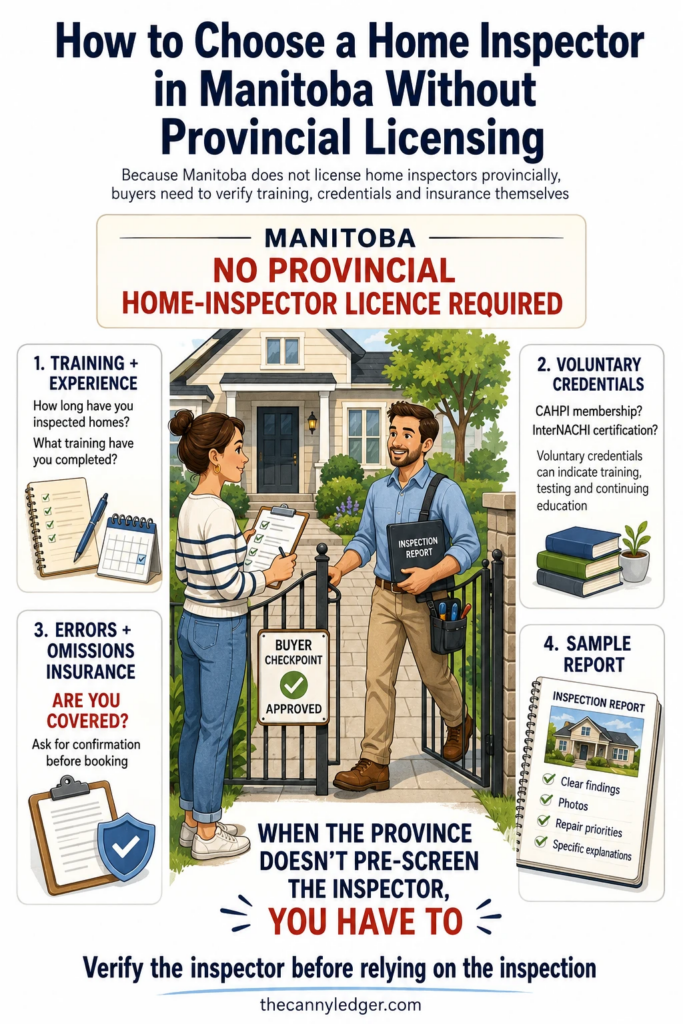
Because Manitoba imposes no provincial requirement, the entire burden of verifying competence falls on the buyer rather than a regulator. That doesn’t mean every inspector in the city is unqualified, most build real expertise through voluntary certification and years of field experience, but it does mean the credential-checking work a licensing board would normally do in Ontario or Alberta has to happen on your end here instead.
Two voluntary accreditations are worth specifically asking about before you book anyone: membership with CAHPI, the Canadian Association of Home & Property Inspectors, or certification through InterNACHI, the International Association of Certified Home Inspectors, which requires members to complete continuing education annually to maintain their standing. Neither is legally required in Manitoba, but both involve a level of training, testing, and ongoing education that a completely uncredentialed inspector simply hasn’t gone through. Errors and omissions insurance is the other question worth asking directly, since nothing in Manitoba law requires an inspector to carry it, and a missed defect on an uninsured inspector’s report leaves you with considerably less recourse than the same mistake would in a province where E&O coverage is mandatory.
Why Winnipeg’s specific conditions make this matter more than the national average
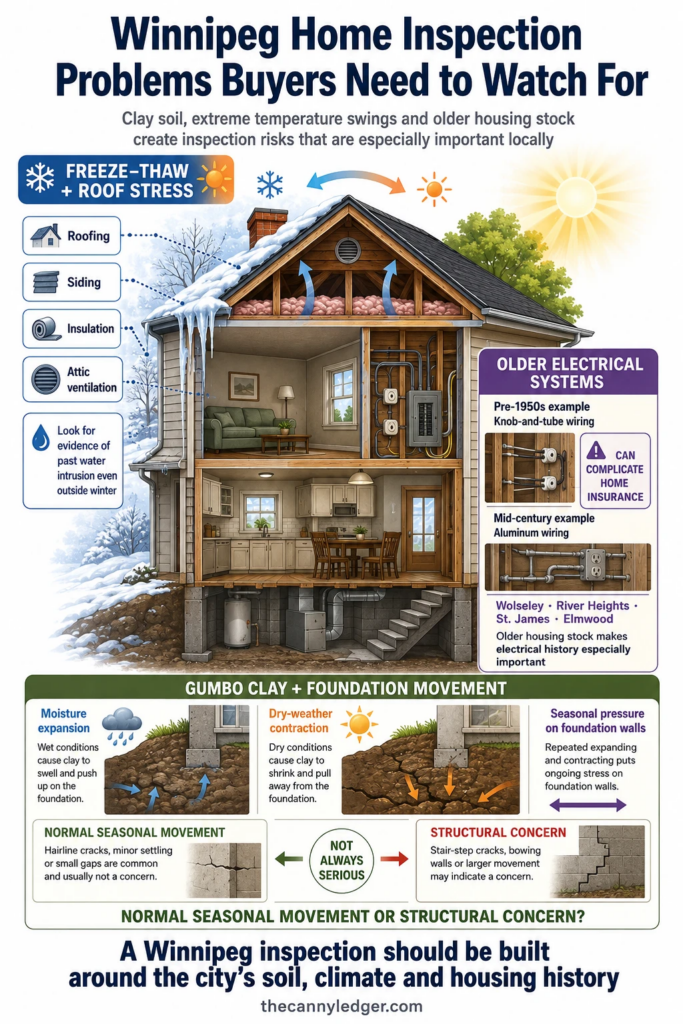
Winnipeg sits on a layer of heavy clay soil that locals call gumbo, and that soil expands when it absorbs moisture and contracts as it dries, putting continuous seasonal pressure on foundation walls throughout the year. Layer Manitoba’s extreme freeze-thaw cycle on top of that, water in the surrounding soil freezing and expanding dozens of times each winter, and you get a city where foundation movement isn’t a rare defect, it’s an expected condition that shows up to varying degrees in a large share of the housing stock, older homes with rubble stone or block foundations especially. None of this means foundation movement is automatically a deal-breaker; it means a qualified inspector’s read on how much movement is normal seasonal behaviour versus a genuine structural concern is worth considerably more here than it would be in a city built on more stable ground.
The city’s temperature swings compound the picture. Winnipeg regularly moves between roughly minus 40 in deep winter and the mid-30s in summer, and that range puts real stress on roofing, siding, and insulation systems in ways that milder Canadian climates simply don’t experience. Ice damming, where melting snow refreezes at a roof’s edge and forces water back under shingles, is a genuinely common Winnipeg-specific issue an inspector needs to know how to spot evidence of even outside the season when it’s actively happening.
Winnipeg’s inner-ring neighbourhoods, Wolseley, River Heights, St. James, Elmwood, and similar areas with housing stock predating 1950, bring a specific electrical concern into the picture: knob-and-tube wiring. This ungrounded system, common in homes built before mid-century, becomes a genuine fire risk when later renovations bury it under modern blown-in insulation that traps heat the original wiring was designed to shed into open air. It’s also, practically speaking, an insurance problem as much as a safety one: a meaningful number of Manitoba insurers won’t write or renew a policy on a home with active knob-and-tube wiring still in service, which means a defect flagged in your inspection report can directly affect whether you can get the coverage your mortgage lender requires to close at all. If you’re buying in one of these older neighbourhoods, our home insurance in Winnipeg guide is worth reading before your offer’s conditions expire, not after, since finding out about an insurability problem after your financing is locked in is a far worse position to be in.
What a proper inspection actually covers
A standard pre-purchase inspection in Winnipeg typically takes two to three hours for an average single-family home and walks through the property’s major systems methodically rather than superficially. The foundation and structural elements get assessed for the kind of movement described above, distinguishing normal seasonal settling from active, worsening structural concern. The roof gets inspected for age, damage, and the kind of ice-damming evidence mentioned earlier, along with attic ventilation and insulation, both directly relevant to how well a home handles Manitoba’s temperature extremes over time.
Electrical systems get a full review, including a direct check for knob-and-tube wiring or 1960s-and-70s-era aluminum wiring, another material that shows up periodically in Winnipeg’s mid-century housing stock and carries its own set of insurance and safety considerations distinct from knob-and-tube. Plumbing gets checked for material type, age, water pressure, and visible leaks, and the furnace, water heater, and any air conditioning or ventilation equipment get assessed for age and functional condition rather than simply confirmed to be present. A written report, typically delivered within a day of the inspection and often including photographs, documents everything found, and a good inspector will walk you through the property in person explaining what they’re seeing as they go rather than simply handing over a document afterward.

What it actually costs
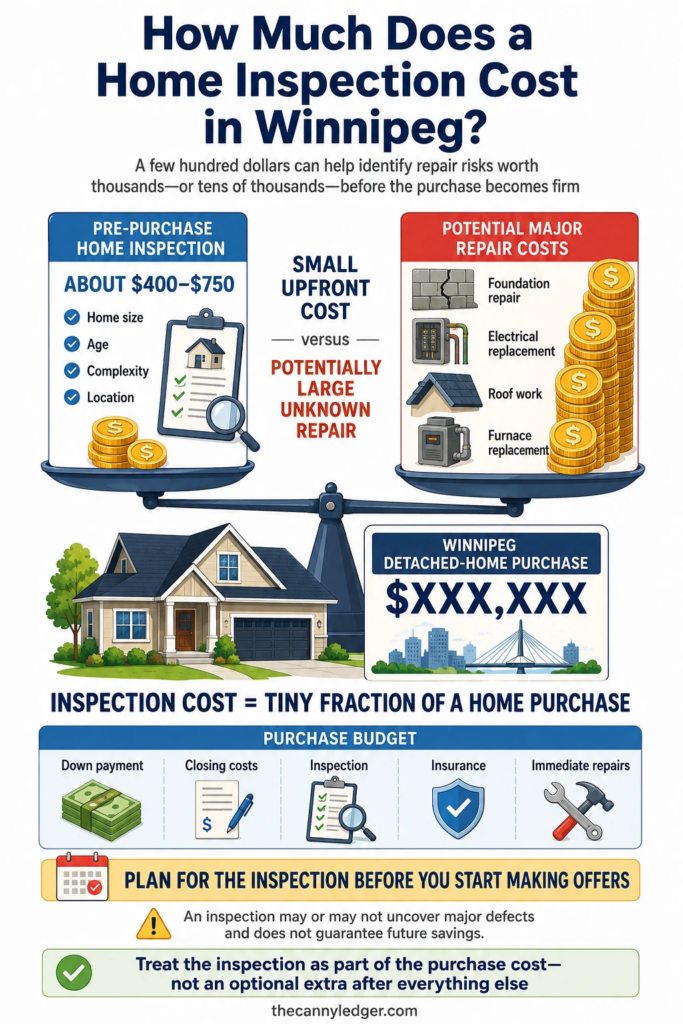
A typical pre-purchase home inspection in Winnipeg runs somewhere between roughly $400 and $750 depending on the home’s size, age, and complexity, with larger homes, older properties requiring more detailed evaluation, and properties outside the immediate city sometimes carrying additional charges. That range is broadly consistent with costs across the rest of the country, and it’s worth treating as one of the genuinely non-negotiable line items in your overall purchase budget rather than an optional add-on to trim if costs are tight. Relative to a purchase price in the mid-$400,000s, which is roughly where Winnipeg’s detached home average currently sits, an inspection costing a few hundred dollars represents a very small percentage of the transaction protecting against defects that can run into the tens of thousands to correct.
The temptation to waive it, and why that’s a genuinely risky trade in today’s market
Winnipeg’s real estate market has been running in seller-favouring conditions through much of 2026, homes moving quickly and competition among buyers pushing some to consider waiving inspection conditions entirely to make their offer more attractive. This is worth thinking through carefully rather than treating as simply the cost of competing for a home you want. Foundation movement in gumbo clay soil, active knob-and-tube wiring that could affect insurability, or an aging furnace nearing the end of its service life are exactly the kinds of defects an inspection catches and a rushed showing doesn’t, and the cost of discovering any of them after your offer has firmed up dwarfs what the inspection itself would have cost.
A genuine middle ground exists if you’re worried about losing out to a buyer with a cleaner offer: some buyers arrange a pre-offer inspection on a property they’re seriously considering, before submitting an offer at all, so the condition doesn’t need to appear in the contract as a contingency the seller has to accommodate. A shortened inspection window, rather than no inspection condition at all, is another reasonable compromise many Winnipeg buyers use to stay competitive without giving up the protection entirely. Whichever approach you take, it’s worth discussing directly with your realtor how competitive your specific offer needs to be in your specific neighbourhood and price range, since the degree of competition varies considerably even within a citywide seller’s market.

What to do when the inspection finds something
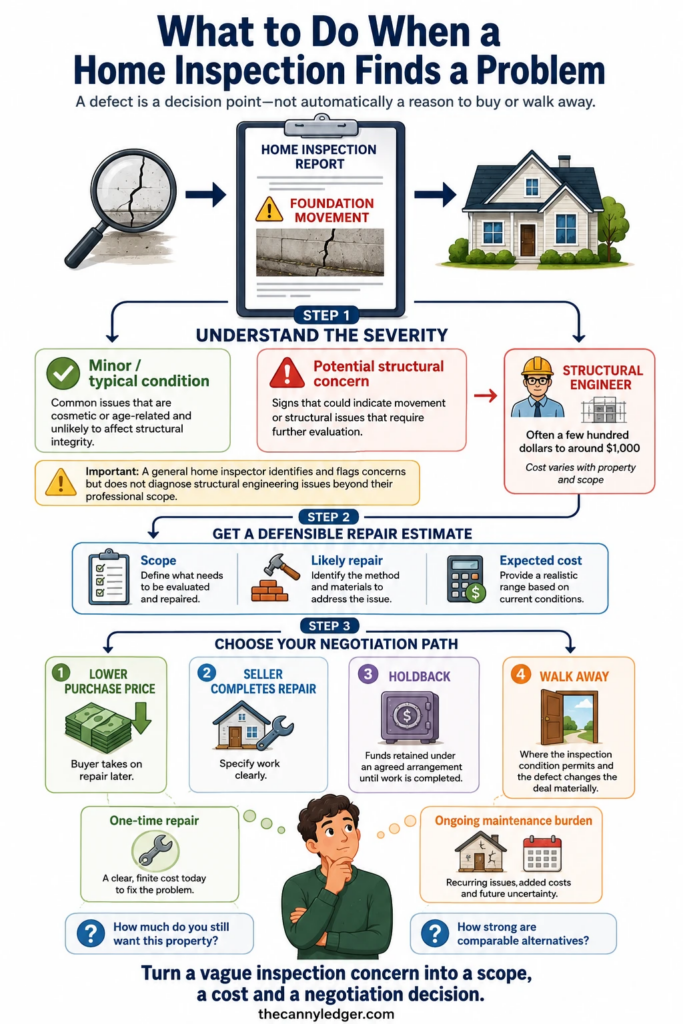
Finding an issue during inspection isn’t automatically a reason to walk away from the purchase, and in a market with limited alternative options, it usually shouldn’t be treated as one without first understanding the actual scope and cost of the problem. For anything involving genuine structural concern, foundation movement beyond what a general inspector considers normal for the area, it’s worth commissioning a structural engineer’s assessment, typically a few hundred to around a thousand dollars, before deciding how to proceed. That assessment gives you a specific, defensible number to bring back to negotiations rather than a vague concern, and it’s often the difference between a seller taking your renegotiation request seriously and dismissing it outright.
From there, your realistic options are renegotiating the purchase price to reflect the cost of repairs, requesting the seller complete specific repairs before closing, arranging a holdback of funds in trust until agreed-upon work is finished, or, in the more serious cases, exercising your inspection condition to walk away entirely. Which of these makes sense depends heavily on how much you want the specific property, how competitive the broader market is for comparable homes, and whether the defect found is a one-time fix or an ongoing maintenance burden you’d be taking on indefinitely.
Rolling this into your bigger financial picture
An inspection finding that affects insurability, active knob-and-tube wiring being the clearest example, deserves a call to an insurance broker before your financing conditions expire, not after, since a lender generally won’t finalize a mortgage without proof of coverage in place. Our cheapest home insurance in Winnipeg and home insurance cost in Winnipeg guides are worth a look if an inspection has flagged something that might complicate coverage, and our mortgage insurance in Winnipeg page covers the separate question of insurance tied specifically to your loan rather than the property itself.
If you’re weighing whether a specific defect changes the overall value of a purchase enough to affect your broader financing plans, particularly if you’re buying near the top of what you can comfortably afford in today’s Winnipeg housing market, it’s worth a conversation with one of the professionals in our financial advisors in Winnipeg roundup before you finalize anything, since an inspection’s findings can meaningfully shift the math on a purchase that looked straightforward on paper.

The bottom line
The absence of provincial licensing in Manitoba doesn’t make home inspections optional here, it makes choosing the right inspector a genuinely more important decision than it would be in a province where a licensing board has already done some of that vetting for you. Ask about CAHPI or InterNACHI credentials, confirm errors and omissions insurance is in place, and treat the few hundred dollars an inspection costs as protection against exactly the kind of gumbo-soil foundation movement, knob-and-tube wiring, and freeze-thaw related damage that make Winnipeg’s housing stock genuinely different from what a general inspection checklist written for a different climate would anticipate. It’s a small cost against the largest purchase most people ever make, and in a city built on clay that moves with the seasons, it’s not a formality, it’s the thing standing between you and finding out the hard way.