
- What actually determines the rate you’re offered
- The legal ceiling almost nobody advertises
- Where to actually shop, roughly in order of likely value
- Comparing offers properly: the details that actually matter
- Protecting your credit score while you shop around
- What lenders actually ask for, and how to strengthen your application before you submit it
- The mistakes that quietly cost people the most
- Where this fits into the bigger picture
A personal loan is one of the few financial products where two people borrowing the exact same amount, for the exact same reason, in the exact same city, can end up paying wildly different amounts for it, sometimes a difference of ten or fifteen percentage points on the interest rate alone. The loan itself isn’t the variable. Where you apply, how you apply, and what you know going in are. This guide is built around that reality: less a list of lenders and more a way of thinking about the shopping process itself, so the rate you end up with reflects your actual creditworthiness rather than which branch happened to be closest to your house.
What actually determines the rate you’re offered
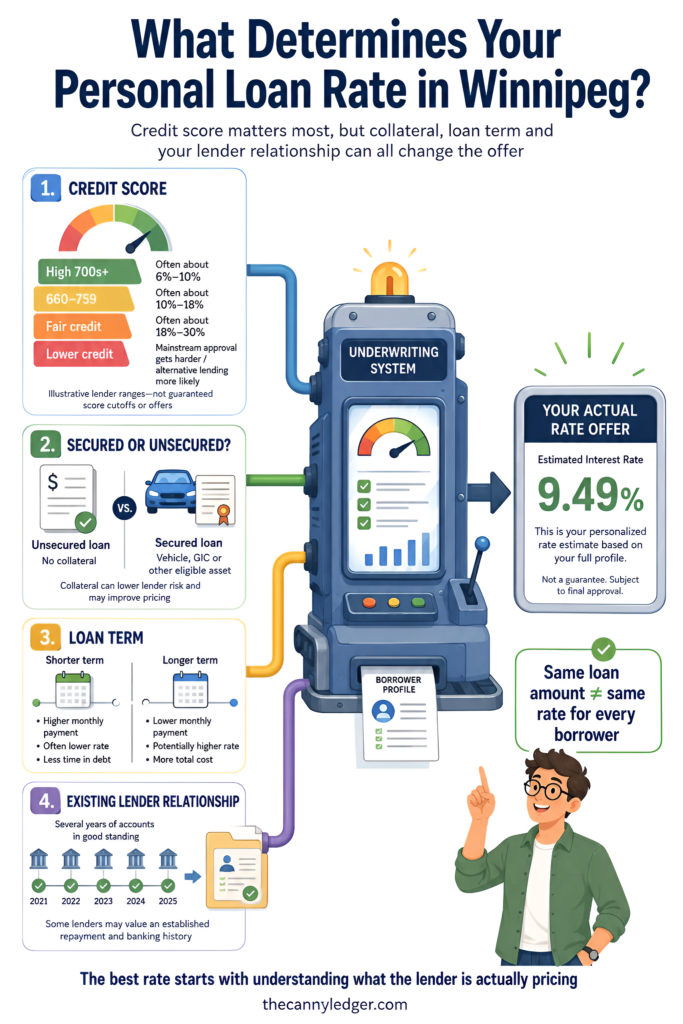
Your credit score does the heaviest lifting, and Canadian lenders generally sort borrowers into bands that shift the offered rate considerably. Someone with excellent credit, generally a score in the high 700s or above, tends to see rates starting somewhere in the 6 to 10 percent range from banks and credit unions. Good credit, roughly the 660 to 759 range, typically lands somewhere between 10 and 18 percent. Fair credit pushes that range up toward 18 to 30 percent, and anything below that tends to mean either a much higher rate from a mainstream lender or a conversation with an alternative lender built specifically for that segment of the market.
Beyond the score itself, whether the loan is secured or unsecured makes a real difference, since pledging an asset, a vehicle or a GIC held at the same institution, for example, generally earns a meaningfully lower rate than an unsecured personal loan carrying no collateral at all. The loan term matters too: a shorter term usually carries a lower rate than a longer one, even though the longer term’s monthly payment looks more manageable on paper, and the total interest paid over a five-year term versus a three-year term at the same amount can differ by a genuinely large margin. Your existing relationship with a lender counts for more than people expect as well. Someone with several years of accounts in good standing at the same bank or credit union often gets quoted a better rate than a first-time applicant with an identical credit file, simply because the lender already has a track record to look at rather than a credit report alone.
The legal ceiling almost nobody advertises
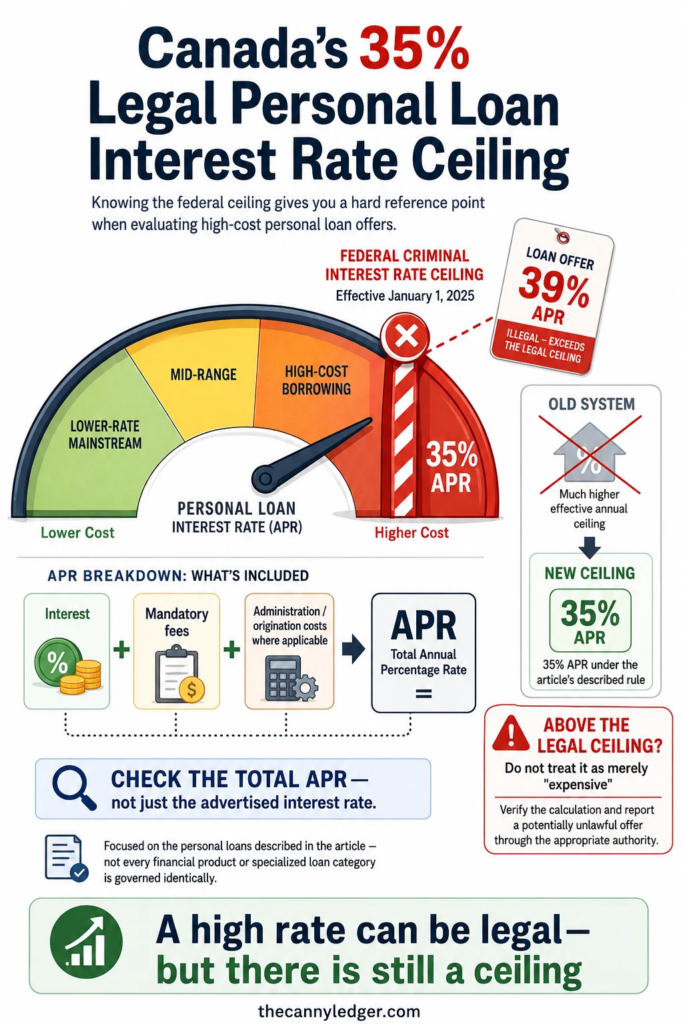
Here’s a fact worth knowing before you compare a single offer: as of January 1, 2025, Canada’s federal criminal interest rate cap dropped from an effective annual rate of 60 percent, roughly 48 percent on an annualized percentage basis, down to a hard ceiling of 35 percent APR under the Criminal Code. No lender operating legally in this country, bank, credit union, or alternative lender, can charge more than that on a personal loan of this kind, regardless of how the rate gets marketed or bundled with fees. This is a meaningfully lower ceiling than existed even a couple of years ago, and it’s specifically why the higher end of the alternative lending market has compressed somewhat compared to what older articles on this topic describe. If you ever see an offer that works out to more than 35 percent APR once every fee is included, that offer isn’t just expensive, it’s illegal, and worth reporting rather than simply declining.
Where to actually shop, roughly in order of likely value
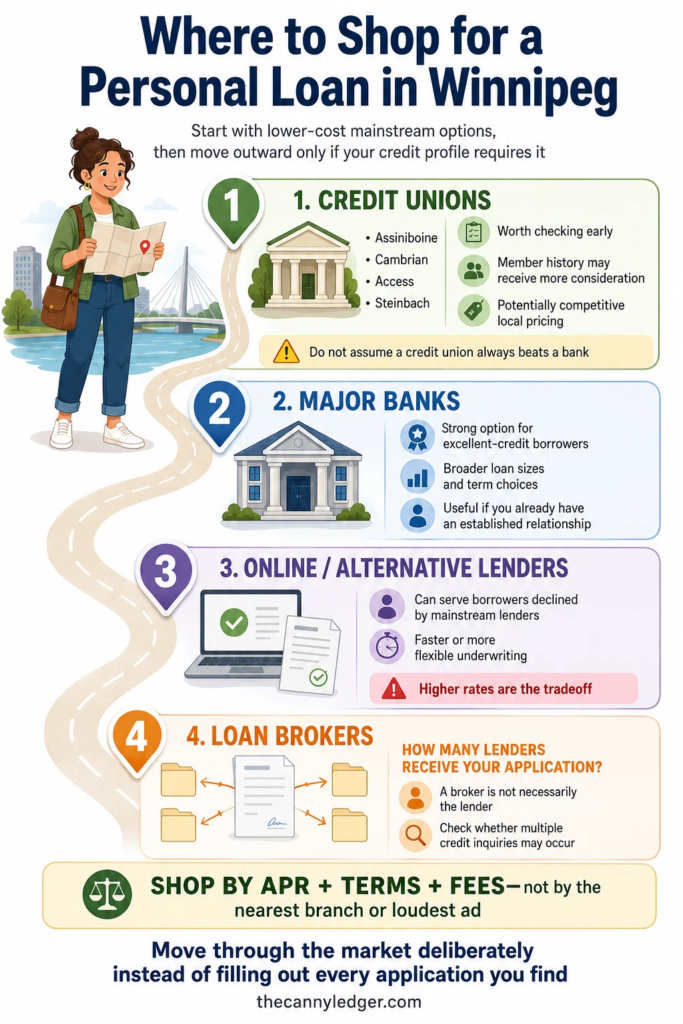
Winnipeg’s credit unions are consistently worth checking first, and not just out of local loyalty. Because credit unions are member-owned rather than shareholder-owned, they tend to price personal loans somewhat below what a comparable big bank offers for the same credit profile, often by a full percentage point or two, and they’re generally more willing to weigh a member’s full account history rather than a credit score in isolation. Our Winnipeg credit unions compared guide breaks down how Assiniboine, Cambrian, Access, and Steinbach differ on exactly this kind of lending, and it’s worth reading before your first application rather than after.
The major banks come next, and they remain the right call for borrowers with excellent credit who want the largest possible loan amounts or the widest range of term lengths. Our best banks in Winnipeg guide covers how the branch networks and digital banking experiences differ locally, which matters if in-person service is part of what you’re weighing alongside the rate itself.
Alternative and online lenders fill the gap for borrowers whose credit doesn’t clear the threshold that banks and credit unions look for, and the legitimate ones in this space operate transparently within the 35 percent legal ceiling, funding faster and asking fewer questions in exchange for a meaningfully higher rate. If this is the category you’re looking at, our bad credit loans in Winnipeg guide goes into which of these lenders are worth your time and which red flags to watch for, since this particular corner of the lending market attracts more predatory advertising than any other.
It’s worth knowing the difference between a lender and a loan broker before you start filling out forms. Sites that promise to match you with “the best lender for your situation” are usually brokers rather than lenders themselves, and applying through one can sometimes trigger multiple credit inquiries across several partner lenders at once rather than the single, controlled inquiry you’d get applying directly. That’s not automatically a reason to avoid them, some are perfectly legitimate, but it’s worth reading the fine print on how many lenders your information actually gets sent to before you submit anything.
Comparing offers properly: the details that actually matter
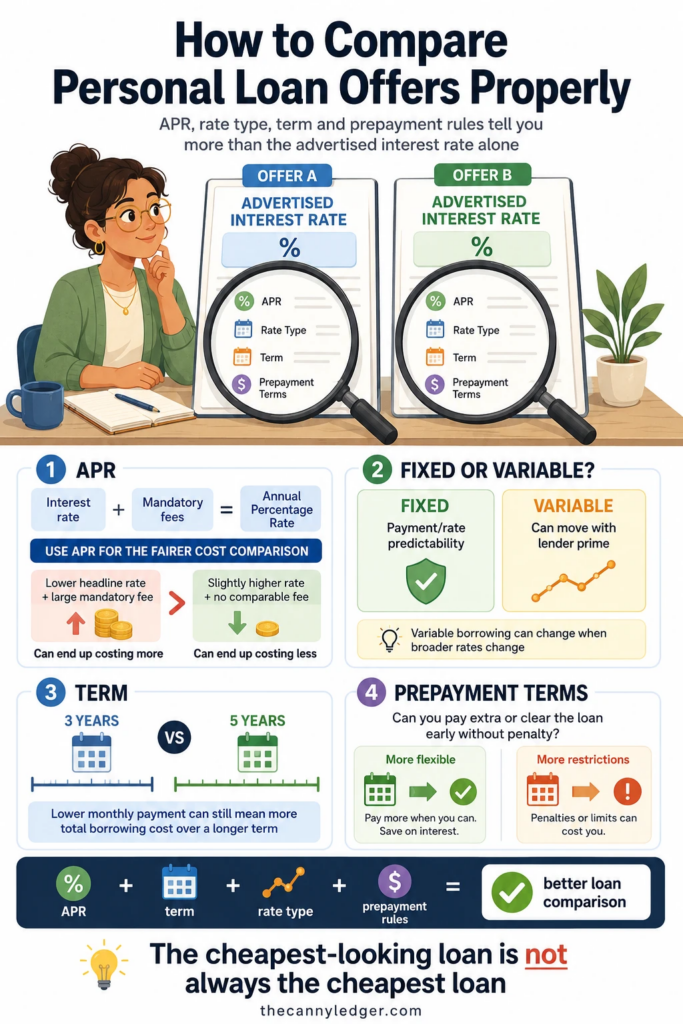
The advertised interest rate and the true cost of a loan aren’t always the same number, which is exactly why the annual percentage rate, or APR, exists as a distinct figure. APR folds in the interest rate plus any mandatory fees the lender charges, origination costs, administration fees, and so on, into a single annualized number, and it’s the only genuinely fair way to compare two loans that might structure their pricing differently on paper. A loan advertising a slightly lower interest rate but a hefty origination fee can easily end up costing more than a loan with a higher headline rate and no fees attached, and the APR is what surfaces that difference immediately.
Fixed versus variable is the next real decision point. A fixed rate stays exactly the same for the life of the loan, which makes budgeting simple and protects you from any future rate increases, while a variable rate moves with the lender’s prime rate, which itself tracks the Bank of Canada’s overnight policy rate. As of mid-2026, the Bank of Canada has held its overnight rate at 2.25 percent through several consecutive announcements, which has kept variable-rate borrowing relatively stable for the time being, but that rate is reviewed on a fixed schedule throughout the year and can move in either direction depending on how inflation and the broader economy behave. If predictability matters more to you than the possibility of a rate drop, a fixed-rate loan removes that uncertainty entirely.
Prepayment terms are worth asking about directly rather than assuming. Some lenders allow you to pay off a personal loan early with no penalty at all, which can save a meaningful amount of interest if your financial situation improves partway through the term. Others charge a prepayment penalty specifically to protect the interest income they were counting on, and that detail rarely shows up prominently in marketing material, so it’s worth asking the question outright before signing anything.
Protecting your credit score while you shop around
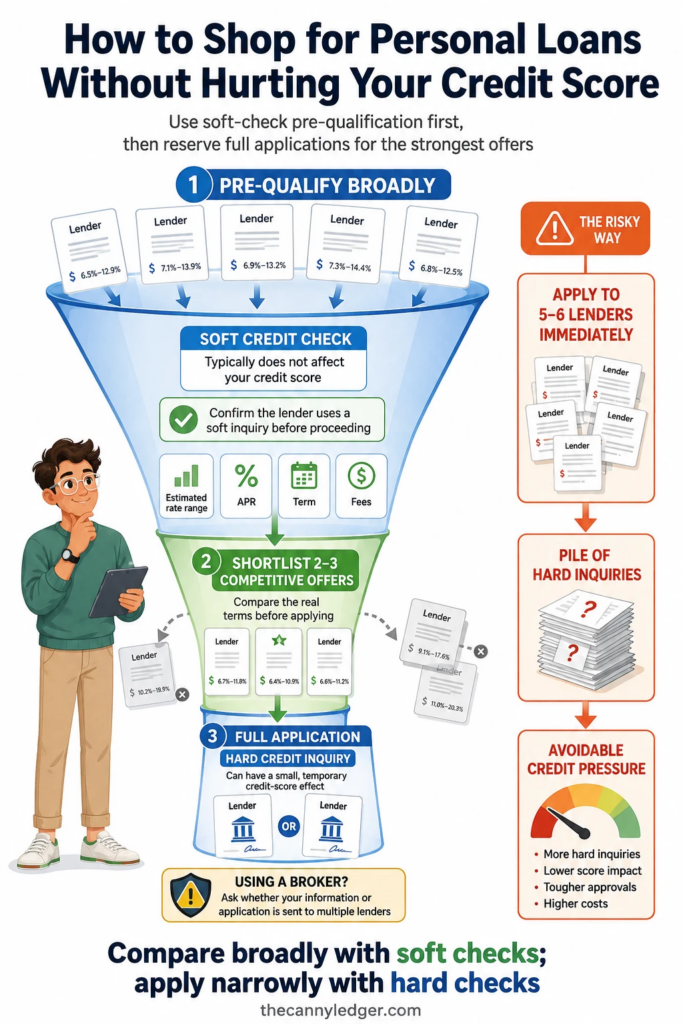
A genuinely useful habit that a lot of people skip: getting pre-qualified with several lenders before submitting a full application to any of them. Pre-qualification typically uses what’s called a soft credit check, which doesn’t affect your credit score at all, and lets you see roughly what rate range you’d qualify for at each lender before committing to a hard inquiry. A hard inquiry, the kind triggered by a full formal application, does have a small, temporary effect on your credit score, and applying to five or six lenders all at once in the same week can compound that effect in a way that actually works against you during the exact period you’re trying to shop smart.
The practical sequence that tends to work best is pre-qualifying broadly first, narrowing down to the two or three offers that look genuinely competitive once you’ve compared APR, term, and any fees side by side, and only then submitting a full application to your top choice or two. This gets you the comparison shopping you actually want without stacking up a pile of hard inquiries that could otherwise nudge your score in the wrong direction right when you’re trying to present the strongest possible file.
What lenders actually ask for, and how to strengthen your application before you submit it
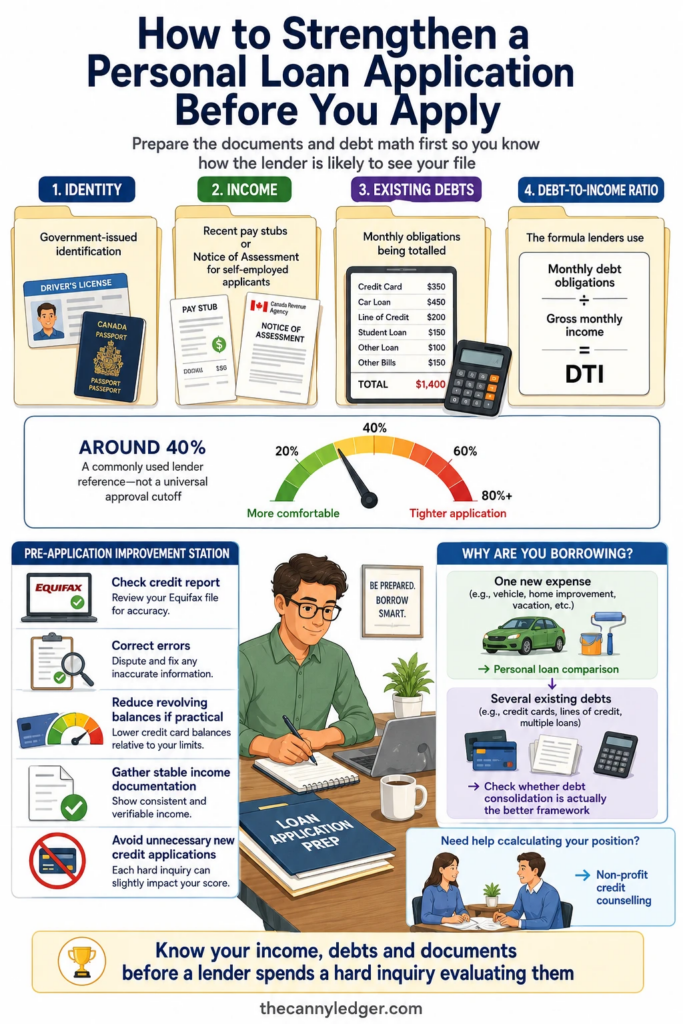
Most personal loan applications in Winnipeg ask for proof of identity, proof of income, generally recent pay stubs or a Notice of Assessment for self-employed applicants, and some accounting of your existing debts relative to your income. Lenders generally want your total monthly debt obligations to sit comfortably under about 40 percent of your gross monthly income, and getting a clear sense of where you currently stand on that ratio before applying can save you from a rejection that dings your credit for no real benefit. If you’re not sure where that ratio actually sits, a free session with a non-profit counsellor covered in our credit counselling in Winnipeg guide can walk through the math with you before you ever submit an application.
If your debt-to-income picture is already tight because of several existing balances rather than one clean need, it’s worth stepping back and asking whether a personal loan taken out to consolidate those balances is actually the better move than a new loan for a fresh, separate purpose. Our debt consolidation in Winnipeg guide covers exactly this distinction and walks through when a consolidation loan specifically, as opposed to a personal loan for something new, makes the most financial sense.
The mistakes that quietly cost people the most
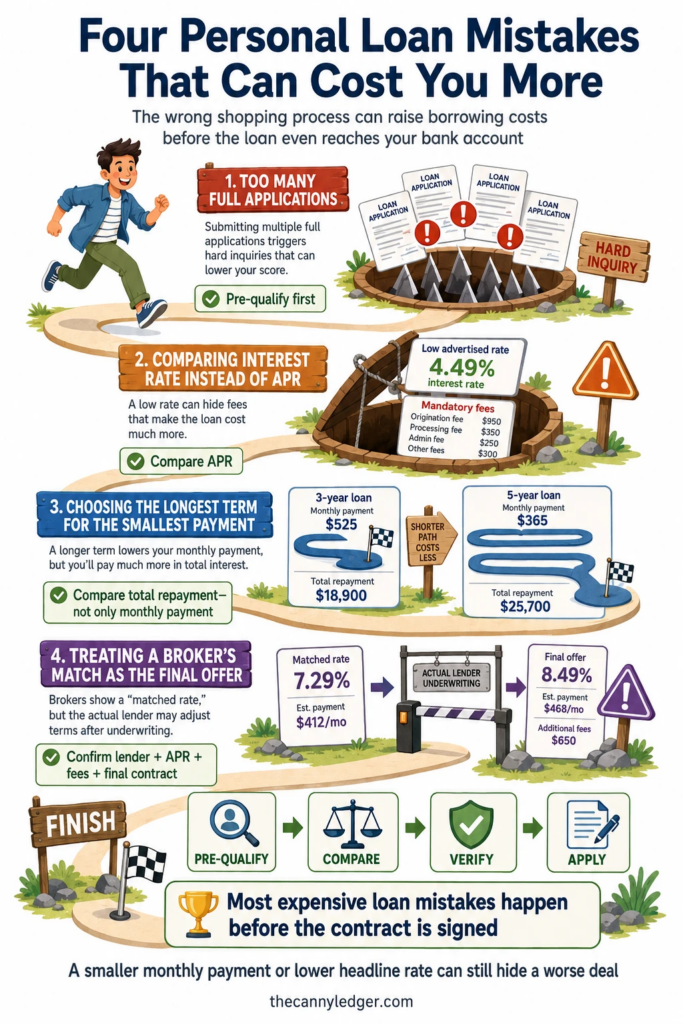
Applying to too many lenders in too short a window, as covered above, is the most common self-inflicted cost, and it’s an easy one to avoid once you know to ask about soft-check pre-qualification upfront.
Comparing the advertised rate instead of the APR is the second, and it’s exactly how a loan with a lower headline number can end up costing more once fees are added in.
Choosing the longest available term purely because the monthly payment looks smaller is the third, and it’s worth actually running the total interest cost at a couple of different term lengths before deciding, since the difference between a three-year and five-year term on an otherwise identical loan can be substantial.
And treating a loan broker’s “matched offer” as the final word rather than confirming the actual lender, rate, and terms directly is the fourth, since brokers occasionally present a best-case scenario that shifts once you’re actually speaking with the underlying lender.
Where this fits into the bigger picture
If your reason for shopping for a personal loan right now involves consolidating higher-interest debt rather than funding something new, it’s worth reading this guide alongside our GIC and savings interest rates in Winnipeg page as well, since understanding what the same institutions pay on deposits gives you a useful sense of their overall margin and how much room they realistically have to offer you a competitive lending rate. And if the loan decision is part of a larger financial picture, retirement contributions, an inheritance, or a business you’re trying to fund alongside personal debt, a conversation with one of the professionals in our financial advisors in Winnipeg roundup can put the loan decision in a context a rate comparison alone can’t provide. Shop the rate, read the APR, and let the lender who actually earns your business with real numbers get the application, not just the one with the shortest line.