
Most of the advice floating around car loans in Canada focuses on the wrong question. People ask what score gets them approved, when the number that actually costs real money is what score gets them a decent rate once they’re in the door. Car loans approve an enormous range of credit profiles, since the vehicle itself backs the loan, but the spread between what a strong score pays and what a weak one pays on the exact same car can run into thousands of dollars over the term.
- Why a Car Loan Behaves Differently Than Other Credit
- Where the Score Actually Moves the Rate
- Bank Financing Versus Dealership Financing
- What a Weak Score Actually Costs Over Time
- Subprime and Specialty Lenders
- Building From No Credit History at All
- Co-Signers and Down Payments as Real Levers
- Where This Leaves You
- A Few More Questions
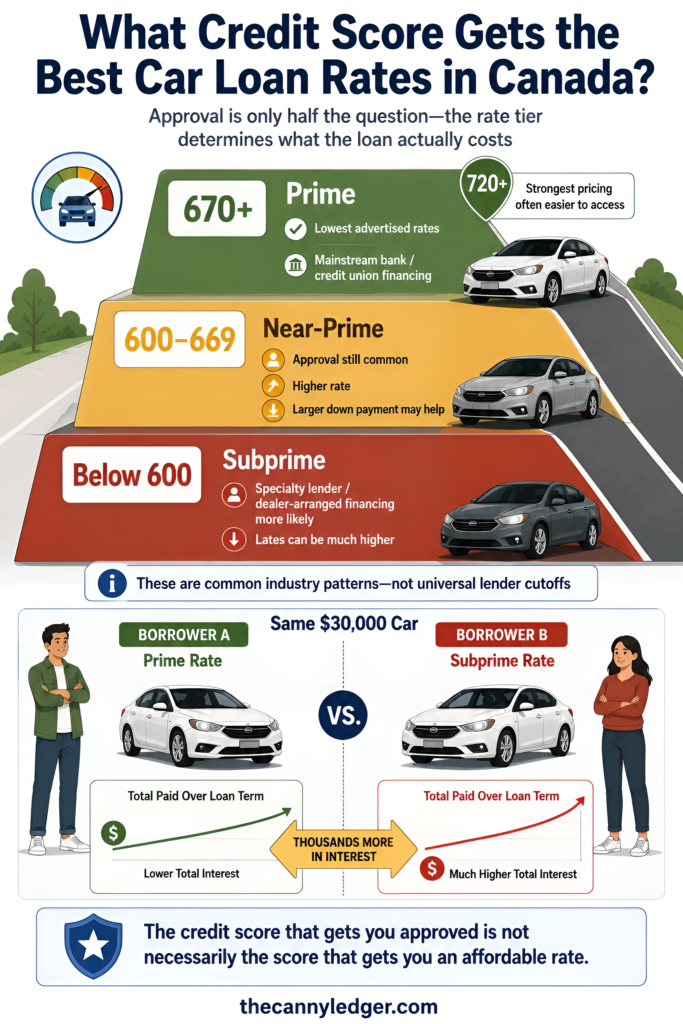
Most banks and credit unions in Canada treat a credit score of 670 or higher as the entry point for prime auto financing and the lowest advertised rates. Scores in the 600s can still qualify but usually come with a higher rate, and scores below 600 typically move a borrower into subprime or dealer-arranged financing. None of these are hard cutoffs the way CMHC’s mortgage insurance floor is, since individual lenders set their own tiers, but the pattern holds consistently enough across major banks to plan around.
Why a Car Loan Behaves Differently Than Other Credit
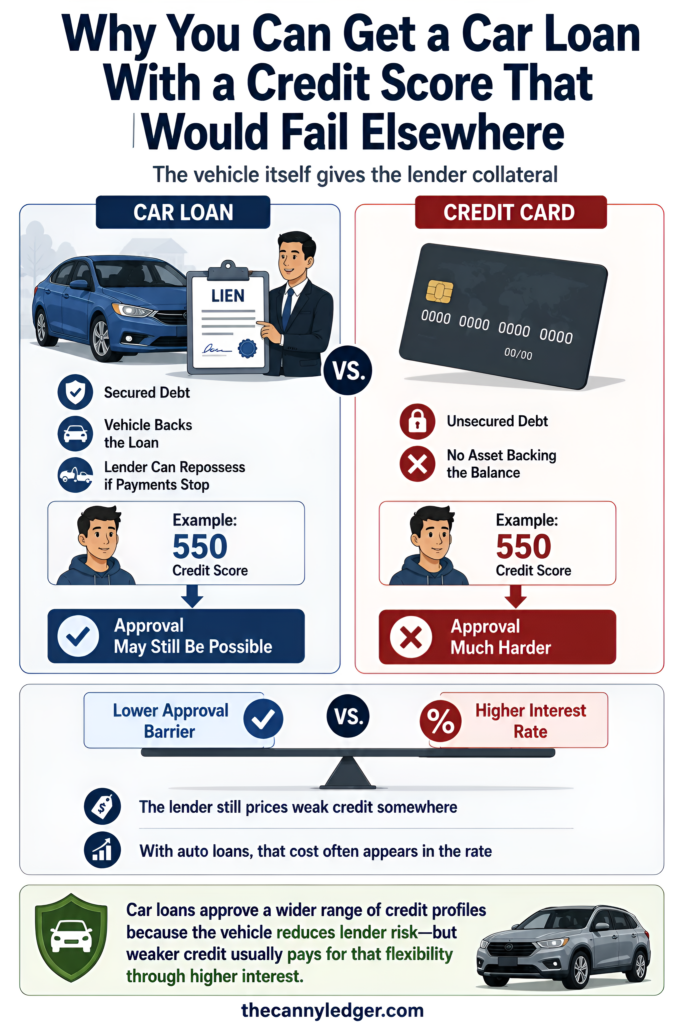
A car loan is secured debt, and that single fact changes almost everything about how lenders treat a weak score compared to an unsecured product like a credit card. If payments stop, the lender can repossess the vehicle and recover most of what’s owed, which means the collateral itself is doing part of the job a strong credit history would otherwise do. That’s the entire reason someone with a 550 score can walk out of a dealership with financing the same afternoon a credit card application at that score would get declined outright.
The tradeoff for that flexibility is price. A lender extending credit against weaker collateral risk still prices that risk somewhere, and with a car loan it shows up almost entirely in the interest rate rather than in the approval decision itself.
Where the Score Actually Moves the Rate
A score sitting at 670 or above generally puts a borrower in what lenders call the prime tier, and prime borrowers get access to the lowest advertised rates a bank or credit union publishes. Scores through the 600s, often described as near-prime, still qualify at most banks but land somewhere between the prime rate and what a subprime lender would charge, sometimes with a larger down payment requested to offset the gap. Below 600, subprime and specialty auto lenders become the more realistic path, and rates there run meaningfully higher, sometimes by ten percentage points or more compared to a prime borrower on the same vehicle.
That gap compounds over a full loan term in a way a lot of buyers underestimate at the dealership, focused on the monthly payment rather than the total interest paid across five or six years. Two people financing an identical $30,000 vehicle over the same term, one at a prime rate and one at a subprime rate, can end up thousands of dollars apart in total cost even if their monthly payments look deceptively close once the term length gets stretched to compensate.
Bank Financing Versus Dealership Financing
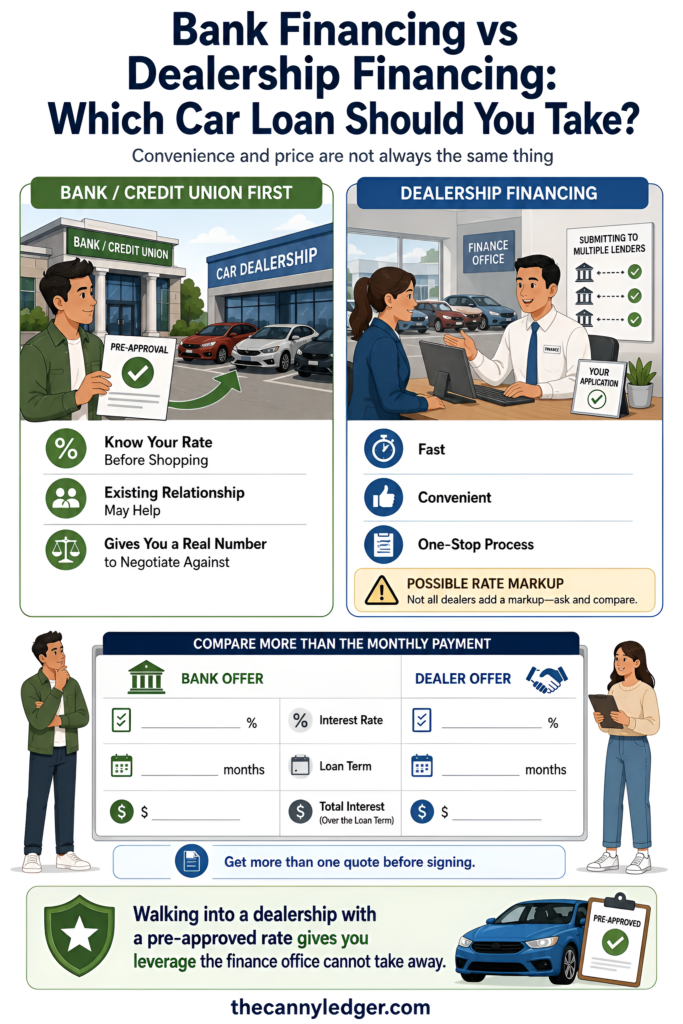
According to the Government of Canada’s own guide to financing a car, most dealerships arrange car loans on your behalf through a lender rather than lending the money themselves, while going directly to a bank or credit union is a separate path that sometimes yields a better rate, particularly for someone who already holds accounts in good standing there. The dealership route is convenient and often faster, since financing gets sorted out in the same visit as picking the car, but that convenience can come with a markup built into the rate compared to what the same lender might offer a customer who applied directly.
The FCAC’s guidance on shopping around is blunt about this exact point, recommending quotes from multiple dealers and lenders before committing, since the difference in interest rate between offers isn’t always obvious from the monthly payment alone. Getting a pre-approval from your own bank before setting foot on a lot changes the negotiating position entirely, since it gives a concrete number to compare against whatever the dealership finance office proposes.
What a Weak Score Actually Costs Over Time
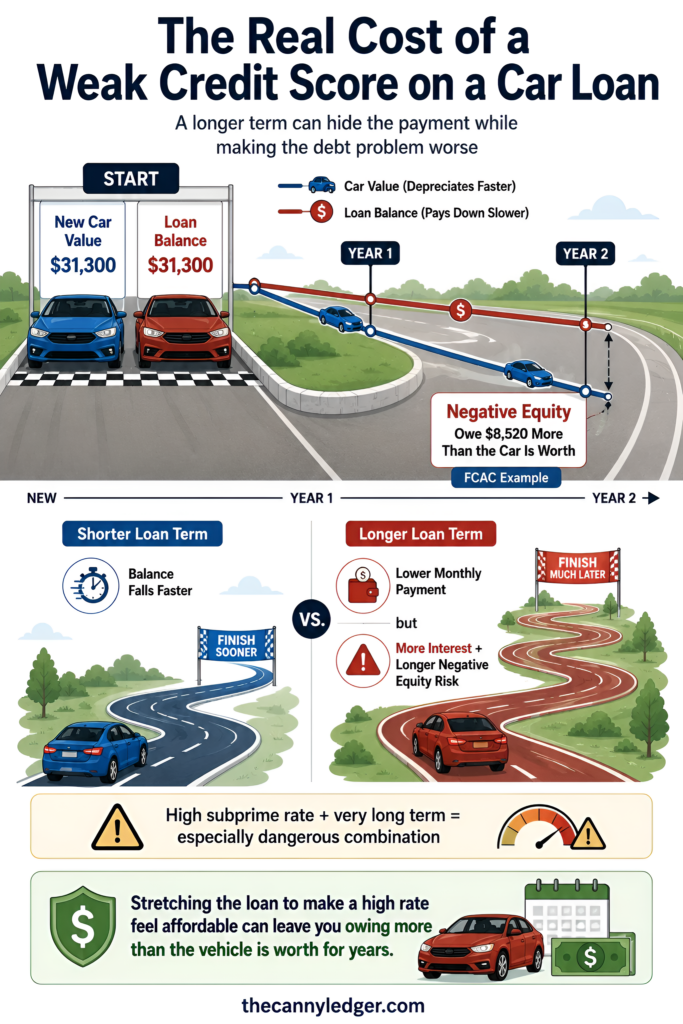
The FCAC’s own worked example on long-term car loans lays out a scenario worth sitting with directly. A new car worth $31,300, financed over a long enough term, can leave the owner owing $8,520 more than the car is worth after just two years, a position called negative equity. Stretching a loan out to manage a higher subprime rate makes this problem worse, not better, since a longer term at a higher rate means the loan balance falls more slowly relative to how fast a new vehicle actually depreciates.
This is the real, compounding cost of financing at a weak score that a lot of advice skips past in favour of just talking about the approval odds. A subprime borrower stretching to a 96-month term to make a high-rate loan affordable monthly isn’t just paying more interest, they’re also more likely to owe more than the car is worth for a longer stretch of that term, which becomes a real problem if the car needs to be sold or traded before the loan is paid down.
Subprime and Specialty Lenders
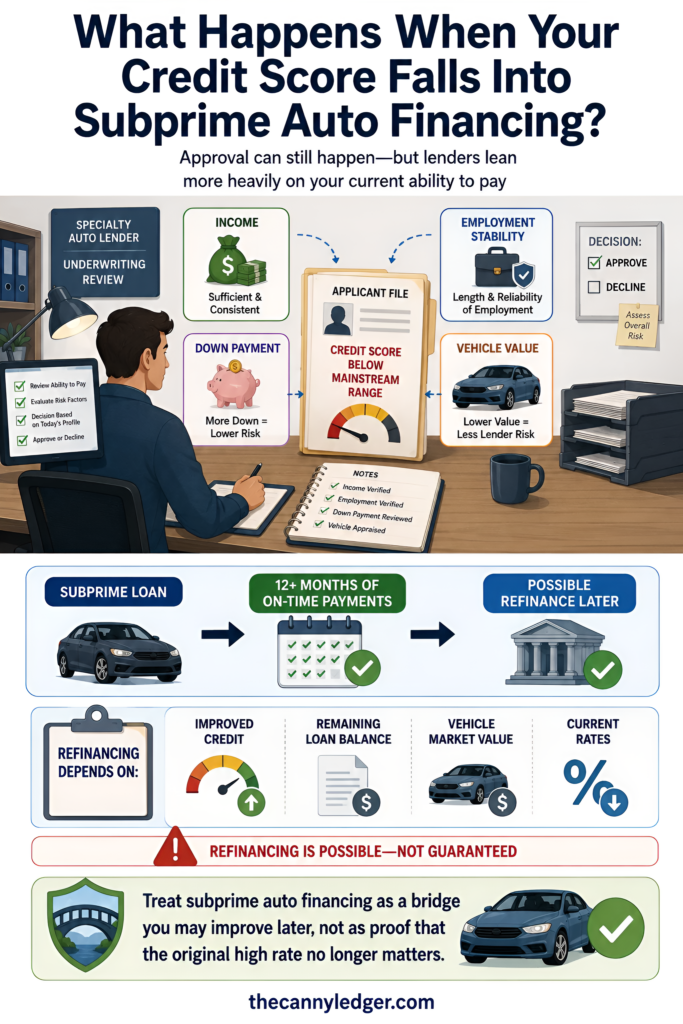
Below the range most banks treat as their comfort zone, specialty auto lenders and dealer networks with access to subprime programs become the realistic option, and approval there leans much more heavily on income, employment stability, and down payment than the score itself. Borrowers who’ve been through a bankruptcy or a consumer proposal can and regularly do get approved through these channels, since the lender is underwriting against the vehicle and the applicant’s current ability to pay rather than a clean credit history.
The honest framing for this tier is that it’s usually a bridge rather than a destination. A borrower who takes a subprime loan, makes consistent on-time payments for a year or so, and rebuilds their score in the process is often in a position to refinance into better terms once that history exists, though refinancing depends on the updated credit profile, how much is still owed, and the current value of the vehicle at that point, not on a guarantee built into the original loan.
Building From No Credit History at All
Newcomers to Canada face a fundamentally different situation than someone with a damaged score, since a car loan applicant with no Canadian credit file yet isn’t a risk case in the same way a subprime borrower is. Several major banks have built specific programs around this gap rather than treating it as bad credit by default. According to RBC’s own auto financing page, its Newcomer Automotive Loan Program is available to permanent residents who’ve been in Canada within the last three years and doesn’t require a Canadian credit history, and RBC also states no credit history is required on vehicles less than ten years old for applicants who meet the program’s other eligibility and credit criteria. TD Auto Finance runs a comparable program aimed specifically at newcomers with limited or no Canadian credit history.
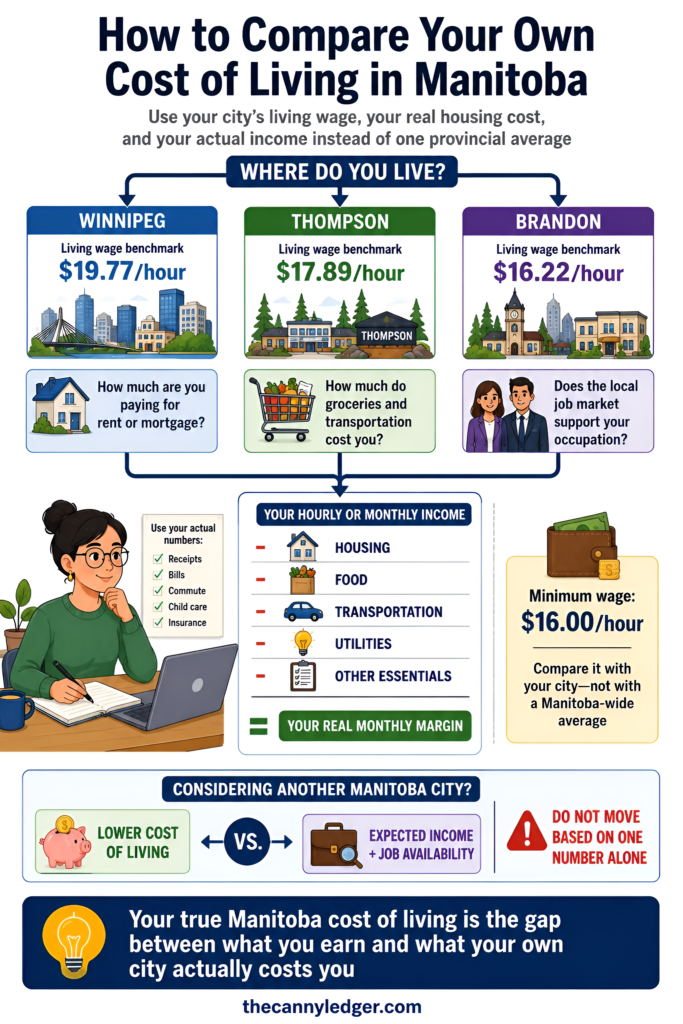
Anyone new to Winnipeg specifically and working through banking basics before a car purchase even comes up should read a newcomers guide covering the earlier steps before applying for financing, since some of these programs work best alongside an existing account relationship rather than as a cold application. Comparing a Winnipeg credit union against a national bank is also worth doing here specifically, since credit unions sometimes extend more flexibility to a thin file than a standardized national newcomer program does.
Co-Signers and Down Payments as Real Levers
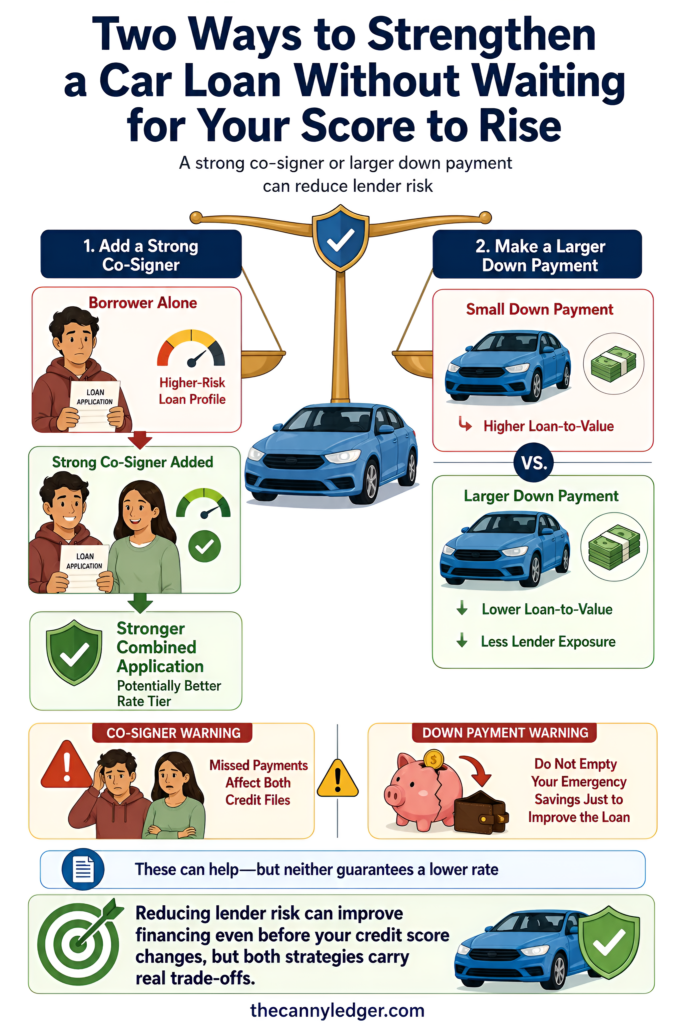
A co-signer with a stronger credit history can move an application from a subprime rate into a near-prime or even prime tier at some lenders, since the lender is now underwriting against both files rather than one. This isn’t a decision to make lightly, since a missed payment on the loan affects the co-signer’s credit exactly as much as the primary borrower’s, but it’s a practical option worth knowing about rather than assuming a low score locks someone into the worst available rate.
A larger down payment does similar work from a different angle, lowering the loan-to-value ratio a lender is exposed to and sometimes unlocking a better rate tier even without touching the credit score itself. For a borrower sitting right at the edge between near-prime and subprime pricing, putting an extra few thousand dollars down can occasionally do more for the rate than waiting months to raise the score by the same margin would. This matters most if you’re buying a used car, where the loan-to-value math tends to be tighter than it is on a new vehicle with a longer expected life.
Where This Leaves You
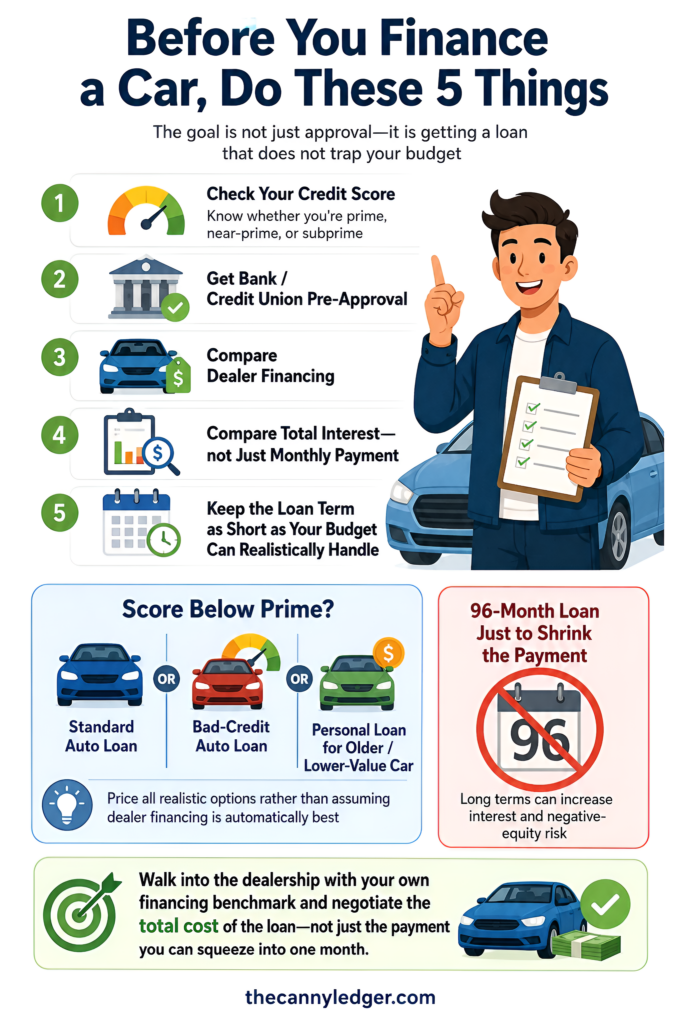
Get pre-approved through your own bank or a credit union before visiting a dealership, since that number becomes your actual leverage point rather than a guess at what you might qualify for once you’re sitting across from a finance manager. If your score sits below what the major banks treat as prime, comparing a dedicated bad-credit car loan option directly against a standard car loan before committing to dealer-arranged financing gives you an actual number to negotiate against rather than accepting the first offer. A personal loan is occasionally worth pricing out too, particularly on an older or lower-value vehicle where a secured auto loan’s advantage over unsecured borrowing shrinks. And whatever tier you land in, resist stretching the term purely to shrink the monthly payment, since the FCAC’s own numbers show exactly how that trade works against you the longer it runs.
A Few More Questions
Does checking my rate with multiple lenders hurt my score? Getting pre-qualified or an estimate typically runs as a soft check with no effect on your score, though a full formal application does generate a hard inquiry. Ask directly which kind of check a lender is running before you authorize it, since the two aren’t the same thing.
Can I get a car loan right after a repossession? It’s harder but not impossible, since a repossession is a serious negative mark that most prime lenders weigh heavily. Subprime and specialty lenders are typically the realistic path immediately afterward, with a return to mainstream financing becoming possible again once enough time and rebuilt payment history have passed.
Does leasing require a different credit score than financing? Leasing companies generally look for stronger credit than financing does, since a lease is a longer-term commitment to a vehicle the leasing company still owns at the end, and defaulting mid-lease leaves them with less recovery flexibility than repossessing a financed vehicle would.