- Why Fixed and Variable Rates Don’t Move Together
- Where Rates Actually Sit Right Now
- The Stress Test Nobody Reads the Fine Print On
- Insured, Insurable, and Uninsurable Mortgages Change Your Rate
- First-Time Buyers Now Get More Room, If You Know Where to Look
- How the FHSA and Home Buyers’ Plan Stack Your Down Payment
- What This Looks Like on an Actual Home Purchase
- Fixed or Variable, Not a Coin Flip
- Renewing? Don’t Assume Your Bank Is Giving You the Best Number
- The Mistakes That Actually Cost People Money
- Now What Actually Comes Next
- Frequently Asked Questions
Ask five people what “the mortgage rate” is right now and you’ll probably get five different numbers, and none of them will be wrong. Someone quotes the Bank of Canada’s overnight rate. Someone else quotes their bank’s prime rate. A third person read a headline about “rates holding steady” and assumes that means their fixed rate is frozen too. It isn’t one number. It’s at least three separate things moving for three separate reasons, and mixing them up is the single most common mistake people make when they start shopping for a mortgage.
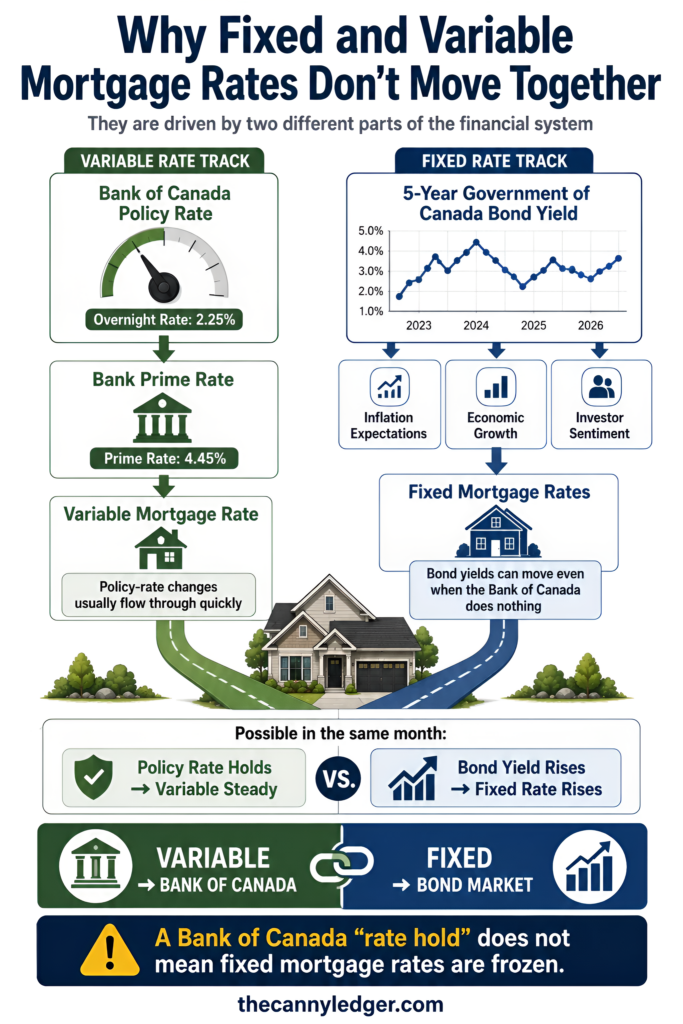
The Bank of Canada sets a policy rate that banks use to price short-term borrowing and variable mortgages. Fixed mortgage rates, on the other hand, track the bond market, specifically the yield on five-year Government of Canada bonds, which moves on its own schedule based on inflation expectations, government borrowing, and global investor sentiment. The two can (and often do) move in opposite directions in the same month. That’s why you’ll sometimes see the Bank of Canada hold its rate steady while fixed mortgage rates creep up anyway, and it confuses people who assumed a “rate hold” meant nothing was changing anywhere.
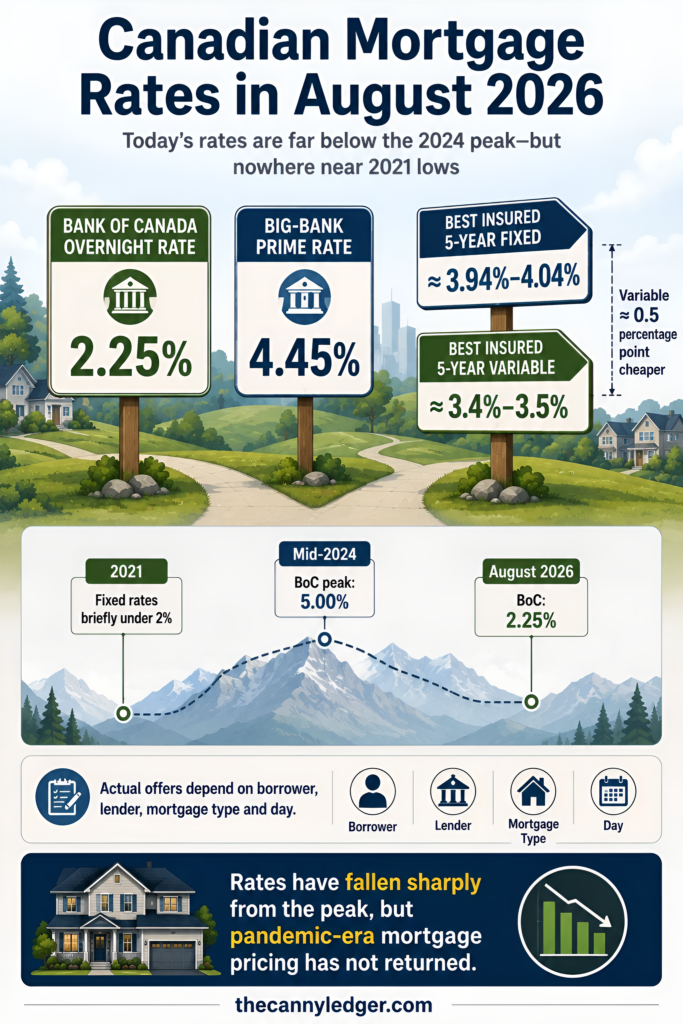
As of August 2026, the Bank of Canada’s overnight rate sits at 2.25%, with the big banks’ prime rate at 4.45%. The best available insured five-year fixed mortgage rates are running roughly 3.94% to 4.04%, while the best insured five-year variable rates sit around 3.4% to 3.5%. Every borrower is still stress-tested at their contract rate plus 2%, well above the federal 5.25% floor either way.
Why Fixed and Variable Rates Don’t Move Together
This is worth sitting with for a second, because it explains almost everything else in this guide. A fixed-rate mortgage locks in a rate for your entire term, typically five years, and that rate is set the day you sign based on where bond yields are at that moment. A variable-rate mortgage moves with your lender’s prime rate, which shifts every time the Bank of Canada changes its policy rate, usually within a business day or two of the announcement.
So when the Bank of Canada held its rate at 2.25% for the sixth straight announcement this past July, citing a Canadian economy that had finally started growing again after stalling for most of the past year, that news mattered mostly for people with variable-rate mortgages or lines of credit. Fixed-rate shoppers were watching something else entirely, the five-year bond yield, which has been pushing up toward 3.2% as growth data improves and energy prices climb, partly because of the ongoing conflict in the Middle East and its effect on oil markets. When bond yields rise, lenders raise fixed rates to protect their margins, regardless of what the Bank of Canada just did.
If you remember nothing else from this article, remember this. Variable rates follow the Bank of Canada, fixed rates follow the bond market, and a headline about one tells you almost nothing about the other.
Where Rates Actually Sit Right Now
A bare percentage doesn’t mean much without something to measure it against. At the height of the post-pandemic hiking cycle in mid-2024, the Bank of Canada’s overnight rate peaked at 5%. It has since been cut all the way down to 2.25%, close to where it sat back in 2019 before any of this started. Prime rate at the big banks currently sits at 4.45%.
On the fixed side, the best insured five-year rate available today is in the high 3% range, generally between 3.94% and 4.04% depending on the lender and the day. That’s a meaningful drop from October 2024, when the average posted five-year rate at Canada’s major chartered banks was 6.49%, but it’s also noticeably higher than the ultra-low fixed rates under 2% that were available briefly in 2021. In other words, we’re not back at pandemic-era lows, and forecasts from RBC Economics and TD Economics both suggest the policy rate is likely to hold roughly where it is through the end of 2027, so don’t expect a dramatic swing in either direction without a specific economic shock triggering it.
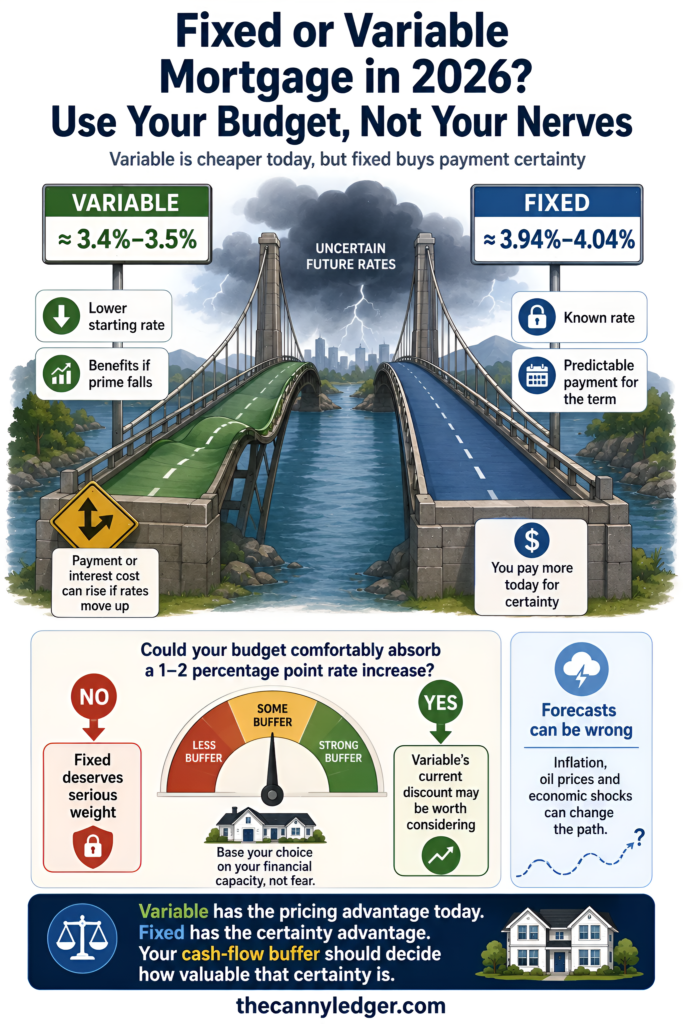
Variable rates are currently the cheaper of the two options, sitting around 3.4% to 3.5% for well-qualified insured borrowers, a gap of roughly half a percentage point below fixed. That spread matters. It’s part of why some buyers are leaning variable this year even though fixed rates offer payment certainty, a trade-off worth thinking through carefully rather than defaulting to whichever option feels safer emotionally.
The Stress Test Nobody Reads the Fine Print On
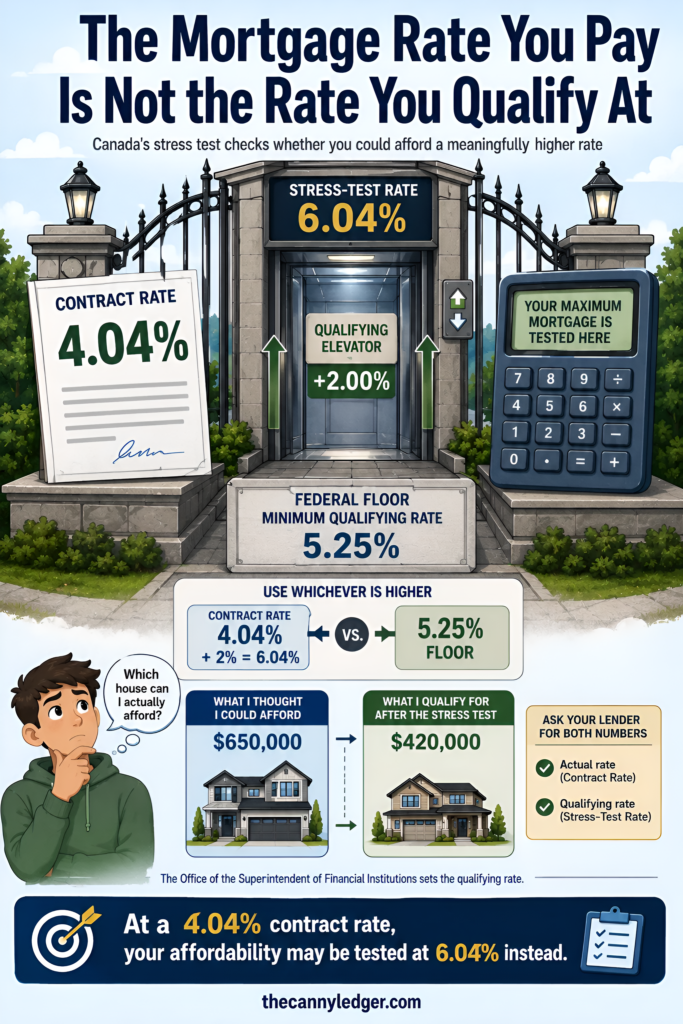
Every mortgage applicant in Canada, insured or not, fixed or variable, has to qualify at a rate higher than the one they’re actually going to pay. This is the mortgage stress test, and it’s been federal policy since 2018. You qualify at the higher of two numbers, either your actual contract rate plus 2% or a minimum qualifying rate set by the Office of the Superintendent of Financial Institutions, currently 5.25%.
Right now, because fixed rates are sitting near 4%, adding 2% pushes almost everyone above that 5.25% floor, meaning your contract rate plus 2% is the number that actually applies. Say you’re approved for a five-year fixed at 4.04%. Your lender doesn’t ask whether you can afford payments at 4.04%, they ask whether you can afford them at 6.04%. That’s the rate used to calculate your maximum approved mortgage amount, even though it’s not the rate you’ll actually pay.
This trips people up constantly, especially first-time buyers who see a rate advertised, do rough math on what they can afford, and then get a much lower approval amount than expected because the bank ran the numbers at a rate two points higher. If you’re house hunting, ask your lender or broker to show you both numbers up front, the rate you’ll pay and the rate you’re qualifying at, so there are no surprises partway through an accepted offer.
Insured, Insurable, and Uninsurable Mortgages Change Your Rate
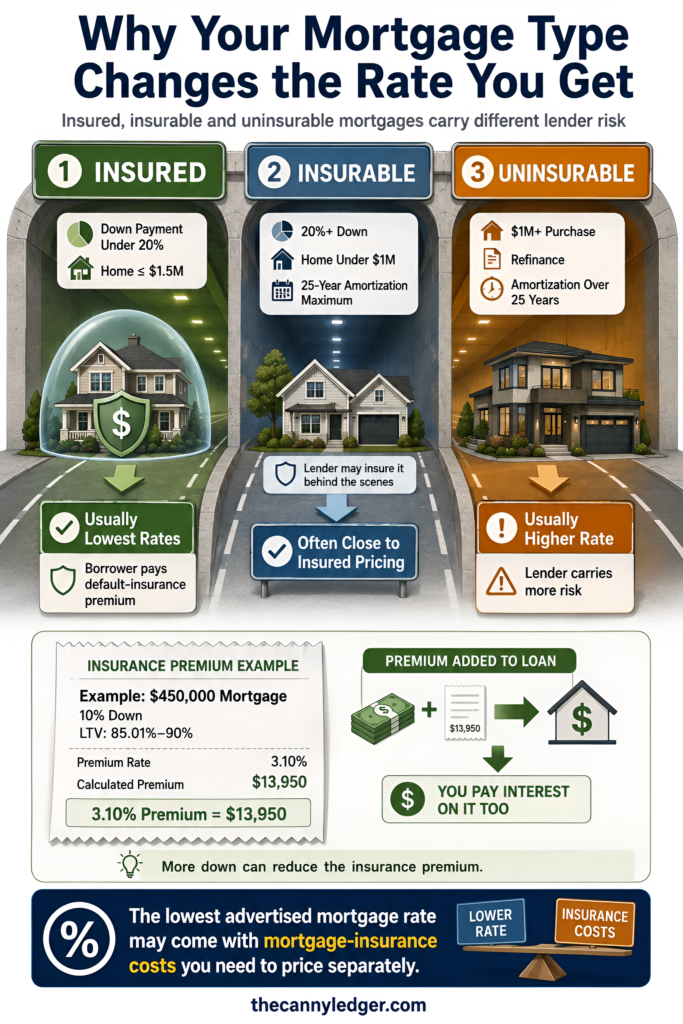
The size of your down payment doesn’t just affect your monthly payment, it changes which category of mortgage you’re even eligible for, and that category affects the interest rate you’re offered.
An insured mortgage applies when your down payment is under 20% of the purchase price and the home costs $1.5 million or less. You’re required to buy mortgage default insurance, most commonly through CMHC, though private insurers Sagen and Canada Guaranty offer nearly identical terms. Because the lender’s risk is covered by that insurance, insured mortgages typically get the best rates on the market, which is why the lowest numbers you’ll see advertised, the 3.94% to 4.04% range mentioned above, are almost always insured rates specifically.
Insurable mortgages are for buyers with 20% or more down on a home under $1 million, with an amortization capped at 25 years. These don’t require default insurance for the borrower, but the lender may still insure the mortgage in bulk on the back end, which lets them offer a rate close to insured pricing without passing the premium cost onto you.
Uninsurable mortgages cover everything else, homes priced at $1 million or more with a conventional down payment, any refinance, and amortizations stretched past 25 years. These carry the highest rates of the three categories, sometimes by a quarter to half a percentage point, because the lender is carrying the full risk with no insurance backstop.
Put that in real dollars. Under CMHC’s current premium schedule, a buyer putting 10% down (a loan-to-value between 85.01% and 90%) pays a premium of 3.10% of the total loan amount. On a $450,000 mortgage, that’s a one-time premium of $13,950, which gets added directly to your loan balance rather than paid in cash, so it’s amortized alongside the rest of your mortgage and accrues interest right along with it. Put down 15% instead and your loan-to-value drops into the 80.01% to 85% bracket, cutting the premium to 2.80%, which sounds like a small difference until you realize it’s the gap between paying insurance interest on roughly $14,000 versus a smaller number for the life of your mortgage.
First-Time Buyers Now Get More Room, If You Know Where to Look
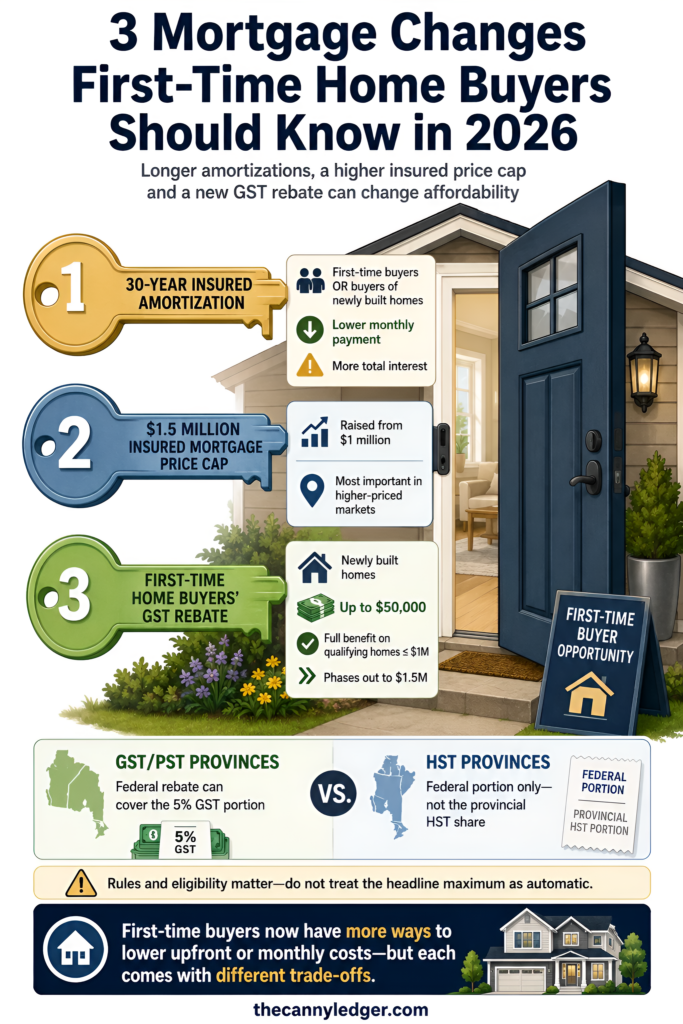
Two federal changes that took effect in December 2024 are still reshaping what first-time buyers can access in 2026, and a lot of people house hunting right now haven’t caught up on either one.
The first is the amortization extension. Insured mortgages used to cap out at 25 years for everyone, full stop. As of December 15, 2024, any first-time home buyer, or any buyer purchasing a newly constructed home regardless of buyer status, can qualify for a 30-year amortization on an insured mortgage instead. Spreading payments over five extra years lowers your monthly payment noticeably, though it also means more total interest paid over the life of the loan, so it’s a real trade-off between short-term affordability and long-term cost, not a free upgrade.
The second is the insured mortgage price cap, which jumped from $1 million to $1.5 million on the same date. That change matters most in expensive markets like Toronto and Vancouver, where average prices sit well above the old $1 million ceiling; in more affordable markets, most purchases were already comfortably under that threshold, so the higher cap doesn’t change much day to day.
There’s also a newer piece that hasn’t fully landed in most people’s awareness yet, the First-Time Home Buyers’ GST Rebate, which received Royal Assent in March 2026. Eligible first-time buyers purchasing a newly built home can recover up to $50,000, on homes priced at $1 million or less, with the rebate phasing out on a sliding scale between $1 million and $1.5 million. How much that’s actually worth depends on where you live. In provinces that charge GST and PST separately, Manitoba, Saskatchewan, British Columbia, and Quebec among them, the rebate covers the full 5% GST on the purchase. In HST provinces like Ontario and most of Atlantic Canada, the federal rebate only covers the federal portion of the HST, not the provincial share, so the dollar value works out differently depending on your province’s combined tax rate.
How the FHSA and Home Buyers’ Plan Stack Your Down Payment
Coming up with a competitive down payment is usually the biggest barrier for first-time buyers, and the federal government has quietly made this easier over the past couple of years by letting two savings vehicles work together.
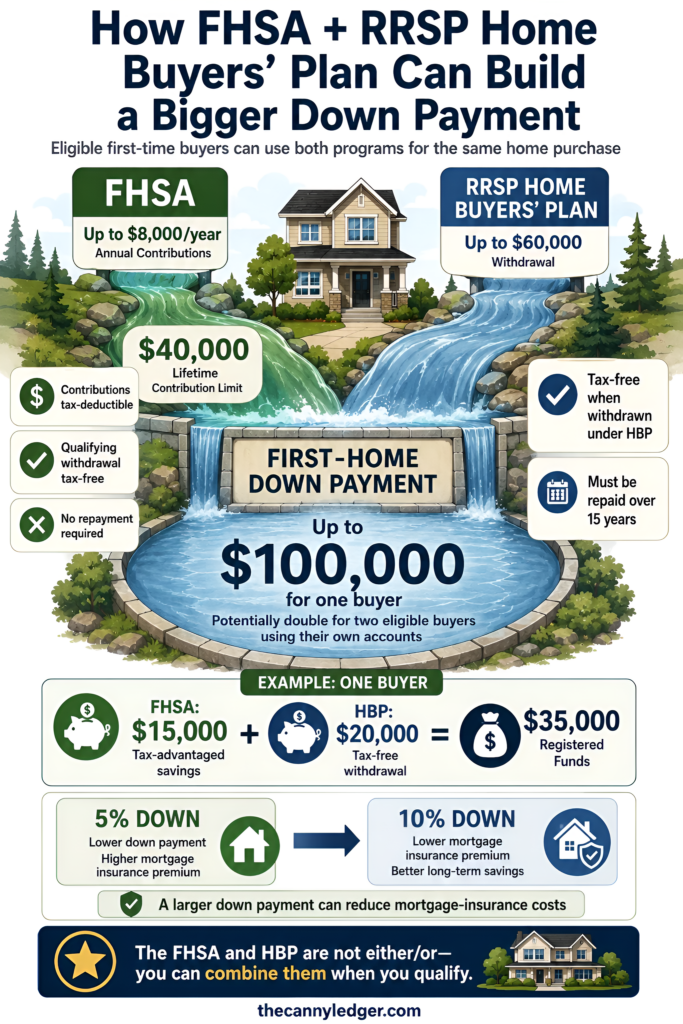
The First Home Savings Account (FHSA) lets you contribute up to $8,000 a year, to a lifetime maximum of $40,000, with contributions tax-deductible like an RRSP and withdrawals completely tax-free when used toward a qualifying first home, no repayment required, ever. Separately, the Home Buyers’ Plan lets a first-time buyer withdraw up to $60,000 from an RRSP, tax-free at the time of withdrawal, though that amount has to be repaid to your RRSP over 15 years or it gets taxed as income.
You’re allowed to use both for the same home purchase. That means a single buyer could theoretically bring $100,000 in registered account funds to a down payment, $40,000 from a maxed-out FHSA plus $60,000 from an RRSP withdrawal under the HBP, and a couple buying together could double both figures. In practice, most people aren’t sitting on $100,000 in registered savings by their first purchase, but even a partial combination of the two, say $15,000 in an FHSA plus a $20,000 HBP withdrawal, can be the difference between a 5% down payment and a 10% down payment, which as shown above meaningfully changes your CMHC premium and your available rate.
What This Looks Like on an Actual Home Purchase
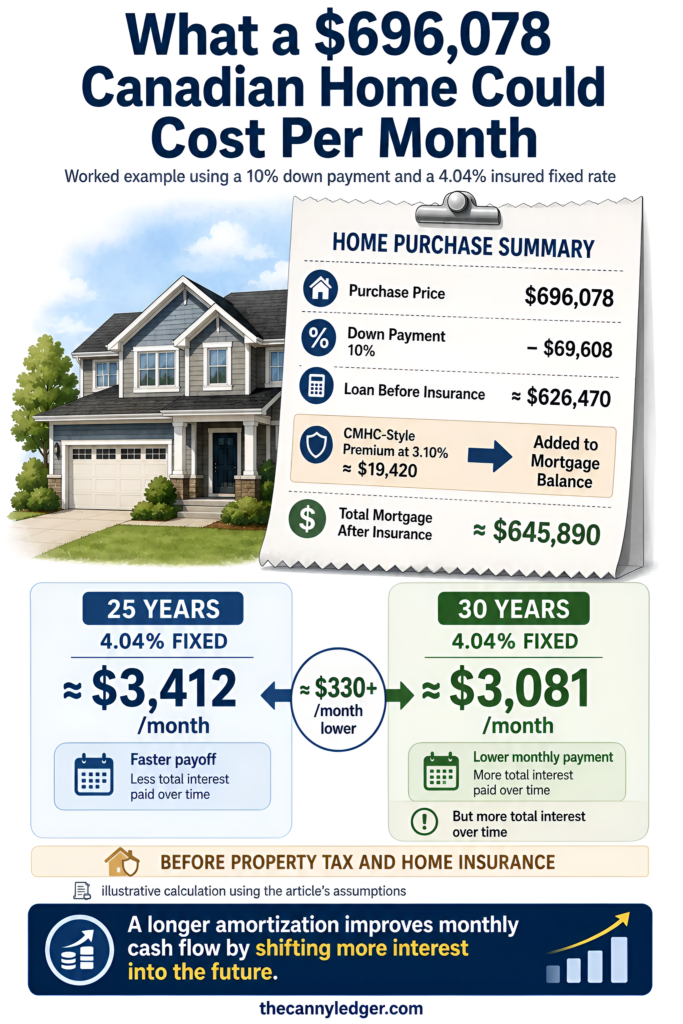
Attach these numbers to an actual purchase price and the abstraction falls away. According to the Canadian Real Estate Association, the non-seasonally adjusted national average home price sat at $696,078 in June 2026, up 0.5% from the same month a year earlier.
Take that national average and run it through the numbers above. A buyer putting 10% down on a $696,078 home is borrowing roughly $626,470 after their down payment, plus a CMHC premium of about $19,420 at the 3.10% rate for that loan-to-value bracket, which typically gets rolled into the mortgage rather than paid upfront. At a 4.04% insured five-year fixed rate on a 25-year amortization, that works out to a monthly payment in the neighbourhood of $3,412, before property tax and insurance are added on top. Stretch that same mortgage to the 30-year amortization now available to first-time buyers, and the monthly payment drops to roughly $3,081, a difference of over $330 a month, though total interest paid over the life of the loan rises by tens of thousands of dollars. That’s the trade-off in concrete terms rather than as a vague warning.
A national figure like that one hides enormous regional variation, though. CREA’s own reporting shows home prices falling year-over-year in British Columbia, Alberta, and Ontario through the first half of 2026, while other provinces have kept climbing. Whatever number your own market is producing right now, run it through the same math above rather than assuming the national figure applies to your street.
Fixed or Variable, Not a Coin Flip
I’m not going to tell you fixed and variable are “both good options depending on your risk tolerance” and leave it there, because that’s the kind of noncommittal answer that helps nobody make an actual decision.
Right now, variable is the cheaper rate on paper, roughly half a point below fixed, and forecasts from the big bank economists suggest the Bank of Canada is more likely to hold or eventually cut its policy rate over the next year than to raise it sharply, given how soft the labour market has been (unemployment sat at 6.5% in June, within the elevated range it’s held since late 2024). If that forecast holds, variable-rate borrowers benefit twice, a lower starting rate and a decent chance of it staying low or dropping further.
But “forecasts suggest” is doing a lot of work in that sentence, and the same economists flagged real upside risk to inflation from tariff threats and elevated oil prices tied to ongoing conflict in the Middle East. If inflation runs hotter than expected, the Bank of Canada could hold rates higher for longer than currently priced in, and a variable-rate borrower who budgeted tightly around today’s lower payment could feel that squeeze. Fixed-rate buyers give up the current rate advantage in exchange for knowing exactly what their payment will be for the next five years, full stop, no surprises. If a rate increase of even one or two percentage points would meaningfully strain your budget, that certainty is worth paying for. If you have real breathing room and can comfortably absorb a higher payment if rates move against you, the variable rate’s current discount is a real advantage, not just a gamble dressed up as one.
Renewing? Don’t Assume Your Bank Is Giving You the Best Number
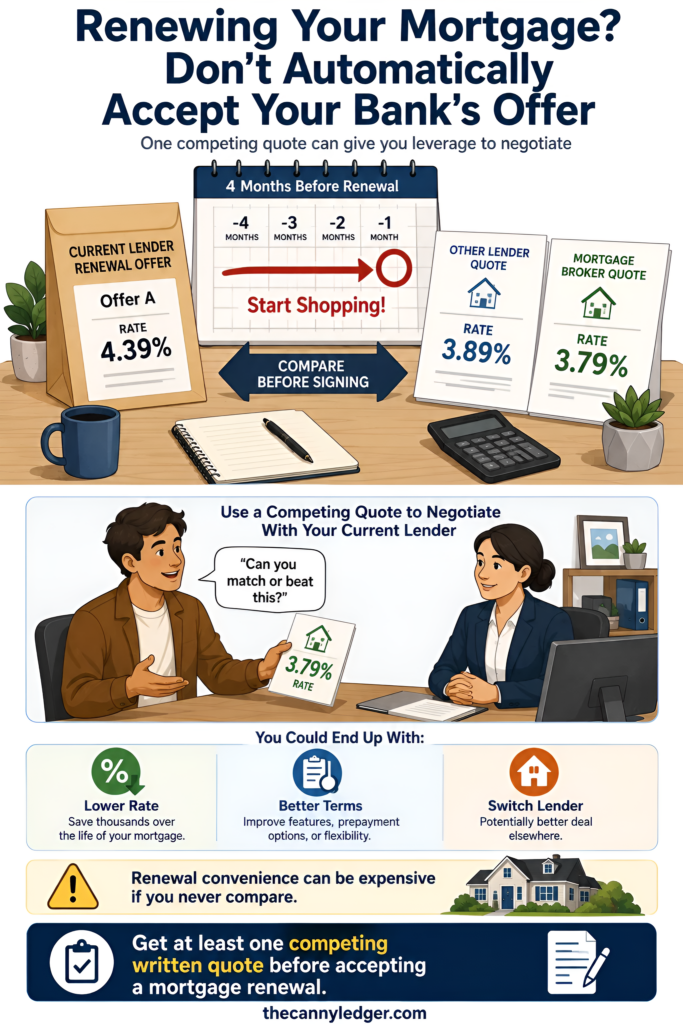
A huge share of Canadian homeowners are hitting mortgage renewal this year and next, many of them locking in five-year fixed rates back in 2020 or 2021 when rates were near historic lows. If that’s you, brace yourself. Even at today’s improved rates compared to the 2024 peak, you’re very likely renewing into a higher rate than you started with, and your monthly payment is going to go up regardless of which lender you choose.
The mistake to avoid here is assuming your current lender’s renewal offer is automatically competitive. Renewal letters typically arrive with a posted rate that’s higher than what the same lender would offer a new customer walking in off the street, on the assumption that inertia will keep you from shopping around. It’s worth getting a second quote from at least one other lender or a mortgage broker before signing a renewal, even if you end up staying put, simply because that comparison gives you leverage to negotiate a better number with your existing bank.
The Mistakes That Actually Cost People Money
A few patterns show up again and again with mortgage shoppers, and they’re worth naming directly rather than burying in a general warning.
Treating a bank’s advertised “posted rate” as the real rate is the most common one. Posted rates are almost always higher than the discounted rate a lender will actually offer a qualified borrower who asks, or who shops the offer against a competitor. Never take the first number on a bank’s website at face value.
Assuming a smaller down payment always means a smaller total cost is another. A 5% down payment gets you in the door faster, but it pushes your CMHC premium into the highest bracket, currently 4.00% on the total loan for a 90.01% to 95% loan-to-value ratio, and that premium accrues interest for the life of your mortgage right along with the rest of your loan. Sometimes waiting an extra year to save a larger down payment ends up saving more money than buying sooner.
And ignoring the penalty structure on a fixed-rate mortgage until you actually need to break it is a mistake that tends to surface at the worst possible moment, usually during a divorce, a job relocation, or an unexpected sale. Fixed-rate prepayment penalties in Canada are calculated using an interest rate differential formula that can run into the thousands of dollars, sometimes tens of thousands, and it’s worth understanding roughly how that penalty is calculated before you sign, not after you need to pay it.
Now What Actually Comes Next
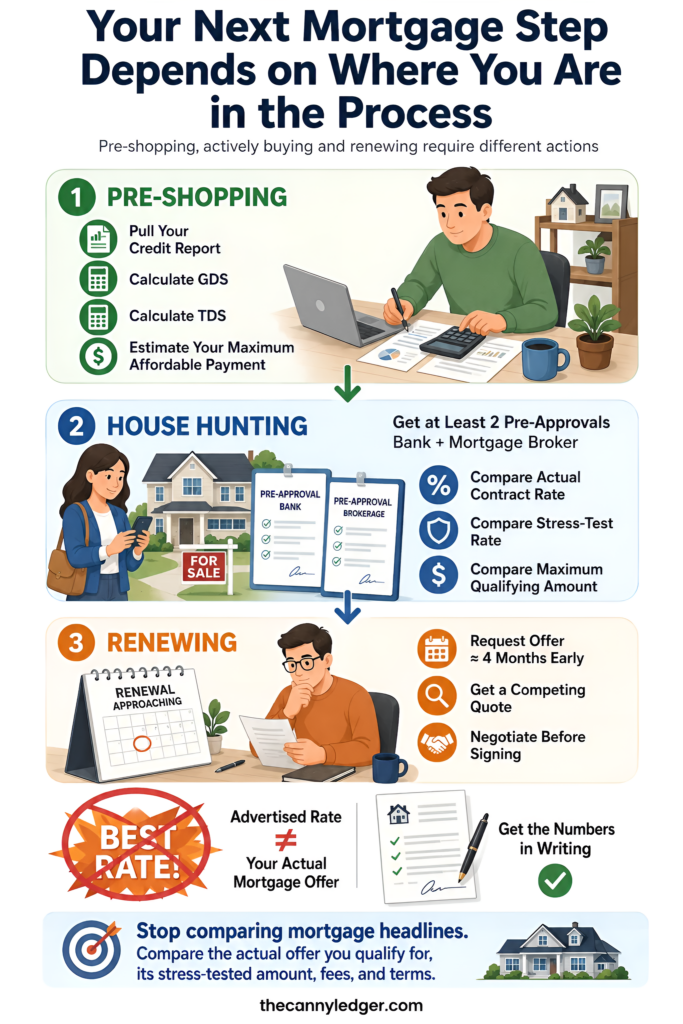
Reading about rates isn’t the same as getting one, and where you go from here depends on which stage you’re actually at. If you’re pre-shopping, start by pulling your credit report and getting a real sense of your Gross Debt Service and Total Debt Service ratios, since those determine your maximum approval more than the rate itself does. If you’re actively house hunting, get a written pre-approval from at least two sources, a bank and a mortgage broker, so you’re comparing real numbers instead of advertised ones, and ask each one to show you your stress-tested qualifying amount alongside your actual contract rate. If you’re approaching a renewal, request your renewal offer in writing at least four months ahead of your term ending, and get at least one competing quote before you sign anything, even if you ultimately stay with the same lender.
Frequently Asked Questions
Is now a good time to lock in a fixed mortgage rate? That depends entirely on your risk tolerance and your budget’s ability to absorb a payment increase, not on any objective “good” or “bad” timing signal. Current five-year fixed rates in the high 3% to low 4% range are meaningfully better than the 2024 peak above 6%, but they’re not the historic lows seen in 2021, and most forecasts show rates holding roughly flat through 2027 rather than dropping sharply.
Do I need 20% down to avoid mortgage default insurance? Yes. Any down payment below 20% on a home requires mortgage default insurance by law in Canada, most commonly through CMHC, and that premium gets added to your loan amount unless you pay it upfront in cash.
Can I combine the FHSA and the Home Buyers’ Plan for the same home purchase? Yes, both programs can be used together for the same qualifying home, giving a single first-time buyer access to up to $40,000 from an FHSA and up to $60,000 from an RRSP under the HBP, for a combined $100,000 in registered savings toward a down payment.
Why did my mortgage renewal quote come in higher than the rates I see advertised online? Renewal letters typically show a lender’s posted rate, which is higher than the discounted rate offered to new customers or negotiated by borrowers who shop around. Getting a competing quote before renewing is the most reliable way to close that gap.
For a deeper dive into any of the pieces covered here, our guides on mortgage rates by province, fixed mortgage rates in Canada, and variable mortgage rates in Canada break down the lending landscape in more detail. For a longer-range view, our Canada mortgage rate forecast tracks where economists expect things to head next, and our mortgage affordability calculator and amortization calculator can help you run your own numbers against the figures used in this guide. For a plain-language breakdown of how default insurance works, see mortgage insurance in Canada, and for help finding someone to walk you through an application, our guide to mortgage brokers and professionals in Canada is a good next stop.