

Most people who’ve heard of CMHC know it for exactly one thing, the insurance premium tacked onto a mortgage when the down payment is under 20%. That’s a real and important part of what the organization does, but it’s a small slice of something far bigger. As of the end of 2025, CMHC’s total insurance-in-force across homeowner and rental mortgages stood at $471 billion. Its bond guarantee programs backed another $580 billion in mortgage funding as of March 2026. And it administers a $115-billion, decade-plus national housing plan on behalf of the federal government. The insurance premium most people associate with CMHC is real, but it’s the visible tip of a much larger institution.
- Where the Organization Actually Started
- The Insurance Business Most People Actually Know
- How CMHC Actually Keeps Mortgage Rates From Being Worse
- The Housing Programs Most Borrowers Never Interact With Directly
- The Data Arm That’s Actually Useful to an Ordinary Homebuyer
- Who Actually Runs It and Who They Answer To
- What CMHC Doesn’t Actually Do
- Where This Leaves You as a Borrower
- Frequently Asked Questions
CMHC, short for Canada Mortgage and Housing Corporation, is a federal Crown corporation created to support housing affordability and the stability of Canada’s housing finance system. It insures mortgages, guarantees the bonds that fund a large share of Canadian mortgage lending, finances the construction and repair of affordable and rental housing, and produces the housing market data that governments, lenders, and researchers across the country rely on. 2026 marks its 80th year in operation.
Where the Organization Actually Started
CMHC was established on January 1, 1946, in the aftermath of the Second World War, when returning veterans needed housing fast and existing supply couldn’t keep up. Its predecessor, Wartime Housing Limited, had built roughly 30,000 homes during the war for workers and military families, and those properties, along with the mandate to keep building, transferred directly to the new corporation. The organization’s very first project, Benny Farm in Montreal, became one of Canada’s first subsidized housing developments and set the tone for a mission that’s shifted in emphasis many times since but has never really changed at its core, keeping Canadians housed when the market alone can’t get the job done fast enough.
That founding purpose is written into the National Housing Act, which defines CMHC’s mandate as promoting housing affordability and choice, facilitating access to efficient and competitive housing finance, protecting the availability of low-cost funding for housing, and generally contributing to the stability of the housing sector within the national economy. Nearly every program the organization runs today traces back to some piece of that mandate.

The Insurance Business Most People Actually Know
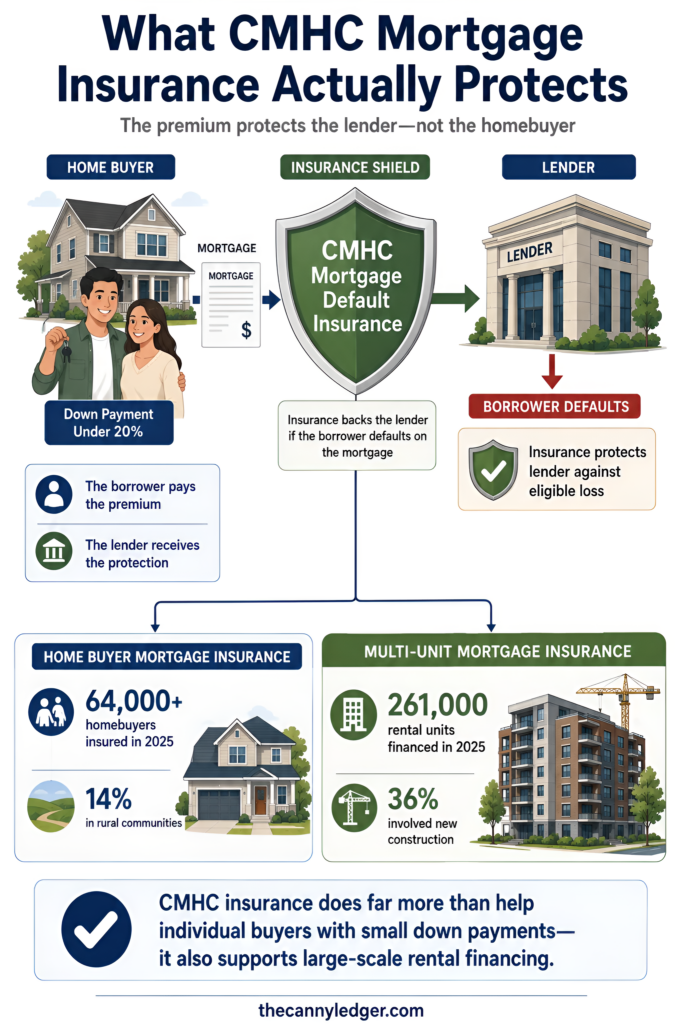
Mortgage default insurance is the piece most homebuyers encounter directly, and it works exactly the way it sounds. When a down payment is under 20%, CMHC insurance protects the lender against default rather than the borrower, which is why lenders extend better rates on insured mortgages than they would otherwise offer for the same level of risk. In 2025 alone, CMHC provided mortgage loan insurance to more than 64,000 homebuyers, up 31% from 49,000 the year before, and 14% of those buyers were in rural communities where CMHC is often the only insurer willing to underwrite the mortgage at all.
That homeowner insurance business is actually the smaller half of CMHC’s insurance activity. Multi-unit insurance, the coverage that backs apartment buildings and rental developments rather than single-family purchases, financed 261,000 rental housing units in 2025, more than four times the volume of the homeowner side, with 36% of those units representing new construction. If there’s a rental building going up in a Canadian city right now, there’s a real chance CMHC’s insurance is part of what made the project financeable in the first place.
How CMHC Actually Keeps Mortgage Rates From Being Worse
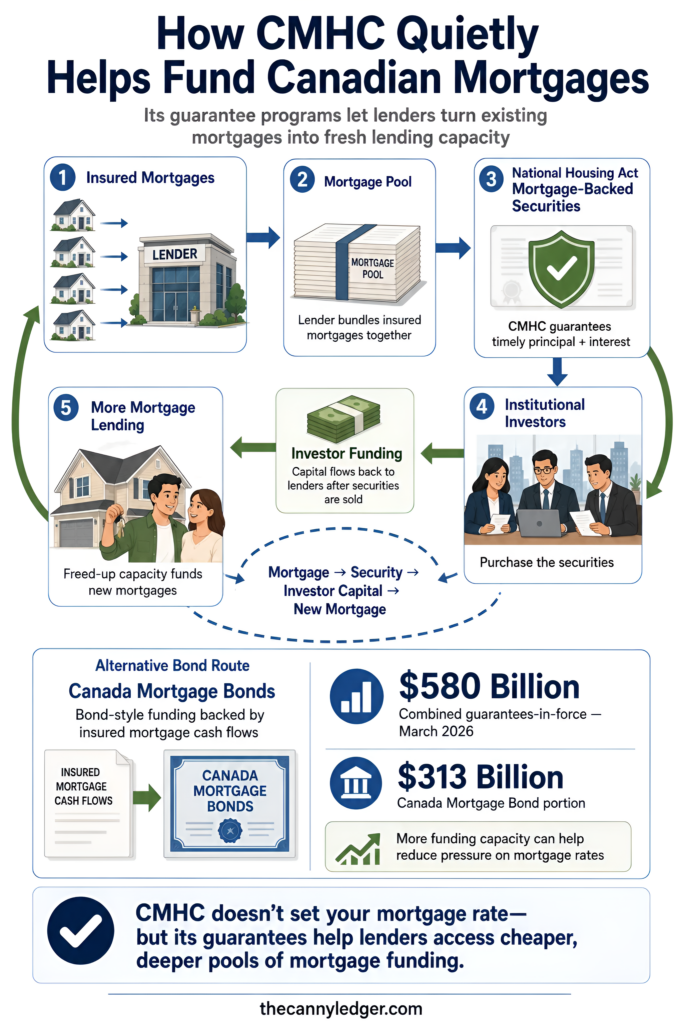
This is the part that rarely gets explained anywhere outside of specialist finance writing, and it’s arguably the most consequential thing CMHC does for the average borrower who’s never applied for its insurance at all. Once a lender issues an insured mortgage, it can bundle that mortgage together with others into a pool and sell that pool to investors as a security, a process called securitization. CMHC guarantees the timely payment of principal and interest on these pools, known as National Housing Act Mortgage-Backed Securities, and a related program called Canada Mortgage Bonds packages that cash flow into a bond-like structure that’s attractive to a much wider range of institutional investors.
The scale of this is enormous. Combined guarantees-in-force across both programs reached $580 billion as of March 31, 2026, with the Canada Mortgage Bond portion alone standing at $313 billion. Budget 2025 raised the annual limit on new Canada Mortgage Bond guarantees to $80 billion, up from $60 billion, and lifted the broader NHA MBS annual limit to $190 billion. What all of this actually does for a borrower who’s never heard the term securitization is simple. It lets lenders sell off insured mortgages to free up capital, which they then lend to the next borrower, keeping the overall supply of mortgage money flowing and keeping fixed mortgage rates from climbing as high as they otherwise might during periods of tight lending capacity.
The Housing Programs Most Borrowers Never Interact With Directly
Separate from insurance and securitization, CMHC administers a large share of Canada’s National Housing Strategy, a plan launched in 2017 that’s grown to more than $115 billion in commitments over its lifetime. As of September 2025, the Strategy had committed $74.08 billion toward creating or preserving 183,274 housing units nationally, with roughly a third of that funding directed specifically toward the housing needs of women and their children.
Two programs under that umbrella have carried much of the recent weight. The Apartment Construction Loan Program has committed more than $29 billion in low-cost loans since its launch, specifically aimed at making new rental construction financially viable for builders facing high costs and tight labour markets. The Affordable Housing Fund, meanwhile, had committed more than $14 billion by the end of 2025, supporting the creation of 57,000 new affordable units and the repair of over 174,000 existing ones. Between the loan program and CMHC’s multi-unit insurance, the organization was behind most of the rental construction activity happening across Canada last year, which matters directly to anyone tracking rental supply and pricing pressure in their own city.

The Data Arm That’s Actually Useful to an Ordinary Homebuyer
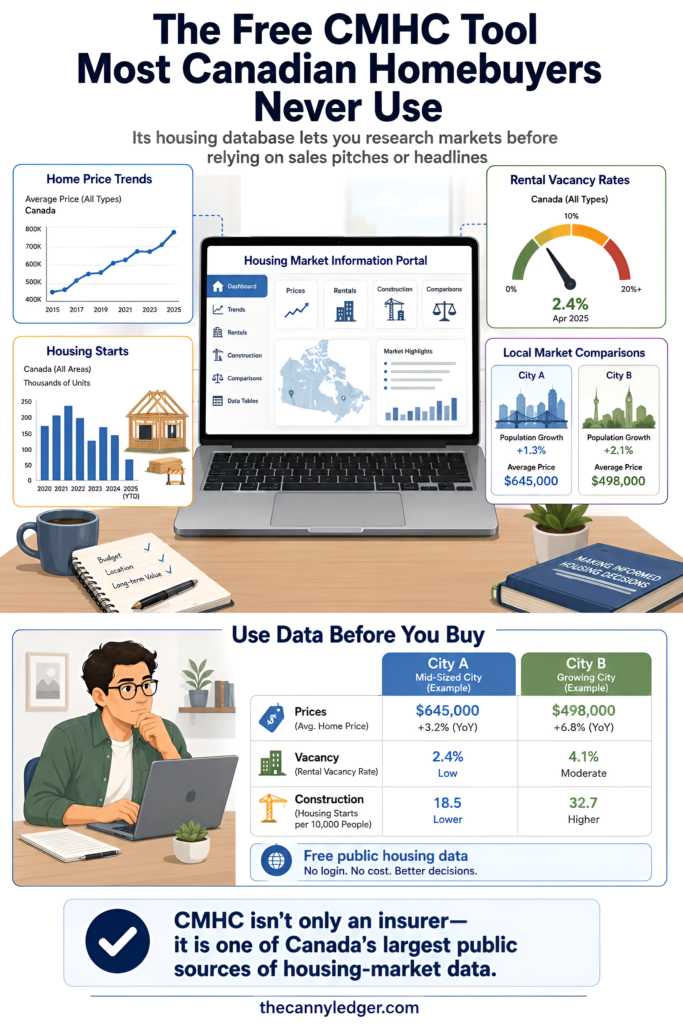
CMHC also functions as Canada’s most extensive housing research source, running the Housing Market Information Portal, a free public tool that gives up-to-date statistical snapshots for local, regional, and national housing markets. Anyone researching a specific neighbourhood or comparing a few cities before deciding where to buy can pull historical price trends, vacancy rates, and construction data directly from the portal rather than relying on a realtor’s summary or a single news article. It’s one of the more underused free resources in Canadian housing research, largely because most people have never connected the CMHC name to anything beyond the insurance premium.
Who Actually Runs It and Who They Answer To
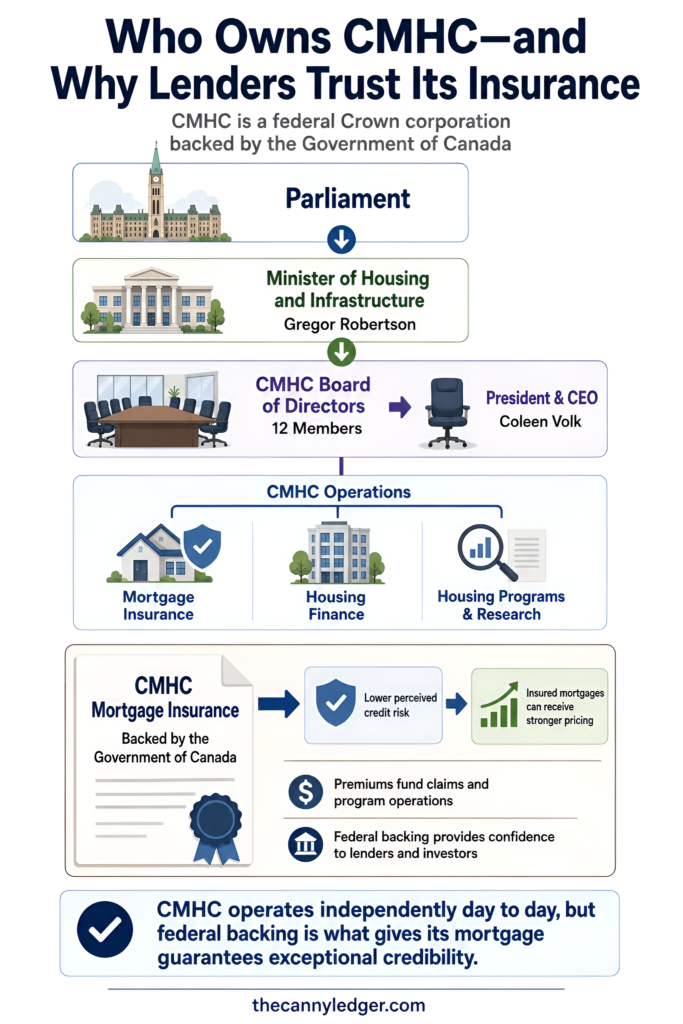
As a Crown corporation, CMHC is publicly owned but operates with its own board and management rather than being run directly out of a government department. A twelve-member board of directors oversees the organization, and Coleen Volk currently serves as President and Chief Executive Officer. CMHC reports to Parliament through the Minister of Housing and Infrastructure, currently the Honourable Gregor Robertson, meaning the organization’s priorities shift somewhat with each government’s housing agenda even though its core mandate under the National Housing Act stays fixed in legislation.
That governance structure matters for one practical reason. CMHC’s mortgage insurance business is fully backed by the Government of Canada, which is exactly why lenders treat CMHC-insured mortgages as close to risk-free and price them accordingly. The insurance premiums borrowers pay fund the program’s claims and operations rather than the other way around, so the system is largely self-sustaining rather than a direct taxpayer subsidy, though the federal guarantee behind it is what makes lenders comfortable extending credit at the volumes they do.
What CMHC Doesn’t Actually Do
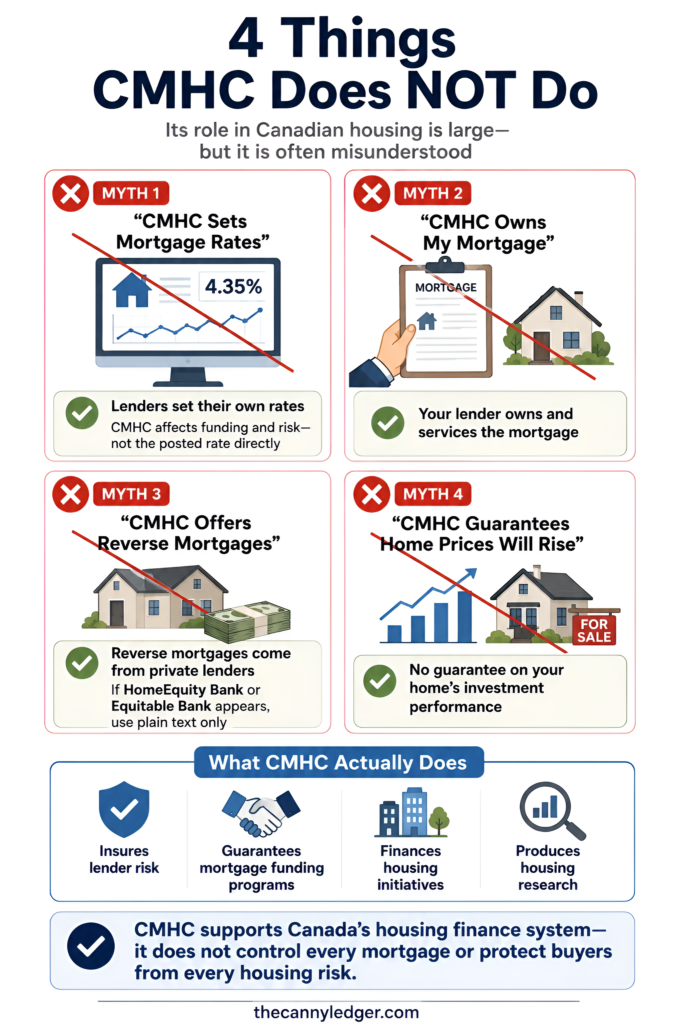
A few misconceptions are worth clearing up directly, since they come up constantly in conversations about Canadian mortgages. CMHC doesn’t set mortgage rates. Lenders price their own products based on funding costs, bond yields, and competition, with CMHC’s guarantee simply making insured mortgages cheaper to fund than uninsured ones. CMHC doesn’t own or service anyone’s mortgage either, it insures the lender’s risk, but the lender still collects payments and handles all direct communication with the borrower.
It’s also worth being direct about a product CMHC has nothing to do with. Reverse mortgages in Canada are offered by HomeEquity Bank and Equitable Bank, not CMHC, and they aren’t CMHC-insured at all, a mix-up that happens constantly given how closely CMHC’s name is associated with mortgages generally. And CMHC doesn’t guarantee that home prices will rise or that any specific purchase is a sound investment. Its mandate is about the stability and functioning of the housing finance system as a whole, not the outcome of any individual buyer’s decision.
Where This Leaves You as a Borrower
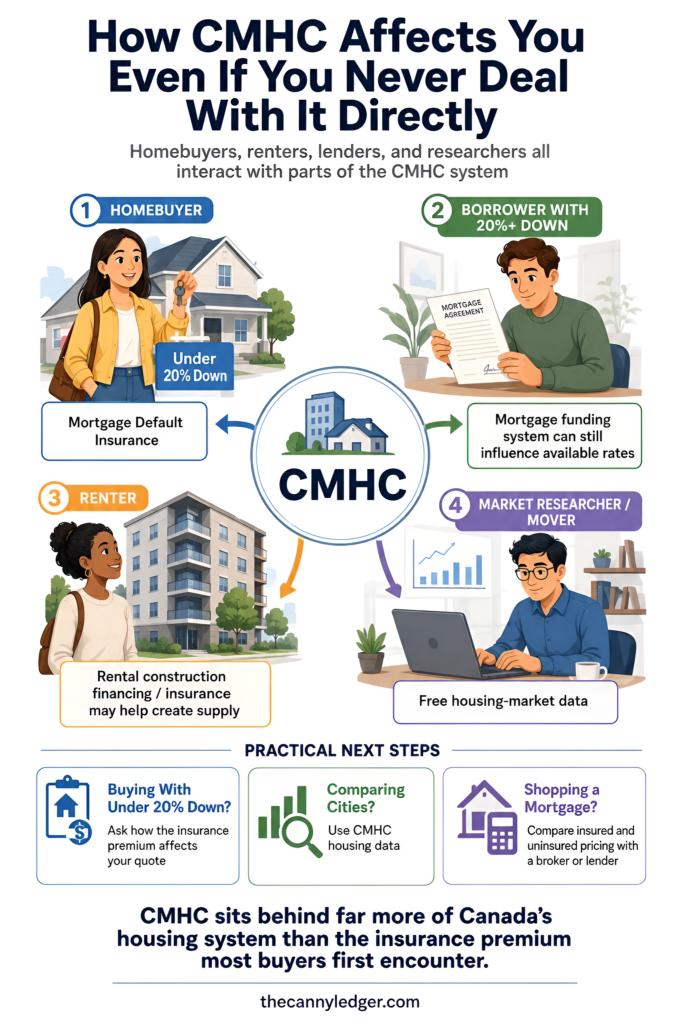
Understanding what CMHC actually does changes how you read a mortgage offer, even if you never interact with the organization directly. If your down payment sits under 20%, the premium on your statement is funding a much larger system that keeps mortgage credit flowing across the entire country, not just covering your individual risk. If you’re renting, there’s a real chance the building you live in exists because CMHC’s multi-unit insurance or construction financing made the project pencil out for the developer. And if you’re comparing markets before a move, CMHC’s Housing Market Information Portal is worth bookmarking before you rely on secondhand summaries of what’s happening in a city you’re considering. For anyone actively shopping a mortgage right now, pairing that broader context with a direct look at current mortgage rates and a conversation with a mortgage broker about how CMHC insurance specifically affects your quote is the most useful next step.
Frequently Asked Questions
Is CMHC a government department or a separate organization? CMHC is a federal Crown corporation, publicly owned but operated separately from a government department, with its own board of directors and management. It reports to Parliament through the Minister of Housing and Infrastructure.
Does CMHC insure all mortgages in Canada? No. CMHC is one of three mortgage default insurers operating in Canada, alongside private insurers Sagen and Canada Guaranty, and insurance is only required at all when a down payment is under 20%. Many mortgages, particularly those with 20% or more down, carry no default insurance from any provider.
Does CMHC set the interest rate on my mortgage? No. Your lender sets your rate based on funding costs, bond yields for fixed terms, and the Bank of Canada’s policy rate for variable terms. CMHC’s guarantee lowers the lender’s risk on insured mortgages, which typically results in a better rate than an equivalent uninsured mortgage would get, but CMHC itself doesn’t set the number.
How is CMHC funded? CMHC’s insurance operations are funded primarily through the premiums borrowers pay, making the program largely self-sustaining rather than directly subsidized by taxpayers. Its housing programs, like the Affordable Housing Fund and Apartment Construction Loan Program, are funded through federal budget allocations under the National Housing Strategy.