

A lot of homeowners assume that every time the Bank of Canada makes an announcement, their mortgage payment is about to move. For a big share of Canadian borrowers, that assumption is just wrong. Whether a rate decision touches your payment at all comes down almost entirely to one thing, whether your mortgage is fixed or variable, and even within variable mortgages the effect isn’t always what people expect. Understanding the actual mechanics here isn’t just trivia. It shapes real decisions, whether to lock in a rate now, whether to ride out a variable term, and how to read the next announcement without either panicking or tuning it out completely.
- What the policy rate actually is
- Why your variable mortgage might not move the same way as your neighbor’s
- Why fixed rates ignore the Bank of Canada almost entirely
- What a hold, cut, or hike would actually mean for your payment
- The stress test that outlasts whatever the Bank of Canada does next
- What this actually means for your payment
The Bank of Canada held its policy rate at 2.25 percent on July 15, 2026, the sixth consecutive hold after a long run of cuts through 2024 and 2025 brought the rate down from a peak of 5 percent. The next scheduled announcement lands September 2, 2026. That number alone tells a variable-rate borrower almost everything they need to know about their payment this month. It tells a fixed-rate borrower almost nothing, because fixed rates don’t take their cue from the policy rate directly, they follow a completely different signal. If you want the full current lineup of what’s on offer right now, our Canadian mortgage rates roundup tracks both sides of that split.
What the policy rate actually is
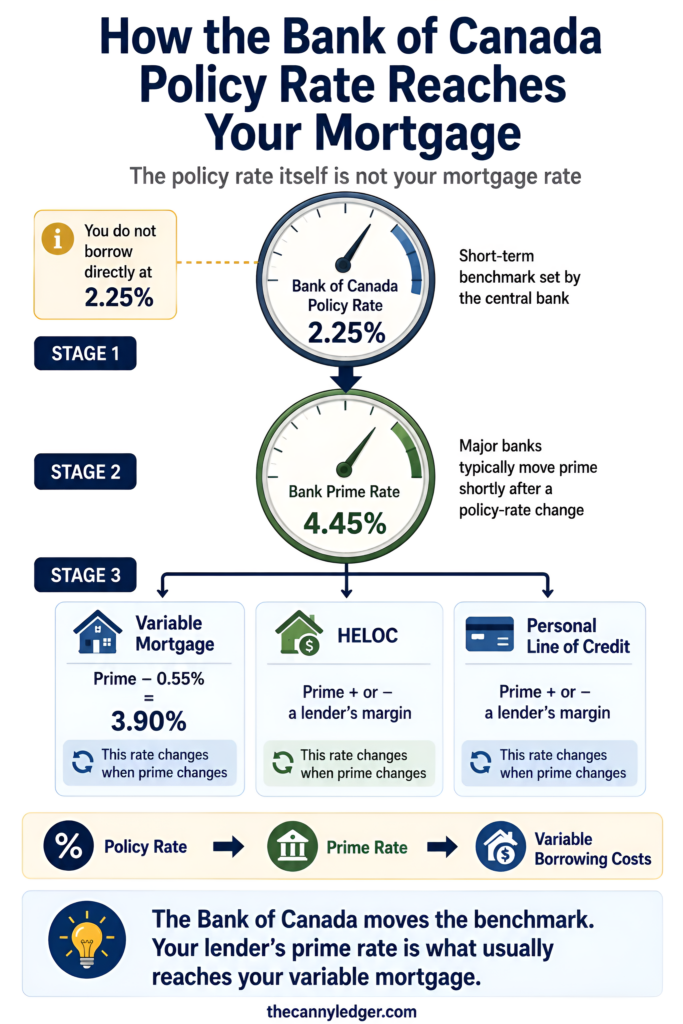
The overnight rate, sometimes just called the policy rate, is the interest rate the Bank of Canada sets for very short-term lending between banks. It isn’t a rate you or I ever borrow at directly. What it does is set the floor that Canada’s major banks build their own prime rate on top of, and prime rate is the number that actually shows up in most people’s mortgage paperwork. As of August 2026, the prime rate sits at 4.45 percent across RBC, TD, BMO, Scotiabank, CIBC, and National Bank, unchanged since the last policy rate move in late October 2025.
When the Bank of Canada raises or lowers the overnight rate, banks typically adjust their own prime rate by the same amount within a day or two, a pattern you can watch play out over time on WOWA’s prime rate history. That prime rate then flows directly into anything priced as prime plus or minus a spread, variable-rate mortgages, home equity lines of credit, and unsecured personal lines of credit all move in lockstep with it. A variable mortgage advertised at prime minus 0.55 percent, for example, currently works out to an effective rate of 3.90 percent, and that 3.90 percent shifts the instant prime does.
Why your variable mortgage might not move the same way as your neighbor’s
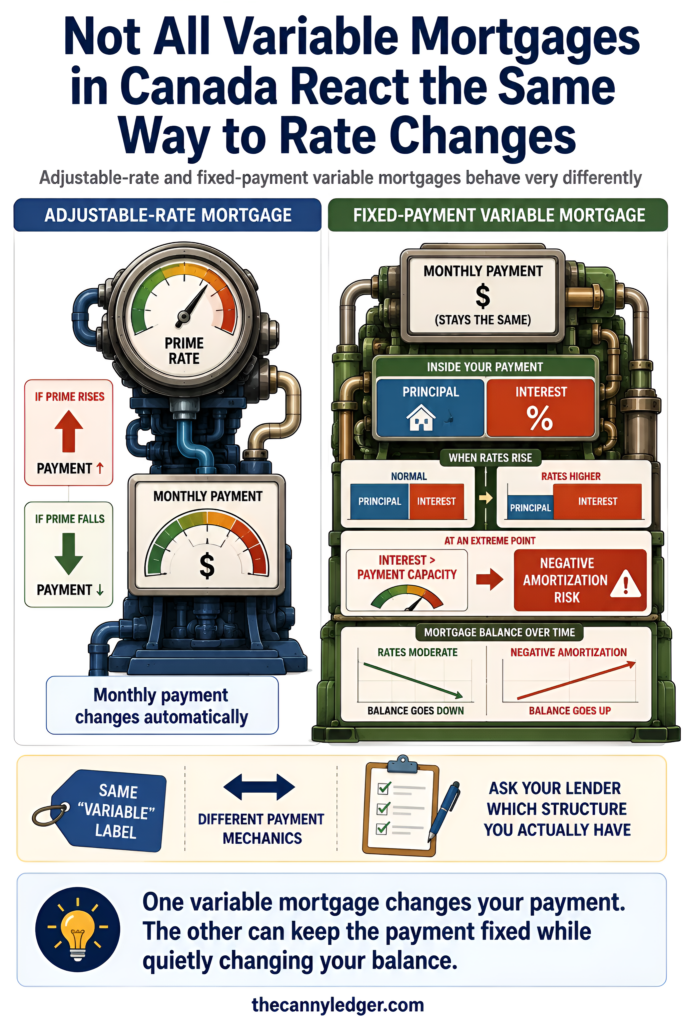
Here’s where it gets genuinely confusing for a lot of people, and it’s worth clearing up properly. Not every variable mortgage responds to a rate change the same way, because there are actually two different structures sold under the same “variable rate” label.
An adjustable-rate mortgage, the more common structure at most banks, has a payment that moves automatically with prime. Rate goes up, your monthly payment goes up. Rate comes down, your payment drops. Nothing else about the loan needs to happen for that to occur.
A fixed-payment variable-rate mortgage works differently, and this is the structure that’s caused a lot of the financial stress you’ve probably read about over the past couple of years. Here the monthly payment amount stays the same even as the rate moves, but the split between principal and interest inside that fixed payment shifts. When prime rises enough, the interest portion can grow large enough to eat the entire payment, and once that happens the loan tips into what’s called negative amortization, where the balance actually grows instead of shrinking even though payments are being made on time every month. Roughly 12 percent of Canada’s fixed-payment variable-rate mortgages were sitting in negative amortization territory earlier this year, according to Bank of Canada research using OSFI data, though that share has been shrinking as rates have stabilized and more of these mortgages reset to their original amortization at renewal.
If you’re not sure which of these two structures you actually hold, it’s worth a five-minute call to your lender to find out, because the practical implications for your balance are meaningfully different.
Why fixed rates ignore the Bank of Canada almost entirely
This is the part that trips people up most. Fixed mortgage rates don’t track the overnight rate. They track the yield on Government of Canada bonds, mainly the 5-year bond for a standard 5-year fixed mortgage, because that’s the maturity that roughly matches the loan itself, and bond yields move on a different set of inputs entirely, things like inflation expectations, global investor demand for Canadian debt, and market forecasts of where the Bank of Canada is headed months or years down the road, not just where it sits today.
That’s why you’ll sometimes see fixed rates drop in the weeks before a Bank of Canada decision, or rise even after a hold, seemingly disconnected from what the central bank actually did. The bond market has usually already priced in the expected decision before it’s announced, and fixed rates respond to that expectation shifting, not to the announcement itself. As of mid-2026, five-year fixed rates from major lenders have generally ranged from roughly 3.99 percent for insured mortgages up to 4.44 percent for conventional ones, well down from the 5.54 percent peak these rates hit in 2023. Manitoba buyers weighing the two structures against each other can see how the tradeoff plays out locally in our fixed versus variable mortgage comparison for Winnipeg.

What a hold, cut, or hike would actually mean for your payment
A hold, which is what’s happened for six straight decisions now, simply means no change for anyone. Variable payments stay where they are, and fixed rates keep moving on their own bond-market schedule regardless.
A cut would lower prime rate within days, dropping payments immediately for adjustable-rate variable borrowers and slowing (or reversing) negative amortization for fixed-payment variable borrowers, while fixed rates would likely have already started drifting down beforehand if the cut was broadly expected by markets. A hike works the same way in reverse, pushing adjustable variable payments up right away and, if unexpected, potentially pushing fixed rates up as well once the bond market recalculates.
For anyone renewing a mortgage this year, this matters more than usual. A large share of mortgages signed during the ultra-low rates of 2020 and 2021 are hitting renewal in 2025 and 2026, and Bank of Canada research puts the average payment increase for five-year fixed borrowers renewing in this window somewhere between 15 and 20 percent, even with the current hold. If you want a deeper look at how that renewal wave connects to rising missed payments and what your options are if a renewal genuinely doesn’t fit your budget, our piece on mortgage delinquency in Canada walks through the warning signs and the process.

The stress test that outlasts whatever the Bank of Canada does next
One thing worth knowing regardless of which way rates move is that qualifying for a brand new mortgage runs through a separate hurdle entirely. Federally regulated lenders are required to qualify most new borrowers using a stress-tested rate, the higher of your actual contract rate plus 2 percentage points, or a 5.25 percent floor set by the Office of the Superintendent of Financial Institutions. That floor has stayed unchanged since it was introduced in 2021, and OSFI confirmed in early 2026 that it isn’t planning to adjust it. With most contract rates currently sitting well above 3.25 percent, the contract-plus-two calculation is what actually applies for most borrowers rather than the floor itself.
Renewals get treated more gently. Staying with your existing lender at renewal has never required clearing the stress test, and since late 2024 that exemption extends to a straight switch too, meaning you can move your mortgage to a different institution at renewal without being stress-tested, as long as your loan amount and remaining amortization don’t increase. That’s a meaningful thing to know if you’ve assumed shopping around at renewal automatically means requalifying at a much higher rate. It generally doesn’t, provided you’re not borrowing more or stretching the amortization out further.

What this actually means for your payment
If you hold a variable mortgage, especially the fixed-payment structure, know which type you have and check in with your lender at least once a year, more often if rates are moving, since that’s the structure most likely to quietly drift into negative amortization without an obvious signal that anything’s wrong. If you’re weighing fixed against variable for a purchase or renewal, remember you’re really choosing between two different forecasts, the bond market’s read on where rates are headed for fixed, versus the Bank of Canada’s actual path for variable, and neither one is a sure thing. Our mortgage affordability calculator can help you stress-test both scenarios against your own budget before you commit either way. And if a renewal is coming up this year, run the numbers well before the offer arrives, using a mortgage broker if you want a second opinion on whether staying with your current lender or shopping around makes more financial sense for your specific situation.